
System Architecture for a DynamicSpectrum Radio Allen Petrin
![Power flux density [W/m 2/Hz] Spectrum Assignment Map for User Terminal Spectrum determined by](https://slidetodoc.com/presentation_image_h2/3e1e1040aa3b638cd89e4b12b1bab71d/image-10.jpg "Power flux density [W/m 2/Hz] Spectrum Assignment Map for User Terminal Spectrum determined by")
![Intermodulation Power [d. Bm] Octave Filter: §Center Freq. 2400 MHz §Bandwidth 1600 MHz §Q](https://slidetodoc.com/presentation_image_h2/3e1e1040aa3b638cd89e4b12b1bab71d/image-15.jpg "Intermodulation Power [d. Bm] Octave Filter: §Center Freq. 2400 MHz §Bandwidth 1600 MHz §Q")
![Power [d. Bm] Azimuthal Profile 2332. 5 MHz Frequency 22 © 2003 all rights](https://slidetodoc.com/presentation_image_h2/3e1e1040aa3b638cd89e4b12b1bab71d/image-22.jpg "Power [d. Bm] Azimuthal Profile 2332. 5 MHz Frequency 22 © 2003 all rights")
![Power [d. Bm] Polarization Usage 2060 MHz 2360 MHz Frequency 1700 MHz © 2003](https://slidetodoc.com/presentation_image_h2/3e1e1040aa3b638cd89e4b12b1bab71d/image-23.jpg "Power [d. Bm] Polarization Usage 2060 MHz 2360 MHz Frequency 1700 MHz © 2003")

- Slides: 26
System Architecture for a Dynamic-Spectrum Radio Allen Petrin Paul Steffes Georgia Institute of Technology School of Electrical and Computer Engineering 1 © 2003 all rights reserved Allen Petrin me@allenpetrin. com Spectrum Policy Technological Solutions for Policy Problems
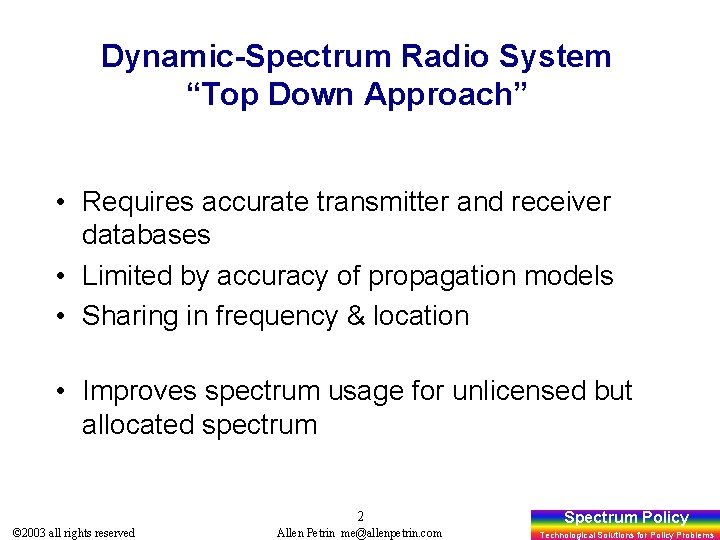
Dynamic-Spectrum Radio System “Top Down Approach” • Requires accurate transmitter and receiver databases • Limited by accuracy of propagation models • Sharing in frequency & location • Improves spectrum usage for unlicensed but allocated spectrum 2 © 2003 all rights reserved Allen Petrin me@allenpetrin. com Spectrum Policy Technological Solutions for Policy Problems
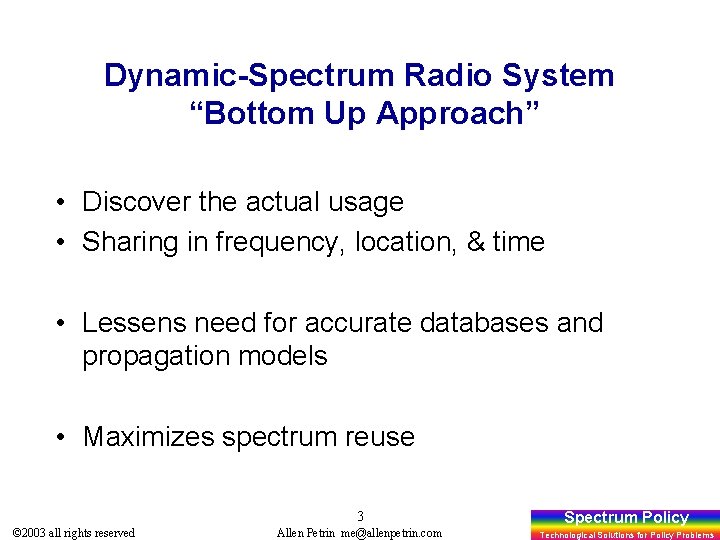
Dynamic-Spectrum Radio System “Bottom Up Approach” • Discover the actual usage • Sharing in frequency, location, & time • Lessens need for accurate databases and propagation models • Maximizes spectrum reuse 3 © 2003 all rights reserved Allen Petrin me@allenpetrin. com Spectrum Policy Technological Solutions for Policy Problems
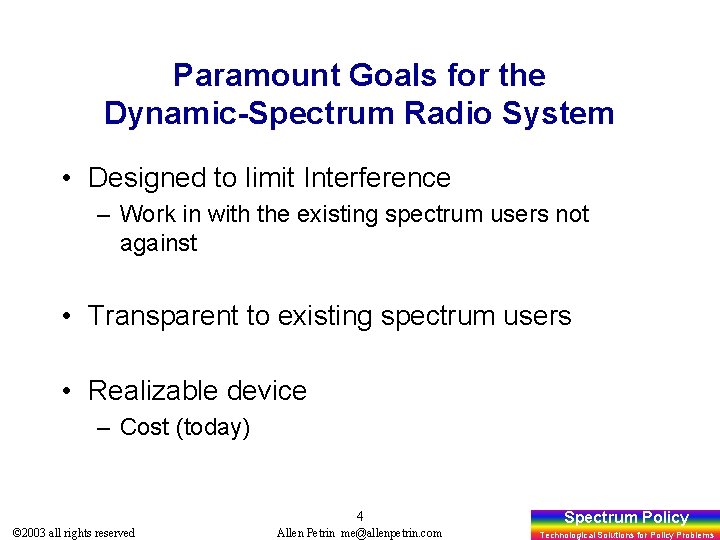
Paramount Goals for the Dynamic-Spectrum Radio System • Designed to limit Interference – Work in with the existing spectrum users not against • Transparent to existing spectrum users • Realizable device – Cost (today) 4 © 2003 all rights reserved Allen Petrin me@allenpetrin. com Spectrum Policy Technological Solutions for Policy Problems
Design Objectives of the Dynamic-Spectrum Radio System • Link lengths greater than 10 km possible – Longer range than unlicensed services • Moderate Transmit Power • High Gain Directional Antenna • Frequency from 500 MHz to 6 GHz – Low-Cost Receiver and Transmitter – Good Propagation Characteristics • Temporary frequency use – No fixed location-frequency license 5 © 2003 all rights reserved Allen Petrin me@allenpetrin. com Spectrum Policy Technological Solutions for Policy Problems
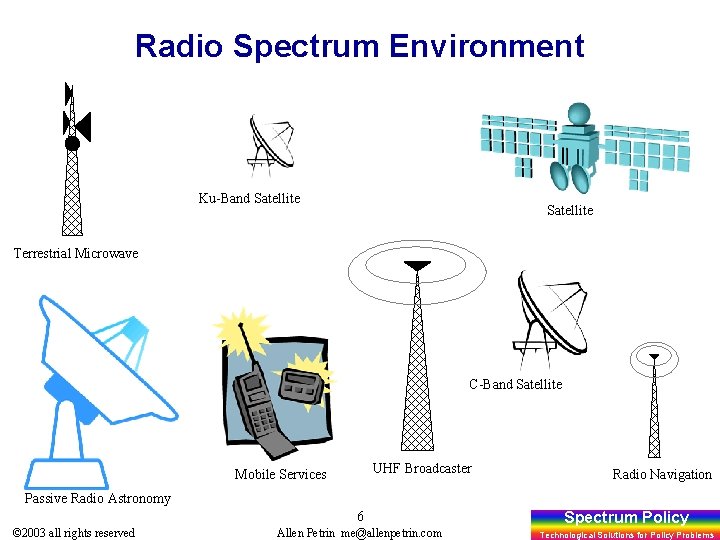
Radio Spectrum Environment Ku-Band Satellite Terrestrial Microwave C-Band Satellite UHF Broadcaster Mobile Services Radio Navigation Passive Radio Astronomy 6 © 2003 all rights reserved Allen Petrin me@allenpetrin. com Spectrum Policy Technological Solutions for Policy Problems
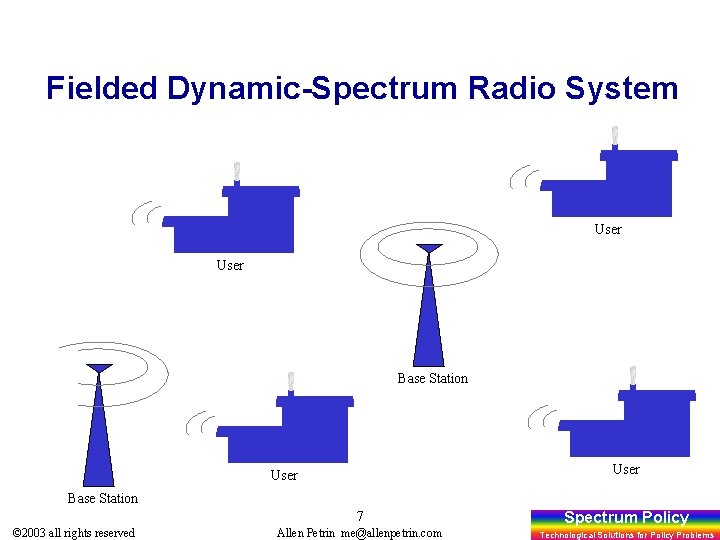
Fielded Dynamic-Spectrum Radio System User Base Station 7 © 2003 all rights reserved Allen Petrin me@allenpetrin. com Spectrum Policy Technological Solutions for Policy Problems
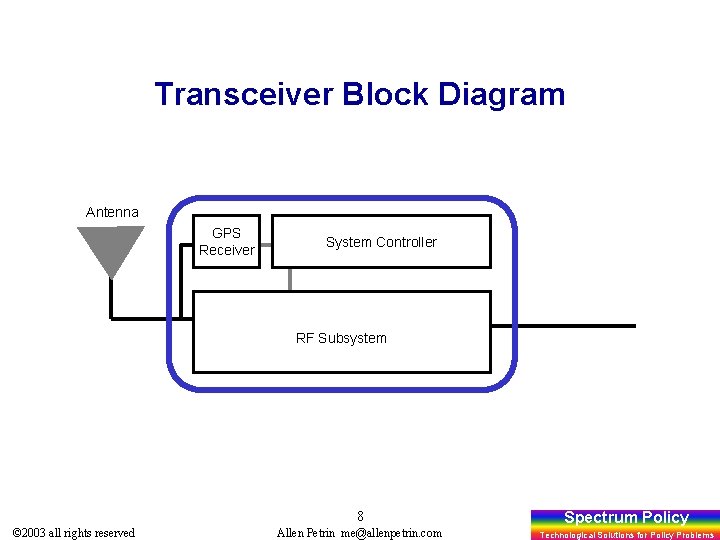
Transceiver Block Diagram Antenna GPS Receiver System Controller RF Subsystem 8 © 2003 all rights reserved Allen Petrin me@allenpetrin. com Spectrum Policy Technological Solutions for Policy Problems
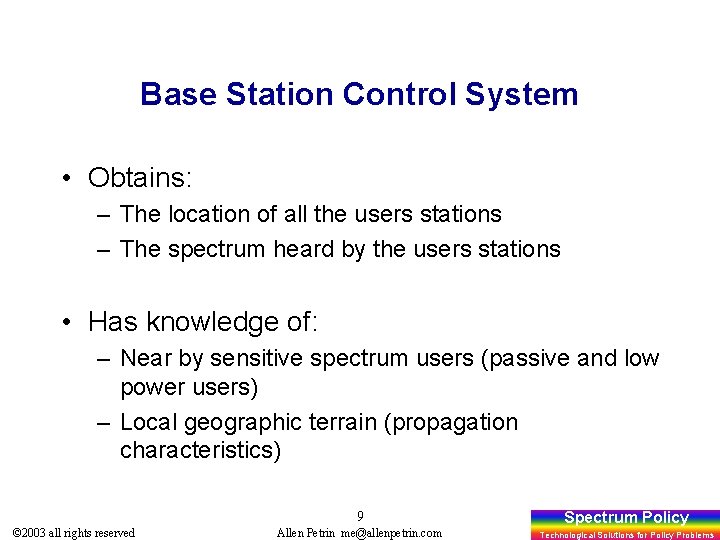
Base Station Control System • Obtains: – The location of all the users stations – The spectrum heard by the users stations • Has knowledge of: – Near by sensitive spectrum users (passive and low power users) – Local geographic terrain (propagation characteristics) 9 © 2003 all rights reserved Allen Petrin me@allenpetrin. com Spectrum Policy Technological Solutions for Policy Problems
Power flux density [W/m 2/Hz] Spectrum Assignment Map for User Terminal Spectrum determined by base station to be occupied by protected users Spectrum determined by user terminal to be occupied by protected users Frequency [MHz] Assigned spectrum to user terminal 10 © 2003 all rights reserved Allen Petrin me@allenpetrin. com Spectrum Policy Technological Solutions for Policy Problems
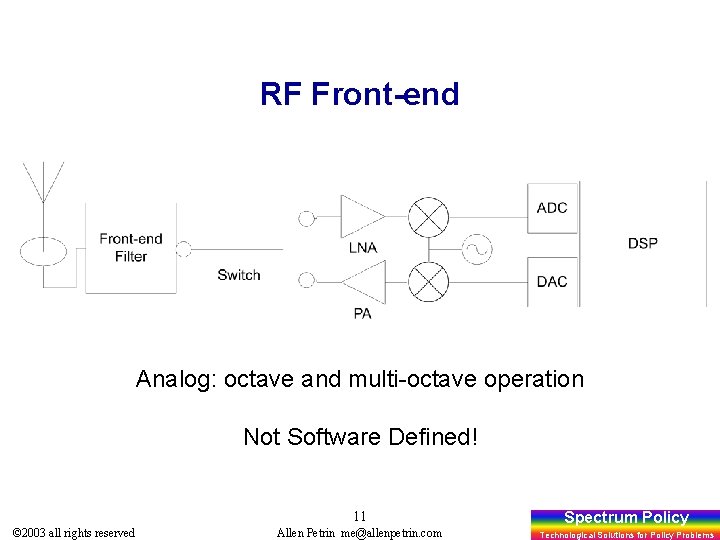
RF Front-end Analog: octave and multi-octave operation Not Software Defined! 11 © 2003 all rights reserved Allen Petrin me@allenpetrin. com Spectrum Policy Technological Solutions for Policy Problems
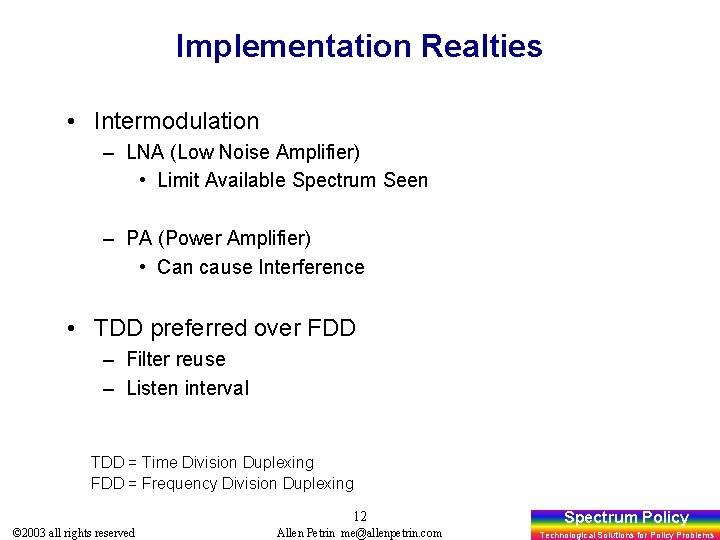
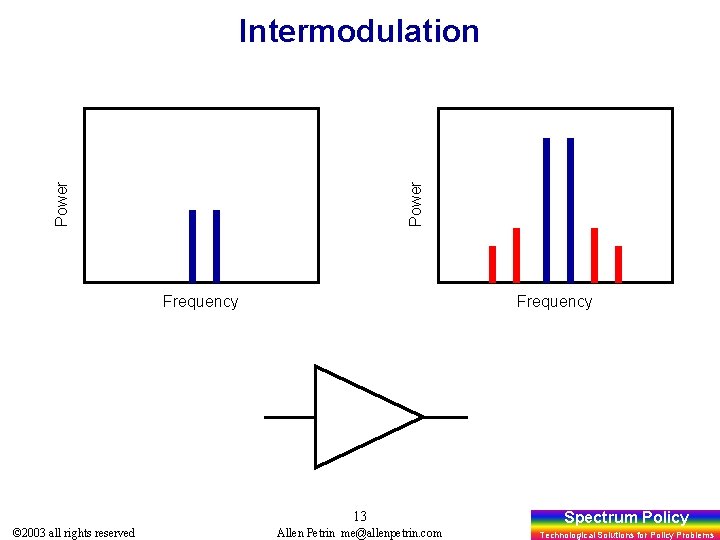
Implementation Realties • Intermodulation – LNA (Low Noise Amplifier) • Limit Available Spectrum Seen – PA (Power Amplifier) • Can cause Interference • TDD preferred over FDD – Filter reuse – Listen interval TDD = Time Division Duplexing FDD = Frequency Division Duplexing 12 © 2003 all rights reserved Allen Petrin me@allenpetrin. com Spectrum Policy Technological Solutions for Policy Problems
Power Intermodulation Frequency 13 © 2003 all rights reserved Allen Petrin me@allenpetrin. com Spectrum Policy Technological Solutions for Policy Problems
Intermodulation Reduction Techniques • LNA – High IP 3 – Attenuation (find optimum amount so that thermal noise floor reaches the height of the intermodulation products) • PA – Linearization • Predistortion • Feedforward • Feedback 14 © 2003 all rights reserved Allen Petrin me@allenpetrin. com Spectrum Policy Technological Solutions for Policy Problems
Intermodulation Power [d. Bm] Octave Filter: §Center Freq. 2400 MHz §Bandwidth 1600 MHz §Q = 1. 5 2650 MHz 2950 MHz Frequency 15 © 2003 all rights reserved Allen Petrin me@allenpetrin. com Spectrum Policy Technological Solutions for Policy Problems
Unknown Variables • What band to select? • Will it be reliable over time? • Will it work over the long term? 16 © 2003 all rights reserved Allen Petrin me@allenpetrin. com Spectrum Policy Technological Solutions for Policy Problems
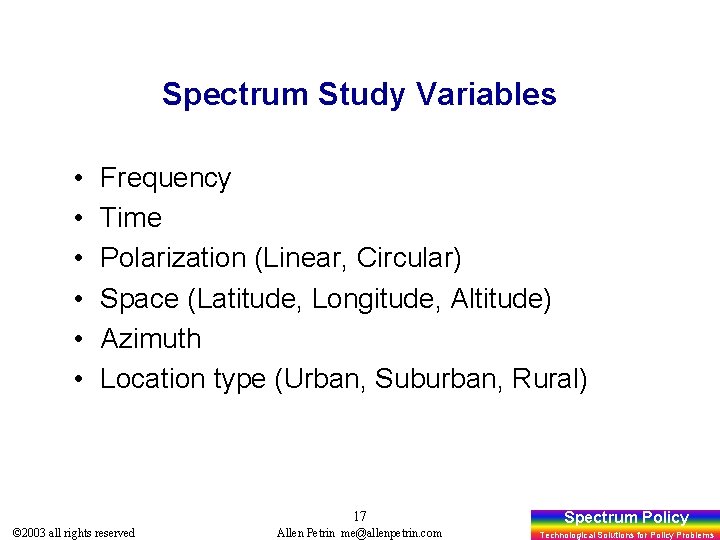
Spectrum Study Variables • • • Frequency Time Polarization (Linear, Circular) Space (Latitude, Longitude, Altitude) Azimuth Location type (Urban, Suburban, Rural) 17 © 2003 all rights reserved Allen Petrin me@allenpetrin. com Spectrum Policy Technological Solutions for Policy Problems
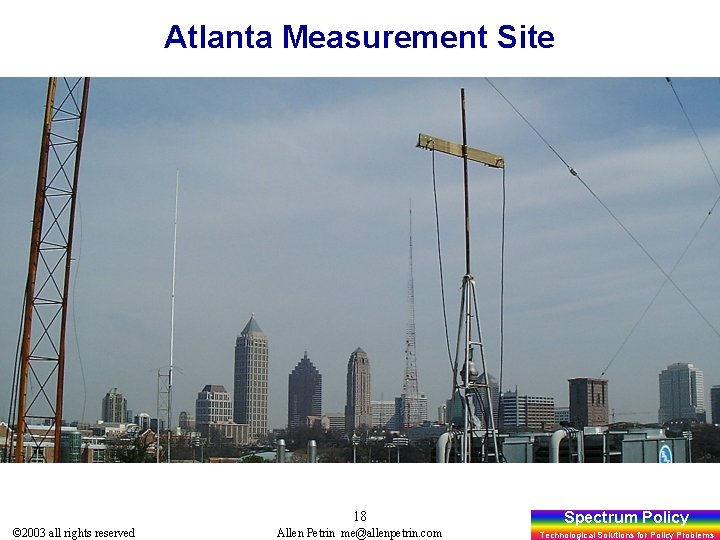
Atlanta Measurement Site 18 © 2003 all rights reserved Allen Petrin me@allenpetrin. com Spectrum Policy Technological Solutions for Policy Problems
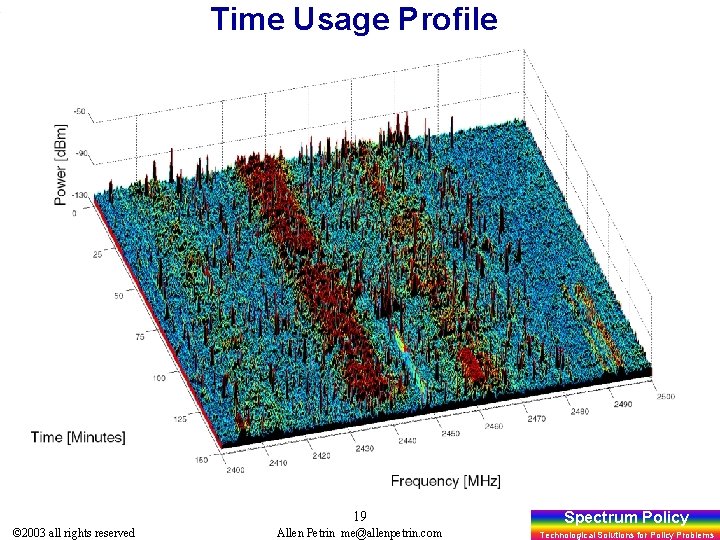
Time Usage Profile 19 © 2003 all rights reserved Allen Petrin me@allenpetrin. com Spectrum Policy Technological Solutions for Policy Problems
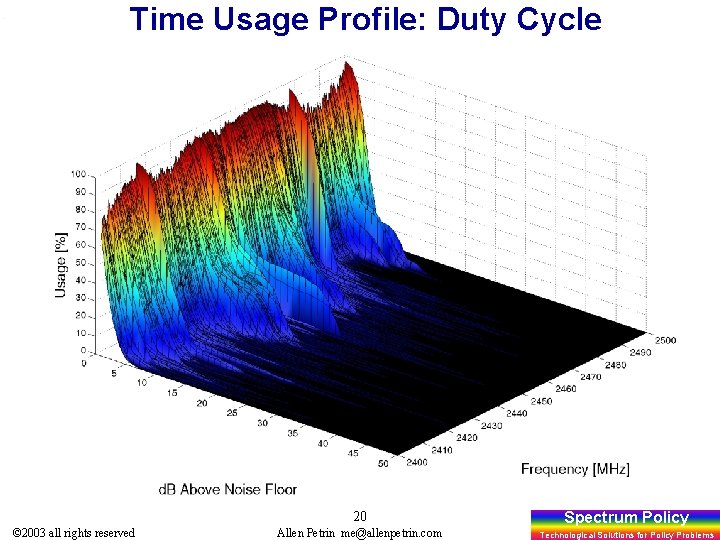
Time Usage Profile: Duty Cycle 20 © 2003 all rights reserved Allen Petrin me@allenpetrin. com Spectrum Policy Technological Solutions for Policy Problems
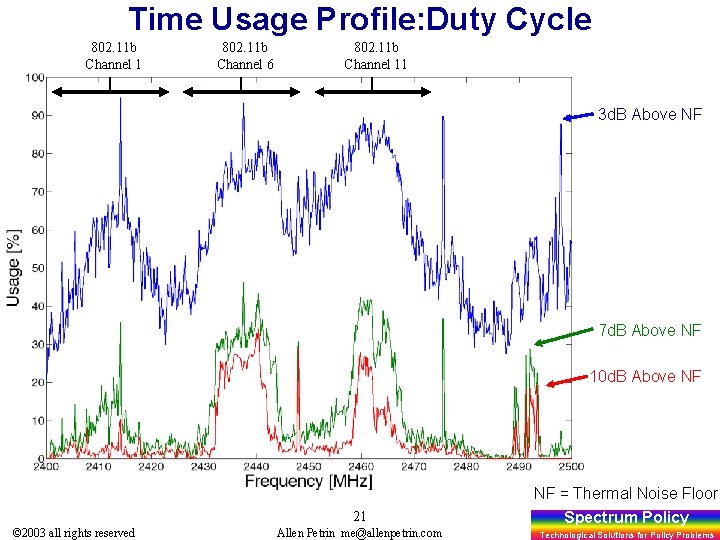
Time Usage Profile: Duty Cycle 802. 11 b Channel 1 802. 11 b Channel 6 802. 11 b Channel 11 3 d. B Above NF 7 d. B Above NF 10 d. B Above NF 21 © 2003 all rights reserved Allen Petrin me@allenpetrin. com NF = Thermal Noise Floor Spectrum Policy Technological Solutions for Policy Problems
Power [d. Bm] Azimuthal Profile 2332. 5 MHz Frequency 22 © 2003 all rights reserved Allen Petrin me@allenpetrin. com 2345 MHz Spectrum Policy Technological Solutions for Policy Problems
Power [d. Bm] Polarization Usage 2060 MHz 2360 MHz Frequency 1700 MHz © 2003 all rights reserved 23 Allen Petrin me@allenpetrin. com Spectrum Policy Technological Solutions for Policy Problems
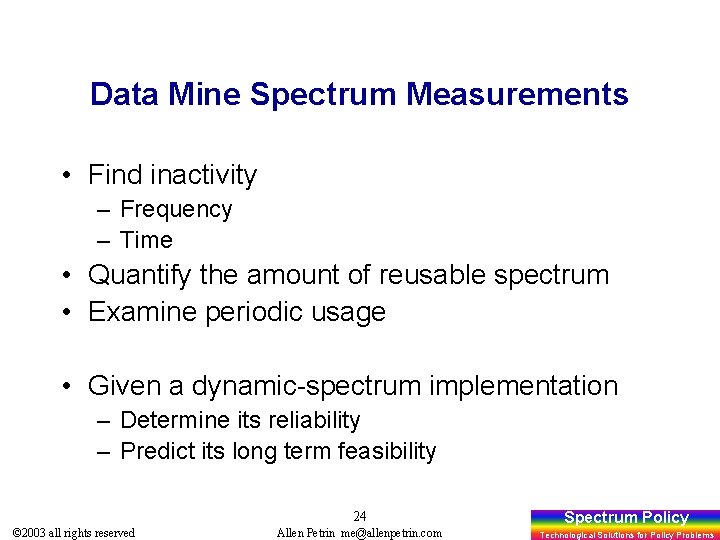
Data Mine Spectrum Measurements • Find inactivity – Frequency – Time • Quantify the amount of reusable spectrum • Examine periodic usage • Given a dynamic-spectrum implementation – Determine its reliability – Predict its long term feasibility 24 © 2003 all rights reserved Allen Petrin me@allenpetrin. com Spectrum Policy Technological Solutions for Policy Problems
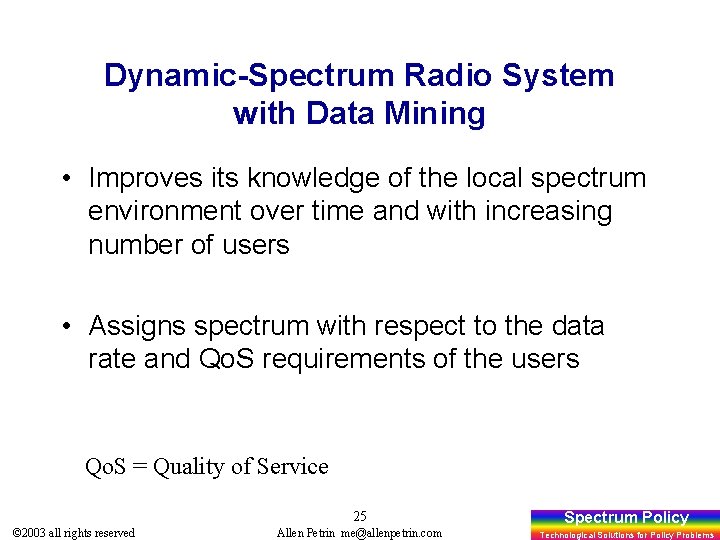
Dynamic-Spectrum Radio System with Data Mining • Improves its knowledge of the local spectrum environment over time and with increasing number of users • Assigns spectrum with respect to the data rate and Qo. S requirements of the users Qo. S = Quality of Service 25 © 2003 all rights reserved Allen Petrin me@allenpetrin. com Spectrum Policy Technological Solutions for Policy Problems
Questions ? 26 © 2003 all rights reserved Allen Petrin me@allenpetrin. com Spectrum Policy Technological Solutions for Policy Problems