
System Analysis Design Chapter 11 ECommerce Digital Markets

- Slides: 21
System Analysis Design Chapter 11 E-Commerce: Digital Markets, Digital Goods 10. 1 © 2010 by Prentice Hall
Learning Objectives q Describe the unique features of e-commerce, digital markets, and digital goods. q Analyze how Internet technology has changed value propositions and business models. q Describe the various types of e-commerce and how ecommerce has changed consumer retailing and business-tobusiness transactions q Evaluate the role of m-commerce, digital markets, and digital goods. q Compare the principal payment systems for electronic commerce. 10. 2 © 2010 by Prentice Hall
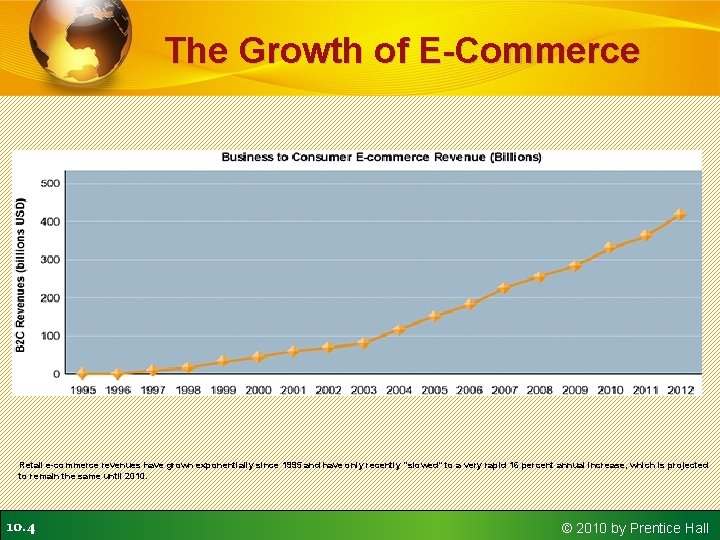
Electronic Commerce and the Internet • E-commerce • Use of the Internet and Web to transact business • Digitally enabled transactions • History of e-commerce • Began in 1995 and grew exponentially; still growing at an annual rate of 16 percent • Rapid growth led to market bubble • While many companies failed, many survived with soaring revenues • E-commerce today the fastest growing form of retail trade in U. S. , Europe, Asia 10. 3 © 2010 by Prentice Hall
The Growth of E-Commerce Retail e-commerce revenues have grown exponentially since 1995 and have only recently “slowed” to a very rapid 16 percent annual increase, which is projected to remain the same until 2010. 4 © 2010 by Prentice Hall
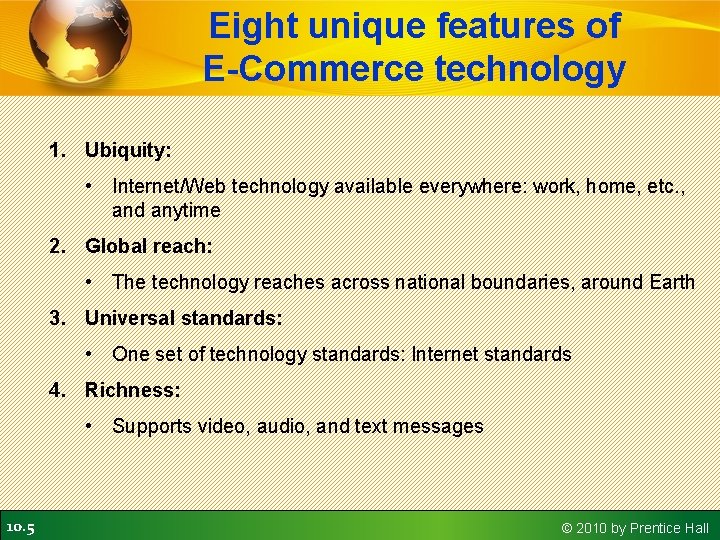
Eight unique features of E-Commerce technology 1. Ubiquity: • Internet/Web technology available everywhere: work, home, etc. , and anytime 2. Global reach: • The technology reaches across national boundaries, around Earth 3. Universal standards: • One set of technology standards: Internet standards 4. Richness: • Supports video, audio, and text messages 10. 5 © 2010 by Prentice Hall
Eight unique features of E-Commerce technology 5. Interactivity • The technology works through interaction with the user 6. Information density • Vast increases in information density—the total amount and quality of information available to all market participants 7. Personalization/Customization: • Technology permits modification of messages, goods 8. Social technology • The technology promotes user content generation and social networking 10. 6 © 2010 by Prentice Hall
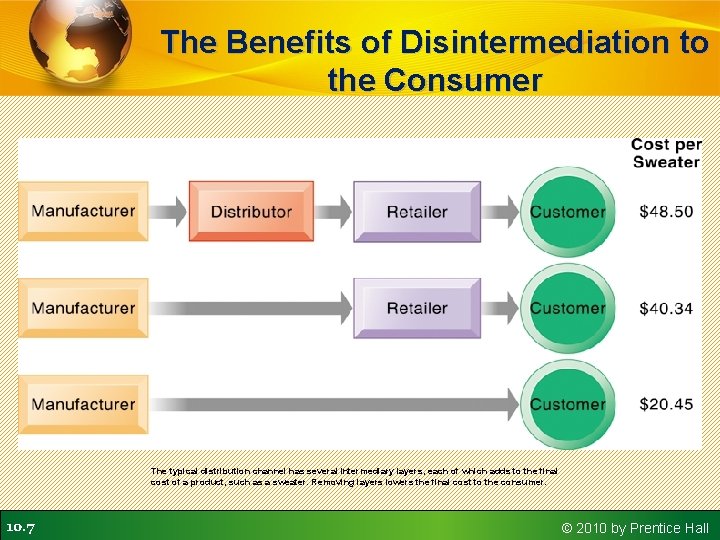
The Benefits of Disintermediation to the Consumer The typical distribution channel has several intermediary layers, each of which adds to the final cost of a product, such as a sweater. Removing layers lowers the final cost to the consumer. 10. 7 © 2010 by Prentice Hall
What is Digital Marketing? q Digital marketing is the use of the Internet, mobile devices, social media, search engines, and other channels to reach consumers. q Some marketing experts consider digital marketing to be an entirely new endeavor that requires a new way of approaching customers and new ways of understanding how customers behave compared to traditional marketing. 10. 8 © 2010 by Prentice Hall
The 5 Ds of digital marketing q Digital devices – audiences experience brands as they interact with business websites and mobile apps typically through a combination of connected devices including smartphones, tablets, desktop computers, TVs and gaming devices. q Digital platforms – most interactions on these devices are through a browser or apps from the major platforms or services, that’s Facebook (and Instagram), Google (and You. Tube), Twitter and Linked. In. q Digital media – different paid, owned and earned communications channels for reaching and engaging audiences including advertising, email and messaging, search engines and social networks. q Digital data – the insight businesses collect about their audience profiles and their interactions with businesses, which now needs to be protected by law in most countries. q Digital technology – the marketing technology or martech stack that businesses use to create interactive experiences from websites and mobile apps to in-store kiosks and email campaigns. 10. 9 © 2010 by Prentice Hall
Digital Marketing Channels q q q 10. 10 Website Marketing Pay-Per-Click (PPC) Advertising Content Marketing Email Marketing Social Media Marketing Affiliate Marketing Video Marketing SMS Messaging Search Engine Optimization (SEO) Conversion Rate Optimization (CRO) Native Advertising © 2010 by Prentice Hall
Key concepts in e-commerce (cont. ) q Digital goods § Goods that can be delivered over a digital network § E. g. , Music tracks, video, software, newspapers, books § Cost of producing first unit almost entire cost of product: marginal cost of producing 2 nd unit is about zero § Costs of delivery over the Internet very low § Marketing costs remain the same; pricing highly variable § Industries with digital goods are undergoing revolutionary changes (publishers, record labels, etc. ) 10. 11 © 2010 by Prentice Hall
Key concepts in e-commerce (cont. ) • Internet business models • Pure-play models • Clicks-and-filling models • Social Network • • • Online meeting place Social shopping sites Can provide ways for corporate clients to target customers through banner ads and pop-up ads • Online marketplace: • Provides a digital environment where buyers and sellers can meet, search for products, display products, and establish prices for those products 10. 12 © 2010 by Prentice Hall
Key concepts in e-commerce (cont. ) • Content provider • Providing digital content, such as digital news, music, photos, or video, over the Web • Online syndicators: Aggregate content from multiple sources, package for distribution, and resell to third-party Web sites • Service provider • Provides Web 2. 0 applications such as photo sharing and interactive maps, and services such as data storage • Portal • “Supersite” that provides comprehensive entry point for huge array of resources and services on the Internet 10. 13 © 2010 by Prentice Hall
Key concepts in e-commerce (cont. ) • Virtual storefront: • Sells physical products directly to consumers or to individual businesses • Information broker/Dealer: • Provides product, pricing, and availability information to individuals and businesses • Transaction broker/Dealer: : • Saves users money and time by processing online sales transactions and generating a fee for each transaction 10. 14 © 2010 by Prentice Hall
Types of Electronic Commerce q Business-to-business (B 2 B) q Business-to-consumer (B 2 C) q Consumer-to-consumer (C 2 C) q Consumer-to-Business (C 2 B) 10. 15 © 2010 by Prentice Hall
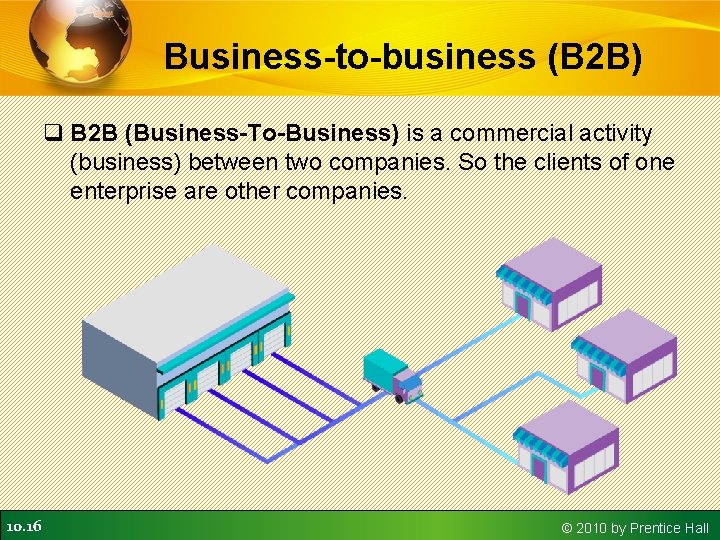
Business-to-business (B 2 B) q B 2 B (Business-To-Business) is a commercial activity (business) between two companies. So the clients of one enterprise are other companies. 10. 16 © 2010 by Prentice Hall
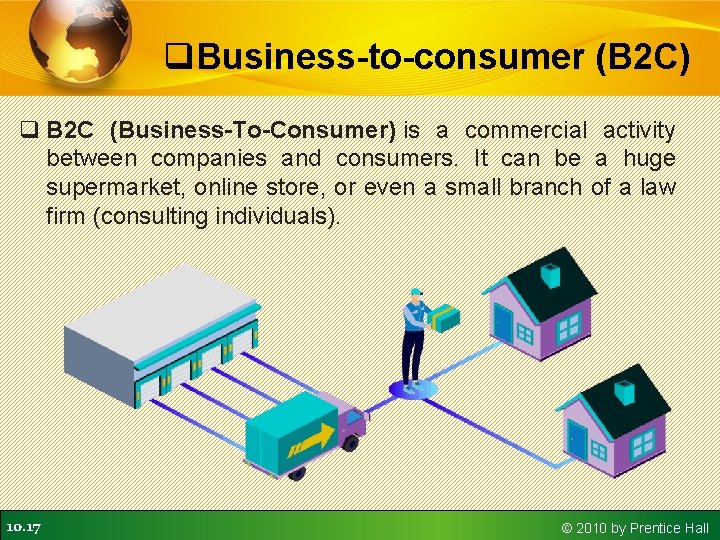
q. Business-to-consumer (B 2 C) q B 2 C (Business-To-Consumer) is a commercial activity between companies and consumers. It can be a huge supermarket, online store, or even a small branch of a law firm (consulting individuals). 10. 17 © 2010 by Prentice Hall
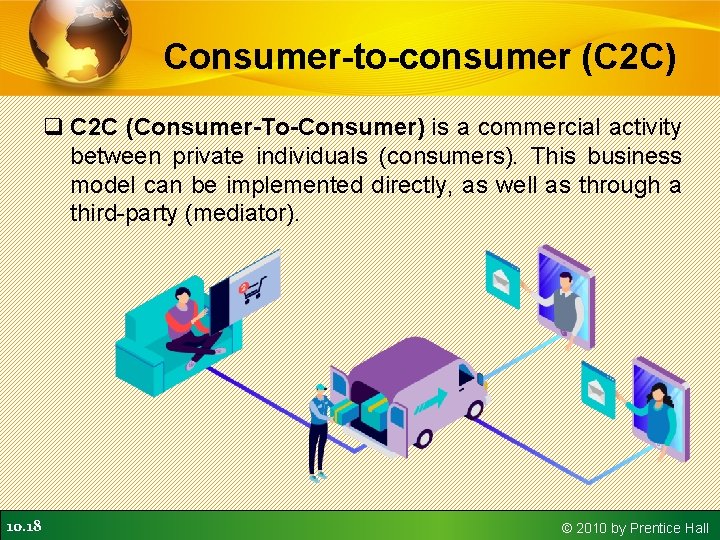
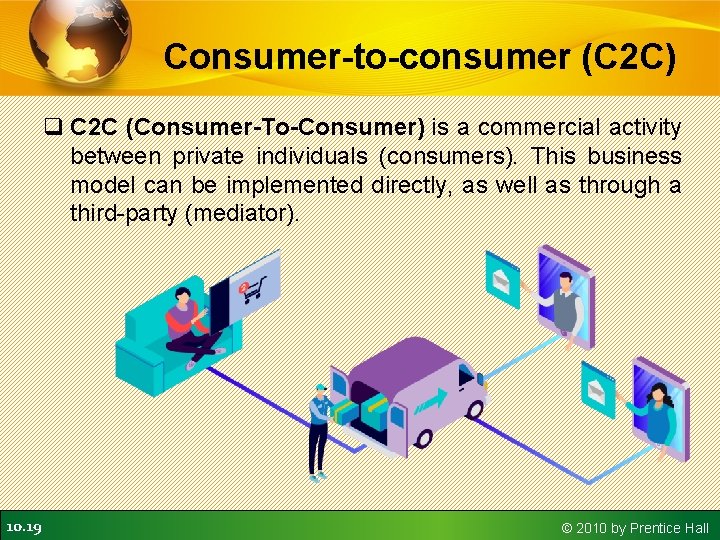
Consumer-to-consumer (C 2 C) q C 2 C (Consumer-To-Consumer) is a commercial activity between private individuals (consumers). This business model can be implemented directly, as well as through a third-party (mediator). 10. 18 © 2010 by Prentice Hall
Consumer-to-consumer (C 2 C) q C 2 C (Consumer-To-Consumer) is a commercial activity between private individuals (consumers). This business model can be implemented directly, as well as through a third-party (mediator). 10. 19 © 2010 by Prentice Hall
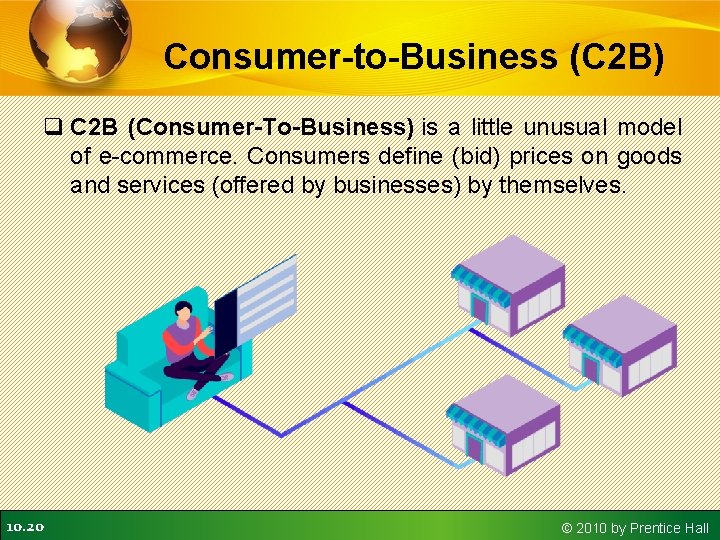
Consumer-to-Business (C 2 B) q C 2 B (Consumer-To-Business) is a little unusual model of e-commerce. Consumers define (bid) prices on goods and services (offered by businesses) by themselves. 10. 20 © 2010 by Prentice Hall
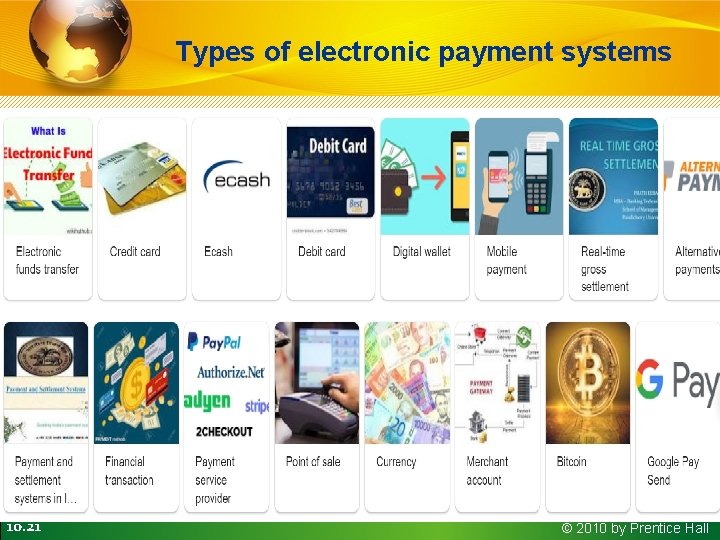
Types of electronic payment systems 10. 21 © 2010 by Prentice Hall