
SYSC 5608 Wireless Communications Systems Engineering PHY Fundamentals
- Slides: 52
SYSC 5608 Wireless Communications Systems Engineering PHY Fundamentals of Wireless Communications Physical Layer Fundamentals of Wireless Communications Halim Yanıkömeroğlu Department of Systems & Computer Engineering Carleton University Ottawa, Canada Winter 2020 – Halim Yanikomeroglu Page 1 of 52
SYSC 5608 Wireless Communications Systems Engineering PHY Fundamentals of Wireless Communications Outline d. B Notation The Big Picture: OSI Model Major impairments in communication systems Noise (AWGN) SNR Main goals of digital communications MAC, RRM, RAN Winter 2020 – Halim Yanikomeroglu Page 2 of 52
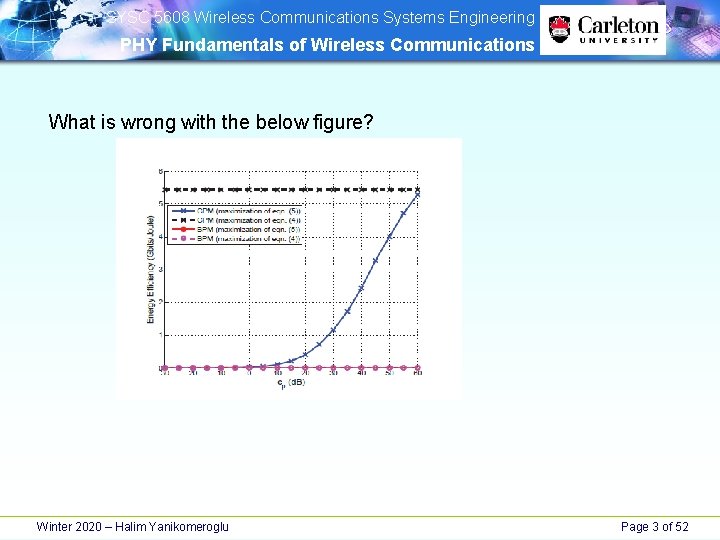
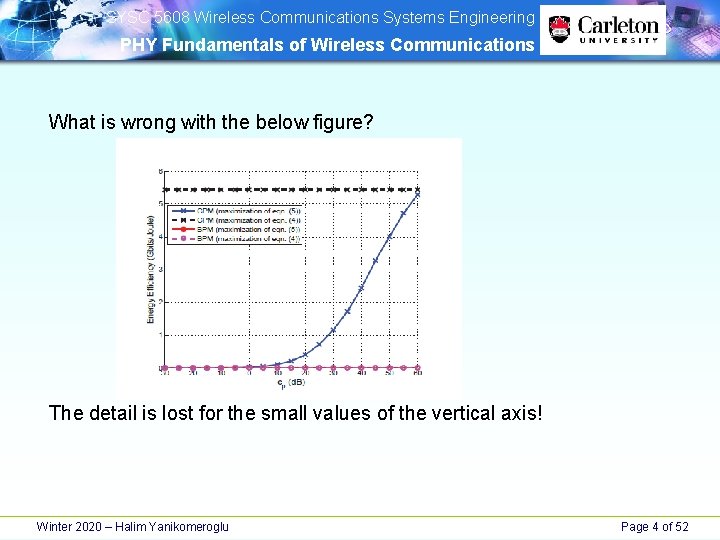
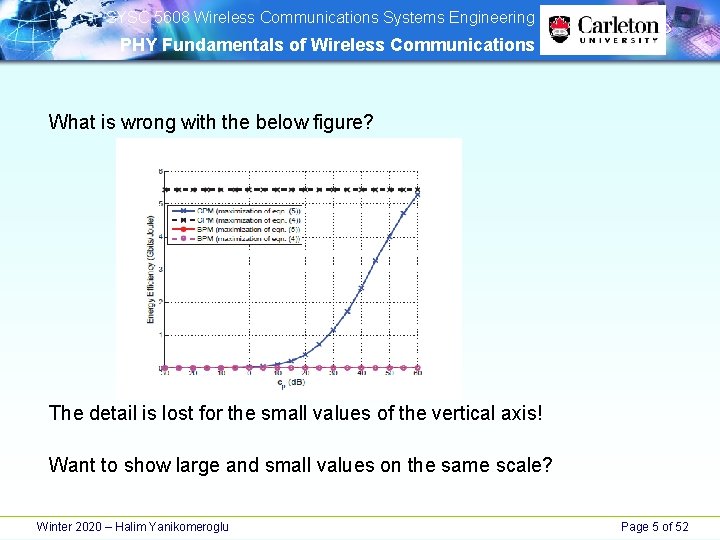
SYSC 5608 Wireless Communications Systems Engineering PHY Fundamentals of Wireless Communications What is wrong with the below figure? Winter 2020 – Halim Yanikomeroglu Page 3 of 52
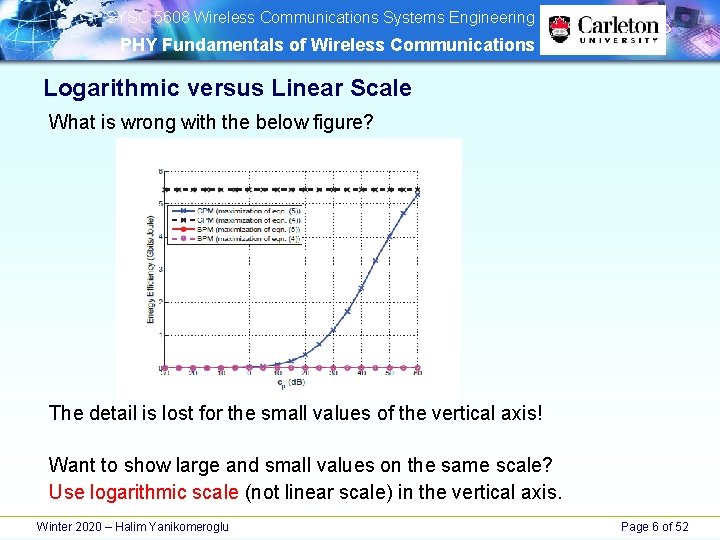
SYSC 5608 Wireless Communications Systems Engineering PHY Fundamentals of Wireless Communications What is wrong with the below figure? The detail is lost for the small values of the vertical axis! Winter 2020 – Halim Yanikomeroglu Page 4 of 52
SYSC 5608 Wireless Communications Systems Engineering PHY Fundamentals of Wireless Communications What is wrong with the below figure? The detail is lost for the small values of the vertical axis! Want to show large and small values on the same scale? Winter 2020 – Halim Yanikomeroglu Page 5 of 52
SYSC 5608 Wireless Communications Systems Engineering PHY Fundamentals of Wireless Communications Logarithmic versus Linear Scale What is wrong with the below figure? The detail is lost for the small values of the vertical axis! Want to show large and small values on the same scale? Use logarithmic scale (not linear scale) in the vertical axis. Winter 2020 – Halim Yanikomeroglu Page 6 of 52
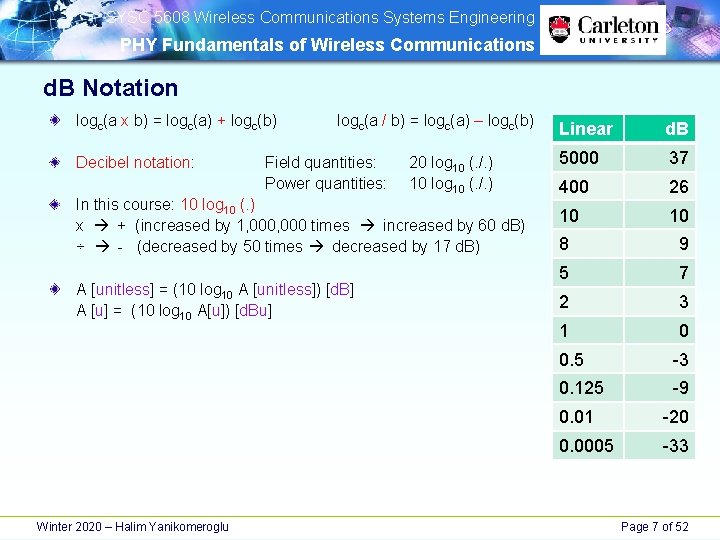
SYSC 5608 Wireless Communications Systems Engineering PHY Fundamentals of Wireless Communications d. B Notation logc(a x b) = logc(a) + logc(b) Decibel notation: logc(a / b) = logc(a) – logc(b) Field quantities: Power quantities: 20 log 10 (. /. ) 10 log 10 (. /. ) In this course: 10 log 10 (. ) x + (increased by 1, 000 times increased by 60 d. B) ÷ - (decreased by 50 times decreased by 17 d. B) A [unitless] = (10 log 10 A [unitless]) [d. B] A [u] = (10 log 10 A[u]) [d. Bu] Winter 2020 – Halim Yanikomeroglu Linear d. B 5000 37 400 26 10 10 8 9 5 7 2 3 1 0 0. 5 -3 0. 125 -9 0. 01 -20 0. 0005 -33 Page 7 of 52
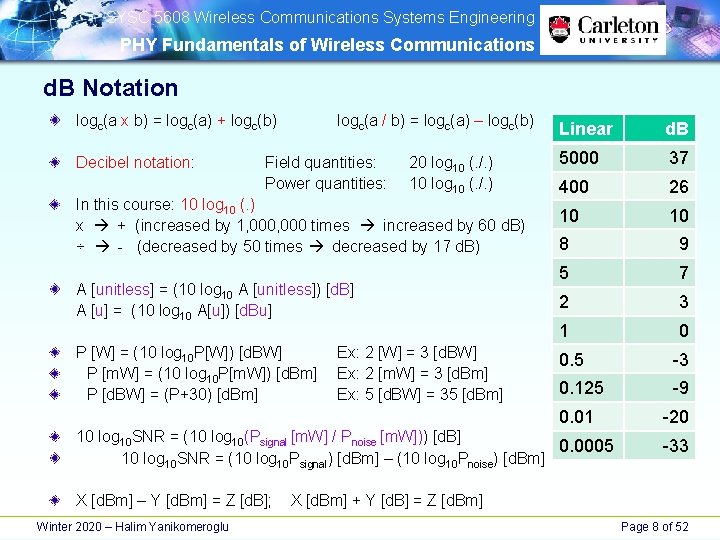
SYSC 5608 Wireless Communications Systems Engineering PHY Fundamentals of Wireless Communications d. B Notation logc(a x b) = logc(a) + logc(b) Decibel notation: logc(a / b) = logc(a) – logc(b) Field quantities: Power quantities: 20 log 10 (. /. ) 10 log 10 (. /. ) In this course: 10 log 10 (. ) x + (increased by 1, 000 times increased by 60 d. B) ÷ - (decreased by 50 times decreased by 17 d. B) A [unitless] = (10 log 10 A [unitless]) [d. B] A [u] = (10 log 10 A[u]) [d. Bu] P [W] = (10 log 10 P[W]) [d. BW] P [m. W] = (10 log 10 P[m. W]) [d. Bm] P [d. BW] = (P+30) [d. Bm] Ex: 2 [W] = 3 [d. BW] Ex: 2 [m. W] = 3 [d. Bm] Ex: 5 [d. BW] = 35 [d. Bm] Linear d. B 5000 37 400 26 10 10 8 9 5 7 2 3 1 0 0. 5 -3 0. 125 -9 0. 01 -20 10 log 10 SNR = (10 log 10(Psignal [m. W] / Pnoise [m. W])) [d. B] 0. 0005 10 log 10 SNR = (10 log 10 Psignal) [d. Bm] – (10 log 10 Pnoise) [d. Bm] -33 X [d. Bm] – Y [d. Bm] = Z [d. B]; X [d. Bm] + Y [d. B] = Z [d. Bm] Winter 2020 – Halim Yanikomeroglu Page 8 of 52
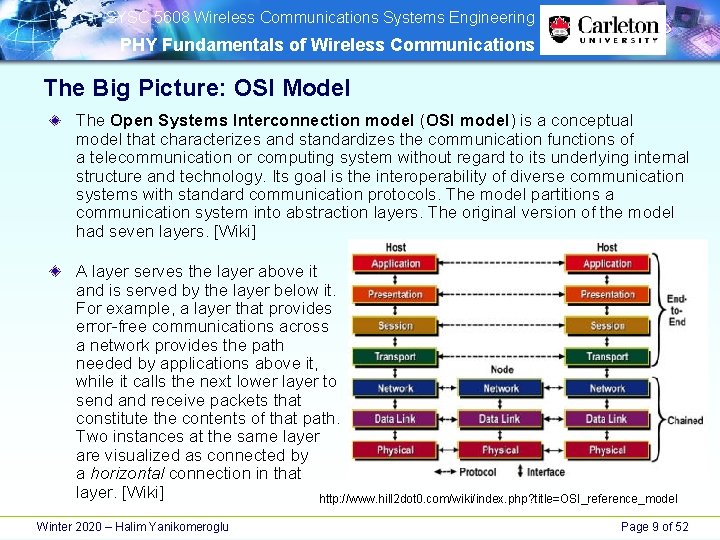
SYSC 5608 Wireless Communications Systems Engineering PHY Fundamentals of Wireless Communications The Big Picture: OSI Model The Open Systems Interconnection model (OSI model) is a conceptual model that characterizes and standardizes the communication functions of a telecommunication or computing system without regard to its underlying internal structure and technology. Its goal is the interoperability of diverse communication systems with standard communication protocols. The model partitions a communication system into abstraction layers. The original version of the model had seven layers. [Wiki] A layer serves the layer above it and is served by the layer below it. For example, a layer that provides error-free communications across a network provides the path needed by applications above it, while it calls the next lower layer to send and receive packets that constitute the contents of that path. Two instances at the same layer are visualized as connected by a horizontal connection in that layer. [Wiki] http: //www. hill 2 dot 0. com/wiki/index. php? title=OSI_reference_model Winter 2020 – Halim Yanikomeroglu Page 9 of 52
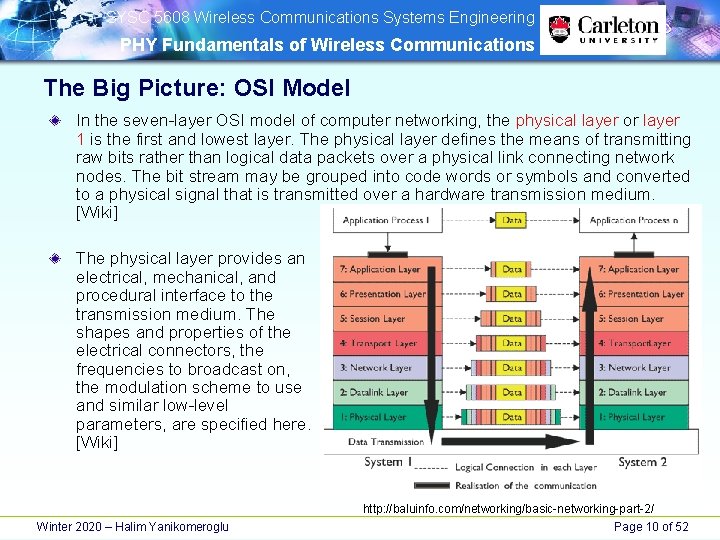
SYSC 5608 Wireless Communications Systems Engineering PHY Fundamentals of Wireless Communications The Big Picture: OSI Model In the seven-layer OSI model of computer networking, the physical layer or layer 1 is the first and lowest layer. The physical layer defines the means of transmitting raw bits rather than logical data packets over a physical link connecting network nodes. The bit stream may be grouped into code words or symbols and converted to a physical signal that is transmitted over a hardware transmission medium. [Wiki] The physical layer provides an electrical, mechanical, and procedural interface to the transmission medium. The shapes and properties of the electrical connectors, the frequencies to broadcast on, the modulation scheme to use and similar low-level parameters, are specified here. [Wiki] http: //baluinfo. com/networking/basic-networking-part-2/ Winter 2020 – Halim Yanikomeroglu Page 10 of 52
SYSC 5608 Wireless Communications Systems Engineering PHY Fundamentals of Wireless Communications Terminology Often used synonymously in industry: Digital Communication (SYSC 5504) [Transmission of a digital message, or of a digitized analog signal, is known as digital communication. (Wikipedia)] Transmission Technologies [Transmission technologies and schemes typically refer to physical layer protocol duties such as modulation, demodulation, line coding, equalization, error control, bit synchronization and multiplexing, but the term may also involve higher-layer protocol duties, for example, digitizing an analog message signal, and source coding (compression). (Wikipedia)] Physical Layer [In the seven-layer OSI model of computer networking, the physical layer or layer 1 is the first and lowest layer. (Wikipedia)] Winter 2020 – Halim Yanikomeroglu Page 11 of 52
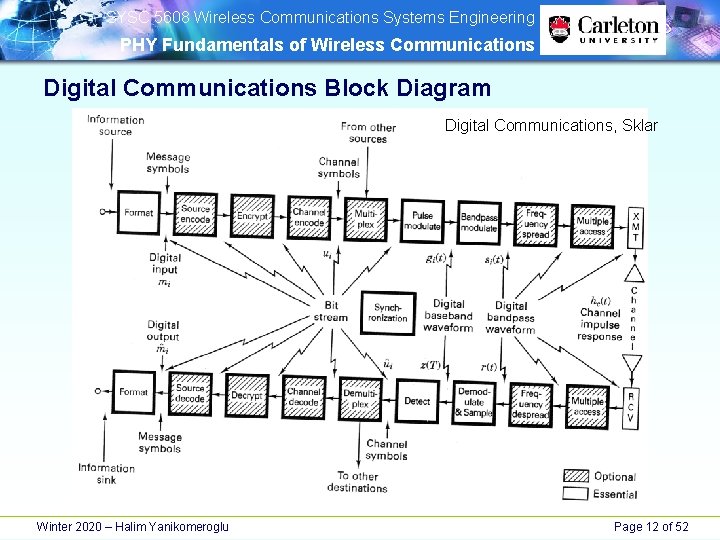
SYSC 5608 Wireless Communications Systems Engineering PHY Fundamentals of Wireless Communications Digital Communications Block Diagram Digital Communications, Sklar Winter 2020 – Halim Yanikomeroglu Page 12 of 52
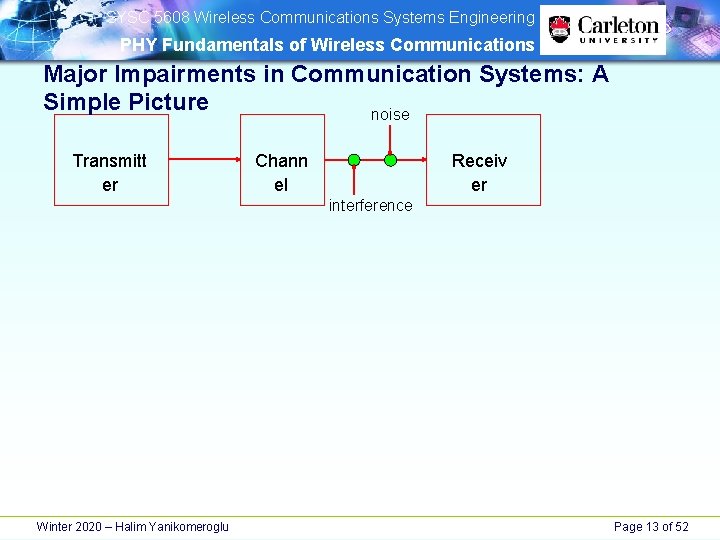
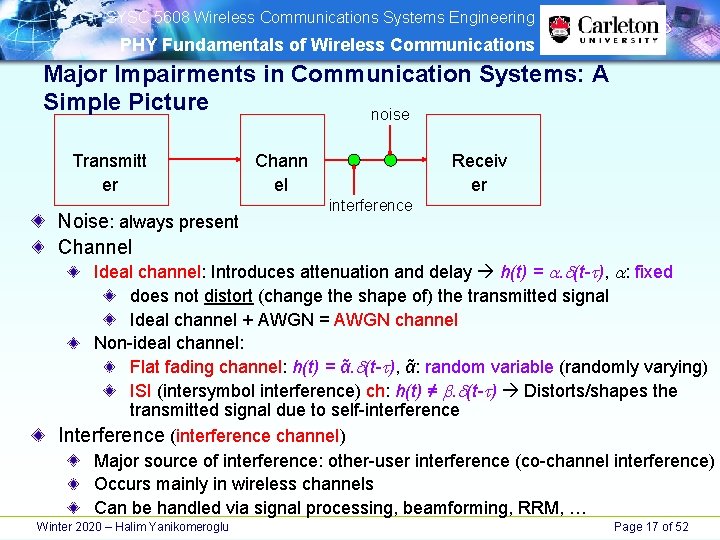
SYSC 5608 Wireless Communications Systems Engineering PHY Fundamentals of Wireless Communications Major Impairments in Communication Systems: A Simple Picture noise Transmitt er Chann el Receiv er interference Winter 2020 – Halim Yanikomeroglu Page 13 of 52
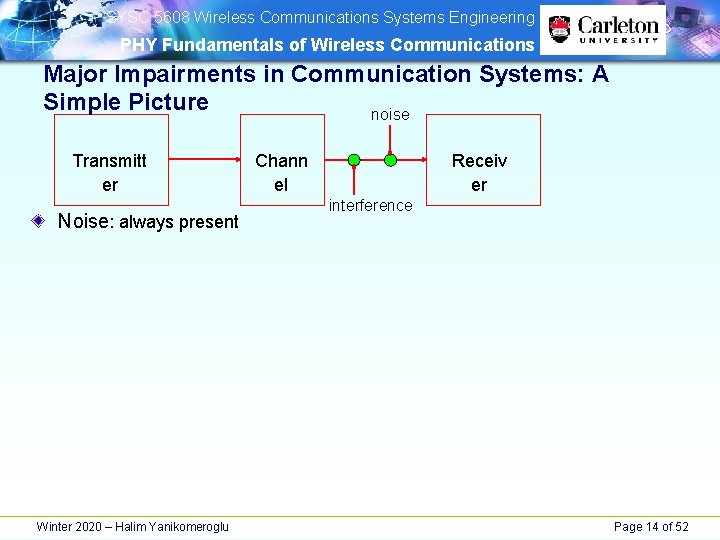
SYSC 5608 Wireless Communications Systems Engineering PHY Fundamentals of Wireless Communications Major Impairments in Communication Systems: A Simple Picture noise Transmitt er Noise: always present Chann el Receiv er interference Winter 2020 – Halim Yanikomeroglu Page 14 of 52
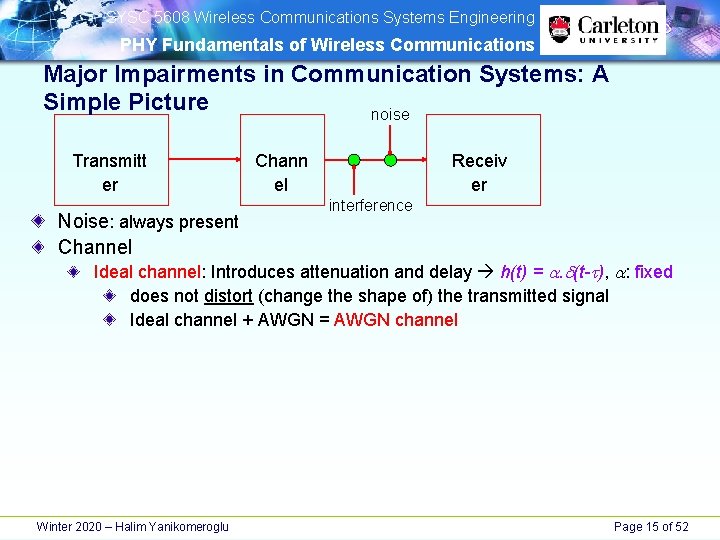
SYSC 5608 Wireless Communications Systems Engineering PHY Fundamentals of Wireless Communications Major Impairments in Communication Systems: A Simple Picture noise Transmitt er Noise: always present Channel Chann el Receiv er interference Ideal channel: Introduces attenuation and delay h(t) = a. d(t-t), a: fixed does not distort (change the shape of) the transmitted signal Ideal channel + AWGN = AWGN channel Winter 2020 – Halim Yanikomeroglu Page 15 of 52
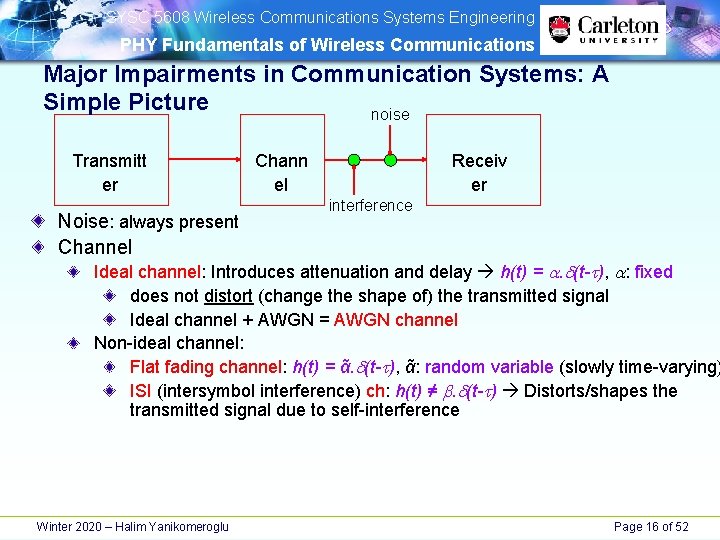
SYSC 5608 Wireless Communications Systems Engineering PHY Fundamentals of Wireless Communications Major Impairments in Communication Systems: A Simple Picture noise Transmitt er Noise: always present Channel Chann el Receiv er interference Ideal channel: Introduces attenuation and delay h(t) = a. d(t-t), a: fixed does not distort (change the shape of) the transmitted signal Ideal channel + AWGN = AWGN channel Non-ideal channel: Flat fading channel: h(t) = ᾶ. d(t-t), ᾶ: random variable (slowly time-varying) ISI (intersymbol interference) ch: h(t) ≠ b. d(t-t) Distorts/shapes the transmitted signal due to self-interference Winter 2020 – Halim Yanikomeroglu Page 16 of 52
SYSC 5608 Wireless Communications Systems Engineering PHY Fundamentals of Wireless Communications Major Impairments in Communication Systems: A Simple Picture noise Transmitt er Noise: always present Channel Chann el Receiv er interference Ideal channel: Introduces attenuation and delay h(t) = a. d(t-t), a: fixed does not distort (change the shape of) the transmitted signal Ideal channel + AWGN = AWGN channel Non-ideal channel: Flat fading channel: h(t) = ᾶ. d(t-t), ᾶ: random variable (randomly varying) ISI (intersymbol interference) ch: h(t) ≠ b. d(t-t) Distorts/shapes the transmitted signal due to self-interference Interference (interference channel) Major source of interference: other-user interference (co-channel interference) Occurs mainly in wireless channels Can be handled via signal processing, beamforming, RRM, … Winter 2020 – Halim Yanikomeroglu Page 17 of 52
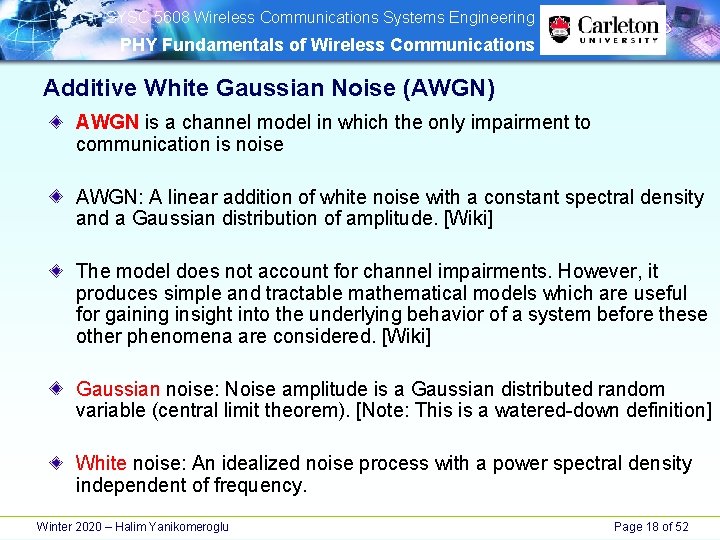
SYSC 5608 Wireless Communications Systems Engineering PHY Fundamentals of Wireless Communications Additive White Gaussian Noise (AWGN) AWGN is a channel model in which the only impairment to communication is noise AWGN: A linear addition of white noise with a constant spectral density and a Gaussian distribution of amplitude. [Wiki] The model does not account for channel impairments. However, it produces simple and tractable mathematical models which are useful for gaining insight into the underlying behavior of a system before these other phenomena are considered. [Wiki] Gaussian noise: Noise amplitude is a Gaussian distributed random variable (central limit theorem). [Note: This is a watered-down definition] White noise: An idealized noise process with a power spectral density independent of frequency. Winter 2020 – Halim Yanikomeroglu Page 18 of 52
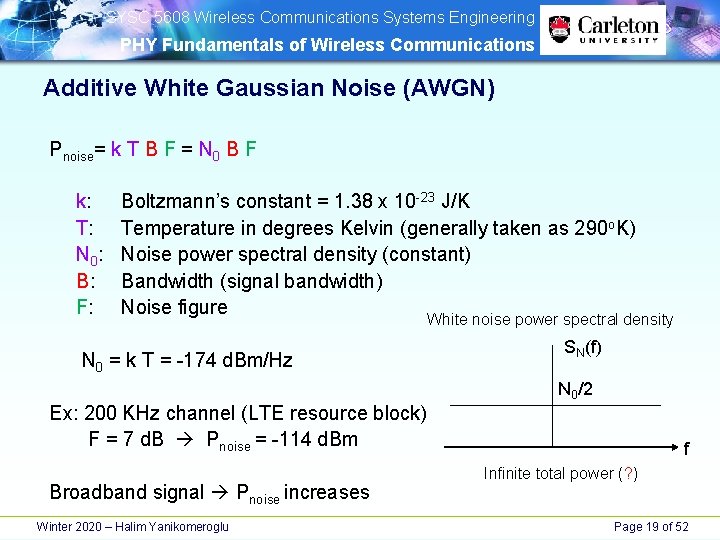
SYSC 5608 Wireless Communications Systems Engineering PHY Fundamentals of Wireless Communications Additive White Gaussian Noise (AWGN) Pnoise= k T B F = N 0 B F k: Boltzmann’s constant = 1. 38 x 10 -23 J/K T: Temperature in degrees Kelvin (generally taken as 290 o. K) N 0: Noise power spectral density (constant) B: Bandwidth (signal bandwidth) F: Noise figure White noise power spectral density SN(f) N 0 = k T = -174 d. Bm/Hz Ex: 200 KHz channel (LTE resource block) F = 7 d. B Pnoise = -114 d. Bm Broadband signal Pnoise increases Winter 2020 – Halim Yanikomeroglu N 0/2 f Infinite total power (? ) Page 19 of 52
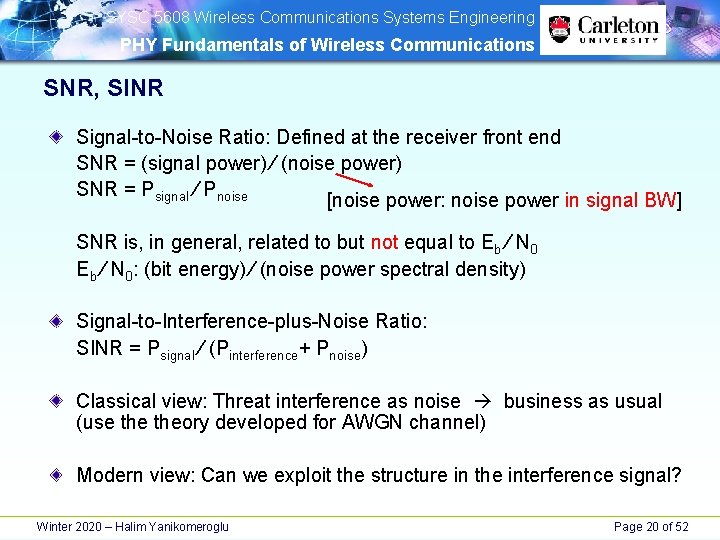
SYSC 5608 Wireless Communications Systems Engineering PHY Fundamentals of Wireless Communications SNR, SINR Signal-to-Noise Ratio: Defined at the receiver front end SNR = (signal power) ∕ (noise power) SNR = Psignal ∕ Pnoise [noise power: noise power in signal BW] SNR is, in general, related to but not equal to Eb ∕ N 0: (bit energy) ∕ (noise power spectral density) Signal-to-Interference-plus-Noise Ratio: SINR = Psignal ∕ (Pinterference+ Pnoise) Classical view: Threat interference as noise business as usual (use theory developed for AWGN channel) Modern view: Can we exploit the structure in the interference signal? Winter 2020 – Halim Yanikomeroglu Page 20 of 52
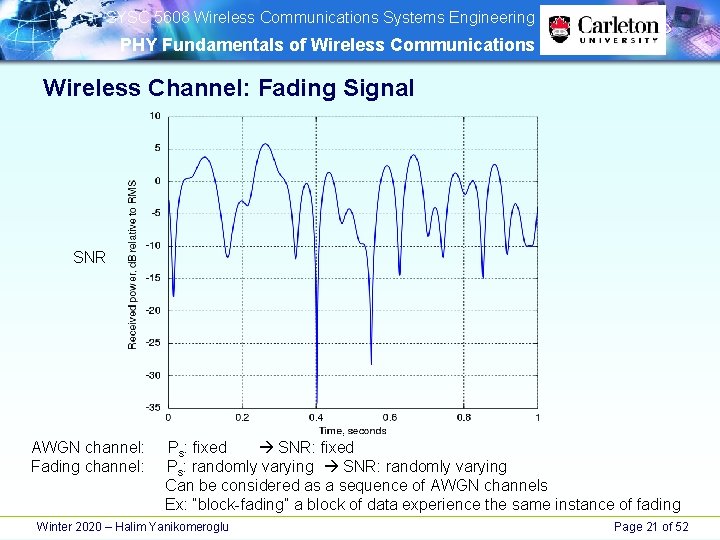
SYSC 5608 Wireless Communications Systems Engineering PHY Fundamentals of Wireless Communications Wireless Channel: Fading Signal SNR AWGN channel: Ps: fixed SNR: fixed Fading channel: Ps: randomly varying SNR: randomly varying Can be considered as a sequence of AWGN channels Ex: “block-fading” a block of data experience the same instance of fading Winter 2020 – Halim Yanikomeroglu Page 21 of 52
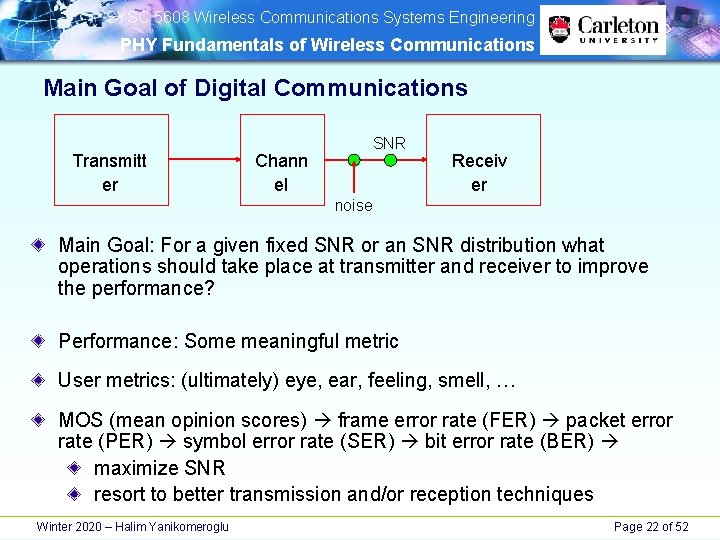
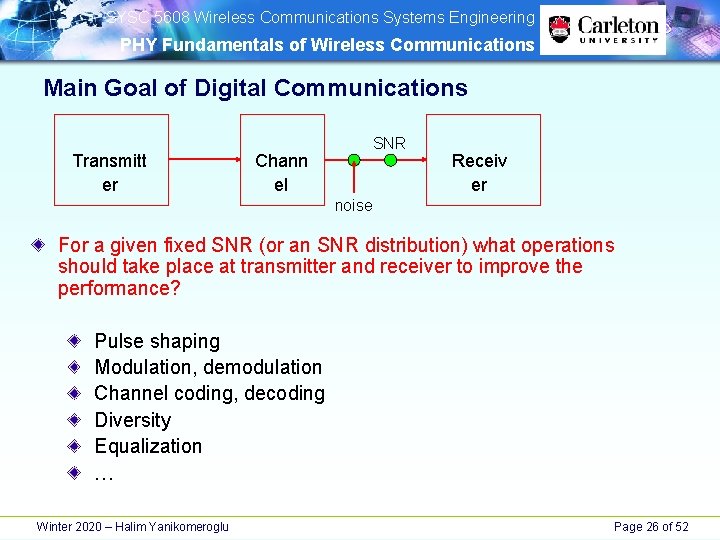
SYSC 5608 Wireless Communications Systems Engineering PHY Fundamentals of Wireless Communications Main Goal of Digital Communications Transmitt er Chann el SNR Receiv er noise Main Goal: For a given fixed SNR or an SNR distribution what operations should take place at transmitter and receiver to improve the performance? Performance: Some meaningful metric User metrics: (ultimately) eye, ear, feeling, smell, … MOS (mean opinion scores) frame error rate (FER) packet error rate (PER) symbol error rate (SER) bit error rate (BER) maximize SNR resort to better transmission and/or reception techniques Winter 2020 – Halim Yanikomeroglu Page 22 of 52
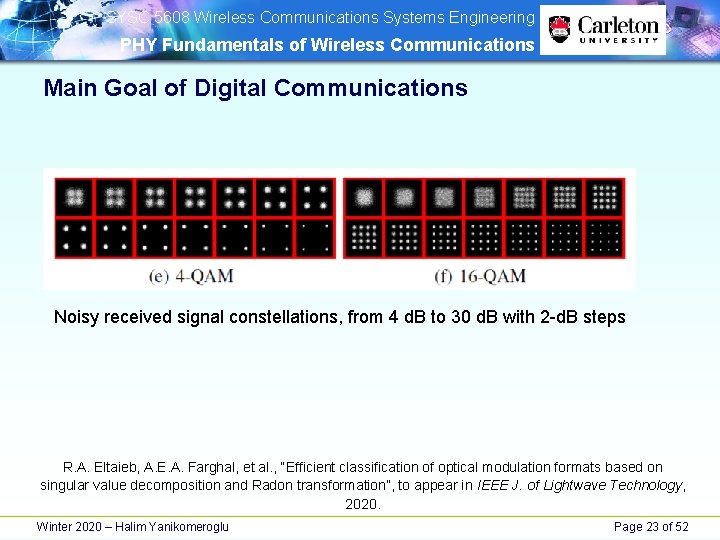
SYSC 5608 Wireless Communications Systems Engineering PHY Fundamentals of Wireless Communications Main Goal of Digital Communications Noisy received signal constellations, from 4 d. B to 30 d. B with 2 -d. B steps R. A. Eltaieb, A. E. A. Farghal, et al. , “Efficient classification of optical modulation formats based on singular value decomposition and Radon transformation”, to appear in IEEE J. of Lightwave Technology, 2020. Winter 2020 – Halim Yanikomeroglu Page 23 of 52
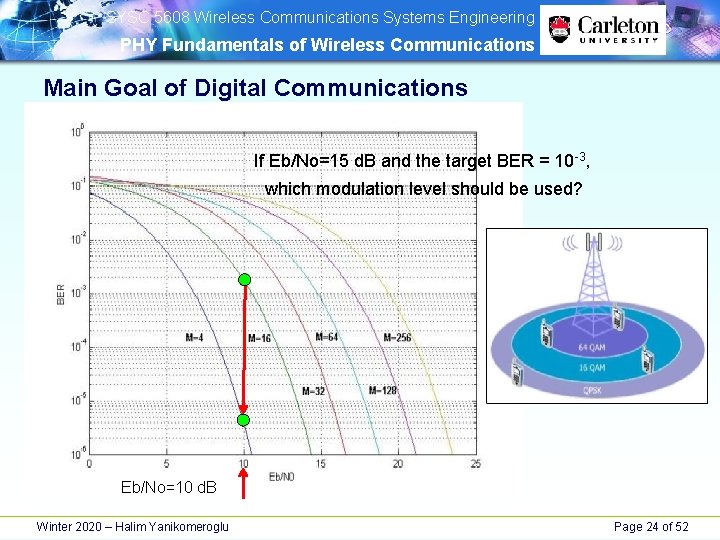
SYSC 5608 Wireless Communications Systems Engineering PHY Fundamentals of Wireless Communications Main Goal of Digital Communications If Eb/No=15 d. B and the target BER = 10 -3, which modulation level should be used? Eb/No=10 d. B Winter 2020 – Halim Yanikomeroglu Page 24 of 52
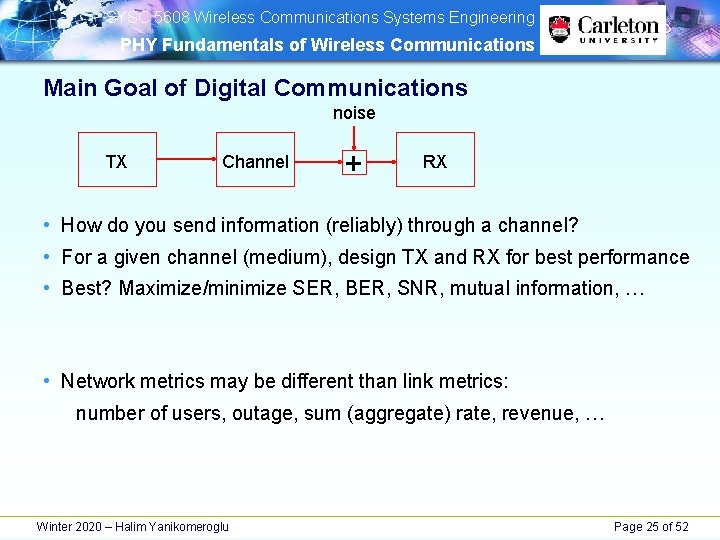
SYSC 5608 Wireless Communications Systems Engineering PHY Fundamentals of Wireless Communications Main Goal of Digital Communications noise TX Channel + RX • How do you send information (reliably) through a channel? • For a given channel (medium), design TX and RX for best performance • Best? Maximize/minimize SER, BER, SNR, mutual information, … • Network metrics may be different than link metrics: number of users, outage, sum (aggregate) rate, revenue, … Winter 2020 – Halim Yanikomeroglu Page 25 of 52
SYSC 5608 Wireless Communications Systems Engineering PHY Fundamentals of Wireless Communications Main Goal of Digital Communications Transmitt er Chann el SNR Receiv er noise For a given fixed SNR (or an SNR distribution) what operations should take place at transmitter and receiver to improve the performance? Pulse shaping Modulation, demodulation Channel coding, decoding Diversity Equalization … Winter 2020 – Halim Yanikomeroglu Page 26 of 52
SYSC 5608 Wireless Communications Systems Engineering PHY Fundamentals of Wireless Communications MAC, RRM, RAN Want SNR ↑ ? PS ↑ and/or Pn ↓ (limited control on Pn) Want SINR ↑ ? PS ↑ and/or PI ↓ and/or Pn ↓(limited control on Pn) How can we increase PS ? How can we decrease PI ? Answer: Medium Access Control (MAC) [layer 2] Radio Resource Management (RRM) [layer 2] Radio Access Network (RAN) How do we compute PS ? Propagation modeling Winter 2020 – Halim Yanikomeroglu Page 27 of 52
SYSC 5608 Wireless Communications Systems Engineering PHY Fundamentals of Wireless Communications Part II l Analog and digital signals l Power spectral density and bandwidth l Digital transmission Winter 2020 – Halim Yanikomeroglu Page 28 of 52
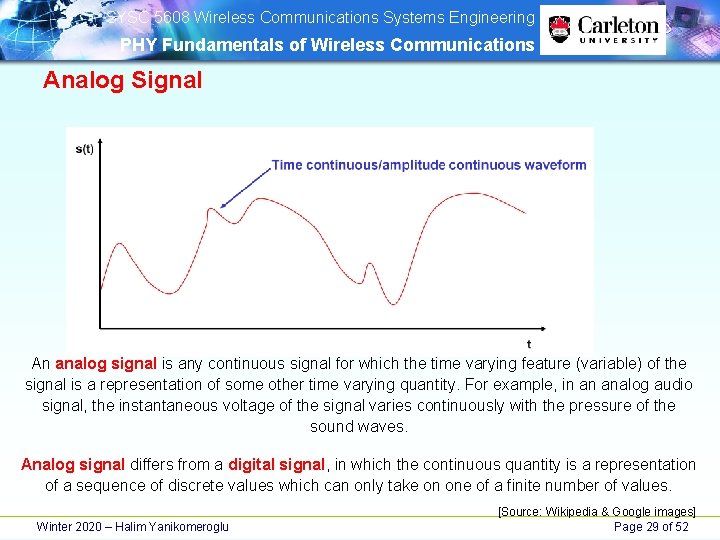
SYSC 5608 Wireless Communications Systems Engineering PHY Fundamentals of Wireless Communications Analog Signal An analog signal is any continuous signal for which the time varying feature (variable) of the signal is a representation of some other time varying quantity. For example, in an analog audio signal, the instantaneous voltage of the signal varies continuously with the pressure of the sound waves. Analog signal differs from a digital signal, in which the continuous quantity is a representation of a sequence of discrete values which can only take on one of a finite number of values. [Source: Wikipedia & Google images] Winter 2020 – Halim Yanikomeroglu Page 29 of 52
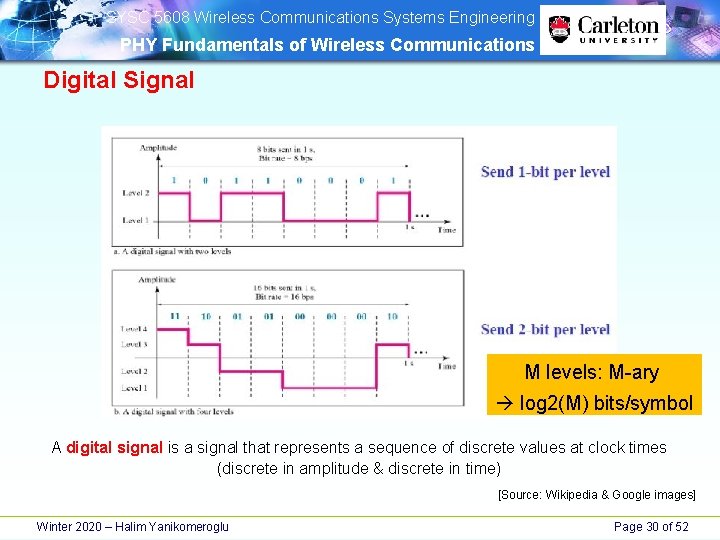
SYSC 5608 Wireless Communications Systems Engineering PHY Fundamentals of Wireless Communications Digital Signal M levels: M-ary log 2(M) bits/symbol A digital signal is a signal that represents a sequence of discrete values at clock times (discrete in amplitude & discrete in time) [Source: Wikipedia & Google images] Winter 2020 – Halim Yanikomeroglu Page 30 of 52
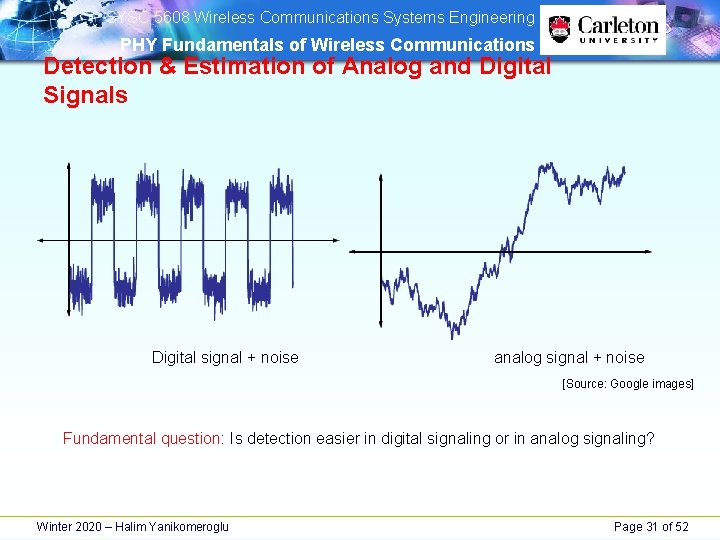
SYSC 5608 Wireless Communications Systems Engineering PHY Fundamentals of Wireless Communications Detection & Estimation of Analog and Digital Signals Digital signal + noise analog signal + noise [Source: Google images] Fundamental question: Is detection easier in digital signaling or in analog signaling? Winter 2020 – Halim Yanikomeroglu Page 31 of 52
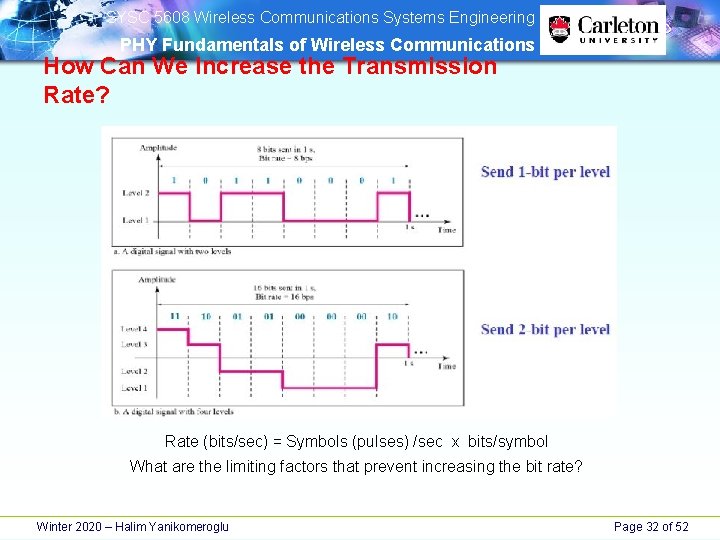
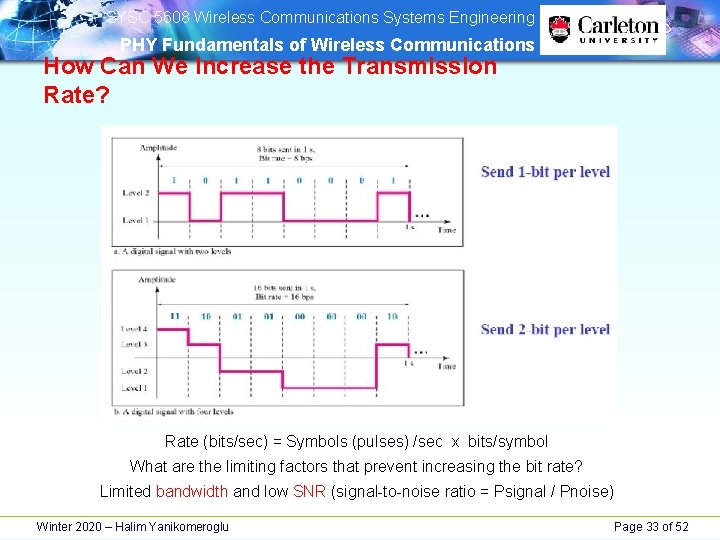
SYSC 5608 Wireless Communications Systems Engineering PHY Fundamentals of Wireless Communications How Can We Increase the Transmission Rate? Rate (bits/sec) = Symbols (pulses) /sec x bits/symbol What are the limiting factors that prevent increasing the bit rate? Winter 2020 – Halim Yanikomeroglu Page 32 of 52
SYSC 5608 Wireless Communications Systems Engineering PHY Fundamentals of Wireless Communications How Can We Increase the Transmission Rate? Rate (bits/sec) = Symbols (pulses) /sec x bits/symbol What are the limiting factors that prevent increasing the bit rate? Limited bandwidth and low SNR (signal-to-noise ratio = Psignal / Pnoise) Winter 2020 – Halim Yanikomeroglu Page 33 of 52
SYSC 5608 Wireless Communications Systems Engineering PHY Fundamentals of Wireless Communications Digital and Analog Signals Some signals (like speech and video) are inherently analog; some (like computer data) are inherently digital. However, both analog and digital signals can be represented and transmitted digitally. Advantages of digital: § § § Reduced sensitivity to line noise, temp. drift, etc. Low cost digital VLSI for switching and transmission. Lower maintenance costs than analog. Uniformity in carrying voice, SMS, email, data, video, etc. (a bit is a bit). Better encryption. Winter 2020 – Halim Yanikomeroglu Page 34 of 52
SYSC 5608 Wireless Communications Systems Engineering PHY Fundamentals of Wireless Communications Power Spectral Density Power spectrum (power spectral density) describes how the average power is distributed with respect to frequency. Deterministic signals Fourier transform Random signals Power spectral density A statistical representation for all random signals in a particular application Winter 2020 – Halim Yanikomeroglu Page 35 of 52
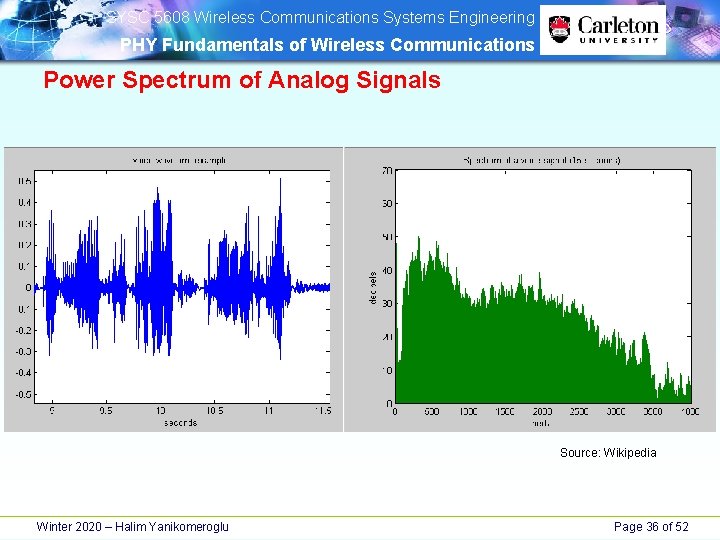
SYSC 5608 Wireless Communications Systems Engineering PHY Fundamentals of Wireless Communications Power Spectrum of Analog Signals Source: Wikipedia Winter 2020 – Halim Yanikomeroglu Page 36 of 52
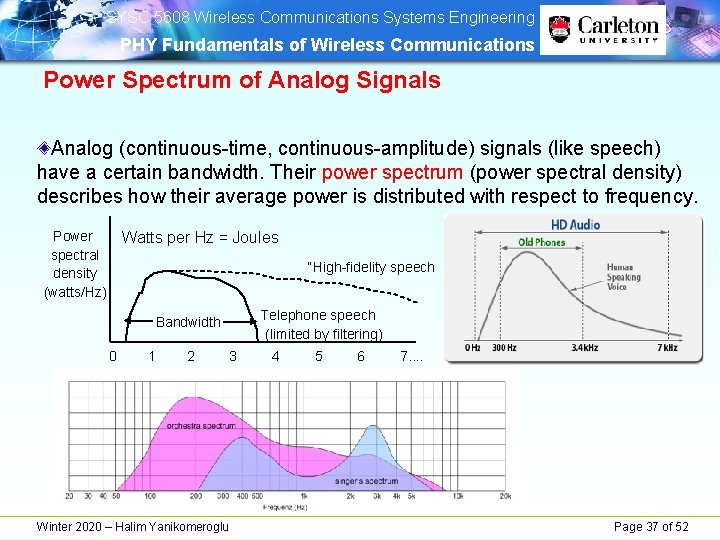
SYSC 5608 Wireless Communications Systems Engineering PHY Fundamentals of Wireless Communications Power Spectrum of Analog Signals Analog (continuous-time, continuous-amplitude) signals (like speech) have a certain bandwidth. Their power spectrum (power spectral density) describes how their average power is distributed with respect to frequency. Power spectral density (watts/Hz) Watts per Hz = Joules “High-fidelity speech Bandwidth Telephone speech (limited by filtering) 0 1 2 3 4 5 6 7. . Winter 2020 – Halim Yanikomeroglu Page 37 of 52
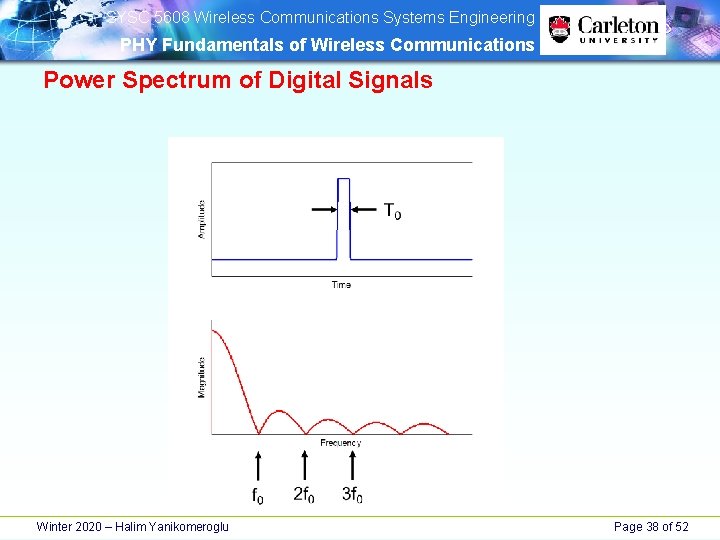
SYSC 5608 Wireless Communications Systems Engineering PHY Fundamentals of Wireless Communications Power Spectrum of Digital Signals Winter 2020 – Halim Yanikomeroglu Page 38 of 52
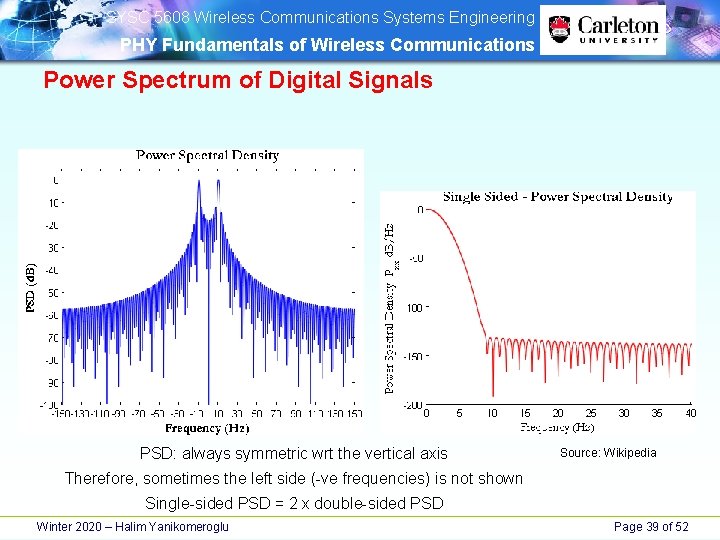
SYSC 5608 Wireless Communications Systems Engineering PHY Fundamentals of Wireless Communications Power Spectrum of Digital Signals PSD: always symmetric wrt the vertical axis Source: Wikipedia Therefore, sometimes the left side (-ve frequencies) is not shown Single-sided PSD = 2 x double-sided PSD Winter 2020 – Halim Yanikomeroglu Page 39 of 52
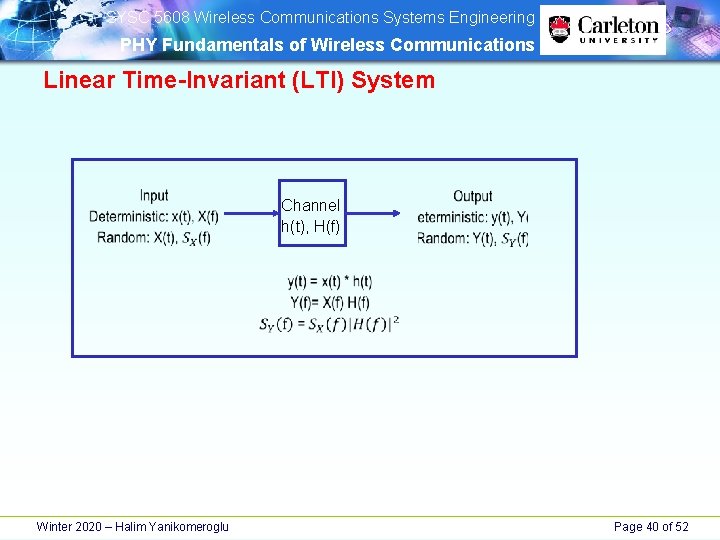
SYSC 5608 Wireless Communications Systems Engineering PHY Fundamentals of Wireless Communications Linear Time-Invariant (LTI) System Channel h(t), H(f) Winter 2020 – Halim Yanikomeroglu Page 40 of 52
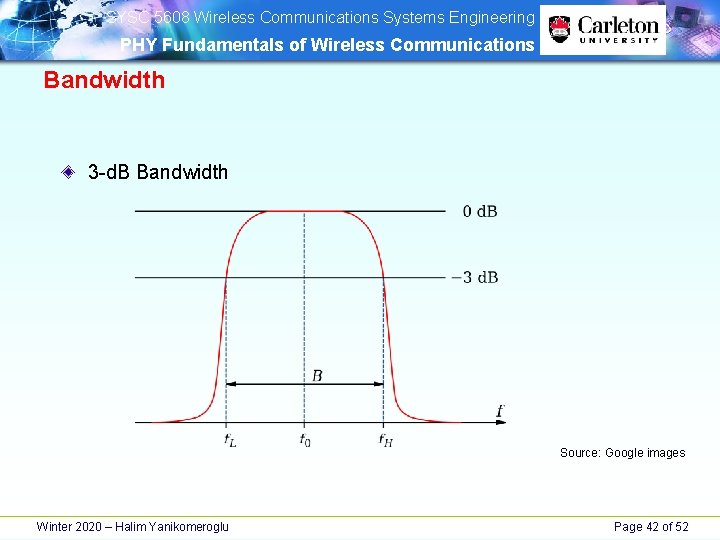
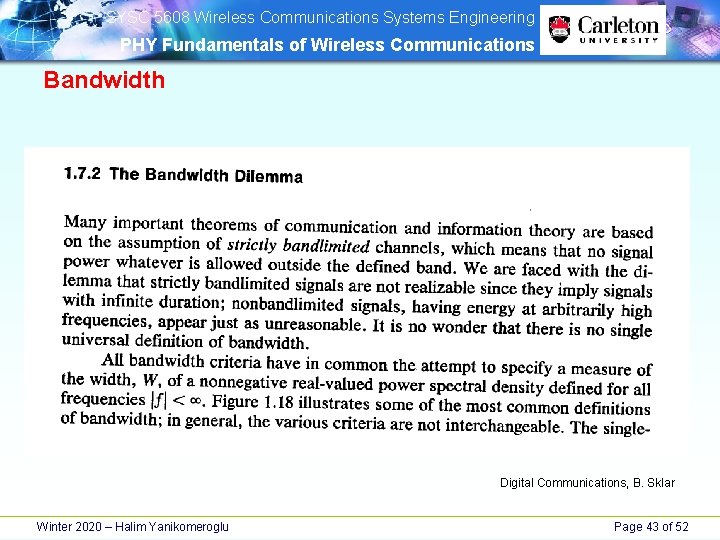
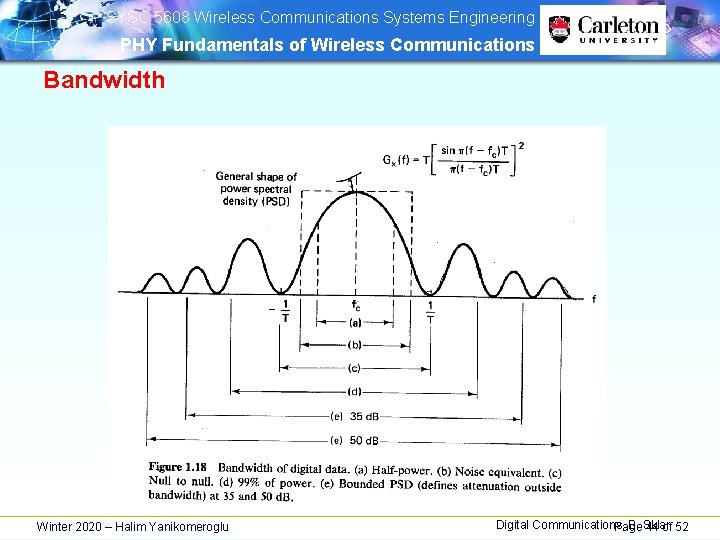
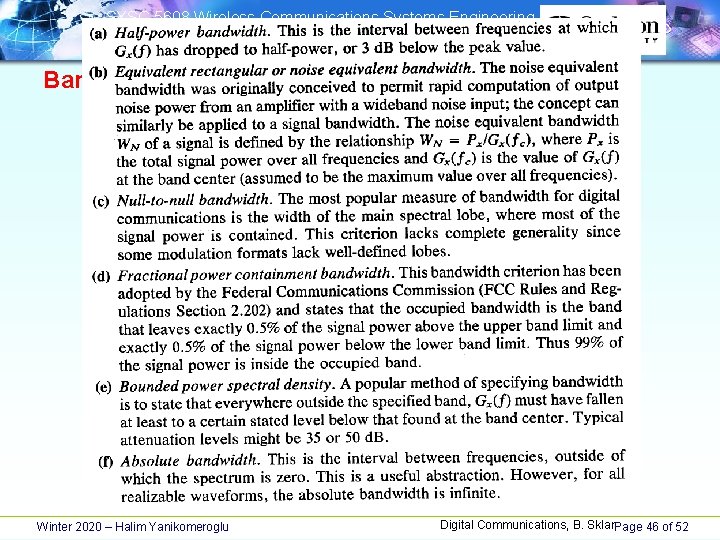
SYSC 5608 Wireless Communications Systems Engineering PHY Fundamentals of Wireless Communications Bandwidth For random signals, bandwidth is determined from the power spectral density. Bandwidth is determined only from the +ve frequencies. There are different bandwidth definitions Absolute bandwidth Y% bandwidth (for instance, 99%) X-d. B bandwidth (for instance, 3 -d. B) Null-to-null bandwidth … Winter 2020 – Halim Yanikomeroglu Page 41 of 52
SYSC 5608 Wireless Communications Systems Engineering PHY Fundamentals of Wireless Communications Bandwidth 3 -d. B Bandwidth Source: Google images Winter 2020 – Halim Yanikomeroglu Page 42 of 52
SYSC 5608 Wireless Communications Systems Engineering PHY Fundamentals of Wireless Communications Bandwidth Digital Communications, B. Sklar Winter 2020 – Halim Yanikomeroglu Page 43 of 52
SYSC 5608 Wireless Communications Systems Engineering PHY Fundamentals of Wireless Communications Bandwidth Winter 2020 – Halim Yanikomeroglu Digital Communications, B. Sklar Page 44 of 52
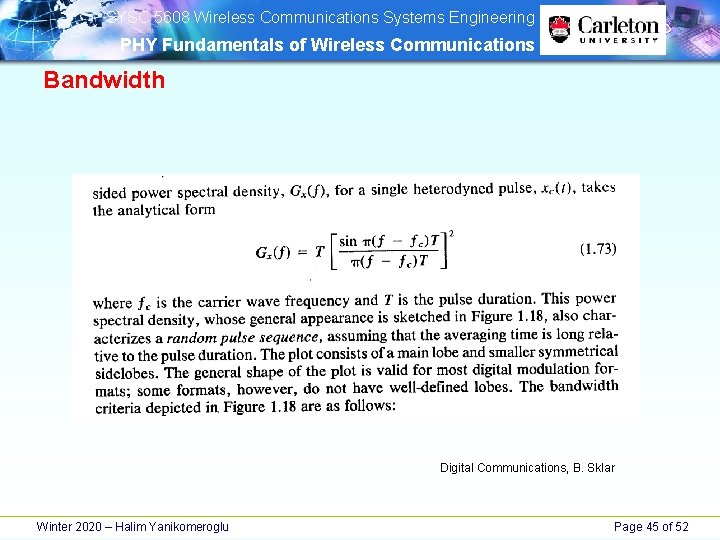
SYSC 5608 Wireless Communications Systems Engineering PHY Fundamentals of Wireless Communications Bandwidth Digital Communications, B. Sklar Winter 2020 – Halim Yanikomeroglu Page 45 of 52
SYSC 5608 Wireless Communications Systems Engineering PHY Fundamentals of Wireless Communications Bandwidth Winter 2020 – Halim Yanikomeroglu Digital Communications, B. Sklar. Page 46 of 52
SYSC 5608 Wireless Communications Systems Engineering PHY Fundamentals of Wireless Communications Channel Capacity Channel capacity, Shannon capacity, information-theoretic capacity C = log 2(1+SNR), bits per second per Hertz Non-constructive existence theorem Developments Shannon’s original formulation: 1948 Block codes, convolutional codes, … Turbo codes (1993) Low-density parity check (LDPC) codes (1963, 1996) Polar codes (2008) Winter 2020 – Halim Yanikomeroglu Page 47 of 52
SYSC 5608 Wireless Communications Systems Engineering PHY Fundamentals of Wireless Communications Bandwidth vs Rate T: Pulse duration, W: Bandwidth R: Rate R = 1/T Inverse relation between T and W Direct relation between R and W Narrow pulses (high rates) Large bandwidth Winter 2020 – Halim Yanikomeroglu Page 48 of 52
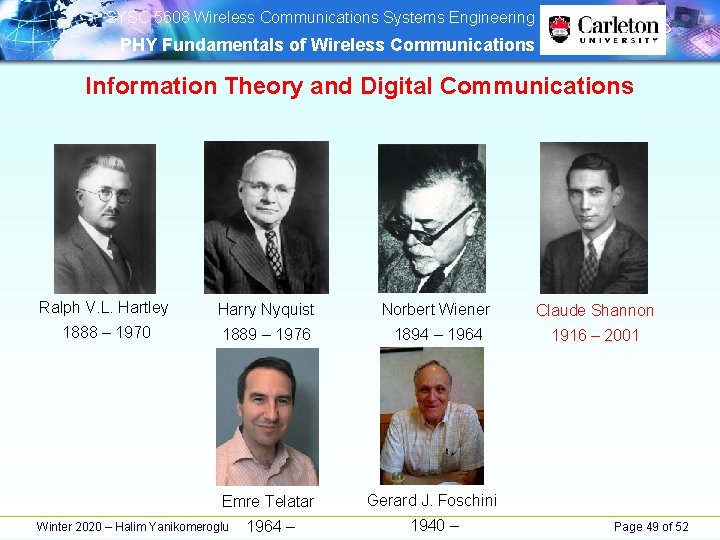
SYSC 5608 Wireless Communications Systems Engineering PHY Fundamentals of Wireless Communications Information Theory and Digital Communications Ralph V. L. Hartley Harry Nyquist Norbert Wiener Claude Shannon 1888 – 1970 1889 – 1976 1894 – 1964 1916 – 2001 Emre Telatar Gerard J. Foschini Winter 2020 – Halim Yanikomeroglu 1964 – 1940 – Page 49 of 52
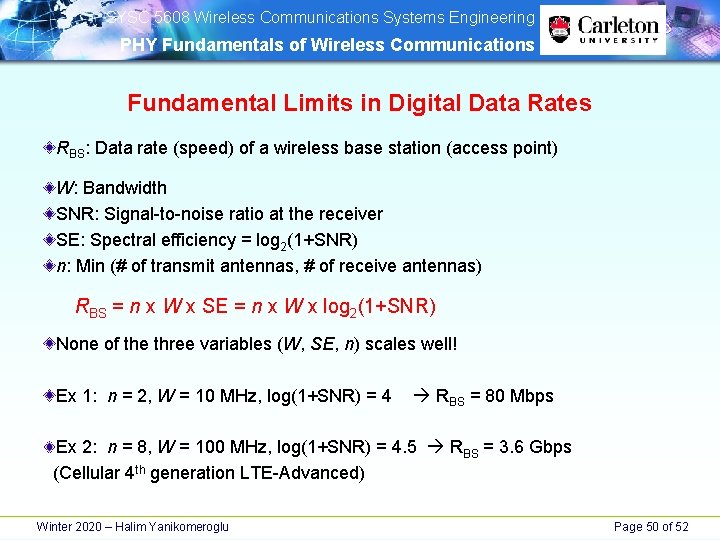
SYSC 5608 Wireless Communications Systems Engineering PHY Fundamentals of Wireless Communications Fundamental Limits in Digital Data Rates RBS: Data rate (speed) of a wireless base station (access point) W: Bandwidth SNR: Signal-to-noise ratio at the receiver SE: Spectral efficiency = log 2(1+SNR) n: Min (# of transmit antennas, # of receive antennas) RBS = n x W x SE = n x W x log 2(1+SNR) None of the three variables (W, SE, n) scales well! Ex 1: n = 2, W = 10 MHz, log(1+SNR) = 4 RBS = 80 Mbps Ex 2: n = 8, W = 100 MHz, log(1+SNR) = 4. 5 RBS = 3. 6 Gbps (Cellular 4 th generation LTE-Advanced) Winter 2020 – Halim Yanikomeroglu Page 50 of 52
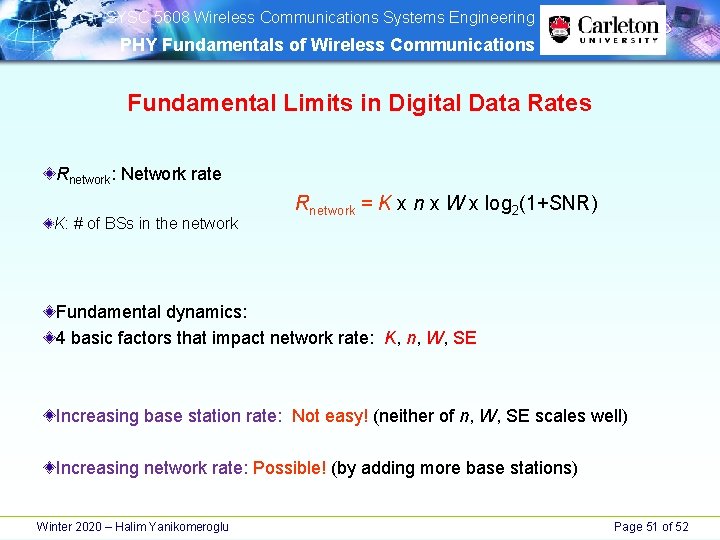
SYSC 5608 Wireless Communications Systems Engineering PHY Fundamentals of Wireless Communications Fundamental Limits in Digital Data Rates Rnetwork: Network rate K: # of BSs in the network Rnetwork = K x n x W x log 2(1+SNR) Fundamental dynamics: 4 basic factors that impact network rate: K, n, W, SE Increasing base station rate: Not easy! (neither of n, W, SE scales well) Increasing network rate: Possible! (by adding more base stations) Winter 2020 – Halim Yanikomeroglu Page 51 of 52
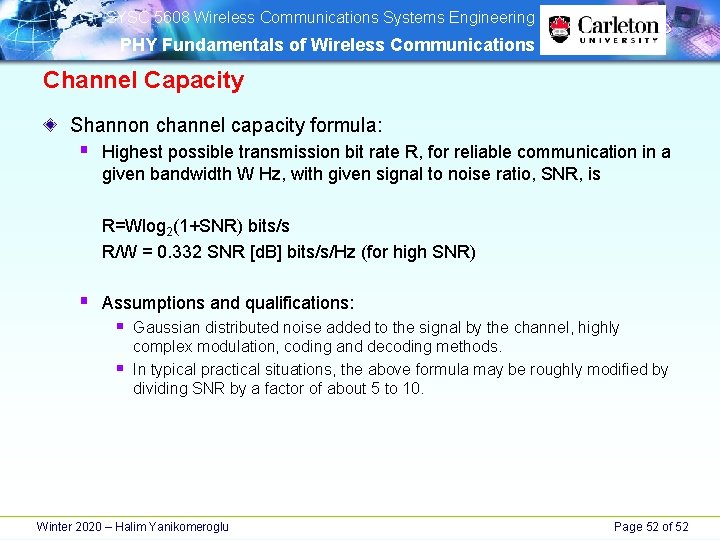
SYSC 5608 Wireless Communications Systems Engineering PHY Fundamentals of Wireless Communications Channel Capacity Shannon channel capacity formula: § Highest possible transmission bit rate R, for reliable communication in a given bandwidth W Hz, with given signal to noise ratio, SNR, is R=Wlog 2(1+SNR) bits/s R/W = 0. 332 SNR [d. B] bits/s/Hz (for high SNR) § Assumptions and qualifications: § Gaussian distributed noise added to the signal by the channel, highly § complex modulation, coding and decoding methods. In typical practical situations, the above formula may be roughly modified by dividing SNR by a factor of about 5 to 10. Winter 2020 – Halim Yanikomeroglu Page 52 of 52