
SYPHILIS Syphilis Causative organism Treponema palladium Staining methods


- Slides: 19
SYPHILIS
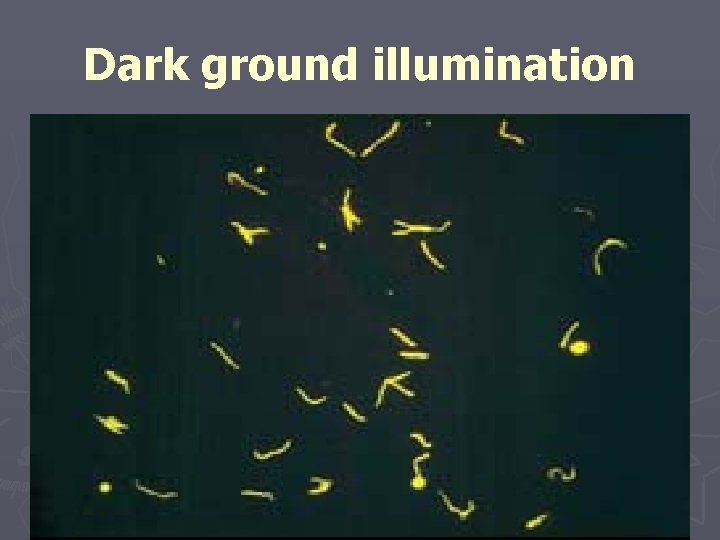
Syphilis Causative organism ► Treponema palladium Staining methods ► Dark ground illumination ► Flourescent antibody techniques ► Silver impregnation techniques
Dark ground illumination
Immunology ► Wasserman antibodies wassermann complement fixing test veneral disease research laboratory (VDRL) test ► Treponemal antibodies Reiter protein complement fixation test (RPCF) Treponema pallidum immobilisation test (TPI) Florescent treponemal antibody test (FTA) Treponemal passive haemagglutination test (TPHA)
Mode of tranmission ► Sexual transmission ► Intimate contact ► Blood transfusion ► Materno foetal transmission
Stages of syphilis ► Acquired syphilis ► Congenital syphilis
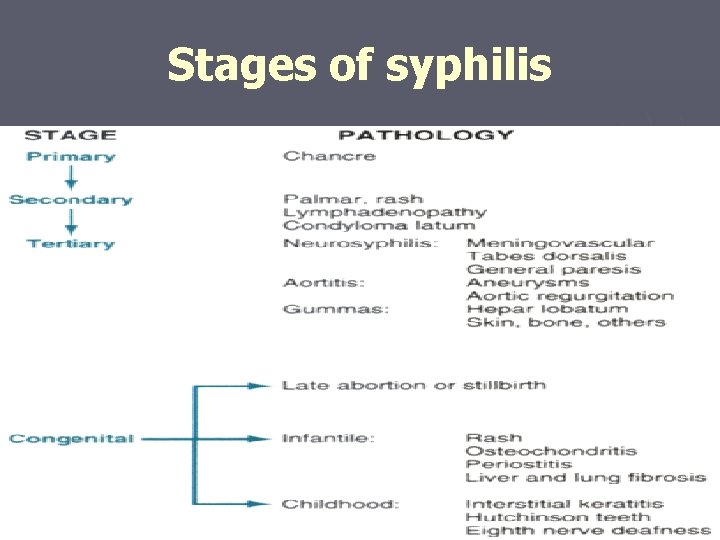
Stages of syphilis
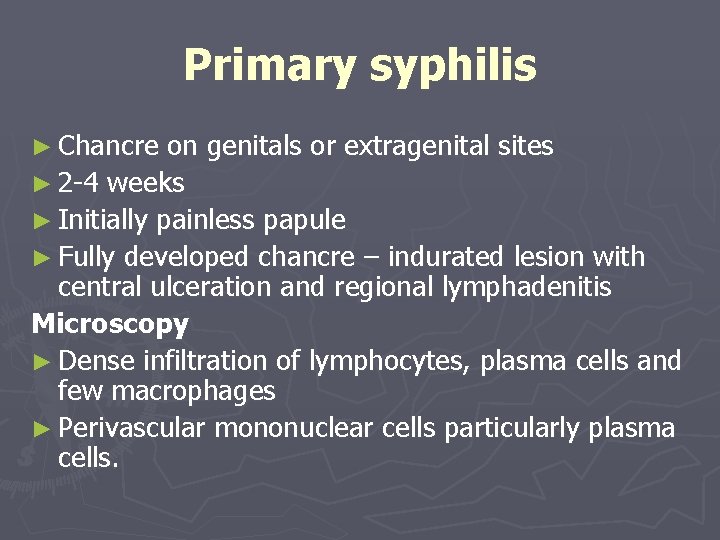
Primary syphilis ► Chancre on genitals or extragenital sites ► 2 -4 weeks ► Initially painless papule ► Fully developed chancre – indurated lesion with central ulceration and regional lymphadenitis Microscopy ► Dense infiltration of lymphocytes, plasma cells and few macrophages ► Perivascular mononuclear cells particularly plasma cells.
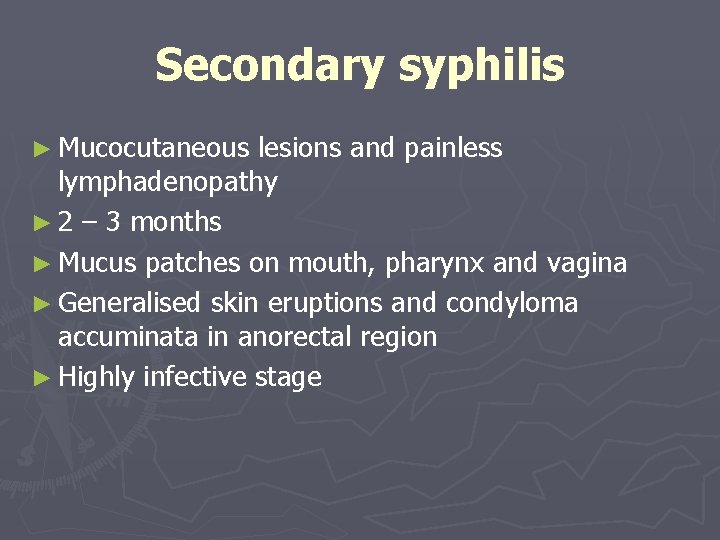
Secondary syphilis ► Mucocutaneous lesions and painless lymphadenopathy ► 2 – 3 months ► Mucus patches on mouth, pharynx and vagina ► Generalised skin eruptions and condyloma accuminata in anorectal region ► Highly infective stage
Tertiary syphilis ► After latent period of secondary lesions ► 2 – 3 years 2 types ► Syphilitic gumma ► Diffuse lesions of tertiary syphilis
1. Syphilitic gumma ► Solitary localised rubbery lesions with central necrosis ► Liver, testis, bone and brain ► In liver, the gumma is associated with scarring of hepatic parenchyma (hepar lobatum) Microscopy ► Gumma – central coagulative necrosis, surrounding zone of palisaded macrophages with lymphocytes, plasma cells giant cells and fibroblasts
2. Diffuse lesions of tertiary syphilis ► CVS and CNS 2 types ► Cardiovascular syphilis ► Neurosyphilis
A. Cardiovascular syphilis ► Thoracic aorta ► Wall of aorta are weakened and dilated, resulting in aortic aneurysm, incompetence of aortic valve and narrowing of coronary ostia
B. Neurosyphilis ► Meningovascular syphilis affecting meninges ► Tabes dorsalis affecting spinal cord ► General paresis affecting brain
Congenital syphilis ► Develop in foetus of more than 16 weeks of gestation 3 types ► Child born dead ► Child born alive ► Late type
1. Child born dead ► Child is premature with macerated skin, enlarged spleen and liver and with syphilitc epiphysitis
2. Child born alive ► Mucocutaneous lesions of acquired secondary syphilis ► Bony lesions like epiphysitis and periostitis ► Bridge of nose may fall due to ulceration and destruction (saddle nose)
3. Late type ► Appear after some years ► Hucthinson’s teeth – Small widely spaced peg-shaped permenant teeth. ► Tertiary lesions like gumma and neurosyphilis Microscopy ► Mononuclear infiltration in most internal organs
THANK YOU