
Syphilis By Prof Dr Ghada Fahmy Helaly Microbiology
Syphilis By: Prof. Dr. Ghada Fahmy Helaly Microbiology & Immunology Department Faculty of Medicine Mu’tah University Prof. Dr. Ghada Fahmy Helaly GUS Module
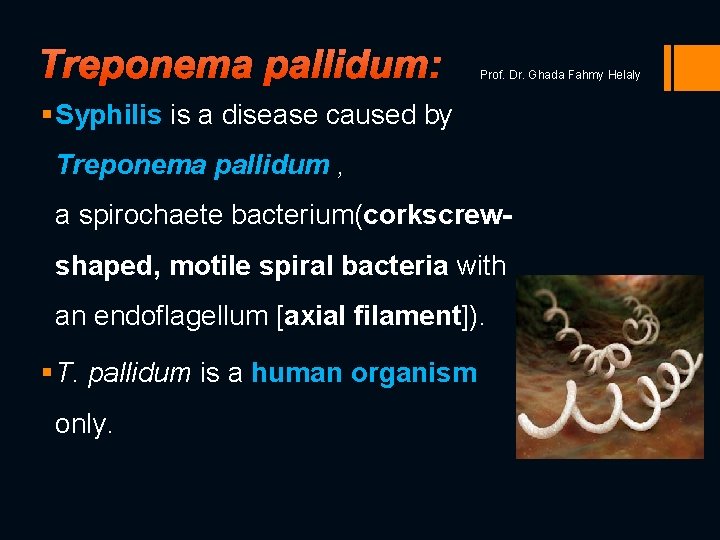
Treponema pallidum: Prof. Dr. Ghada Fahmy Helaly § Syphilis is a disease caused by Treponema pallidum , a spirochaete bacterium(corkscrewshaped, motile spiral bacteria with an endoflagellum [axial filament]). § T. pallidum is a human organism only.
Prof. Dr. Ghada Fahmy Helaly § T. pallidum has not been grown on bacteriologic media or in cell culture. § Syphilis occurs worldwide. § Marked increase in incidence of the disease in homosexual men in recent years.
Prof. Dr. Ghada Fahmy Helaly Transmission : Sexual contact: from spirochete-containing lesions of skin or mucous membranes. From pregnant women to their fetuses. Rarely, blood for transfusions (early syphilis).
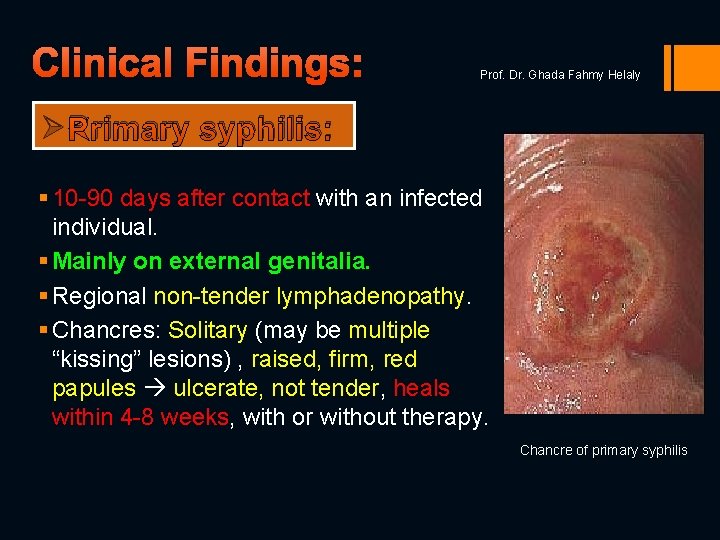
Clinical Findings: Prof. Dr. Ghada Fahmy Helaly Ø Primary syphilis: § 10 -90 days after contact with an infected individual. § Mainly on external genitalia. § Regional non-tender lymphadenopathy. § Chancres: Solitary (may be multiple “kissing” lesions) , raised, firm, red papules ulcerate, not tender, heals within 4 -8 weeks, with or without therapy. Chancre of primary syphilis
Ø Secondary syphilis: Prof. Dr. Ghada Fahmy Helaly § One to 3 months later. § Lesions are rich in spirochetes and highly infectious. § Maculopapular rash (including palms and soles) § Moist lesions on the genitals “condylomata lata” § Patchy alopecia. § Constitutional symptoms of secondary syphilis: fever, …… § Meningitis, hepatitis, nephropathy, …. .
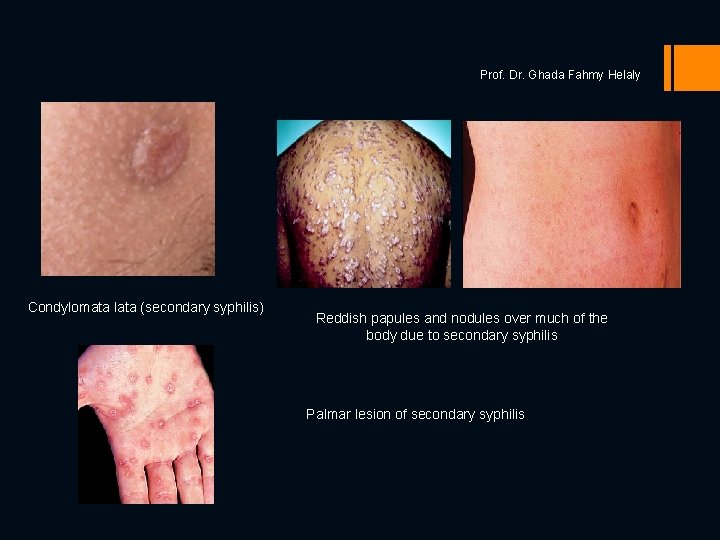
Prof. Dr. Ghada Fahmy Helaly Condylomata lata (secondary syphilis) Reddish papules and nodules over much of the body due to secondary syphilis Palmar lesion of secondary syphilis
Ø Latent syphilis: Prof. Dr. Ghada Fahmy Helaly § Few years to as many as 25 years. § No lesions appear, positive serologic tests. § latent period divided into early and late stages. v Early latent: last for a year or 2 after the secondary stage the symptoms of secondary syphilis may reappear (infectious). v Late latent: last for many years: No symptoms, not infectious.
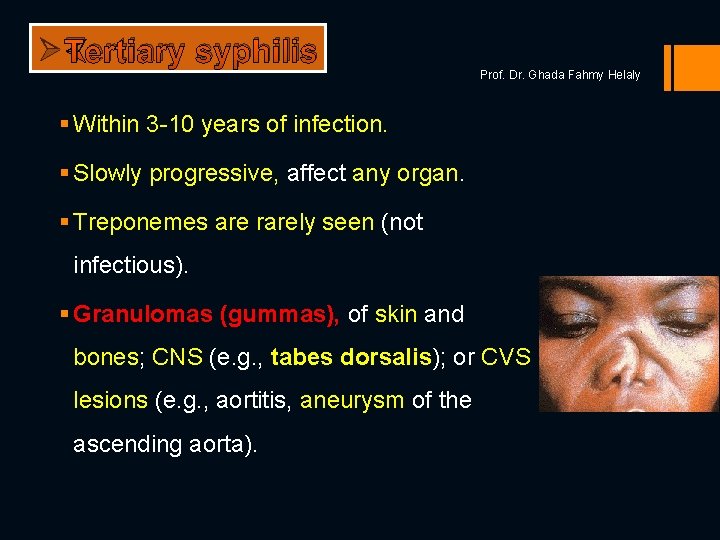
Ø Tertiary syphilis Prof. Dr. Ghada Fahmy Helaly § Within 3 -10 years of infection. § Slowly progressive, affect any organ. § Treponemes are rarely seen (not infectious). § Granulomas (gummas), of skin and bones; CNS (e. g. , tabes dorsalis); or CVS lesions (e. g. , aortitis, aneurysm of the ascending aorta).
Ø Congenital syphilis: Prof. Dr. Ghada Fahmy Helaly § Transmitted across the placenta. § Infected neonates (early): abortion, stillbirth, birth defects, or latent infection (most common) with snuffles (rhinitis) followed by a rash and desquamation. § After age 2 years (late): hearing, language development and vision problems, facial and dental abnormalities. Immunity: § Antibodies do not stop the progression of the disease. § Patients can contract syphilis again.
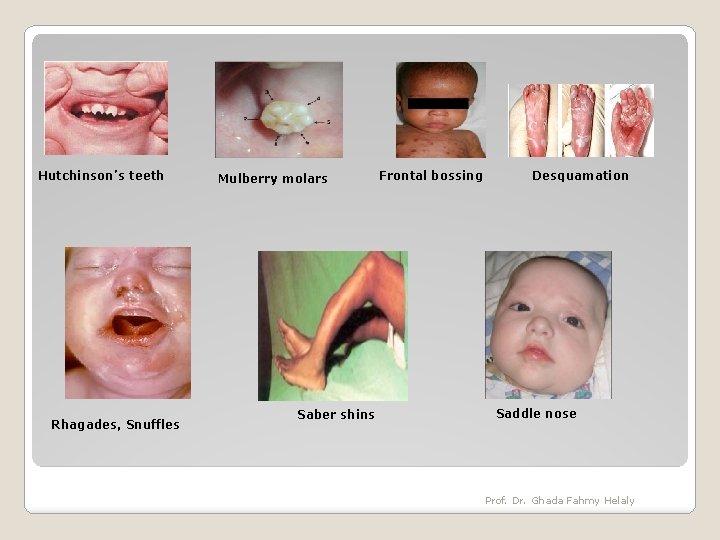
Hutchinson’s teeth Rhagades, Snuffles Mulberry molars Saber shins Frontal bossing Desquamation Saddle nose Prof. Dr. Ghada Fahmy Helaly
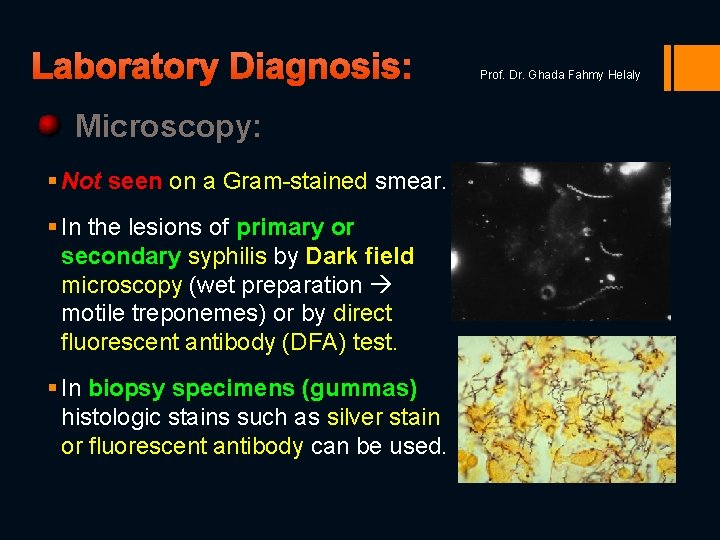
Laboratory Diagnosis: Microscopy: § Not seen on a Gram-stained smear. § In the lesions of primary or secondary syphilis by Dark field microscopy (wet preparation motile treponemes) or by direct fluorescent antibody (DFA) test. § In biopsy specimens (gummas) histologic stains such as silver stain or fluorescent antibody can be used. Prof. Dr. Ghada Fahmy Helaly
Prof. Dr. Ghada Fahmy Helaly Nonspecific Serologic Tests: § Inexpensive and easy screening. § Venereal Disease Research Laboratory [VDRL] and rapid plasma reagin [RPR] tests) § Non-treponemal antigens, Cardiolipin (from beef heart) which react with antibodies “reagin” in serum. § Decline with effective treatment, in contrast to the specific antibodies, which are positive for life.
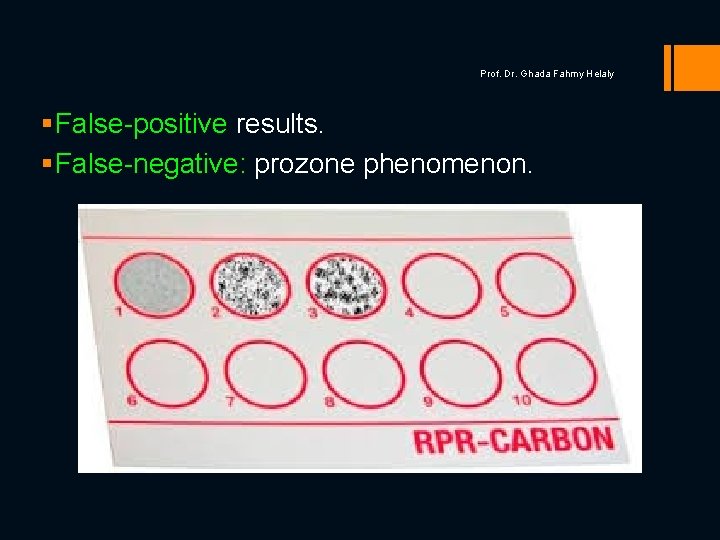
Prof. Dr. Ghada Fahmy Helaly § False-positive results. § False-negative: prozone phenomenon.
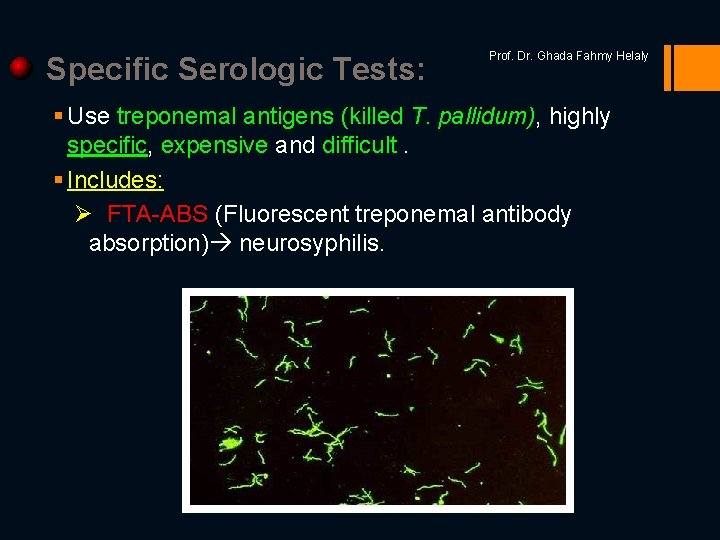
Specific Serologic Tests: Prof. Dr. Ghada Fahmy Helaly § Use treponemal antigens (killed T. pallidum), highly specific, expensive and difficult. § Includes: Ø FTA-ABS (Fluorescent treponemal antibody absorption) neurosyphilis.
Prof. Dr. Ghada Fahmy Helaly Ø TP-PA (T. pallidum particle agglutination assay). Ø MHA-TP (Micro-hemagglutination assay). Ø Immunoassays (AIA)- for screening purposes. § Molecular testing ( PCR detects the genetic material from the sore, in blood, or in CSF).
Treatment: Prof. Dr. Ghada Fahmy Helaly § Long-lasting penicillin. § Treatment of secondary syphilis may trigger the Jarisch. Herxheimer reaction immediately after antibiotic therapy. Prevention: § Early diagnosis and adequate treatment. § Use of condoms. § Antibiotic after suspected exposure. § Follow-up of infected individuals and their contacts. § STD test for syphilis.
h T k n a u o y Prof. Dr. Ghada Fahmy Helaly
- Slides: 18