
Synthetic Sequence Design for Signal Location YawLing Lin



- Slides: 27
Synthetic Sequence Design for Signal Location Yaw-Ling Lin ( 林 耀 鈴 ) Dept Computer Sci and Info Engineering College of Computing and Informatics Providence University, Taiwan E-mail: yllin@pu. edu. tw http: //www. cs. pu. edu. tw/~yawlin 2020/10/26 Synthetic Design for Signal Location 1
Outline • Motivation • Introduction • • • 2020/10/26 Terminology Definition Signal location search Group testing designs Adjacent levels of the Hasse diagram Suggested Designations Conclusion Synthetic Design for Signal Location 2
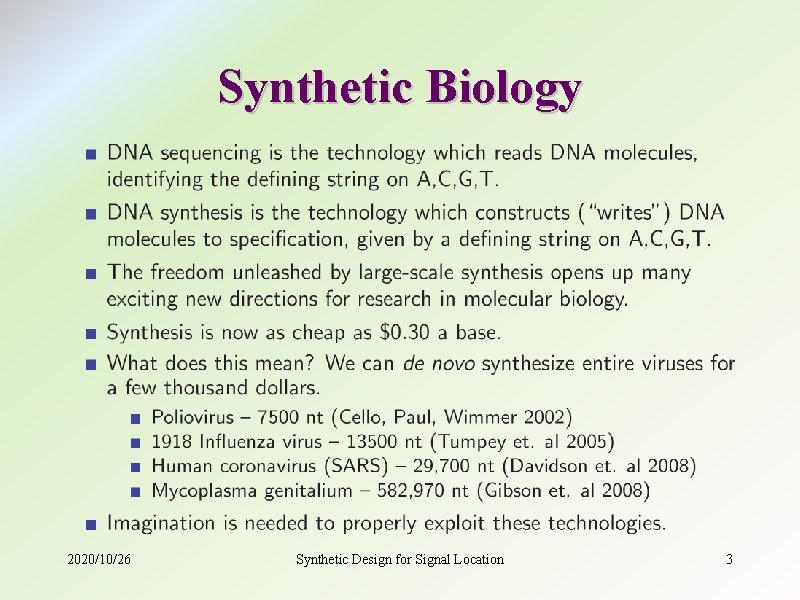
Synthetic Biology 2020/10/26 Synthetic Design for Signal Location 3
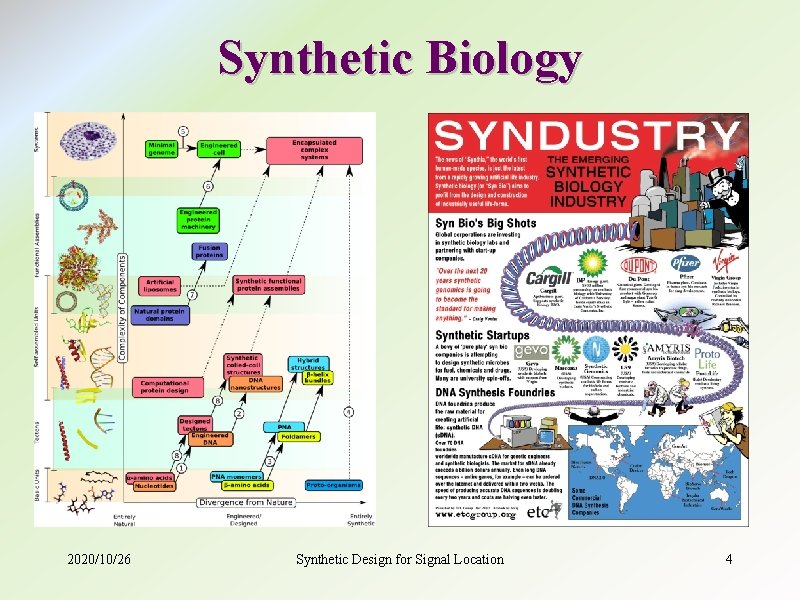
Synthetic Biology 2020/10/26 Synthetic Design for Signal Location 4
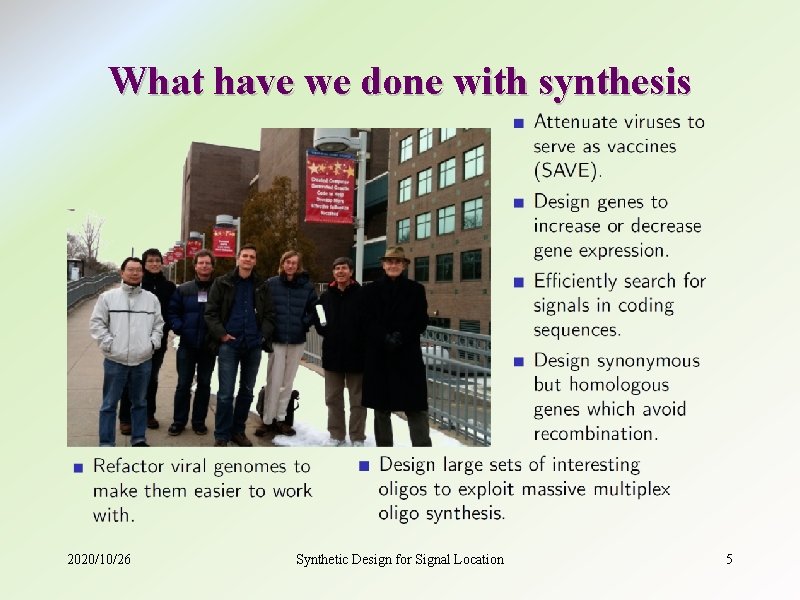
What have we done with synthesis 2020/10/26 Synthetic Design for Signal Location 5
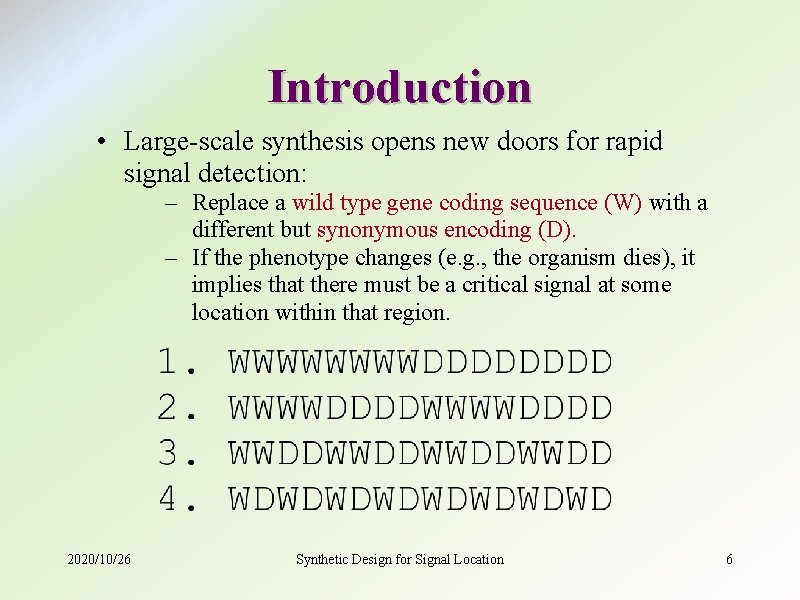
Introduction • Large-scale synthesis opens new doors for rapid signal detection: – Replace a wild type gene coding sequence (W) with a different but synonymous encoding (D). – If the phenotype changes (e. g. , the organism dies), it implies that there must be a critical signal at some location within that region. 2020/10/26 Synthetic Design for Signal Location 6
Contribution • A Group-Testing Approach for Biological Signal Location. • Group Testing for Expensive Pools. • Improved Designs for Consecutive Positive Group Testing. • Middle-Levels Conjecture Equivalence. • Web link: http: //www. algorithm. cs. sunysb. edu/signal. Search. 2020/10/26 Synthetic Design for Signal Location 7
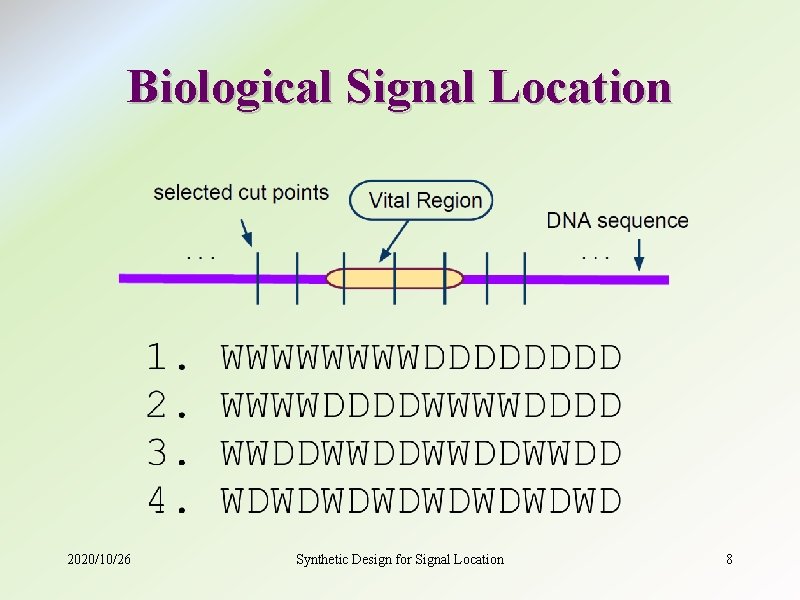
Biological Signal Location 2020/10/26 Synthetic Design for Signal Location 8
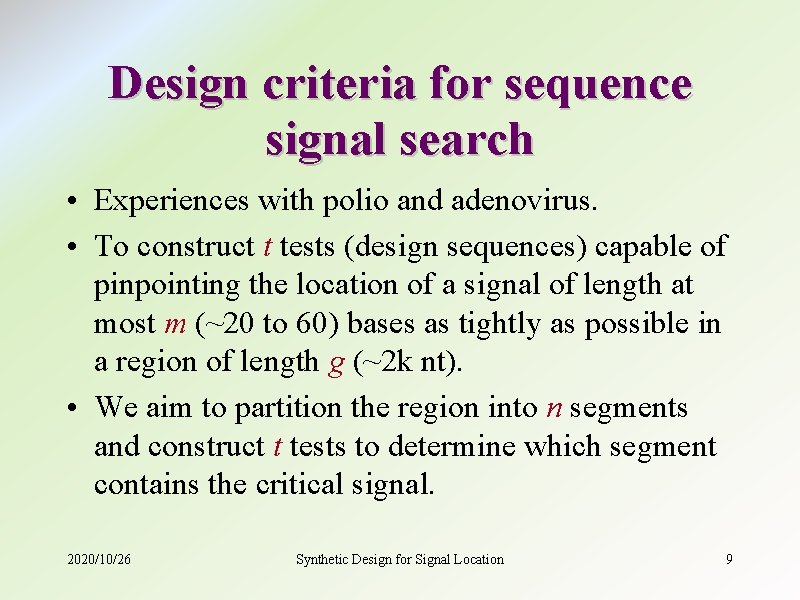
Design criteria for sequence signal search • Experiences with polio and adenovirus. • To construct t tests (design sequences) capable of pinpointing the location of a signal of length at most m (~20 to 60) bases as tightly as possible in a region of length g (~2 k nt). • We aim to partition the region into n segments and construct t tests to determine which segment contains the critical signal. 2020/10/26 Synthetic Design for Signal Location 9
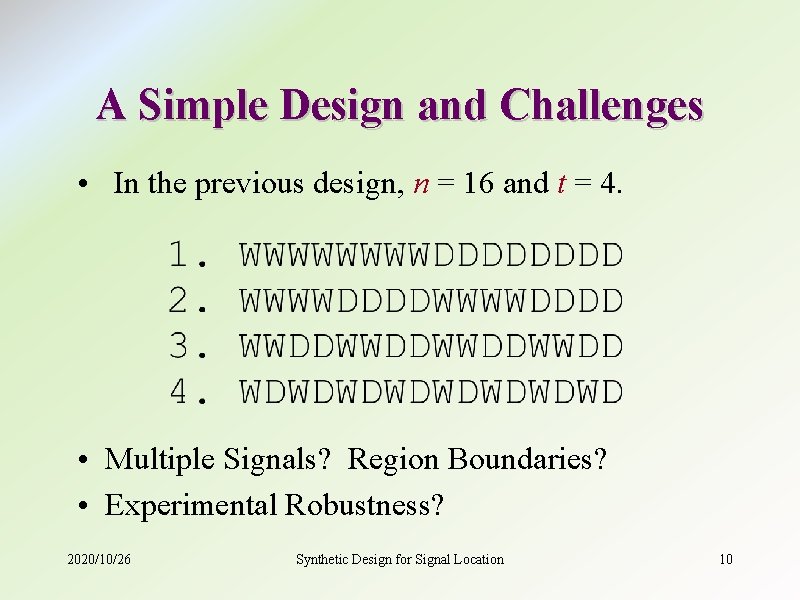
A Simple Design and Challenges • In the previous design, n = 16 and t = 4. • Multiple Signals? Region Boundaries? • Experimental Robustness? 2020/10/26 Synthetic Design for Signal Location 10
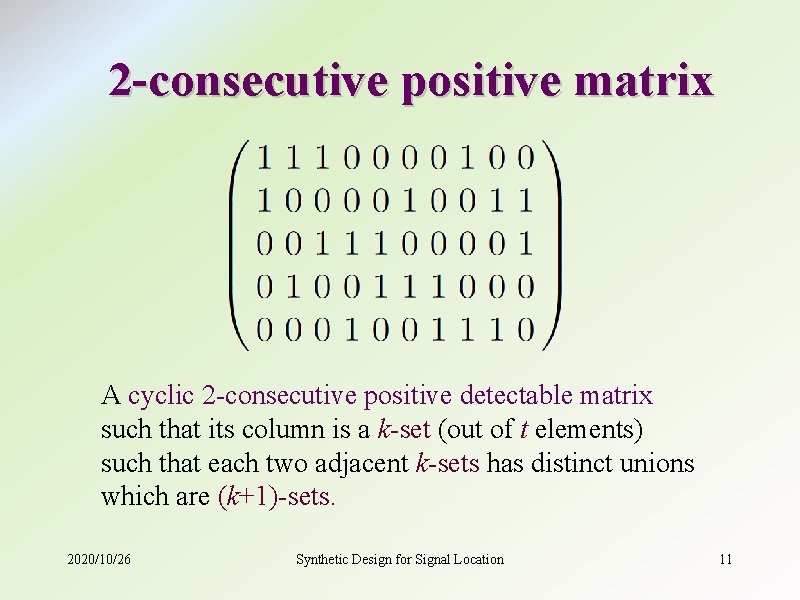
2 -consecutive positive matrix A cyclic 2 -consecutive positive detectable matrix such that its column is a k-set (out of t elements) such that each two adjacent k-sets has distinct unions which are (k+1)-sets. 2020/10/26 Synthetic Design for Signal Location 11
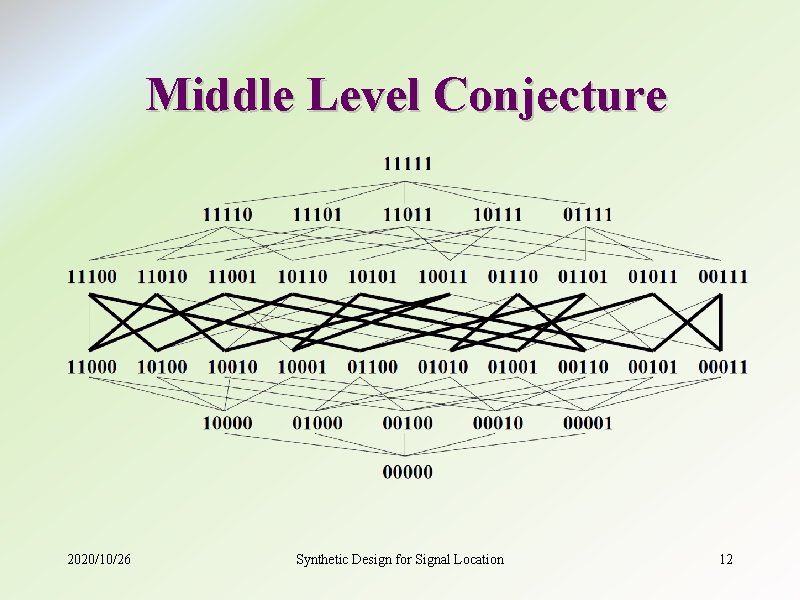
Middle Level Conjecture 2020/10/26 Synthetic Design for Signal Location 12
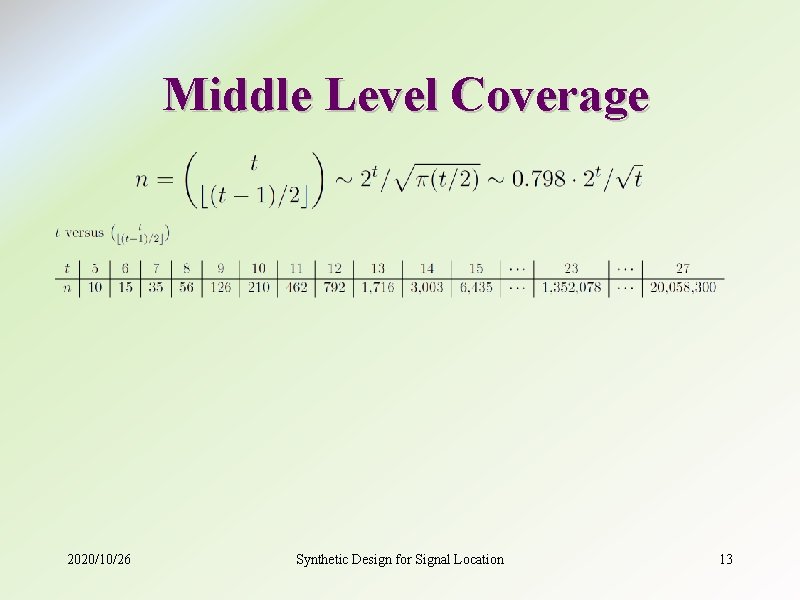
Middle Level Coverage 2020/10/26 Synthetic Design for Signal Location 13
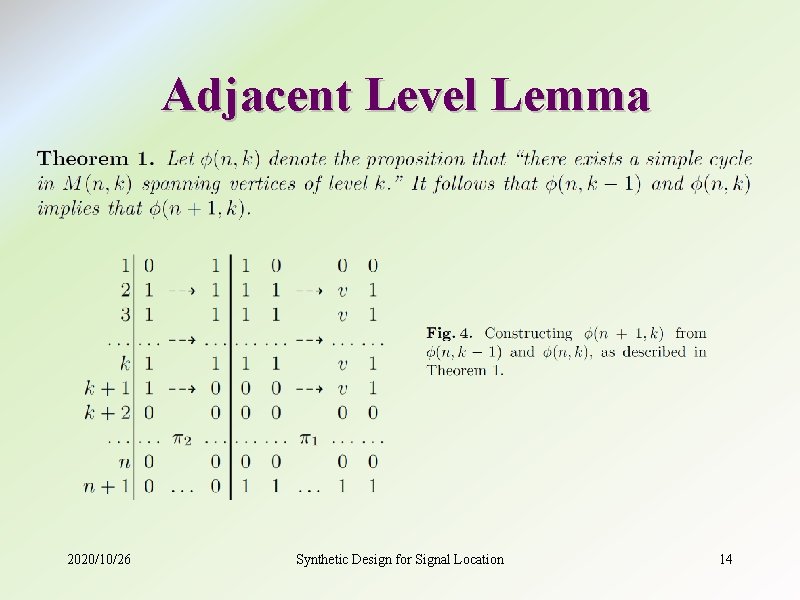
Adjacent Level Lemma 2020/10/26 Synthetic Design for Signal Location 14
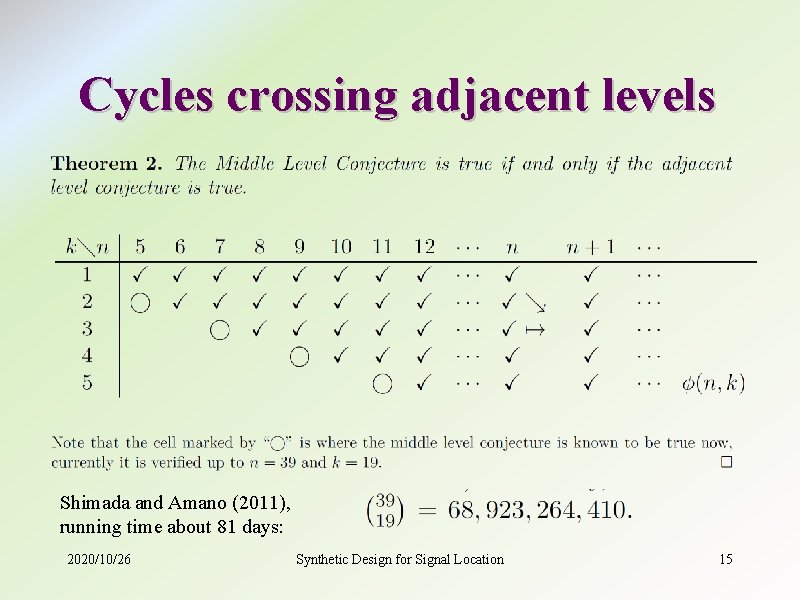
Cycles crossing adjacent levels Shimada and Amano (2011), running time about 81 days: 2020/10/26 Synthetic Design for Signal Location 15
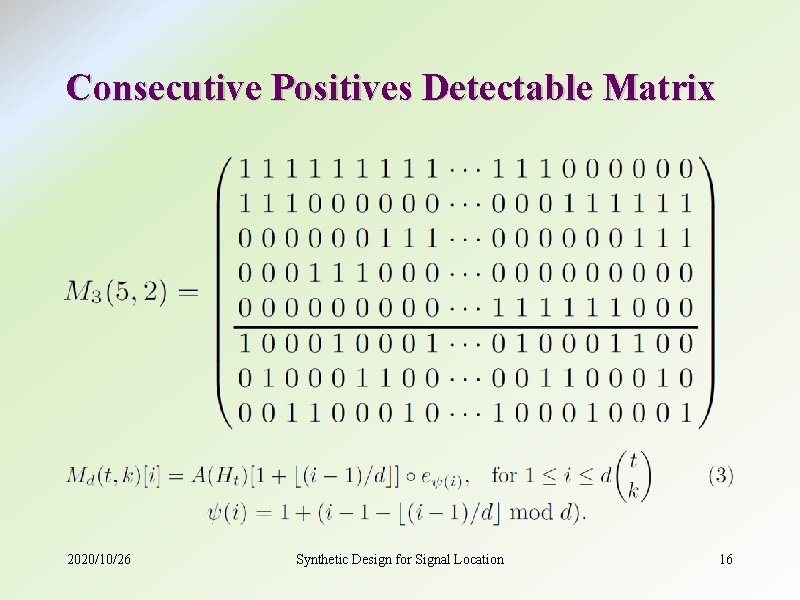
Consecutive Positives Detectable Matrix 2020/10/26 Synthetic Design for Signal Location 16
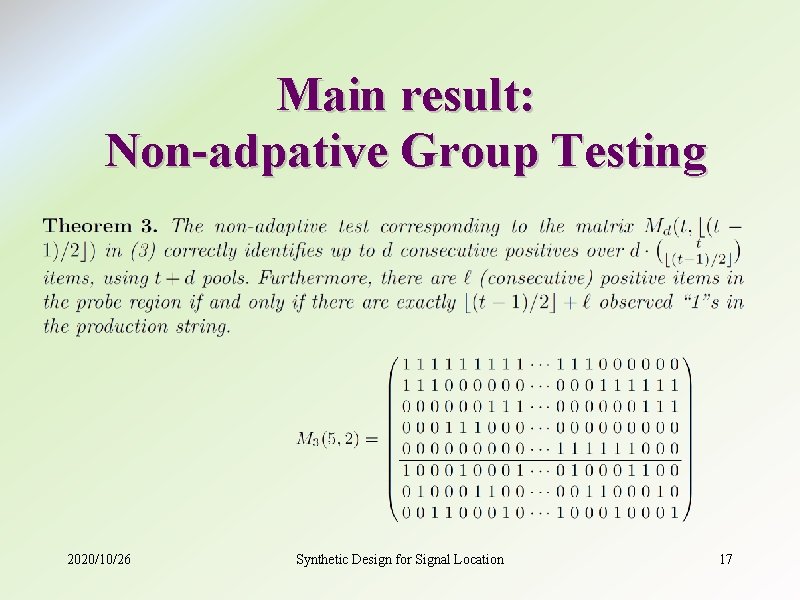
Main result: Non-adpative Group Testing 2020/10/26 Synthetic Design for Signal Location 17
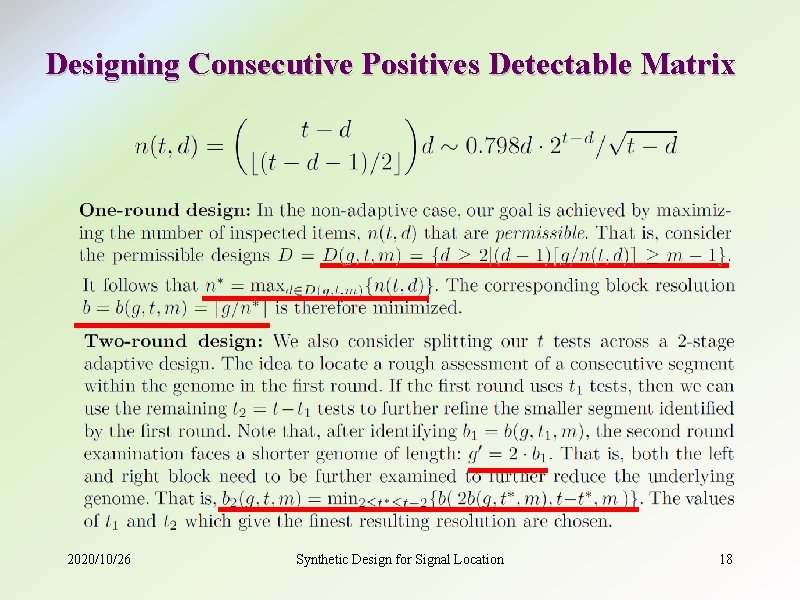
Designing Consecutive Positives Detectable Matrix 2020/10/26 Synthetic Design for Signal Location 18
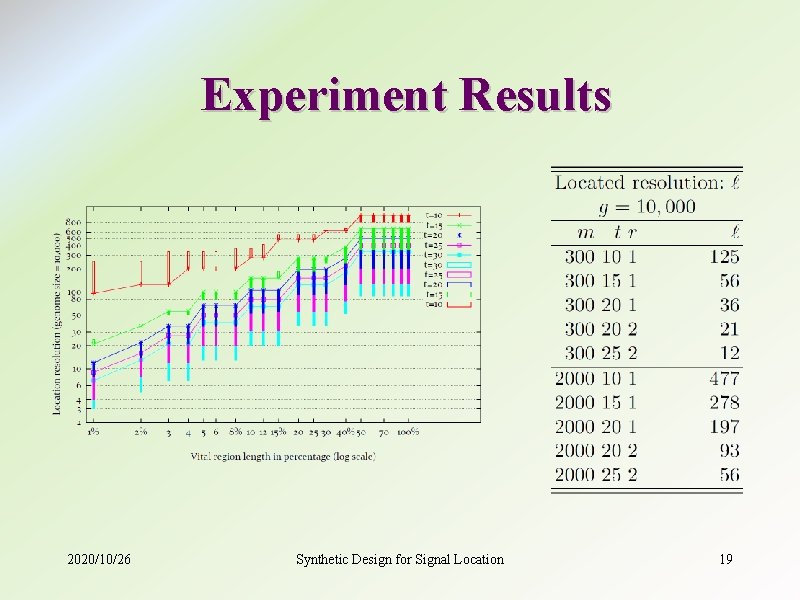
Experiment Results 2020/10/26 Synthetic Design for Signal Location 19
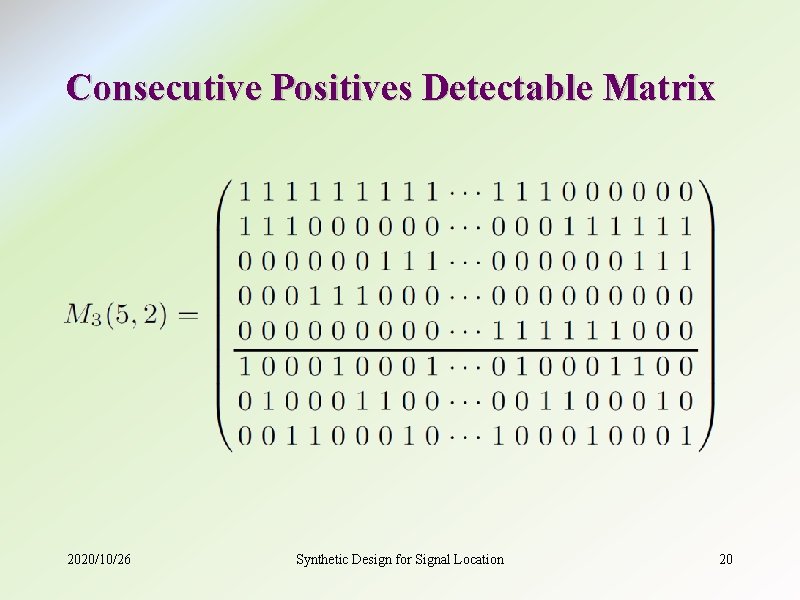
Consecutive Positives Detectable Matrix 2020/10/26 Synthetic Design for Signal Location 20
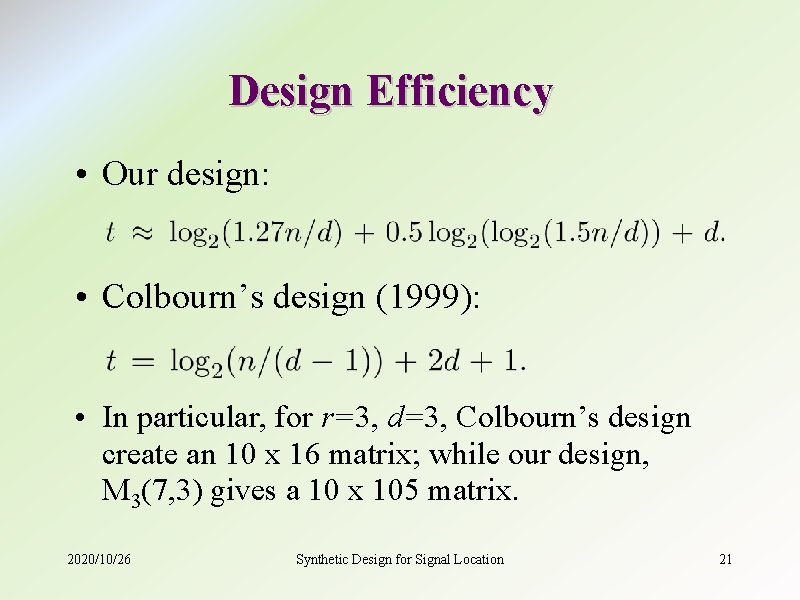
Design Efficiency • Our design: • Colbourn’s design (1999): • In particular, for r=3, d=3, Colbourn’s design create an 10 x 16 matrix; while our design, M 3(7, 3) gives a 10 x 105 matrix. 2020/10/26 Synthetic Design for Signal Location 21
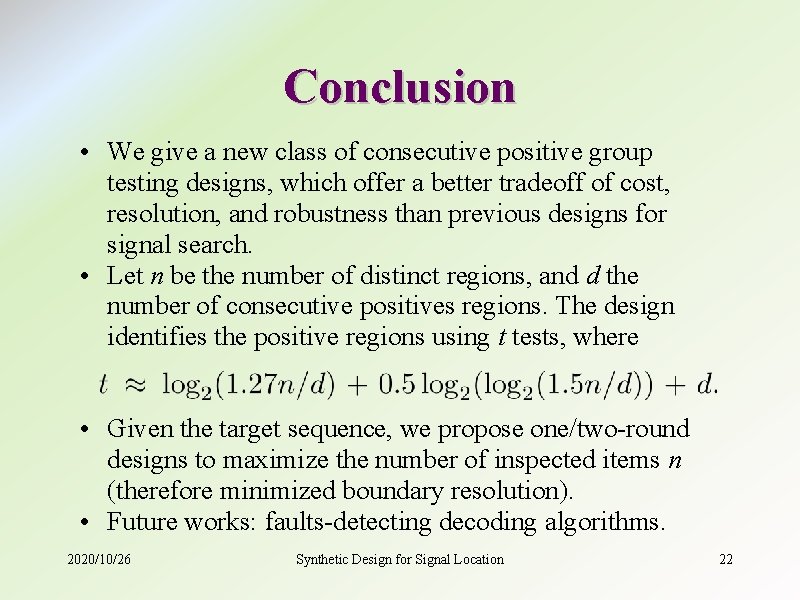
Conclusion • We give a new class of consecutive positive group testing designs, which offer a better tradeoff of cost, resolution, and robustness than previous designs for signal search. • Let n be the number of distinct regions, and d the number of consecutive positives regions. The design identifies the positive regions using t tests, where • Given the target sequence, we propose one/two-round designs to maximize the number of inspected items n (therefore minimized boundary resolution). • Future works: faults-detecting decoding algorithms. 2020/10/26 Synthetic Design for Signal Location 22
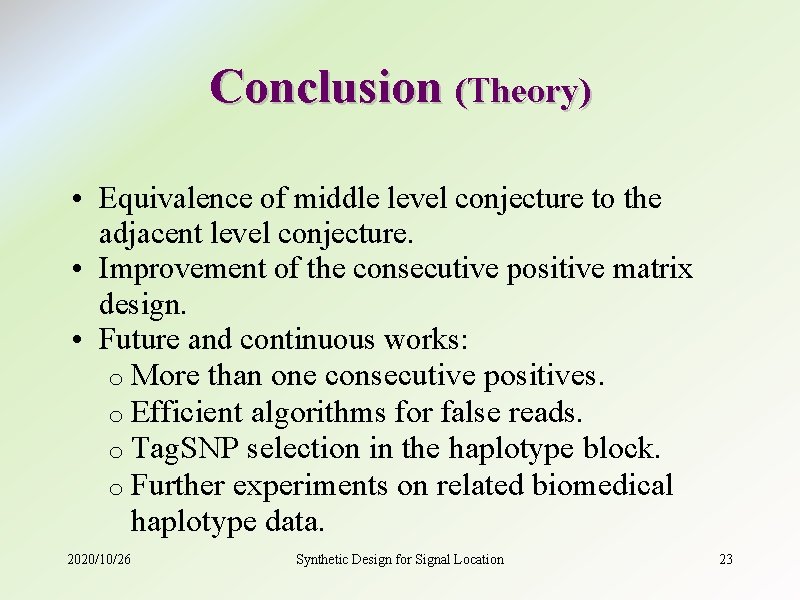
Conclusion (Theory) • Equivalence of middle level conjecture to the adjacent level conjecture. • Improvement of the consecutive positive matrix design. • Future and continuous works: o More than one consecutive positives. o Efficient algorithms for false reads. o Tag. SNP selection in the haplotype block. o Further experiments on related biomedical haplotype data. 2020/10/26 Synthetic Design for Signal Location 23
Thank You! Any Question? 2020/10/26 Synthetic Design for Signal Location 24
2020/10/26 Synthetic Design for Signal Location 25
Thank you. Q&A 2020/10/26 Synthetic Design for Signal Location 26
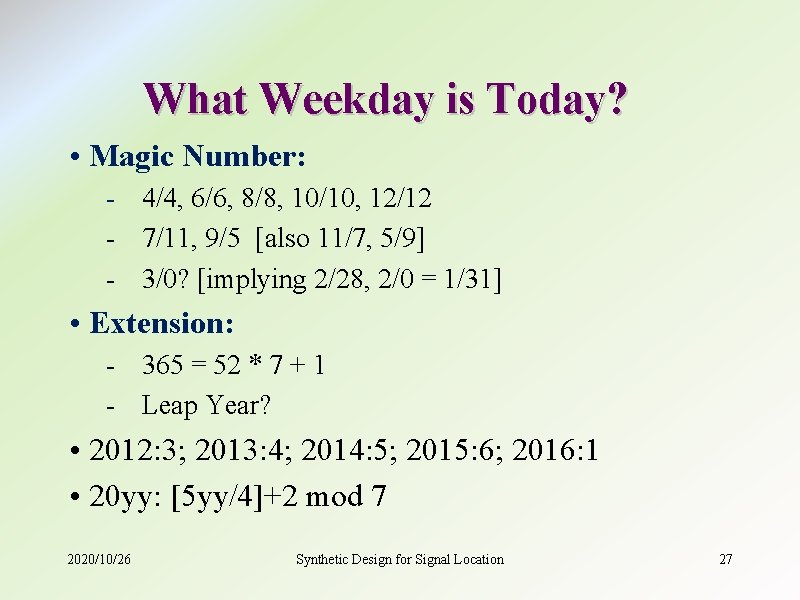
What Weekday is Today? • Magic Number: - 4/4, 6/6, 8/8, 10/10, 12/12 - 7/11, 9/5 [also 11/7, 5/9] - 3/0? [implying 2/28, 2/0 = 1/31] • Extension: - 365 = 52 * 7 + 1 - Leap Year? • 2012: 3; 2013: 4; 2014: 5; 2015: 6; 2016: 1 • 20 yy: [5 yy/4]+2 mod 7 2020/10/26 Synthetic Design for Signal Location 27