
Synthetic Phonics Putting together unfamiliar words by translating
Synthetic Phonics Putting together unfamiliar words by translating letters into sounds and blending them together : synthesising)

Basic Phonics PHONEME – sound GRAPHEME-letter that represents the sound GPC – grapheme phoneme correspondence: letters that match the sound 1 letter – p 2 letters – sh 3 letters – tch 4 letters – ough Diagraph – 2 letters that make one sound e. g. th, ai, ie, or Trigraph – 3 letters that make one sound
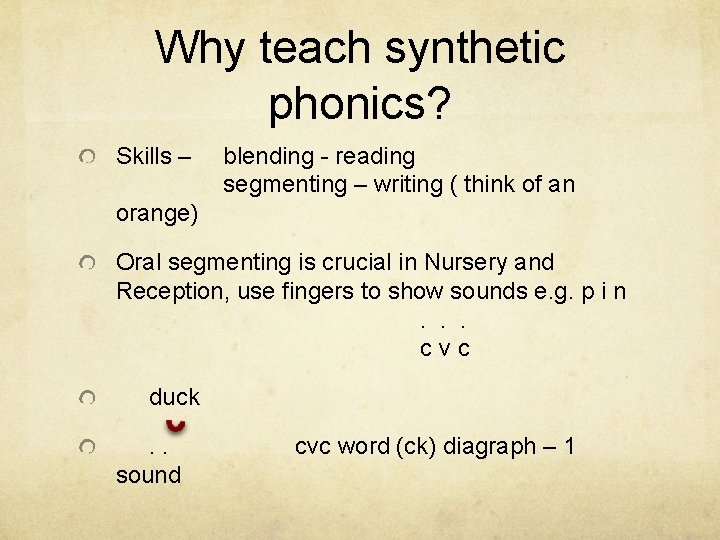
Why teach synthetic phonics? Skills – blending - reading segmenting – writing ( think of an orange) Oral segmenting is crucial in Nursery and Reception, use fingers to show sounds e. g. p i n. . . cvc duck. . sound cvc word (ck) diagraph – 1
Best Bets Teach children about ‘best bets’ – understand which graphemes go where e. g. /ai/ normally appears in the middle of a word. ay is normally found at the end of words. ‘day’ instead of ‘dai’ The same spelling may represent more than one phoneme: mean deaf i. e. reading for meaning
Split diagraphs/(Magic ‘e’) Phase 5 a – m-/a/-k-/e/ not m-/ai/-k Play the standing word activity with 2 letters of the split diagraph holding hands. Show the separation. Thereafter in written words mark the split diagraph with a curved line underneath joining the two letters together Try a split digraph hunt in a piece of text
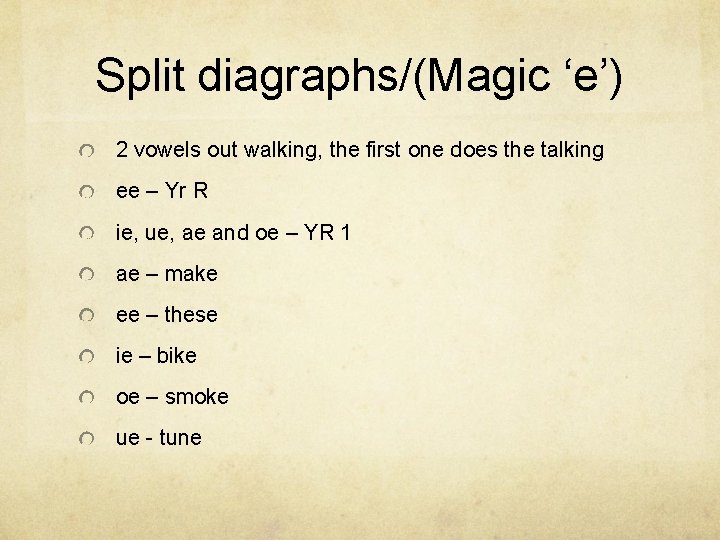
Split diagraphs/(Magic ‘e’) 2 vowels out walking, the first one does the talking ee – Yr R ie, ue, ae and oe – YR 1 ae – make ee – these ie – bike oe – smoke ue - tune
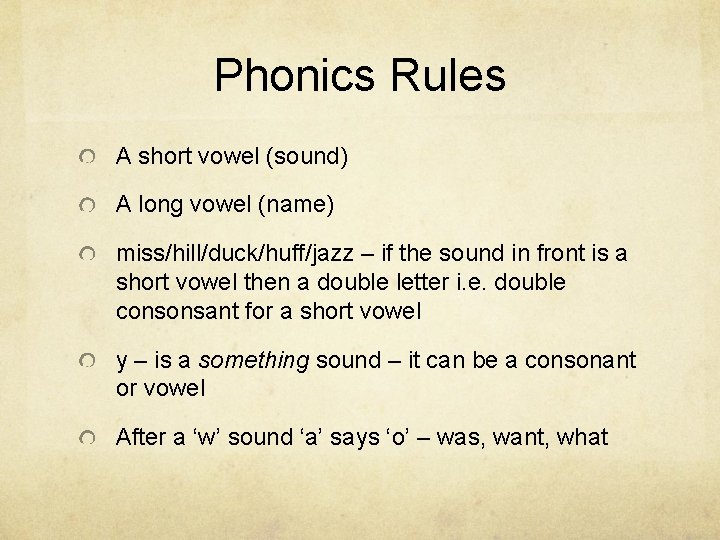
Phonics Rules A short vowel (sound) A long vowel (name) miss/hill/duck/huff/jazz – if the sound in front is a short vowel then a double letter i. e. double consonsant for a short vowel y – is a something sound – it can be a consonant or vowel After a ‘w’ sound ‘a’ says ‘o’ – was, want, what
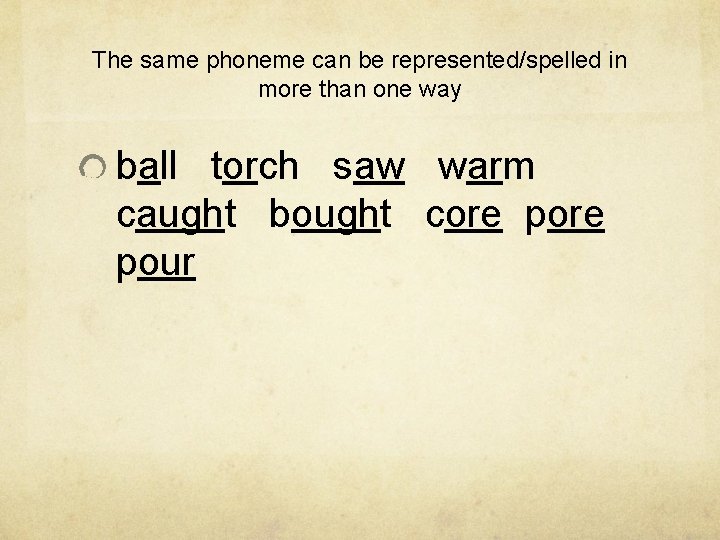
The same phoneme can be represented/spelled in more than one way ball torch saw warm caught bought core pour
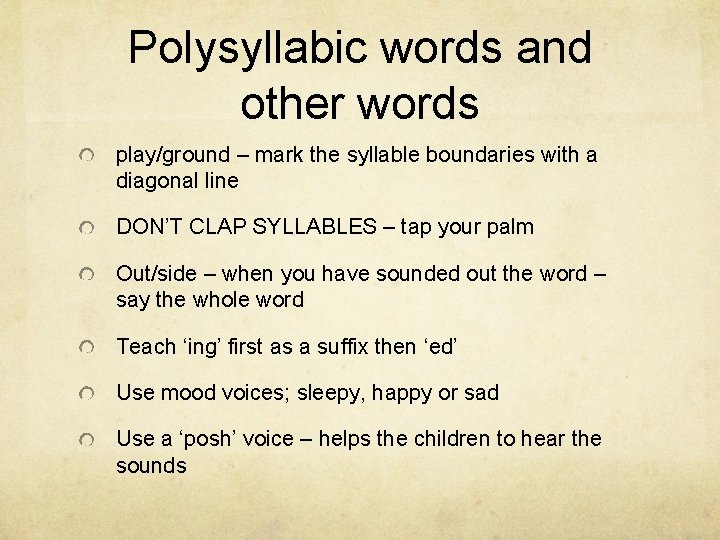
Polysyllabic words and other words play/ground – mark the syllable boundaries with a diagonal line DON’T CLAP SYLLABLES – tap your palm Out/side – when you have sounded out the word – say the whole word Teach ‘ing’ first as a suffix then ‘ed’ Use mood voices; sleepy, happy or sad Use a ‘posh’ voice – helps the children to hear the sounds
Phase 6 Still a focus on sounding out and blending and using best bets to spell words Greater focus on formal spelling patterns Using rules to add suffixes to words e. g. drop the e add ed Teach the meaning of these suffixes and how they change the word e. g. ed changes a word to past tense.
Suffixes & Prefixes ed, ing- changing the tense of the verb (irreguler verbs) er, est- superlatives and comparatives ly- adverbs ful & less- full of, less of cian, tion and sion mis, non- opposite un- undo
Grammar in Phonics Looking into what nouns, verbs, adjectives and adverbs are Adding s or es for plurals Compound words e. g. butter + fly Contractions- using apostrophe in correct place Mnemonics e. g. because- big elephants cause accidents unless tanding easy beautiful b e a u tiful Changing nouns into adjectives by adding y
ICT Resources www. phonicsplay. co. uk - interactive resources, planning and resources (subscription for more access) free 7 day trial www. lesleyclarkesyntheticphonics. co. uk - resources and Letters and Sounds overview (subscription for more access) www. babcock-education. co. uk (planning and assessment grids and resources and electronic version of Dfe’s ‘Letters and Sounds’ – which is now out of print) Teacher’s pet/sparklebox/twinkle – all have good resources www. espresso. co. uk www. letter-and-sounds. com www. crickweb. co. uk
- Slides: 13