
Synthetic Division By Group Awesome Arianna Brittany Dana
Synthetic Division By: Group Awesome Arianna, Brittany, Dana, Julie and Raymond
Lesson Plan � � � Lesson Plan Objective: To learn how to divide polynomials using Synthetic Division Method: � Use a powerpoint � Demonstrate, using a model � Provide practice problems Procedure: First, we will provide a sample problem to demonstrate the process of synthetic division for the class. After fully explaining the process of synthetic division, we will distribute a handout that contains several practice problems for the class to complete. At the end of the lesson, we will go over the sheet. Materials: A powerpoint with the example problem, copies of a worksheet with the practice problems Evaluation: We will be able to tell if we have effectively taught the lesson if the students are able to correctly do the practice problems that we have given them, which will demonstrate that they both understand the concept of the lesson and how to put the strategy into effect.
What even is synthetic division? � Synthetic division is a shorthand, or shortcut, method of polynomial division in the special case of dividing by a linear factor and it only works in this case. � Synthetic division is generally used, however, not for dividing out factors but for finding zeroes of polynomials.
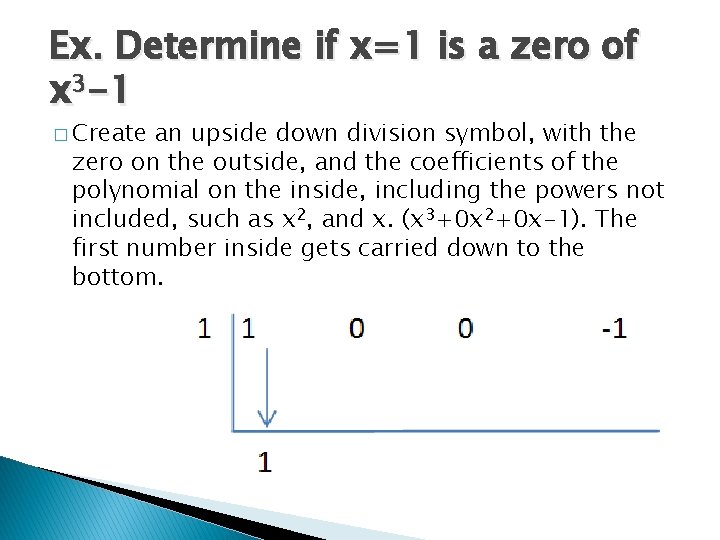
Ex. Determine if x=1 is a zero of x 3 -1 � Create an upside down division symbol, with the zero on the outside, and the coefficients of the polynomial on the inside, including the powers not included, such as x 2, and x. (x 3+0 x 2+0 x-1). The first number inside gets carried down to the bottom.
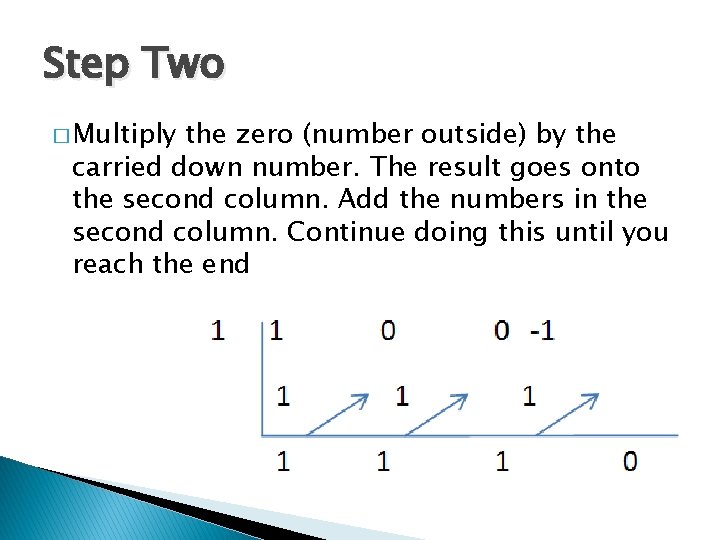
Step Two � Multiply the zero (number outside) by the carried down number. The result goes onto the second column. Add the numbers in the second column. Continue doing this until you reach the end
Step Three � The last number is the remainder of the division problem, and if the remainder is zero, then x=1 is a zero of x 3 -1.
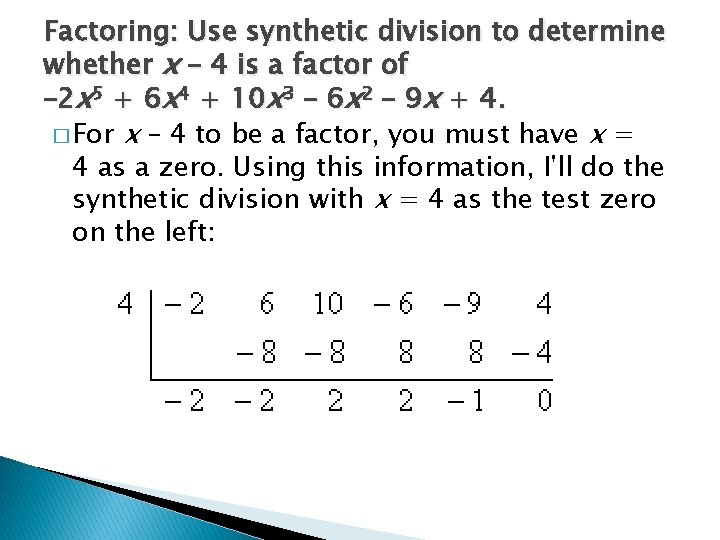
Factoring: Use synthetic division to determine whether x – 4 is a factor of – 2 x 5 + 6 x 4 + 10 x 3 – 6 x 2 – 9 x + 4. � For x – 4 to be a factor, you must have x = 4 as a zero. Using this information, I'll do the synthetic division with x = 4 as the test zero on the left:
Since the remainder is zero, then x = 4 is indeed a zero of – 2 x 5 + 6 x 4 + 10 x 3 – 6 x 2 – 9 x + 4, so: x – 4 is a factor of – 2 x 5 + 6 x 4 + 10 x 3 – 6 x 2 – 9 x + 4 � Yes,
- Slides: 8