
Synthetic aperture photography and illumination using arrays of
![A virtual high-speed video camera [Wilburn, 2004 (submitted) ] • • • 52 cameras,](https://slidetodoc.com/presentation_image_h2/b104a05be0ec8af344758f174fad783e/image-10.jpg "A virtual high-speed video camera [Wilburn, 2004 (submitted) ] • • • 52 cameras,")
![A virtual high-speed video camera [Wilburn, 2004 (submitted) ] • • • 52 cameras,](https://slidetodoc.com/presentation_image_h2/b104a05be0ec8af344758f174fad783e/image-12.jpg "A virtual high-speed video camera [Wilburn, 2004 (submitted) ] • • • 52 cameras,")
![[UMIC SUNY/Stonybrook]](https://slidetodoc.com/presentation_image_h2/b104a05be0ec8af344758f174fad783e/image-40.jpg "[UMIC SUNY/Stonybrook]")
![Application to underwater exploration [Ballard/IFE 2004] Ó 2004 Marc Levoy](https://slidetodoc.com/presentation_image_h2/b104a05be0ec8af344758f174fad783e/image-64.jpg "Application to underwater exploration [Ballard/IFE 2004] Ó 2004 Marc Levoy")
- Slides: 67
Synthetic aperture photography and illumination using arrays of cameras and projectors Marc Levoy Computer Science Department Stanford University Ó 2004 Marc Levoy
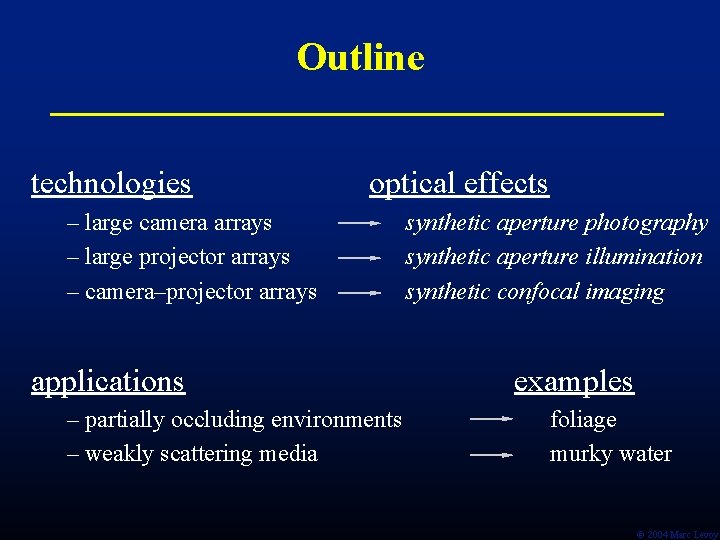
Outline technologies optical effects – large camera arrays – large projector arrays – camera–projector arrays applications – partially occluding environments – weakly scattering media synthetic aperture photography synthetic aperture illumination synthetic confocal imaging examples foliage murky water Ó 2004 Marc Levoy
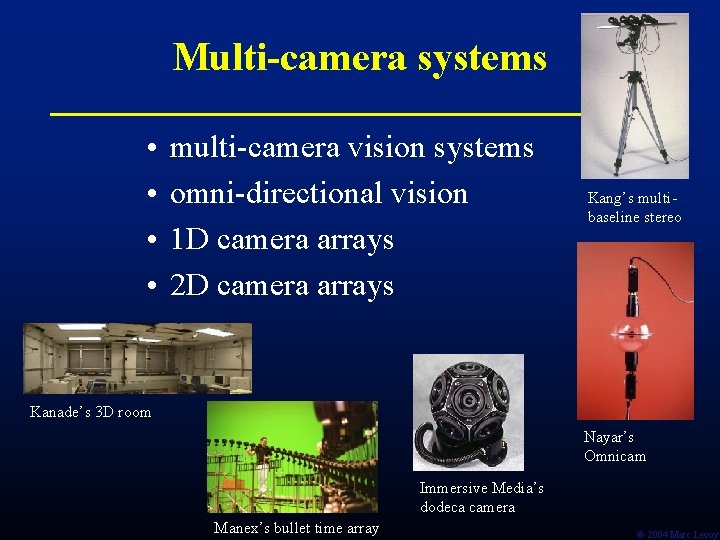
Multi-camera systems • • multi-camera vision systems omni-directional vision 1 D camera arrays 2 D camera arrays Kang’s multibaseline stereo Kanade’s 3 D room Nayar’s Omnicam Immersive Media’s dodeca camera Manex’s bullet time array Ó 2004 Marc Levoy
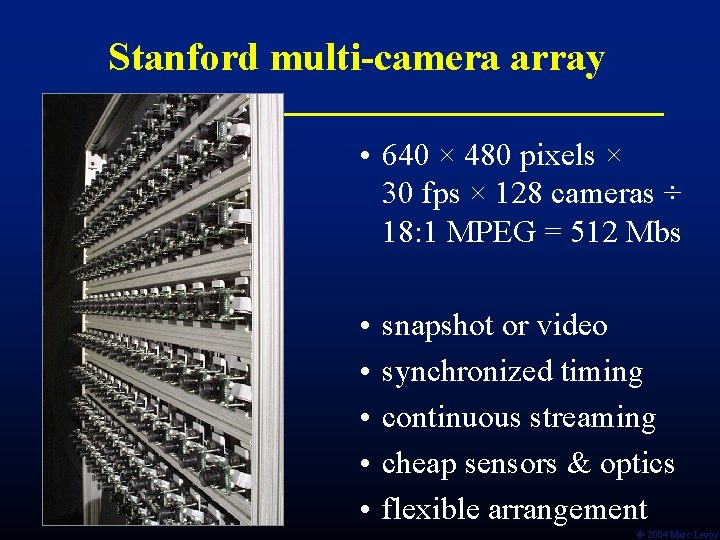
Stanford multi-camera array • 640 × 480 pixels × 30 fps × 128 cameras ÷ 18: 1 MPEG = 512 Mbs • • • snapshot or video synchronized timing continuous streaming cheap sensors & optics flexible arrangement Ó 2004 Marc Levoy
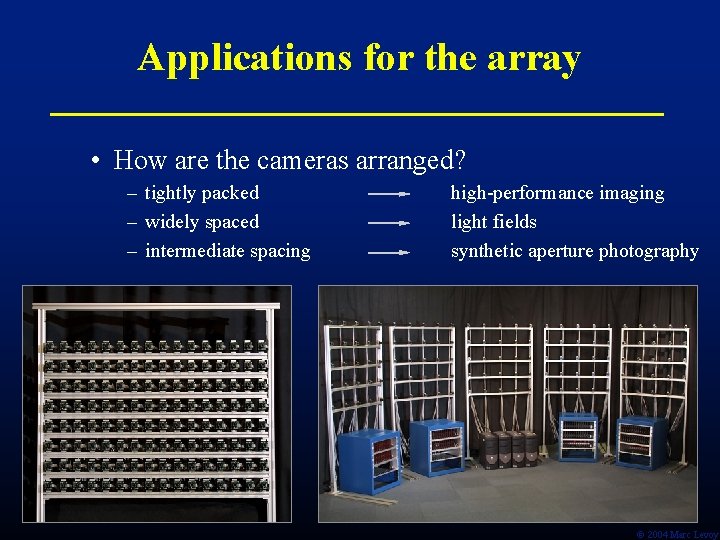
Applications for the array • How are the cameras arranged? – tightly packed – widely spaced – intermediate spacing high-performance imaging light fields synthetic aperture photography Ó 2004 Marc Levoy
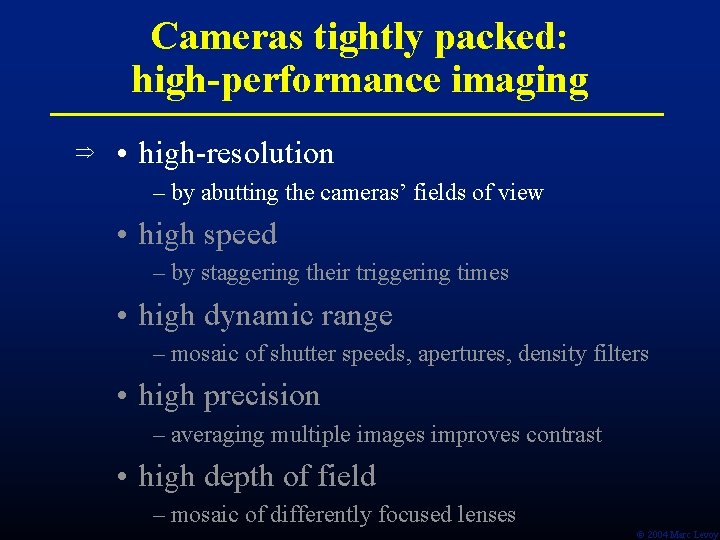
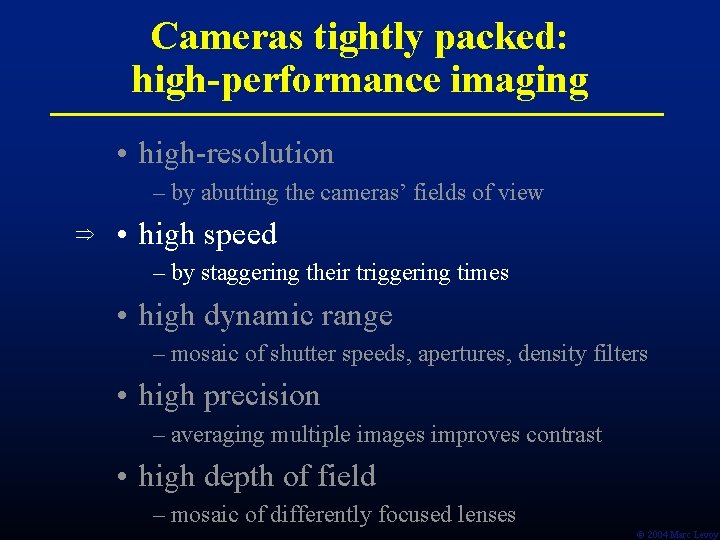
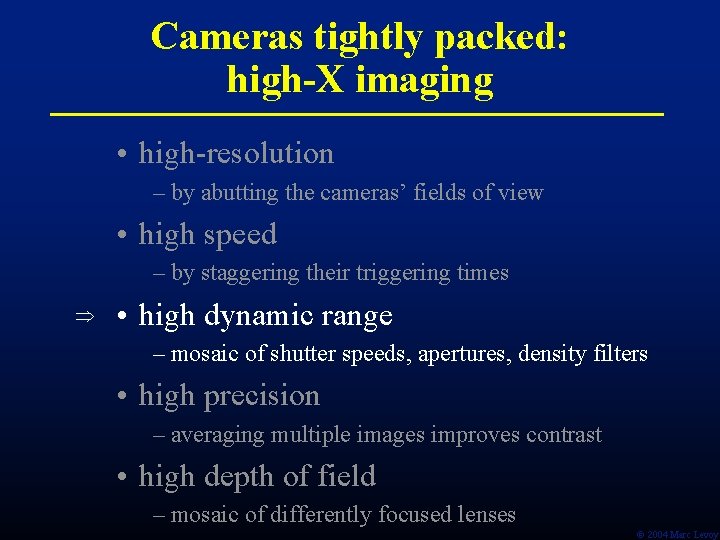
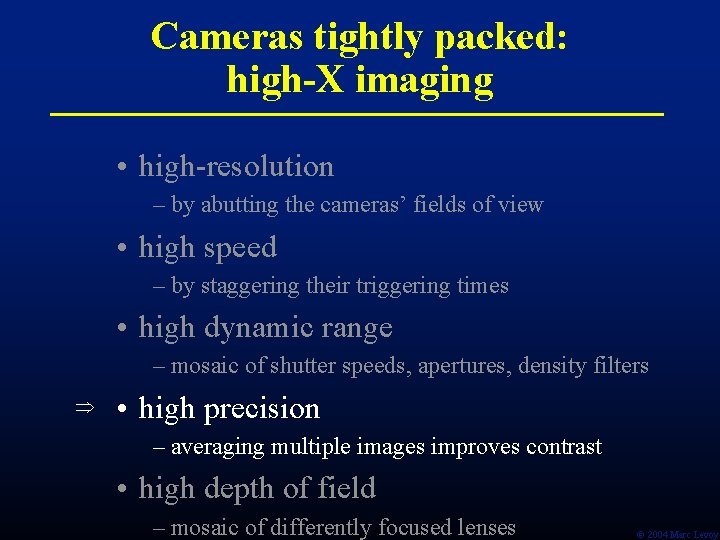
Cameras tightly packed: high-performance imaging • high-resolution – by abutting the cameras’ fields of view • high speed – by staggering their triggering times • high dynamic range – mosaic of shutter speeds, apertures, density filters • high precision – averaging multiple images improves contrast • high depth of field – mosaic of differently focused lenses Ó 2004 Marc Levoy
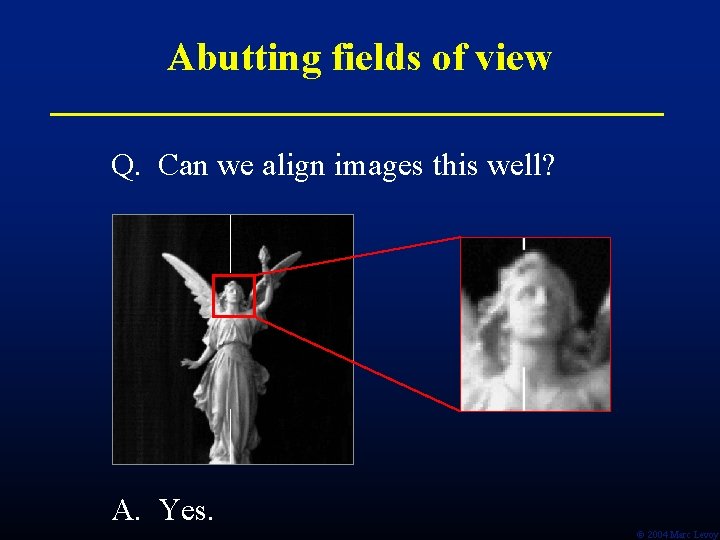
Abutting fields of view Q. Can we align images this well? A. Yes. Ó 2004 Marc Levoy
Cameras tightly packed: high-performance imaging • high-resolution – by abutting the cameras’ fields of view • high speed – by staggering their triggering times • high dynamic range – mosaic of shutter speeds, apertures, density filters • high precision – averaging multiple images improves contrast • high depth of field – mosaic of differently focused lenses Ó 2004 Marc Levoy
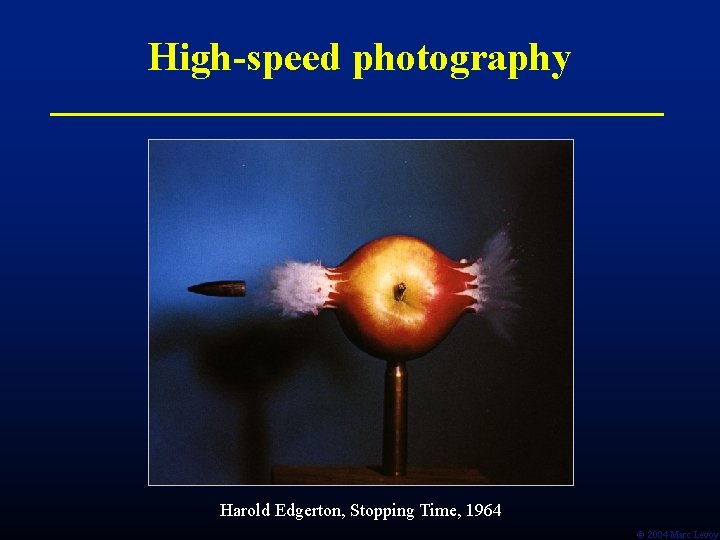
High-speed photography Harold Edgerton, Stopping Time, 1964 Ó 2004 Marc Levoy
A virtual high-speed video camera [Wilburn, 2004 (submitted) ] • • • 52 cameras, each 30 fps packed as closely as possible staggered firing, short exposure result is 1560 fps camera continuous streaming no triggering needed Ó 2004 Marc Levoy
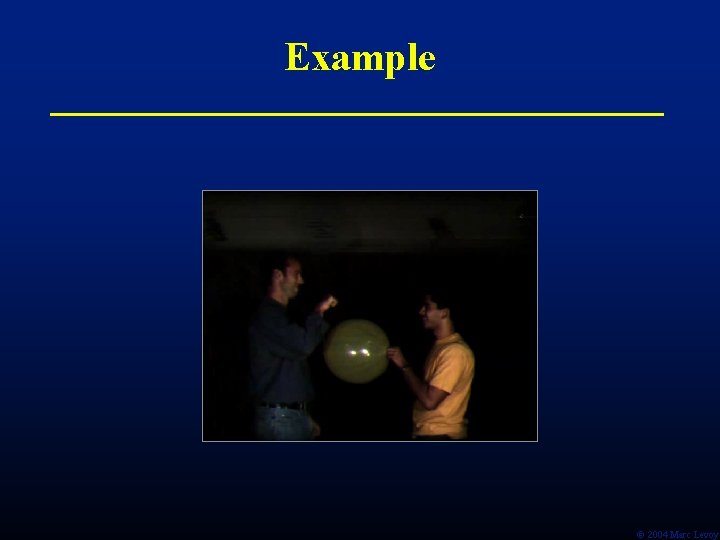
Example Ó 2004 Marc Levoy
A virtual high-speed video camera [Wilburn, 2004 (submitted) ] • • • 52 cameras, 30 fps, 640 × 480 packed as closely as possible short exposure, staggered firing result is 1536 fps camera continuous streaming no triggering needed scalable to more cameras limited by available photons overlap exposure times? 100 cameras 3072 fps Ó 2004 Marc Levoy
Cameras tightly packed: high-X imaging • high-resolution – by abutting the cameras’ fields of view • high speed – by staggering their triggering times • high dynamic range – mosaic of shutter speeds, apertures, density filters • high precision – averaging multiple images improves contrast • high depth of field – mosaic of differently focused lenses Ó 2004 Marc Levoy
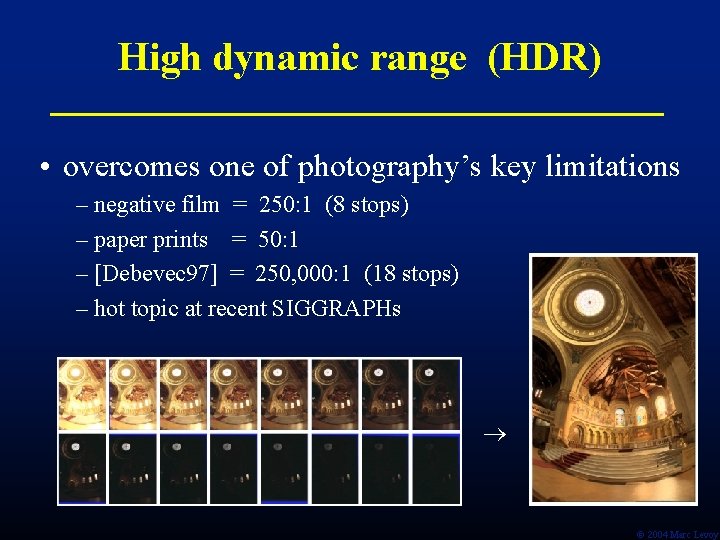
High dynamic range (HDR) • overcomes one of photography’s key limitations – negative film = 250: 1 (8 stops) – paper prints = 50: 1 – [Debevec 97] = 250, 000: 1 (18 stops) – hot topic at recent SIGGRAPHs Ó 2004 Marc Levoy
Cameras tightly packed: high-X imaging • high-resolution – by abutting the cameras’ fields of view • high speed – by staggering their triggering times • high dynamic range – mosaic of shutter speeds, apertures, density filters • high precision – averaging multiple images improves contrast • high depth of field – mosaic of differently focused lenses Ó 2004 Marc Levoy
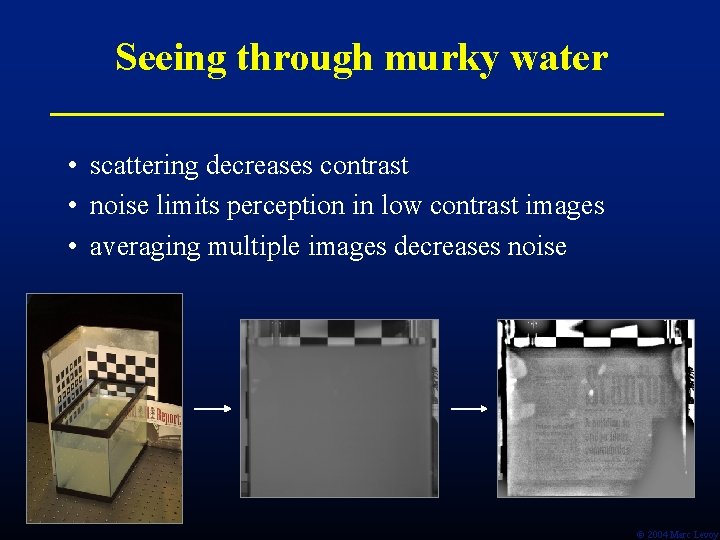
Seeing through murky water • scattering decreases contrast • noise limits perception in low contrast images • averaging multiple images decreases noise Ó 2004 Marc Levoy
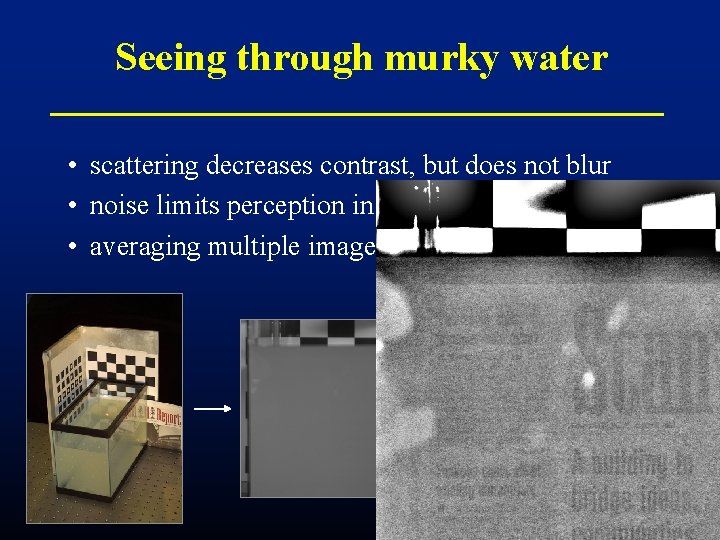
Seeing through murky water • scattering decreases contrast, but does not blur • noise limits perception in low contrast images • averaging multiple images decreases noise Ó 2004 Marc Levoy
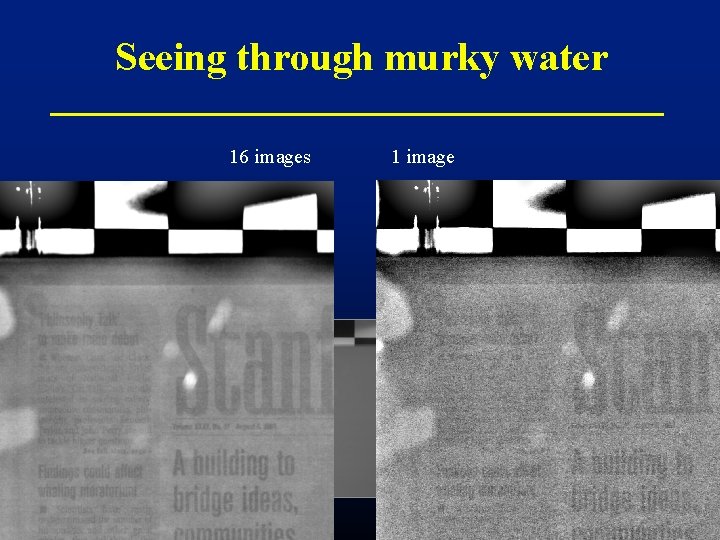
Seeing through murky water 16 images 1 image Ó 2004 Marc Levoy
Cameras tightly packed: high-X imaging • high-resolution – by abutting the cameras’ fields of view • high speed – by staggering their triggering times • high dynamic range – mosaic of shutter speeds, apertures, density filters • high precision – averaging multiple images improves contrast • high depth of field – mosaic of differently focused lenses Ó 2004 Marc Levoy
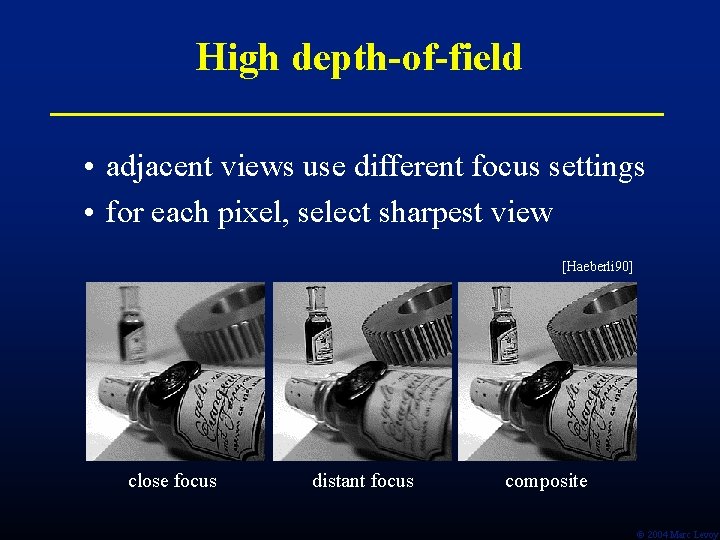
High depth-of-field • adjacent views use different focus settings • for each pixel, select sharpest view [Haeberli 90] close focus distant focus composite Ó 2004 Marc Levoy
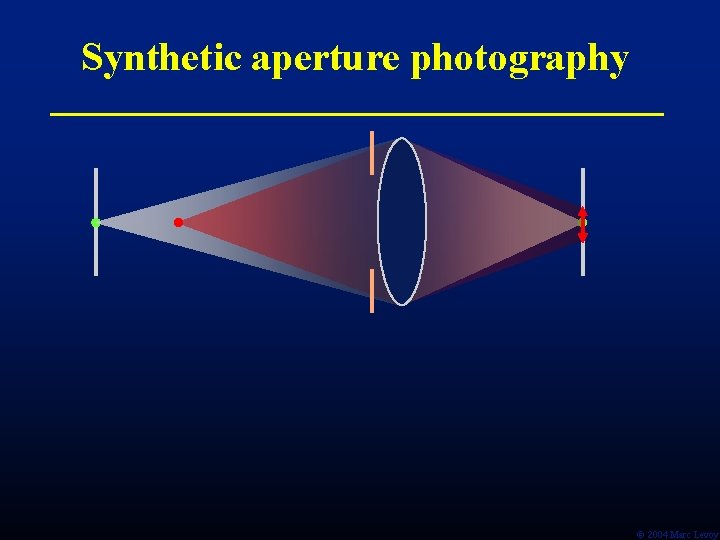
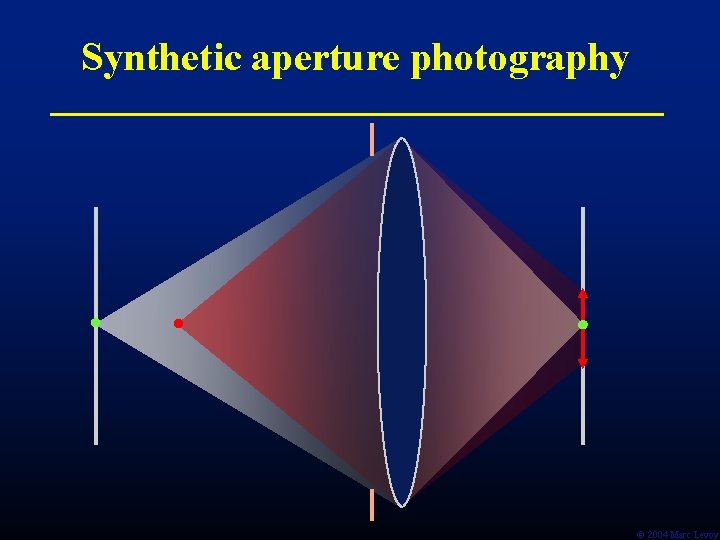
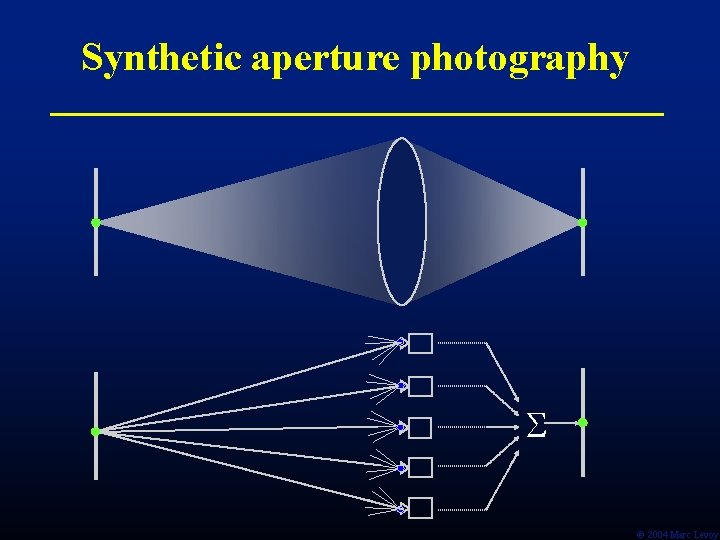
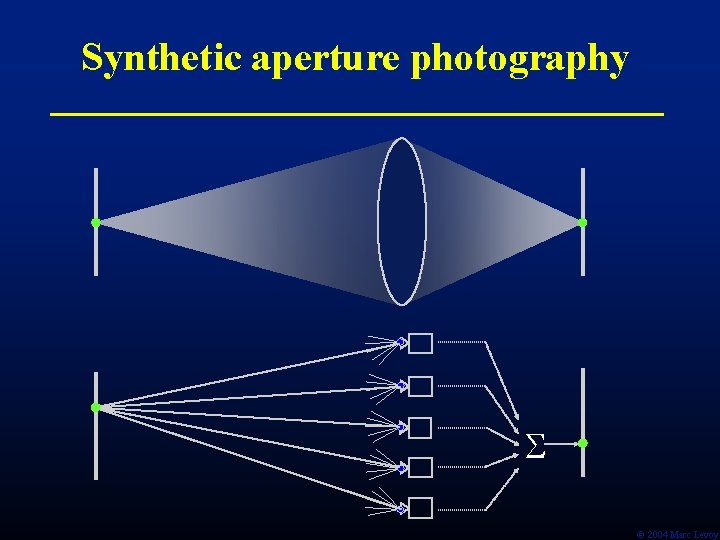
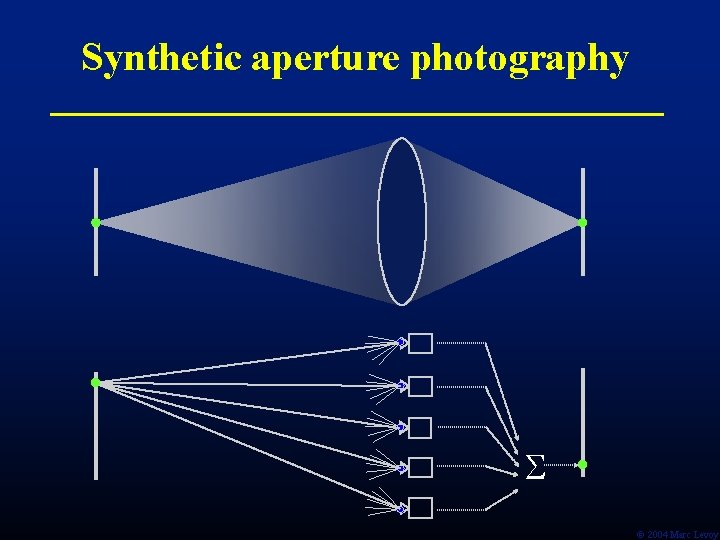
Synthetic aperture photography Ó 2004 Marc Levoy
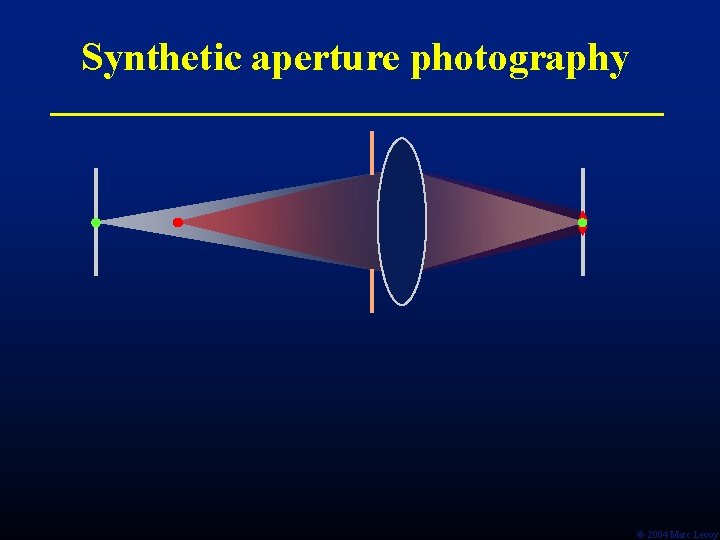
Synthetic aperture photography Ó 2004 Marc Levoy
Synthetic aperture photography Ó 2004 Marc Levoy
Synthetic aperture photography Ó 2004 Marc Levoy
Synthetic aperture photography Ó 2004 Marc Levoy
Synthetic aperture photography Ó 2004 Marc Levoy
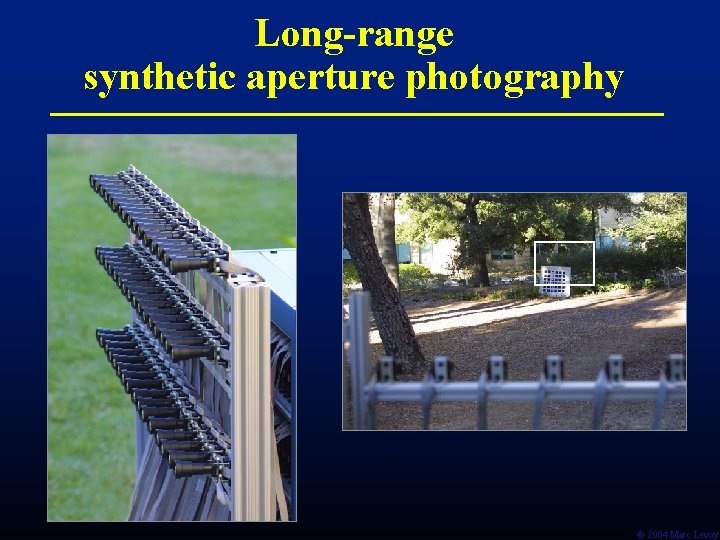
Long-range synthetic aperture photography Ó 2004 Marc Levoy
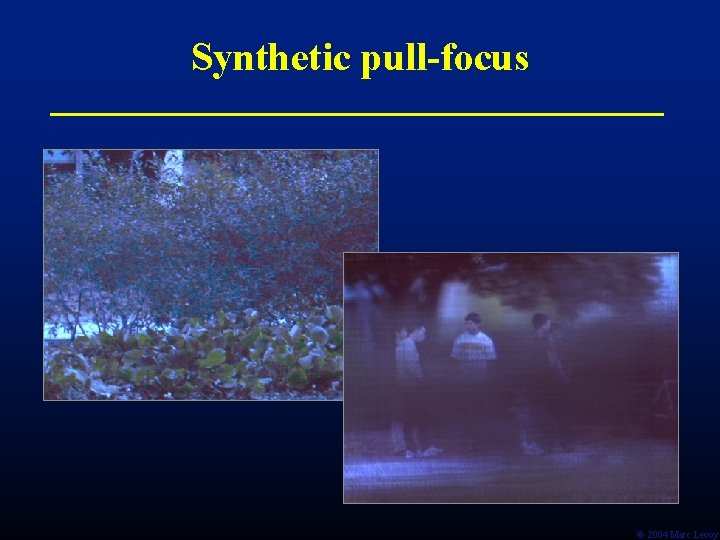
Synthetic pull-focus Ó 2004 Marc Levoy
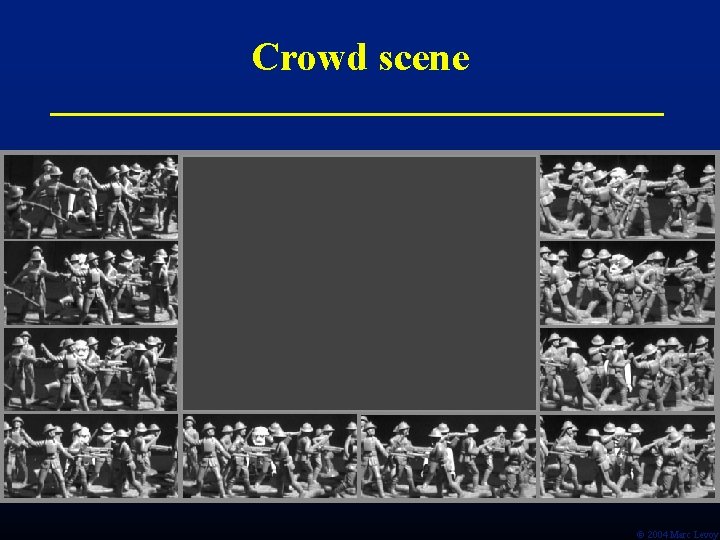
Crowd scene Ó 2004 Marc Levoy
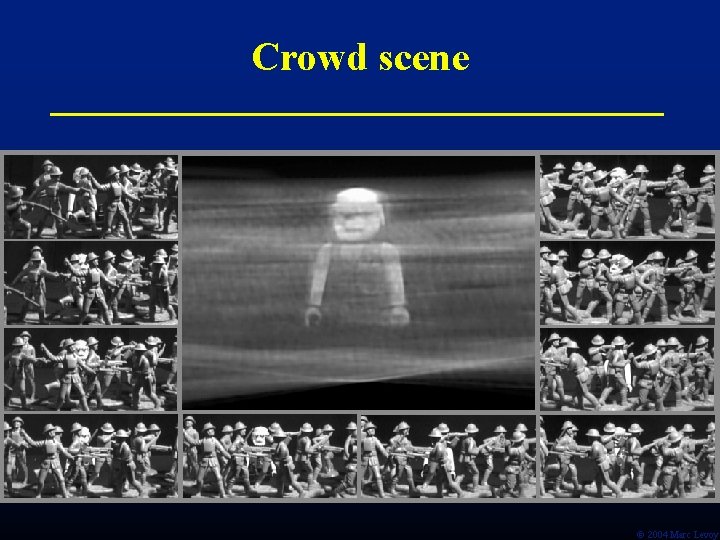
Crowd scene Ó 2004 Marc Levoy
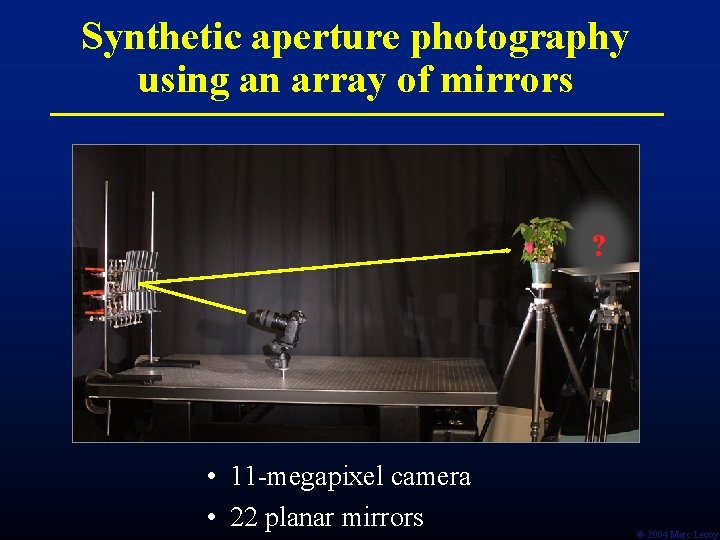
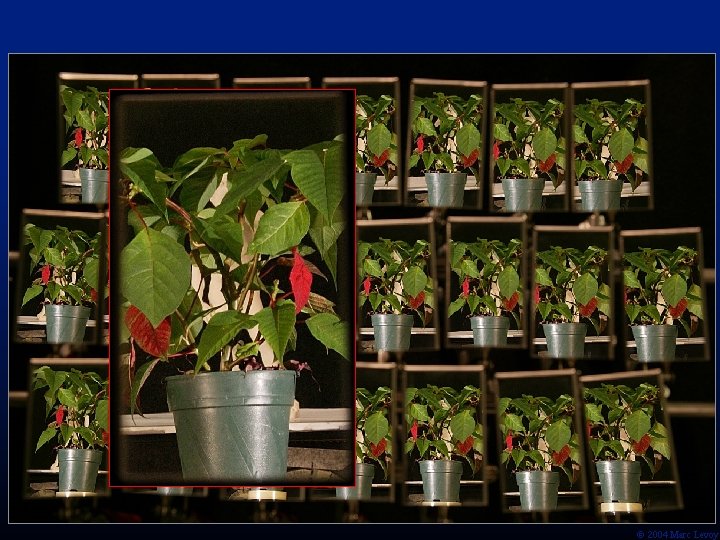
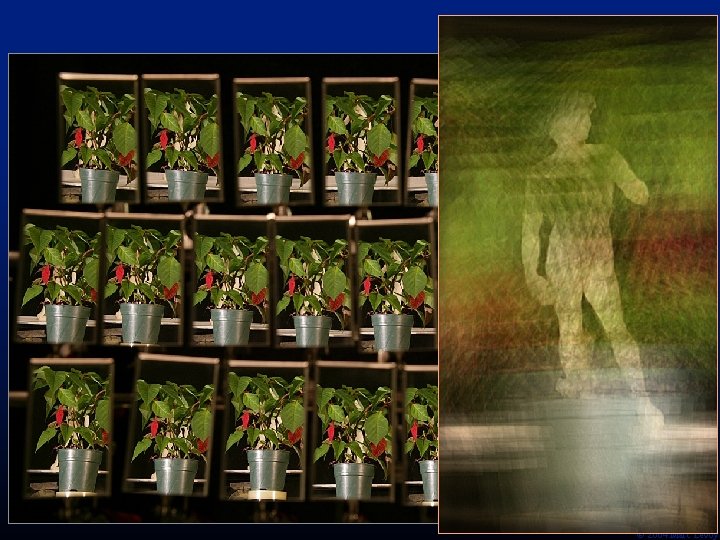
Synthetic aperture photography using an array of mirrors ? • 11 -megapixel camera • 22 planar mirrors Ó 2004 Marc Levoy
Ó 2004 Marc Levoy
Ó 2004 Marc Levoy
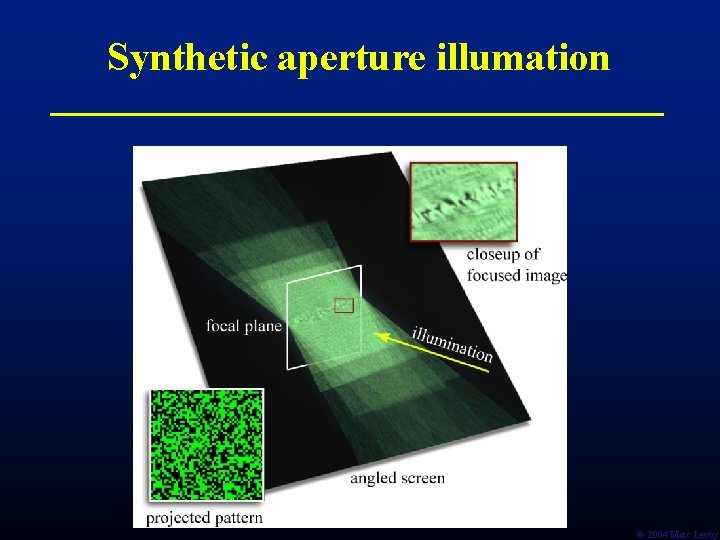
Synthetic aperture illumation Ó 2004 Marc Levoy
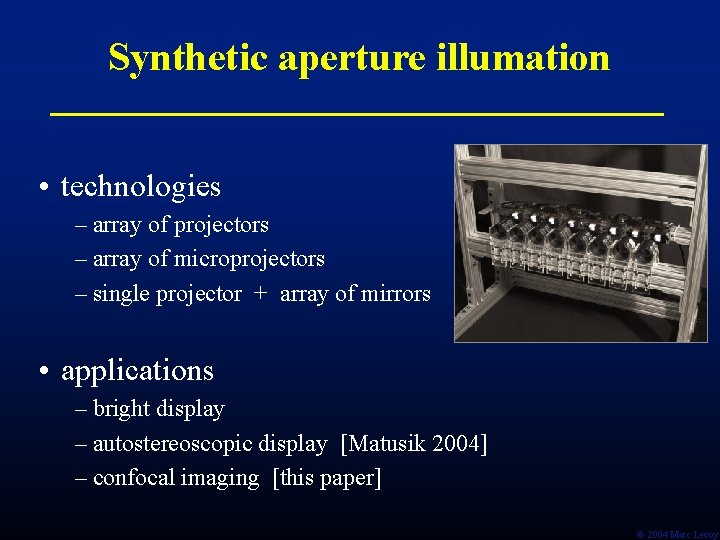
Synthetic aperture illumation • technologies – array of projectors – array of microprojectors – single projector + array of mirrors • applications – bright display – autostereoscopic display [Matusik 2004] – confocal imaging [this paper] Ó 2004 Marc Levoy
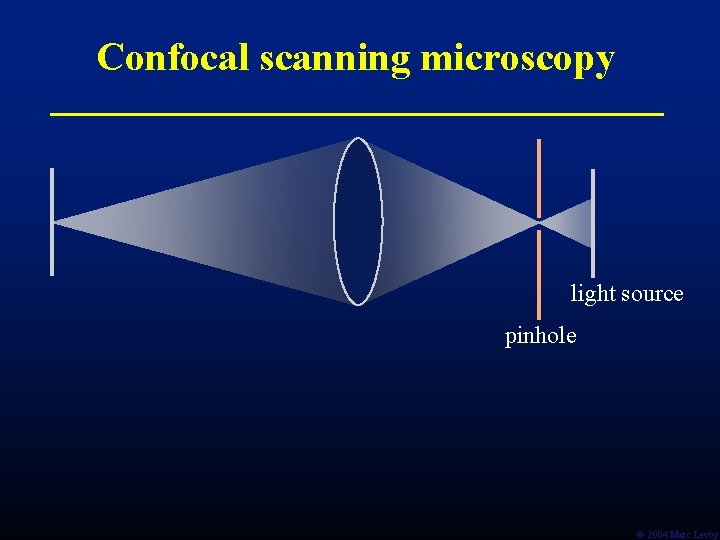
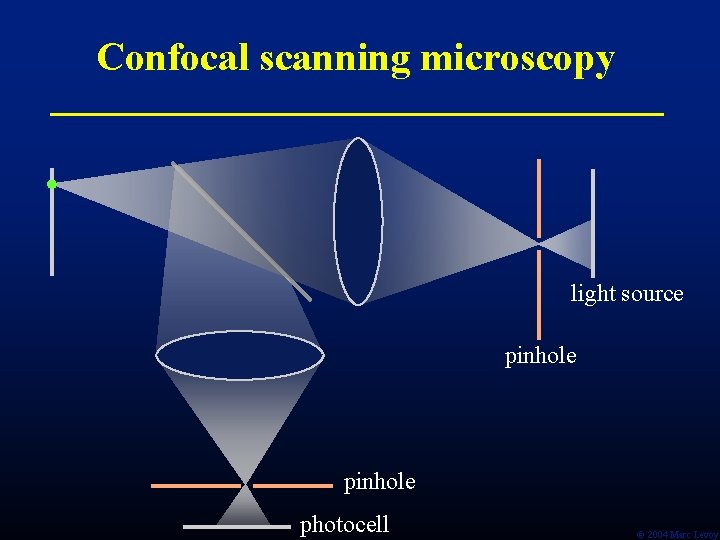
Confocal scanning microscopy light source pinhole Ó 2004 Marc Levoy
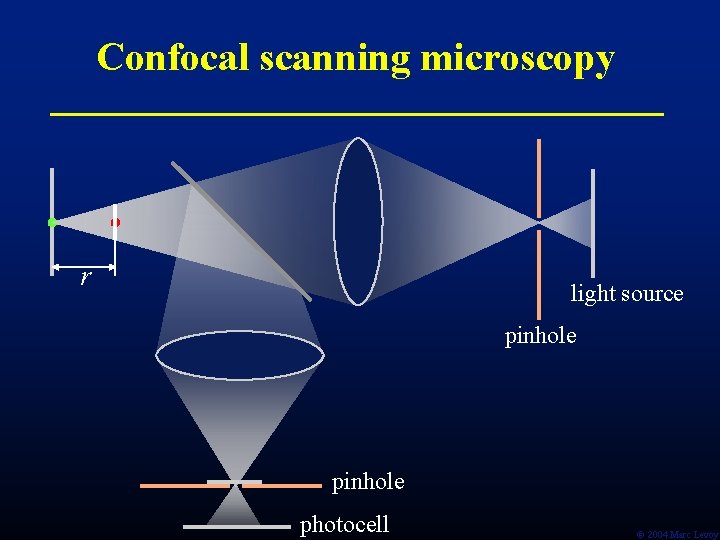
Confocal scanning microscopy r light source pinhole photocell Ó 2004 Marc Levoy
Confocal scanning microscopy light source pinhole photocell Ó 2004 Marc Levoy
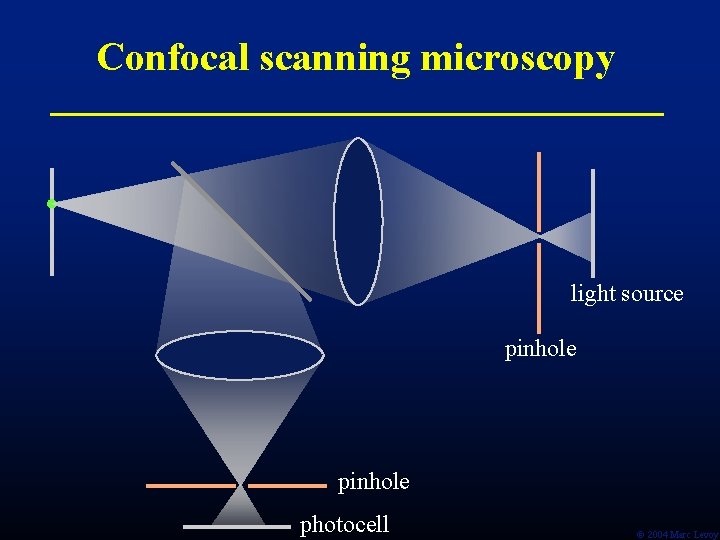
Confocal scanning microscopy light source pinhole photocell Ó 2004 Marc Levoy
[UMIC SUNY/Stonybrook]
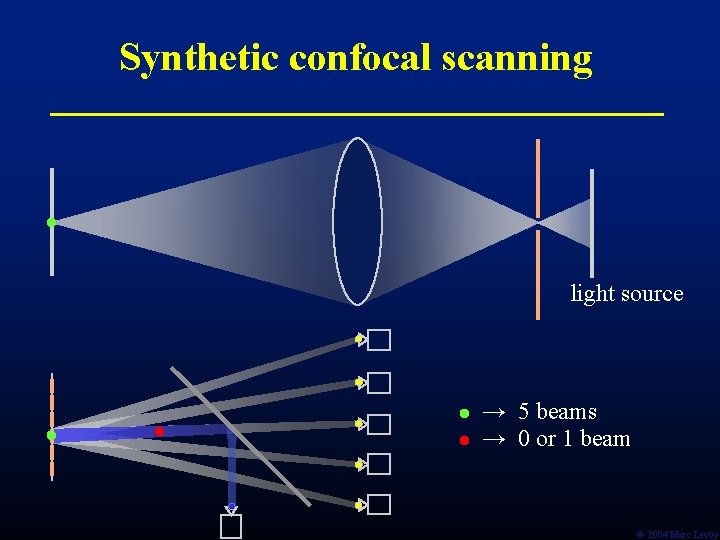
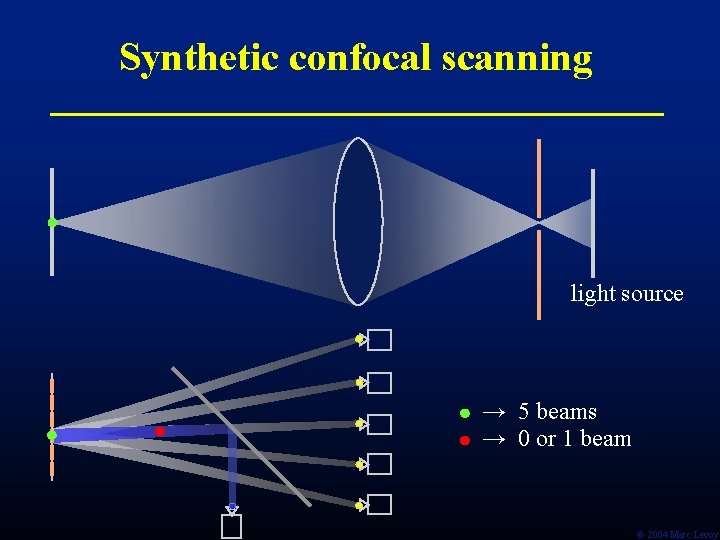
Synthetic confocal scanning light source → 5 beams → 0 or 1 beam Ó 2004 Marc Levoy
Synthetic confocal scanning light source → 5 beams → 0 or 1 beam Ó 2004 Marc Levoy
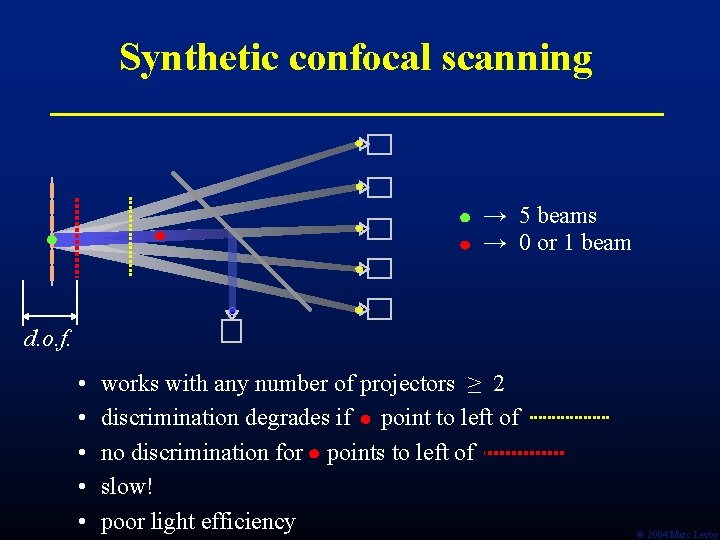
Synthetic confocal scanning → 5 beams → 0 or 1 beam d. o. f. • • • works with any number of projectors ≥ 2 discrimination degrades if point to left of no discrimination for points to left of slow! poor light efficiency Ó 2004 Marc Levoy
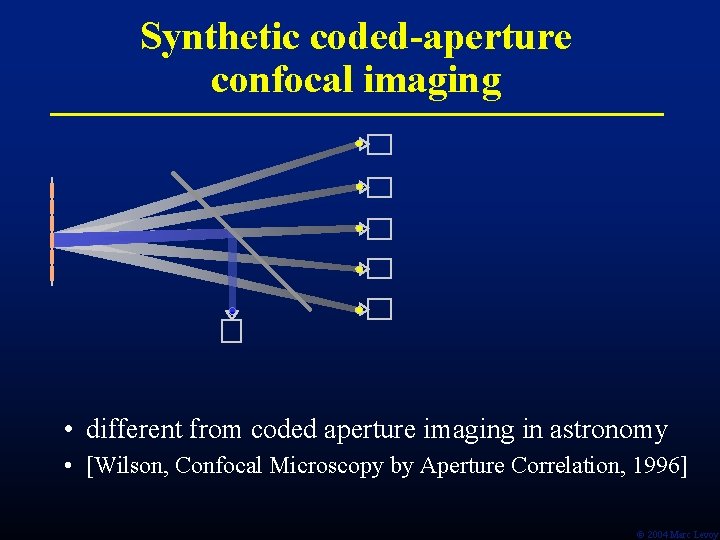
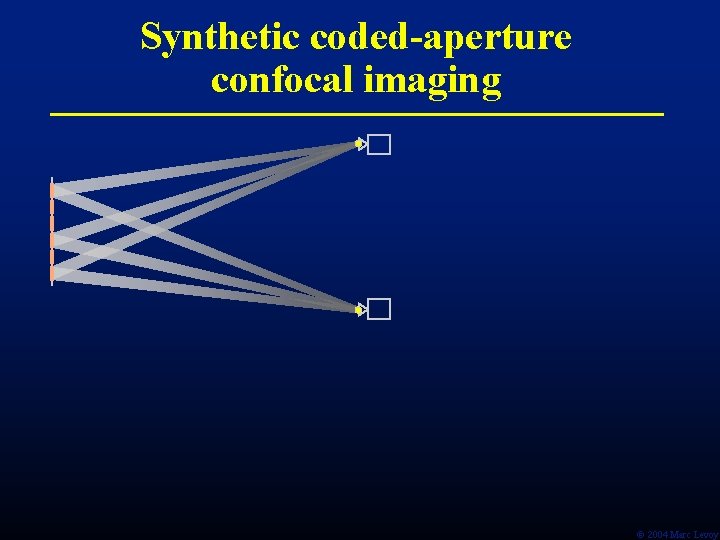
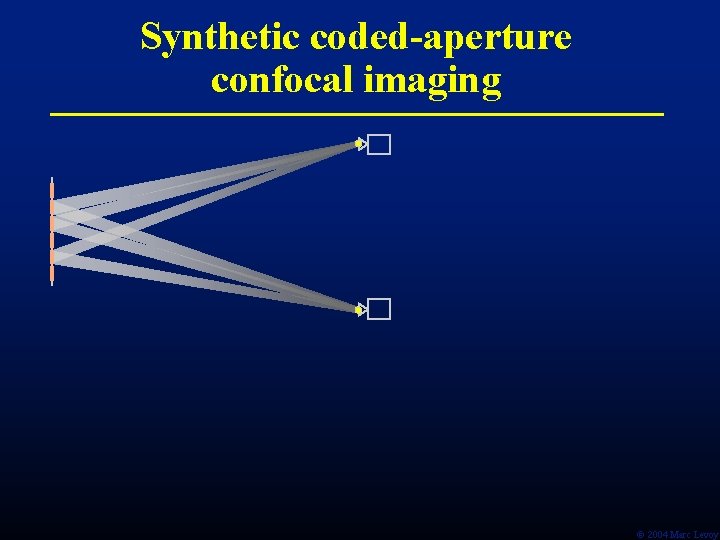
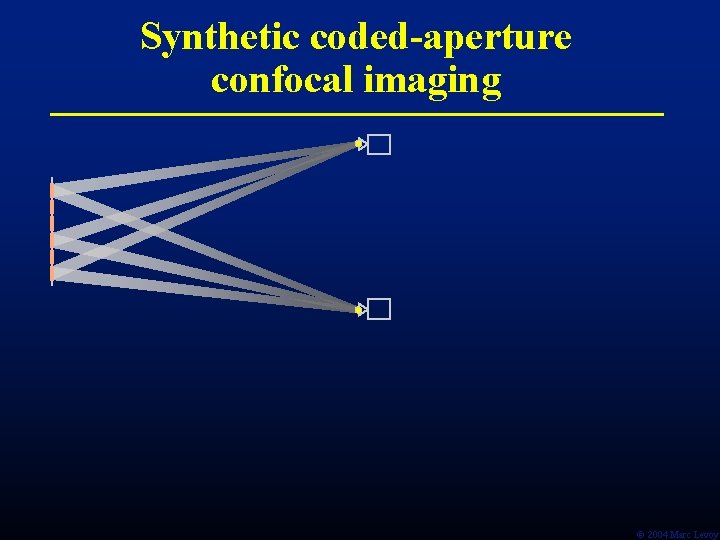
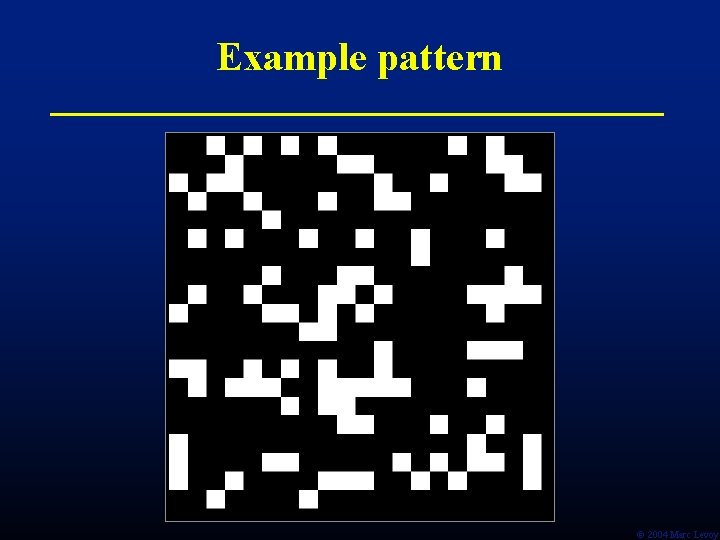
Synthetic coded-aperture confocal imaging • different from coded aperture imaging in astronomy • [Wilson, Confocal Microscopy by Aperture Correlation, 1996] Ó 2004 Marc Levoy
Synthetic coded-aperture confocal imaging Ó 2004 Marc Levoy
Synthetic coded-aperture confocal imaging Ó 2004 Marc Levoy
Synthetic coded-aperture confocal imaging Ó 2004 Marc Levoy
Example pattern Ó 2004 Marc Levoy
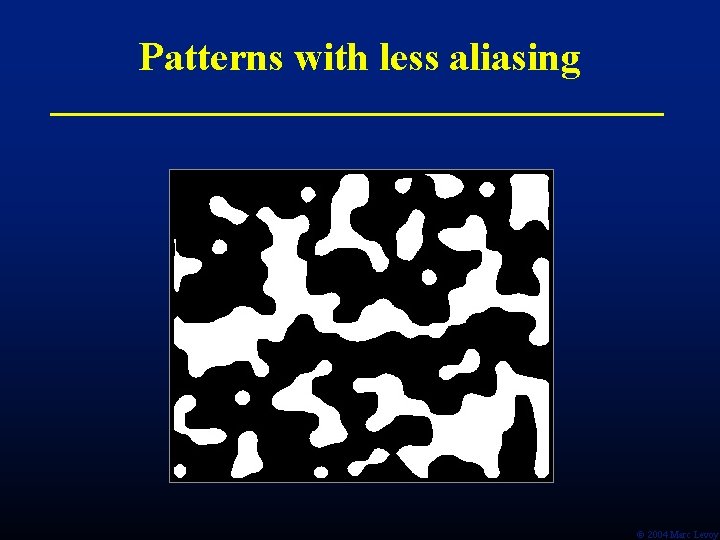
Patterns with less aliasing Ó 2004 Marc Levoy
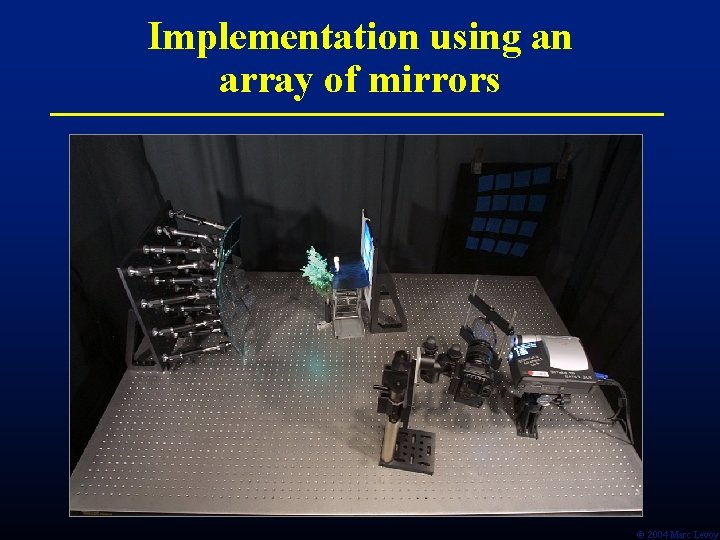
Implementation using an array of mirrors Ó 2004 Marc Levoy
(video available at http: //graphics. stanford. edu/papers/confocal/)
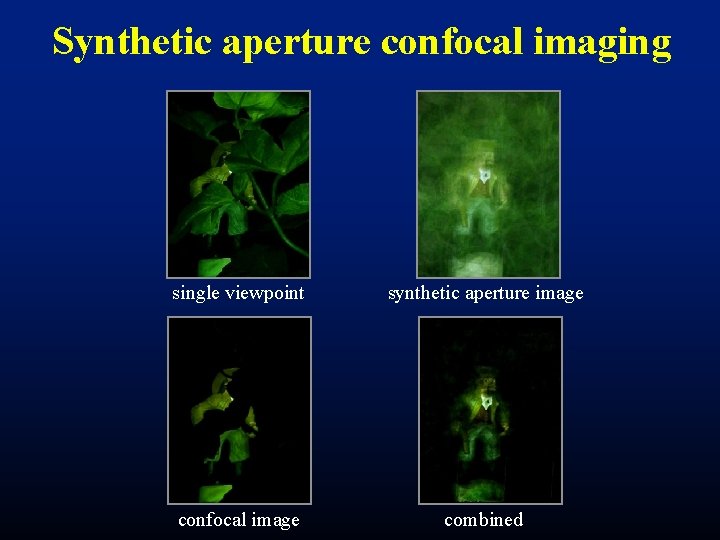
Synthetic aperture confocal imaging single viewpoint synthetic aperture image confocal image combined
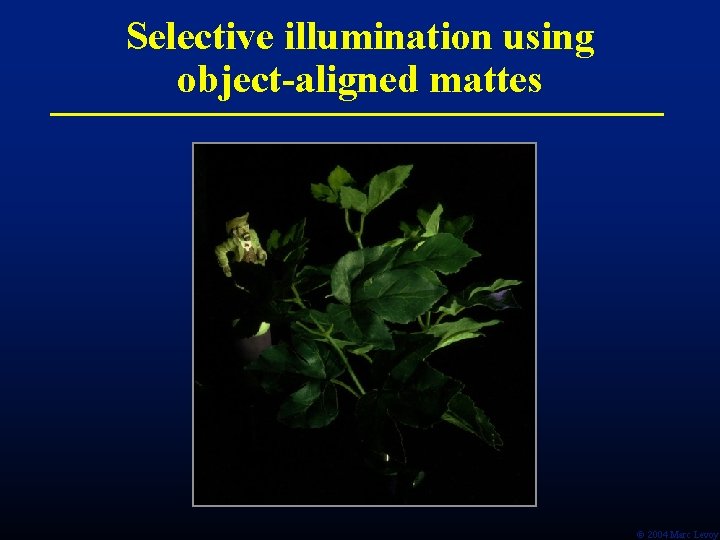
Selective illumination using object-aligned mattes Ó 2004 Marc Levoy
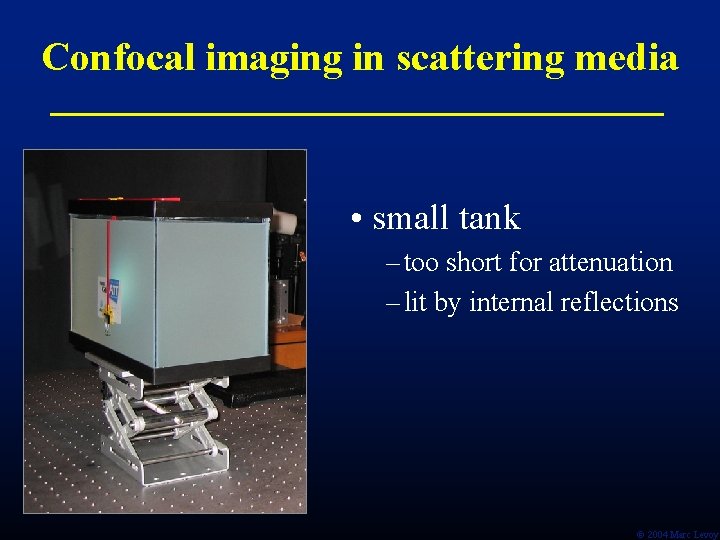
Confocal imaging in scattering media • small tank – too short for attenuation – lit by internal reflections Ó 2004 Marc Levoy
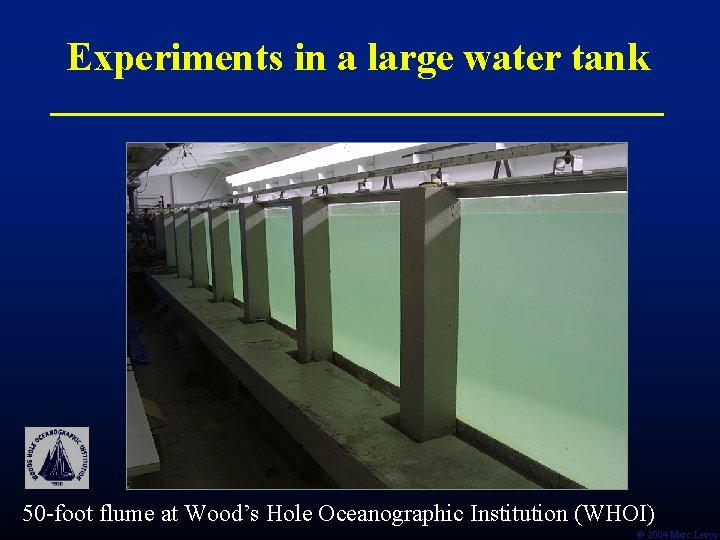
Experiments in a large water tank 50 -foot flume at Wood’s Hole Oceanographic Institution (WHOI) Ó 2004 Marc Levoy
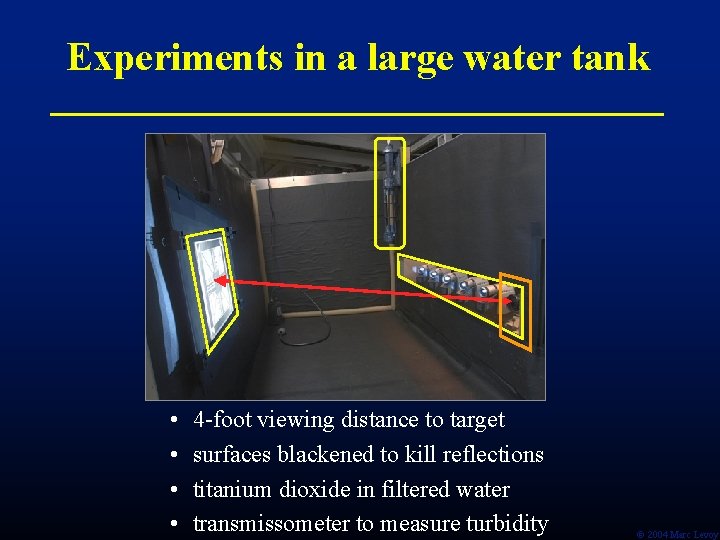
Experiments in a large water tank • • 4 -foot viewing distance to target surfaces blackened to kill reflections titanium dioxide in filtered water transmissometer to measure turbidity Ó 2004 Marc Levoy
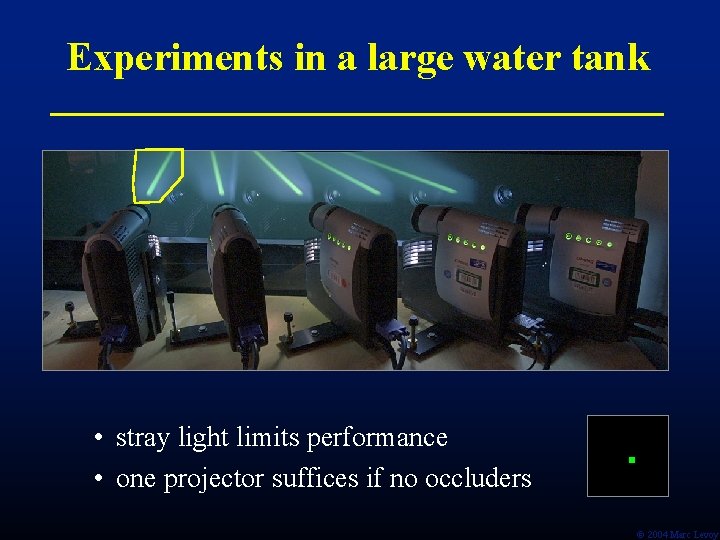
Experiments in a large water tank • stray light limits performance • one projector suffices if no occluders Ó 2004 Marc Levoy
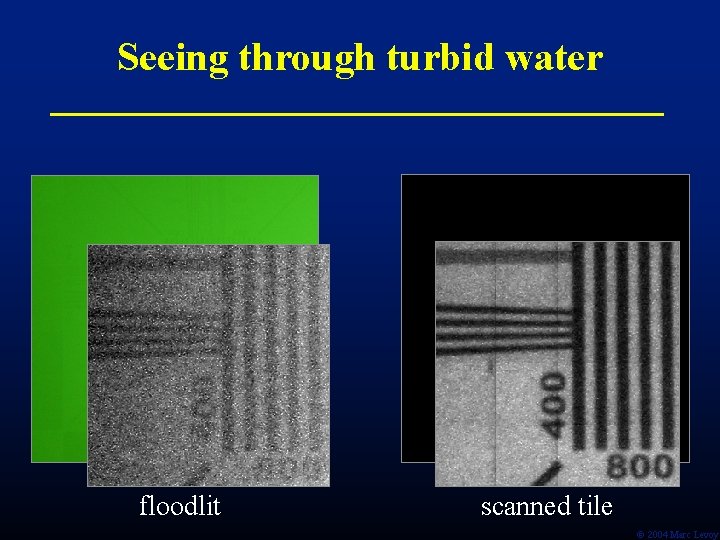
Seeing through turbid water floodlit scanned tile Ó 2004 Marc Levoy
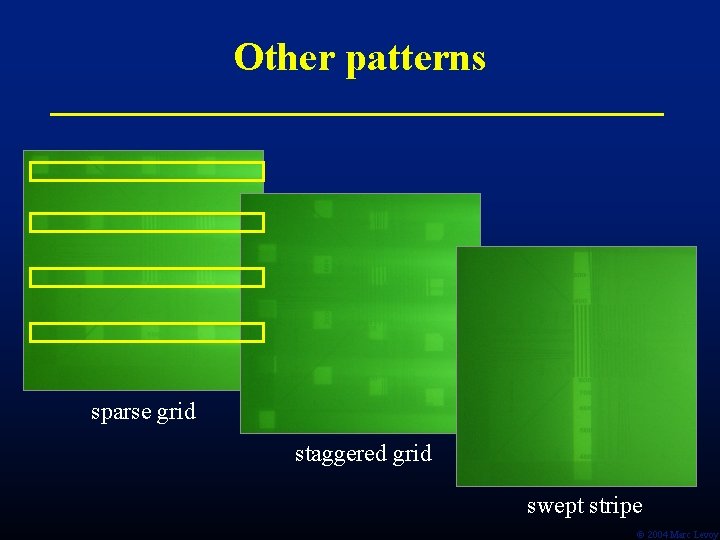
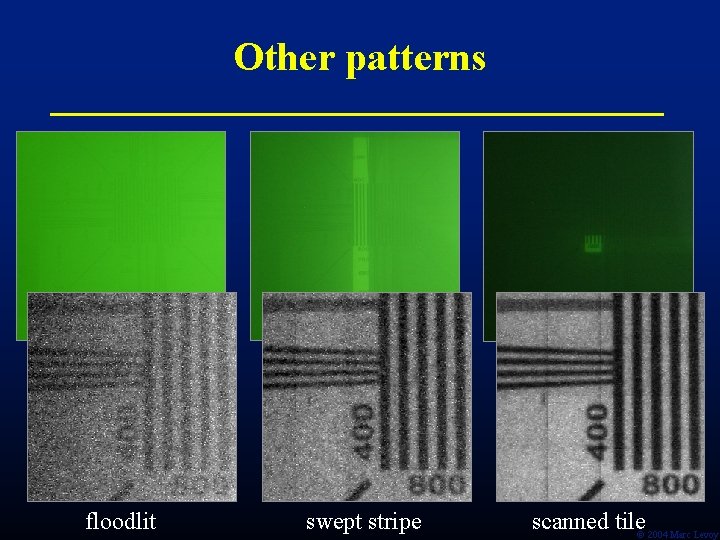
Other patterns sparse grid staggered grid swept stripe Ó 2004 Marc Levoy
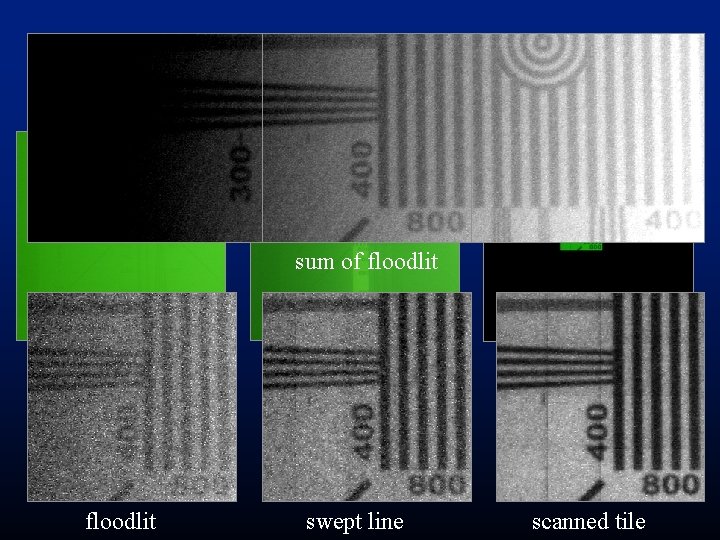
Other patterns floodlit swept stripe scanned tileÓ 2004 Marc Levoy
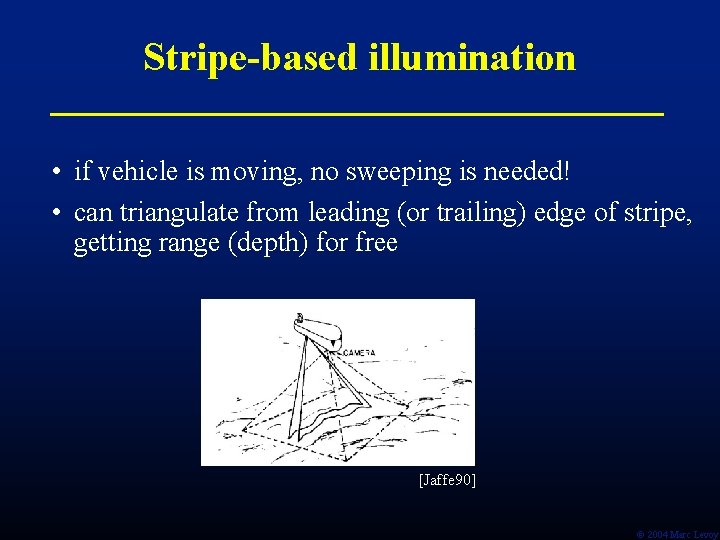
Stripe-based illumination • if vehicle is moving, no sweeping is needed! • can triangulate from leading (or trailing) edge of stripe, getting range (depth) for free [Jaffe 90] Ó 2004 Marc Levoy
sum of floodlit swept line scanned tile
Strawman conclusions on imaging through a scattering medium • shaping the illumination lets you see 2 -3 x further, but requires scanning or sweeping • use a pattern that avoids illuminating the media along the line of sight • contrast degrades with increasing total illumination, regardless of pattern Ó 2004 Marc Levoy
Application to underwater exploration [Ballard/IFE 2004] Ó 2004 Marc Levoy
The team • staff – Mark Horowitz – Marc Levoy – Bennett Wilburn • students – – – – – Billy Chen Vaibhav Vaish Katherine Chou Monica Goyal Neel Joshi Hsiao-Heng Kelin Lee Georg Petschnigg Guillaume Poncin Michael Smulski Augusto Roman • collaborators – Mark Bolas – Ian Mc. Dowall – Guillermo Sapiro • funding – – – Intel Sony Interval Research NSF DARPA Ó 2004 Marc Levoy
Relevant publications (in reverse chronological order) – Spatiotemporal Sampling and Interpolation for Dense Camera Arrays Bennett Wilburn, Neel Joshi, Katherine Chou, Marc Levoy, Mark Horowitz ACM Transactions on Graphics (conditionally accepted) – Interactive Design of Multi-Perspective Images for Visualizing Urban Landscapes Augusto Román, Gaurav Garg, Marc Levoy Proc. IEEE Visualization 2004 – Synthetic aperture confocal imaging Marc Levoy, Billy Chen, Vaibhav Vaish, Mark Horowitz, Ian Mc. Dowall, Mark Bolas Proc. SIGGRAPH 2004 – High Speed Video Using a Dense Camera Array Bennett Wilburn, Neel Joshi, Vaibhav Vaish, Marc Levoy, Mark Horowitz Proc. CVPR 2004 – The Light Field Video Camera Bennett Wilburn, Michael Smulski, Hsiao-Heng Kelin Lee, and Mark Horowitz Proc. Media Processors 2002, SPIE Electronic Imaging 2002
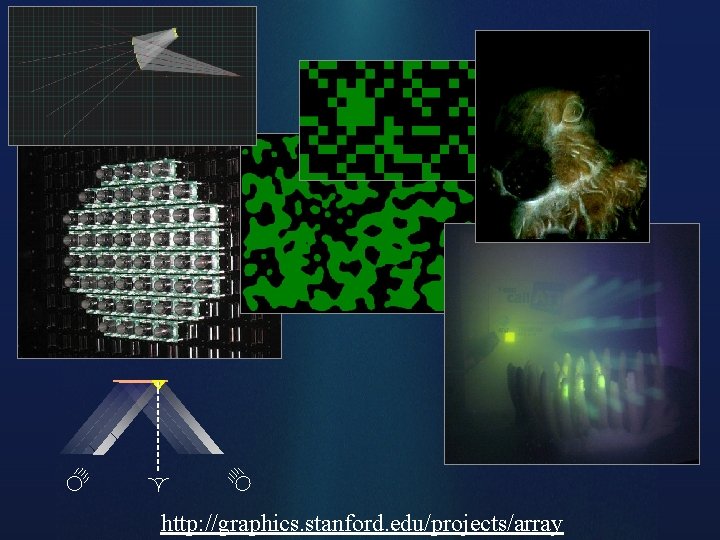
http: //graphics. stanford. edu/projects/array Ó 2004 Marc Levoy