
Synthesizing Patterns By Yarinette Ventura and Shania Dias

Synthesizing Patterns By: Yarinette Ventura and Shania Dias
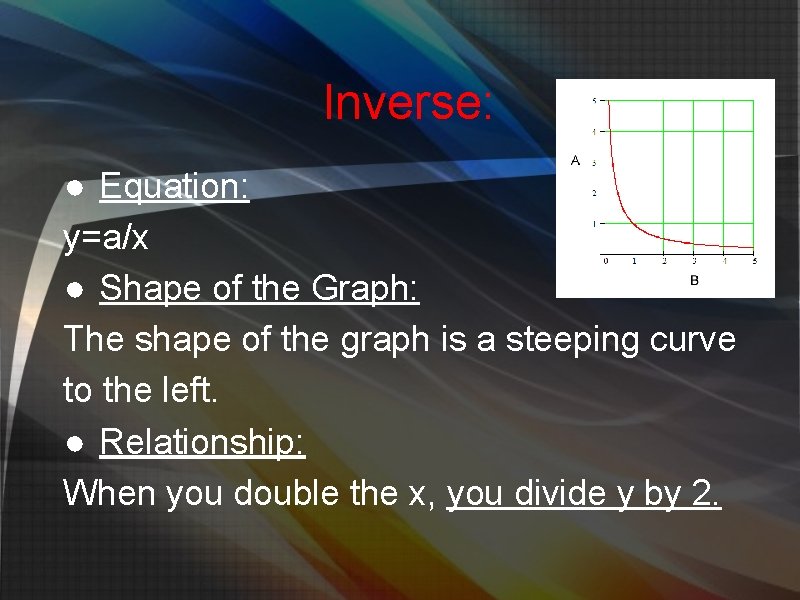
Inverse: ● Equation: y=a/x ● Shape of the Graph: The shape of the graph is a steeping curve to the left. ● Relationship: When you double the x, you divide y by 2.
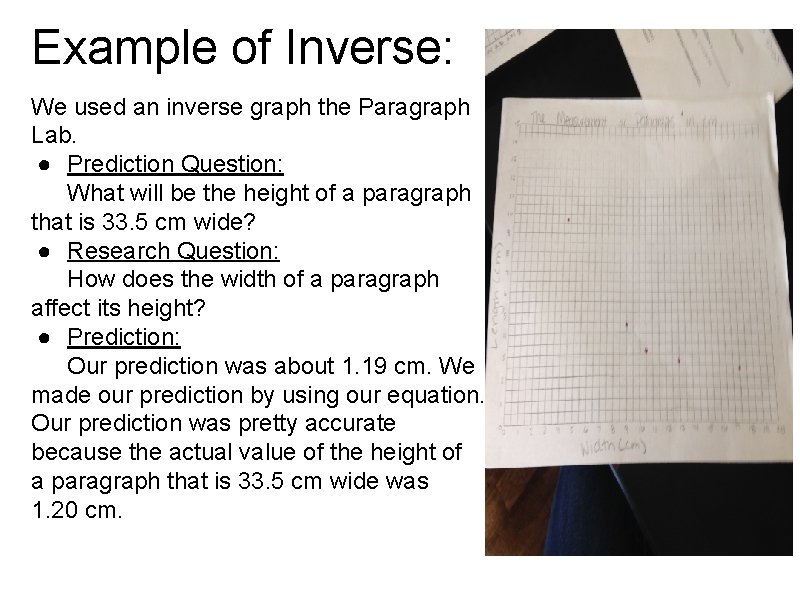
Example of Inverse: We used an inverse graph the Paragraph Lab. ● Prediction Question: What will be the height of a paragraph that is 33. 5 cm wide? ● Research Question: How does the width of a paragraph affect its height? ● Prediction: Our prediction was about 1. 19 cm. We made our prediction by using our equation. Our prediction was pretty accurate because the actual value of the height of a paragraph that is 33. 5 cm wide was 1. 20 cm.
Procedure of the Paragraph Lab: 1. Gather all materials 2. Measure the height and width of each paragraph and record. 3. Using different widths of the paragraph, do 5 trials in total.
How we answered the research question: We had the same paragraph printed out, but with different widths. Everything else about the paragraph and the paper stayed the same. We answered the research question by measuring the height and the width of each version of the paragraph. Then, we saw how the width affected the height of the paragraph each time. We compared the different measurements. We saw that as the width of the paragraph decreased, the height of the paragraph increased, each time.
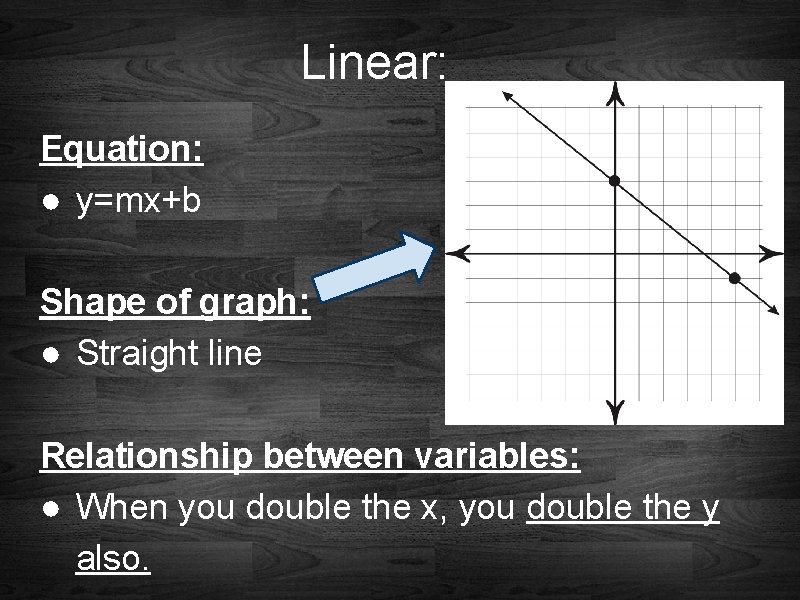
Linear: Equation: ● y=mx+b Shape of graph: ● Straight line Relationship between variables: ● When you double the x, you double the y also.
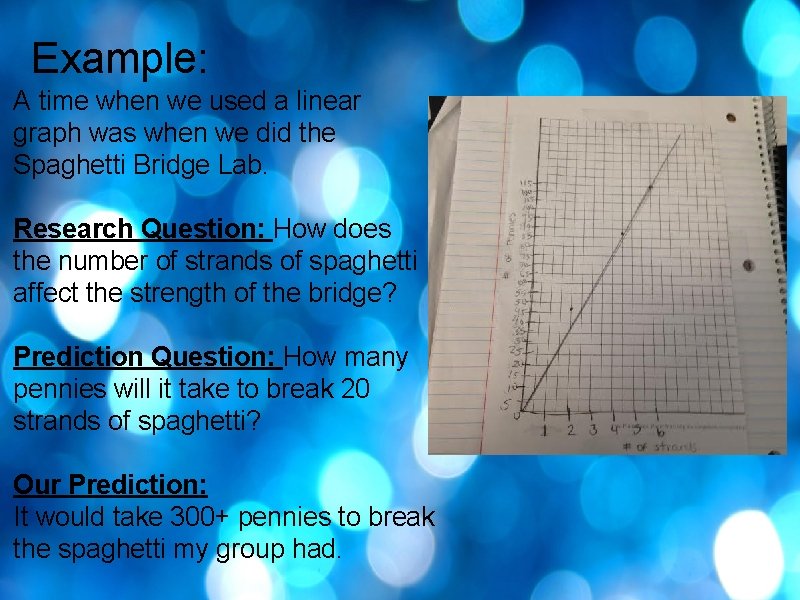
Example: A time when we used a linear graph was when we did the Spaghetti Bridge Lab. Research Question: How does the number of strands of spaghetti affect the strength of the bridge? Prediction Question: How many pennies will it take to break 20 strands of spaghetti? Our Prediction: It would take 300+ pennies to break the spaghetti my group had.

How we answered the research question: My group and I answered the research question by placing a low amount of strands of spaghetti and adding one penny at a time. The more amount of strands we used to build the bridge made it harder to break. We added more strands of spaghetti 3 times to see if the number of pennies to break would increase. At the end of the 3 trials we came to the conclusion that when increasing the amount of strands of spaghetti increased the amount of pennies also.
Procedure for Spaghetti Bridge Lab: 1. Get all the materials. 1. Move tables away from each other. 1. Make a bridge out of the spaghetti. 1. Have the material manger ready to get the cup. 1. Place cup on bridge. 1. Add pennies one by one until the bridge breaks. 1. Record data. 1. Do 3 times.
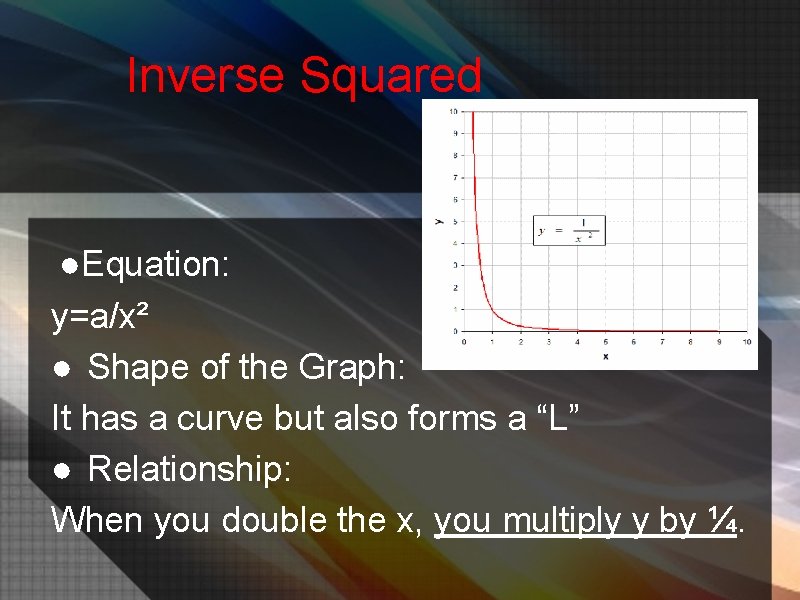
Inverse Squared ●Equation: y=a/x² ● Shape of the Graph: It has a curve but also forms a “L” ● Relationship: When you double the x, you multiply y by ¼.
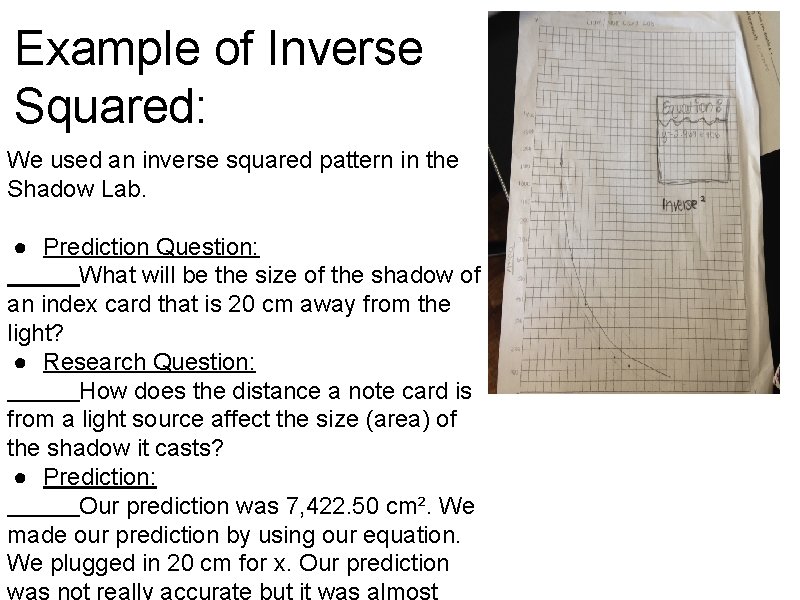
Example of Inverse Squared: We used an inverse squared pattern in the Shadow Lab. ● Prediction Question: What will be the size of the shadow of an index card that is 20 cm away from the light? ● Research Question: How does the distance a note card is from a light source affect the size (area) of the shadow it casts? ● Prediction: Our prediction was 7, 422. 50 cm². We made our prediction by using our equation. We plugged in 20 cm for x. Our prediction
Procedure of the Shadow Lab: 1. Get out the materials 2. A person must hold the light and measure the distance between the light and the wall. 3. The same person holds the index card and the light. 4. Turn on the light and find the area of the shadow and record. 5. Do 6 trials.
How we answered the research question: We answered the research question by holding an index card and using a flashlight to cast a shadow of the index card. We measured the distance that the index card was from the flashlight. We also measured the area of the shadow. Then, we compared the distance that the index card was from the light, to the area of the shadow. In the end, we found out that, the smaller the distance is from the index card to the light, the bigger the area of the shadow will be.
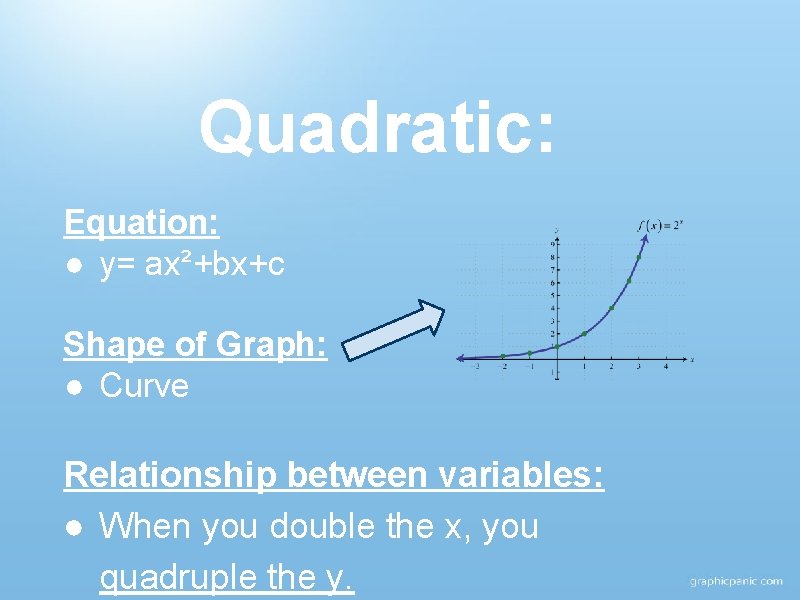
Quadratic: Equation: ● y= ax²+bx+c Shape of Graph: ● Curve Relationship between variables: ● When you double the x, you quadruple the y.
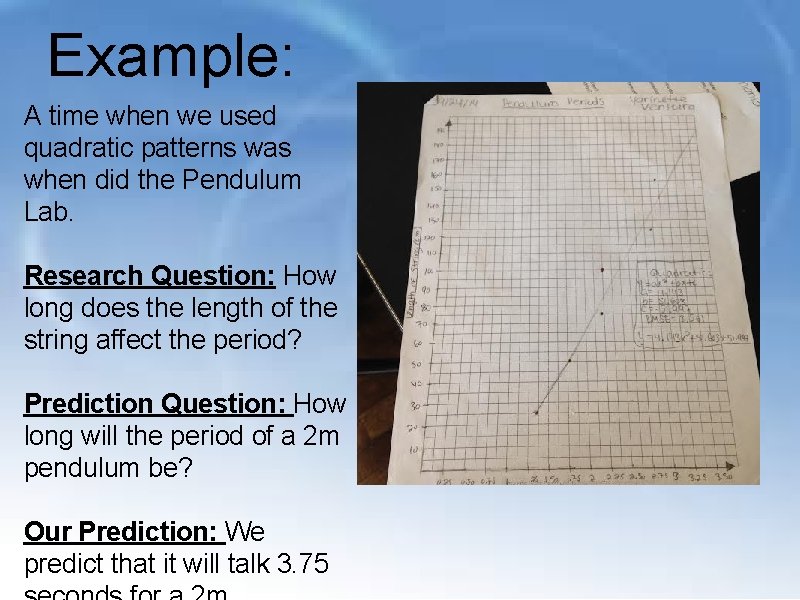
Example: A time when we used quadratic patterns was when did the Pendulum Lab. Research Question: How long does the length of the string affect the period? Prediction Question: How long will the period of a 2 m pendulum be? Our Prediction: We predict that it will talk 3. 75
How we answered the research question: My group and I answered the research question by making a graph and determining where the point would be plotted. After we finished looking at the graph we did the experiment to see if we were correct. My group and I guess it would be 3. 75 and it reached us at 3. 75.
Procedure: 1. Measure the string. 1. Place weight on string. 1. Someone holds pendulum. 1. Position arm at a 90 degree angle. 1. Someone hold the pendulum at a 30 degree angle (use protractor to help). 1. Time the pendulum from the second it is released to when it reaches the angle it started from. 1. Repeat 3 times for each string.
- Slides: 17