
Synthesis of TwoDimensional Polymer Using SelfAssembly at AirWater
Synthesis of Two-Dimensional Polymer Using Self-Assembly at Air/Water Interface Tobe Lab. M 1 Kazuki Kunimoto 1
Contents • Introduction • Two-Dimensional Polymer • Purpose of My Work • My Work • Designing and Synthesizing Monomer • Preparation and Measurement of Langmuir Film and Langmuir-Blodgett (LB) Film • Irradiation of Langmuir Film • Summary and Future Works

Introduction-2 D polymer 2 D Polymer: Sheet shape defect free polymer connected by covalent bonding. Lateral connection of monomers result in a sheet shape polymer. monomer Unique potential properties: Two distinguishable faces Mechanical properties Separation of small molecules 2 D polymer Schlüter, A. D. et al. Angew. Chem. Int. Ed. 2009, 48, 1030. ex) graphene[2] exf o liat ion Properties of graphene: superlative mechanical strength extraordinarily high carrier mobility single-molecule detection http: //mono. sozonochikara. com/2010/08/26/pencil. gif [2] http: //www. nanochemistry. it/download/graphene 01 h. jpg
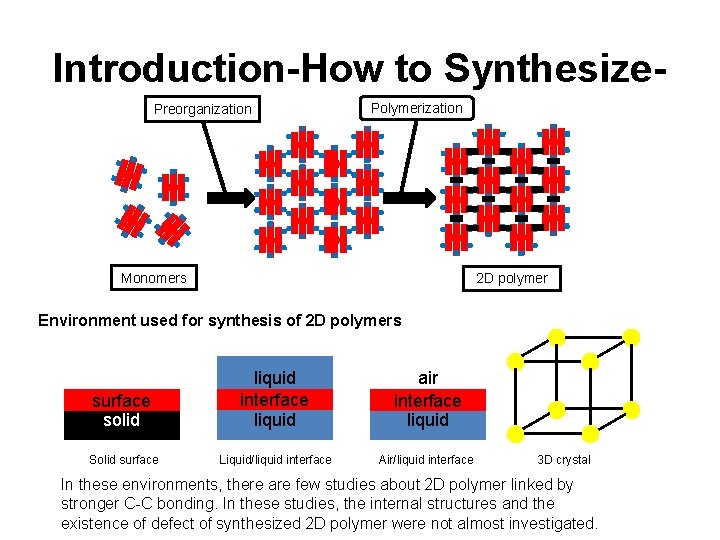
Introduction-How to Synthesize. Preorganization Polymerization Monomers 2 D polymer Environment used for synthesis of 2 D polymers surface solid liquid interface liquid air interface liquid Solid surface Liquid/liquid interface Air/liquid interface 3 D crystal In these environments, there are few studies about 2 D polymer linked by stronger C-C bonding. In these studies, the internal structures and the existence of defect of synthesized 2 D polymer were not almost investigated.
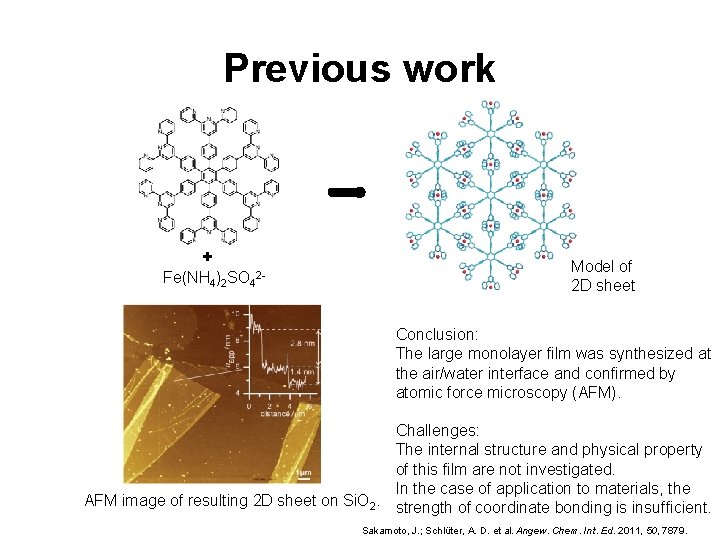
Previous work + Fe(NH 4)2 SO 42 - Model of 2 D sheet Conclusion: The large monolayer film was synthesized at the air/water interface and confirmed by atomic force microscopy (AFM). Challenges: The internal structure and physical property of this film are not investigated. In the case of application to materials, the AFM image of resulting 2 D sheet on Si. O 2. strength of coordinate bonding is insufficient. Sakamoto, J. ; Schlüter, A. D. et al. Angew. Chem. Int. Ed. 2011, 50, 7879.
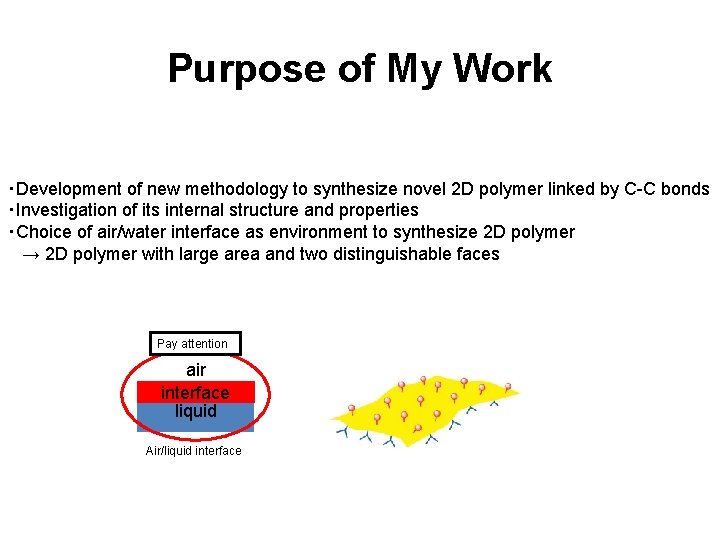
Purpose of My Work ・Development of new methodology to synthesize novel 2 D polymer linked by C-C bonds ・Investigation of its internal structure and properties ・Choice of air/water interface as environment to synthesize 2 D polymer → 2 D polymer with large area and two distinguishable faces Pay attention air interface liquid Air/liquid interface

Molecular Design of Monomer Photo-dimerization of vinyl groups Ramamurthy, V. et al. Org. Lett. 2007, 9, 5059 -5062. Supplements Possible conformation of monomer 1 at air/water interface hydrophilic groups hydrophobic and photoreactive groups Design Features of Building Block • Hexaphenylbenzene as scaffold with six-fold symmetry • Photoreactive vinyl groups to connect building blocks by C-C bonds • Amphiphilicity to enforce desirable conformation at air/water interface
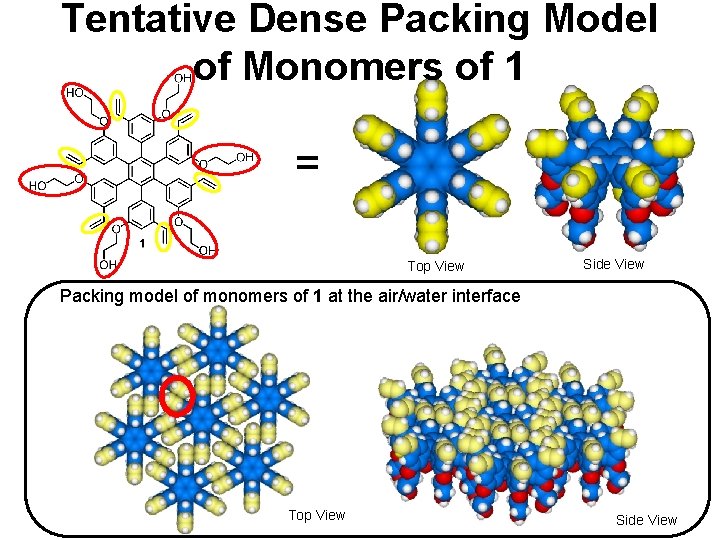
Tentative Dense Packing Model of Monomers of 1 = Top View Side View Packing model of monomers of 1 at the air/water interface Top View Side View

Synthesis of Monomer 1

Synthesis of Monomer 1
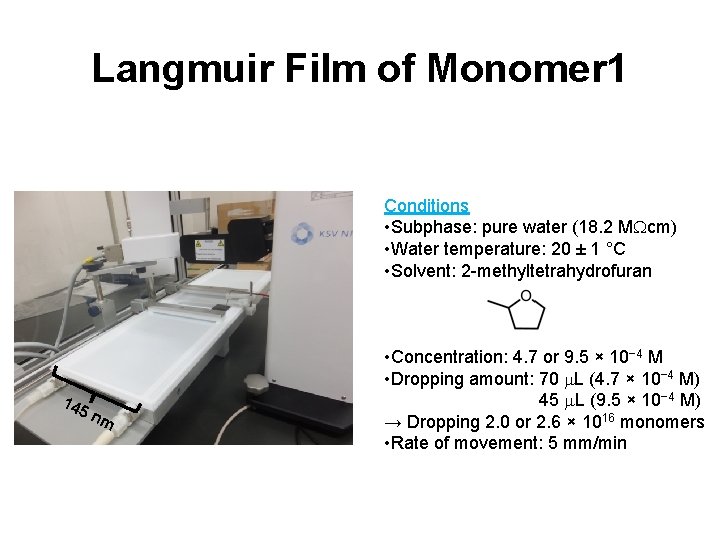
Langmuir Film of Monomer 1 Conditions • Subphase: pure water (18. 2 MWcm) • Water temperature: 20 ± 1 °C • Solvent: 2 -methyltetrahydrofuran 145 nm • Concentration: 4. 7 or 9. 5 × 10− 4 M • Dropping amount: 70 m. L (4. 7 × 10− 4 M) 45 m. L (9. 5 × 10− 4 M) → Dropping 2. 0 or 2. 6 × 10¹⁶ monomers • Rate of movement: 5 mm/min
![SP [m. N/m] Langmuir Film of Monomer 1 1. 0 m. N/m 60 50](http://slidetodoc.com/presentation_image_h/774d57ebb252f015d8ce667db4d20e49/image-12.jpg "SP [m. N/m] Langmuir Film of Monomer 1 1. 0 m. N/m 60 50")
SP [m. N/m] Langmuir Film of Monomer 1 1. 0 m. N/m 60 50 40 30 20 10 0 12. 8 Å 60 ° 12. 8 Å 0 100 142 200 MMA [Å2] 20 m. N/m 27 m. N/m (142 Å)
![SP [m. N/m] 50 Changing SP 40 from 30 to 3. 0 m. N/m](http://slidetodoc.com/presentation_image_h/774d57ebb252f015d8ce667db4d20e49/image-13.jpg "SP [m. N/m] 50 Changing SP 40 from 30 to 3. 0 m. N/m")
SP [m. N/m] 50 Changing SP 40 from 30 to 3. 0 m. N/m Changing SP to 30 m. N/m 30 20 100 150 200 MMA [Å2] 50 40 30 20 100 2 cycles changing SP between 3. 0 and 50 m. N/m 150 MMA [Å2] 200 SP [m. N/m] Langmuir Film of Monomer 1 50 cycles changing SP 40 3 between 3. 0 and 30 m. N/m 30 20 100 150 MMA [Å2] 200

Langmuir-Blodgett (LB) Film of Monomer 1 -How to Transfer(a) Vertically lifting after preparing a Langmuir film (b) Transfer Conditions • Concentration: 4. 7 × 10− 4 M (Si. O 2) 9. 5 × 10− 4 M (mica) • Volume of solution: 70 m. L (4. 7 × 10− 4 M) 45 m. L (9. 5 × 10− 4 M) • SP: 30 m. N/m (Si. O 2) 20 m. N/m (mica) • Rate of substrate movement: 0. 5 mm/min
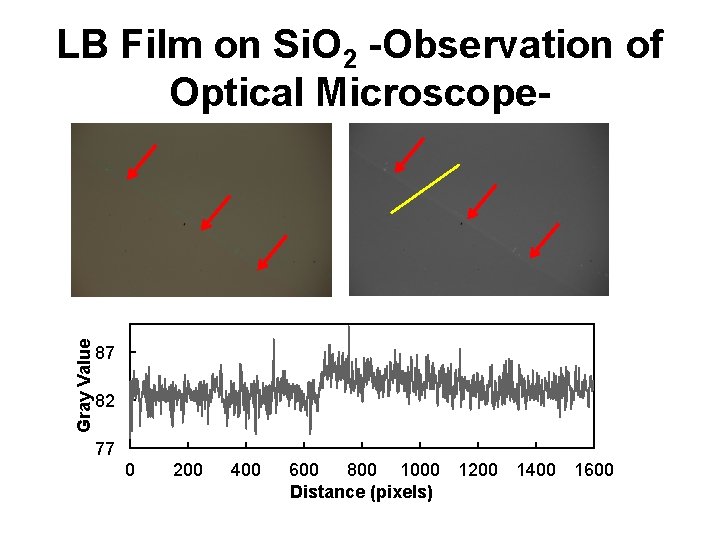
Gray Value LB Film on Si. O 2 -Observation of Optical Microscope- 87 82 77 0 200 400 600 800 1000 Distance (pixels) 1200 1400 1600
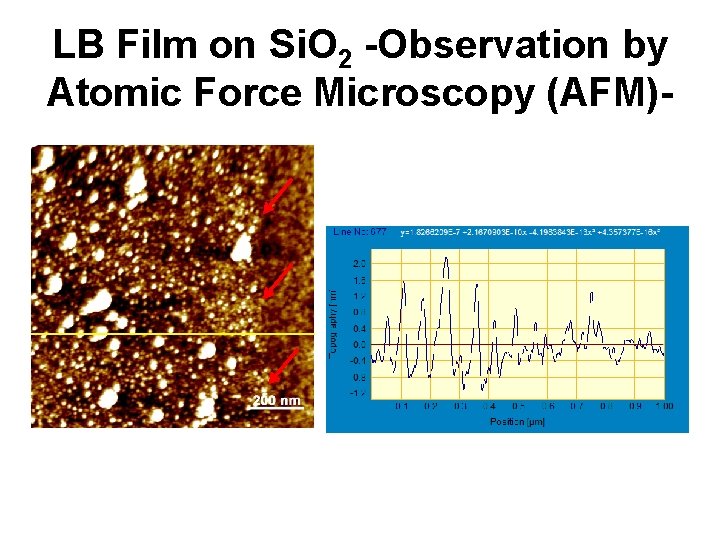
LB Film on Si. O 2 -Observation by Atomic Force Microscopy (AFM)-

LB Film on Mica -Observation by AFM- 10. 1 Å Side View

Irradiation of Langmuir Film Conditions • Light source: Xenon Lamp • Band-Pass Filter: 254 or 320 nm • Irradiation time: 1 or 2 h

Irradiated LB Film on Si. O 2 -Observation by AFM-
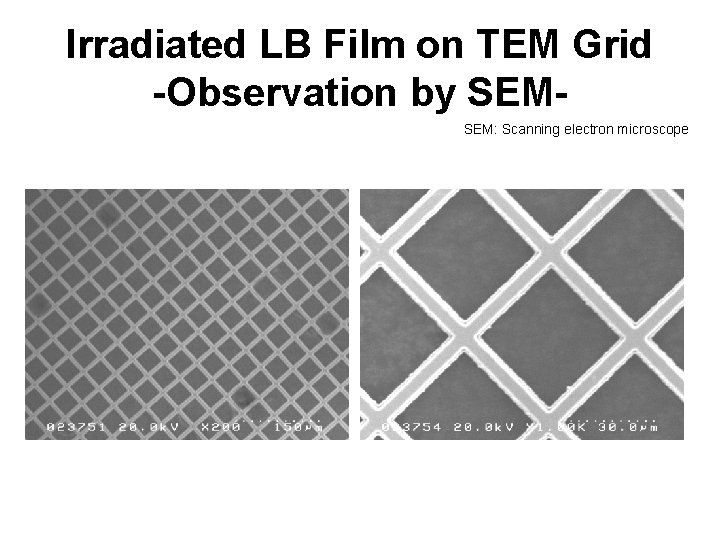
Irradiated LB Film on TEM Grid -Observation by SEMSEM: Scanning electron microscope

Why not to Polymerize 3. 1 Å Topochemical control of the reaction dictates that the pair of reacting olefins should be parallel to one another, and be separated by a distance of less than 4. 2 Å. Izgorodina, E. I. ; Saito, K. et al. Photochem. Photobiol. Sci. 2012, 11, 1938– 1951.
Summary • Designed monomer 1 was synthesized. • Monomer 1 formed a homogeneous film at air/water interface. • A Langmuir film was not transferred on a Si. O 2 surface probably because of uneven features of the Si. O 2 surface. • A Langmuir film was transferred on a mica surface. While lateral size is small, height profiles measured from AFM topography images confined that thickness of the transferred film (1 nm) corresponded an estimated molecular height of ca. 1 nm. • Irradiation of a Langmuir film at the air/water interface didn’t occur photopolymerization of Monomer 1.

Future Works • Optimization of conditions for film transfer on a mica surface. • Characterization of transferred films. • Cross-linking via photodimerization of the vinyl groups of 1 in both Langmuir films at the interface and LB films on mica surfaces to synthesize 2 D polymers.
- Slides: 23