
Synthesis of titanium and diamondlike carbon thin films
Synthesis of titanium and diamond-like carbon thin films bi-layers used as an electrode for electrochemical advanced oxidation in diuron degradation by dc magnetron sputtering Nimit Kantiyawong 1, Varong Pavarajarn 1, Boonchoat Paosawatyanyong 2 1 Center of Excellent in Particle Technology, Faculty of Engineering, Chulalongkorn University, Thailand 2 Department of Physics, Faculty of Science, Chulalongkorn University, Thailand 1
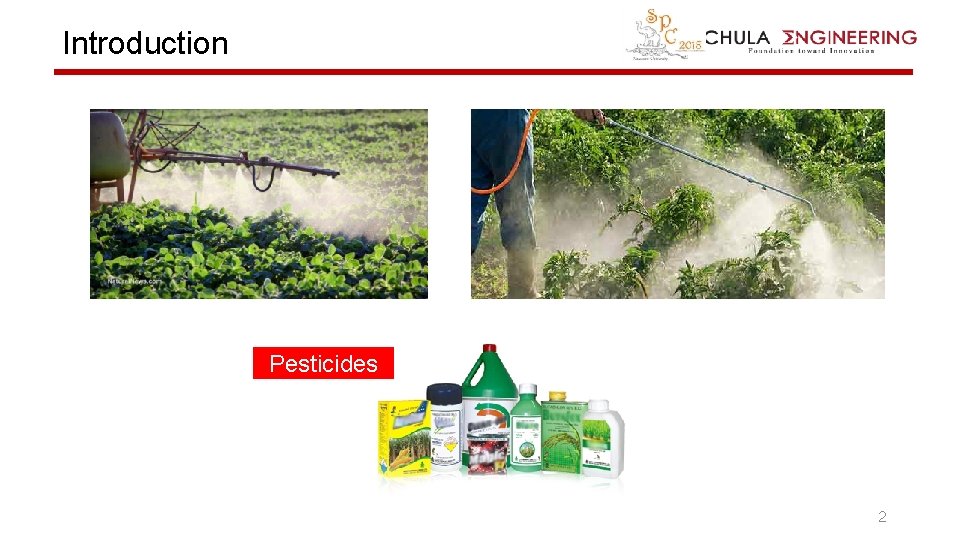
Introduction Pesticides 2
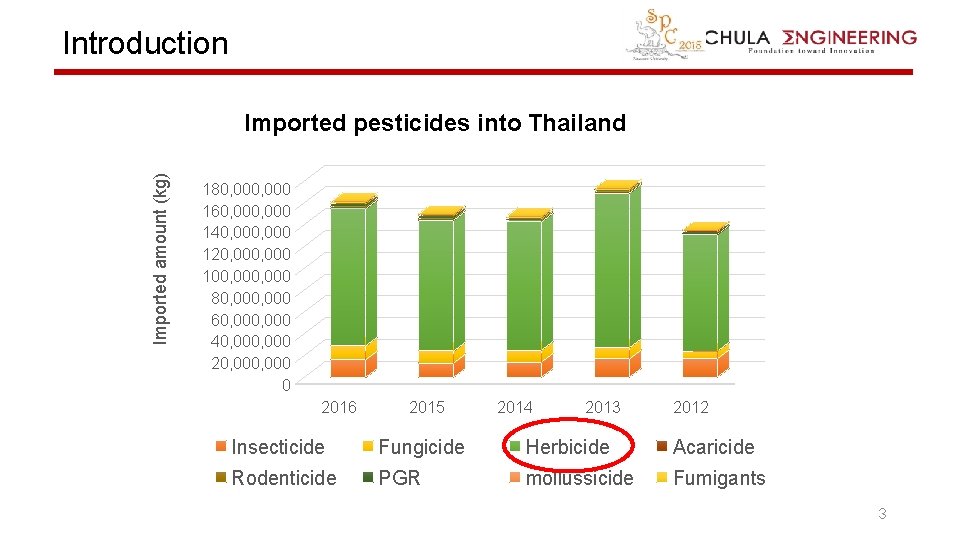
Introduction Imported amount (kg) Imported pesticides into Thailand 180, 000 160, 000 140, 000 120, 000 100, 000 80, 000 60, 000 40, 000 20, 000 0 2016 2015 2014 2013 2012 Insecticide Fungicide Herbicide Acaricide Rodenticide PGR mollussicide Fumigants 3
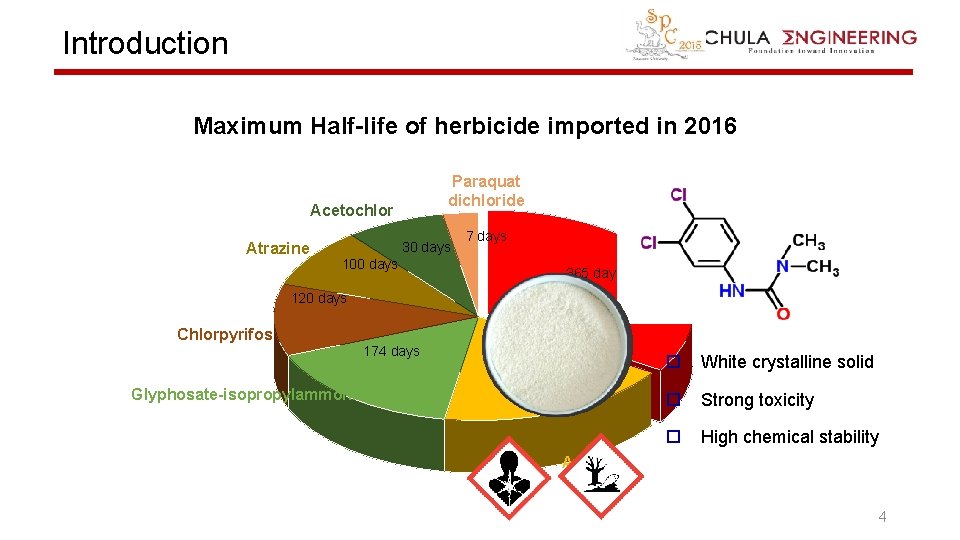
Introduction Maximum Half-life of herbicide imported in 2016 Paraquat dichloride Acetochlor Atrazine 30 days 7 days 100 days 365 days [CATEGOR Y NAME] 120 days Chlorpyrifos 174 days 210 days Glyphosate-isopropylammonium o White crystalline solid o Strong toxicity o High chemical stability Ametryn 4

Introduction Techniques for the treatment of diuron contamination in water Disintegration of substance by bacteria Bio H H e H 2 O AOPs Used porous materials to remove substance Adsorb H H Photocatalytic process OH radicals Creation of highly reactive radicals Fenton’ process EAOP ü High efficiency ü Easy to fabricate 5
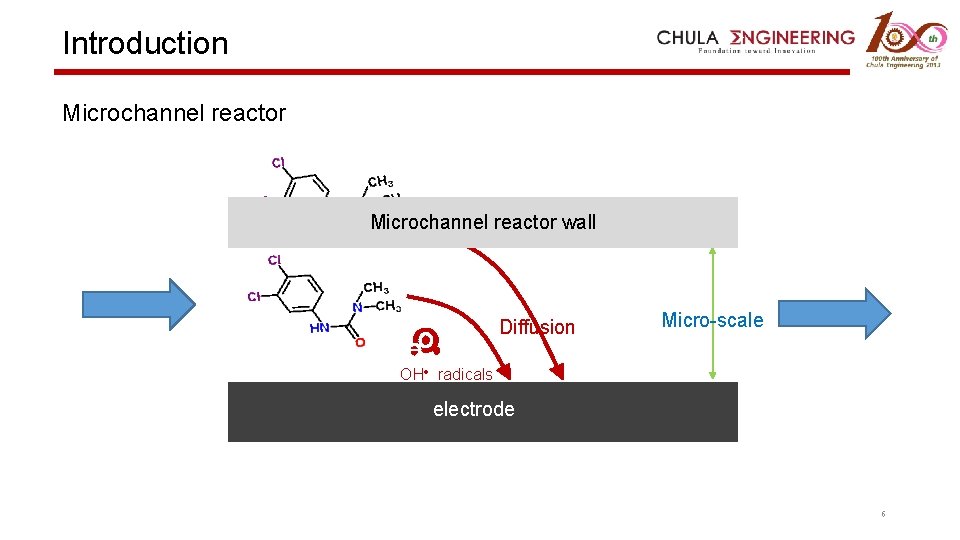
Introduction Microchannel reactor wall Diffusion Micro-scale H OH radicals electrode 6

Introduction Diamond-like carbon (DLC) DLC is the amorphous carbon films combination of graphite-like bond and diamond-like bond Graphite-like bond Properties of DLC films ü High chemical inertness ü Hardness Diamond-like bond ü Wide potential window 7
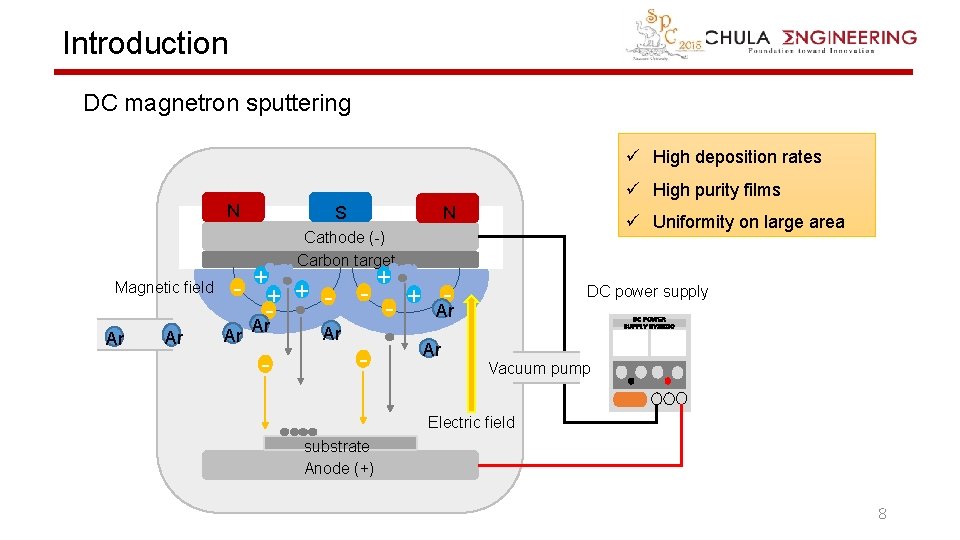
Introduction DC magnetron sputtering ü High deposition rates ü High purity films N N S ü Uniformity on large area Cathode (-) Carbon target Magnetic field Ar Ar - ++ + - - + + Ar Ar - - DC power supply DC POWER SUPPLY HY 3003 D Ar Vacuum pump Electric field substrate Anode (+) 8
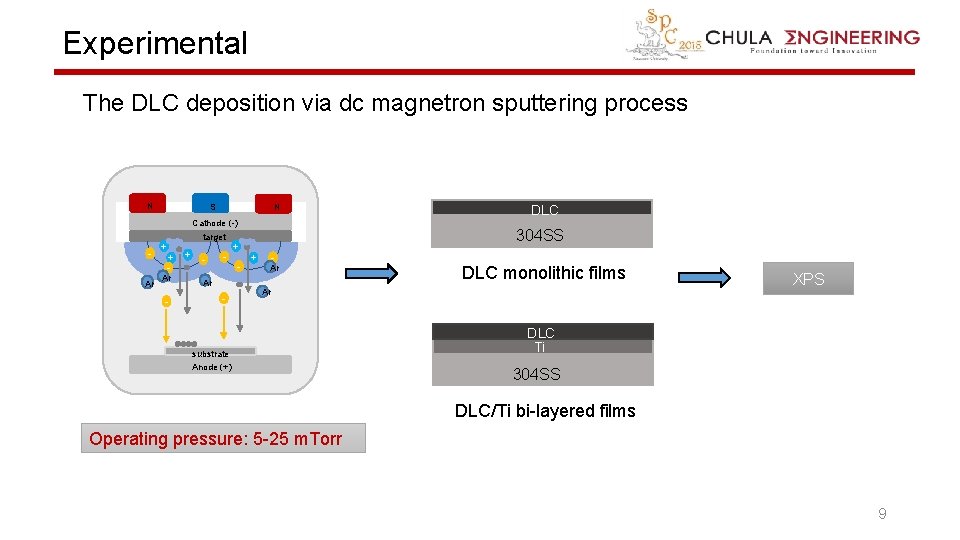
Experimental The DLC deposition via dc magnetron sputtering process N N S Cathode (-) Ar + + - Ar - target + - - Ar - + - DLC 304 SS + - Ar DLC monolithic films Ar substrate Anode (+) XPS DLC Ti 304 SS DLC/Ti bi-layered films Operating pressure: 5 -25 m. Torr 9
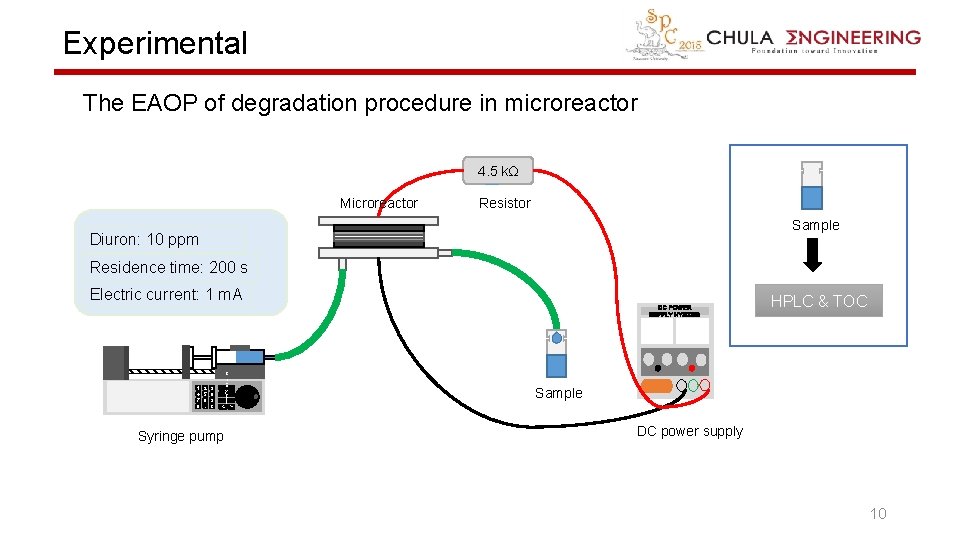
Experimental The EAOP of degradation procedure in microreactor 4. 5 kΩ Microreactor Resistor Sample Diuron: 10 ppm Residence time: 200 s Electric current: 1 m. A DC POWER SUPPLY HY 3003 D 1 4 7 0 2 5 8. 3 6 9 C C h a E n x > gi e|t <| > Syringe pump HPLC & TOC Sample DC power supply 10
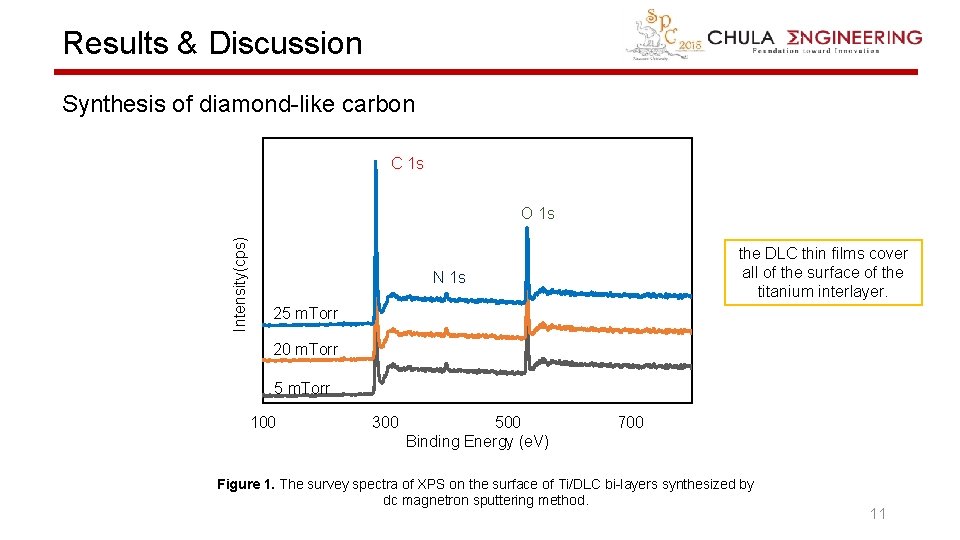
Results & Discussion Synthesis of diamond-like carbon C 1 s Intensity(cps) O 1 s the DLC thin films cover all of the surface of the titanium interlayer. N 1 s 25 m. Torr 20 m. Torr 5 m. Torr 100 300 500 Binding Energy (e. V) 700 Figure 1. The survey spectra of XPS on the surface of Ti/DLC bi-layers synthesized by dc magnetron sputtering method. 11

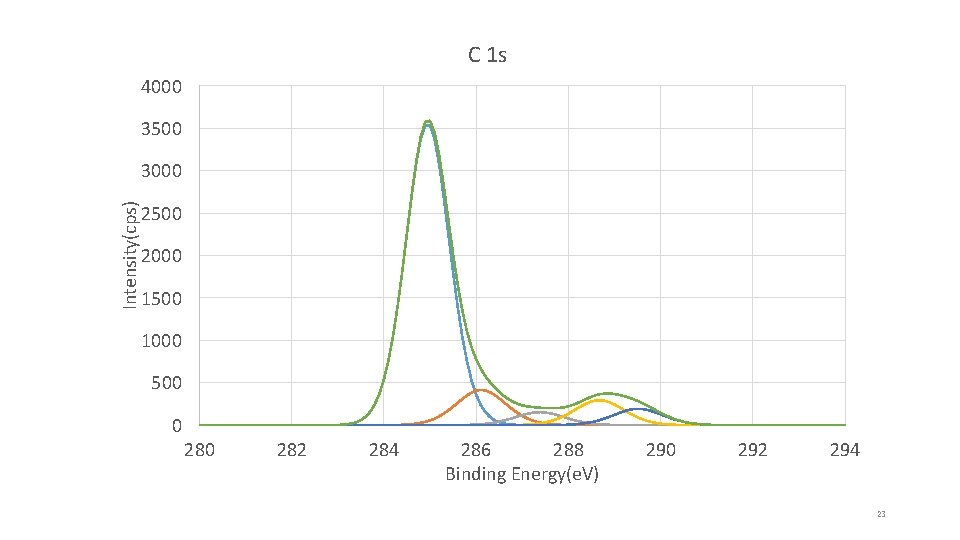
Results & Discussion Synthesis of diamond-like carbon Operating pressure 5 m. Torr 20 m. Torr 25 m. Torr Intensity (cps) sp 3 (285. 2 e. V) sp 3 (285. 2) sp 2 (284. 4) sp 2/sp 3 634. 9 6484. 87 1018. 69 1914. 34 2234. 39 1871. 97 0. 32 0. 35 0. 54 sp 2 (284. 4 e. V) the increasing of operating pressure increases the ratio of sp 2/sp 3. C-O 282 284 286 288 290 Binding Energy (e. V) 292 Figure 2. The deconvolution of C 1 s peak of diamond-like carbon synthesized by dc magnetron sputtering method. 12
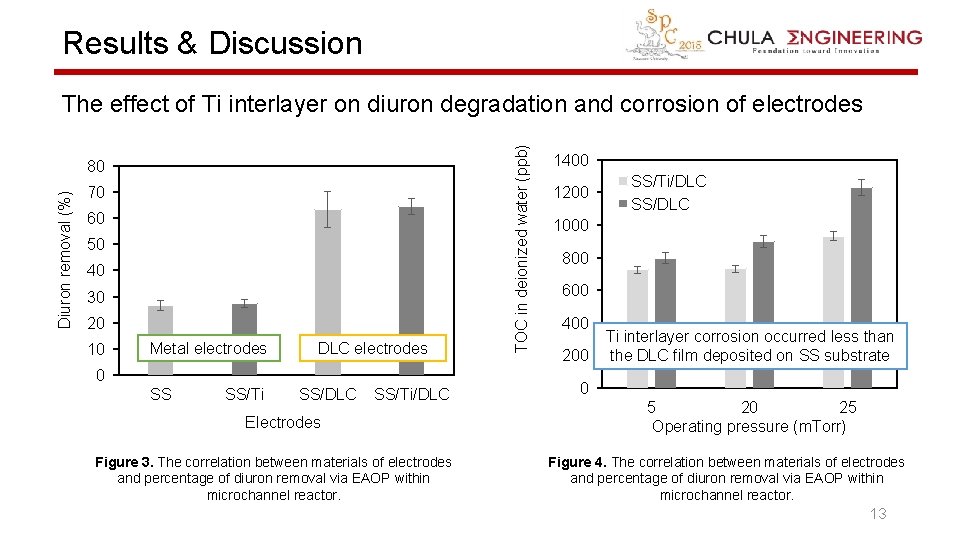
Results & Discussion Diuron removal (%) 80 70 60 50 40 30 20 10 Metal electrodes DLC electrodes 0 SS SS/Ti SS/DLC SS/Ti/DLC Electrodes Figure 3. The correlation between materials of electrodes and percentage of diuron removal via EAOP within microchannel reactor. TOC in deionized water (ppb) The effect of Ti interlayer on diuron degradation and corrosion of electrodes 1400 1200 SS/Ti/DLC SS/DLC 1000 800 600 400 200 Ti interlayer corrosion occurred less than the DLC film deposited on SS substrate 0 5 20 25 Operating pressure (m. Torr) Figure 4. The correlation between materials of electrodes and percentage of diuron removal via EAOP within microchannel reactor. 13
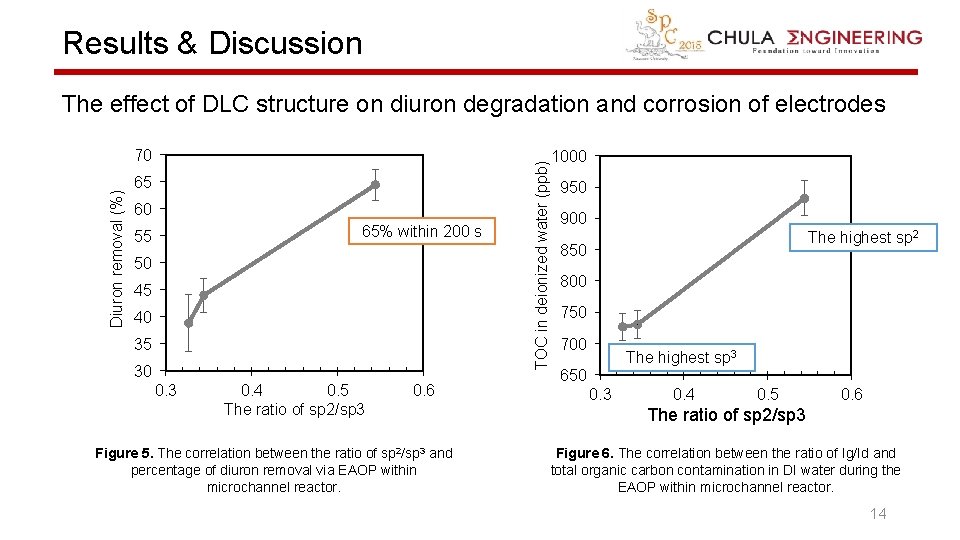
Results & Discussion Diuron removal (%) 70 65 60 65% within 200 s 55 50 45 40 35 30 0. 3 0. 4 0. 5 The ratio of sp 2/sp 3 0. 6 Figure 5. The correlation between the ratio of sp 2/sp 3 and percentage of diuron removal via EAOP within microchannel reactor. TOC in deionized water (ppb) The effect of DLC structure on diuron degradation and corrosion of electrodes 1000 950 900 The highest sp 2 850 800 750 700 The highest sp 3 650 0. 3 0. 4 0. 5 0. 6 The ratio of sp 2/sp 3 Figure 6. The correlation between the ratio of Ig/Id and total organic carbon contamination in DI water during the EAOP within microchannel reactor. 14
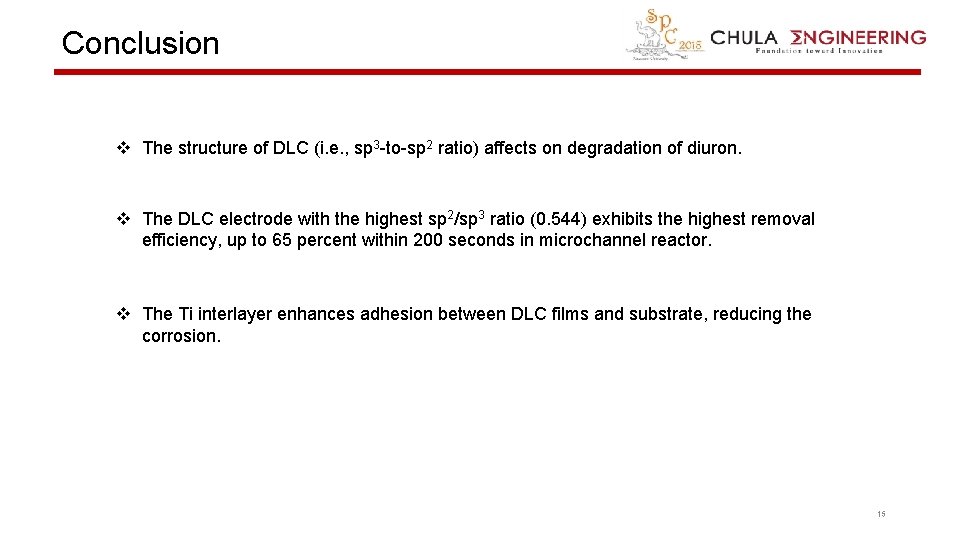
Conclusion v The structure of DLC (i. e. , sp 3 -to-sp 2 ratio) affects on degradation of diuron. v The DLC electrode with the highest sp 2/sp 3 ratio (0. 544) exhibits the highest removal efficiency, up to 65 percent within 200 seconds in microchannel reactor. v The Ti interlayer enhances adhesion between DLC films and substrate, reducing the corrosion. 15

Q&A 16

Backup 17
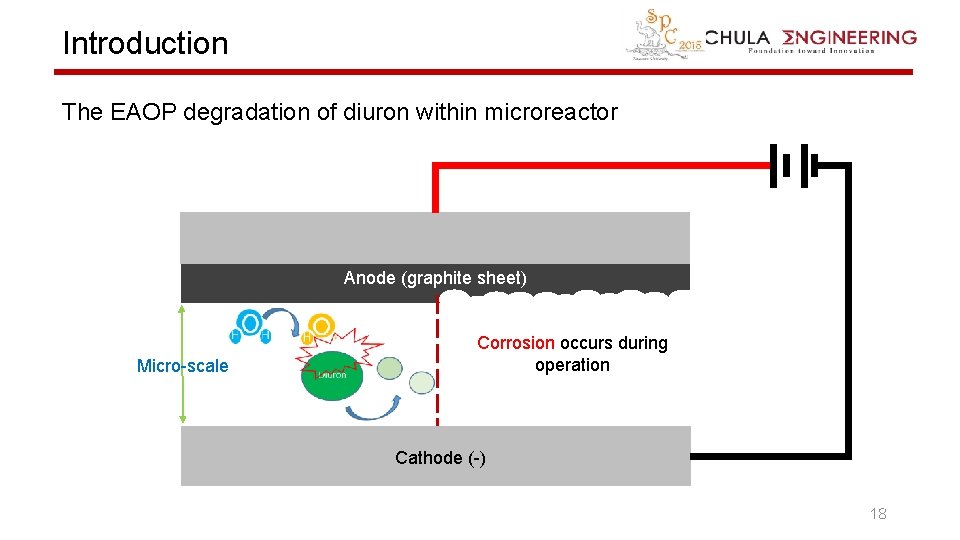
Introduction The EAOP degradation of diuron within microreactor Anode (graphite sheet) Micro-scale Corrosion occurs during operation Cathode (-) 18
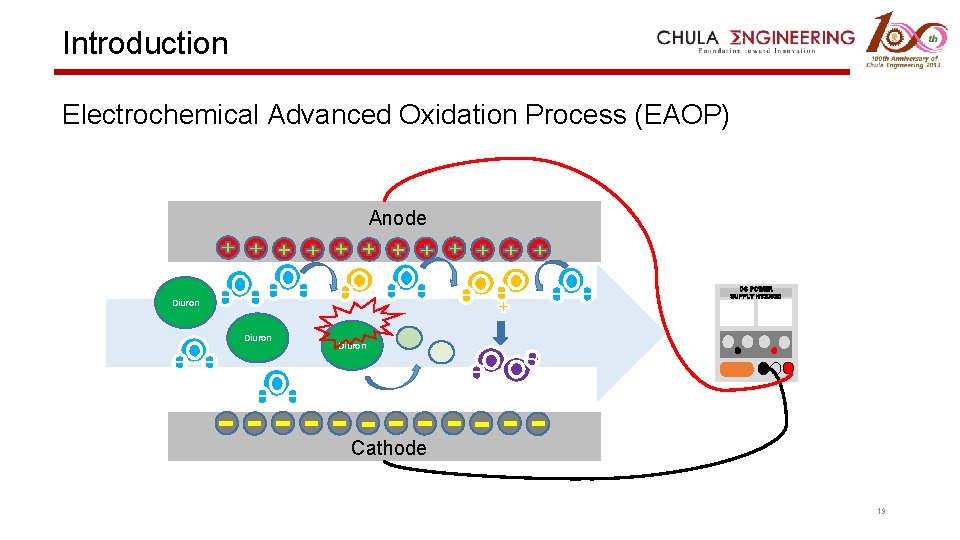
Introduction Electrochemical Advanced Oxidation Process (EAOP) Anode Diuron H H H DC POWER SUPPLY HY 3003 D H Diuron H HH H Cathode 19
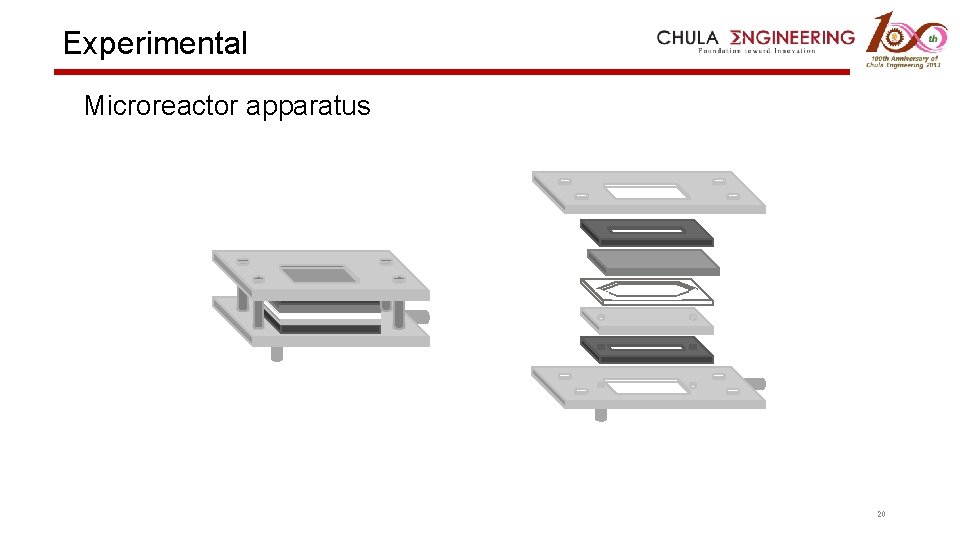
Experimental Microreactor apparatus 20
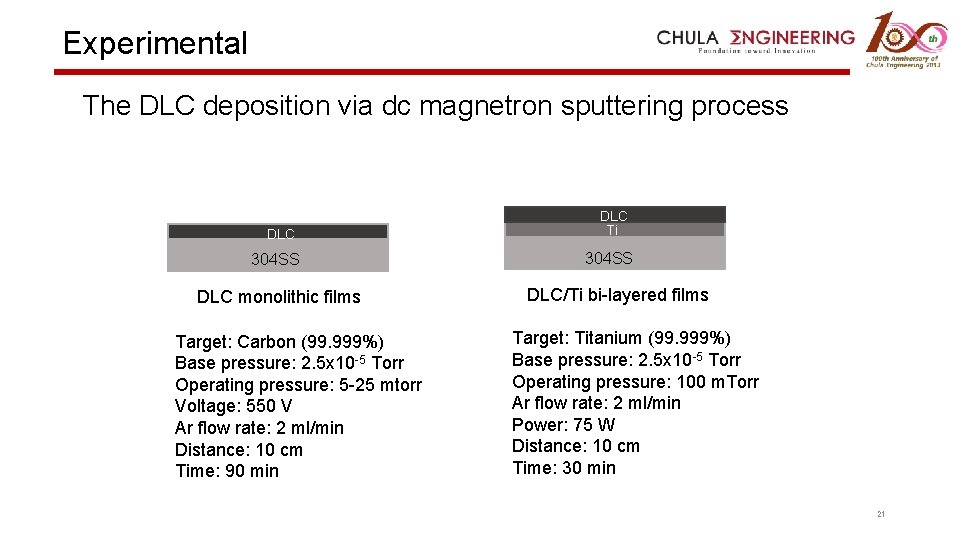
Experimental The DLC deposition via dc magnetron sputtering process DLC 304 SS DLC monolithic films Target: Carbon (99. 999%) Base pressure: 2. 5 x 10 -5 Torr Operating pressure: 5 -25 mtorr Voltage: 550 V Ar flow rate: 2 ml/min Distance: 10 cm Time: 90 min DLC Ti 304 SS DLC/Ti bi-layered films Target: Titanium (99. 999%) Base pressure: 2. 5 x 10 -5 Torr Operating pressure: 100 m. Torr Ar flow rate: 2 ml/min Power: 75 W Distance: 10 cm Time: 30 min 21
Introduction Electrochemical electrode properties § § § Hard and durable Good chemical inertness Morphological and microstructural stability High electrical conductivity Wide electrochemical potential window Handbook of electrochemical electrode 22
C 1 s 4000 3500 Intensity(cps) 3000 2500 2000 1500 1000 500 0 282 284 286 288 Binding Energy(e. V) 290 292 294 23
- Slides: 23