
Synthesis of superheavy elements using the mass Spectrometer

![The element 112 experiment (IVO [In-situ Volatilisation and On-line detection] Technique) Beam (48 Ca;](https://slidetodoc.com/presentation_image/13115a01a3d328d0db6cceb934f153d2/image-6.jpg "The element 112 experiment (IVO [In-situ Volatilisation and On-line detection] Technique) Beam (48 Ca;")




- Slides: 20
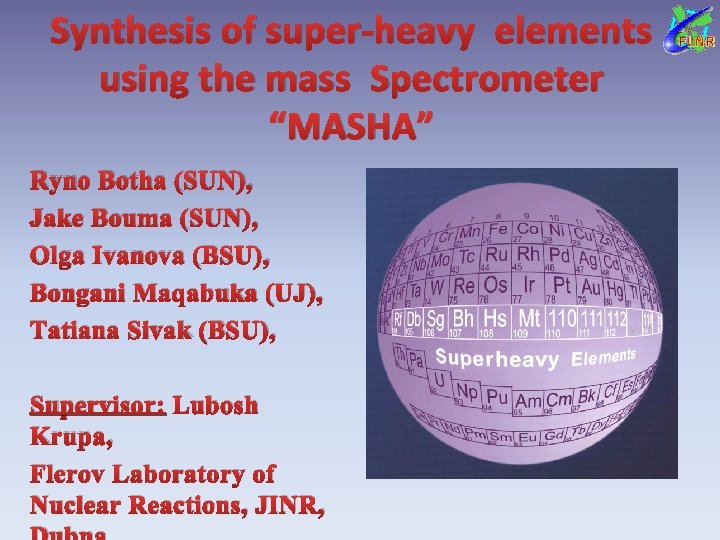
Synthesis of super-heavy elements using the mass Spectrometer “MASHA” Ryno Botha (SUN), Jake Bouma (SUN), Olga Ivanova (BSU), Bongani Maqabuka (UJ), Tatiana Sivak (BSU), Supervisor: Lubosh Krupa, Flerov Laboratory of Nuclear Reactions, JINR,
Overview • Review of synthesis of super heavy elements: reactions, decays and characterization. • Experimental Setup of MASHA. • Results of first experiments. study of evaporation residua in the reactions 40 Ar+nat. Sm and 40 Ar+166 Er. • Our time with MASHA. • Future development.
Background
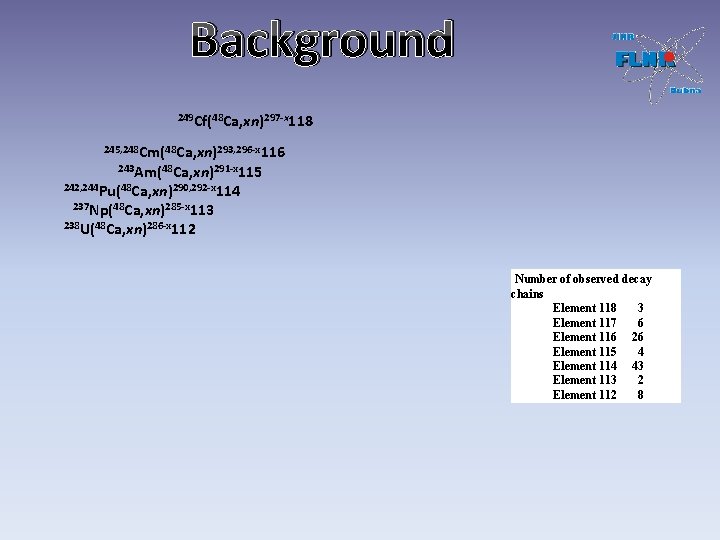
Background 249 Cf(48 Ca, xn)297 -x 118 245, 248 Cm(48 Ca, xn)293, 296 -x 116 243 Am(48 Ca, xn)291 -x 115 242, 244 Pu(48 Ca, xn)290, 292 -x 114 237 Np(48 Ca, xn)285 -x 113 238 U(48 Ca, xn)286 -x 112 Number of observed decay chains Element 118 3 Element 117 6 Element 116 26 Element 115 4 Element 114 43 Element 113 2 Element 112 8
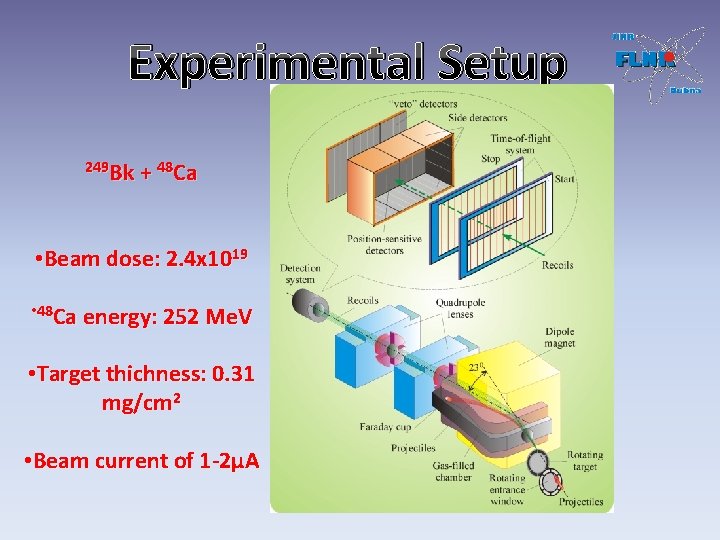
Experimental Setup 249 Bk + 48 Ca • Beam dose: 2. 4 x 10¹⁹ • 48 Ca energy: 252 Me. V • Target thichness: 0. 31 mg/cm 2 • Beam current of 1 -2µA
The element 112 experiment (IVO [In-situ Volatilisation and On-line detection] Technique) Beam (48 Ca; 233 -239 Me. V) Window/ Target (242 Pu: 1. 4 mg/cm 2) Recoil chamber Beam stop Teflon capillary Si. O 2 -Filter Ta metal 850°C Quartz inlay Cryo On-line Detector (4 p COLD) (32 pairs PIN diodes, one side gold covered) Pb Quartz column 112 Rn Loop Temperature gradient: 35°C to – 184 °C T/C Carrier gas He/Ar (70/30) l
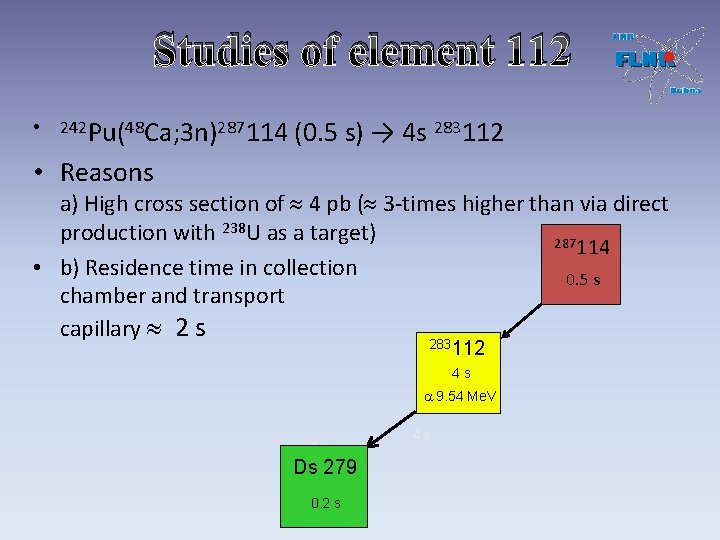
Studies of element 112 • 242 Pu(48 Ca; 3 n)287114 (0. 5 s) → 4 s 283112 • Reasons a) High cross section of 4 pb ( 3 -times higher than via direct production with 238 U as a target) 287114 • b) Residence time in collection 0. 5 s chamber and transport capillary 2 s 283112 4 s a 9. 54 Me. V 4 s Ds 279 0. 2 s 4 s
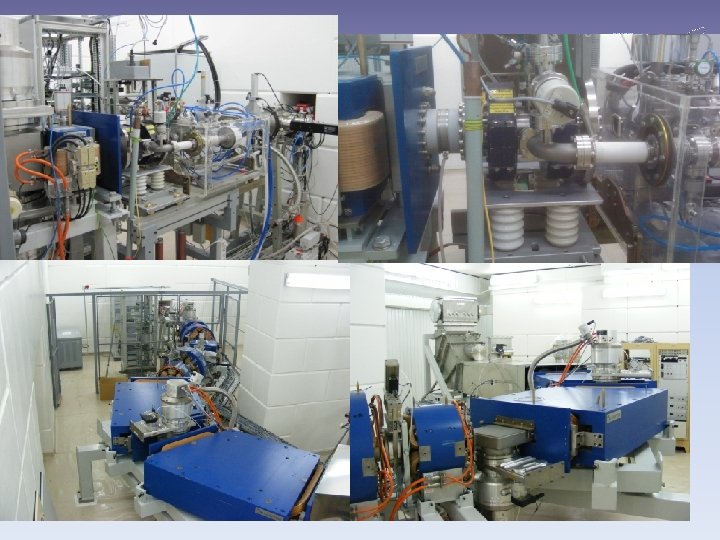
MASHA: Experimental Setup 1 – Target block with hot catcher; 2 – Ion source; 3 – Mass separator; 4 – DAQ in the focal plane.
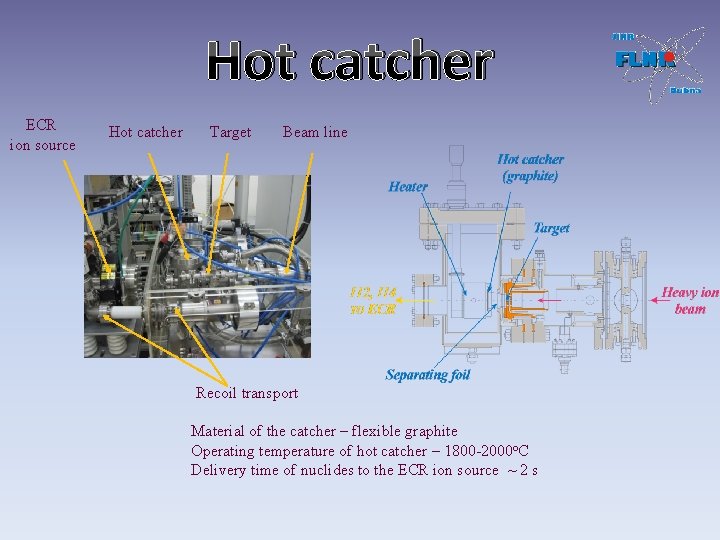
Hot catcher ECR ion source Hot catcher Target Beam line Recoil transport Material of the catcher – flexible graphite Operating temperature of hot catcher – 1800 -2000 о. С Delivery time of nuclides to the ECR ion source ~ 2 s
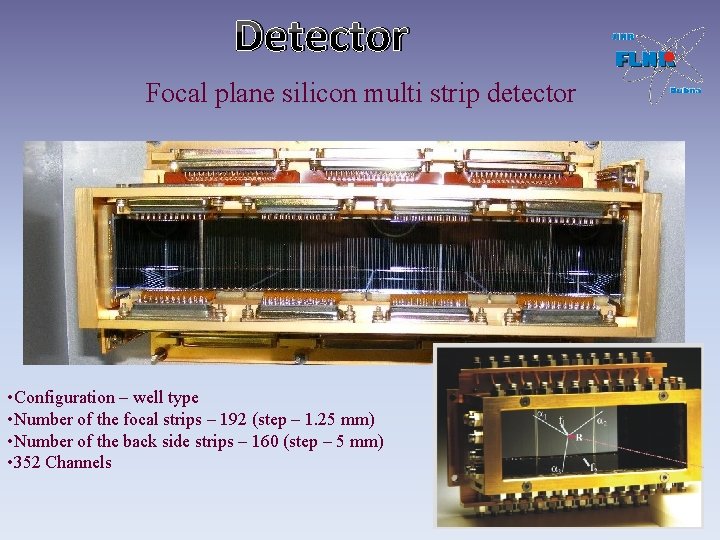
Detector Focal plane silicon multi strip detector • Configuration – well type • Number of the focal strips – 192 (step – 1. 25 mm) • Number of the back side strips – 160 (step – 5 mm) • 352 Channels
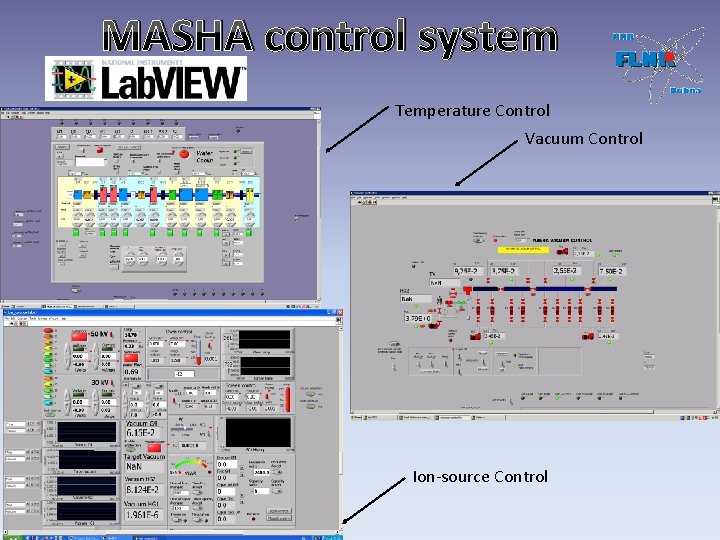
MASHA control system Temperature Control Vacuum Control Ion-source Control
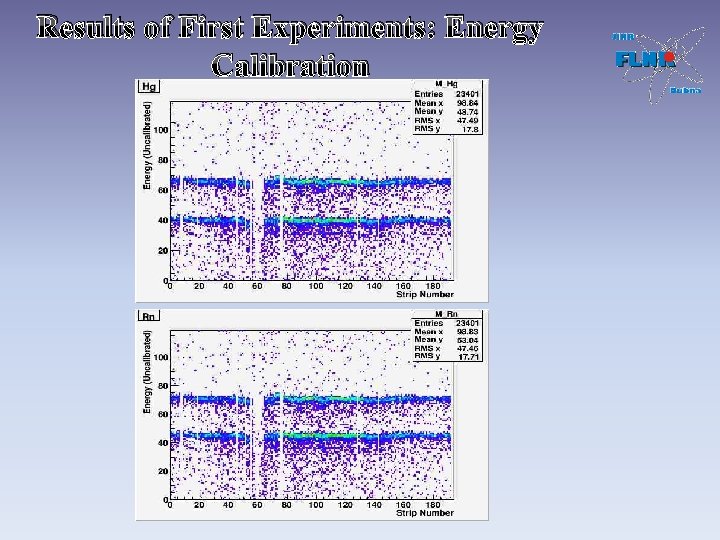
Results of First Experiments: Energy Calibration
Results of First Experiments 40 Ar 5+, Beam Current = 1 -2 u. A , Ebeam = 5 -6 Me. V/nucleon
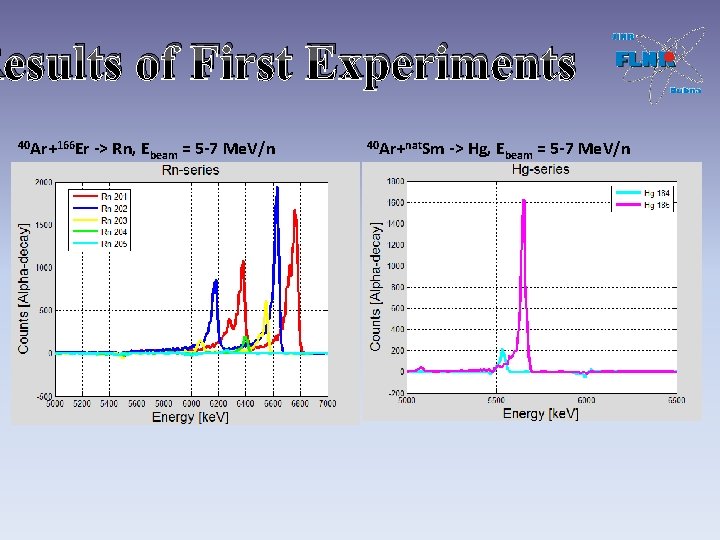
Results of First Experiments 40 Ar+166 Er -> Rn, Ebeam = 5 -7 Me. V/n 40 Ar+nat. Sm -> Hg, Ebeam = 5 -7 Me. V/n
• Future Developments Gas Catcher Short extraction times. Extraction times of 10 ms or less would be ideal. • A larger scope of reactions could be studied with a shorter half-life • Applicability to all fragment beams.
• • • Future Developments PXI Data acquisition Faster Data transfer, 100 MB/s Less physical modules needed Digital Control Environment Synchronisation with MESHA control system Better Energy and Time resolution MESHA detector, 352 channels
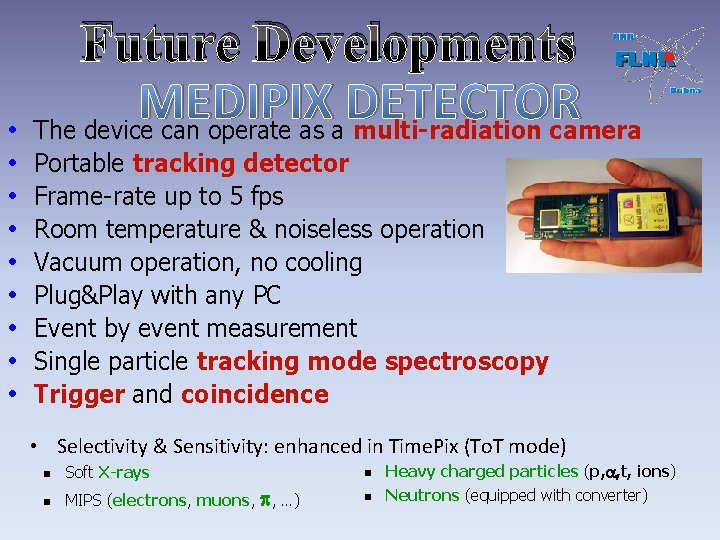
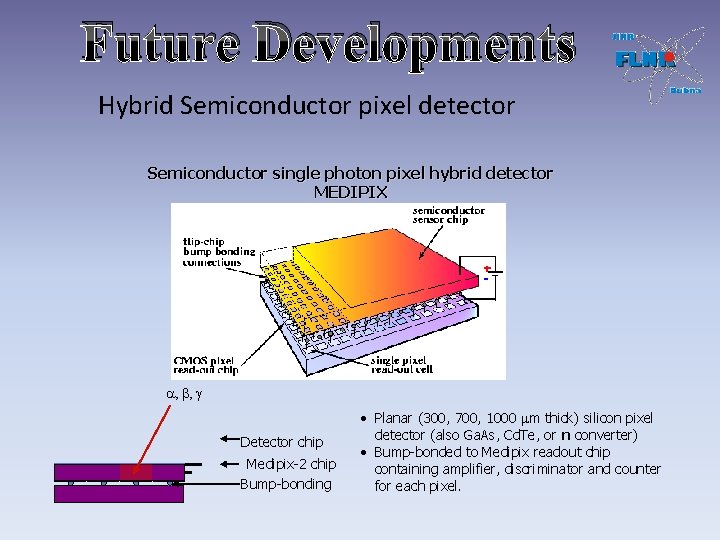
• • • Future Developments MEDIPIX DETECTOR The device can operate as a multi-radiation camera Portable tracking detector Frame-rate up to 5 fps Room temperature & noiseless operation Vacuum operation, no cooling Plug&Play with any PC Event by event measurement Single particle tracking mode spectroscopy Trigger and coincidence • Selectivity & Sensitivity: enhanced in Time. Pix (To. T mode) n Soft X-rays n n MIPS (electrons, muons, p, …) n Heavy charged particles (p, a, t, ions) Neutrons (equipped with converter)
Future Developments Hybrid Semiconductor pixel detector Semiconductor single photon pixel hybrid detector MEDIPIX a, b, g Detector chip Medipix-2 chip Bump-bonding • Planar (300, 700, 1000 mm thick) silicon pixel detector (also Ga. As, Cd. Te, or n converter) • Bump-bonded to Medipix readout chip containing amplifier, discriminator and counter for each pixel.
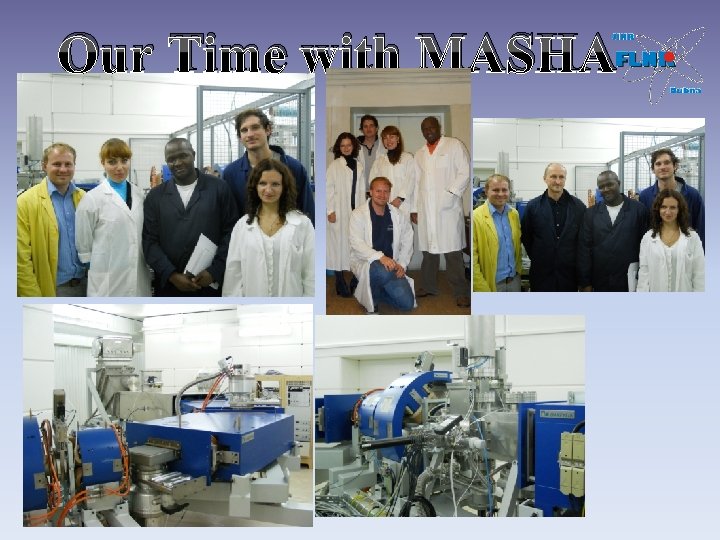
Our Time with MASHA
Questions Heavy Elements