
Synthesis of sequential circuits Steps in synthesis of

- Slides: 10
Synthesis of sequential circuits • Steps in synthesis of a sequential circuit – Specify the FSM (state table or state diagram) – Minimize the states PS x – State assignment/encoding 0 S 3 1 S 1 1 S 5 1 S 2 0 S 3 1 S 4 S 2 1 S 5 1 S 3 0 S 2 0 1/1 S 3 1 S 1 1 S 4 0 S 4 1 S 5 1 S 1 0 0/1 1/1 0/0 S 2 1/1 0/1 1/0 1/1 S 5 z S 1 • Specification: S 3 NS
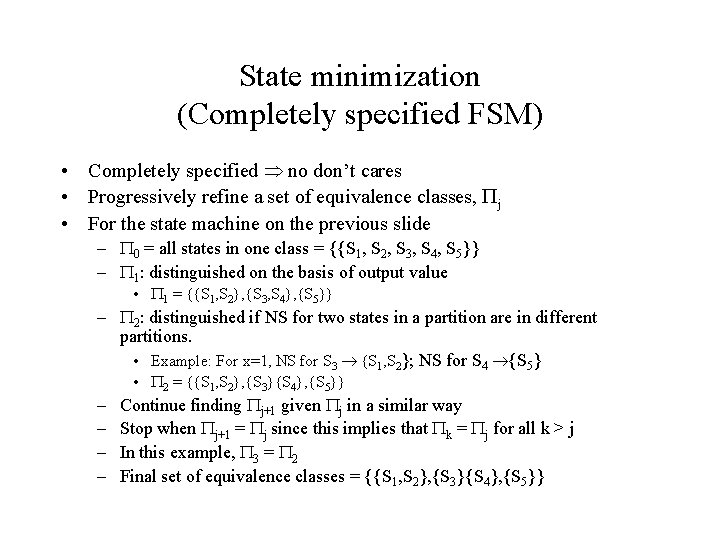
State minimization (Completely specified FSM) • Completely specified no don’t cares • Progressively refine a set of equivalence classes, j • For the state machine on the previous slide – 0 = all states in one class = {{S 1, S 2, S 3, S 4, S 5}} – 1: distinguished on the basis of output value • 1 = {{S 1, S 2}, {S 3, S 4}, {S 5}} – 2: distinguished if NS for two states in a partition are in different partitions. • Example: For x=1, NS for S 3 {S 1, S 2}; NS for S 4 {S 5} • 2 = {{S 1, S 2}, {S 3}{S 4}, {S 5}} – – Continue finding j+1 given j in a similar way Stop when j+1 = j since this implies that k = j for all k > j In this example, 3 = 2 Final set of equivalence classes = {{S 1, S 2}, {S 3}{S 4}, {S 5}}
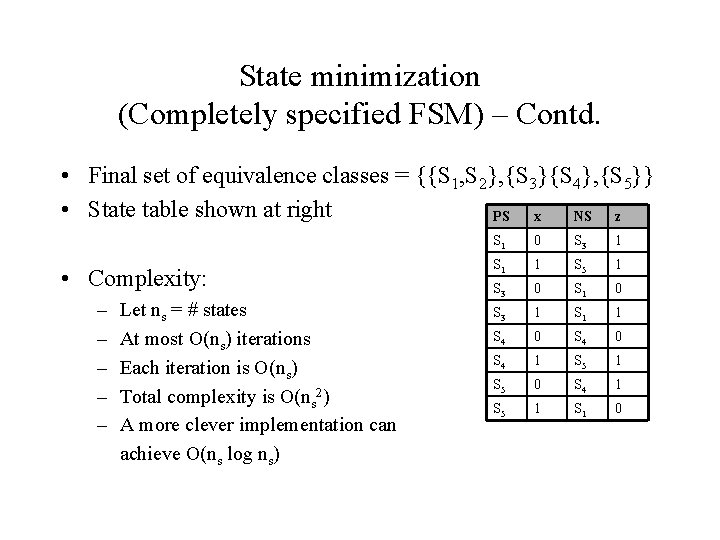
State minimization (Completely specified FSM) – Contd. • Final set of equivalence classes = {{S 1, S 2}, {S 3}{S 4}, {S 5}} • State table shown at right PS x NS z • Complexity: – – – Let ns = # states At most O(ns) iterations Each iteration is O(ns) Total complexity is O(ns 2) A more clever implementation can achieve O(ns log ns) S 1 0 S 3 1 S 1 1 S 5 1 S 3 0 S 1 0 S 3 1 S 1 1 S 4 0 S 4 1 S 5 1 S 1 0
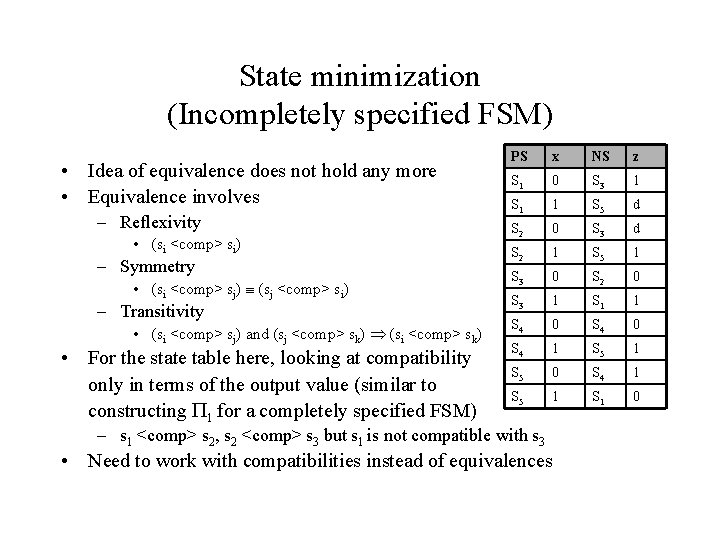
State minimization (Incompletely specified FSM) • Idea of equivalence does not hold any more • Equivalence involves – Reflexivity • (si <comp> si) – Symmetry • (si <comp> sj) (sj <comp> si) – Transitivity • (si <comp> sj) and (sj <comp> sk) (si <comp> sk) • For the state table here, looking at compatibility only in terms of the output value (similar to constructing 1 for a completely specified FSM) PS x NS z S 1 0 S 3 1 S 1 1 S 5 d S 2 0 S 3 d S 2 1 S 5 1 S 3 0 S 2 0 S 3 1 S 1 1 S 4 0 S 4 1 S 5 1 S 1 0 – s 1 <comp> s 2, s 2 <comp> s 3 but s 1 is not compatible with s 3 • Need to work with compatibilities instead of equivalences
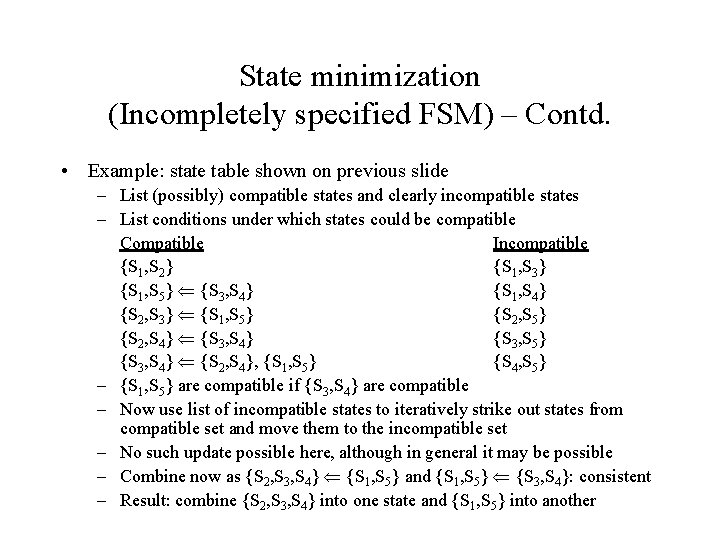
State minimization (Incompletely specified FSM) – Contd. • Example: state table shown on previous slide – List (possibly) compatible states and clearly incompatible states – List conditions under which states could be compatible Compatible Incompatible {S 1, S 2} {S 1, S 3} {S 1, S 5} {S 3, S 4} {S 1, S 4} {S 2, S 3} {S 1, S 5} {S 2, S 4} {S 3, S 4} {S 3, S 5} {S 3, S 4} {S 2, S 4}, {S 1, S 5} {S 4, S 5} – {S 1, S 5} are compatible if {S 3, S 4} are compatible – Now use list of incompatible states to iteratively strike out states from compatible set and move them to the incompatible set – No such update possible here, although in general it may be possible – Combine now as {S 2, S 3, S 4} {S 1, S 5} and {S 1, S 5} {S 3, S 4}: consistent – Result: combine {S 2, S 3, S 4} into one state and {S 1, S 5} into another
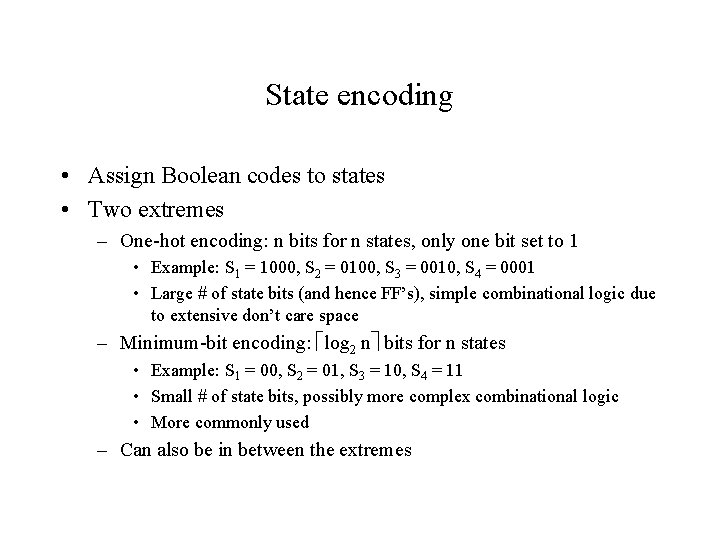
State encoding • Assign Boolean codes to states • Two extremes – One-hot encoding: n bits for n states, only one bit set to 1 • Example: S 1 = 1000, S 2 = 0100, S 3 = 0010, S 4 = 0001 • Large # of state bits (and hence FF’s), simple combinational logic due to extensive don’t care space – Minimum-bit encoding: log 2 n bits for n states • Example: S 1 = 00, S 2 = 01, S 3 = 10, S 4 = 11 • Small # of state bits, possibly more complex combinational logic • More commonly used – Can also be in between the extremes
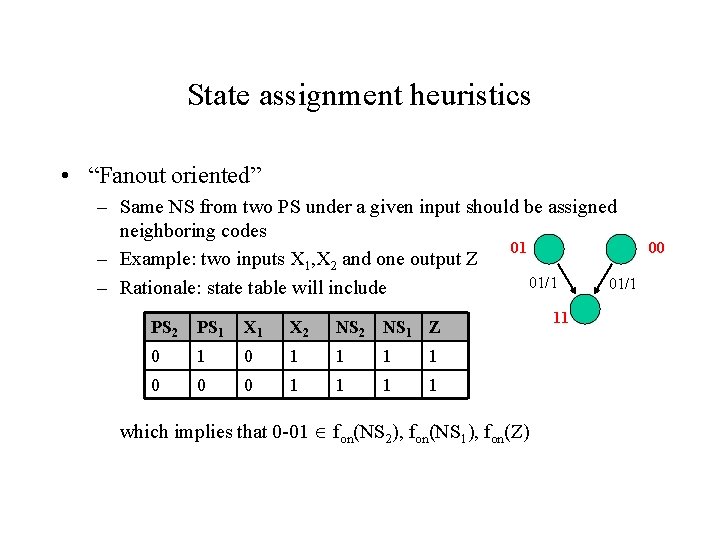
State assignment heuristics • “Fanout oriented” – Same NS from two PS under a given input should be assigned neighboring codes 01 – Example: two inputs X 1, X 2 and one output Z 01/1 – Rationale: state table will include PS 2 PS 1 X 2 NS 1 Z 0 1 1 1 1 0 0 0 1 1 which implies that 0 -01 fon(NS 2), fon(NS 1), fon(Z) 11 00
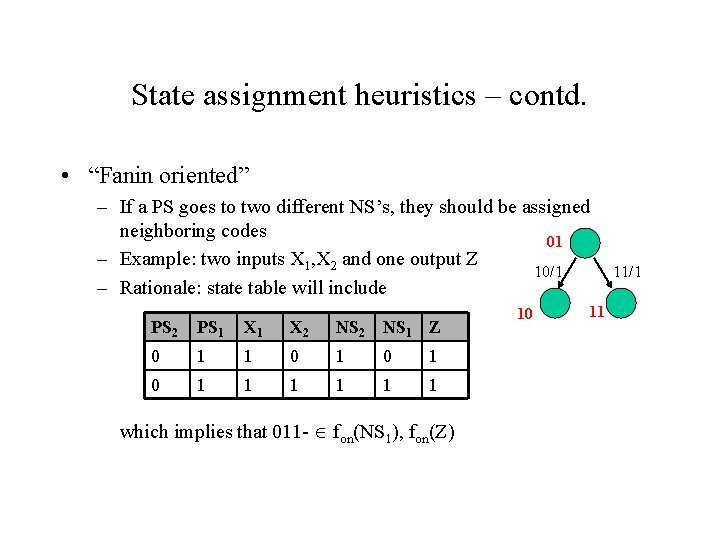
State assignment heuristics – contd. • “Fanin oriented” – If a PS goes to two different NS’s, they should be assigned neighboring codes 01 – Example: two inputs X 1, X 2 and one output Z 10/1 – Rationale: state table will include PS 2 PS 1 X 2 NS 1 Z 0 1 1 0 1 0 1 1 1 which implies that 011 - fon(NS 1), fon(Z) 10 11 11/1
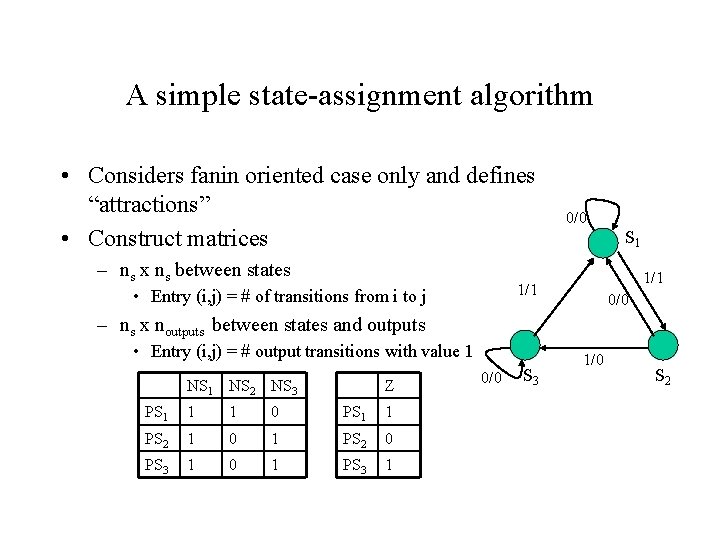
A simple state-assignment algorithm • Considers fanin oriented case only and defines “attractions” • Construct matrices – ns x ns between states 0/0 S 1 1/1 • Entry (i, j) = # of transitions from i to j 0/0 – ns x noutputs between states and outputs • Entry (i, j) = # output transitions with value 1 NS 2 NS 3 Z PS 1 1 1 0 PS 1 1 PS 2 1 0 1 PS 2 0 PS 3 1 0 1 PS 3 1 0/0 S 3 1/0 S 2
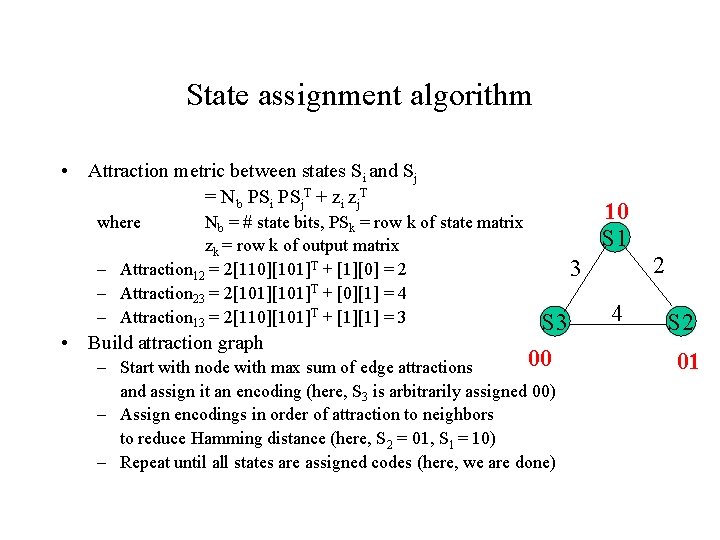
State assignment algorithm • Attraction metric between states Si and Sj = Nb PSi PSj. T + zi zj. T Nb = # state bits, PSk = row k of state matrix zk = row k of output matrix – Attraction 12 = 2[110][101]T + [1][0] = 2 – Attraction 23 = 2[101]T + [0][1] = 4 – Attraction 13 = 2[110][101]T + [1][1] = 3 10 S 1 where • Build attraction graph 2 3 S 3 00 – Start with node with max sum of edge attractions and assign it an encoding (here, S 3 is arbitrarily assigned 00) – Assign encodings in order of attraction to neighbors to reduce Hamming distance (here, S 2 = 01, S 1 = 10) – Repeat until all states are assigned codes (here, we are done) 4 S 2 01