
Synthesis of Novel Chalcogenide Materials Using a Building
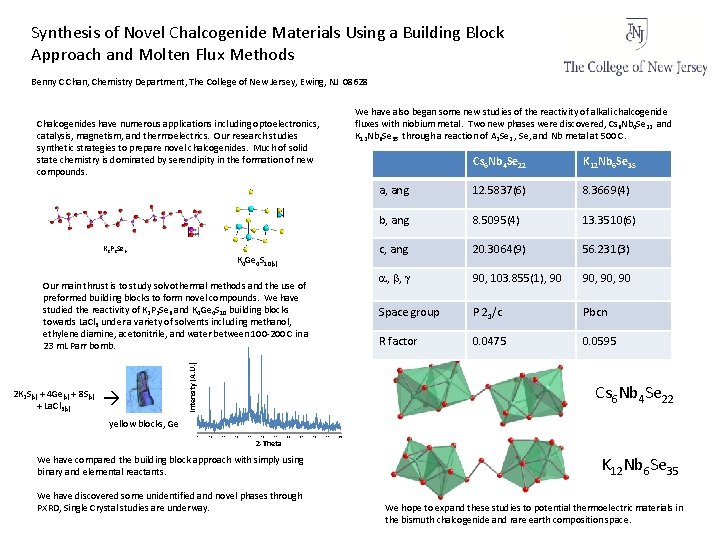
Synthesis of Novel Chalcogenide Materials Using a Building Block Approach and Molten Flux Methods Benny C Chan, Chemistry Department, The College of New Jersey, Ewing, NJ 08628 We have also began some new studies of the reactivity of alkali chalcogenide fluxes with niobium metal. Two new phases were discovered, Cs 6 Nb 4 Se 22 and K 12 Nb 6 Se 35 through a reaction of A 2 Se 2 , Se, and Nb metal at 500 C. Chalcogenides have numerous applications including optoelectronics, catalysis, magnetism, and thermoelectrics. Our research studies synthetic strategies to prepare novel chalcogenides. Much of solid state chemistry is dominated by serendipity in the formation of new compounds. K 2 P 2 Se 6 K 4 Ge 4 S 10(s) 2 K 2 S(s) + 4 Ge(s) + 8 S(s) + La. Cl 3(s) Intensity (A. U. ) Our main thrust is to study solvothermal methods and the use of preformed building blocks to form novel compounds. We have studied the reactivity of K 2 P 2 Se 6 and K 4 Ge 4 S 10 building blocks towards La. Cl 3 under a variety of solvents including methanol, ethylene diamine, acetonitrile, and water between 100 -200 C in a 23 m. L Parr bomb. Cs 6 Nb 4 Se 22 K 12 Nb 6 Se 35 a, ang 12. 5837(6) 8. 3669(4) b, ang 8. 5095(4) 13. 3510(6) c, ang 20. 3064(9) 56. 231(3) , , 90, 103. 855(1), 90 90, 90 Space group P 21/c Pbcn R factor 0. 0475 0. 0595 Cs 6 Nb 4 Se 22 yellow blocks, Ge 5 10 15 20 25 30 35 2 -Theta 40 45 We have compared the building block approach with simply using binary and elemental reactants. We have discovered some unidentified and novel phases through PXRD, Single Crystal studies are underway. 50 55 60 K 12 Nb 6 Se 35 We hope to expand these studies to potential thermoelectric materials in the bismuth chalcogenide and rare earth composition space.
- Slides: 1