
SYNTHESIS OF BANANA OIL Chemistry 318 Fall 2018
SYNTHESIS OF BANANA OIL Chemistry 318 Fall 2018
Schedule of day ■ PPE check – at the door ■ Pre-lab check – at the door ■ Quiz ■ Recitation – Synthesis of Banana Oil ■ Safety – Put bags away – Goggles – Gloves – Lab Coat ■ LAB!
Due Dates ■ Today – At beginning of lab - Aldehydes and Ketones Report • For instructions, see Notebook & Report Formats for Unknown ID in Bb – End of lab – yellow Notebook pages (Synthesis of banana oil). ■ Next Week – Synthesis of Banana Oil Report • For instructions, see Notebook & Report Formats for Synthesis reports in Bb.
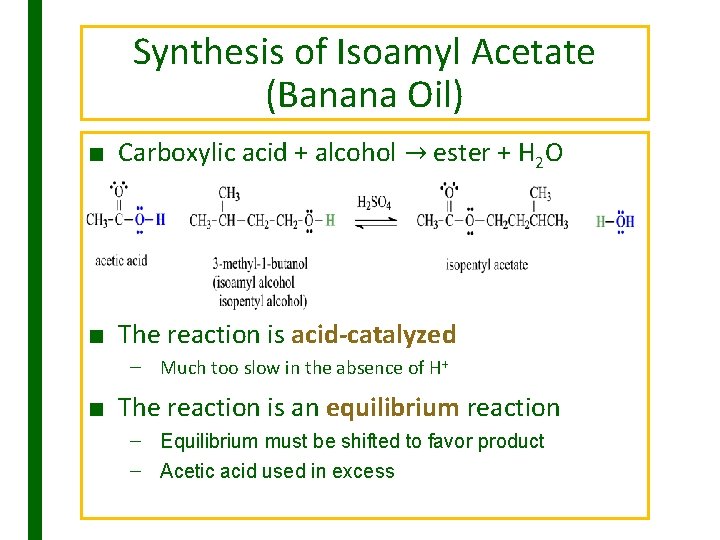
Synthesis of Isoamyl Acetate (Banana Oil) ■ Carboxylic acid + alcohol → ester + H 2 O ■ The reaction is acid-catalyzed – Much too slow in the absence of H+ ■ The reaction is an equilibrium reaction – Equilibrium must be shifted to favor product – Acetic acid used in excess
Synthesis of Isoamyl Acetate ■ Mechanism: nucleophilic acyl substitution ■ 2 main reaction steps: – 1) addition, and – 2) elimination – overall substitution
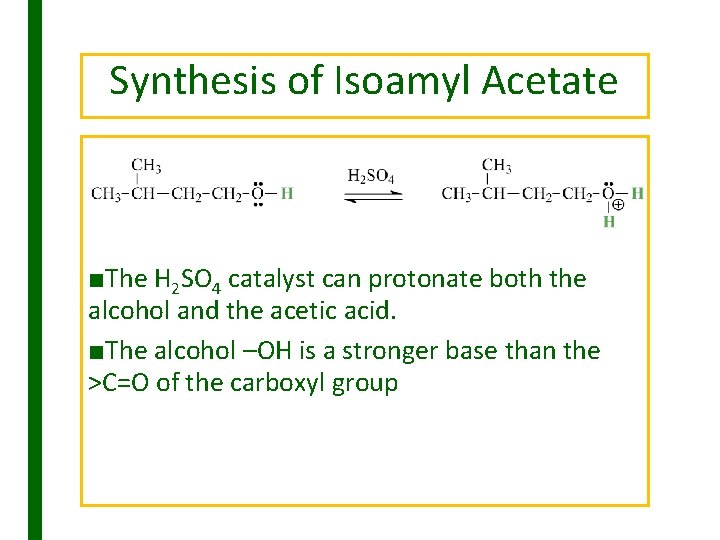
Synthesis of Isoamyl Acetate ■The H 2 SO 4 catalyst can protonate both the alcohol and the acetic acid. ■The alcohol –OH is a stronger base than the >C=O of the carboxyl group
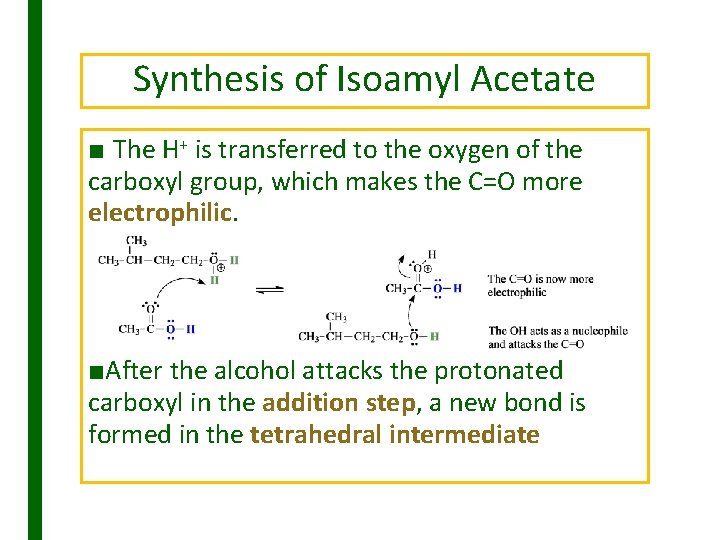
Synthesis of Isoamyl Acetate ■ The H+ is transferred to the oxygen of the carboxyl group, which makes the C=O more electrophilic. ■After the alcohol attacks the protonated carboxyl in the addition step, a new bond is formed in the tetrahedral intermediate
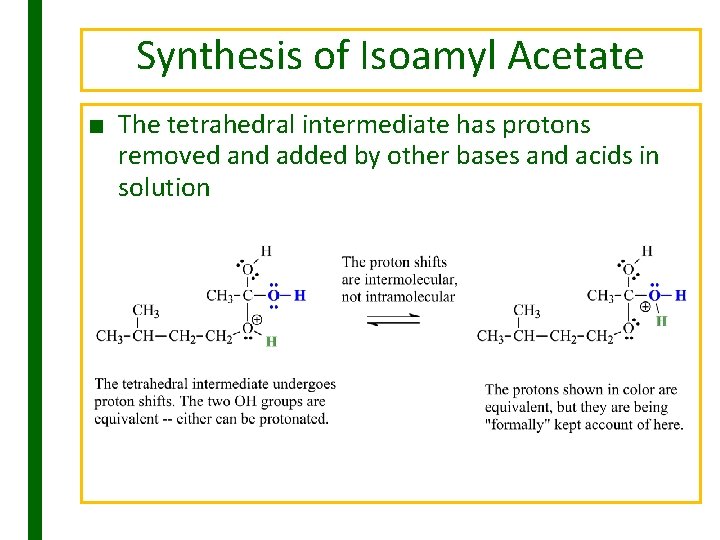
Synthesis of Isoamyl Acetate ■ The tetrahedral intermediate has protons removed and added by other bases and acids in solution
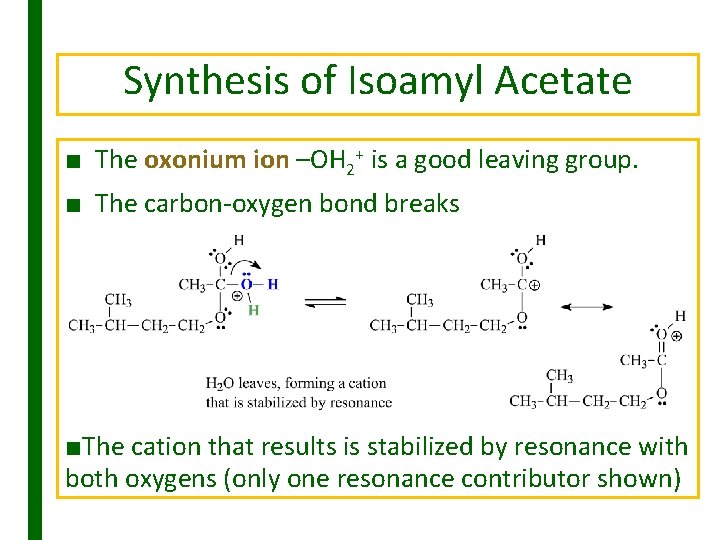
Synthesis of Isoamyl Acetate ■ The oxonium ion –OH 2+ is a good leaving group. ■ The carbon-oxygen bond breaks ■The cation that results is stabilized by resonance with both oxygens (only one resonance contributor shown)
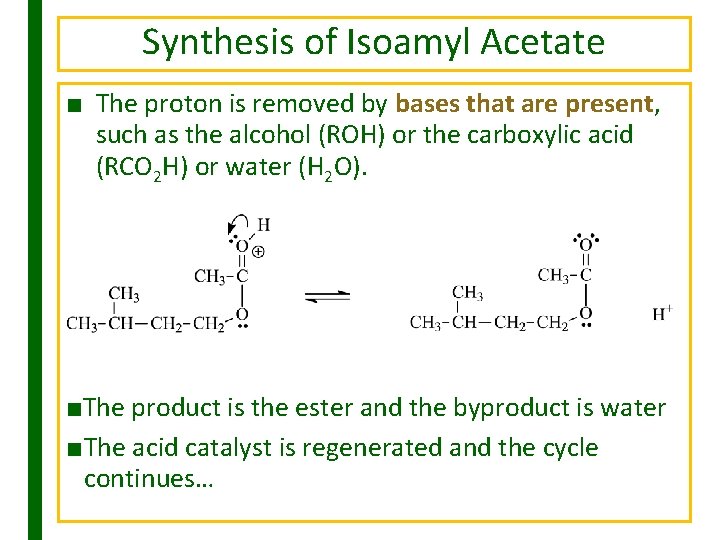
Synthesis of Isoamyl Acetate ■ The proton is removed by bases that are present, such as the alcohol (ROH) or the carboxylic acid (RCO 2 H) or water (H 2 O). ■The product is the ester and the byproduct is water ■ The acid catalyst is regenerated and the cycle continues…
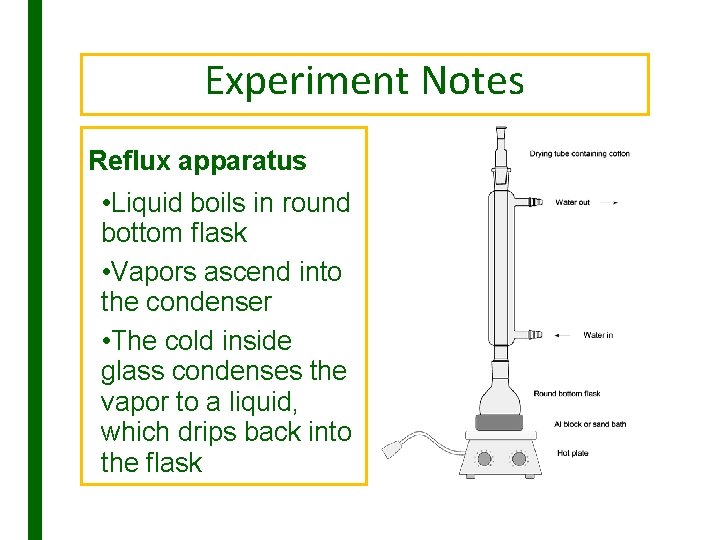
Experiment Notes Reflux apparatus • Liquid boils in round bottom flask • Vapors ascend into the condenser • The cold inside glass condenses the vapor to a liquid, which drips back into the flask
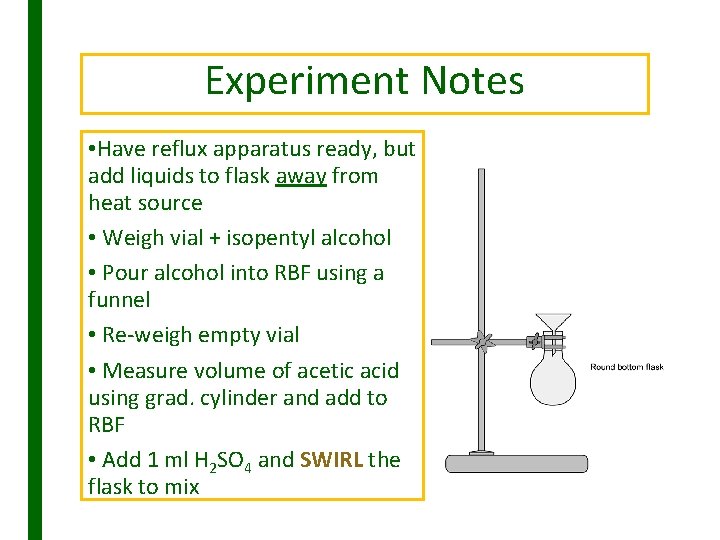
Experiment Notes • Have reflux apparatus ready, but add liquids to flask away from heat source • Weigh vial + isopentyl alcohol • Pour alcohol into RBF using a funnel • Re-weigh empty vial • Measure volume of acetic acid using grad. cylinder and add to RBF • Add 1 ml H 2 SO 4 and SWIRL the flask to mix
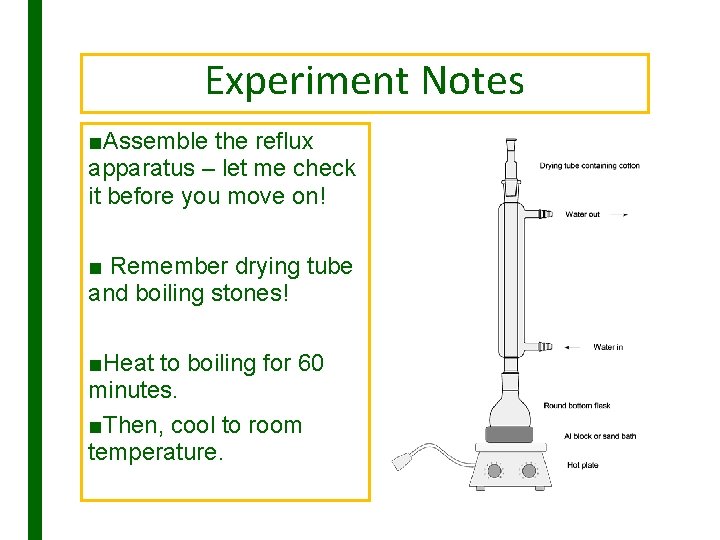
Experiment Notes ■Assemble the reflux apparatus – let me check it before you move on! ■ Remember drying tube and boiling stones! ■Heat to boiling for 60 minutes. ■Then, cool to room temperature.
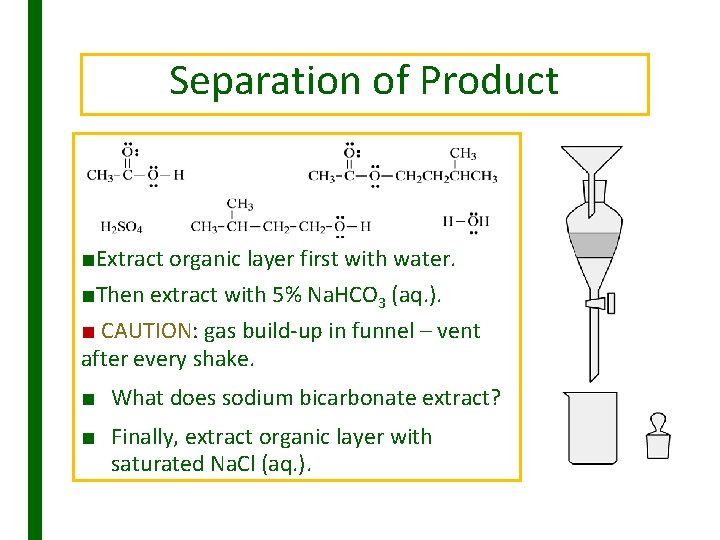
Separation of Product ■Extract organic layer first with water. ■Then extract with 5% Na. HCO 3 (aq. ). ■ CAUTION: gas build-up in funnel – vent after every shake. ■ What does sodium bicarbonate extract? ■ Finally, extract organic layer with saturated Na. Cl (aq. ).
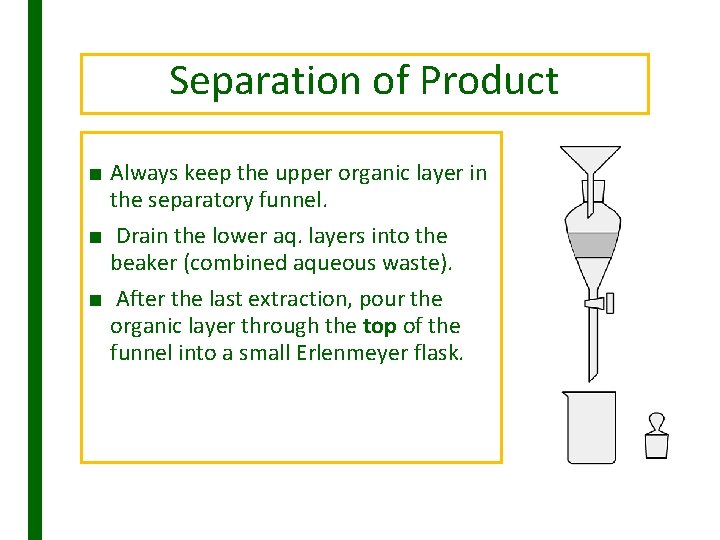
Separation of Product ■ Always keep the upper organic layer in the separatory funnel. ■ Drain the lower aq. layers into the beaker (combined aqueous waste). ■ After the last extraction, pour the organic layer through the top of the funnel into a small Erlenmeyer flask.
Separation of Product ■Add Na 2 SO 4 as drying agent (anhydrous). ■ After absorbing H 2 O from the organic layer, it becomes the hydrated salt Na 2 SO 4 ∙ n. H 2 O ■ After ester is dried, transfer (decant) liquid to a small vial. ■Take refractive index and IR.
- Slides: 16