
Synthesis and Release of Protein Learning Outcomes State




- Slides: 59
Synthesis and Release of Protein
Learning Outcomes • State that proteins can be classified as either fibrous or globular, describe their structure and function and give examples of each type.
Proteins • Proteins contain the elements Carbon (C), Hydrogen (H), Oxygen (O) and Nitrogen (N). • They also often contain sulphur (S). • Proteins are build up from subunits called amino acids.
Proteins • Amino acids are joined together by peptide bonds to form polypeptides. • Each polypeptide chain will have a particular sequence of amino acids. • Once the polypeptide chains are formed they can then be arranged in different ways to form different types of proteins.
Proteins • The sequence of amino acids determines the structure and function of the protein. • Proteins have many important roles within an organism – – – Enzymes - amylase, pepsin, lipase Structural - membranes, hair Hormones – insulin Defence – antibodies Carriers – haemoglobin
Fibrous Protein • Fibrous proteins are insoluble, and play a structural or supportive role in the body, and are also involved in movement (e. g. in muscle). • Collagen – strong and elastic found in ligaments and skin. • Actin and myosin – a contractile protein found in muscle cells.
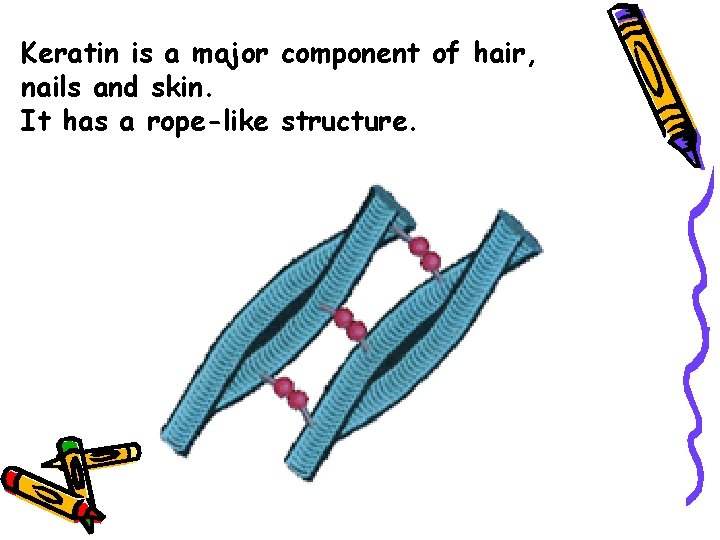
Keratin is a major component of hair, nails and skin. It has a rope-like structure.
Globular proteins • Once the polypeptide chains have been formed they are folded into a spherical shape to form a globular protein. • Globular proteins are found in the plasma membrane (structural proteins). • They can also be hormones , enzymes and antibodies.
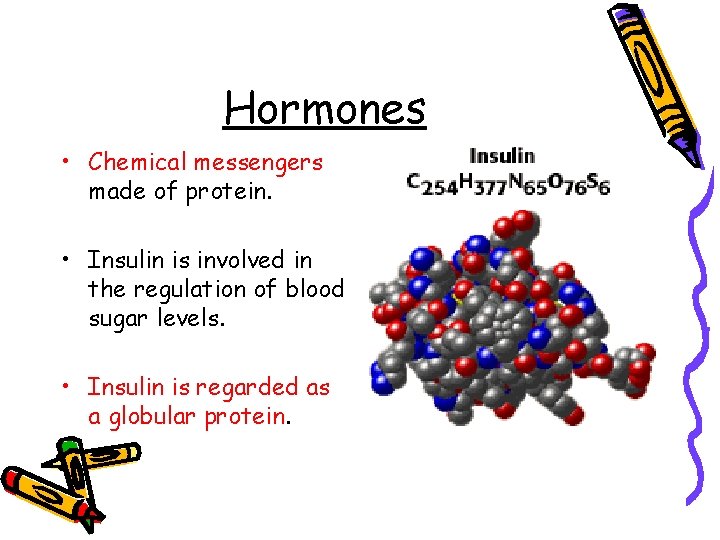
Hormones • Chemical messengers made of protein. • Insulin is involved in the regulation of blood sugar levels. • Insulin is regarded as a globular protein.
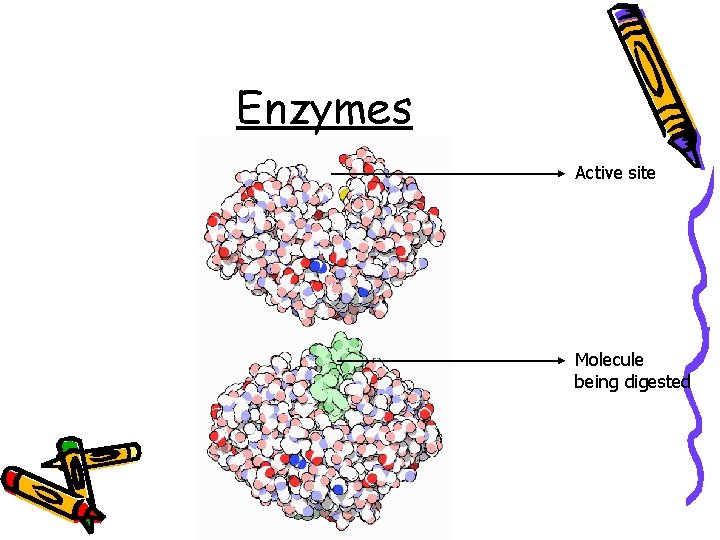
Enzymes Active site Molecule being digested
Conjugated Proteins • Sometimes a globular protein can have a non organic component as part of their structure. These are known as conjugated proteins. • Haemoglobin has iron in the structure and is used to transport oxygen. • Chlorophyll has magnesium in the structure and is an essential component of photosynthesis.
Questions 1. What elements are present in protein? 2. What determines the structure and function of a protein? 3. Give 2 examples of a fibrous protein and state their functions. 4. Name 2 types of globular protein and state their function. 5. What is a conjugated protein? Give an example.
Learning Outcome • Describe the structure of a nucleotide and recall the names of all the bases found in them. • Give an account of the structure of DNA, describing the positioning of the nucleotides, the base pairs established, and the coiling of the molecule to form the “double helix”.
DNA • Chromosomes are thread-like structures found inside the nucleus of a cell. • They contain deoxyribonucleic acid (DNA). • A molecule of DNA consists of 2 strands, each made up of repeating units called nucleotides.
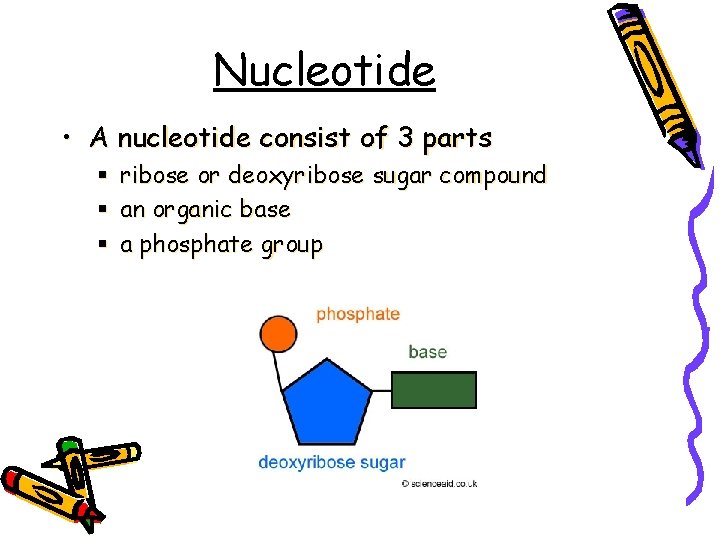
Nucleotide • A nucleotide consist of 3 parts § § § ribose or deoxyribose sugar compound an organic base a phosphate group
DNA Bases • There are 4 different DNA bases: – – Adenine (A) Thymine (T) Cytosine (C) Guanine (G) • So there are 4 different nucleotides, depending on what type of base they have.
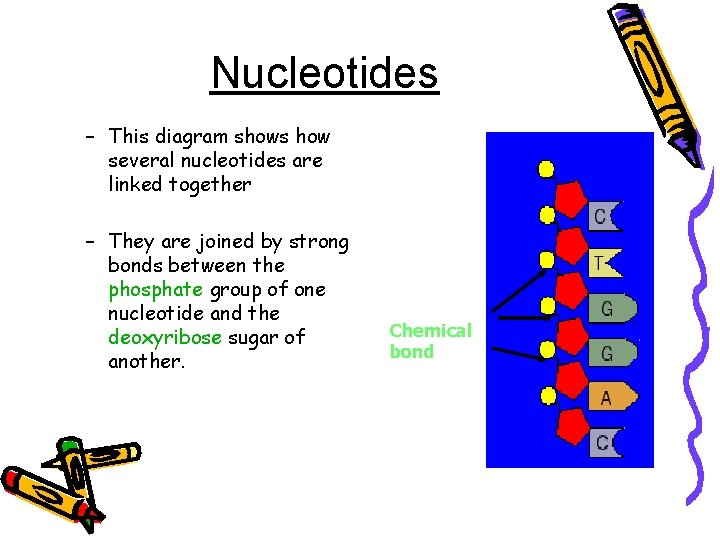
Nucleotides – This diagram shows how several nucleotides are linked together – They are joined by strong bonds between the phosphate group of one nucleotide and the deoxyribose sugar of another. Chemical bond
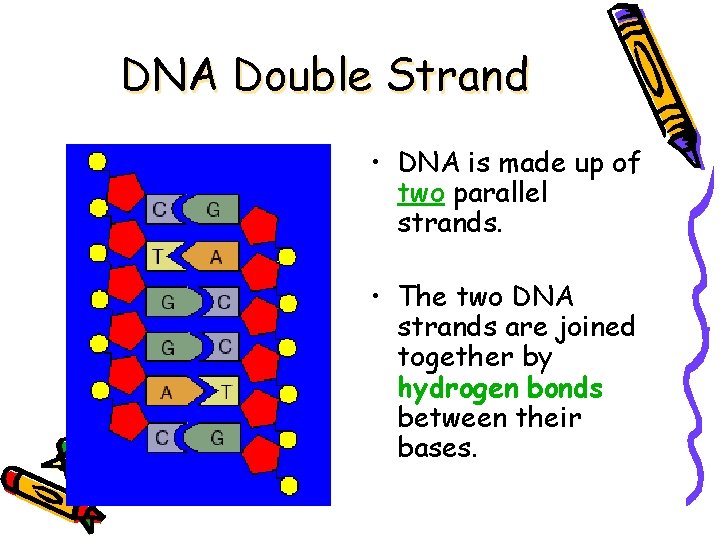
DNA Double Strand • DNA is made up of two parallel strands. • The two DNA strands are joined together by hydrogen bonds between their bases.
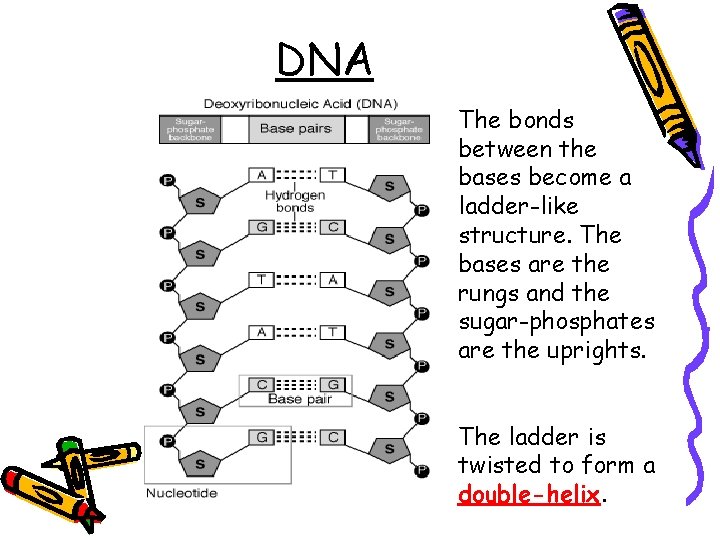
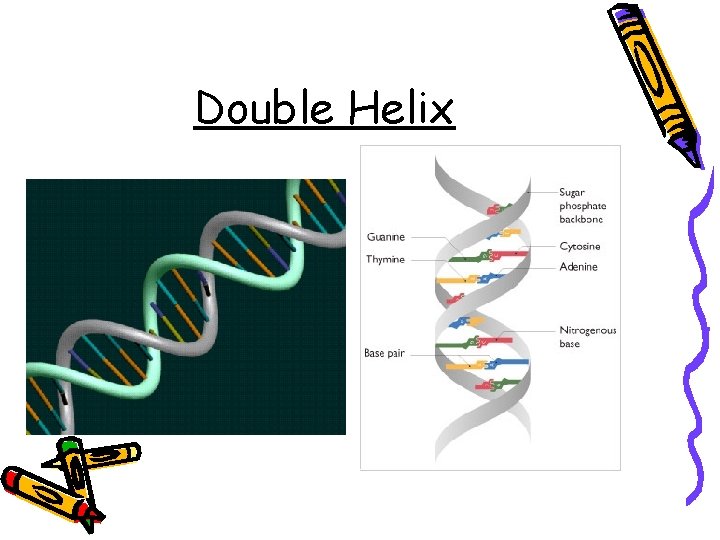
DNA The bonds between the bases become a ladder-like structure. The bases are the rungs and the sugar-phosphates are the uprights. The ladder is twisted to form a double-helix.
Double Helix
DNA Bases • Each base can only join with one other type of base. • Adenine (A) will only join with Thymine (T). • Cytosine (C) will only join with Guanine (G).
Learning Outcomes • Show an understanding of DNA replication, identifying the stages and substances required for the process to take place.
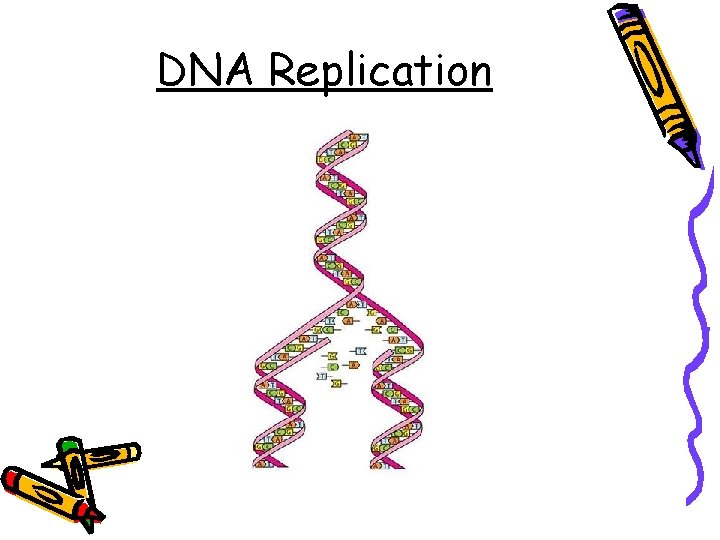
Replication of DNA • DNA is able to reproduce itself exactly, this is called replication. • There a number of stages in DNA replication. • Stage 1: The original DNA molecule becomes unwound.
Replication of DNA • Stage 2: Weak hydrogen bonds between the bases break and cause the 2 strands of DNA to ‘unzip’ and expose their bases. • Stage 3: Pairing of 2 bases allows a free DNA nucleotide to find and line up with its complementary nucleotide on the open chain.
Replication of DNA • Stage 4: Weak hydrogen bonds are forming between complementary base pairs. • Stage 5: A strong chemical bond is forming between the sugar of one nucleotide and the phosphate of the next one. • The linking of nucleotides into a chain is controlled by an enzyme called DNA polymerase.
Replication of DNA • Stage 6: The newly formed molecule of DNA is about to wind up into a double helix. • The new DNA molecule is identical to the original DNA molecule.
DNA Replication
DNA replication • For DNA replication to occur the nucleus must contain: – DNA (to act as a template for the new molecule) – A supply of the 4 types of DNA nucleotide – The appropriate enzymes (DNA polymerase) – A supply of ATP to provide energy
Importance of Replication • DNA replication ensures that an exact copy of the species genetic information is passed from cell to cell and from generation to generation. • It ensures that daughter cells have exactly the same genetic information as the parent cells.
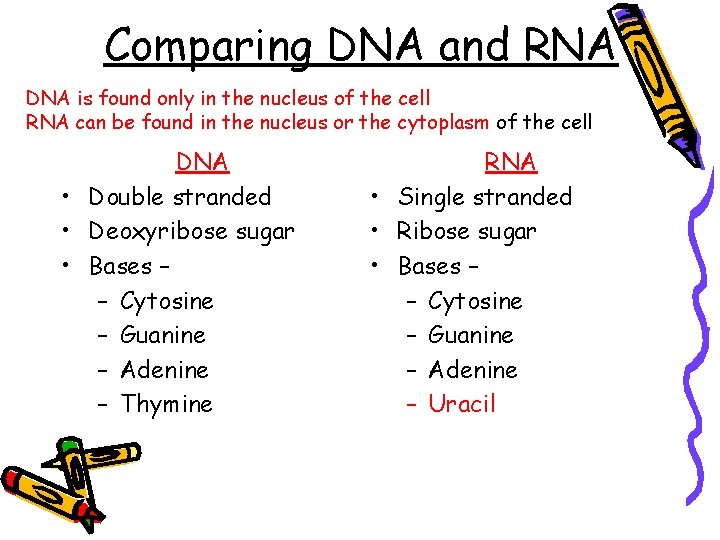
RNA • The second type of nucleic acid is called ribonucleic acid (RNA). • The structure of RNA is similar to DNA, but differs from it in 3 important ways.
Comparing DNA and RNA DNA is found only in the nucleus of the cell RNA can be found in the nucleus or the cytoplasm of the cell DNA • Double stranded • Deoxyribose sugar • Bases – – Cytosine – Guanine – Adenine – Thymine RNA • Single stranded • Ribose sugar • Bases – – Cytosine – Guanine – Adenine – Uracil
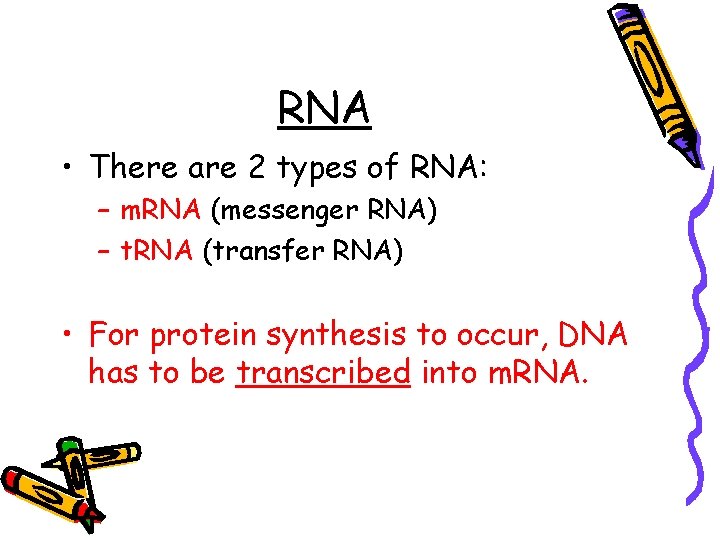
RNA • There are 2 types of RNA: – m. RNA (messenger RNA) – t. RNA (transfer RNA) • For protein synthesis to occur, DNA has to be transcribed into m. RNA.
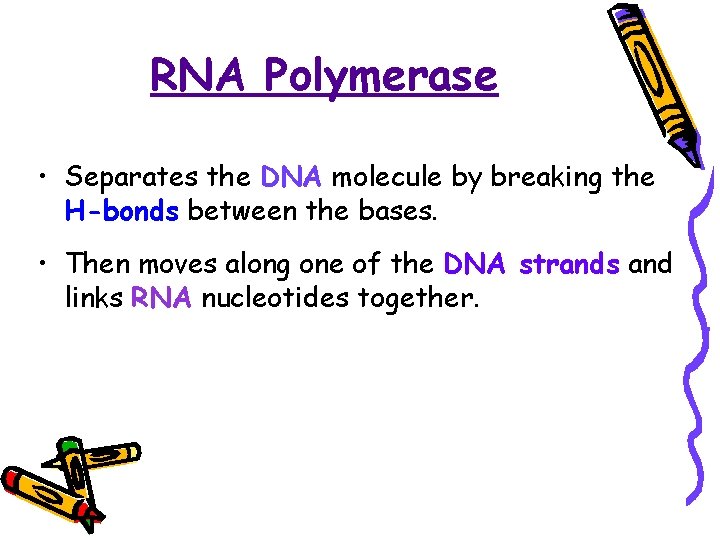
RNA Polymerase • Separates the DNA molecule by breaking the H-bonds between the bases. • Then moves along one of the DNA strands and links RNA nucleotides together.
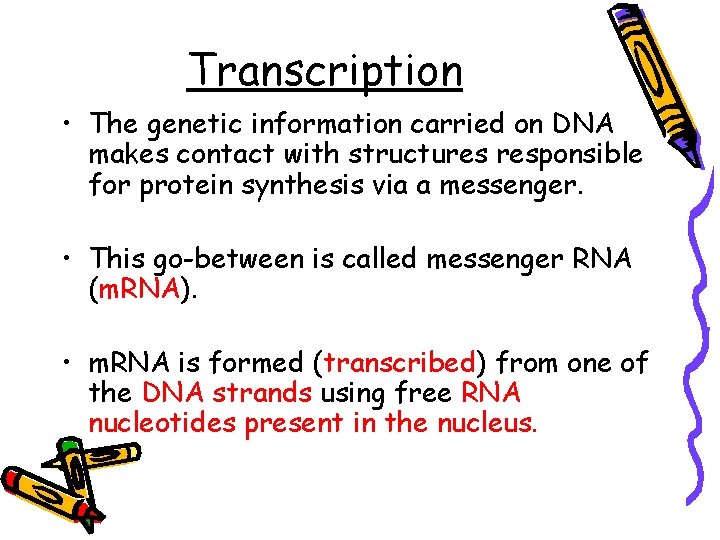
Transcription • The genetic information carried on DNA makes contact with structures responsible for protein synthesis via a messenger. • This go-between is called messenger RNA (m. RNA). • m. RNA is formed (transcribed) from one of the DNA strands using free RNA nucleotides present in the nucleus.
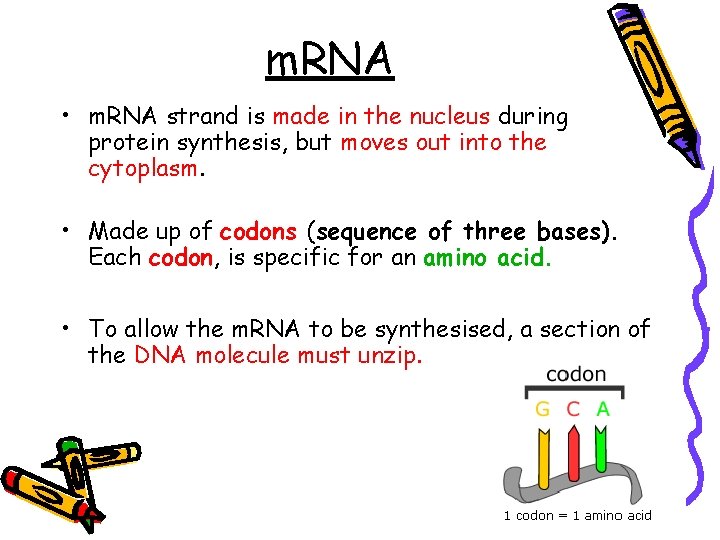
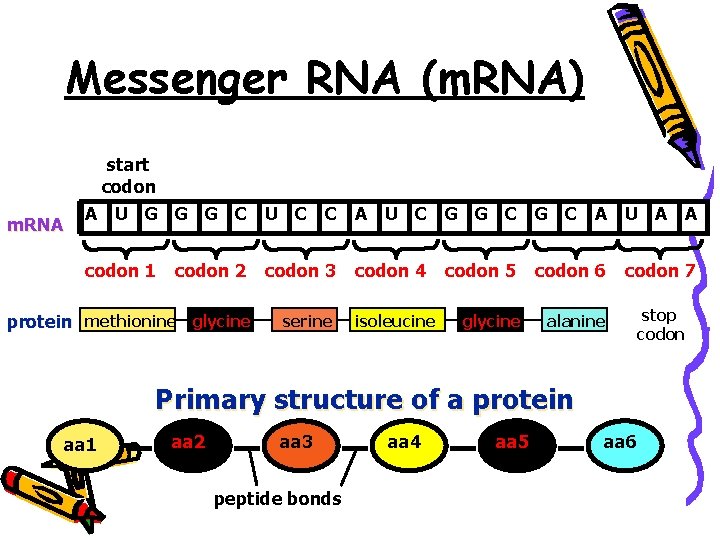
m. RNA • m. RNA strand is made in the nucleus during protein synthesis, but moves out into the cytoplasm. • Made up of codons (sequence of three bases). Each codon, is specific for an amino acid. • To allow the m. RNA to be synthesised, a section of the DNA molecule must unzip.
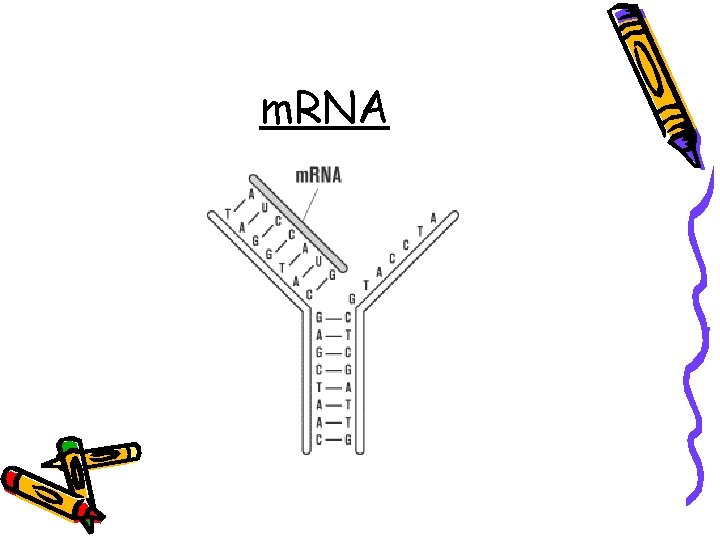
m. RNA synthesis • Once the DNA strand has partially unzipped , RNA nucleotides will enter the nucleus. • They will line up beside the complementary bases on the exposed section of DNA. • The RNA nucleotides now link up between the phosphate group and the sugars. • This is called transcription ie a copy of the genetic code is made in the nucleus and is then taken into the cytoplasm and attaches to the ribosome.
m. RNA
Transcription • The transfer of information in the nucleus from a DNA molecule to an RNA molecule. • Only 1 DNA strand serves as the template 1. RNA polymerase unwinds and unzips (hydrogen bonds between bases break) part of a chromosome (ATP supplies the energy needed) 2. Base pairing occurs between free RNA nucleotides and DNA template 3. Strong chemical bond forms between the RNA nucleotides. 4. m. RNA separates from DNA and leaves nucleus.
Messenger RNA (m. RNA) start codon m. RNA A U G G G C U C C A U C G G C A U A A codon 1 codon 2 codon 3 protein methionine glycine serine codon 4 isoleucine codon 5 codon 6 glycine alanine codon 7 Primary structure of a protein aa 1 aa 2 aa 3 peptide bonds aa 4 aa 5 aa 6 stop codon
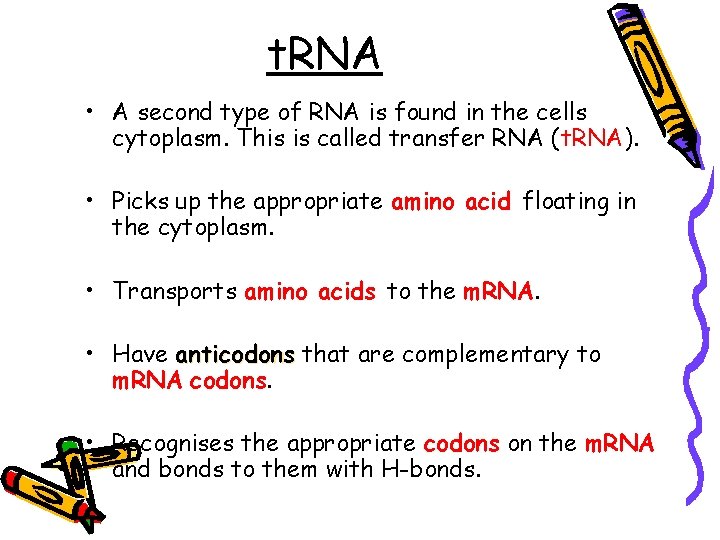
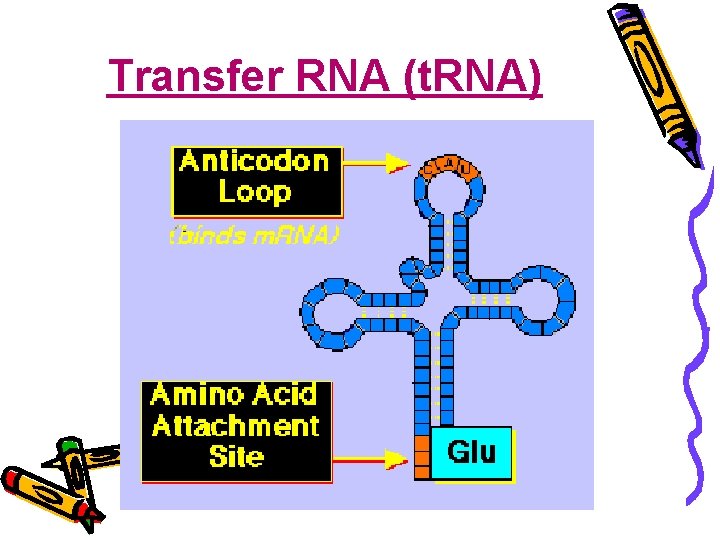
t. RNA • A second type of RNA is found in the cells cytoplasm. This is called transfer RNA (t. RNA). • Picks up the appropriate amino acid floating in the cytoplasm. • Transports amino acids to the m. RNA. • Have anticodons that are complementary to m. RNA codons. • Recognises the appropriate codons on the m. RNA and bonds to them with H-bonds.
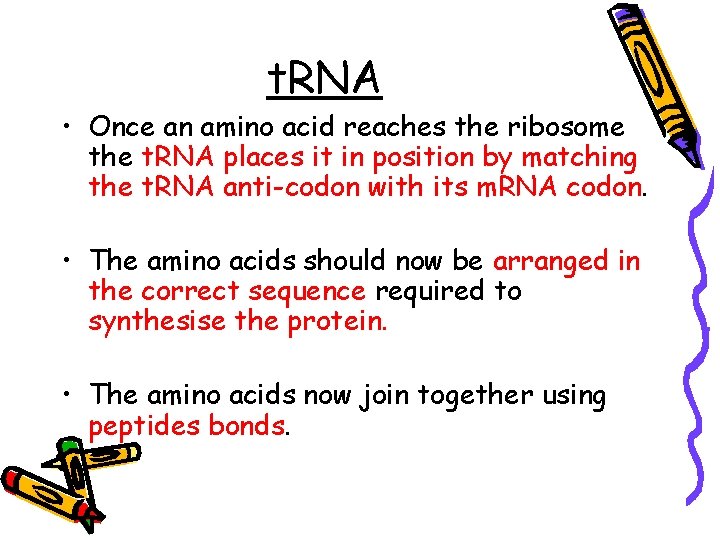
t. RNA • Once an amino acid reaches the ribosome the t. RNA places it in position by matching the t. RNA anti-codon with its m. RNA codon. • The amino acids should now be arranged in the correct sequence required to synthesise the protein. • The amino acids now join together using peptides bonds.
Transfer RNA (t. RNA)
Ribosomes • Ribosomes are found free floating in the cytoplasm and attached to ER. • They are the site of translation of m. RNA into protein. • Each ribosome contains enzymes needed for protein synthesis. Large numbers of ribosomes are found in growing cells which need to produce large quantities of protein.
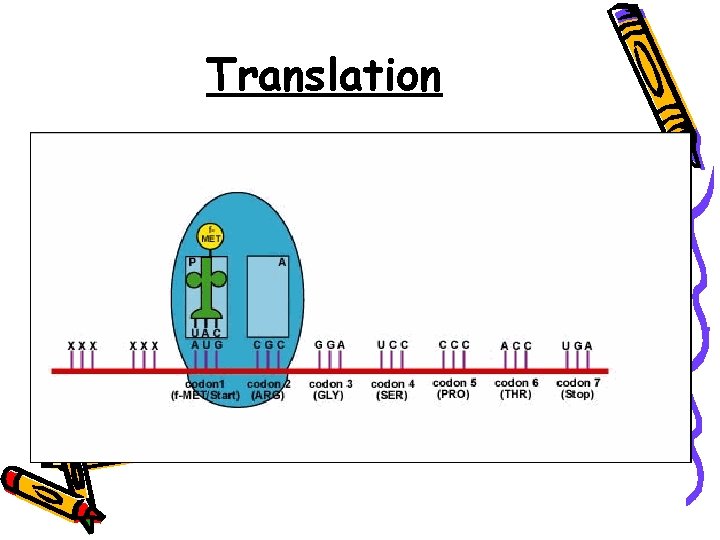
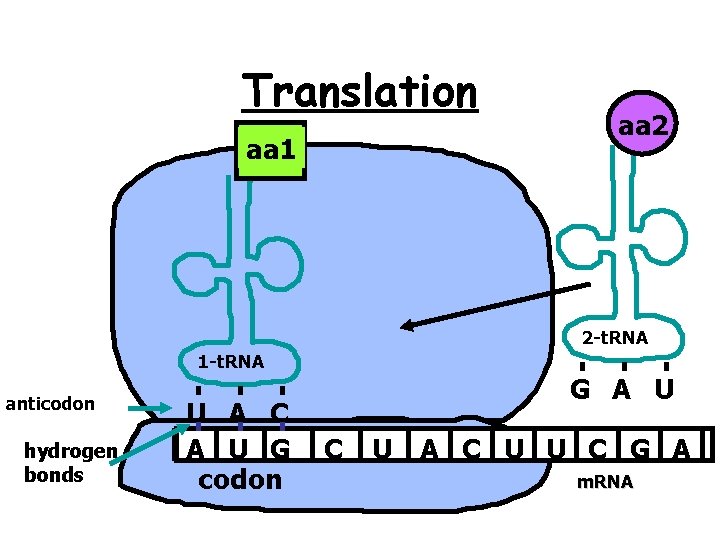
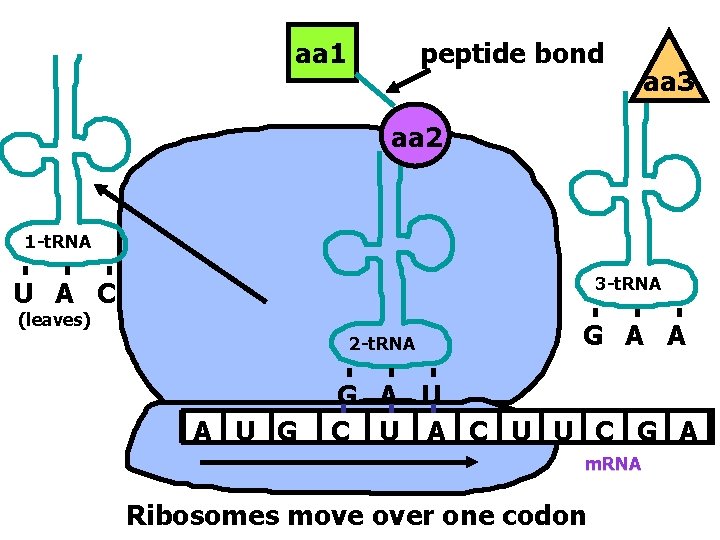
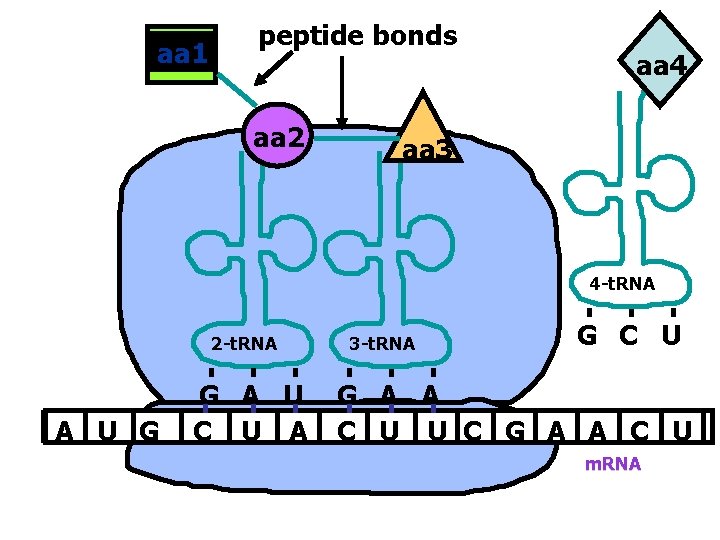
Translation • A ribosome becomes attached to one end of the m. RNA molecule about to be translated. • Inside the ribosome, there are sites that t. RNA molecules can attach to, which allows the anticodon to line up with the m. RNA codon. • As this happens along the molecule, it allows amino acids to line up and become joined together by peptide bonds.
Translation • Synthesis of proteins in the cytoplasm • Involves the following: 1. m. RNA (codons) 2. t. RNA (anticodons) 3. ribosomes 4. amino acids
Translation
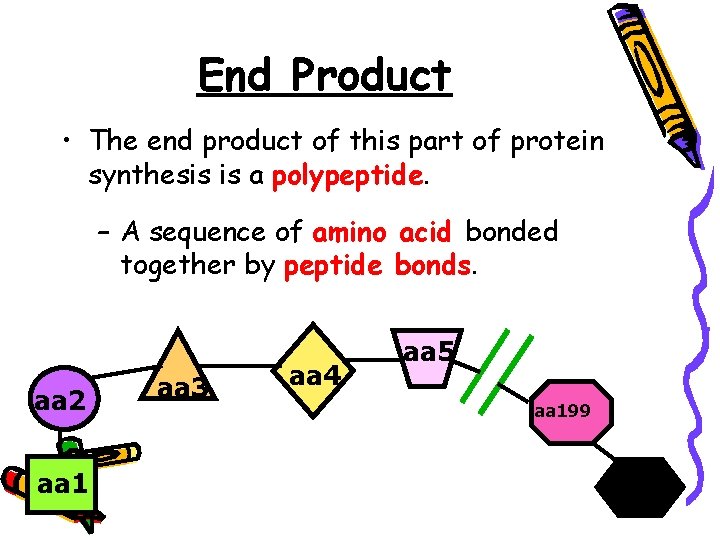
End Product • The end product of this part of protein synthesis is a polypeptide. – A sequence of amino acid bonded together by peptide bonds. aa 2 aa 1 aa 3 aa 4 aa 5 aa 199 aa 200
Re-use of RNA • Each t. RNA molecule becomes attached to another molecule of amino acid, ready to repeat the process. • The m. RNA is often also reused to produce further molecules of the same polypeptide. • Protein synthesised in ribosomes is for use in the cell. Protein synthesised in ribosomes attached to ER is for export.
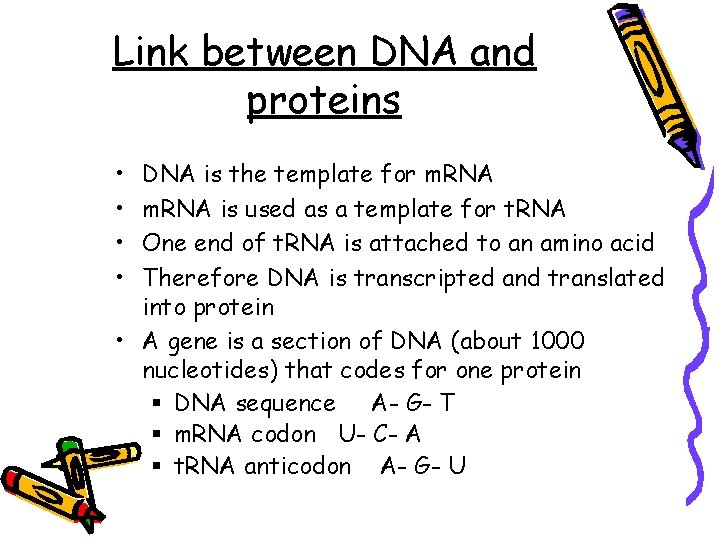
Link between DNA and proteins • • DNA is the template for m. RNA is used as a template for t. RNA One end of t. RNA is attached to an amino acid Therefore DNA is transcripted and translated into protein • A gene is a section of DNA (about 1000 nucleotides) that codes for one protein § DNA sequence A- G- T § m. RNA codon U- C- A § t. RNA anticodon A- G- U
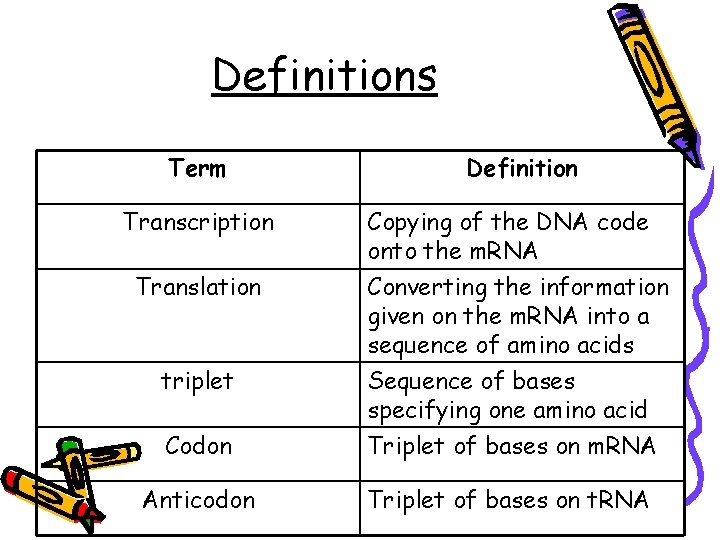
Definitions Term Transcription Translation Definition Copying of the DNA code onto the m. RNA Converting the information given on the m. RNA into a sequence of amino acids triplet Sequence of bases specifying one amino acid Codon Triplet of bases on m. RNA Anticodon Triplet of bases on t. RNA
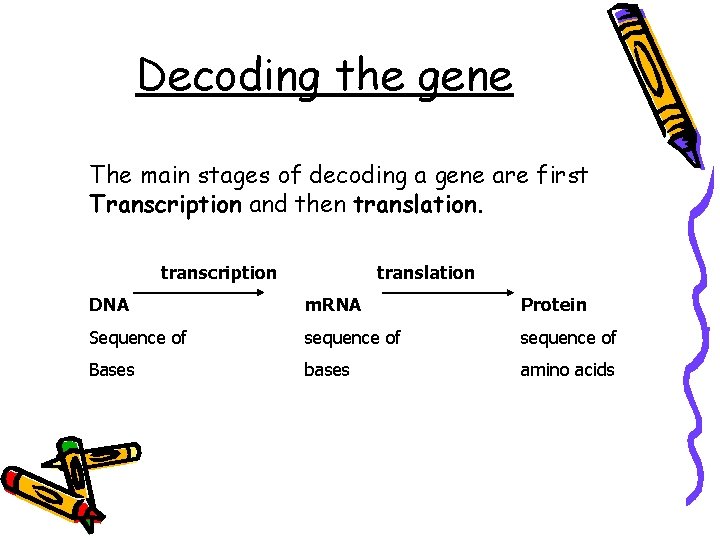
Decoding the gene The main stages of decoding a gene are first Transcription and then translation. transcription translation DNA m. RNA Protein Sequence of sequence of Bases bases amino acids
Translation aa 1 aa 2 2 -t. RNA 1 -t. RNA anticodon hydrogen bonds U A C A U G codon G A U C U A C U U C G A m. RNA
peptide bond aa 3 aa 1 aa 2 3 -t. RNA 1 -t. RNA anticodon hydrogen bonds U A C A U G codon 2 -t. RNA G A U C U A C U U C G A m. RNA
aa 1 peptide bond aa 3 aa 2 1 -t. RNA 3 -t. RNA U A C (leaves) 2 -t. RNA A U G G A A G A U C U A C U U C G A m. RNA Ribosomes move over one codon
aa 1 peptide bonds aa 2 aa 4 aa 3 4 -t. RNA 2 -t. RNA A U G G A U C U A 3 -t. RNA G C U G A A C U U C G A A C U m. RNA
Golgi Apparatus • Proteins synthesised on the rough ER are secreted by the cell. These proteins are passed on to the Golgi apparatus for packaging and secretion. • This happens when vesicles containing the protein pinch off from the ER and fuse with the Golgi apparatus.
Golgi Apparatus • The Golgi apparatus then processes the protein. • Vesicles containing the finished protein become pinched off from the Golgi apparatus. • The vesicle then moves towards the cell membrane and fuses with it, discharging its contents.
Questions 1. What are the subunits of DNA called? Draw and label one. 2. What type of bond holds 2 strands of DNA together? 3. Where in a cell does m. RNA synthesis occur? 4. Where does the m. RNA go once it has been synthesised? 5. What are the triplets of bases called on m. RNA and t. RNA?
Questions 1. What must happen to amino acids to form a polypeptide chain? 2. Which organelle in a cell transports protein once it has been synthesised? 3. Which organelle processes the protein for secretion? 4. Once processed, how does it leave the cell?