
SyntaxDirected Translation 1 SyntaxDirected Translation 2 SyntaxDirected Translation













- Slides: 47
Syntax-Directed Translation 1
Syntax-Directed Translation 2
Syntax-Directed Translation 3
Syntax-Directed Translation In a syntax-directed definition, each production A→α is associated with a set of semantic rules of the form: b=f(c 1, c 2, …, cn) where f is a function and b can be one of the followings: b is a synthesized attribute of A and c 1, c 2, …, cn are attributes of the grammar symbols in the production ( A→α ). OR b is an inherited attribute one of the grammar symbols in α (on the right side of the production), and c 1, c 2, …, cn are attributes of the grammar symbols in the production ( A→α ). 4
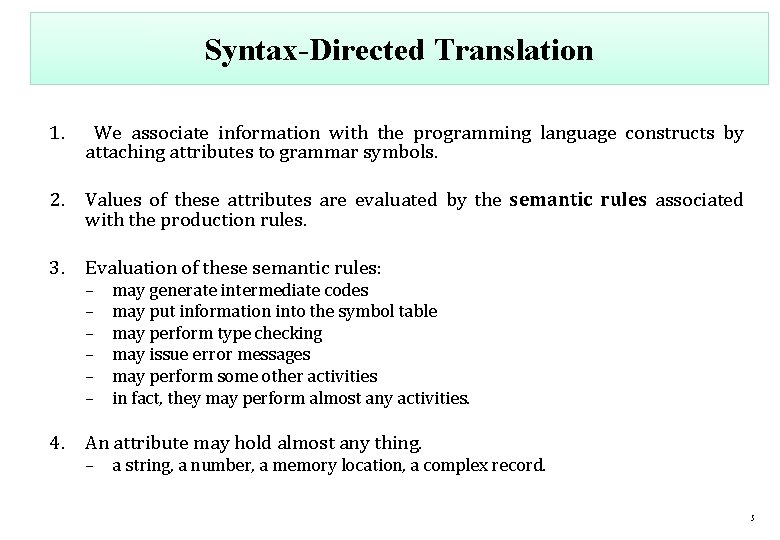
Syntax-Directed Translation 1. We associate information with the programming language constructs by attaching attributes to grammar symbols. 2. Values of these attributes are evaluated by the semantic rules associated with the production rules. 3. Evaluation of these semantic rules: – – – may generate intermediate codes may put information into the symbol table may perform type checking may issue error messages may perform some other activities in fact, they may perform almost any activities. 4. An attribute may hold almost any thing. – a string, a number, a memory location, a complex record. 5
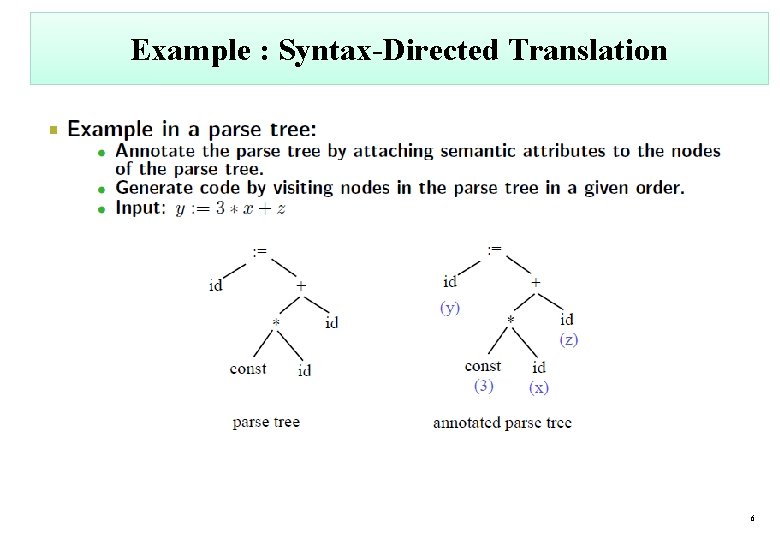
Example : Syntax-Directed Translation 6
Annotated Parse Tree 1. A parse tree showing the values of attributes at each node is called an annotated parse tree. 2. Values of Attributes in nodes of annotated parse-tree are either, – initialized to constant values or by the lexical analyzer. – determined by the semantic-rules. 3. The process of computing the attributes values at the nodes is called annotating (or decorating) of the parse tree. 4. Of course, the order of these computations depends on the dependency graph induced by the semantic rules. 7
Syntax-Directed Definitions and Translation Schemes 1. When we associate semantic rules with productions, we use two notations: – Syntax-Directed Definitions (abstract) – Translation Schemes (detail) A. Syntax-Directed Definitions: – give high-level specifications for translations – hide many implementation details such as order of evaluation of semantic actions. – We associate a production rule with a set of semantic actions, and we do not say when they will be evaluated. B. Translation Schemes: – indicate the order of evaluation of semantic actions associated with a production rule. – In other words, translation schemes give a little bit information about implementation details. 8
Syntax-Directed Definitions and Translation Schemes • Conceptually with both the syntax directed translation and translation scheme we – Parse the input token stream – Build the parse tree – Traverse the tree to evaluate the semantic rules at the parse tree nodes. Input string parse tree dependency graph evaluation order for semantic rules Conceptual view of syntax directed translation 9
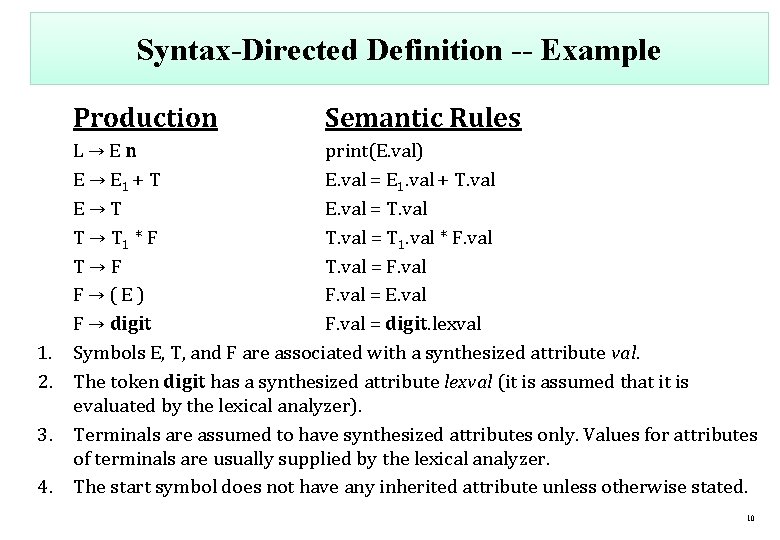
Syntax-Directed Definition -- Example Production 1. 2. 3. 4. Semantic Rules L→En print(E. val) E → E 1 + T E. val = E 1. val + T. val E→T E. val = T. val T → T 1 * F T. val = T 1. val * F. val T→F T. val = F. val F→(E) F. val = E. val F → digit F. val = digit. lexval Symbols E, T, and F are associated with a synthesized attribute val. The token digit has a synthesized attribute lexval (it is assumed that it is evaluated by the lexical analyzer). Terminals are assumed to have synthesized attributes only. Values for attributes of terminals are usually supplied by the lexical analyzer. The start symbol does not have any inherited attribute unless otherwise stated. 10
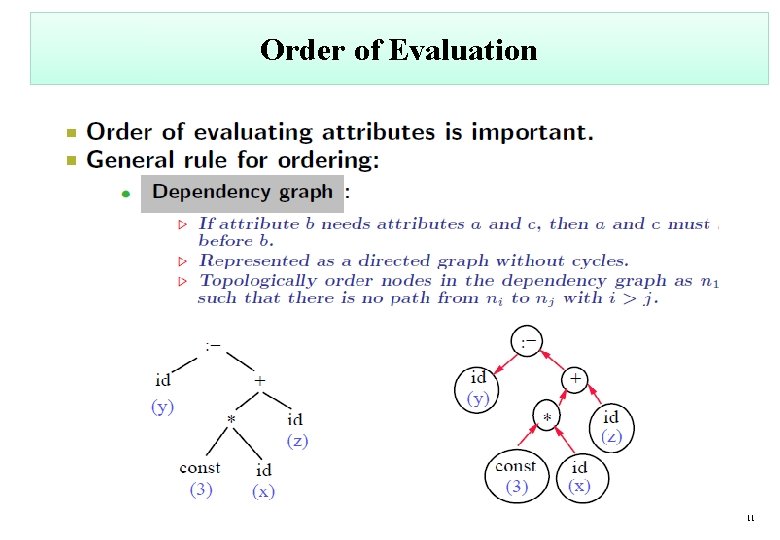
Order of Evaluation 11
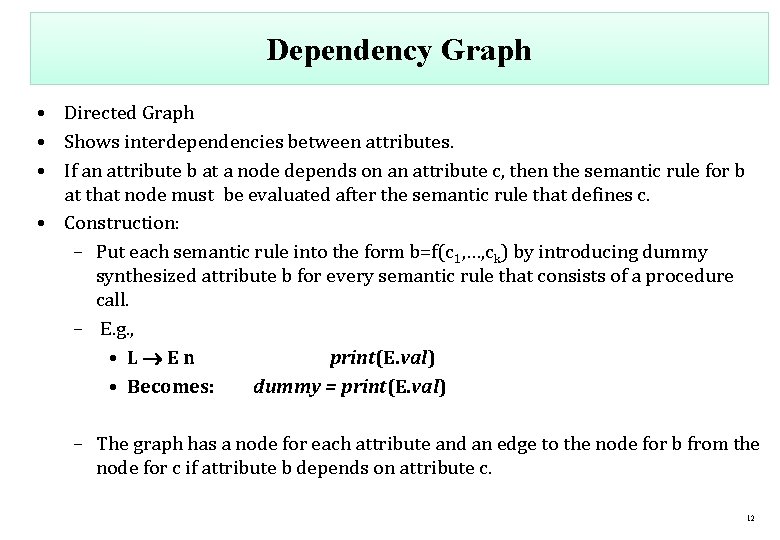
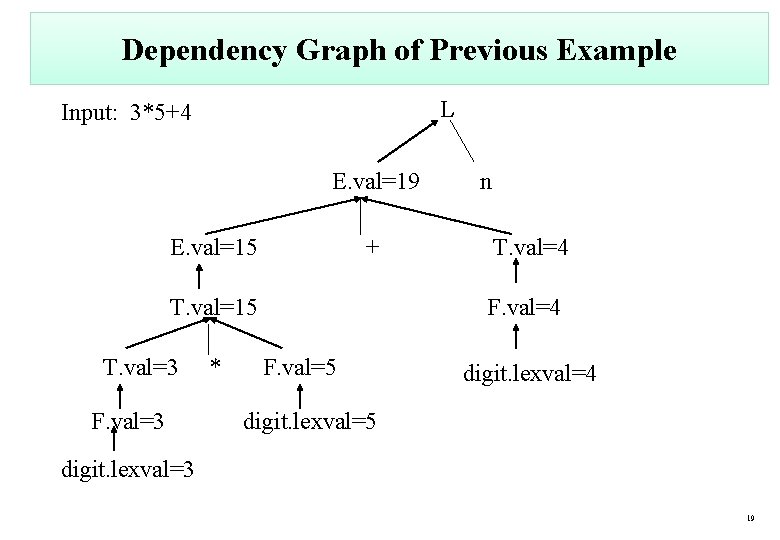
Dependency Graph • Directed Graph • Shows interdependencies between attributes. • If an attribute b at a node depends on an attribute c, then the semantic rule for b at that node must be evaluated after the semantic rule that defines c. • Construction: – Put each semantic rule into the form b=f(c 1, …, ck) by introducing dummy synthesized attribute b for every semantic rule that consists of a procedure call. – E. g. , • L En print(E. val) • Becomes: dummy = print(E. val) – The graph has a node for each attribute and an edge to the node for b from the node for c if attribute b depends on attribute c. 12
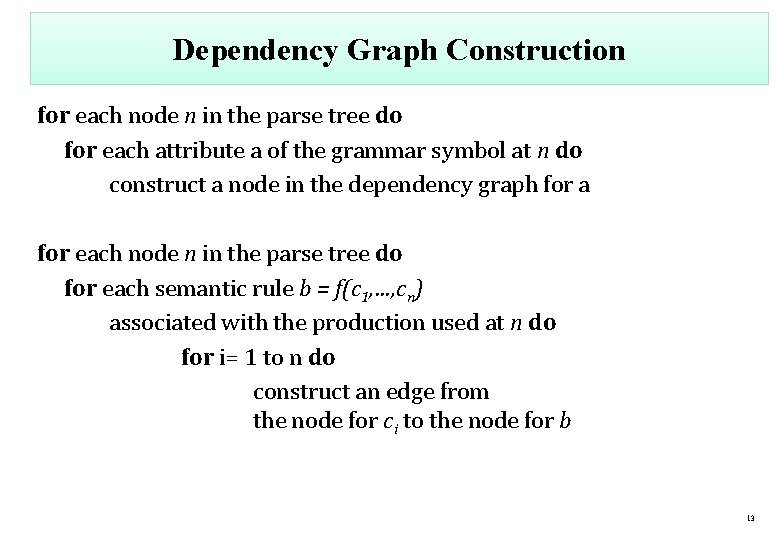
Dependency Graph Construction for each node n in the parse tree do for each attribute a of the grammar symbol at n do construct a node in the dependency graph for a for each node n in the parse tree do for each semantic rule b = f(c 1, …, cn) associated with the production used at n do for i= 1 to n do construct an edge from the node for ci to the node for b 13
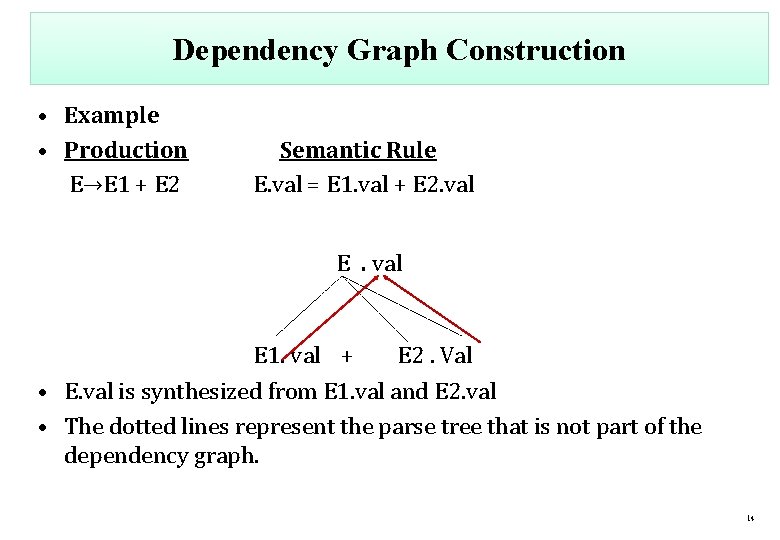
Dependency Graph Construction • Example • Production E→E 1 + E 2 Semantic Rule E. val = E 1. val + E 2. val E 1. val + E 2. Val • E. val is synthesized from E 1. val and E 2. val • The dotted lines represent the parse tree that is not part of the dependency graph. 14
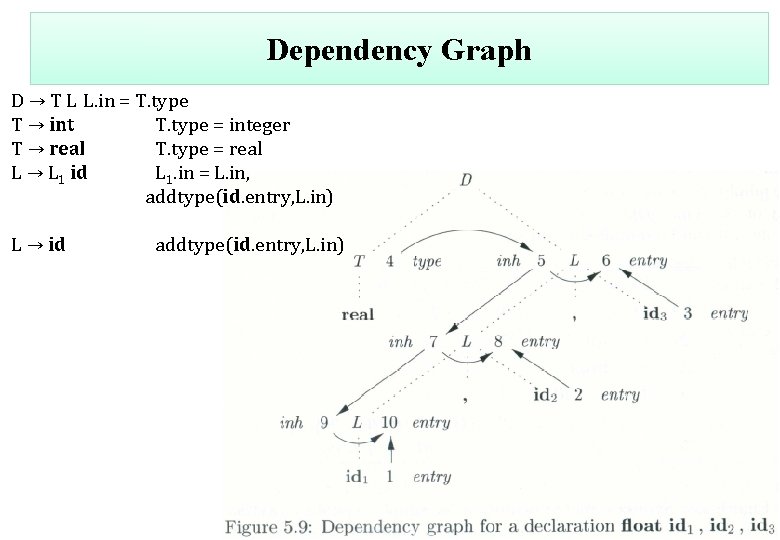
Dependency Graph D → T L L. in = T. type T → int T. type = integer T → real T. type = real L → L 1 id L 1. in = L. in, addtype(id. entry, L. in) L → id addtype(id. entry, L. in) 15
Attribute Grammar • So, a semantic rule b=f(c 1, c 2, …, cn) indicates that the attribute b depends on attributes c 1, c 2, …, cn. • In a syntax-directed definition, a semantic rule may evaluate a value of an attribute or it may have some side effects such as printing values. • An attribute grammar is a syntax-directed definition in which the functions in the semantic rules cannot have side effects (they can only evaluate values of attributes). 16
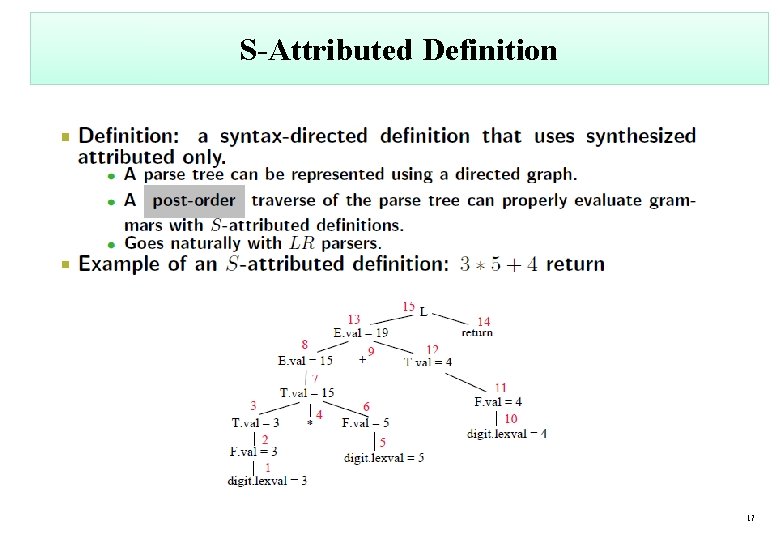
S-Attributed Definition 17
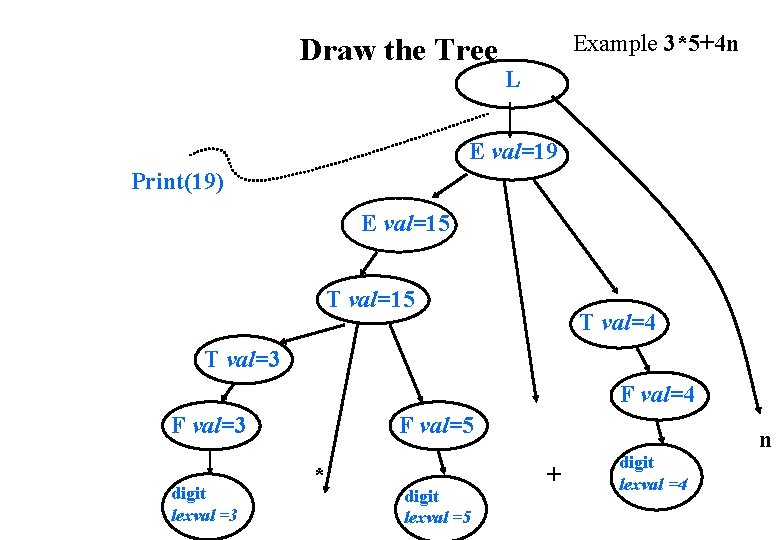
Draw the Tree Example 3*5+4 n L E val=19 Print(19) E val=15 T val=4 T val=3 F val=4 F val=3 digit lexval =3 F val=5 * digit lexval =5 n + digit lexval =4
Dependency Graph of Previous Example L Input: 3*5+4 E. val=19 E. val=15 + T. val=15 T. val=3 F. val=3 * n T. val=4 F. val=5 digit. lexval=4 digit. lexval=5 digit. lexval=3 19
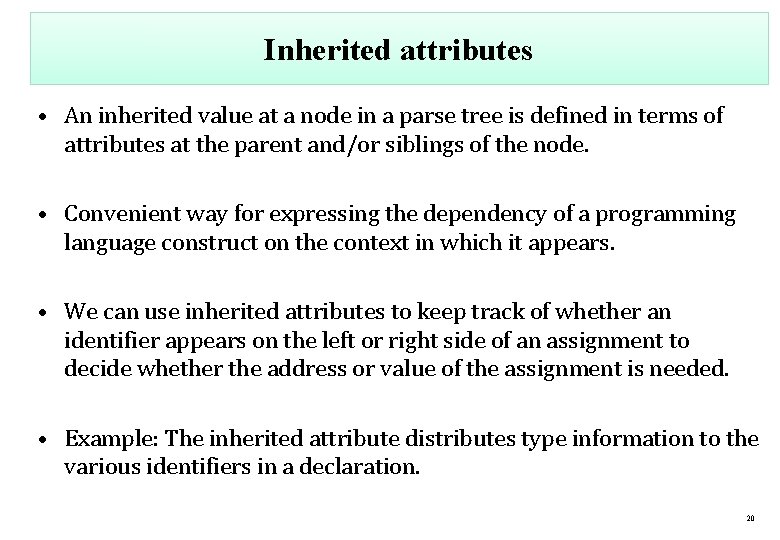
Inherited attributes • An inherited value at a node in a parse tree is defined in terms of attributes at the parent and/or siblings of the node. • Convenient way for expressing the dependency of a programming language construct on the context in which it appears. • We can use inherited attributes to keep track of whether an identifier appears on the left or right side of an assignment to decide whether the address or value of the assignment is needed. • Example: The inherited attribute distributes type information to the various identifiers in a declaration. 20
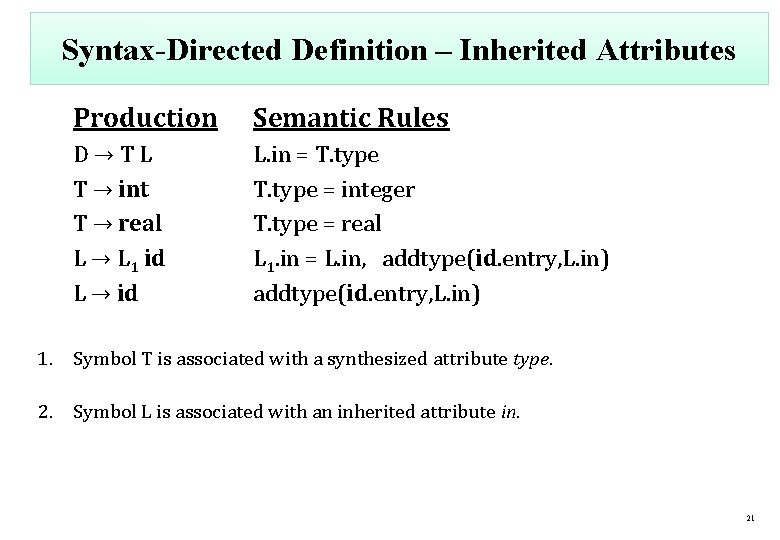
Syntax-Directed Definition – Inherited Attributes Production Semantic Rules D→TL T → int T → real L → L 1 id L → id L. in = T. type = integer T. type = real L 1. in = L. in, addtype(id. entry, L. in) 1. Symbol T is associated with a synthesized attribute type. 2. Symbol L is associated with an inherited attribute in. 21
L-Attributed Definitions • When translation takes place during parsing, order of evaluation is linked to the order in which the nodes of a parse tree are created by parsing method. • A natural order can be obtained by applying the procedure dfvisit to the root of a parse tree. • We call this evaluation order depth first order. • L-attributed definition is a class of syntax directed definition whose attributes can always be evaluated in depth first order( L stands for left since attribute information flows from left to right).
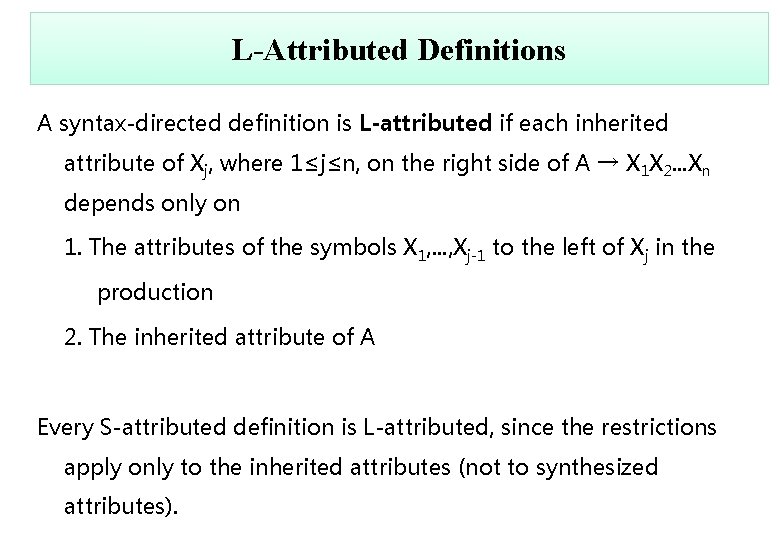
L-Attributed Definitions A syntax-directed definition is L-attributed if each inherited attribute of Xj, where 1≤j≤n, on the right side of A → X 1 X 2. . . Xn depends only on 1. The attributes of the symbols X 1, . . . , Xj-1 to the left of Xj in the production 2. The inherited attribute of A Every S-attributed definition is L-attributed, since the restrictions apply only to the inherited attributes (not to synthesized attributes).
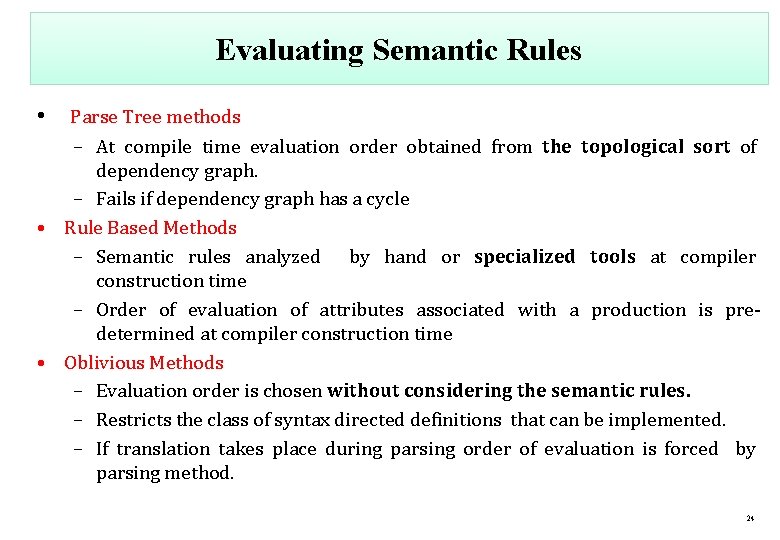
Evaluating Semantic Rules • Parse Tree methods – At compile time evaluation order obtained from the topological sort of dependency graph. – Fails if dependency graph has a cycle • Rule Based Methods – Semantic rules analyzed by hand or specialized tools at compiler construction time – Order of evaluation of attributes associated with a production is predetermined at compiler construction time • Oblivious Methods – Evaluation order is chosen without considering the semantic rules. – Restricts the class of syntax directed definitions that can be implemented. – If translation takes place during parsing order of evaluation is forced by parsing method. 24
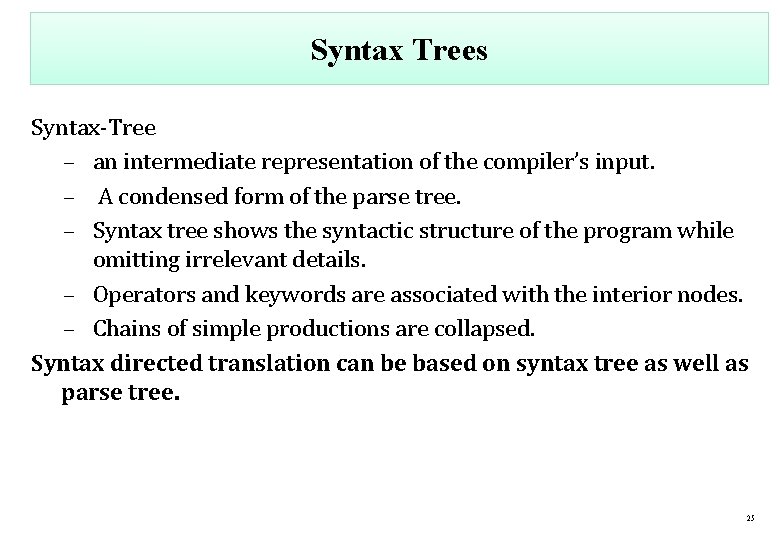
Syntax Trees Syntax-Tree – an intermediate representation of the compiler’s input. – A condensed form of the parse tree. – Syntax tree shows the syntactic structure of the program while omitting irrelevant details. – Operators and keywords are associated with the interior nodes. – Chains of simple productions are collapsed. Syntax directed translation can be based on syntax tree as well as parse tree. 25
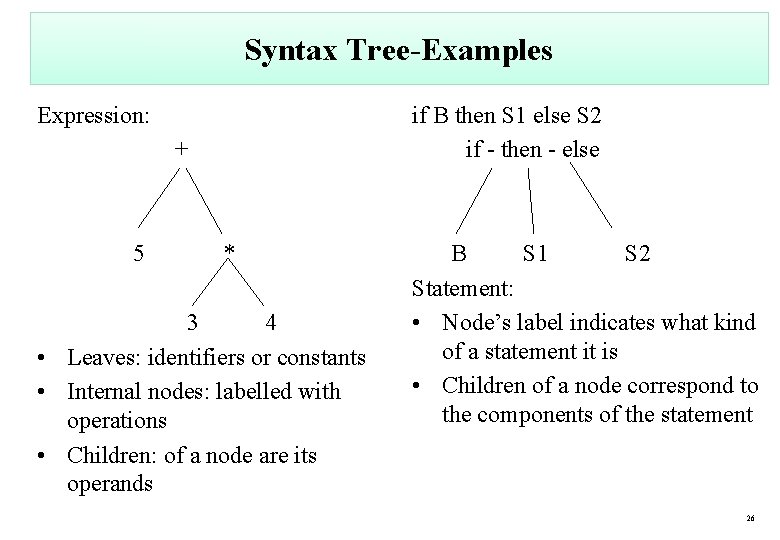
Syntax Tree-Examples Expression: if B then S 1 else S 2 if - then - else + 5 * 3 4 • Leaves: identifiers or constants • Internal nodes: labelled with operations • Children: of a node are its operands B S 1 S 2 Statement: • Node’s label indicates what kind of a statement it is • Children of a node correspond to the components of the statement 26
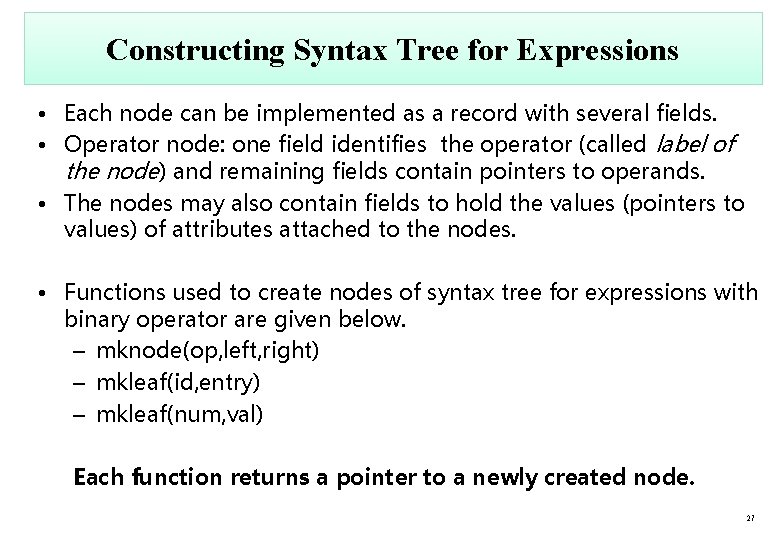
Constructing Syntax Tree for Expressions • Each node can be implemented as a record with several fields. • Operator node: one field identifies the operator (called label of the node) and remaining fields contain pointers to operands. • The nodes may also contain fields to hold the values (pointers to values) of attributes attached to the nodes. • Functions used to create nodes of syntax tree for expressions with binary operator are given below. – mknode(op, left, right) – mkleaf(id, entry) – mkleaf(num, val) Each function returns a pointer to a newly created node. 27
Constructing Syntax Tree for Expressions. Example: a-4+c + 1. 2. 3. 4. 5. p 1: =mkleaf(id, entrya); p 2: =mkleaf(num, 4); p 3: =mknode(-, p 1, p 2) p 4: =mkleaf(id, entryc); p 5: = mknode(+, p 3, p 4); • The tree is constructed bottom up. - id to entry for c id num 4 to entry for a 28
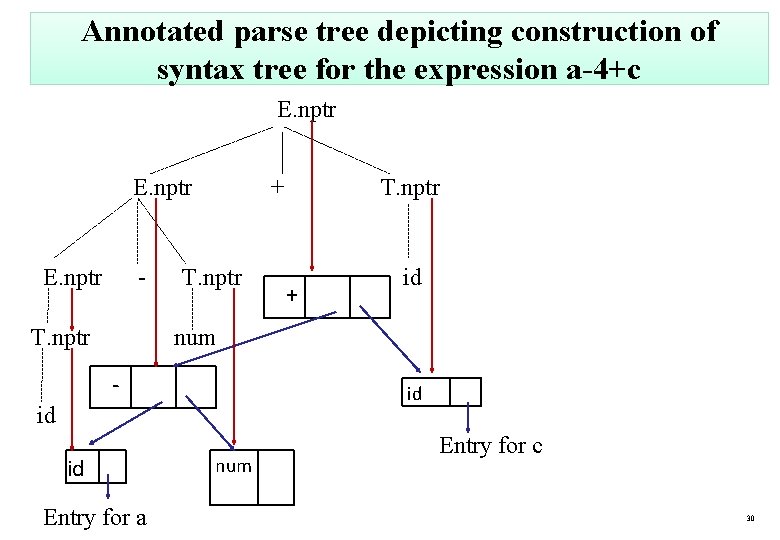
A syntax Directed Definition for Constructing Syntax Tree 1. It uses underlying productions of the grammar to schedule the calls of the functions mkleaf and mknode to construct the syntax tree 2. Employment of the synthesized attribute nptr (pointer) for E and T to keep track of the pointers returned by the function calls. PRODUCTIONSEMANTIC RULE E E 1 + T E. nptr = mknode(“+”, E 1. nptr , T. nptr) E E 1 - T E. nptr = mknode(“-”, E 1. nptr , T. nptr) E T E. nptr = T. nptr T (E) T. nptr = E. nptr T id T. nptr = mkleaf(id, id. lexval) T num T. nptr = mkleaf(num, num. val) 29
Annotated parse tree depicting construction of syntax tree for the expression a-4+c E. nptr - T. nptr + id num - id id id Entry for a num Entry for c 30
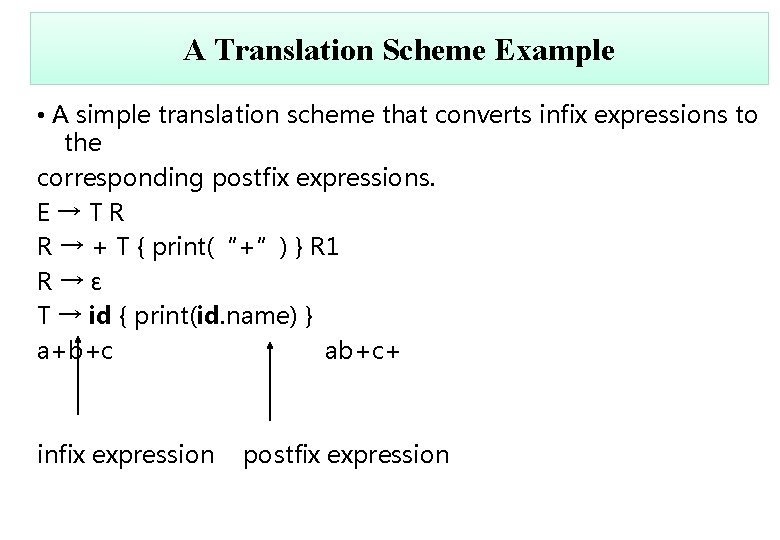
A Translation Scheme Example • A simple translation scheme that converts infix expressions to the corresponding postfix expressions. E→TR R → + T { print(“+”) } R 1 R→ε T → id { print(id. name) } a+b+c ab+c+ infix expression postfix expression
Translation of Assignment Statements • In the syntax directed translation, assignment statement is mainly dealt with expressions. The expression can be of type real, integer, array and records. • Consider the grammar S → id : = E E → E 1 + E 2 E → E 1 * E 2 E → (E 1) E → id
Translation of Assignment Statements Production rule Semantic actions S → id : =E {p = look_up(id. name); If p ≠ nil then Emit (p = E. place) Else Error; } E → E 1 + E 2 {E. place = newtemp(); Emit (E. place = E 1. place '+' E 2. place) } E → E 1 * E 2 {E. place = newtemp(); Emit (E. place = E 1. place '*' E 2. place) } E → (E 1) {E. place = E 1. place} E → id {p = look_up(id. name); If p ≠ nil then Emit (E. place = p) Else Error; } • The p returns the entry for id. name in the symbol table. • The Emit function is used for appending the three address code to the output file. Otherwise it will report an error. • The newtemp() is a function used to generate new temporary variables. • E. place holds the value of E.
Translation of Assignment Statements S E : = id E 1 • Consider the assignment and expression statement as: x: = a*b + c*d E 2 + E 1 id id id c d * id a E 2 b *
Translation of Assignment Statements Production rule Semantic actions E → id id. name is a {p = look_up(id. name); If p ≠ nil then Emit (E. place = p) Else Error; } Thus, p=a Thus, E. Place = a Again, E → id id. name is b Thus, p = b Thus, E. Place = a E → E 1 * E 2 E. Place = t 1 = a * b {p = look_up(id. name); If p ≠ nil then Emit (E. place = p) Else Error; } {E. place = newtemp(); Emit (E. place = E 1. place '*' E 2. place) } • Consider the assignment and expression statement as: x: = a*b + c*d
Translation of Assignment Statements Production rule Semantic actions E → id id. name is c {p = look_up(id. name); If p ≠ nil then Emit (E. place = p) Else Error; } Thus, p=c Thus, E. Place = c Again, E → id id. name is d Thus, p = d Thus, E. Place = d E → E 1 * E 2 E. Place = t 2 = c * d {p = look_up(id. name); If p ≠ nil then Emit (E. place = p) Else Error; } {E. place = newtemp(); Emit (E. place = E 1. place '*' E 2. place) } • Consider the assignment and expression statement as: x: = a*b + c*d
Translation of Assignment Statements Production rule Semantic actions E → E 1 + E 2 E 1. Place = t 1 E 2. Place = t 2 E. Place = t 3 = t 1 + t 2 {E. place = newtemp(); Emit (E. place = E 1. place '+' E 2. place) } E → id {p = look_up(id. name); If p ≠ nil then Emit (E. place = p) Else Error; } Thus, E. Place = x S → id : =E id. name is x Thus, p=x x = t 3 {p = look_up(id. name); If p ≠ nil then Emit (p = E. place) Else Error; } • Consider the assignment and expression statement as: x: = a*b + c*d • Thus, final ICG based on SDT for assignment statements is: t 1 = a * b t 2 = c * d t 3 = t 1 + t 2 x = t 3
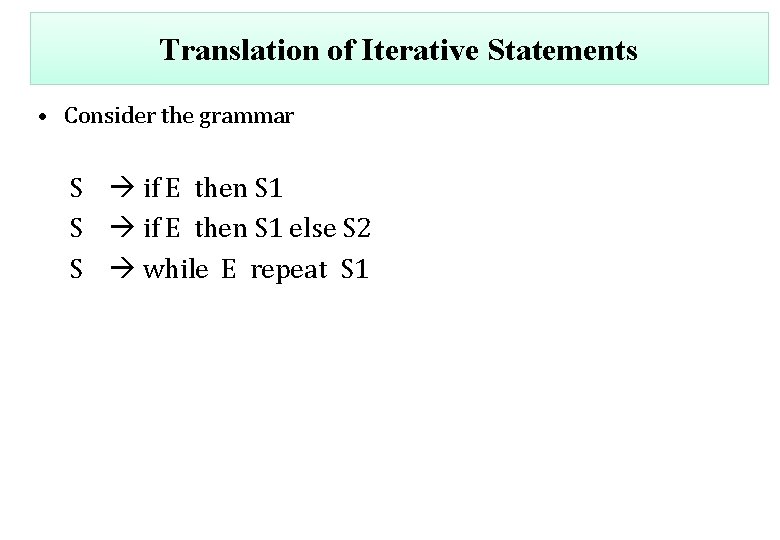
Translation of Iterative Statements • Consider the grammar S if E then S 1 else S 2 S while E repeat S 1
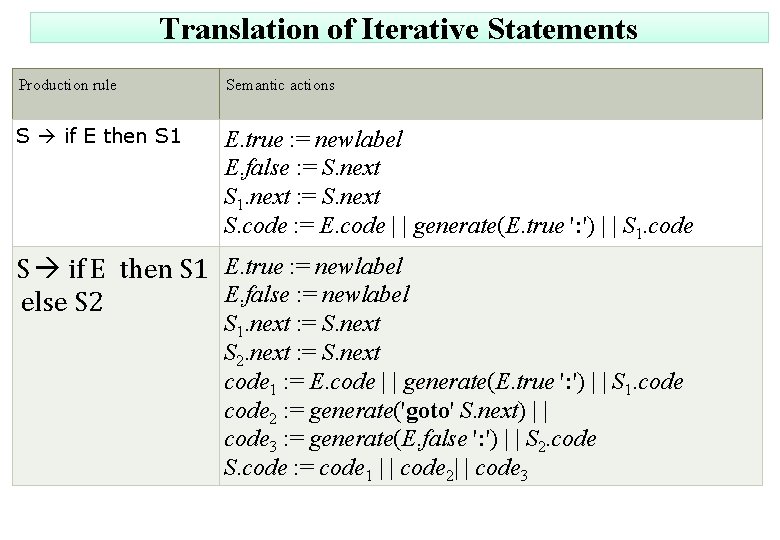
Translation of Iterative Statements Production rule Semantic actions S if E then S 1 E. true : = newlabel E. false : = S. next S 1. next : = S. next S. code : = E. code | | generate(E. true ': ') | | S 1. code S if E then S 1 E. true : = newlabel E. false : = newlabel else S 2 S 1. next : = S. next S 2. next : = S. next code 1 : = E. code | | generate(E. true ': ') | | S 1. code 2 : = generate('goto' S. next) | | code 3 : = generate(E. false ': ') | | S 2. code S. code : = code 1 | | code 2| | code 3
Translation of Iterative Statements Production rule Semantic actions S while E repeat S 1 S. begin : = newlabel E. true : = newlabel E. false : = S. next S 1. next : = S. begin code 1 : = generate(S. begin ': ') | | E. code 2 : = generate(E. true ': ') | | S 1. code 3 : = generate('goto' S. begin) | | S. code : = code 1 | | code 2 | | code 3
Translation of Iterative Statements Production rule Semantic actions S if E then S 1 E. True = L 1 E. False = S. next S 1. next = S. next S. Code = a L 1: b E. true : = newlabel E. false : = S. next S 1. next : = S. next S. code : = E. code | | generate(E. true ': ') | | S 1. code Thus, final ICG based on SDT for assignment statements is: a L 1 : b S. Next • Consider the statement as: If a then b
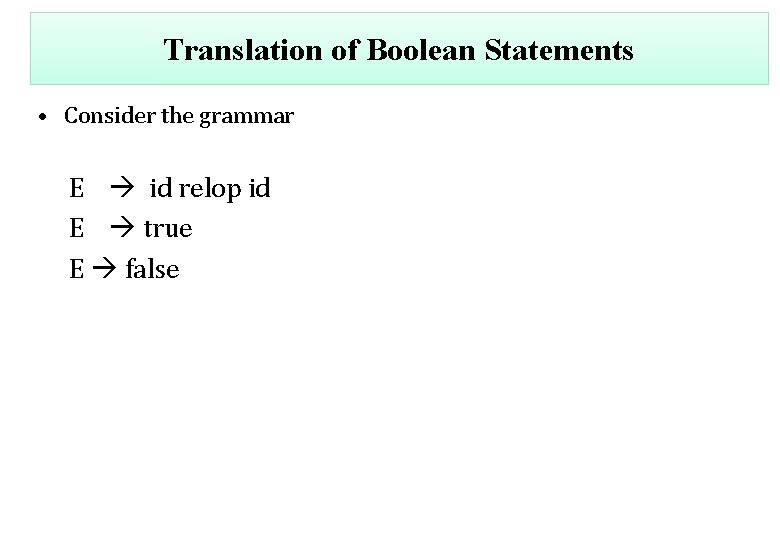
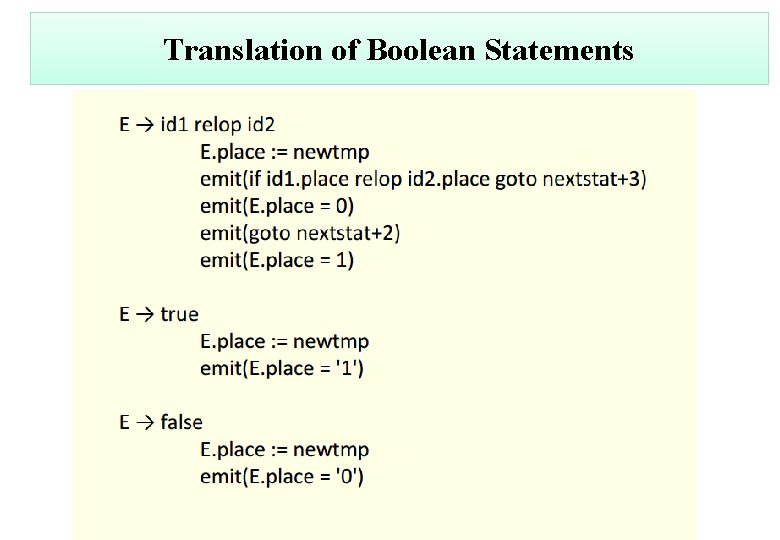
Translation of Boolean Statements • Consider the grammar E id relop id E true E false
Translation of Boolean Statements
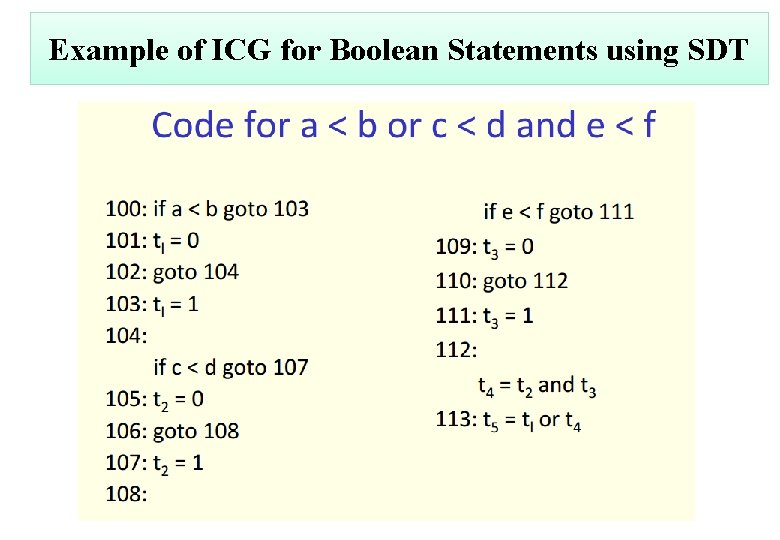
Example of ICG for Boolean Statements using SDT
Alternative : Translation of Boolean Statements
Example : Alternative : Translation of Boolean Statements
Example