
SYNTAX LI 2013 NATHALIE F MARTIN Table of
SYNTAX LI 2013 NATHALIE F. MARTIN
Table of Content II. Grammatical vs. Ungrammatical The Sentence III. Phrases I. Rowe & Levine (2012): p. 115 -155. O’Grady & Archibald (2009) p. 146 -189. IV. Tree Diagrams /Labelling Phrases Inflection VI. Syntax & Ambiguity VII. Deep Structure vs. Surface Structure VIII. Moves V.
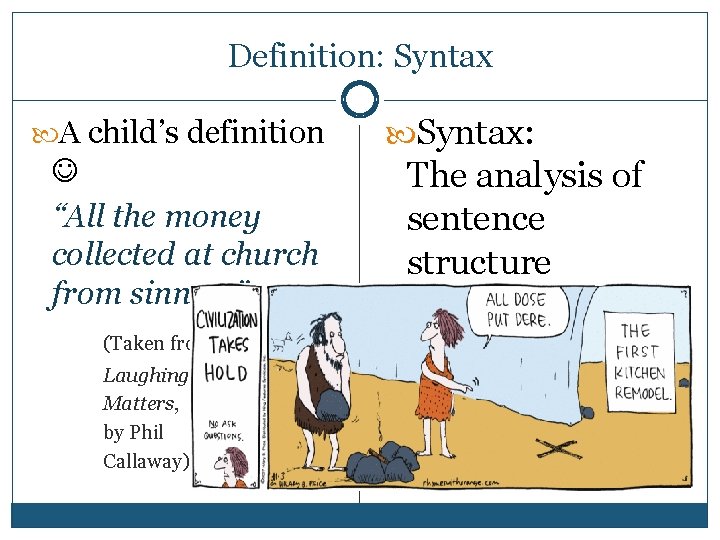
Definition: Syntax A child’s definition “All the money collected at church from sinners” (Taken from Laughing Matters, by Phil Callaway) Syntax: The analysis of sentence structure

Grammatical vs Ungrammatical
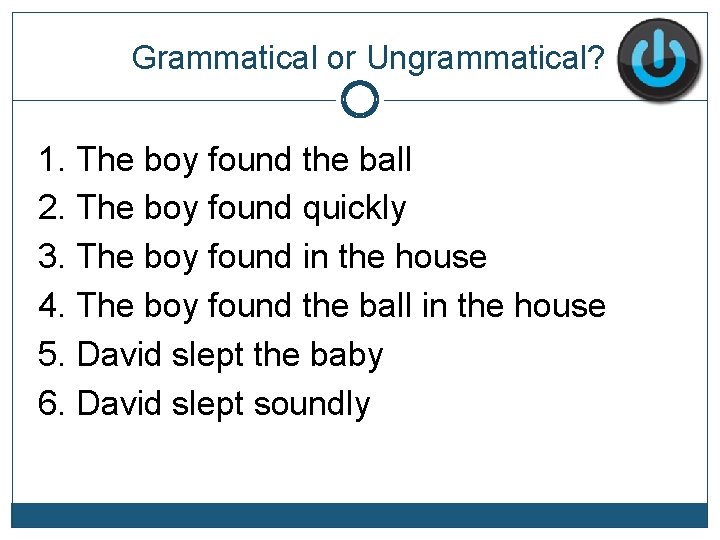
Grammatical or Ungrammatical? 1. The boy found the ball 2. The boy found quickly 3. The boy found in the house 4. The boy found the ball in the house 5. David slept the baby 6. David slept soundly
KEEP IN MIND ØWritten versus spoken ØFormal versus informal (or even slang) ØRight or wrong?
The Sentence DIFFERENT PERSPECTIVES TO THE SENTENCE
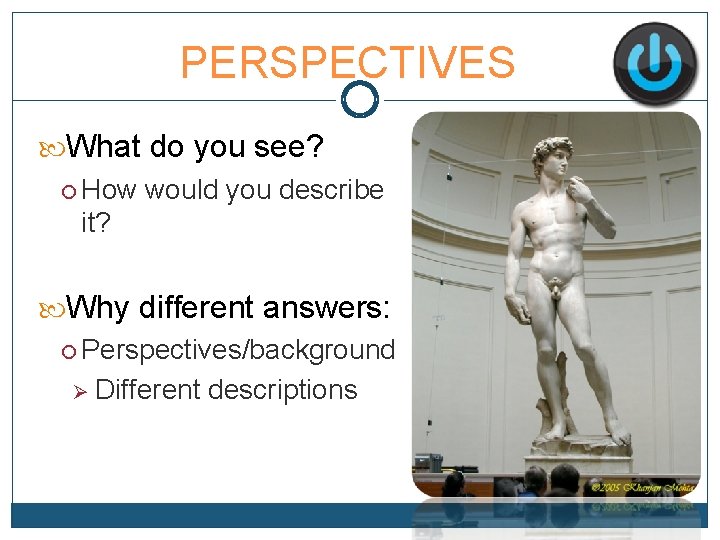
PERSPECTIVES What do you see? How would you describe it? Why different answers: Perspectives/background Ø Different descriptions

Mise en situation
Phrase PHRASE TYPES PHRASE STRUCTURE
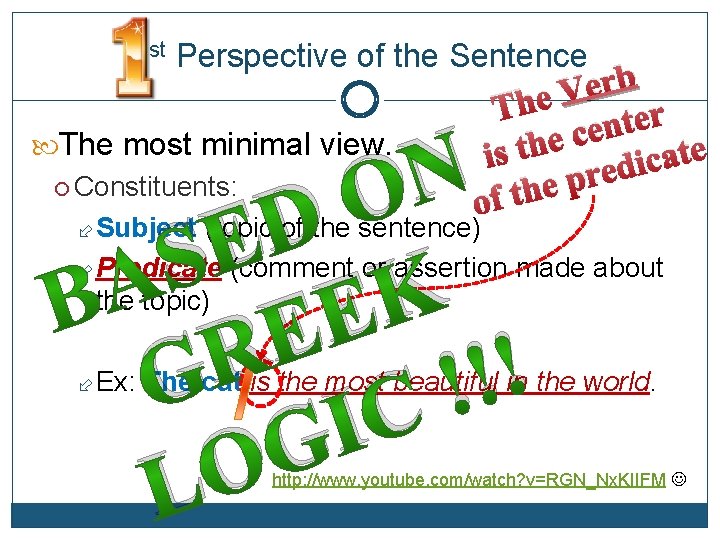
1 st Perspective of the Sentence b r e V The nter e c e h e t is t a c i d e r p e h t of N O D E S K E E R ! ! G ! C I G O L The most minimal view. Constituents: Subject (topic of the sentence) Predicate (comment or assertion made about the topic) Ex: The cat is the most beautiful in the world. http: //www. youtube. com/watch? v=RGN_Nx. KIIFM
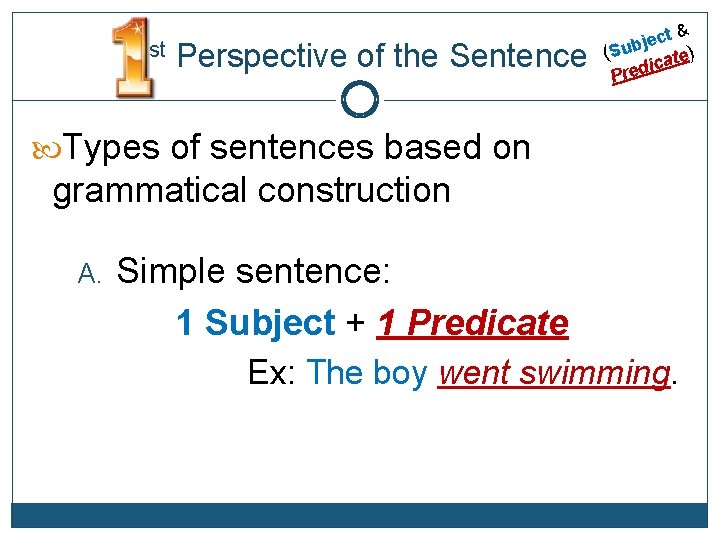
1 st Perspective of the Sentence & t c e j (Sub cate) i Pred Types of sentences based on grammatical construction A. Simple sentence: 1 Subject + 1 Predicate Ex: The boy went swimming.
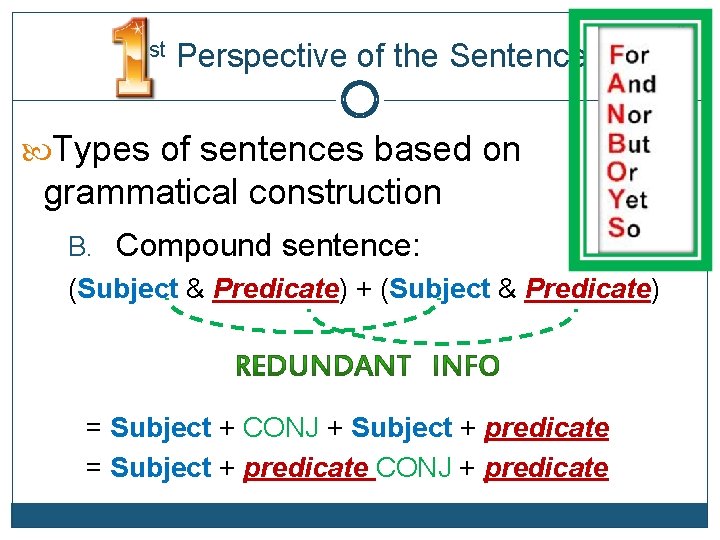
1 st Perspective of the Sentence & t c e j (Sub cate) i Pred Types of sentences based on grammatical construction B. Compound sentence: (Subject & Predicate) + (Subject & Predicate) = Subject + CONJ + Subject + predicate = Subject + predicate CONJ + predicate
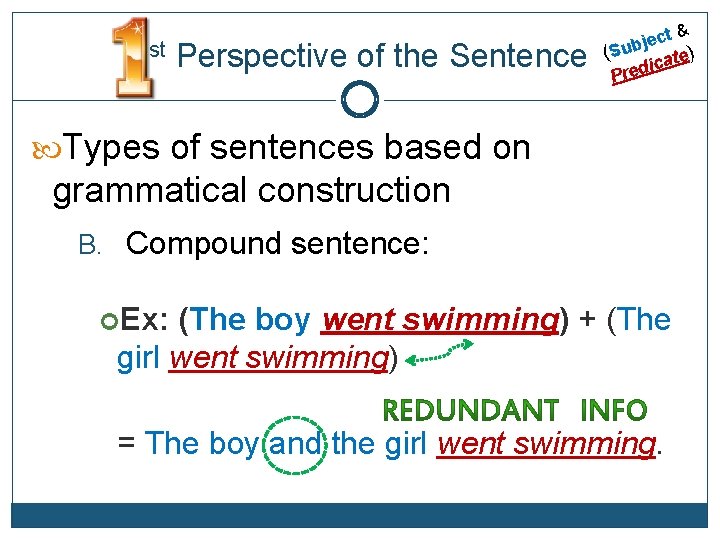
1 st Perspective of the Sentence & t c e j (Sub cate) i Pred Types of sentences based on grammatical construction B. Compound sentence: Ex: (The boy went swimming) + (The girl went swimming) = The boy and the girl went swimming.
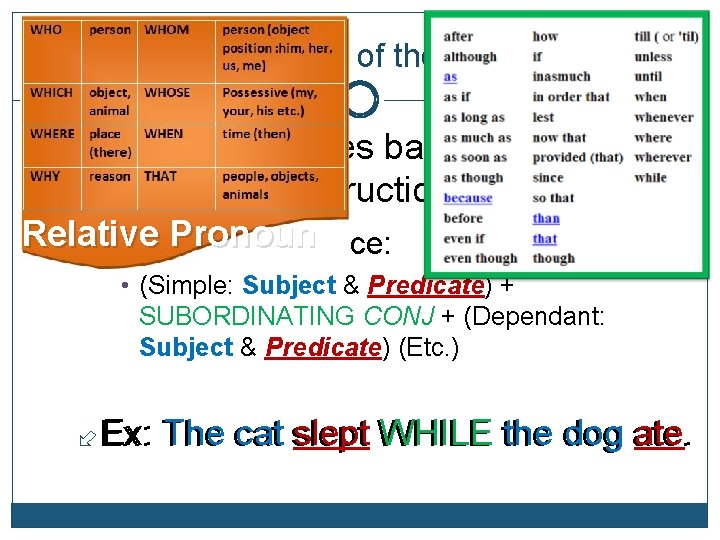
1 st Perspective of the Sentence & t c e j (Sub cate) i Pred Types of sentences based on grammatical construction Relative Pronoun C. Complex sentence: • (Simple: Subject & Predicate) + SUBORDINATING CONJ + (Dependant: Subject & Predicate) (Etc. ) Ex: The cat slept WHILE the dog ate.
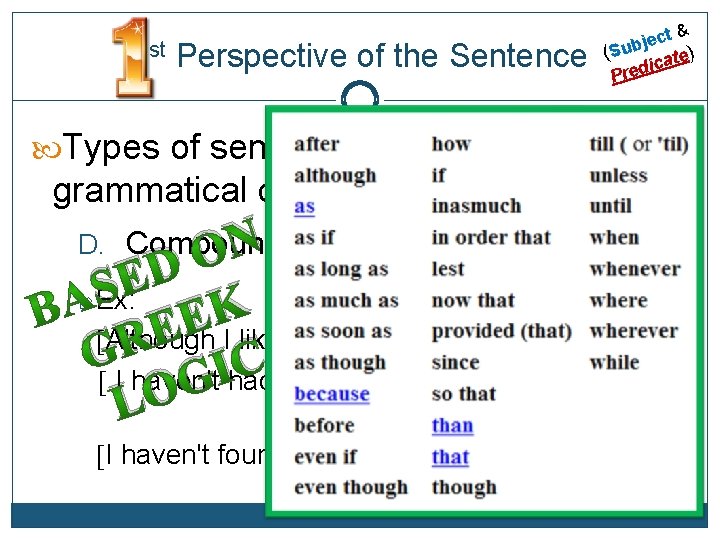
1 st Perspective of the Sentence & t c e j (Sub cate) i Pred Types of sentences based on grammatical construction D. Compound-Complex sentence: N O D E S Ex: K E E Although I like to go camping (Dep clause), R G I haven't had the time to go lately (Ind clause), C I G O L AND I haven't found anyone to go with (Ind clause).
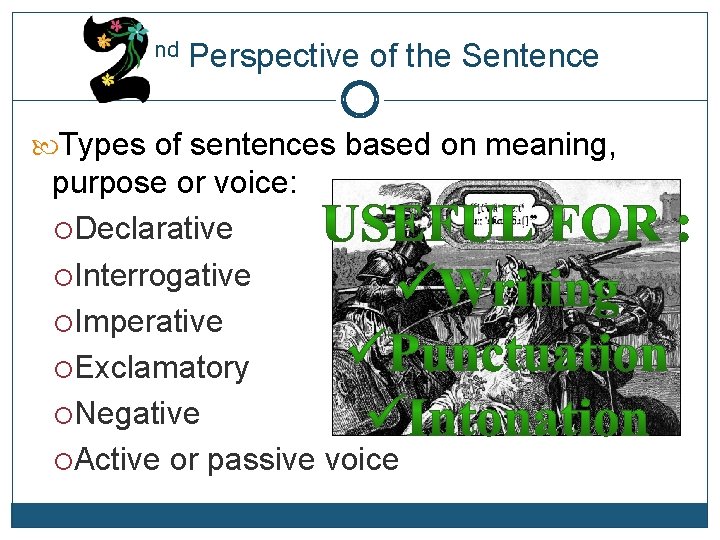
nd Perspective of the Sentence Types of sentences based on meaning, purpose or voice: Declarative Interrogative Imperative Exclamatory Negative Active or passive voice
3 rd Perspective of the Sentence Study of the sentence based on grammatical construction. Phrases: Heads of phrases + dependants (specifiers + complements) • Nouns, verbs, prepositions, adjectives, etc.
Phrase PHRASE TYPES PHRASE STRUCTURE
Let’s Try it Out How would you divide this sentence? a) The children put the brand new toys in the box. Definition of “phrases”: independent linguistic objects with their own characteristics and internal structure
From Phrase Structure to Sentence Structure We form sentences by combining words into phrasal constituents, phrases into larger constituents, and these constituents into sentences.
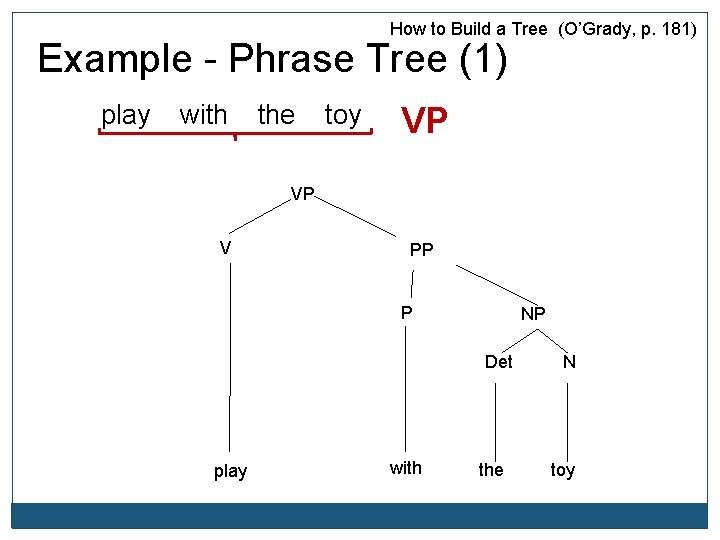
Phrase types Noun Phrase (NP): Functions like a noun Ex. The car, a clever student Verb Phrase (VP): Functions like a verb Ex: study hard, play the guitar
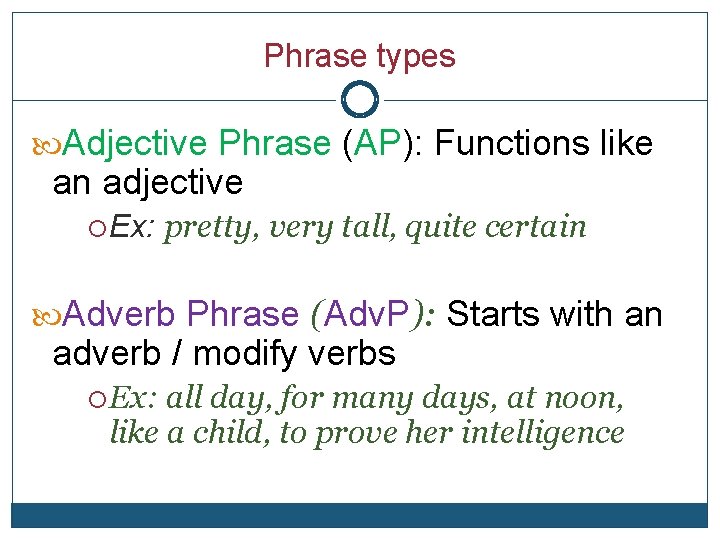
Phrase types Adjective Phrase (AP): Functions like an adjective Ex: pretty, very tall, quite certain Adverb Phrase (Adv. P): Starts with an adverb / modify verbs Ex: all day, for many days, at noon, like a child, to prove her intelligence
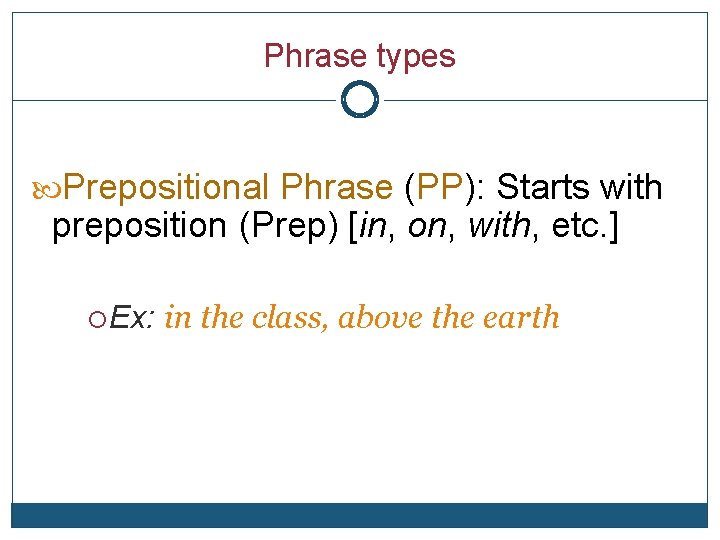
Phrase types Prepositional Phrase (PP): Starts with preposition (Prep) [in, on, with, etc. ] Ex: in the class, above the earth
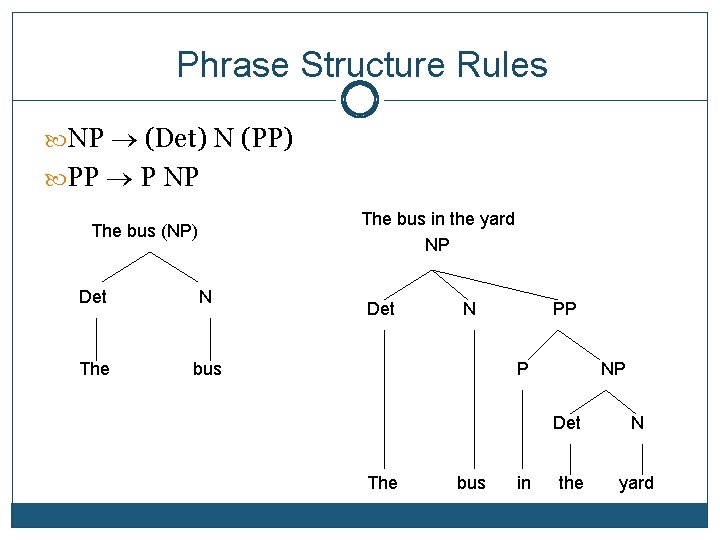
Phrase Structure Rules NP (Det) N (PP) PP P NP The bus in the yard NP The bus (NP) Det N The bus Det N PP P The bus in NP Det N the yard
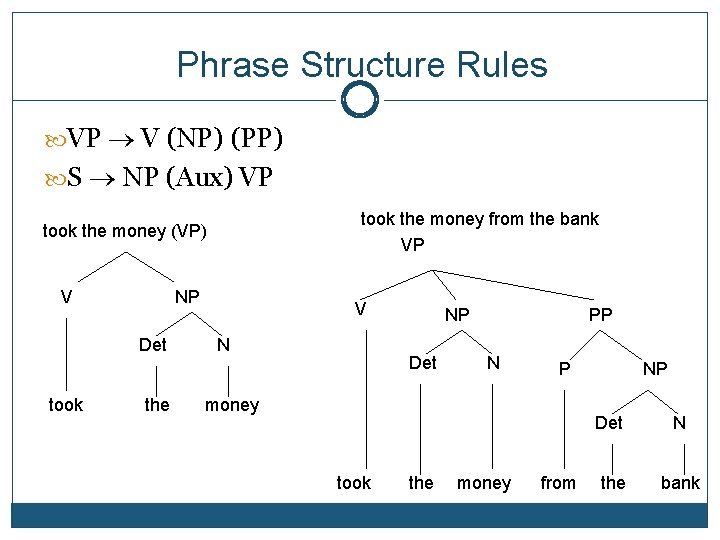
Phrase Structure Rules VP V (NP) (PP) S NP (Aux) VP took the money from the bank VP took the money (VP) V NP Det took the V N NP Det PP N P money took the money from NP Det N the bank
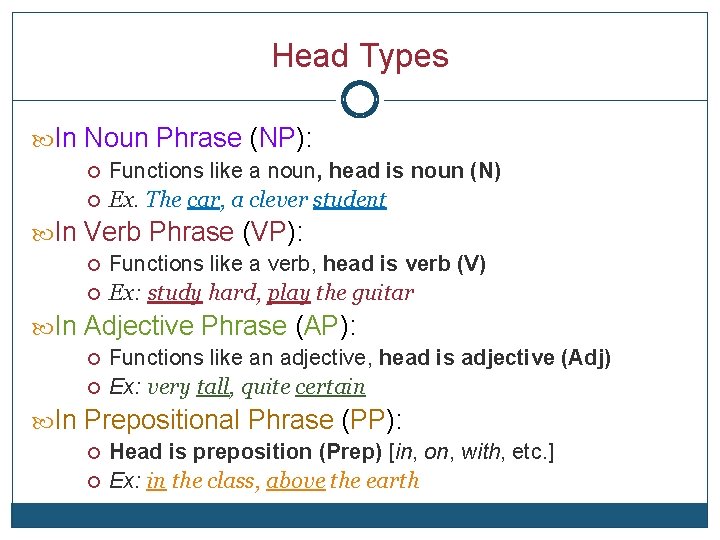
Head Types In Noun Phrase (NP): Functions like a noun, head is noun (N) Ex. The car, a clever student In Verb Phrase (VP): Functions like a verb, head is verb (V) Ex: study hard, play the guitar In Adjective Phrase (AP): Functions like an adjective, head is adjective (Adj) Ex: very tall, quite certain In Prepositional Phrase (PP): Head is preposition (Prep) [in, on, with, etc. ] Ex: in the class, above the earth
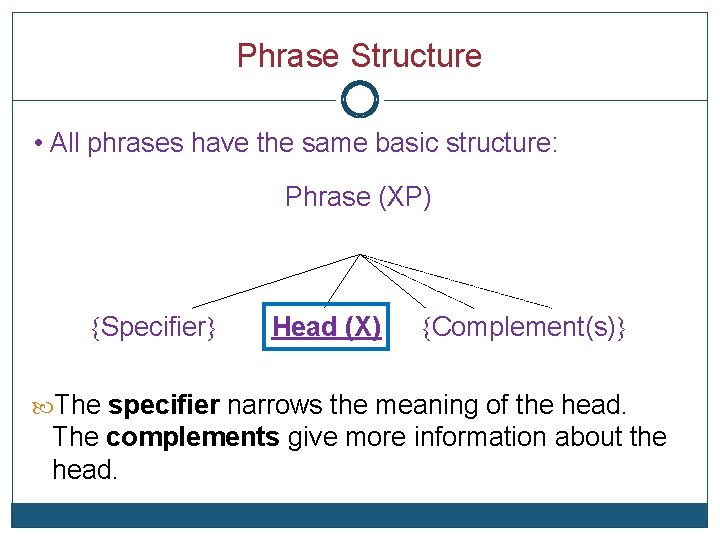
Phrase Structure • All phrases have the same basic structure: Phrase (XP) {Specifier} Head (X) {Complement(s)} The specifier narrows the meaning of the head. The complements give more information about the head.
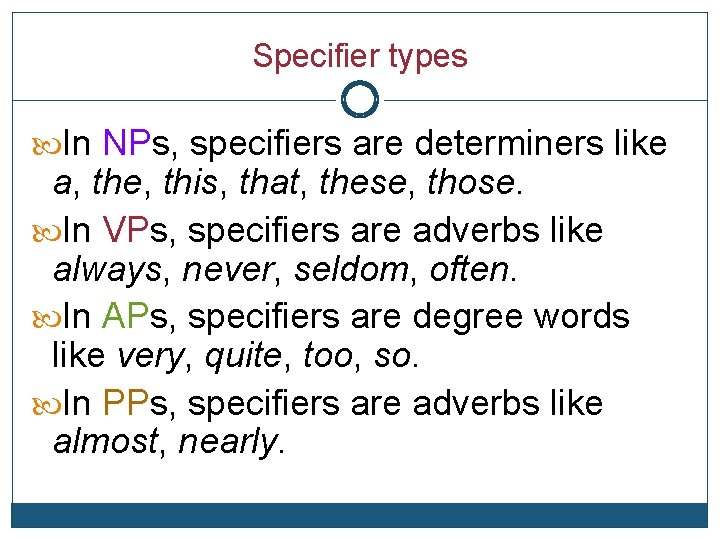
Specifier types In NPs, specifiers are determiners like a, the, this, that, these, those. In VPs, specifiers are adverbs like always, never, seldom, often. In APs, specifiers are degree words like very, quite, too, so. In PPs, specifiers are adverbs like almost, nearly.
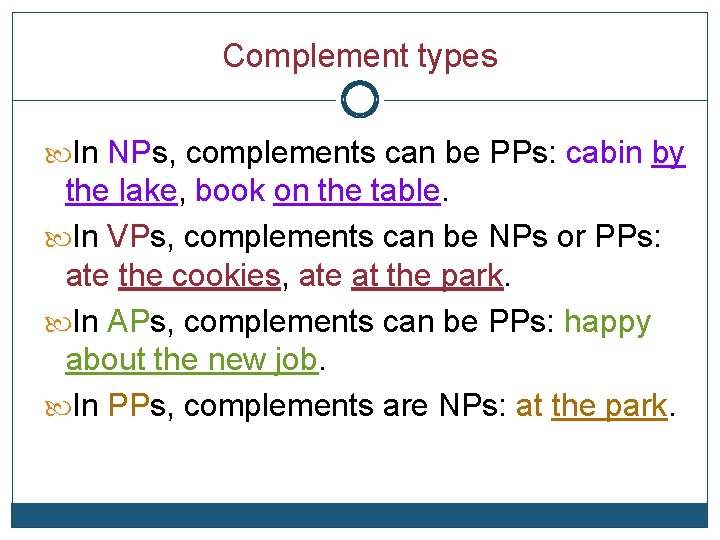
Complement types In NPs, complements can be PPs: cabin by the lake, book on the table. In VPs, complements can be NPs or PPs: ate the cookies, ate at the park. In APs, complements can be PPs: happy about the new job. In PPs, complements are NPs: at the park.
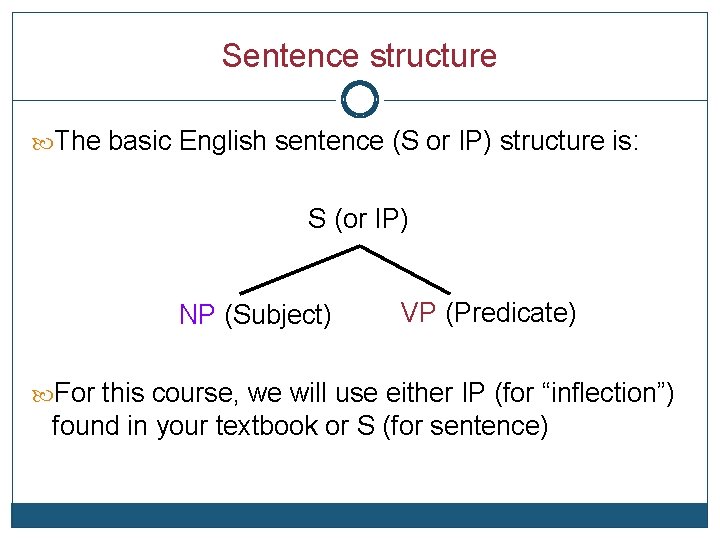
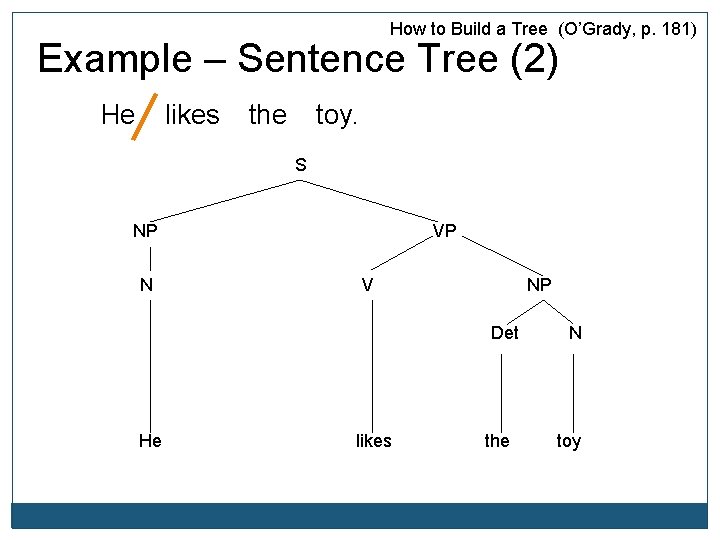
Sentence structure The basic English sentence (S or IP) structure is: S (or IP) NP (Subject) VP (Predicate) For this course, we will use either IP (for “inflection”) found in your textbook or S (for sentence)
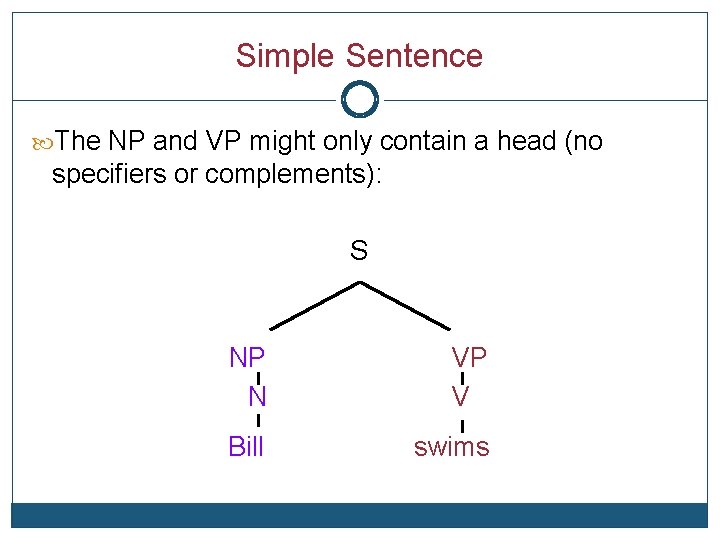
Simple Sentence The NP and VP might only contain a head (no specifiers or complements): S NP VP N V Bill swims
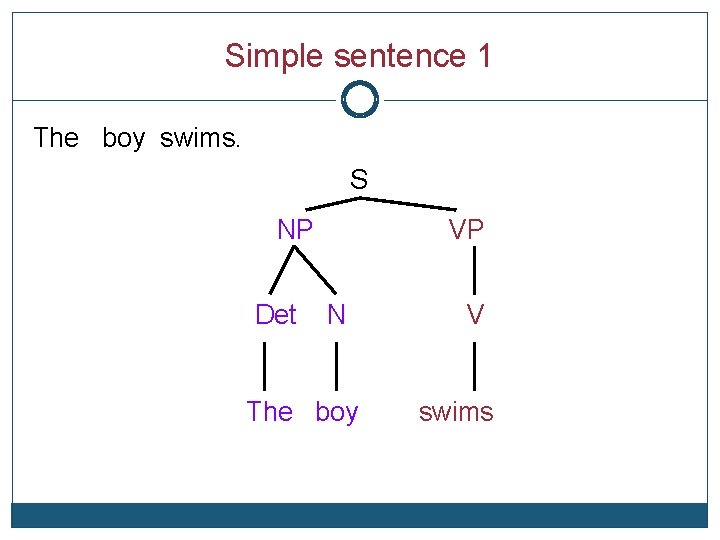
Simple sentence 1 The boy swims. S NP VP Det N V The boy swims
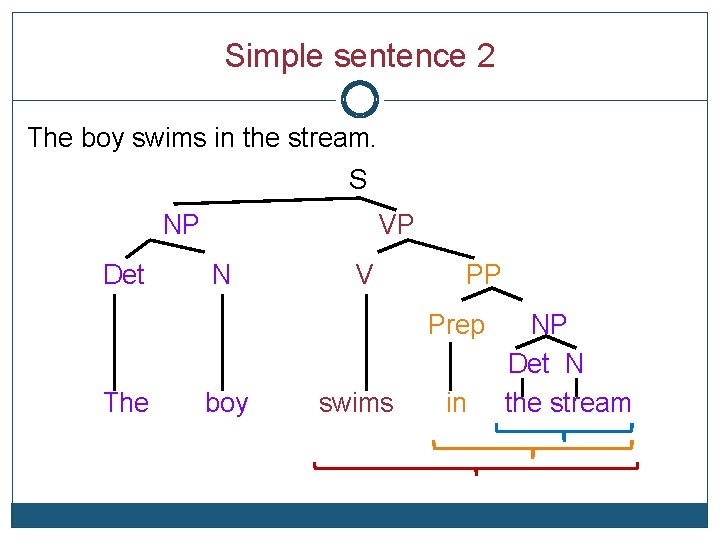
Simple sentence 2 The boy swims in the stream. S NP VP Det N V PP The boy Prep NP Det N swims in the stream
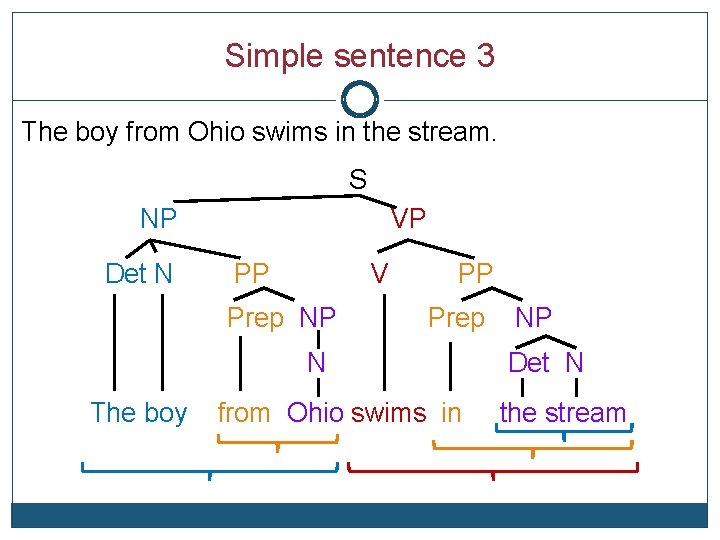
Simple sentence 3 The boy from Ohio swims in the stream. S NP VP Det N PP V PP Prep NP N Prep NP Det N The boy from Ohio swims in the stream
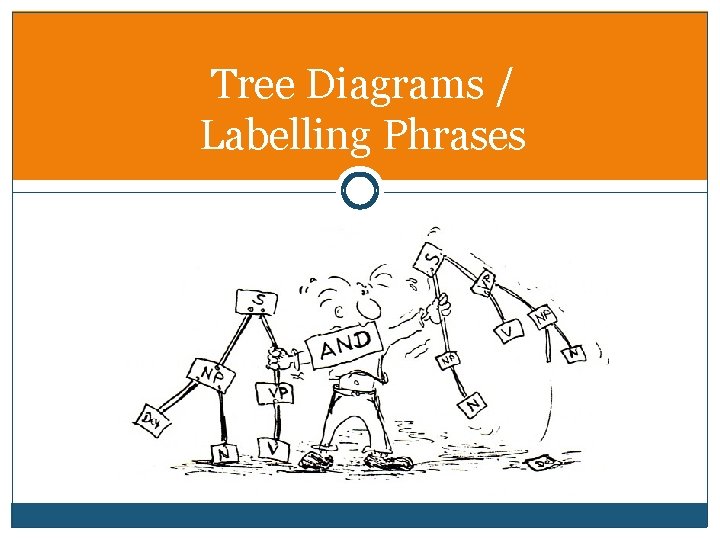
Tree Diagrams / Labelling Phrases
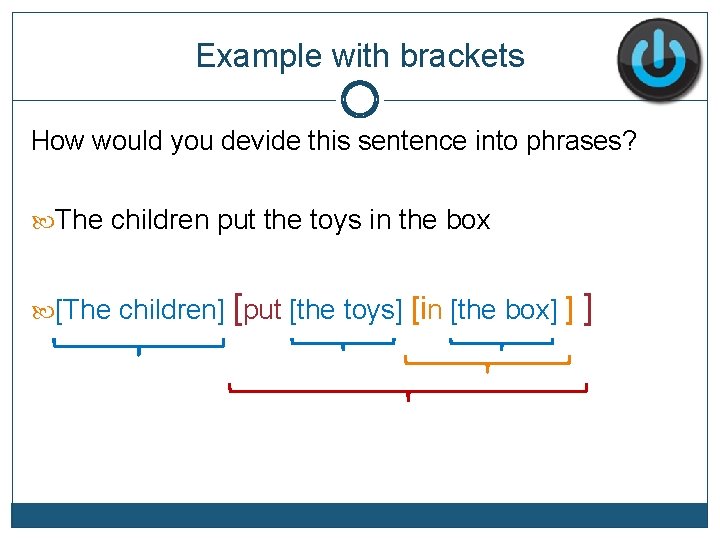
Example with brackets How would you devide this sentence into phrases? The children put the toys in the box [The children] [put [the toys] [in [the box] ] ]

The Main Phrase Structure Rules 1. S NP VP 2. NP (Det) (AP) N (PP) 3. VP (Aux) V (NP) 4. PP (Deg) P (NP)
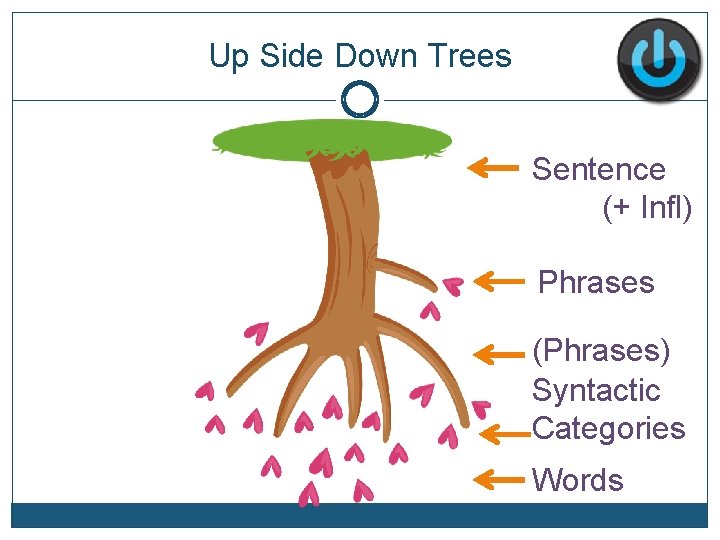
Up Side Down Trees Sentence (+ Infl) Phrases (Phrases) Syntactic Categories Words
O’Grady, p. 181 How to build trees structures:
How to Build a Tree (O’Grady, p. 181) Example - Phrase Tree (1) play with the toy VP VP V PP P NP Det play with the N toy
Draw the tree Structure of phrase 1. repair the telephone 2. the success of the program 3. a film about pollution 4. move towards the window 5. The end of the road
How to Build a Tree (O’Grady, p. 181) Example – Sentence Tree (2) He likes the toy. S NP N VP V NP Det He likes the N toy
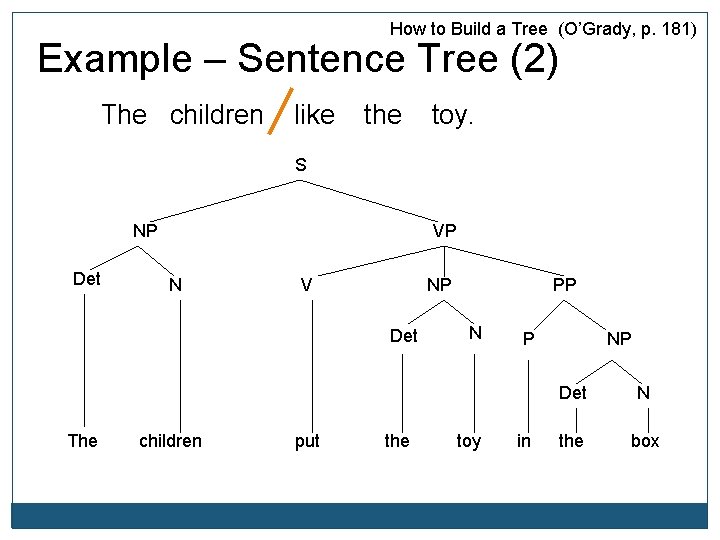
How to Build a Tree (O’Grady, p. 181) Example – Sentence Tree (2) The children like the toy. S NP Det VP N V NP Det The children put the PP N toy P in NP Det N the box
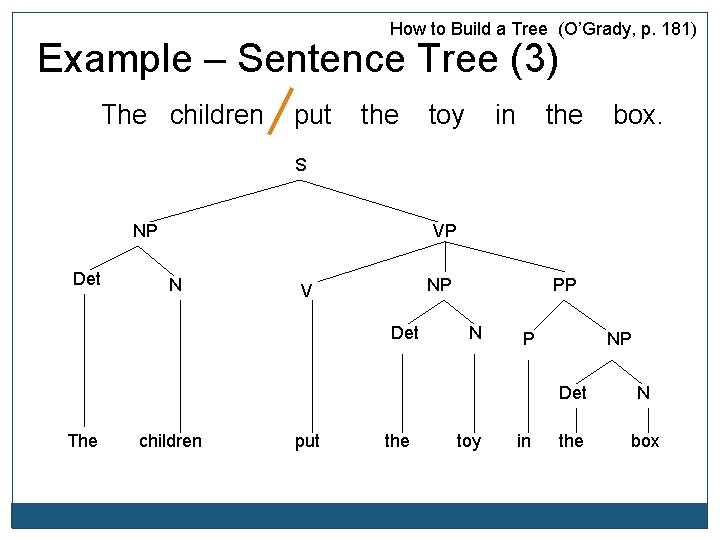
How to Build a Tree (O’Grady, p. 181) Example – Sentence Tree (3) The children put the toy in the box. S NP Det VP N NP V Det The children put the PP N toy P in NP Det N the box
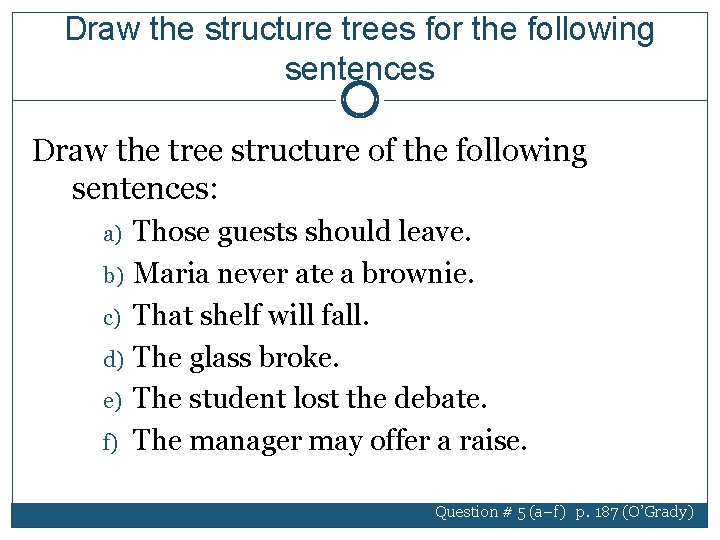
Draw the structure trees for the following sentences Draw the tree structure of the following sentences: a) b) c) d) e) f) Those guests should leave. Maria never ate a brownie. That shelf will fall. The glass broke. The student lost the debate. The manager may offer a raise. Question # 5 (a–f) p. 187 (O’Grady)
TENSE THE TENSE OF THE SENTENCE
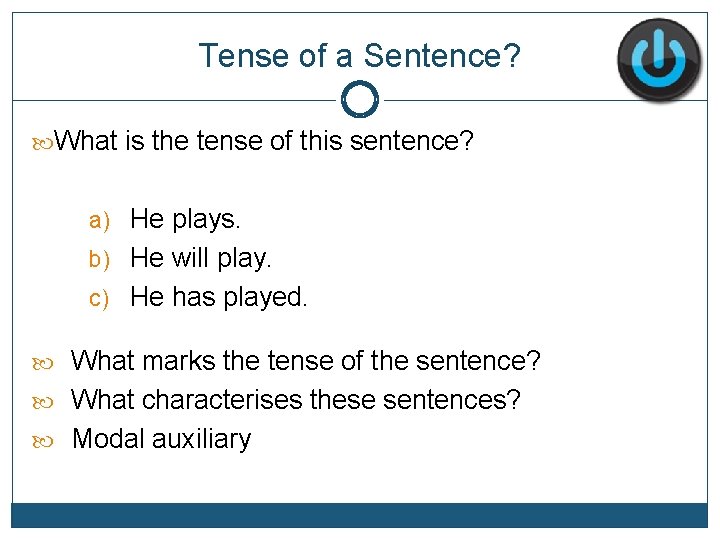
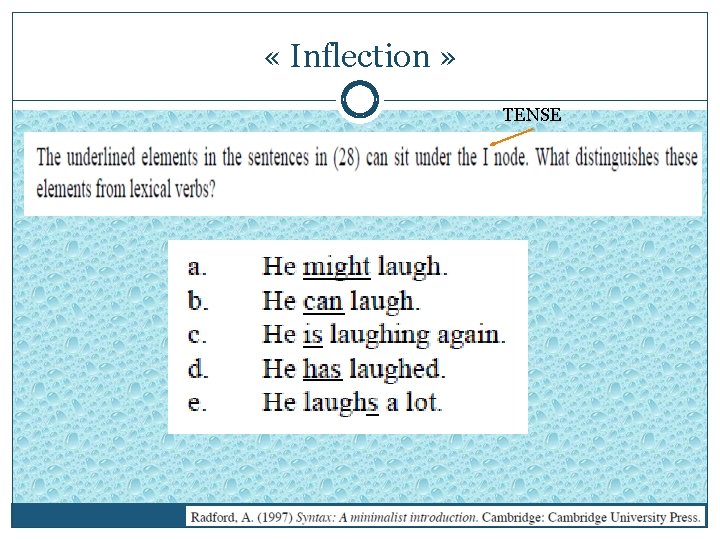
Tense of a Sentence? What is the tense of this sentence? a) He plays. b) He will play. c) He has played. What marks the tense of the sentence? What characterises these sentences? Modal auxiliary
« Inflection » or TENSE Abstract category dubbed « tense » and sometimes « Infl » for inflection that indicates the tense of the sentence. ØWithin the VP
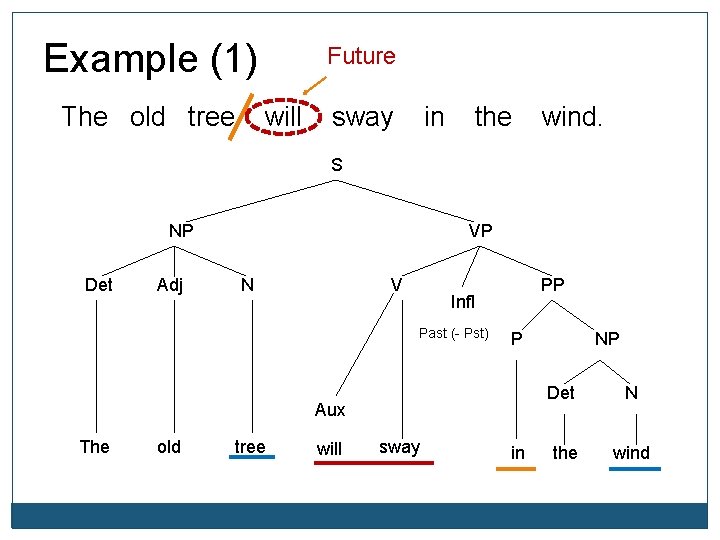
Example (1) Future The old tree will sway in the wind. S NP Det Adj VP N V PP Infl Past (- Pst) P Aux The old tree will sway in NP Det N the wind
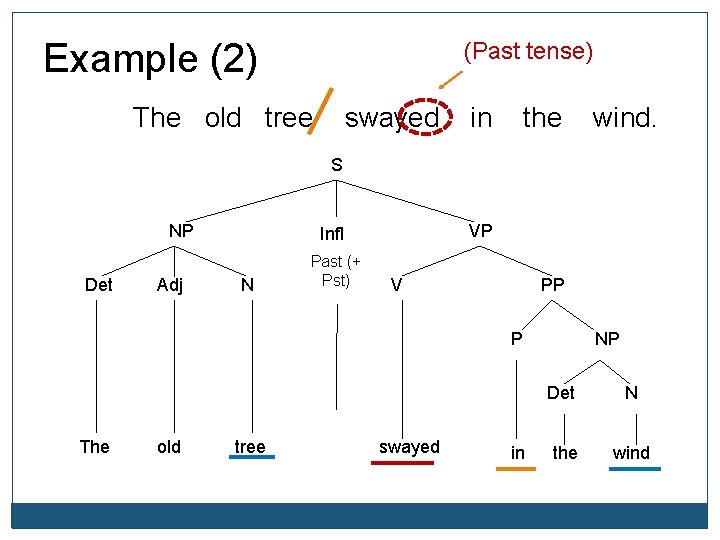
Example (2) (Past tense) The old tree swayed in the wind. S NP Det Adj VP Infl N Past (+ Pst) V PP P The old tree swayed in NP Det N the wind
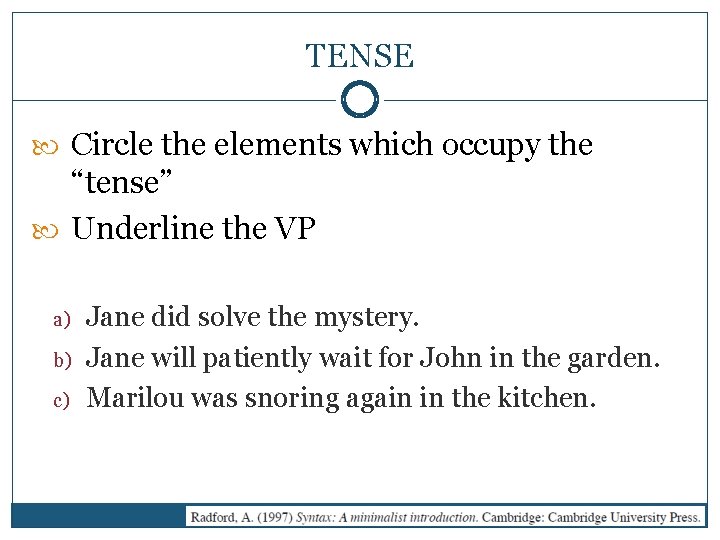
TENSE Circle the elements which occupy the “tense” Underline the VP a) b) c) Jane did solve the mystery. Jane will patiently wait for John in the garden. Marilou was snoring again in the kitchen.
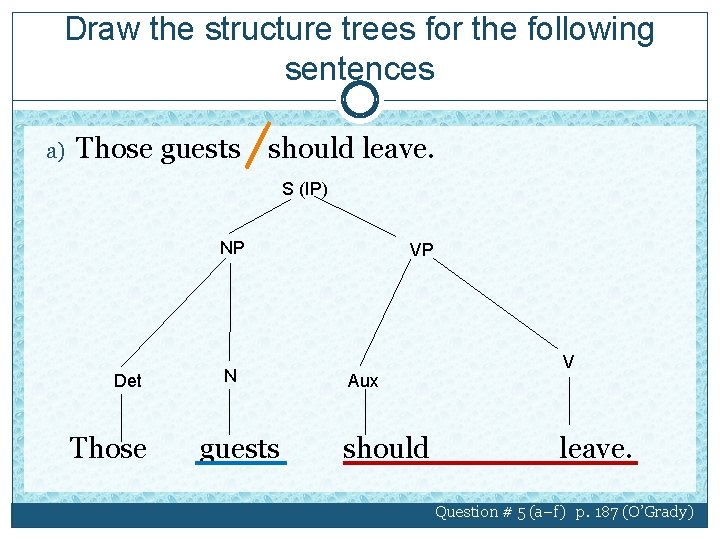
Draw the structure trees for the following sentences a) Those guests should leave. S (IP) NP Det Those N guests VP V Aux should leave. Question # 5 (a–f) p. 187 (O’Grady)
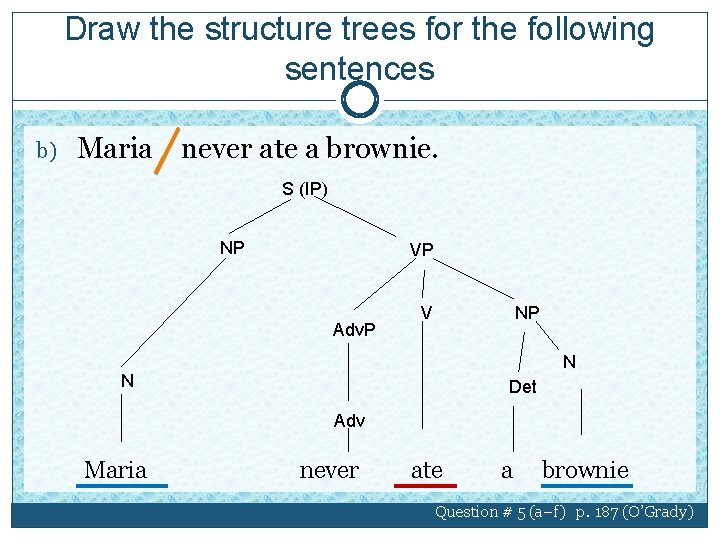
Draw the structure trees for the following sentences b) Maria never ate a brownie. S (IP) NP VP Adv. P V NP N N Det Adv Maria never ate a brownie Question # 5 (a–f) p. 187 (O’Grady)
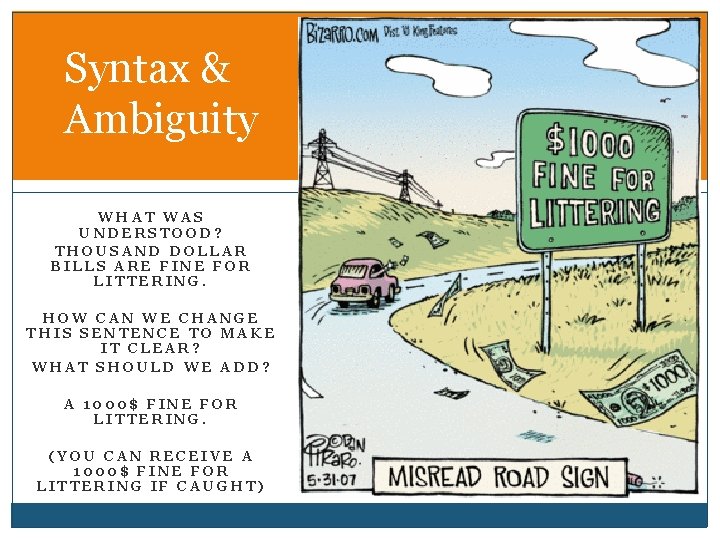
Syntax & Ambiguity WHAT WAS UNDERSTOOD? THOUSAND DOLLAR BILLS ARE FINE FOR LITTERING. HOW CAN WE CHANGE THIS SENTENCE TO MAKE IT CLEAR? WHAT SHOULD WE ADD? A 1000$ FINE FOR LITTERING. (YOU CAN RECEIVE A 1000$ FINE FOR LITTERING IF CAUGHT)
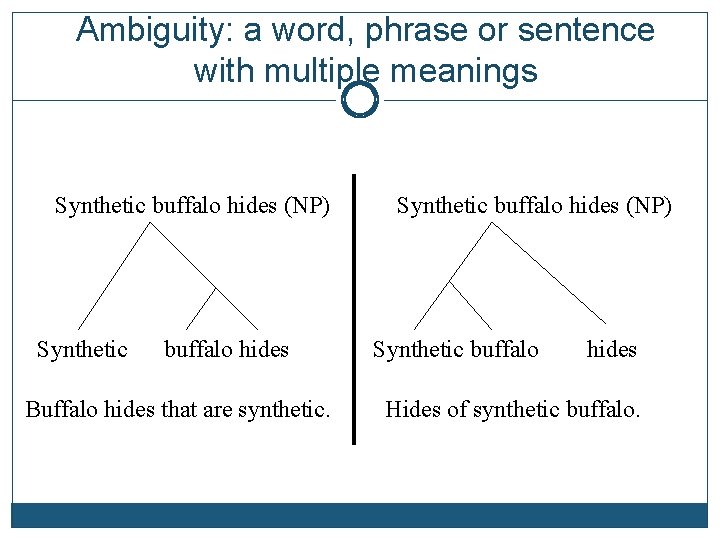
Ambiguity: a word, phrase or sentence with multiple meanings Synthetic buffalo hides (NP) Synthetic buffalo hides Buffalo hides that are synthetic. Synthetic buffalo hides (NP) Synthetic buffalo hides Hides of synthetic buffalo.
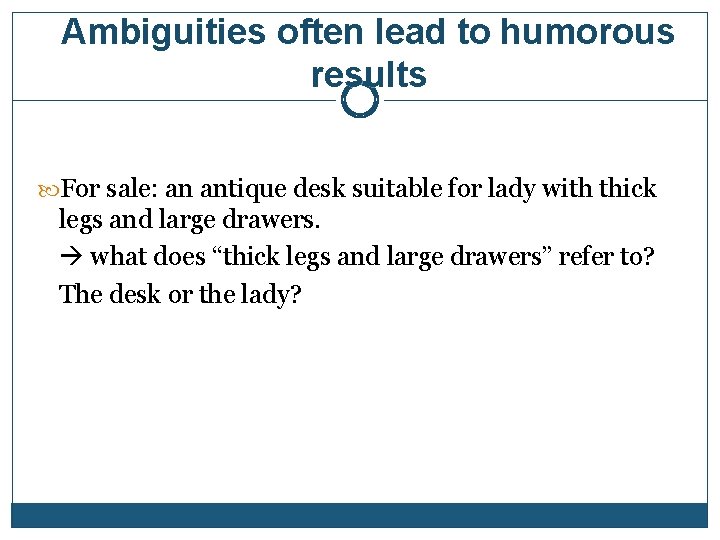
Ambiguities often lead to humorous results For sale: an antique desk suitable for lady with thick legs and large drawers. what does “thick legs and large drawers” refer to? The desk or the lady?
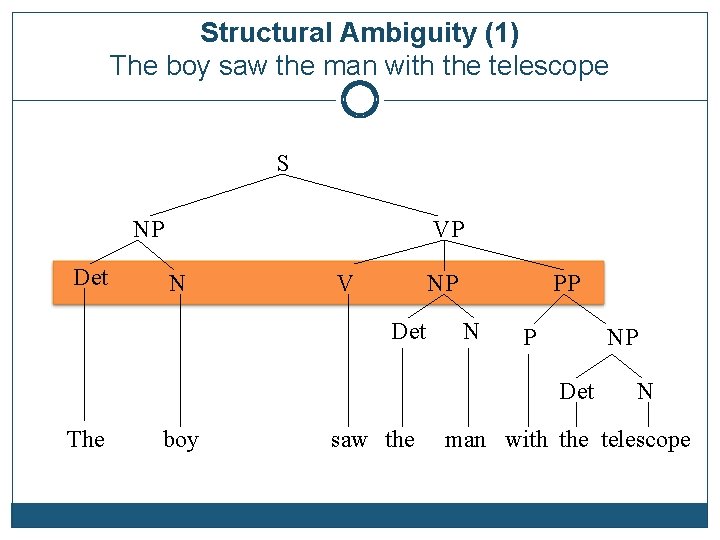
Structural Ambiguity (1) The boy saw the man with the telescope S NP Det VP N V NP Det PP N P NP Det The boy saw the N man with the telescope
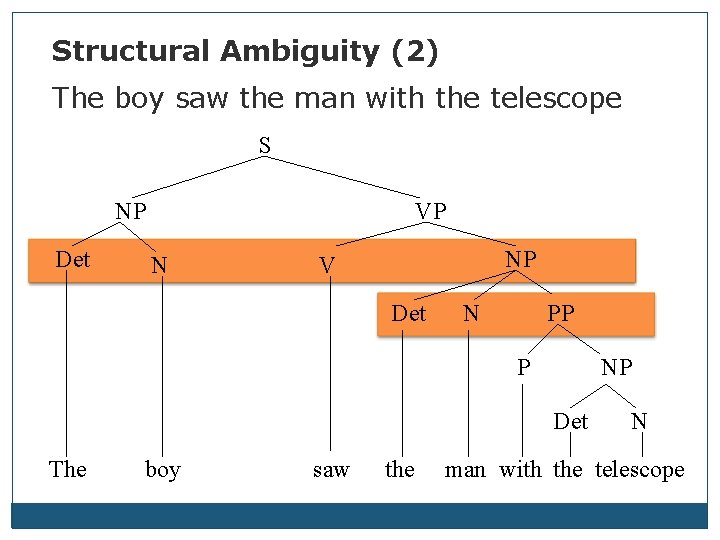
Structural Ambiguity (2) The boy saw the man with the telescope S NP Det VP N NP V Det N PP P NP Det The boy saw the N man with the telescope
« Inflection » TENSE
Deep Stucture and Surface Structure
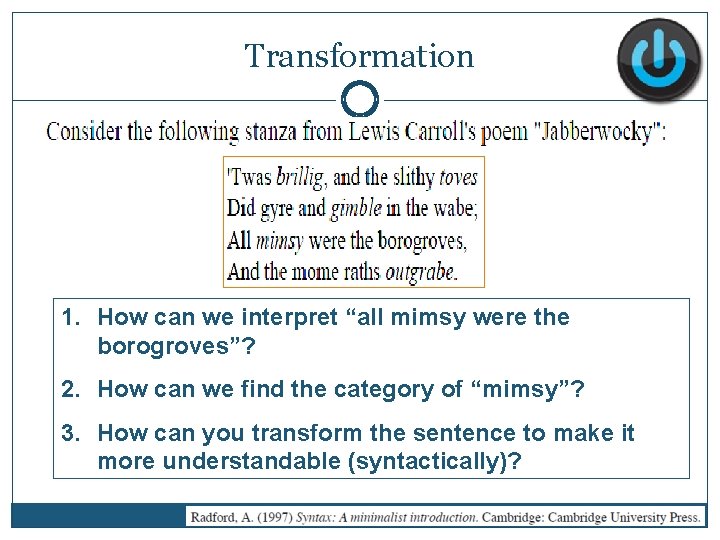
Transformation 1. How can we interpret “all mimsy were the borogroves”? 2. How can we find the category of “mimsy”? 3. How can you transform the sentence to make it more understandable (syntactically)?
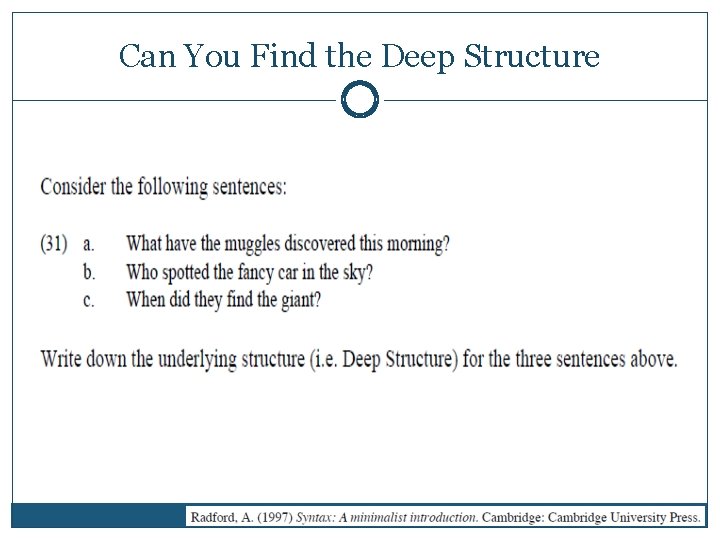
Can You Find the Deep Structure
Draw the deep structure of the following sentences (adapted from #10 & 11, p. 242) 1. Will the boss hire Hillary? 2. Is that player leaving the team? 3. Who should the director call? 4. What is Joanne eating?
Transformation DECLARATIVE – INTERROGATIVE YES-NO QUESTIONS DO INSERTION WH MOVEMENT
Transformation Movement Transformation Deletion Transformation Insertion Transformation Substitution Transformation
From One Sentencfe to The Other Look at these sentences: 1. What do we need to do to transform it from one sentence structure to the other? a) Will the boy leave? b) Which car is your’s?
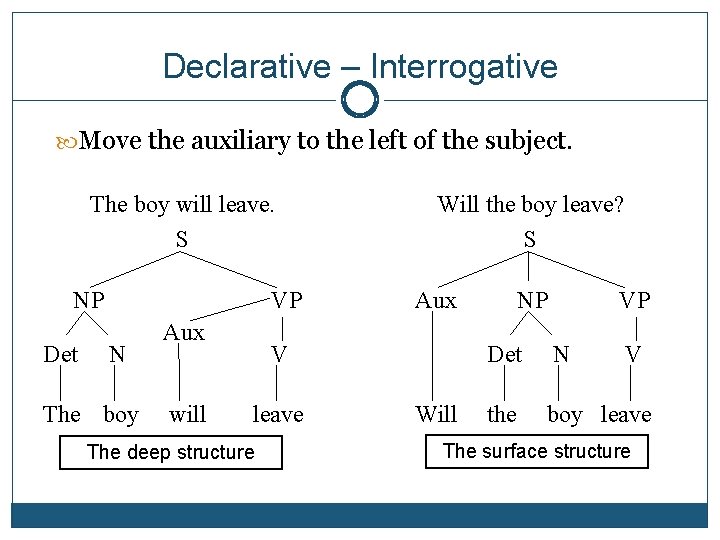
Declarative – Interrogative Move the auxiliary to the left of the subject. The boy will leave. S NP Det VP N The boy Aux will Will the boy leave? S Aux V leave The deep structure Will NP VP Det N V the boy leave The surface structure
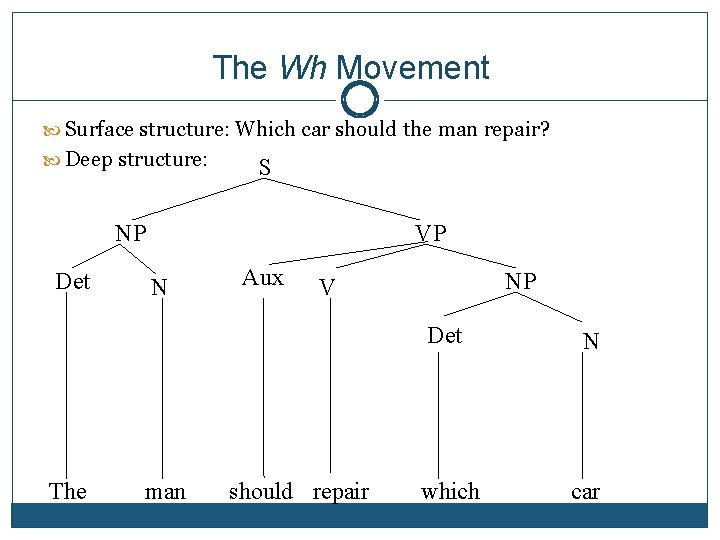
The Wh Movement Surface structure: Which car should the man repair? Deep structure: S NP Det The VP N man Aux NP V should repair Det N which car
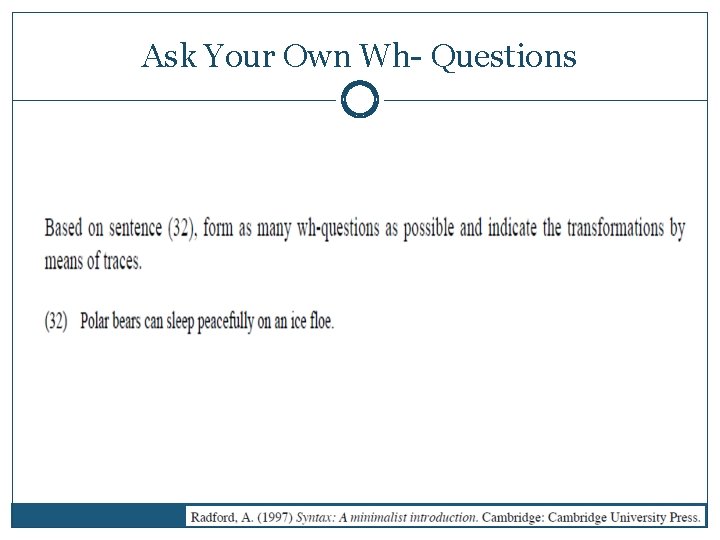
Ask Your Own Wh- Questions
- Slides: 70