
Syntax Continued Constituency Tests Phrase Structure Rules How
- Slides: 35
Syntax Continued Constituency Tests Phrase Structure Rules
How to determine constituency n Semantic Intuitions n n sometimes, we just know that certain strings of words go together as a unit. Constituency Tests (more reliable) n tests that can be applied to string of words in a given sentence to determine if the string is a constituent or not.
Three kinds of constituency tests n n n Stand Alone Test Substitution Test Movement Test
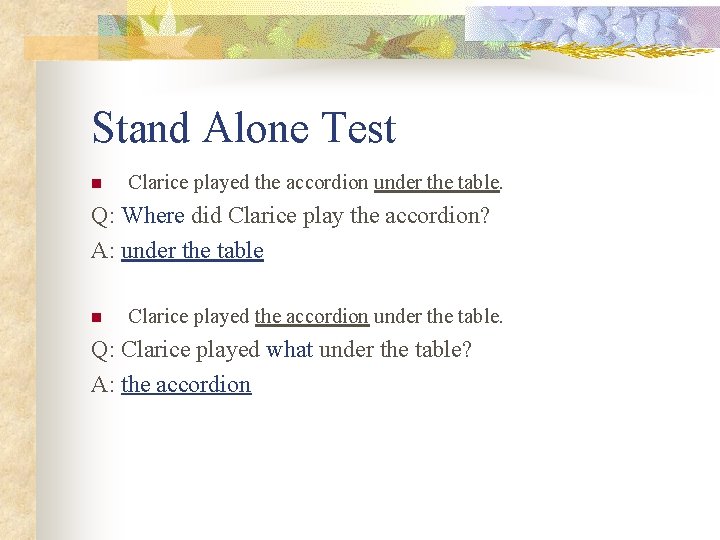
Stand Alone Test n n A constituent can often be replaced by a question expression such as who, what, where, how, why, or do/did what. The replaced constituent can then stand alone as an answer to the question.
Stand Alone Test n Clarice played the accordion under the table. Q: Where did Clarice play the accordion? A: under the table n Clarice played the accordion under the table. Q: Clarice played what under the table? A: the accordion
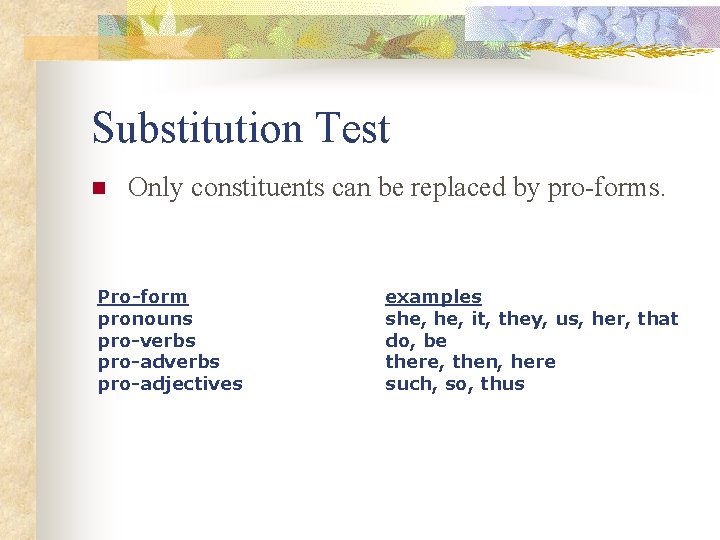
Substitution Test n Only constituents can be replaced by pro-forms. Pro-form pronouns pro-verbs pro-adjectives examples she, it, they, us, her, that do, be there, then, here such, so, thus
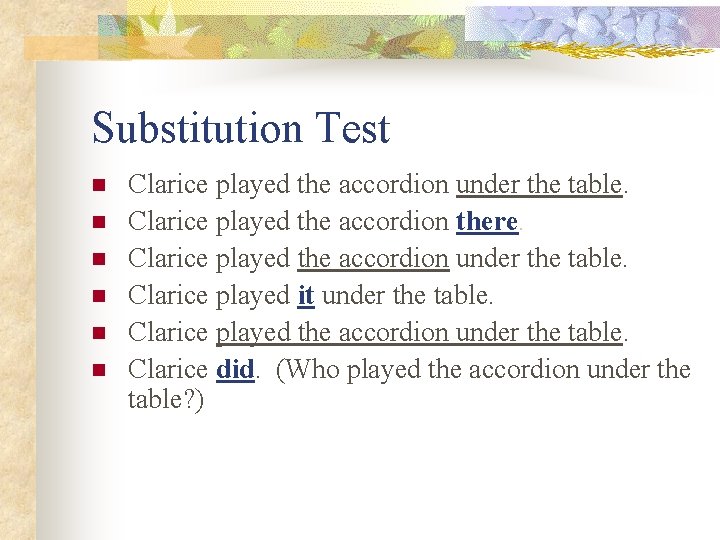
Substitution Test n n n Clarice played the accordion under the table. Clarice played the accordion there. Clarice played the accordion under the table. Clarice played it under the table. Clarice played the accordion under the table. Clarice did. (Who played the accordion under the table? )
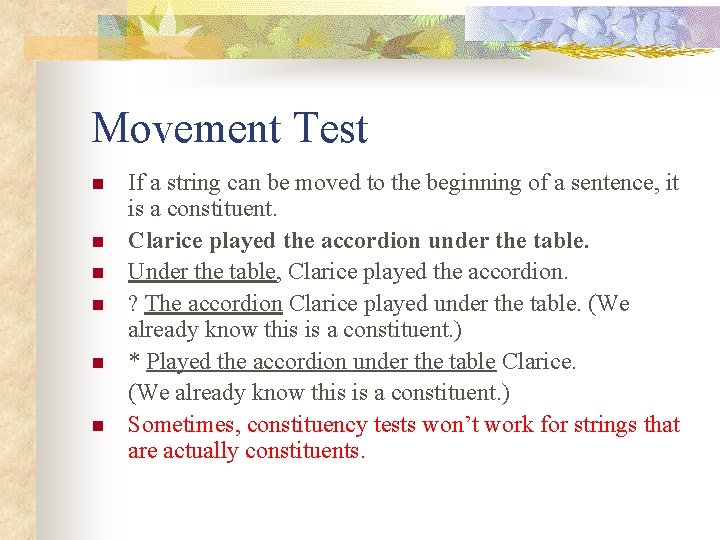
Movement Test n n n If a string can be moved to the beginning of a sentence, it is a constituent. Clarice played the accordion under the table. Under the table, Clarice played the accordion. ? The accordion Clarice played under the table. (We already know this is a constituent. ) * Played the accordion under the table Clarice. (We already know this is a constituent. ) Sometimes, constituency tests won’t work for strings that are actually constituents.
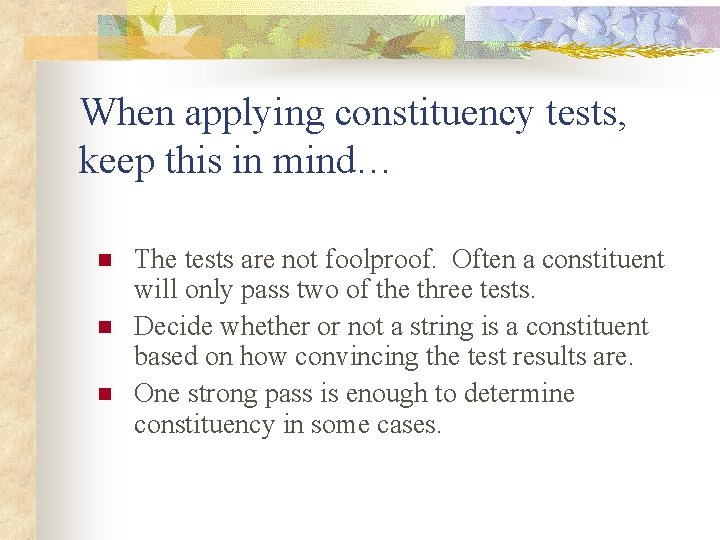
When applying constituency tests, keep this in mind… n n n The tests are not foolproof. Often a constituent will only pass two of the three tests. Decide whether or not a string is a constituent based on how convincing the test results are. One strong pass is enough to determine constituency in some cases.
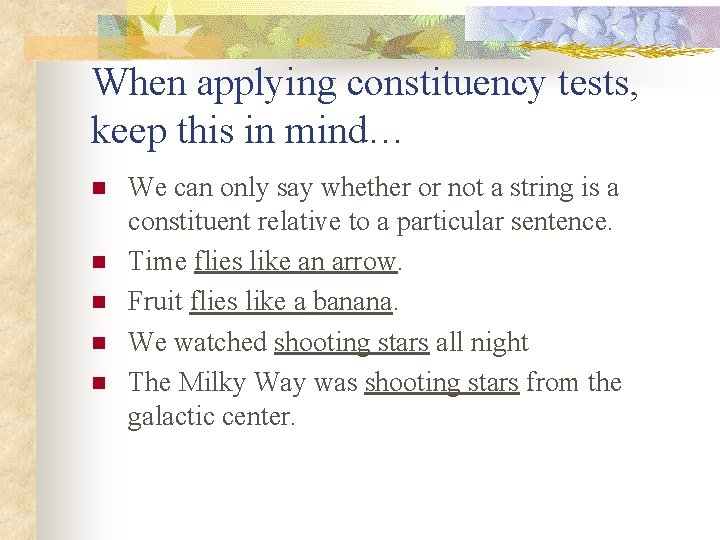
When applying constituency tests, keep this in mind… n n n We can only say whether or not a string is a constituent relative to a particular sentence. Time flies like an arrow. Fruit flies like a banana. We watched shooting stars all night The Milky Way was shooting stars from the galactic center.
Phrase Structure Rules n n n Our Grammar Consists of a set of rules acquired in order to form sentences They are formed by putting words from different lexical categories together PSRs (Phrase Structure Rules) differ from language to language.
Lexical category n n n Parts of speech Many words, limited categories What you learned in school n Noun n n Verb n n Person, place or thing Action word Adjective n Describes something
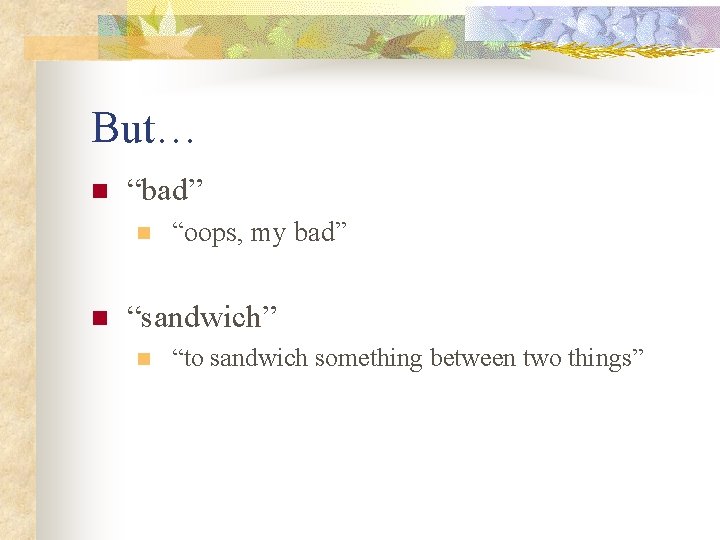
But… n “bad” n n “oops, my bad” “sandwich” n “to sandwich something between two things”
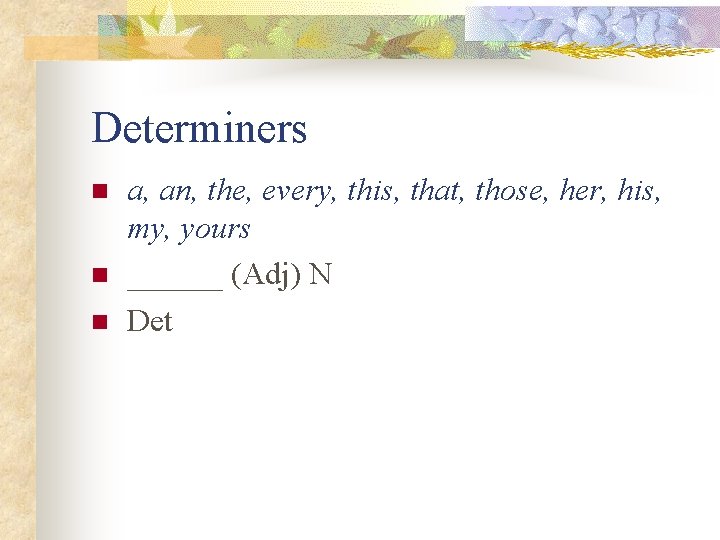
Determiners n n n a, an, the, every, this, that, those, her, his, my, yours ______ (Adj) N Det
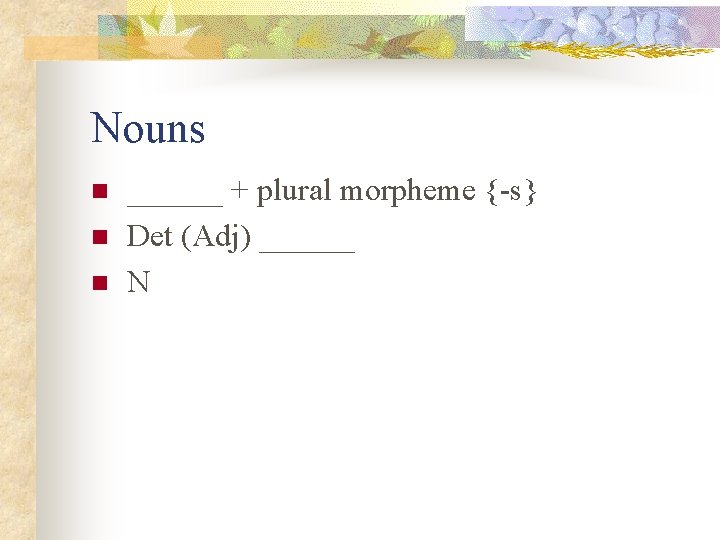
Nouns n n n ______ + plural morpheme {-s} Det (Adj) ______ N
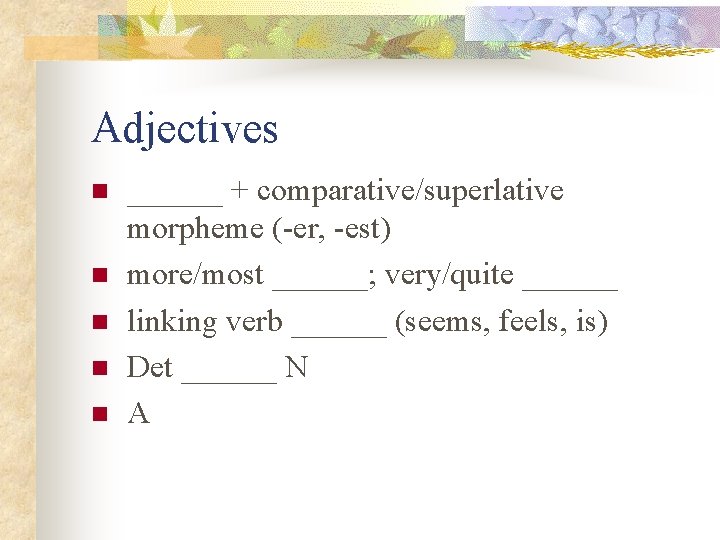
Adjectives n n n ______ + comparative/superlative morpheme (-er, -est) more/most ______; very/quite ______ linking verb ______ (seems, feels, is) Det ______ N A
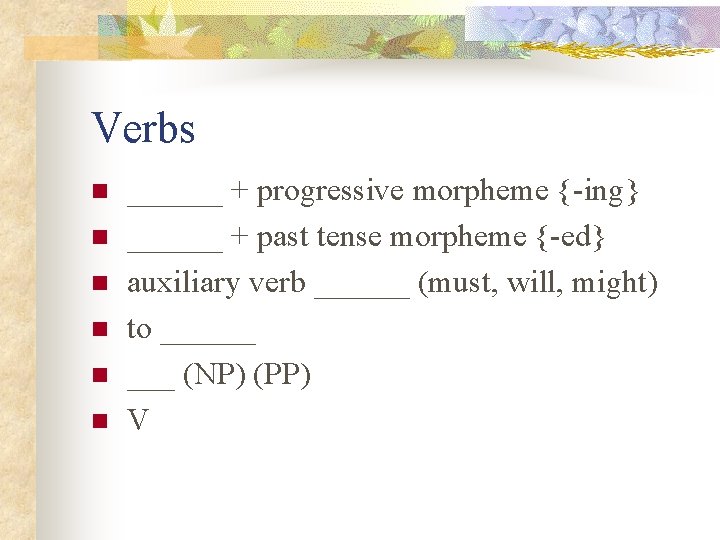
Verbs n n n ______ + progressive morpheme {-ing} ______ + past tense morpheme {-ed} auxiliary verb ______ (must, will, might) to ______ (NP) (PP) V
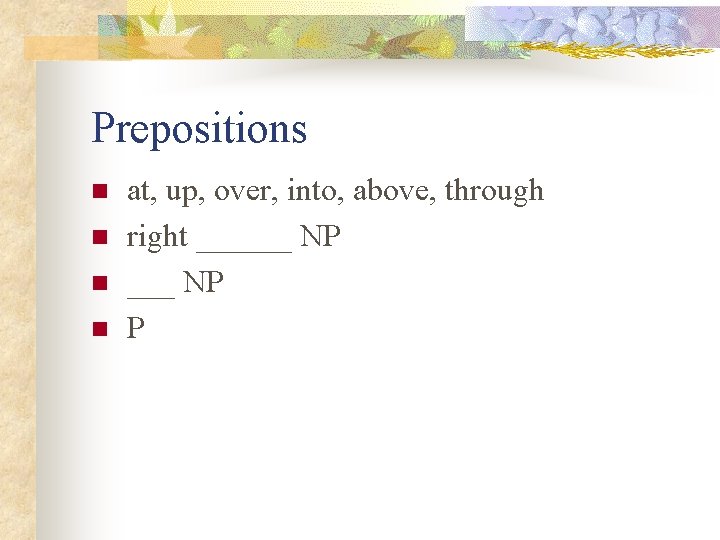
Prepositions n n at, up, over, into, above, through right ______ NP P
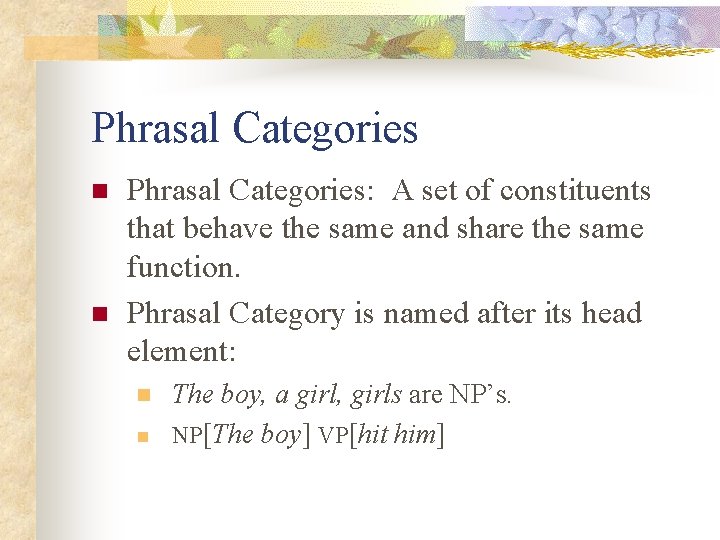
Phrasal Categories n n Phrasal Categories: A set of constituents that behave the same and share the same function. Phrasal Category is named after its head element: n n The boy, a girl, girls are NP’s. NP[The boy] VP[hit him]
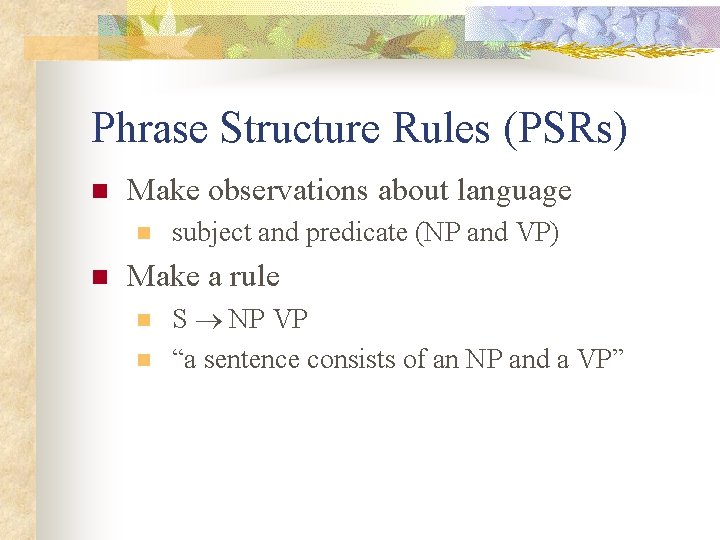
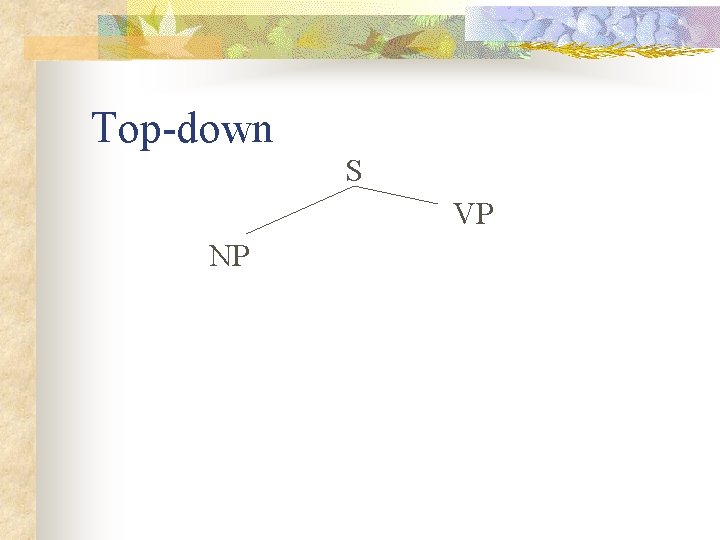
Phrase Structure Rules (PSRs) n Make observations about language n n subject and predicate (NP and VP) Make a rule n n S NP VP “a sentence consists of an NP and a VP”
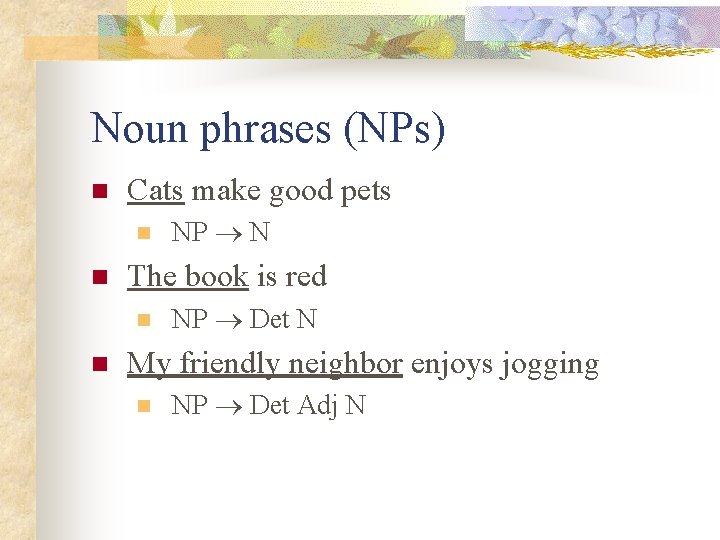
Noun phrases (NPs) n Cats make good pets n n The book is red n n NP N NP Det N My friendly neighbor enjoys jogging n NP Det Adj N
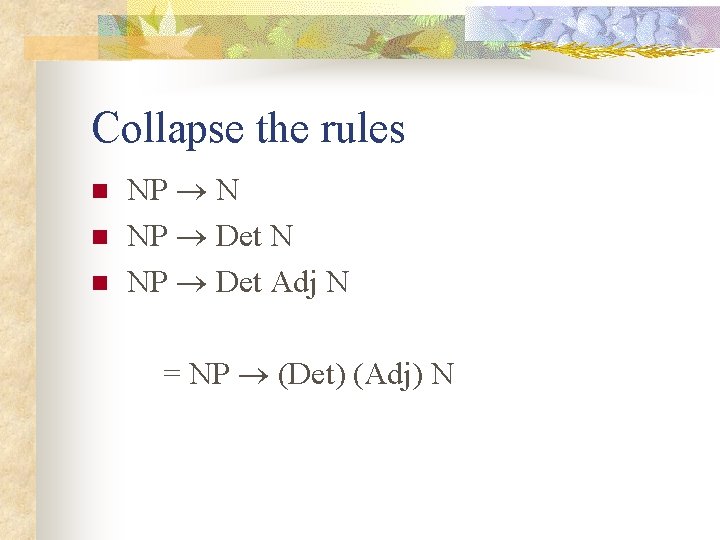
Collapse the rules n n n NP N NP Det Adj N = NP (Det) (Adj) N
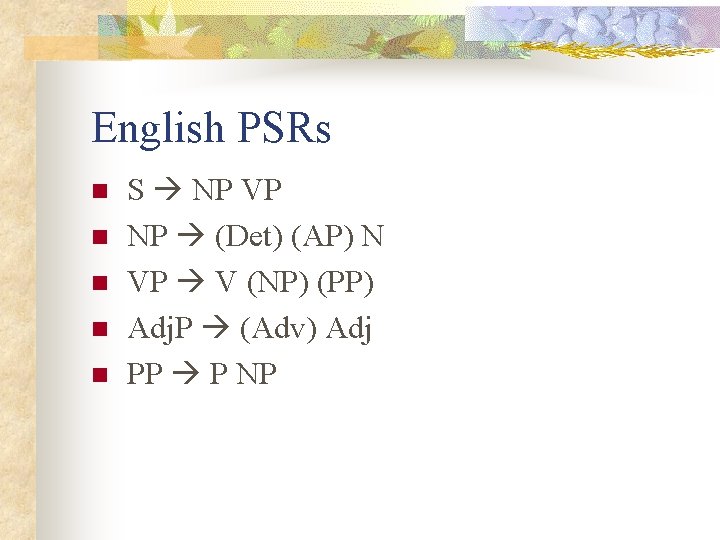
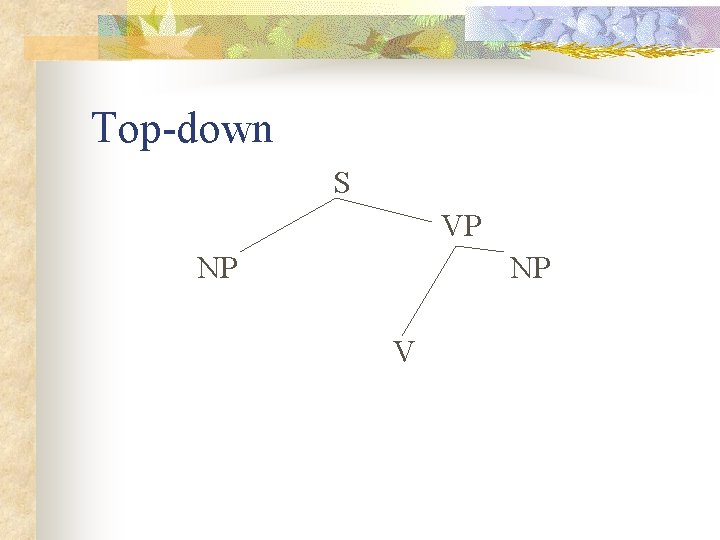
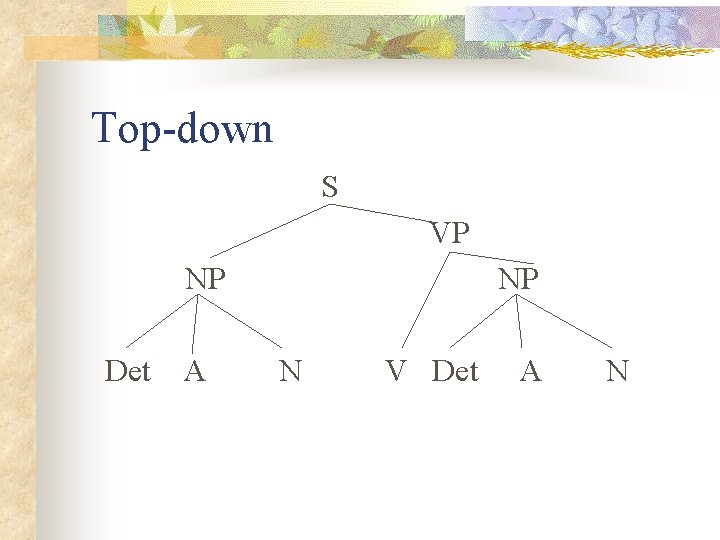
English PSRs n n n S NP VP NP (Det) (AP) N VP V (NP) (PP) Adj. P (Adv) Adj PP P NP
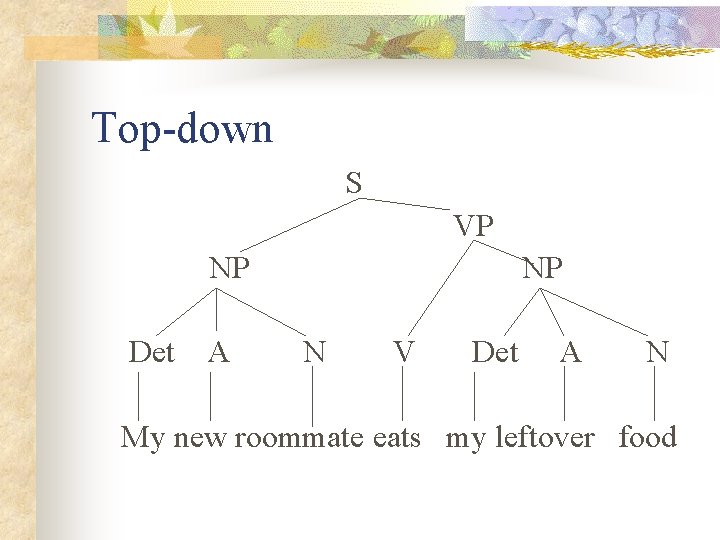
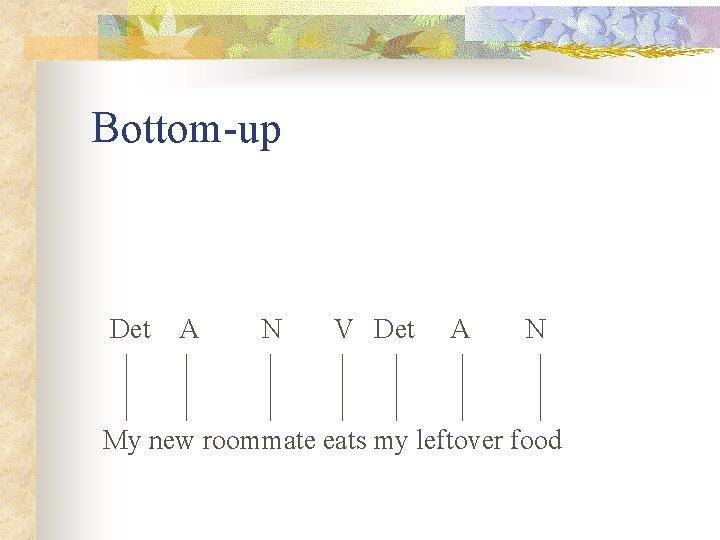
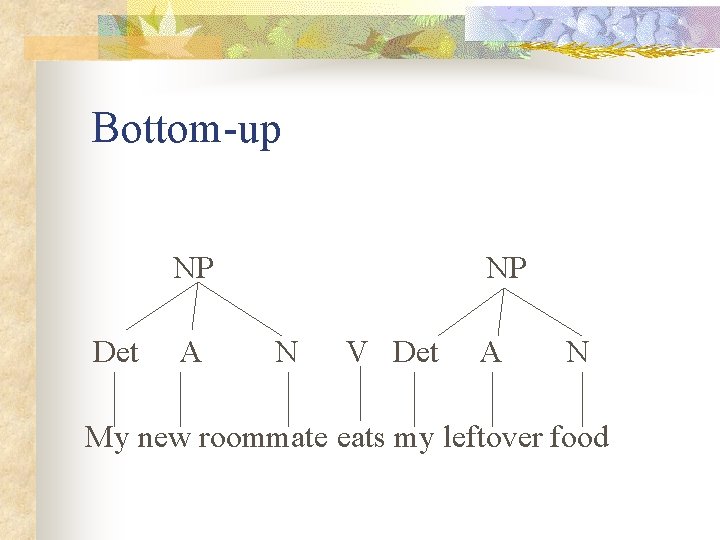
Building trees n n Words and rules Different ways n n top-down bottom-up
Top-down S
Top-down S VP NP
Top-down S VP NP NP V
Top-down S VP NP Det A NP N V Det A N
Top-down S VP NP Det A NP N V Det A N My new roommate eats my leftover food
Bottom-up My new roommate eats my leftover food
Bottom-up Det A N V Det A N My new roommate eats my leftover food
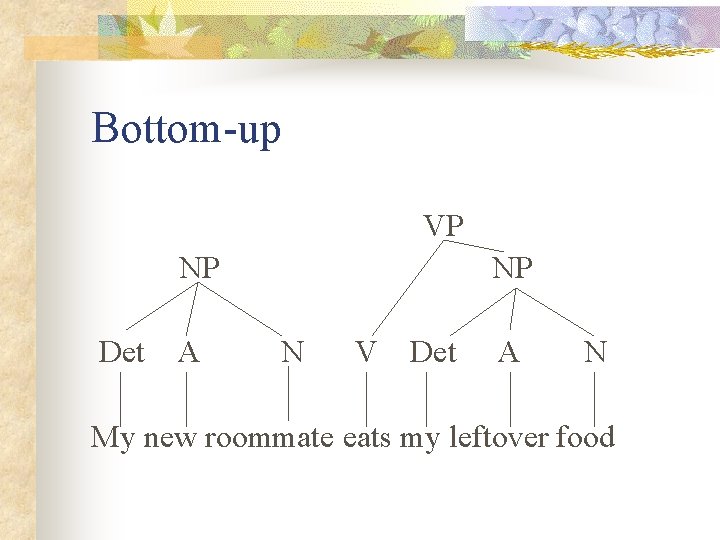
Bottom-up NP Det A NP N V Det A N My new roommate eats my leftover food
Bottom-up VP NP Det A NP N V Det A N My new roommate eats my leftover food
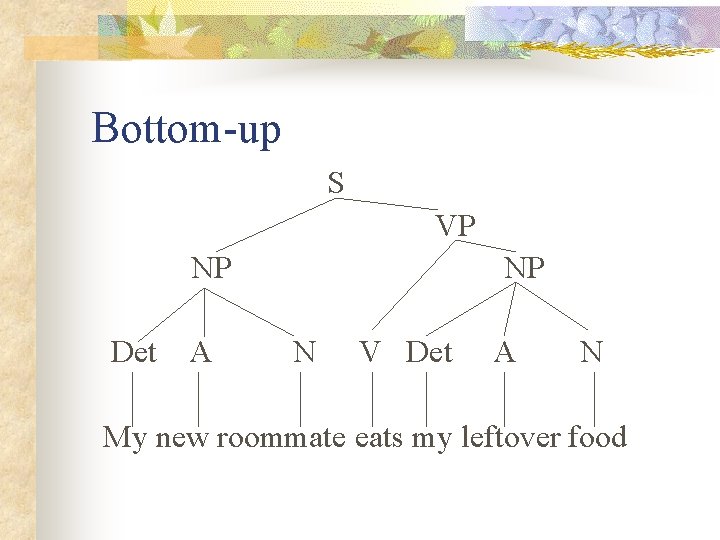
Bottom-up S VP NP Det A NP N V Det A N My new roommate eats my leftover food
Practice Sentences n The energetic boy ran up the hill. n The little dog ate the biscuits.