
Syntactic Structures Semantic Internalism e u g swi
![Toy Model: Meanings as instructions for how to access and assemble concepts Meaning[France] =](https://slidetodoc.com/presentation_image_h2/7c869dda4df0034128ecef0def704abc/image-50.jpg "Toy Model: Meanings as instructions for how to access and assemble concepts Meaning[France] =")
![Toy Model: Meanings as instructions for how to access and assemble concepts Meaning[France] =](https://slidetodoc.com/presentation_image_h2/7c869dda4df0034128ecef0def704abc/image-51.jpg "Toy Model: Meanings as instructions for how to access and assemble concepts Meaning[France] =")
![Toy Model: Meanings as instructions for how to access and assemble concepts Meaning[France] =](https://slidetodoc.com/presentation_image_h2/7c869dda4df0034128ecef0def704abc/image-52.jpg "Toy Model: Meanings as instructions for how to access and assemble concepts Meaning[France] =")

- Slides: 54
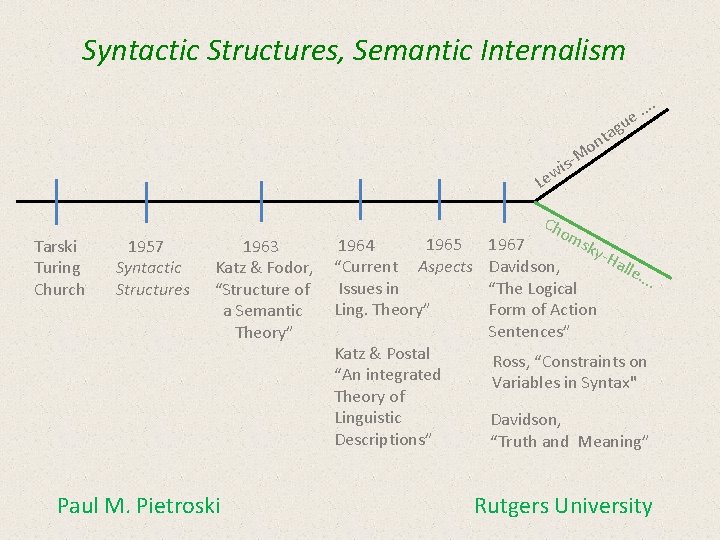
Syntactic Structures, Semantic Internalism. . . e. u g swi ta n o M Le Tarski Turing Church 1957 Syntactic Structures 1963 Katz & Fodor, “Structure of a Semantic Theory” Paul M. Pietroski 1965 1964 “Current Aspects Issues in Ling. Theory” Katz & Postal “An integrated Theory of Linguistic Descriptions” Ch om sky 1967 -Ha Davidson, lle. . “The Logical Form of Action Sentences” Ross, “Constraints on Variables in Syntax" Davidson, “Truth and Meaning” Rutgers University
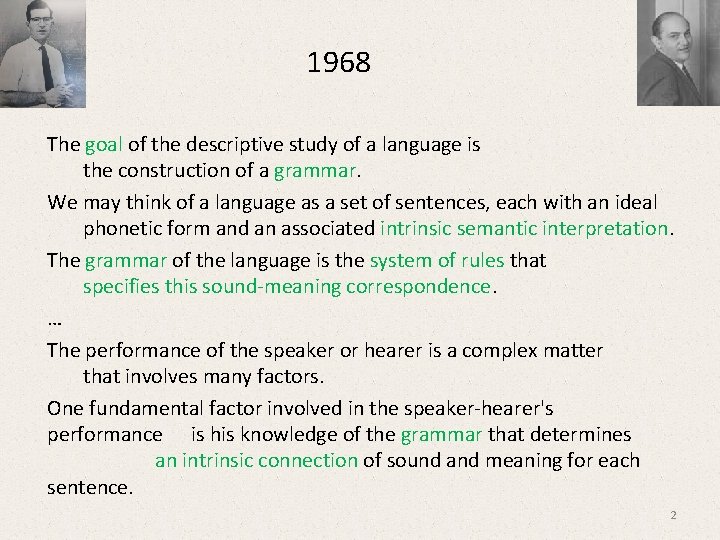
1968 The goal of the descriptive study of a language is the construction of a grammar. We may think of a language as a set of sentences, each with an ideal phonetic form and an associated intrinsic semantic interpretation. The grammar of the language is the system of rules that specifies this sound-meaning correspondence. … The performance of the speaker or hearer is a complex matter that involves many factors. One fundamental factor involved in the speaker-hearer's performance is his knowledge of the grammar that determines an intrinsic connection of sound and meaning for each sentence. 2
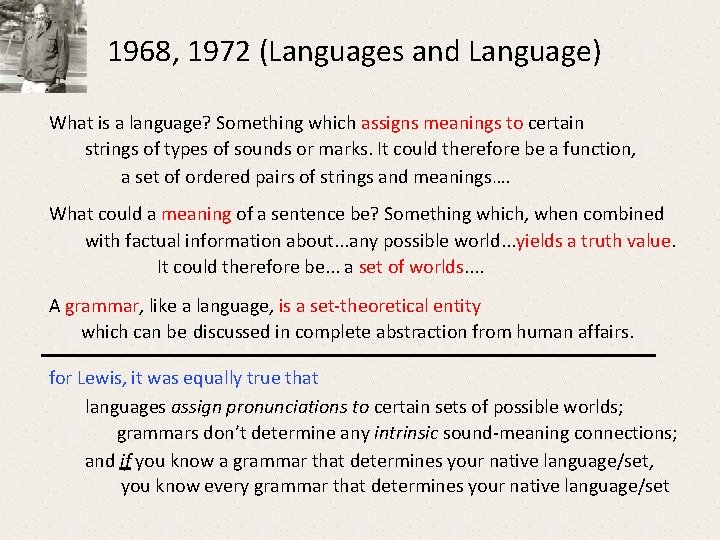
1968, 1972 (Languages and Language) What is a language? Something which assigns meanings to certain strings of types of sounds or marks. It could therefore be a function, a set of ordered pairs of strings and meanings…. What could a meaning of a sentence be? Something which, when combined with factual information about. . . any possible world. . . yields a truth value. It could therefore be. . . a set of worlds. . A grammar, like a language, is a set-theoretical entity which can be discussed in complete abstraction from human affairs. for Lewis, it was equally true that languages assign pronunciations to certain sets of possible worlds; grammars don’t determine any intrinsic sound-meaning connections; and if you know a grammar that determines your native language/set, you know every grammar that determines your native language/set
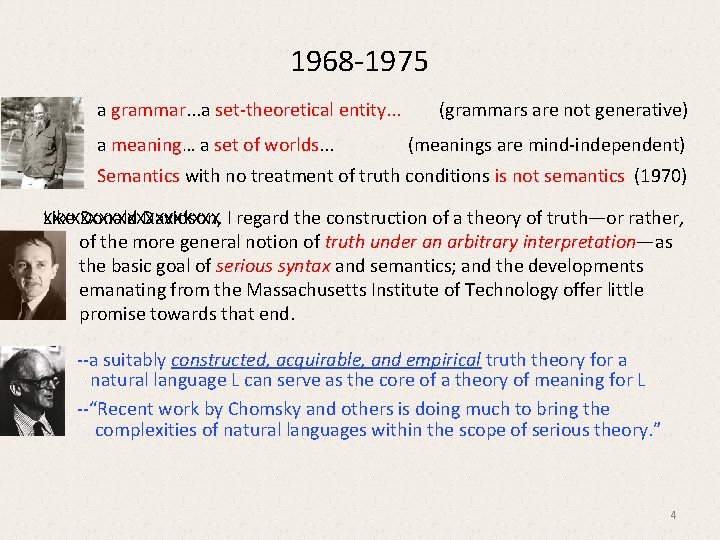
1968 -1975 a grammar. . . a set-theoretical entity. . . a meaning… a set of worlds. . . (grammars are not generative) (meanings are mind-independent) Semantics with no treatment of truth conditions is not semantics (1970) Like Donald Davidson, I regard the construction of a theory of truth—or rather, XXXXXXXXXX of the more general notion of truth under an arbitrary interpretation—as the basic goal of serious syntax and semantics; and the developments emanating from the Massachusetts Institute of Technology offer little promise towards that end. --a suitably constructed, acquirable, and empirical truth theory for a natural language L can serve as the core of a theory of meaning for L --“Recent work by Chomsky and others is doing much to bring the complexities of natural languages within the scope of serious theory. ” 4
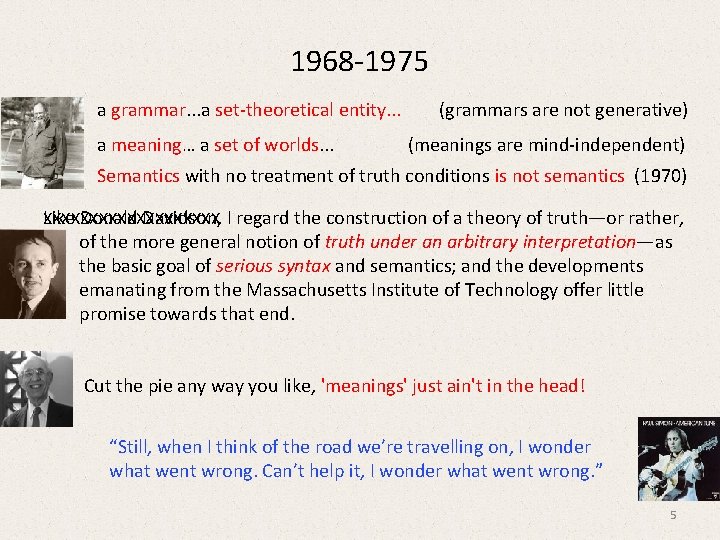
1968 -1975 a grammar. . . a set-theoretical entity. . . a meaning… a set of worlds. . . (grammars are not generative) (meanings are mind-independent) Semantics with no treatment of truth conditions is not semantics (1970) Like Donald Davidson, I regard the construction of a theory of truth—or rather, XXXXXXXXXX of the more general notion of truth under an arbitrary interpretation—as the basic goal of serious syntax and semantics; and the developments emanating from the Massachusetts Institute of Technology offer little promise towards that end. Cut the pie any way you like, 'meanings' just ain't in the head! “Still, when I think of the road we’re travelling on, I wonder what went wrong. Can’t help it, I wonder what went wrong. ” 5
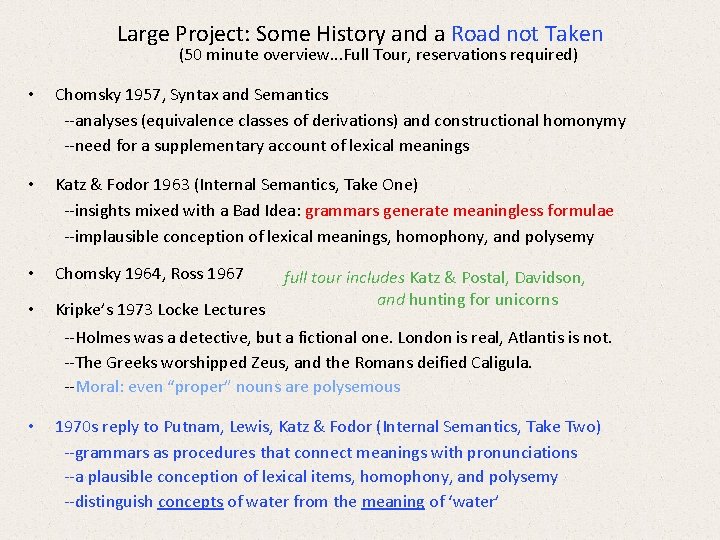
Large Project: Some History and a Road not Taken (50 minute overview. . . Full Tour, reservations required) • Chomsky 1957, Syntax and Semantics --analyses (equivalence classes of derivations) and constructional homonymy --need for a supplementary account of lexical meanings • Katz & Fodor 1963 (Internal Semantics, Take One) --insights mixed with a Bad Idea: grammars generate meaningless formulae --implausible conception of lexical meanings, homophony, and polysemy • Chomsky 1964, Ross 1967 • Kripke’s 1973 Locke Lectures full tour includes Katz & Postal, Davidson, and hunting for unicorns --Holmes was a detective, but a fictional one. London is real, Atlantis is not. --The Greeks worshipped Zeus, and the Romans deified Caligula. --Moral: even “proper” nouns are polysemous • 1970 s reply to Putnam, Lewis, Katz & Fodor (Internal Semantics, Take Two) --grammars as procedures that connect meanings with pronunciations --a plausible conception of lexical items, homophony, and polysemy --distinguish concepts of water from the meaning of ‘water’
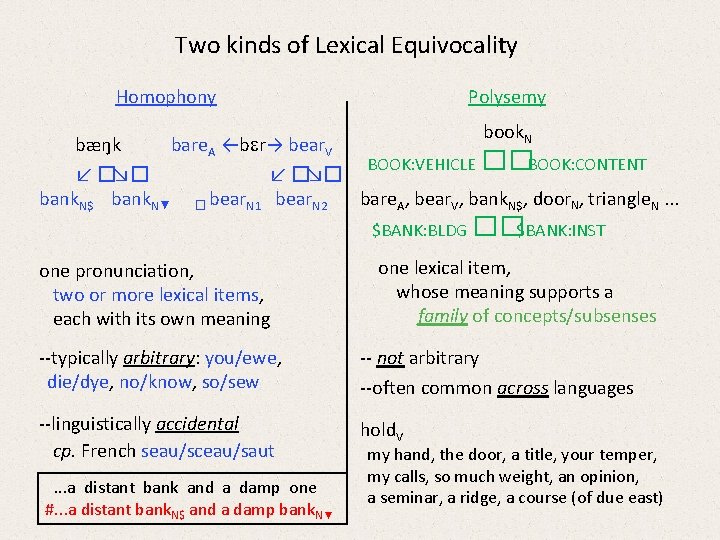
Two kinds of Lexical Equivocality Homophony Polysemy book. N bæŋk bare. A ←b r→ bear. V BOOK: VEHICLE ��BOOK: CONTENT ↙ �↘� bare. A, bear. V, bank. N$, door. N, triangle. N. . . bank. N$ bank. N▼ � bear. N 1 bear. N 2 $BANK: BLDG �� $BANK: INST one pronunciation, two or more lexical items, each with its own meaning one lexical item, whose meaning supports a family of concepts/subsenses --typically arbitrary: you/ewe, die/dye, no/know, so/sew -- not arbitrary --often common across languages --linguistically accidental cp. French seau/sceau/saut hold. V . . . a distant bank and a damp one #. . . a distant bank. N$ and a damp bank. N▼ my hand, the door, a title, your temper, my calls, so much weight, an opinion, a seminar, a ridge, a course (of due east)
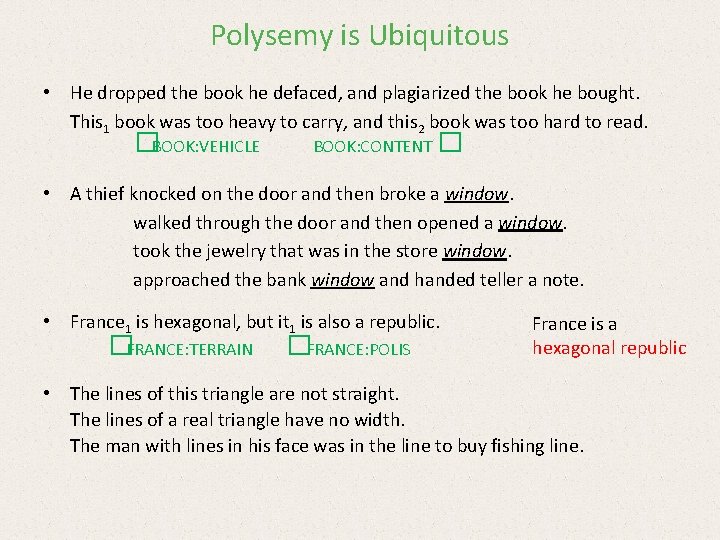
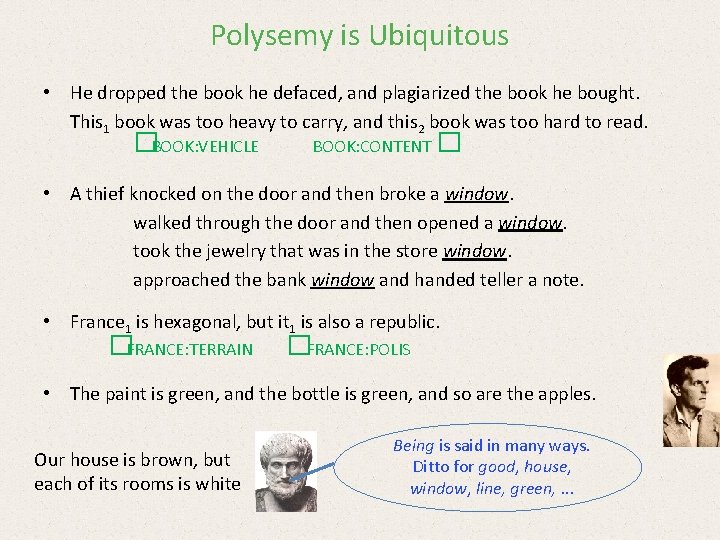
Polysemy is Ubiquitous • He dropped the book he defaced, and plagiarized the book he bought. This 1 book was too heavy to carry, and this 2 book was too hard to read. �BOOK: VEHICLE BOOK: CONTENT � • A thief knocked on the door and then broke a window. walked through the door and then opened a window. took the jewelry that was in the store window. approached the bank window and handed teller a note. • France 1 is hexagonal, but it 1 is also a republic. �FRANCE: TERRAIN �FRANCE: POLIS France is a hexagonal republic • The lines of this triangle are not straight. The lines of a real triangle have no width. The man with lines in his face was in the line to buy fishing line.
Polysemy is Ubiquitous • He dropped the book he defaced, and plagiarized the book he bought. This 1 book was too heavy to carry, and this 2 book was too hard to read. �BOOK: VEHICLE BOOK: CONTENT � • A thief knocked on the door and then broke a window. walked through the door and then opened a window. took the jewelry that was in the store window. approached the bank window and handed teller a note. • France 1 is hexagonal, but it 1 is also a republic. �FRANCE: TERRAIN �FRANCE: POLIS • The paint is green, and the bottle is green, and so are the apples. Our house is brown, but each of its rooms is white Being is said in many ways. Ditto for good, house, window, line, green, . . .
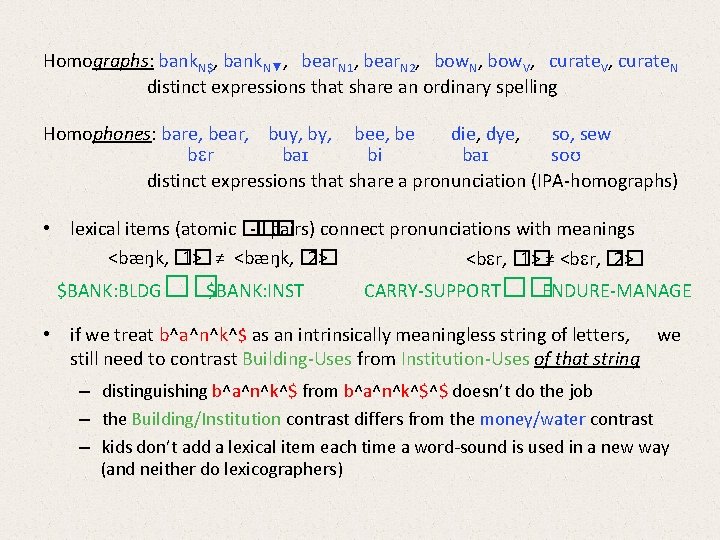
Homographs: bank. N$, bank. N▼, bear. N 1, bear. N 2, bow. N, bow. V, curate. N distinct expressions that share an ordinary spelling Homophones: bare, bear, buy, bee, be die, dye, so, sew b r baɪ bi baɪ soʊ distinct expressions that share a pronunciation (IPA-homographs) • lexical items (atomic �� -�� pairs) connect pronunciations with meanings <bæŋk, �� 1> ≠ <bæŋk, �� 2> <b r, �� 1> ≠ <b r, �� 2> $BANK: BLDG�� $BANK: INST CARRY-SUPPORT�� ENDURE-MANAGE • if we treat b^a^n^k^$ as an intrinsically meaningless string of letters, we still need to contrast Building-Uses from Institution-Uses of that string – distinguishing b^a^n^k^$ from b^a^n^k^$^$ doesn’t do the job – the Building/Institution contrast differs from the money/water contrast – kids don’t add a lexical item each time a word-sound is used in a new way (and neither do lexicographers)
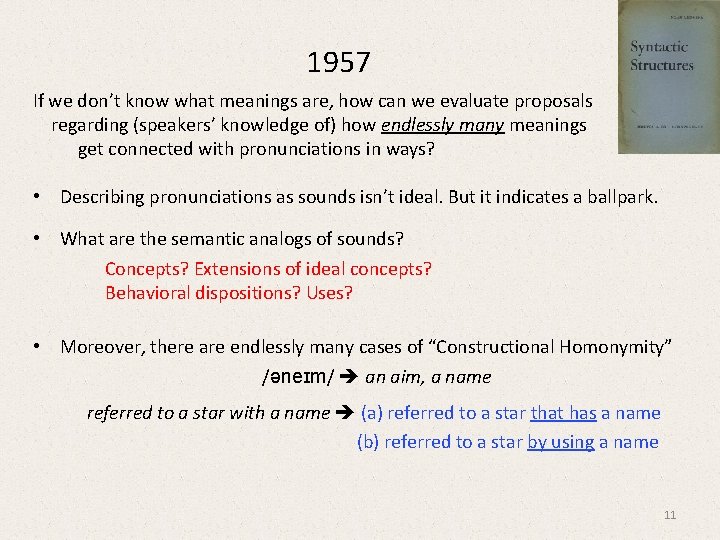
1957 If we don’t know what meanings are, how can we evaluate proposals regarding (speakers’ knowledge of) how endlessly many meanings get connected with pronunciations in ways? • Describing pronunciations as sounds isn’t ideal. But it indicates a ballpark. • What are the semantic analogs of sounds? Concepts? Extensions of ideal concepts? Behavioral dispositions? Uses? • Moreover, there are endlessly many cases of “Constructional Homonymity” /əneɪm/ an aim, a name referred to a star with a name (a) referred to a star that has a name (b) referred to a star by using a name 11
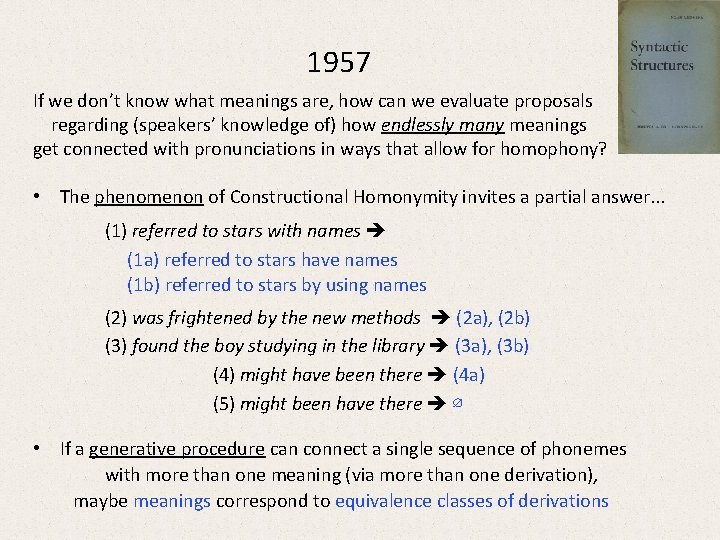
1957 If we don’t know what meanings are, how can we evaluate proposals regarding (speakers’ knowledge of) how endlessly many meanings get connected with pronunciations in ways that allow for homophony? • The phenomenon of Constructional Homonymity invites a partial answer. . . (1) referred to stars with names (1 a) referred to stars have names (1 b) referred to stars by using names (2) was frightened by the new methods (2 a), (2 b) (3) found the boy studying in the library (3 a), (3 b) (4) might have been there (4 a) (5) might been have there ∅ • If a generative procedure can connect a single sequence of phonemes with more than one meaning (via more than one derivation), maybe meanings correspond to equivalence classes of derivations
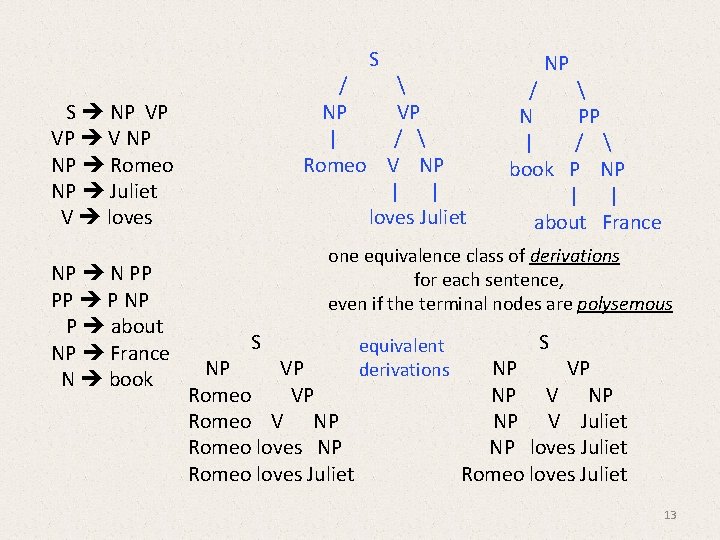
S / NP VP | / Romeo V NP | | loves Juliet S NP VP VP V NP NP Romeo NP Juliet V loves NP N PP PP P NP P about NP France N book NP / N PP | / book P NP | | about France one equivalence class of derivations for each sentence, even if the terminal nodes are polysemous S NP VP Romeo V NP Romeo loves Juliet equivalent derivations S NP VP NP V NP NP V Juliet NP loves Juliet Romeo loves Juliet 13
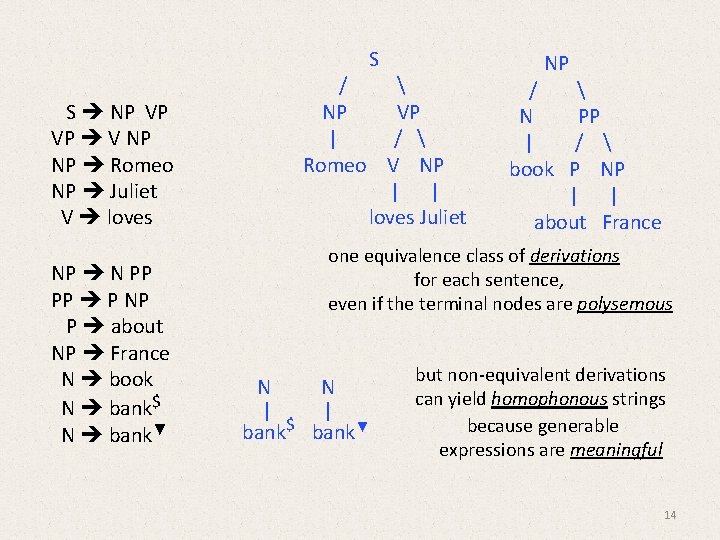
S S NP VP VP V NP NP Romeo NP Juliet V loves NP N PP PP P NP P about NP France N book N bank$ N bank▼ / NP VP | / Romeo V NP | | loves Juliet NP / N PP | / book P NP | | about France one equivalence class of derivations for each sentence, even if the terminal nodes are polysemous N N | | $ bank▼ but non-equivalent derivations can yield homophonous strings because generable expressions are meaningful 14
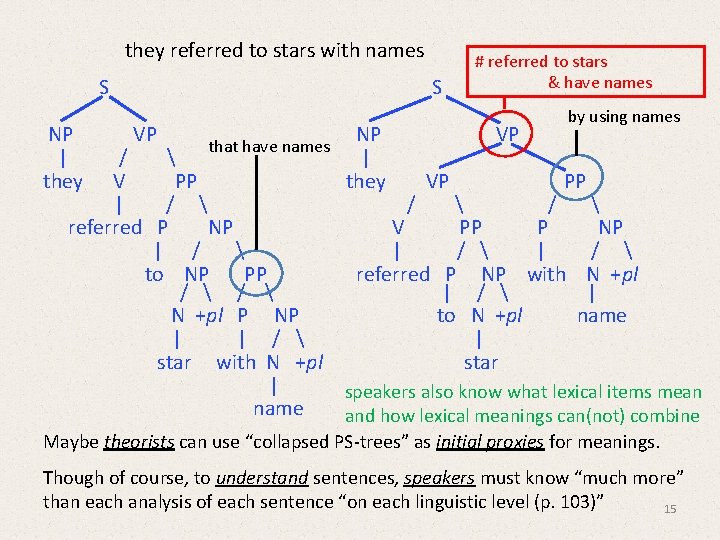
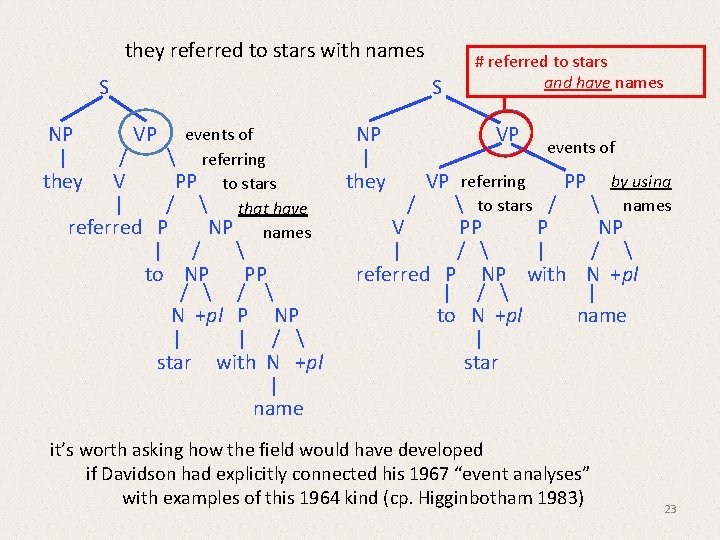
they referred to stars with names S NP | they S VP that have names NP | they # referred to stars & have names VP by using names / V PP VP PP | / / referred P NP V PP P NP | / to NP PP referred P NP with N +pl / | N +pl P NP to N +pl name | | / | star with N +pl star | speakers also know what lexical items mean name and how lexical meanings can(not) combine Maybe theorists can use “collapsed PS-trees” as initial proxies for meanings. Though of course, to understand sentences, speakers must know “much more” than each analysis of each sentence “on each linguistic level (p. 103)” 15
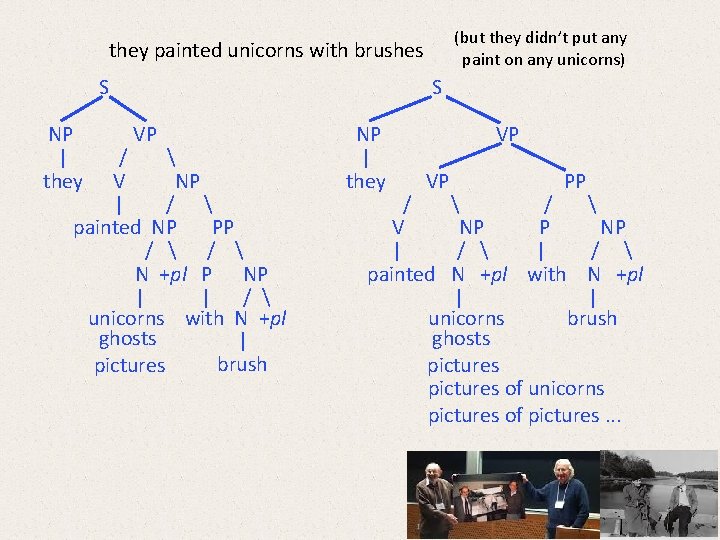
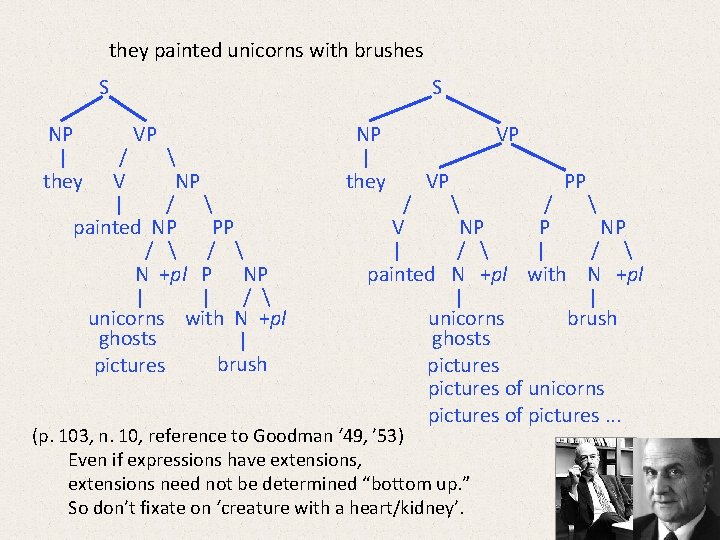
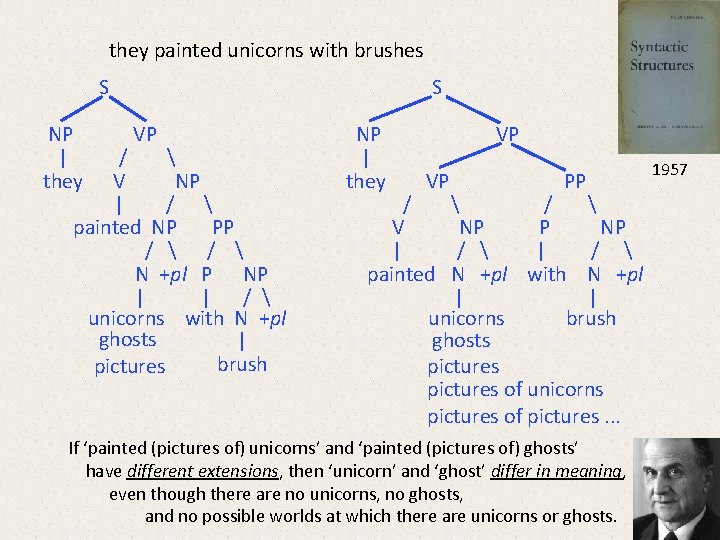
(but they didn’t put any paint on any unicorns) they painted unicorns with brushes S NP | they S VP / V NP | / painted NP PP / N +pl P NP | | / unicorns with N +pl ghosts | brush pictures NP | they VP VP PP / V NP P NP | / painted N +pl with N +pl | | unicorns brush ghosts pictures of unicorns pictures of pictures. . .
they painted unicorns with brushes S NP | they S VP / V NP | / painted NP PP / N +pl P NP | | / unicorns with N +pl ghosts | brush pictures NP | they VP VP PP / V NP P NP | / painted N +pl with N +pl | | unicorns brush ghosts pictures of unicorns pictures of pictures. . . (p. 103, n. 10, reference to Goodman ‘ 49, ’ 53) Even if expressions have extensions, extensions need not be determined “bottom up. ” So don’t fixate on ‘creature with a heart/kidney’. 17
they painted unicorns with brushes S NP | they S VP / V NP | / painted NP PP / N +pl P NP | | / unicorns with N +pl ghosts | brush pictures NP | they VP VP PP 1957 / V NP P NP | / painted N +pl with N +pl | | unicorns brush ghosts pictures of unicorns pictures of pictures. . . If ‘painted (pictures of) unicorns’ and ‘painted (pictures of) ghosts’ have different extensions, then ‘unicorn’ and ‘ghost’ differ in meaning, even though there are no unicorns, no ghosts, and no possible worlds at which there are unicorns or ghosts. 18
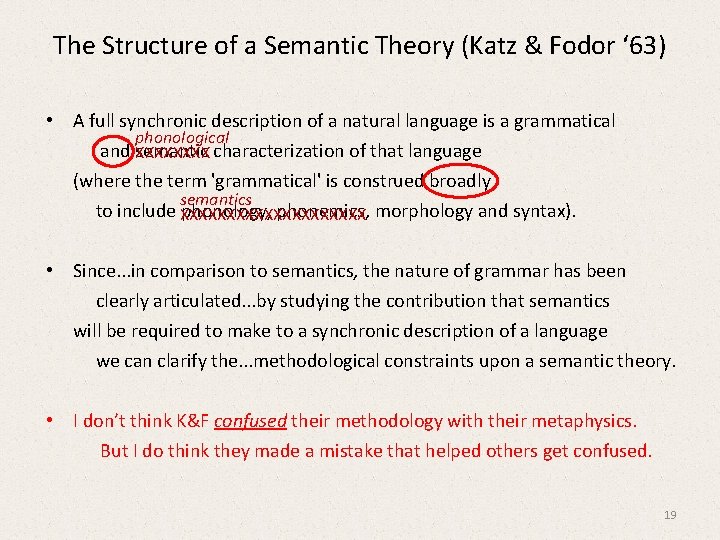
The Structure of a Semantic Theory (Katz & Fodor ‘ 63) • A full synchronic description of a natural language is a grammatical phonological and XXXX semantic characterization of that language (where the term 'grammatical' is construed broadly semantics to include XXXXXXXXXX phonology, phonemics, morphology and syntax). • Since. . . in comparison to semantics, the nature of grammar has been clearly articulated. . . by studying the contribution that semantics will be required to make to a synchronic description of a language we can clarify the. . . methodological constraints upon a semantic theory. • I don’t think K&F confused their methodology with their metaphysics. But I do think they made a mistake that helped others get confused. 19
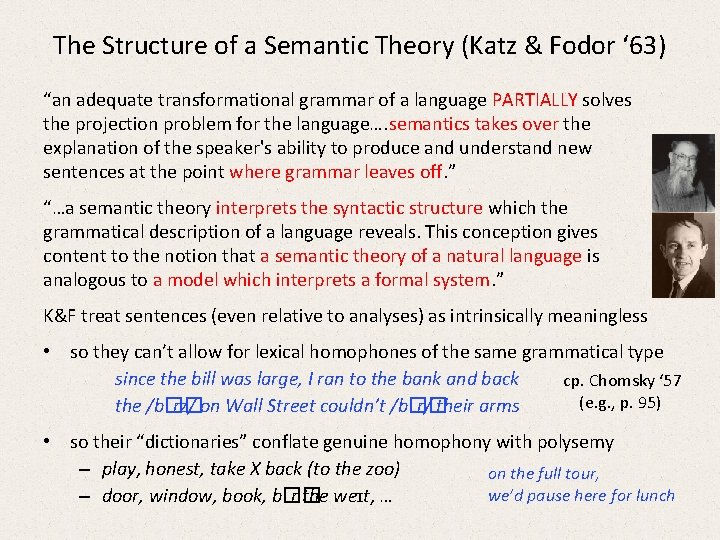
The Structure of a Semantic Theory (Katz & Fodor ‘ 63) “an adequate transformational grammar of a language PARTIALLY solves the projection problem for the language…. semantics takes over the explanation of the speaker's ability to produce and understand new sentences at the point where grammar leaves off. ” “…a semantic theory interprets the syntactic structure which the grammatical description of a language reveals. This conception gives content to the notion that a semantic theory of a natural language is analogous to a model which interprets a formal system. ” K&F treat sentences (even relative to analyses) as intrinsically meaningless • so they can’t allow for lexical homophones of the same grammatical type since the bill was large, I ran to the bank and back cp. Chomsky ‘ 57 (e. g. , p. 95) the /b�� rz/ on Wall Street couldn’t /b�� r/ their arms • so their “dictionaries” conflate genuine homophony with polysemy – play, honest, take X back (to the zoo) on the full tour, we’d pause here for lunch – door, window, book, b�� r the weɪt, …
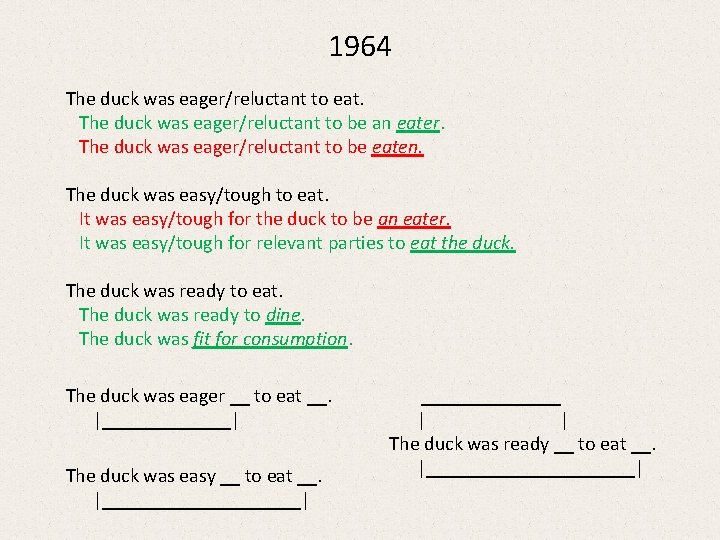
1964 The duck was eager/reluctant to eat. The duck was eager/reluctant to be an eater. The duck was eager/reluctant to be eaten. The duck was easy/tough to eat. It was easy/tough for the duck to be an eater. It was easy/tough for relevant parties to eat the duck. The duck was ready to eat. The duck was ready to dine. The duck was fit for consumption. The duck was eager __ to eat __. |_______| The duck was easy __ to eat __. |__________| _______ | | The duck was ready __ to eat __. |___________|
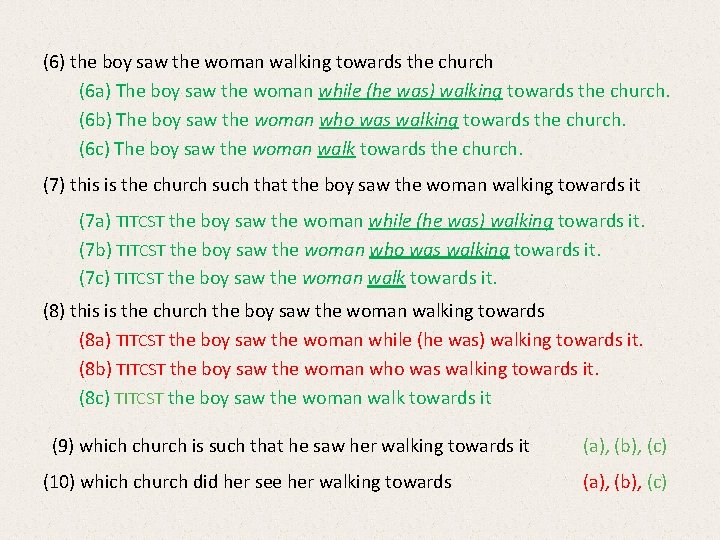
(6) the boy saw the woman walking towards the church (6 a) The boy saw the woman while (he was) walking towards the church. (6 b) The boy saw the woman who was walking towards the church. (6 c) The boy saw the woman walk towards the church. (7) this is the church such that the boy saw the woman walking towards it (7 a) TITCST the boy saw the woman while (he was) walking towards it. (7 b) TITCST the boy saw the woman who was walking towards it. (7 c) TITCST the boy saw the woman walk towards it. (8) this is the church the boy saw the woman walking towards (8 a) TITCST the boy saw the woman while (he was) walking towards it. (8 b) TITCST the boy saw the woman who was walking towards it. (8 c) TITCST the boy saw the woman walk towards it (9) which church is such that he saw her walking towards it (10) which church did her see her walking towards (a), (b), (c)
they referred to stars with names S NP | they S VP / V | referred events of referring PP to stars / that have P NP names | / to NP PP / N +pl P NP | | / star with N +pl | name NP | they # referred to stars and have names VP events of VP referring PP by using / to stars / names V PP P NP | / referred P NP with N +pl | / | to N +pl name | star it’s worth asking how the field would have developed if Davidson had explicitly connected his 1967 “event analyses” with examples of this 1964 kind (cp. Higginbotham 1983) 23
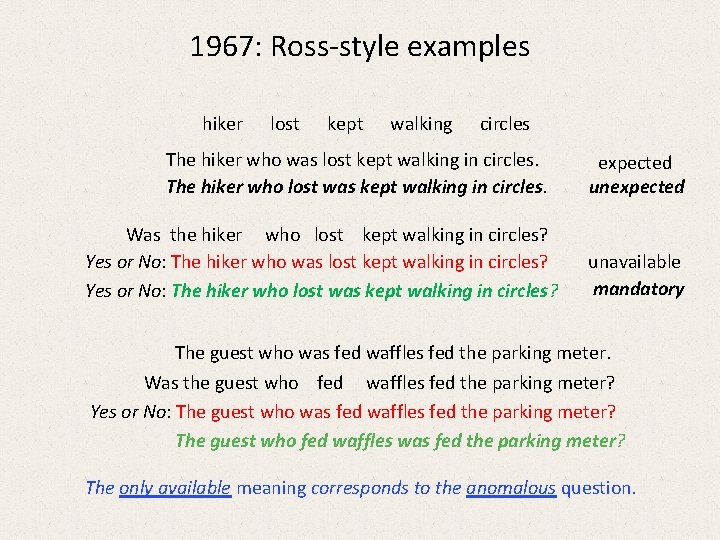
1967: Ross-style examples hiker lost kept walking circles The hiker who was lost kept walking in circles. The hiker who lost was kept walking in circles. Was the hiker who lost kept walking in circles? Yes or No: The hiker who was lost kept walking in circles? Yes or No: The hiker who lost was kept walking in circles? expected unavailable mandatory The guest who was fed waffles fed the parking meter. Was the guest who fed waffles fed the parking meter? Yes or No: The guest who was fed waffles fed the parking meter? The guest who fed waffles was fed the parking meter? The only available meaning corresponds to the anomalous question.
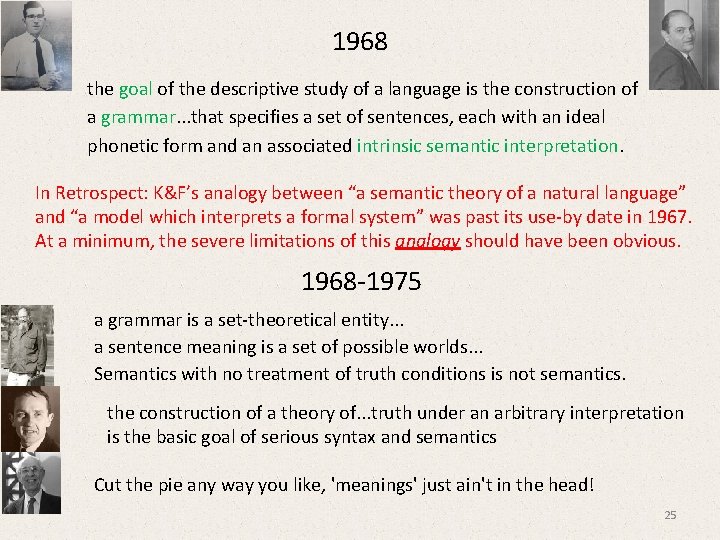
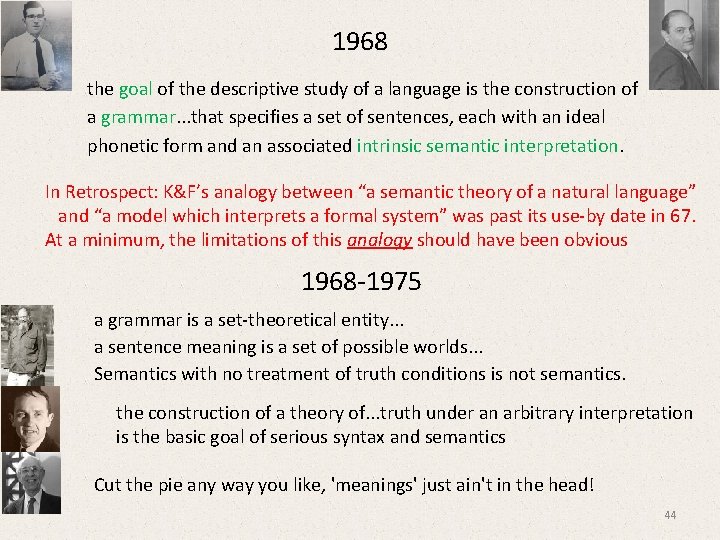
1968 the goal of the descriptive study of a language is the construction of a grammar. . . that specifies a set of sentences, each with an ideal phonetic form and an associated intrinsic semantic interpretation. In Retrospect: K&F’s analogy between “a semantic theory of a natural language” and “a model which interprets a formal system” was past its use-by date in 1967. At a minimum, the severe limitations of this analogy should have been obvious. 1968 -1975 a grammar is a set-theoretical entity. . . a sentence meaning is a set of possible worlds. . . Semantics with no treatment of truth conditions is not semantics. the construction of a theory of. . . truth under an arbitrary interpretation is the basic goal of serious syntax and semantics Cut the pie any way you like, 'meanings' just ain't in the head! 25
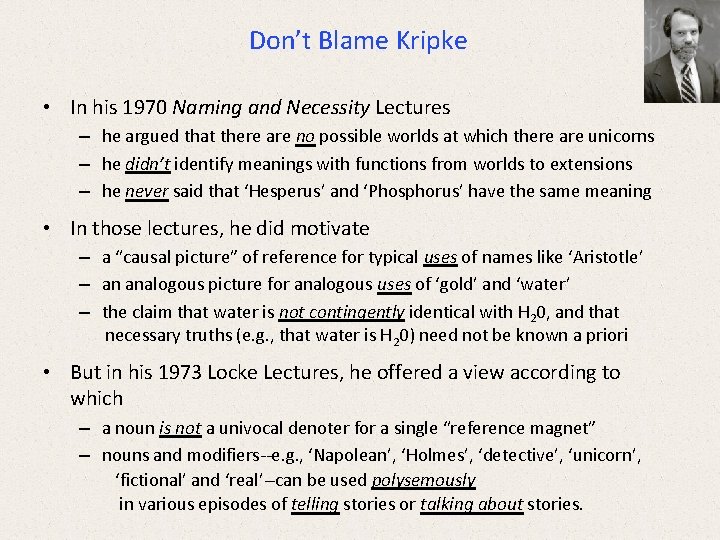
Don’t Blame Kripke • In his 1970 Naming and Necessity Lectures – he argued that there are no possible worlds at which there are unicorns – he didn’t identify meanings with functions from worlds to extensions – he never said that ‘Hesperus’ and ‘Phosphorus’ have the same meaning • In those lectures, he did motivate – a “causal picture” of reference for typical uses of names like ‘Aristotle’ – an analogous picture for analogous uses of ‘gold’ and ‘water’ – the claim that water is not contingently identical with H 20, and that necessary truths (e. g. , that water is H 20) need not be known a priori • But in his 1973 Locke Lectures, he offered a view according to which – a noun is not a univocal denoter for a single “reference magnet” – nouns and modifiers--e. g. , ‘Napolean’, ‘Holmes’, ‘detective’, ‘unicorn’, ‘fictional’ and ‘real’--can be used polysemously in various episodes of telling stories or talking about stories.
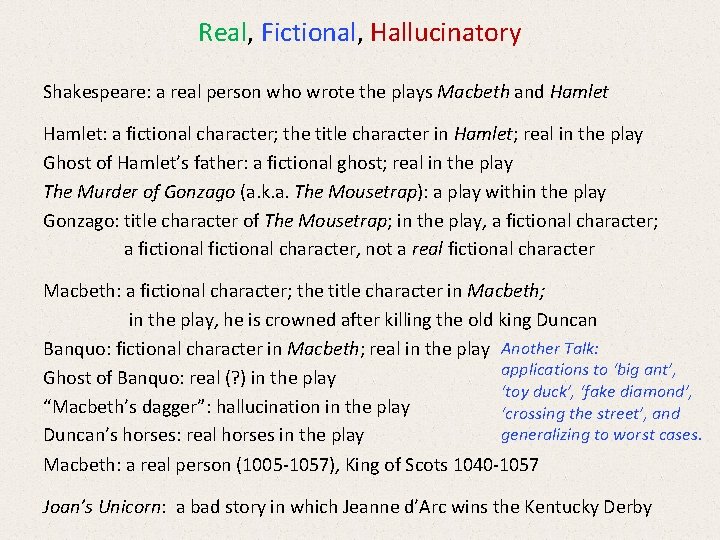
Real, Fictional, Hallucinatory Shakespeare: a real person who wrote the plays Macbeth and Hamlet: a fictional character; the title character in Hamlet; real in the play Ghost of Hamlet’s father: a fictional ghost; real in the play The Murder of Gonzago (a. k. a. The Mousetrap): a play within the play Gonzago: title character of The Mousetrap; in the play, a fictional character; a fictional character, not a real fictional character Macbeth: a fictional character; the title character in Macbeth; in the play, he is crowned after killing the old king Duncan Banquo: fictional character in Macbeth; real in the play Another Talk: applications to ‘big ant’, Ghost of Banquo: real (? ) in the play ‘toy duck’, ‘fake diamond’, “Macbeth’s dagger”: hallucination in the play ‘crossing the street’, and generalizing to worst cases. Duncan’s horses: real horses in the play Macbeth: a real person (1005 -1057), King of Scots 1040 -1057 Joan’s Unicorn: a bad story in which Jeanne d’Arc wins the Kentucky Derby
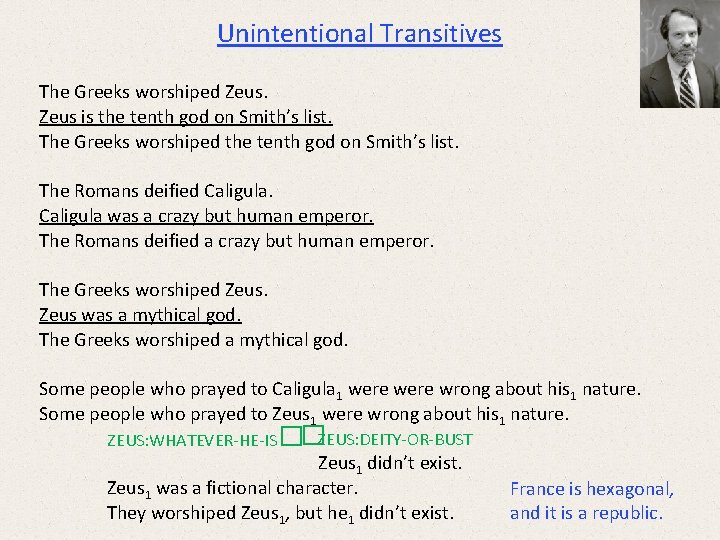
Unintentional Transitives The Greeks worshiped Zeus is the tenth god on Smith’s list. The Greeks worshiped the tenth god on Smith’s list. The Romans deified Caligula was a crazy but human emperor. The Romans deified a crazy but human emperor. The Greeks worshiped Zeus was a mythical god. The Greeks worshiped a mythical god. Some people who prayed to Caligula 1 were wrong about his 1 nature. Some people who prayed to Zeus 1 were wrong about his 1 nature. ZEUS: DEITY-OR-BUST ZEUS: WHATEVER-HE-IS�� Zeus 1 didn’t exist. Zeus 1 was a fictional character. They worshiped Zeus 1, but he 1 didn’t exist. France is hexagonal, and it is a republic.
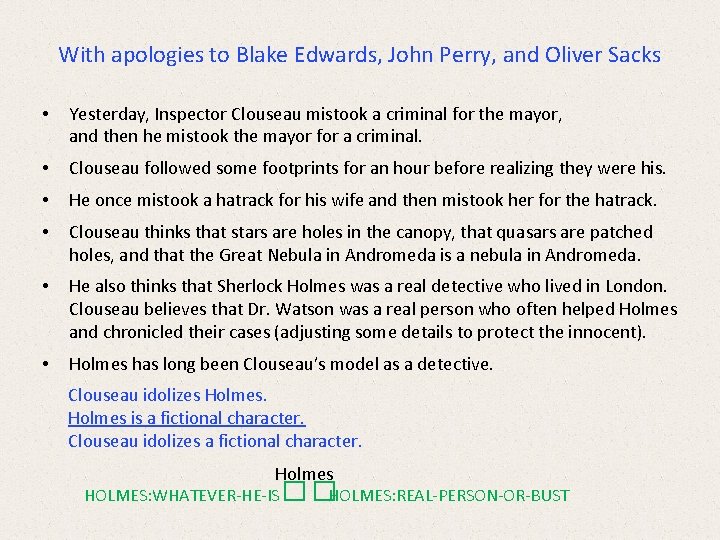
With apologies to Blake Edwards, John Perry, and Oliver Sacks • Yesterday, Inspector Clouseau mistook a criminal for the mayor, and then he mistook the mayor for a criminal. • Clouseau followed some footprints for an hour before realizing they were his. • He once mistook a hatrack for his wife and then mistook her for the hatrack. • Clouseau thinks that stars are holes in the canopy, that quasars are patched holes, and that the Great Nebula in Andromeda is a nebula in Andromeda. • He also thinks that Sherlock Holmes was a real detective who lived in London. Clouseau believes that Dr. Watson was a real person who often helped Holmes and chronicled their cases (adjusting some details to protect the innocent). • Holmes has long been Clouseau’s model as a detective. Clouseau idolizes Holmes is a fictional character. Clouseau idolizes a fictional character. Holmes HOLMES: WHATEVER-HE-IS�� HOLMES: REAL-PERSON-OR-BUST
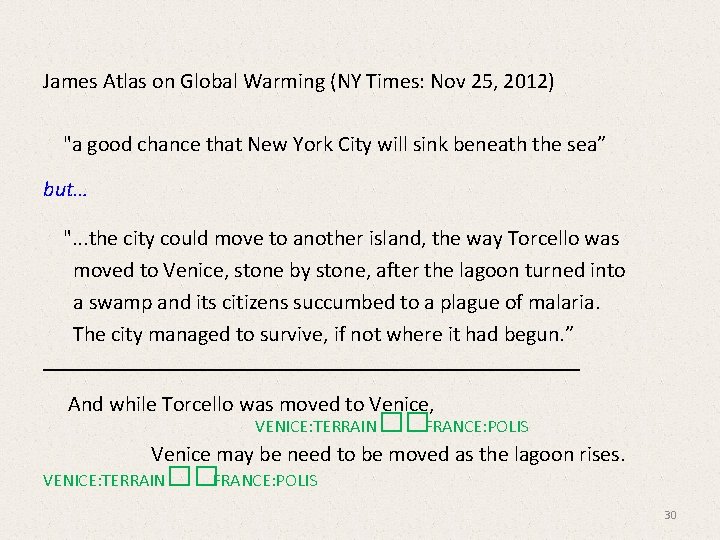
James Atlas on Global Warming (NY Times: Nov 25, 2012) "a good chance that New York City will sink beneath the sea” but… ". . . the city could move to another island, the way Torcello was moved to Venice, stone by stone, after the lagoon turned into a swamp and its citizens succumbed to a plague of malaria. The city managed to survive, if not where it had begun. ” _________________________ And while Torcello was moved to Venice, VENICE: TERRAIN��FRANCE: POLIS Venice may be need to be moved as the lagoon rises. VENICE: TERRAIN��FRANCE: POLIS 30
“Language and Nature” (Mind 1995) Quite typically, words offer conflicting perspectives…. We have no problem understanding a report in the daily press about the unfortunate town of Chelsea, which is “preparing to move” … with some residents opposed because “by moving the town, it will take the spirit out of it”, while others counter that “unless Chelsea moves, floods will eventually kill it”. There is a city called both “Jerusalem” and “al-Quds”, much as London is called “London” and “Londres”…. The government that claims it as its capital city has been considering plans to move al-Quds, while leaving Jerusalem in place…. The discussion would pose puzzles…if, failing to observe some of Wittgenstein's good advice, we were to suppose that words like “London” or “Jerusalem” refer to things in the world in some public language, and were to try to sharpen meanings and ideas for conditions under which the presuppositions of normal use do not hold. 31
The Meaning of ‘Meaning’ (1975) • the “idealization” that words have extensions is “very severe” – vagueness – multiple “senses” for a single “term” • but no homophony/polysemy distinction • and only one (weird) example: ‘rabbit 1’ - animal of a certain kind ‘rabbit 2’ - coward • ‘water’ has a meaning that determines an extension • water is H 2 O • we can imagine a planet like Earth, except that in place of all the H 2 O, there is a superficially but distinct substance (XYZ) • on that planet, there is no water • the extension of ‘water’ is the set of samples of H 2 O (modulo impurities) “Find an Argument”
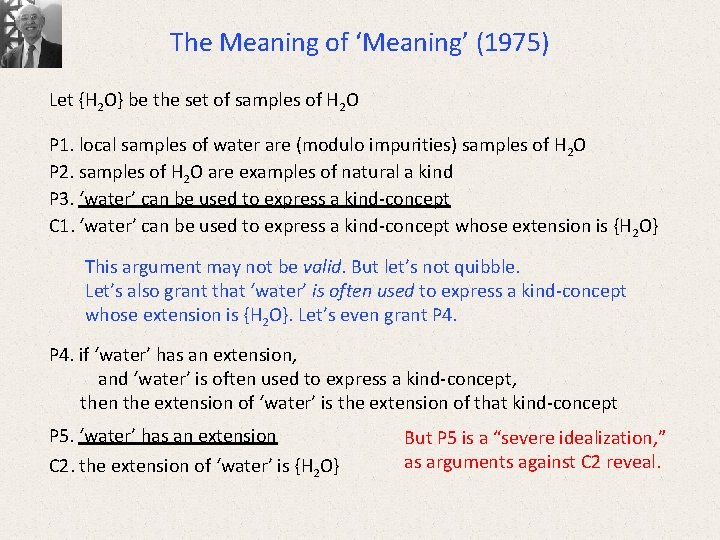
The Meaning of ‘Meaning’ (1975) Let {H 2 O} be the set of samples of H 2 O P 1. local samples of water are (modulo impurities) samples of H 2 O P 2. samples of H 2 O are examples of natural a kind P 3. ‘water’ can be used to express a kind-concept C 1. ‘water’ can be used to express a kind-concept whose extension is {H 2 O} This argument may not be valid. But let’s not quibble. Let’s also grant that ‘water’ is often used to express a kind-concept whose extension is {H 2 O}. Let’s even grant P 4. if ‘water’ has an extension, and ‘water’ is often used to express a kind-concept, then the extension of ‘water’ is the extension of that kind-concept P 5. ‘water’ has an extension C 2. the extension of ‘water’ is {H 2 O} But P 5 is a “severe idealization, ” as arguments against C 2 reveal.
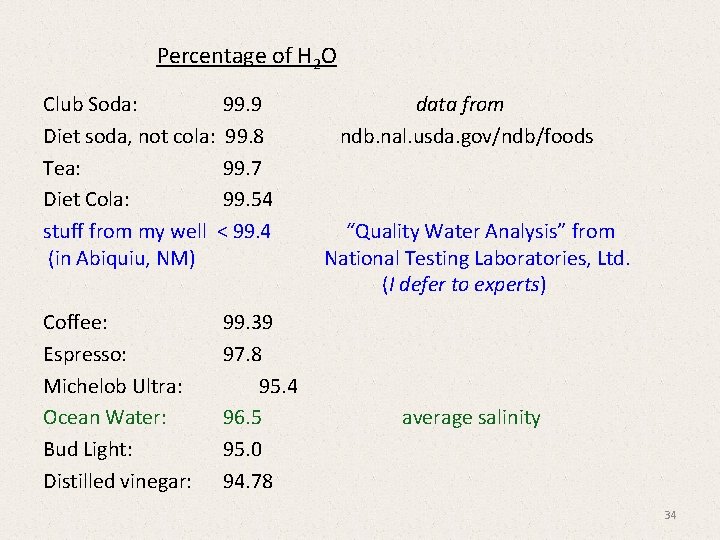
Percentage of H 2 O Club Soda: 99. 9 Diet soda, not cola: 99. 8 Tea: 99. 7 Diet Cola: 99. 54 stuff from my well < 99. 4 (in Abiquiu, NM) Coffee: Espresso: Michelob Ultra: Ocean Water: Bud Light: Distilled vinegar: 99. 39 97. 8 95. 4 96. 5 95. 0 94. 78 data from ndb. nal. usda. gov/ndb/foods “Quality Water Analysis” from National Testing Laboratories, Ltd. (I defer to experts) average salinity 34
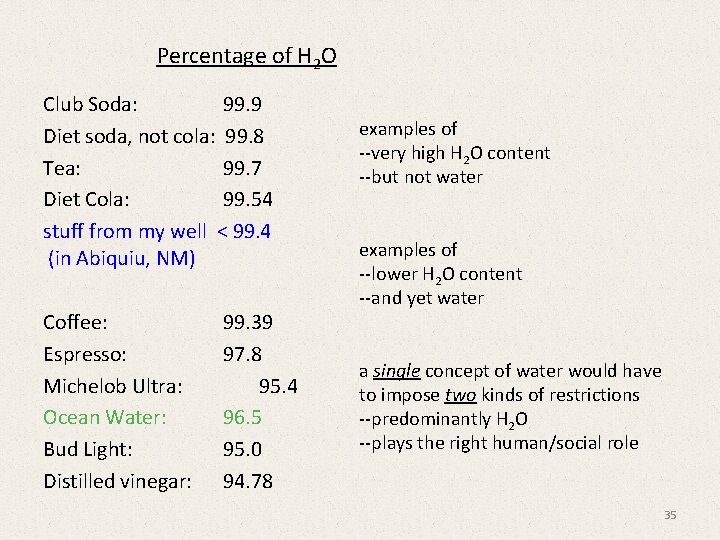
Percentage of H 2 O Club Soda: 99. 9 Diet soda, not cola: 99. 8 Tea: 99. 7 Diet Cola: 99. 54 stuff from my well < 99. 4 (in Abiquiu, NM) Coffee: Espresso: Michelob Ultra: Ocean Water: Bud Light: Distilled vinegar: 99. 39 97. 8 95. 4 96. 5 95. 0 94. 78 examples of --very high H 2 O content --but not water examples of --lower H 2 O content --and yet water a single concept of water would have to impose two kinds of restrictions --predominantly H 2 O --plays the right human/social role 35
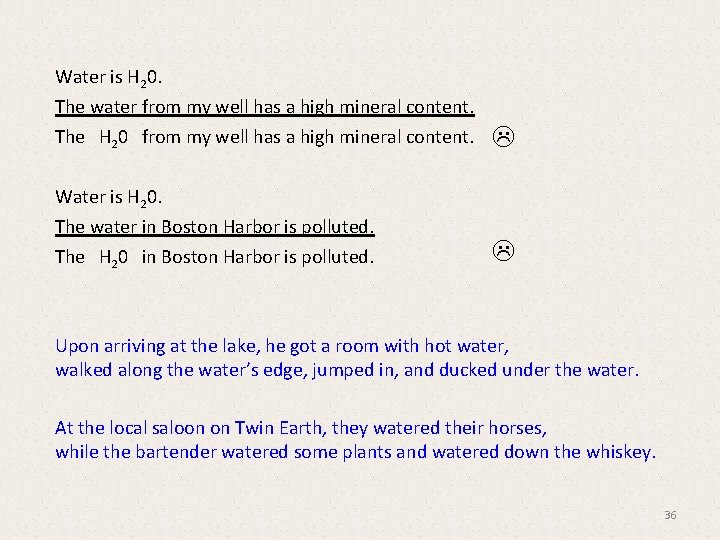
Water is H 20. The water from my well has a high mineral content. The H 20 from my well has a high mineral content. Water is H 20. The water in Boston Harbor is polluted. The H 20 in Boston Harbor is polluted. Upon arriving at the lake, he got a room with hot water, walked along the water’s edge, jumped in, and ducked under the water. At the local saloon on Twin Earth, they watered their horses, while the bartender watered some plants and watered down the whiskey. 36
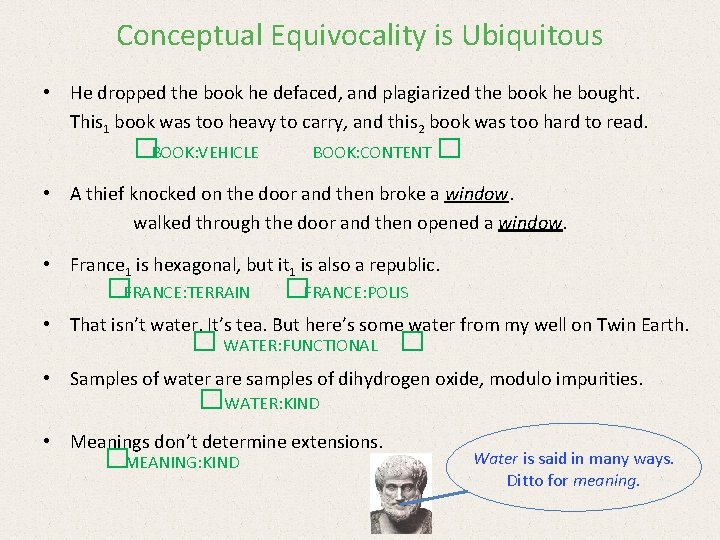
Conceptual Equivocality is Ubiquitous • He dropped the book he defaced, and plagiarized the book he bought. This 1 book was too heavy to carry, and this 2 book was too hard to read. �BOOK: VEHICLE BOOK: CONTENT � • A thief knocked on the door and then broke a window. walked through the door and then opened a window. • France 1 is hexagonal, but it 1 is also a republic. �FRANCE: TERRAIN �FRANCE: POLIS • That isn’t water. It’s tea. But here’s some water from my well on Twin Earth. � WATER: FUNCTIONAL � • Samples of water are samples of dihydrogen oxide, modulo impurities. �WATER: KIND • Meanings don’t determine extensions. �MEANING: KIND Water is said in many ways. Ditto for meaning.
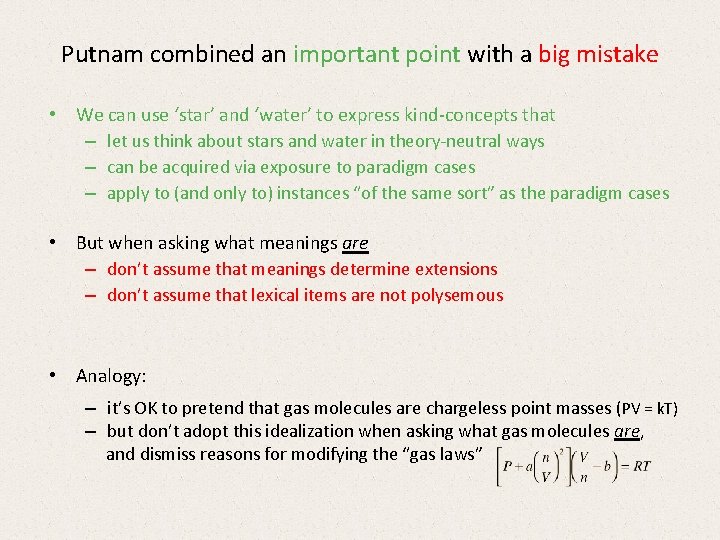
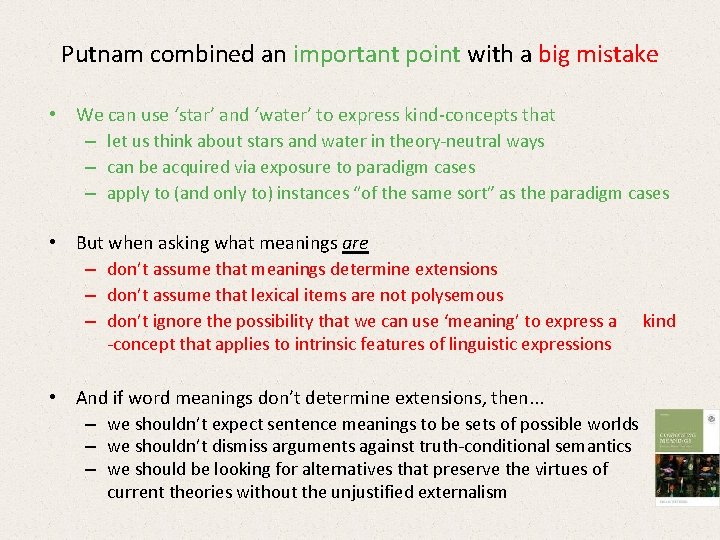
Putnam combined an important point with a big mistake • We can use ‘star’ and ‘water’ to express kind-concepts that – let us think about stars and water in theory-neutral ways – can be acquired via exposure to paradigm cases – apply to (and only to) instances “of the same sort” as the paradigm cases • But when asking what meanings are – don’t assume that meanings determine extensions – don’t assume that lexical items are not polysemous • Analogy: – it’s OK to pretend that gas molecules are chargeless point masses (PV = k. T) – but don’t adopt this idealization when asking what gas molecules are, and dismiss reasons for modifying the “gas laws”
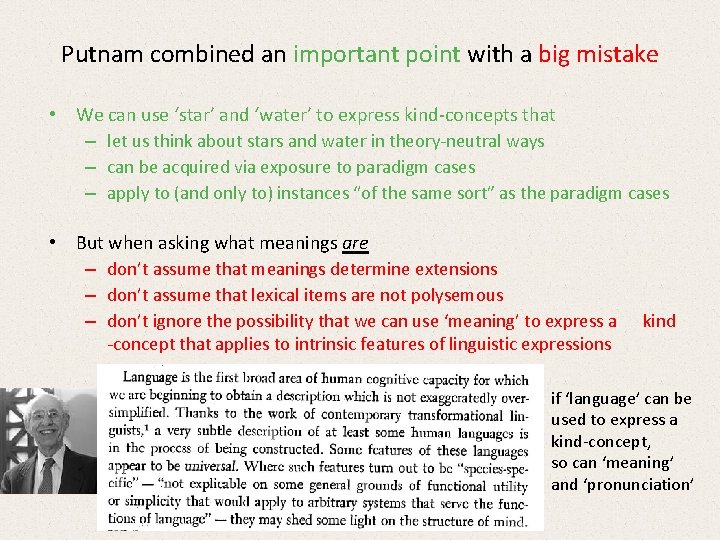
Putnam combined an important point with a big mistake • We can use ‘star’ and ‘water’ to express kind-concepts that – let us think about stars and water in theory-neutral ways – can be acquired via exposure to paradigm cases – apply to (and only to) instances “of the same sort” as the paradigm cases • But when asking what meanings are – don’t assume that meanings determine extensions – don’t assume that lexical items are not polysemous – don’t ignore the possibility that we can use ‘meaning’ to express a -concept that applies to intrinsic features of linguistic expressions kind if ‘language’ can be used to express a kind-concept, so can ‘meaning’ and ‘pronunciation’
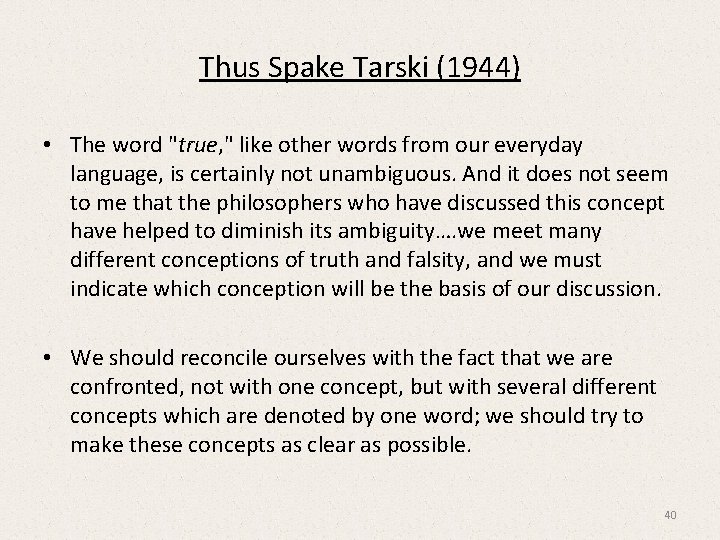
Thus Spake Tarski (1944) • The word "true, " like other words from our everyday language, is certainly not unambiguous. And it does not seem to me that the philosophers who have discussed this concept have helped to diminish its ambiguity…. we meet many different conceptions of truth and falsity, and we must indicate which conception will be the basis of our discussion. • We should reconcile ourselves with the fact that we are confronted, not with one concept, but with several different concepts which are denoted by one word; we should try to make these concepts as clear as possible. 40
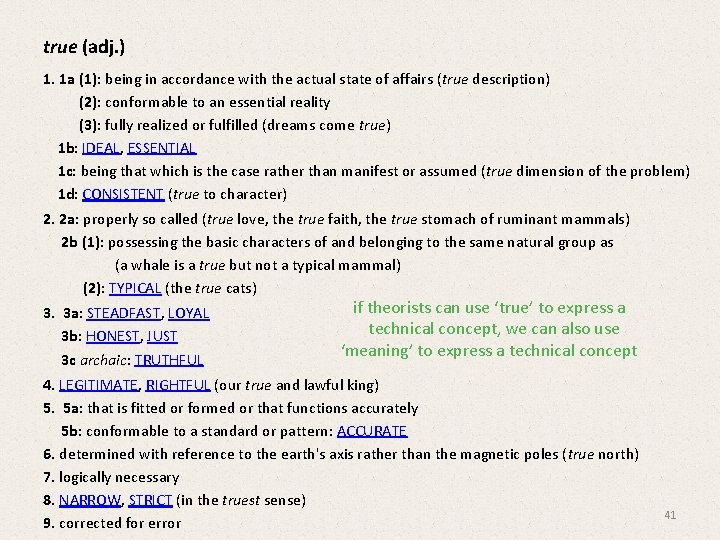
true (adj. ) 1. 1 a (1): being in accordance with the actual state of affairs (true description) (2): conformable to an essential reality (3): fully realized or fulfilled (dreams come true) 1 b: IDEAL, ESSENTIAL 1 c: being that which is the case rather than manifest or assumed (true dimension of the problem) 1 d: CONSISTENT (true to character) 2. 2 a: properly so called (true love, the true faith, the true stomach of ruminant mammals) 2 b (1): possessing the basic characters of and belonging to the same natural group as (a whale is a true but not a typical mammal) (2): TYPICAL (the true cats) 3. 3 a: STEADFAST, LOYAL 3 b: HONEST, JUST 3 c archaic: TRUTHFUL if theorists can use ‘true’ to express a technical concept, we can also use ‘meaning’ to express a technical concept 4. LEGITIMATE, RIGHTFUL (our true and lawful king) 5. 5 a: that is fitted or formed or that functions accurately 5 b: conformable to a standard or pattern: ACCURATE 6. determined with reference to the earth's axis rather than the magnetic poles (true north) 7. logically necessary 8. NARROW, STRICT (in the truest sense) 9. corrected for error 41
Putnam combined an important point with a big mistake • We can use ‘star’ and ‘water’ to express kind-concepts that – let us think about stars and water in theory-neutral ways – can be acquired via exposure to paradigm cases – apply to (and only to) instances “of the same sort” as the paradigm cases • But when asking what meanings are – don’t assume that meanings determine extensions – don’t assume that lexical items are not polysemous – don’t ignore the possibility that we can use ‘meaning’ to express a -concept that applies to intrinsic features of linguistic expressions • And if word meanings don’t determine extensions, then. . . – we shouldn’t expect sentence meanings to be sets of possible worlds – we shouldn’t dismiss arguments against truth-conditional semantics – we should be looking for alternatives that preserve the virtues of current theories without the unjustified externalism kind
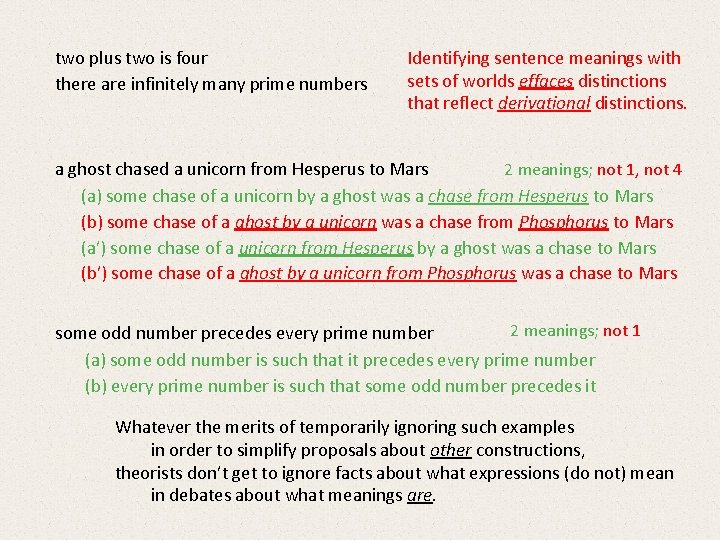
two plus two is four there are infinitely many prime numbers Identifying sentence meanings with sets of worlds effaces distinctions that reflect derivational distinctions. 2 meanings; not 1, not 4 a ghost chased a unicorn from Hesperus to Mars (a) some chase of a unicorn by a ghost was a chase from Hesperus to Mars (b) some chase of a ghost by a unicorn was a chase from Phosphorus to Mars (a’) some chase of a unicorn from Hesperus by a ghost was a chase to Mars (b’) some chase of a ghost by a unicorn from Phosphorus was a chase to Mars 2 meanings; not 1 some odd number precedes every prime number (a) some odd number is such that it precedes every prime number (b) every prime number is such that some odd number precedes it Whatever the merits of temporarily ignoring such examples in order to simplify proposals about other constructions, theorists don’t get to ignore facts about what expressions (do not) mean in debates about what meanings are.
1968 the goal of the descriptive study of a language is the construction of a grammar. . . that specifies a set of sentences, each with an ideal phonetic form and an associated intrinsic semantic interpretation. In Retrospect: K&F’s analogy between “a semantic theory of a natural language” and “a model which interprets a formal system” was past its use-by date in 67. At a minimum, the limitations of this analogy should have been obvious 1968 -1975 a grammar is a set-theoretical entity. . . a sentence meaning is a set of possible worlds. . . Semantics with no treatment of truth conditions is not semantics. the construction of a theory of. . . truth under an arbitrary interpretation is the basic goal of serious syntax and semantics Cut the pie any way you like, 'meanings' just ain't in the head! 44
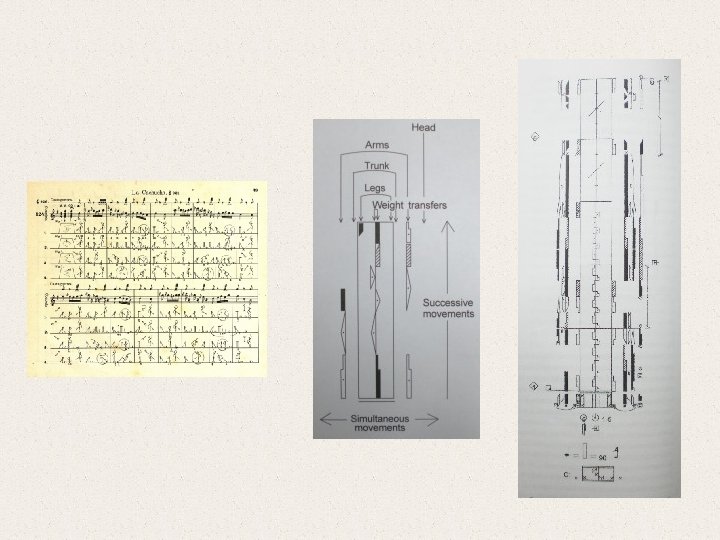
Post Script: Scores without Games Grammars (I-languages) connect meanings (depicted via LFs) with pronunciations (depicted via PFs) Halle (1990): Vocal pronunciation involves a “gymnastics executed by certain anatomical structures, ” including the lower lip, tongue, soft palate, and larynx. “The cavities bordered by these structures are commonly referred to as the vocal tract, and the acoustic signal that strikes the ears during speech is produced by changes in the geometry of the vocal tract. ” “An X-ray motion picture recording the behavior of the vocal tract in the course of producing a particular utterance bears a striking resemblance to a stylized dance performed by dancers of great skill. ” ”If utterances are regarded as “dances” performed by. . . movable portions of the vocal tract, then one must also suppose that underlying each utterance (“dance”) there is a “score” in some “choreographic” notation that instructs each “dancer” what to do and when. ”
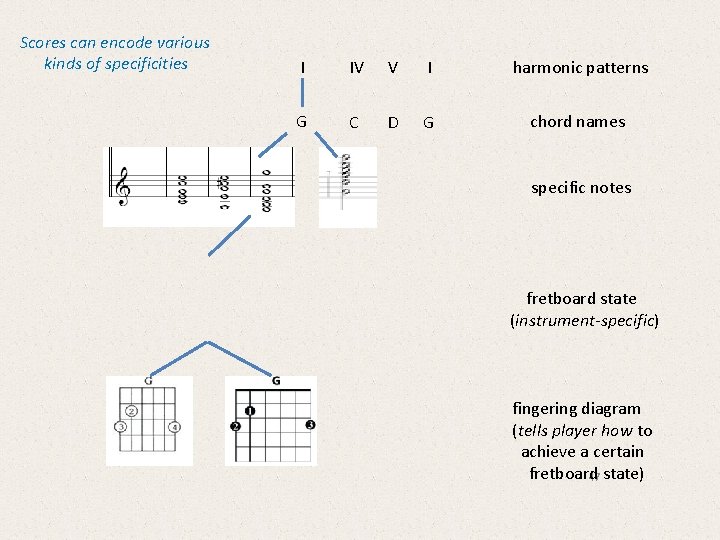
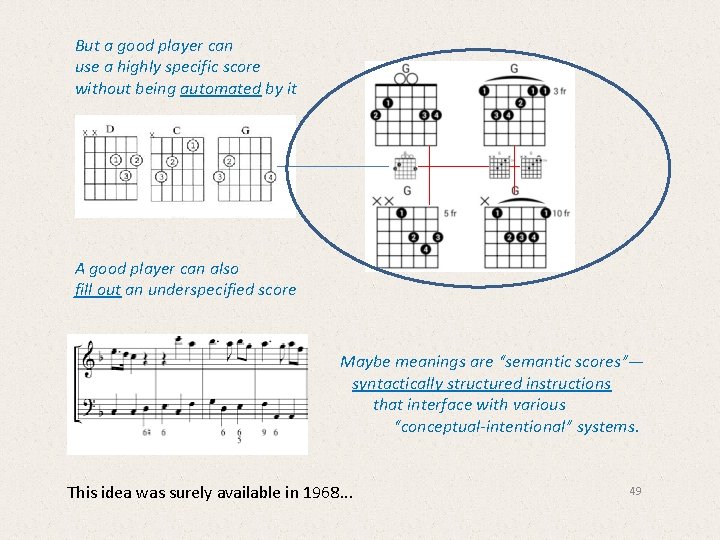
Scores can encode various kinds of specificities I IV V I harmonic patterns G C D G chord names specific notes fretboard state (instrument-specific) fingering diagram (tells player how to achieve a certain fretboard 47 state)
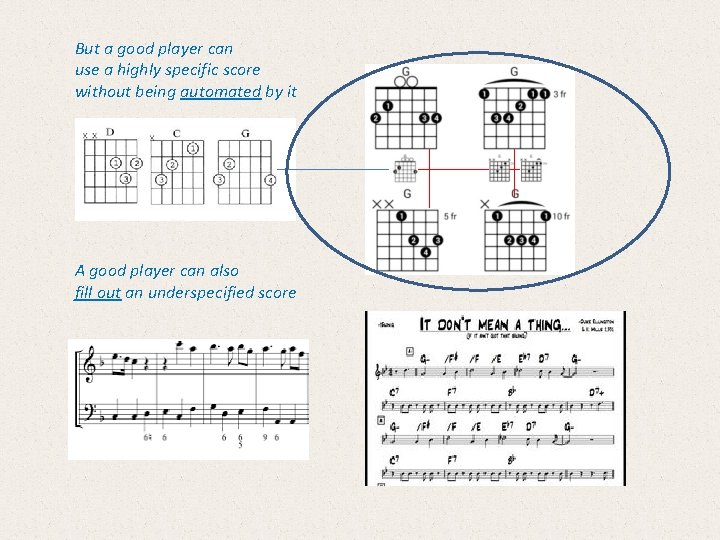
But a good player can use a highly specific score without being automated by it A good player can also fill out an underspecified score
But a good player can use a highly specific score without being automated by it A good player can also fill out an underspecified score Maybe meanings are “semantic scores”— syntactically structured instructions that interface with various “conceptual-intentional” systems. This idea was surely available in 1968. . . 49
Toy Model: Meanings as instructions for how to access and assemble concepts Meaning[France] = fetch@address: France FRANCE-TERRAIN FRANCE-POLIS Meaning[hexagonal] = fetch@address: hexagonal HEXAGONAL(_) Meaning[France is hexagonal] = Combine(Meaning[hexagonal], Meaning[France]) HEXAGONAL(FRANCE-TERRAIN) HEXAGONAL(FRANCE-POLIS)
Toy Model: Meanings as instructions for how to access and assemble concepts Meaning[France] = fetch@address: France FRANCE-TERRAIN FRANCE-POLIS Meaning[republic] = fetch@address: republic REPUBLIC(_) Meaning[France is hexagonal] = Combine(Meaning[hexagonal], Meaning[France]) REPUBLIC(FRANCE-TERRAIN) REPUBLIC(FRANCE-POLIS)
Toy Model: Meanings as instructions for how to access and assemble concepts Meaning[France] = fetch@address: France FRANCE-TERRAIN(_) FRANCE-POLIS(_) Meaning[hexagonal] = fetch@address: hexagonal HEXAGONAL-AT(_, _) Meaning[is hexagonal] = Combine(Meaning[is], Meaning[hexagonal]) ∃x[HEXAGONAL-AT(_, X) & REF-TIME(X)] Meaning[France is hexagonal] = Combine(Meaning[is hexagonal], Meaning[France]) ∃{FR-TERRAIN(_) &∃x[HEXAGONAL-AT(_, X) & REF-TIME(X)]}
A Plea for a Return to the Conservative 1960 s • a grammar generates (endlessly many) meaning-pronunciation pairs in a way that allows for both homophony and polysemy • differences in meaning need not reflect contrasts in the environment • meanings don’t determine extensions. . . not even for nouns like ‘water’ • while sentence meanings are not merely classes of derivations, identifying them with sets of possible worlds was always grossly implausible • meanings and pronunciations are more like syntactically structured scores the goal of the descriptive study of a language is the construction of a grammar. . . that specifies a set of sentences, each with an ideal phonetic form and an associated intrinsic semantic interpretation.
Thanks 54