
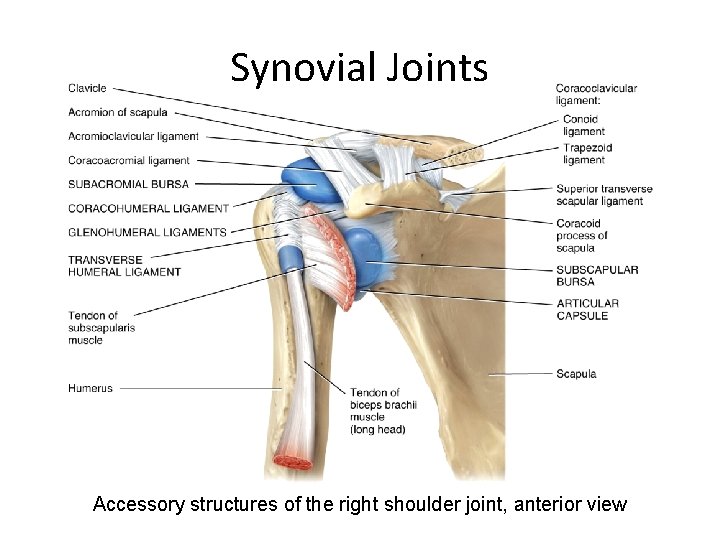
Synovial Joints Accessory structures of the right shoulder
- Slides: 13
Synovial Joints Accessory structures of the right shoulder joint, anterior view
Types of Synovial Joints • There are 6 types of synovial joints based on the shapes of the articulating bone surfaces. – Not all synovial joints have all (or any) accessory structures like ligaments and bursae – some of them are quite simple.
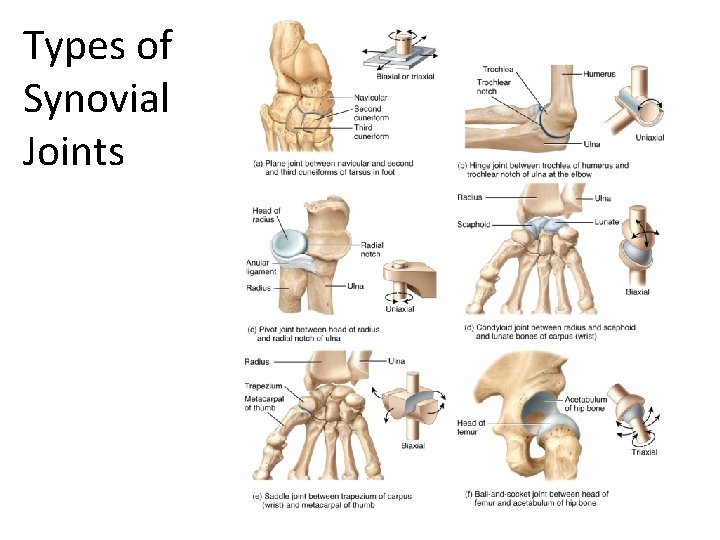
Types of Synovial Joints
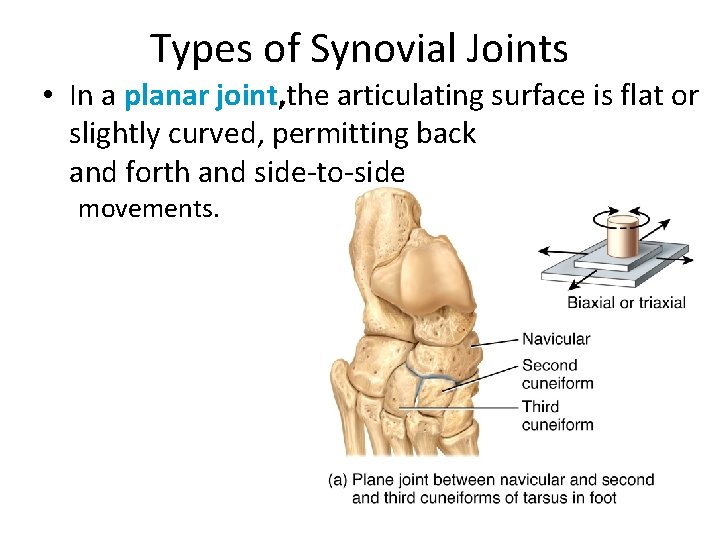
Types of Synovial Joints • In a planar joint, the articulating surface is flat or slightly curved, permitting back and forth and side-to-side movements.
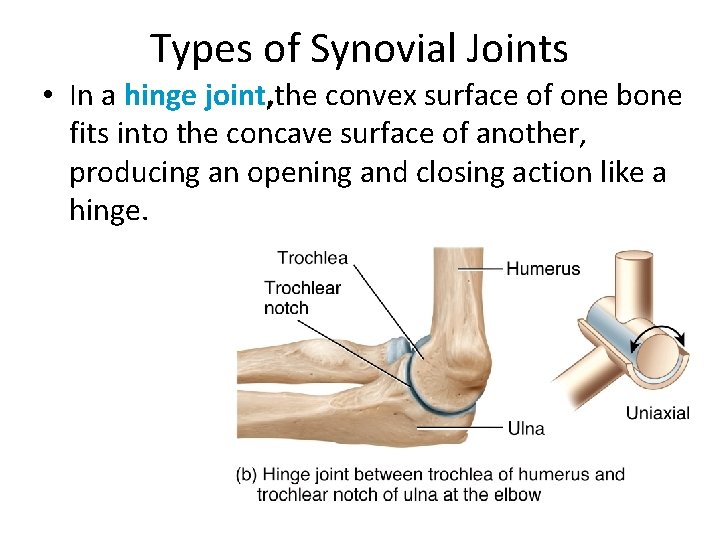
Types of Synovial Joints • In a hinge joint, the convex surface of one bone fits into the concave surface of another, producing an opening and closing action like a hinge.
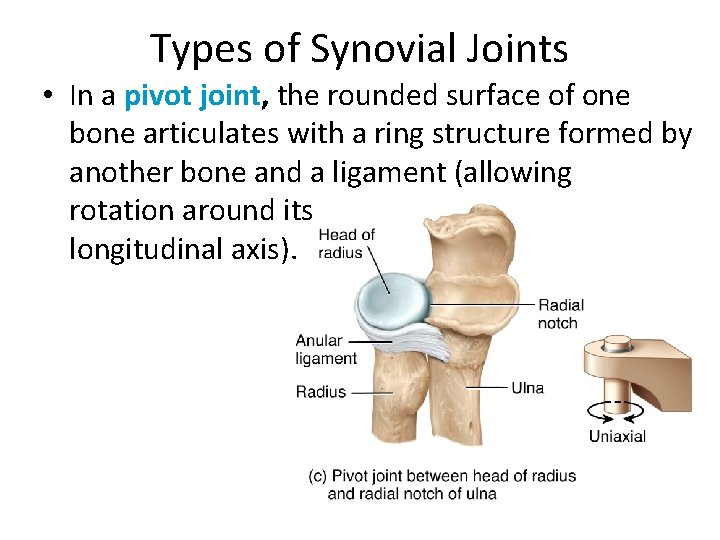
Types of Synovial Joints • In a pivot joint, the rounded surface of one bone articulates with a ring structure formed by another bone and a ligament (allowing rotation around its longitudinal axis).
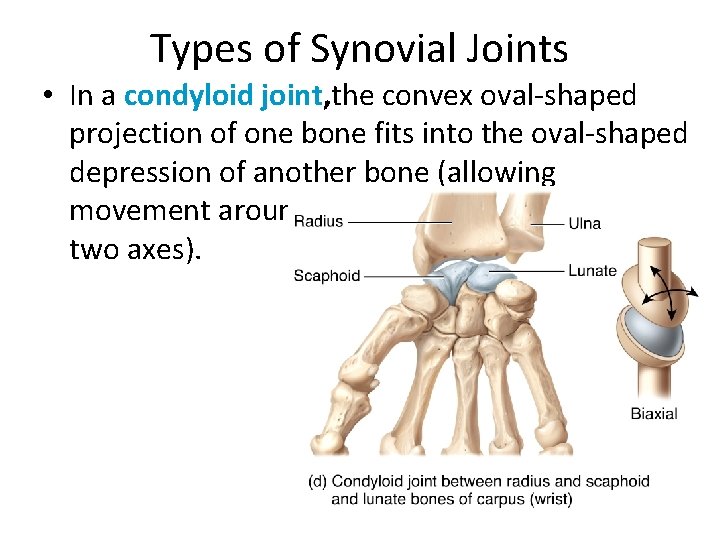
Types of Synovial Joints • In a condyloid joint, the convex oval-shaped projection of one bone fits into the oval-shaped depression of another bone (allowing movement around two axes).
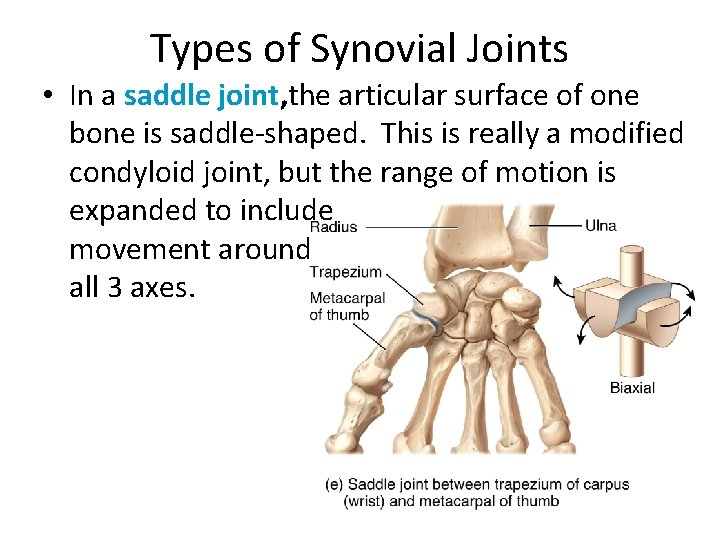
Types of Synovial Joints • In a saddle joint, the articular surface of one bone is saddle-shaped. This is really a modified condyloid joint, but the range of motion is expanded to include movement around all 3 axes.
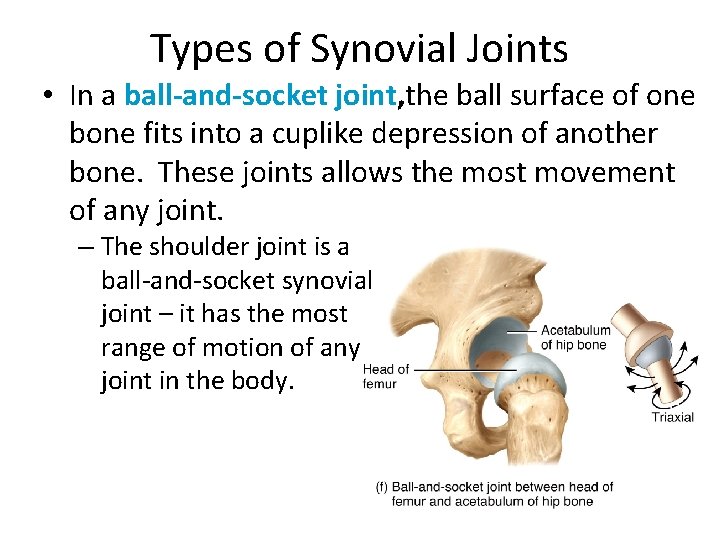
Types of Synovial Joints • In a ball-and-socket joint, the ball surface of one bone fits into a cuplike depression of another bone. These joints allows the most movement of any joint. – The shoulder joint is a ball-and-socket synovial joint – it has the most range of motion of any joint in the body.
Joint Movements • Range of motion (ROM) refers to the range, measured in degrees of a circle, through which the bones of a joint can be moved. Some of the factors that contribute to keeping the articular surfaces in contact (and affect ROM) include: – Structure or shape of the articulating bones • The shape of the articulating bones determines how closely they fit together. – The strength and tension of the muscles and joint ligaments varies to restrict or permit certain positions.
Joint Movements • ROM is also affected by: – Hormones • Relaxin increases the flexibility of the pubic symphysis and loosens the ligaments between the sacrum and hip bone toward the end of pregnancy. – Disuse • Movement may be restricted if a joint has not been used for an extended period.
Joint Movements • Joint movements are grouped into four main categories: – Gliding – relatively flat bone surfaces move backand-forth and from side-to-side with respect to one another. – Angular movements – there is an increase or a decrease in the angle between articulating bones. – Rotation – a bone revolves around its own longitudinal axis. – Special movements
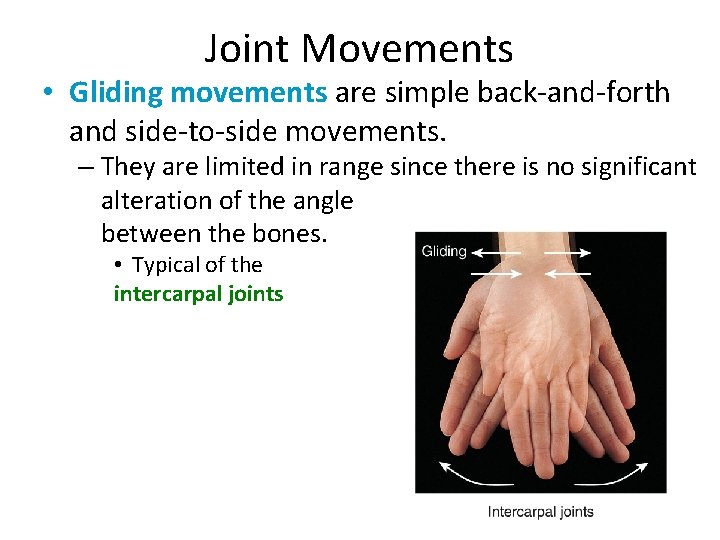
Joint Movements • Gliding movements are simple back-and-forth and side-to-side movements. – They are limited in range since there is no significant alteration of the angle between the bones. • Typical of the intercarpal joints