
Synod of the Pacific Meeting October 8 2020
Synod of the Pacific Meeting October 8, 2020 Rev. Molly Casteel, Assistant Stated Clerk Equity and Representation, Presbyterian Church USA WHAT DOES THE LORD REQUIRE OF US? …AND WHO IS “US”?
GROUNDING IN To hold space for everyone to enter and be – here, now… Get in a comfortable position for your body. Let your eyes lose focus or close them BIBO: Breathe in, breathe out (with intention) • drop your shoulders from your ears, • relax your tongue from the top of your mouth… • regulate your vagus nerve by taking deep and slow breaths, hold a beat and exhale slowly (make a noise when doing so helps the focus)– • breathe in presence and breathe out distraction, • breathe in connection and breath out isolation • breathe in love and breathe out justice
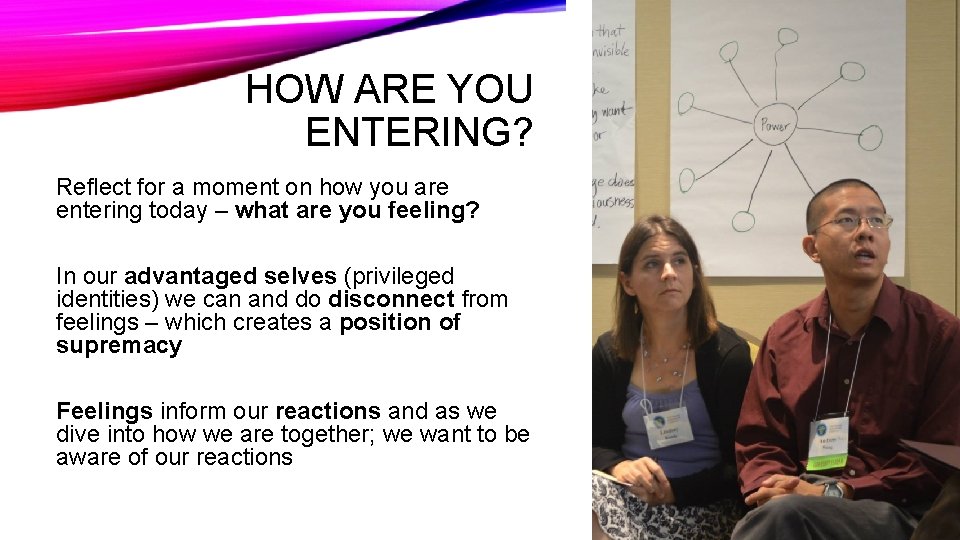
HOW ARE YOU ENTERING? Reflect for a moment on how you are entering today – what are you feeling? In our advantaged selves (privileged identities) we can and do disconnect from feelings – which creates a position of supremacy Feelings inform our reactions and as we dive into how we are together; we want to be aware of our reactions
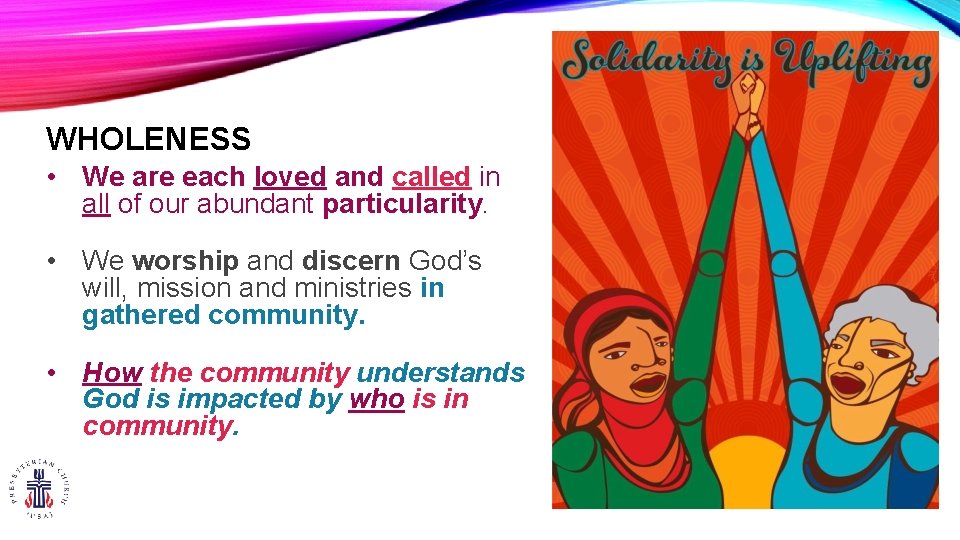
WHOLENESS • We are each loved and called in all of our abundant particularity. • We worship and discern God’s will, mission and ministries in gathered community. • How the community understands God is impacted by who is in community.
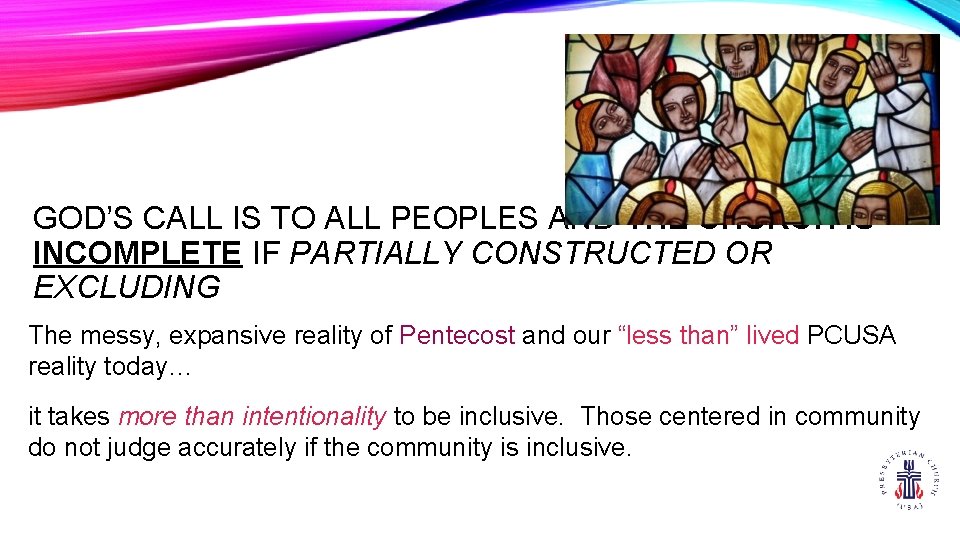
GOD’S CALL IS TO ALL PEOPLES AND THE CHURCH IS INCOMPLETE IF PARTIALLY CONSTRUCTED OR EXCLUDING The messy, expansive reality of Pentecost and our “less than” lived PCUSA reality today… it takes more than intentionality to be inclusive. Those centered in community do not judge accurately if the community is inclusive.
The story of Pentecost (Acts 2) disrupts the normative and promotes inclusion. Beyond diversity and inclusion, it offers a model of equity. • No single language and ethnicity is posited as normative. There is no “other” here.
Matthew 25: 31+ takes the idea of the other to a different level. A critical question for inclusion – when was it that we saw you? The parable of the sheep and goats suggests that the other is an embodiment of the divine and should be welcomed accordingly. The other also becomes the space/occasion—literal and metaphorical—in which one meets the divine.
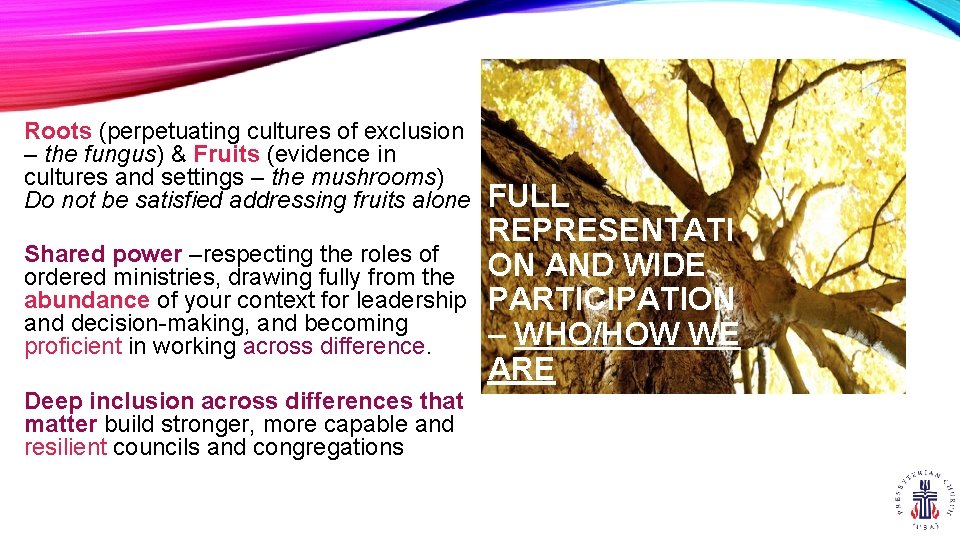
Roots (perpetuating cultures of exclusion – the fungus) & Fruits (evidence in cultures and settings – the mushrooms) Do not be satisfied addressing fruits alone Shared power –respecting the roles of ordered ministries, drawing fully from the abundance of your context for leadership and decision-making, and becoming proficient in working across difference. Deep inclusion across differences that matter build stronger, more capable and resilient councils and congregations FULL REPRESENTATI ON AND WIDE PARTICIPATION – WHO/HOW WE ARE
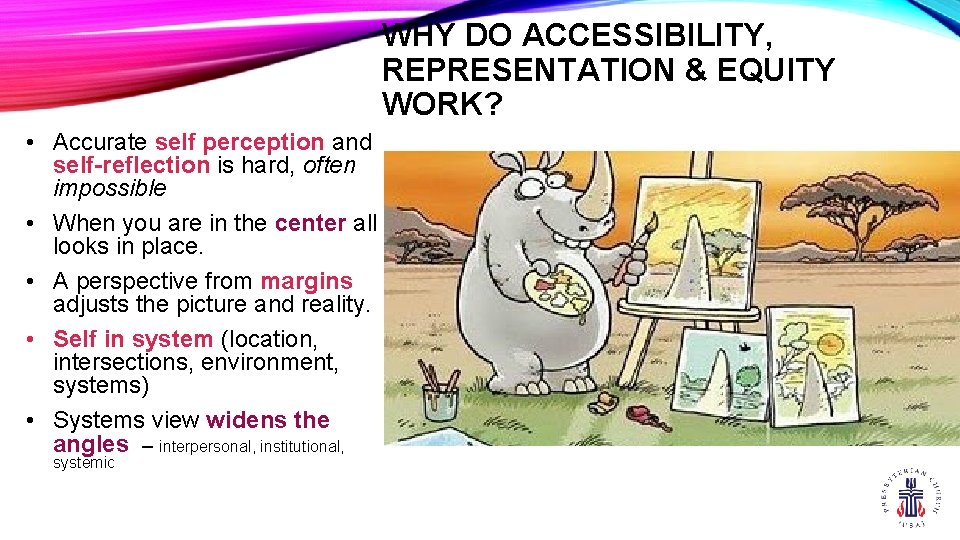
WHY DO ACCESSIBILITY, REPRESENTATION & EQUITY WORK? • Accurate self perception and self-reflection is hard, often impossible • When you are in the center all looks in place. • A perspective from margins adjusts the picture and reality. • Self in system (location, intersections, environment, systems) • Systems view widens the angles – interpersonal, institutional, systemic
ALL [PEOPLE] CAN STAND “ NEARLY ADVERSITY, BUT IF YOU WANT TO TEST A [PERSON’S] CHARACTER, GIVE [THEM] POWER. —Abraham Lincoln Covid-19 is a test beyond how we adapt to the technical transitions… ”
“ WASHING ONE'S HANDS OF THE CONFLICT BETWEEN THE POWERFUL AND THE POWERLESS MEANS TO SIDE WITH THE POWERFUL, NOT TO BE NEUTRAL. —Paulo Freire There is no innocence for those in dominance – inaction is harm ”
“ THE MOST COMMON WAY PEOPLE GIVE UP THEIR POWER IS BY THINKING THEY DON’T HAVE ANY. —Alice Walker Each person has a circle of influence and a means of connecting to coalition for power… the LIE is that you can do nothing. ”
“ POWER CONCEDES NOTHING WITHOUT A DEMAND. IT NEVER DID AND IT NEVER WILL. — Frederick Douglass Active resistance of the powers and principalities is required to make change happen – energy (imagination, intelligence and love) is required to break the bonds of status quo. ”
Looking for more? THE PRAXIS PROJECT OFFERS THIS POWER ANALYSIS TOOL HTTPS: //WWW. RACIALEQUITYTOOLS. ORG/MODULE/POWER-ANALYSIS The purpose of Power Analysis module is to critically explore the meaning of power and how it is implemented, learn how to conduct a power analysis, and practice how to dismantle power for the purpose of making changes that support justice and equity for all Also • Sources of Power handout from the National Community Development Institute: http: //www. buildingmovement. org/wp-content/uploads/2020/03/Sources_of_Power. pdf • Social Determinants Framework – the river model https: //multco. us/file/8323/download • Dynamics of Power, Inclusion and Exclusion (Tools for Analyzing Power, Inclusion and Exclusion) https: //www. justassociates. org/sites/justassociates. org/files/toolsforanalyzingpower. pdf
CONSEQUENCES OF POWER DYNAMICS • Handout for review • Breakout into small groups of 4 or 5 people • Discussion • • What catches your attention? What invites you to deeper reflection? Where do you see connections to Synod and its committees? How decisions on how meetings are set up and process, impact who participates? • In-person: room, arrangement, microphones, accessibility, screen and font sizes, time • allotted for items of business and the arrangement of those times (near meal, first of morning, end of day) Virtual: “room” arrangement, connection strength and consistency, devices and capacity to navigate multiple devices; rules for being recognized, which screen someone is on, time given for folks to respond, add your own
MUTUAL INVITATION (CAN BE A PRACTICE OF DECENTERING DOMINANCE) • First speaker contributes until they are done, invites another • Invited person has option to participate, to pass for now, to pass – after they act, they invite the next speaker • Continue in this pattern until all have participated or the time has elapsed • Do not interrupt a speaker or ask questions – allow folks to offer what they will – time management is part of the learning • If a person or person is missed in one round of discussion – I suggest they start it off next round.
ACTION-ORIENTED QUESTIONS • How do we ensure that conversations about and engagement around accessibility, representation, and equity become catalysts for change rather than substitutes? • What will happen when we are doing theology rather than talking theology? • How shall we move from tolerance (acknowledgement) to respect and celebration (affirmation) of multiplicity? • What are some possibilities for a theology of full participation and equity in action in settings where we have power and privilege?
QUESTIONS FOR SMALL GROUP REFLECTION OR JOURNAL PROMPT • How do we disrupt models of patronage and privilege so that we become partners in the Church and beyond? • How shall we see each other in new, radical and mutually hospitable ways? When will we know it? • From your study and reflection, what is one intersectional anti-racist practice you would like to see implemented at the synod level?
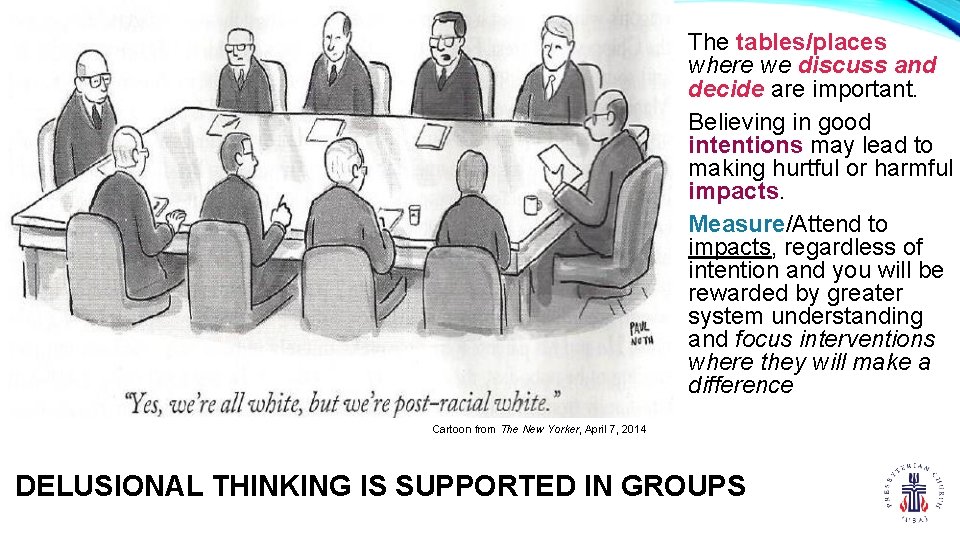
The tables/places where we discuss and decide are important. Believing in good intentions may lead to making hurtful or harmful impacts. Measure/Attend to impacts, regardless of intention and you will be rewarded by greater system understanding and focus interventions where they will make a difference Cartoon from The New Yorker, April 7, 2014 DELUSIONAL THINKING IS SUPPORTED IN GROUPS
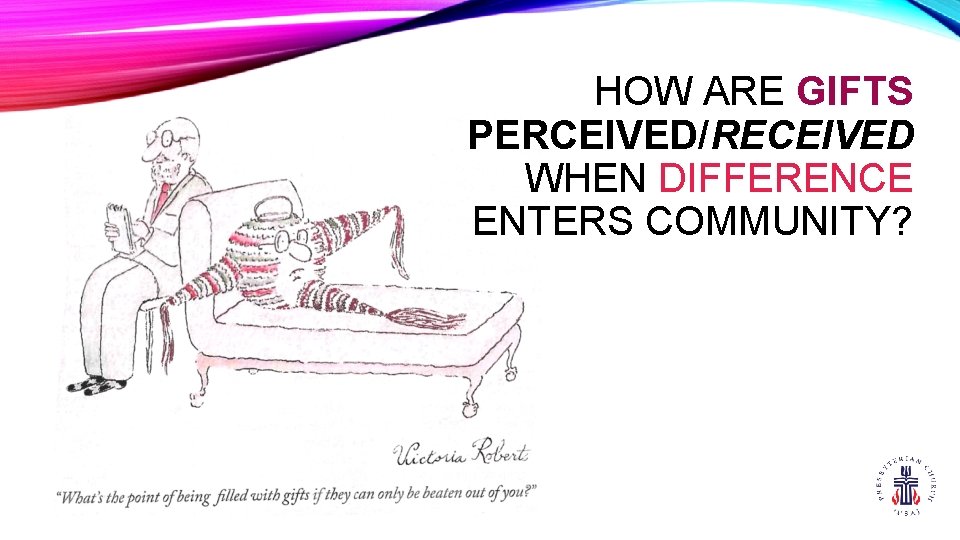
HOW ARE GIFTS PERCEIVED/RECEIVED WHEN DIFFERENCE ENTERS COMMUNITY?
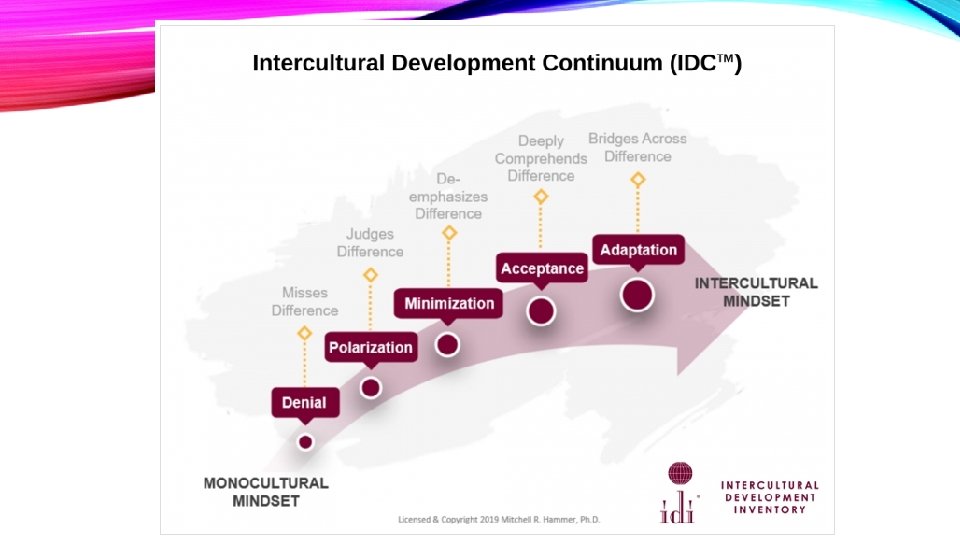
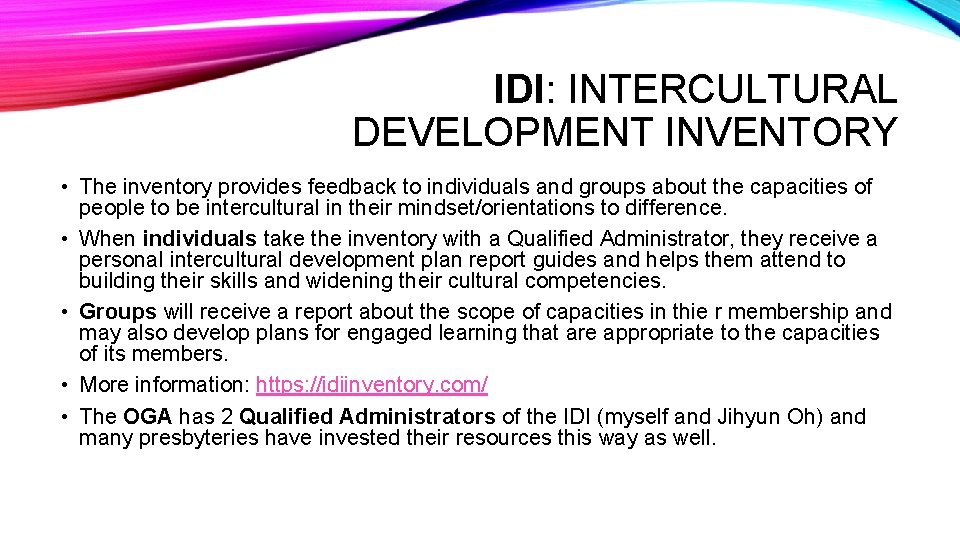
IDI: INTERCULTURAL DEVELOPMENT INVENTORY • The inventory provides feedback to individuals and groups about the capacities of people to be intercultural in their mindset/orientations to difference. • When individuals take the inventory with a Qualified Administrator, they receive a personal intercultural development plan report guides and helps them attend to building their skills and widening their cultural competencies. • Groups will receive a report about the scope of capacities in thie r membership and may also develop plans for engaged learning that are appropriate to the capacities of its members. • More information: https: //idiinventory. com/ • The OGA has 2 Qualified Administrators of the IDI (myself and Jihyun Oh) and many presbyteries have invested their resources this way as well.
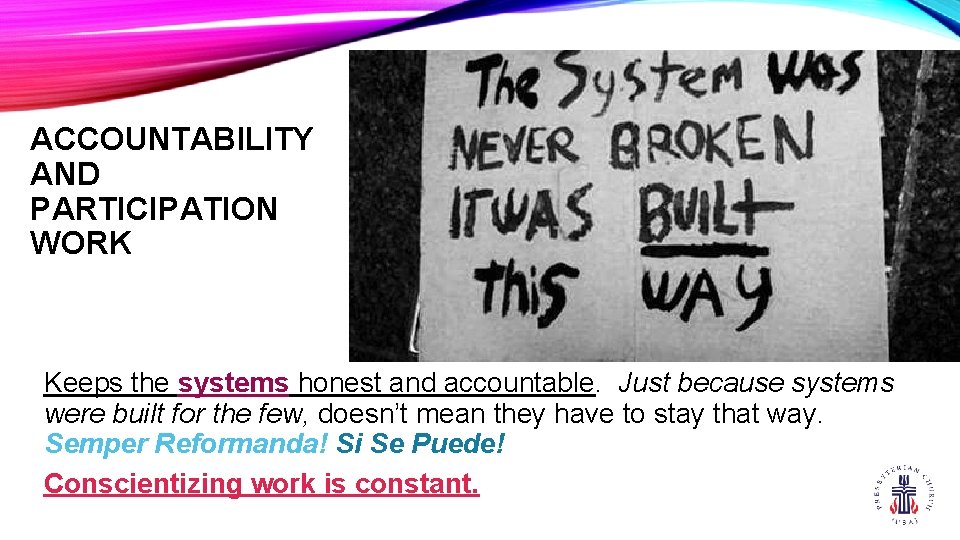
ACCOUNTABILITY AND PARTICIPATION WORK Keeps the systems honest and accountable. Just because systems were built for the few, doesn’t mean they have to stay that way. Semper Reformanda! Si Se Puede! Conscientizing work is constant.
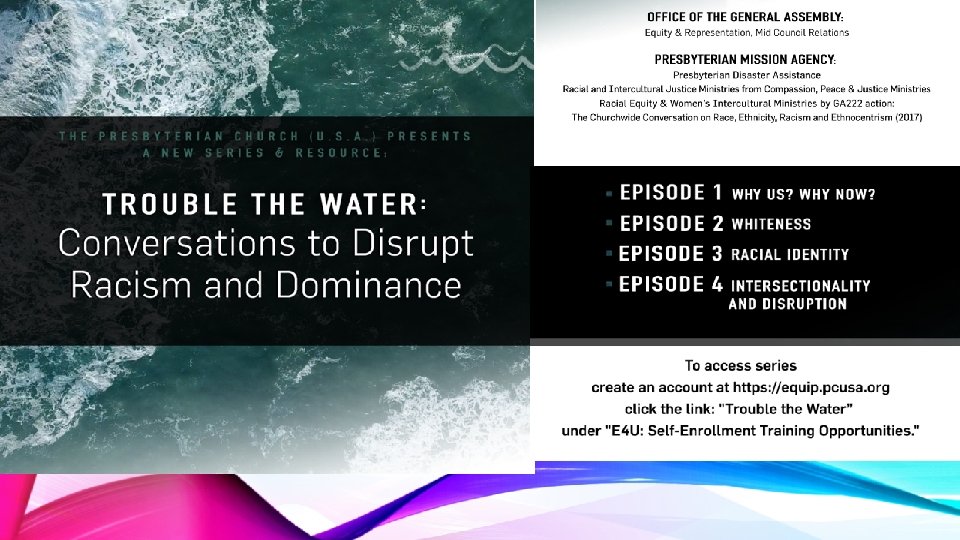
THANK YOU For more information: Contact me at molly. casteel@pcusa. org or 502 -287 -2001 My work is supported by the per capita funds which unite all Presbyterians in sharing God’s love through mission and ministry. Thank you for supporting ministries in the presbytery, synod and assembly. Coming Soon and Just released: www. equip. pcusa. org – Course on Disability and the Way of Jesus is available now. Trouble the Water: Conversations to Disrupt Racism and Dominance www. pcusa. org/troublethewater
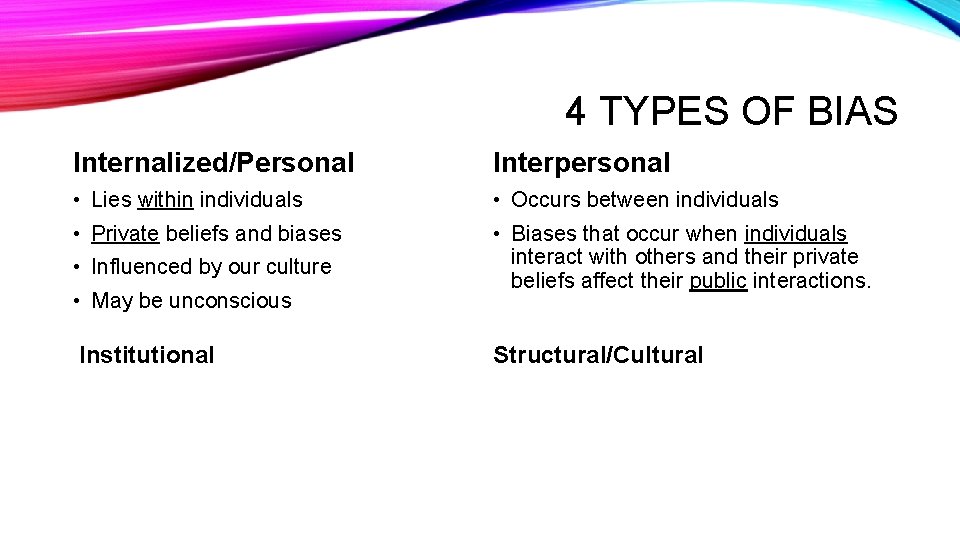
4 TYPES OF BIAS Internalized/Personal Interpersonal • Lies within individuals • Occurs between individuals • Private beliefs and biases • Biases that occur when individuals interact with others and their private beliefs affect their public interactions. • Influenced by our culture • May be unconscious Institutional Structural/Cultural
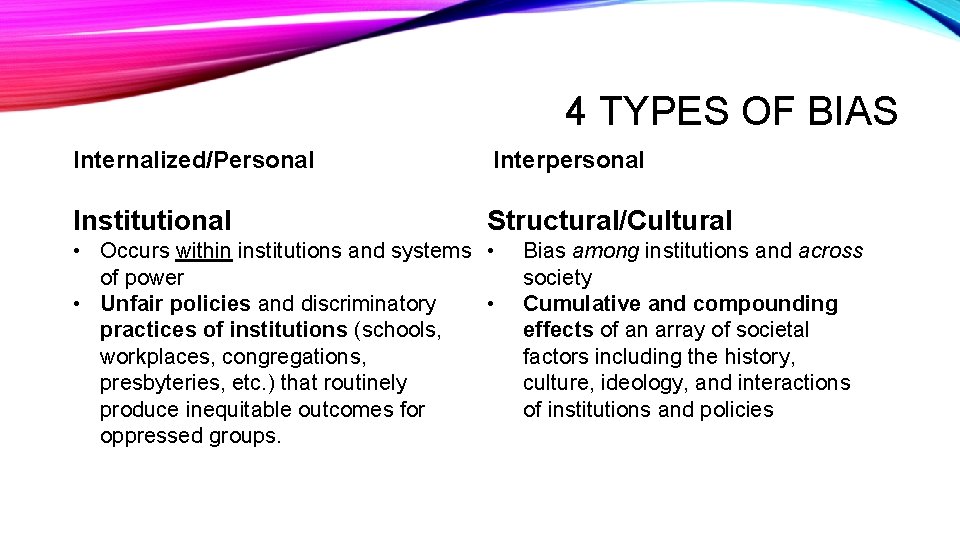
4 TYPES OF BIAS Internalized/Personal Interpersonal Institutional Structural/Cultural • Occurs within institutions and systems • of power • Unfair policies and discriminatory • practices of institutions (schools, workplaces, congregations, presbyteries, etc. ) that routinely produce inequitable outcomes for oppressed groups. Bias among institutions and across society Cumulative and compounding effects of an array of societal factors including the history, culture, ideology, and interactions of institutions and policies
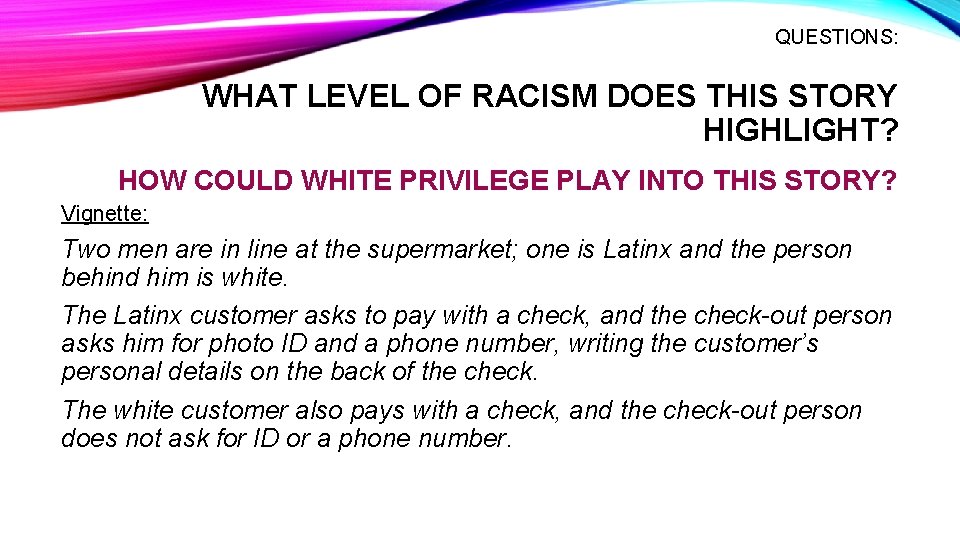
QUESTIONS: WHAT LEVEL OF RACISM DOES THIS STORY HIGHLIGHT? HOW COULD WHITE PRIVILEGE PLAY INTO THIS STORY? Vignette: Two men are in line at the supermarket; one is Latinx and the person behind him is white. The Latinx customer asks to pay with a check, and the check-out person asks him for photo ID and a phone number, writing the customer’s personal details on the back of the check. The white customer also pays with a check, and the check-out person does not ask for ID or a phone number.
- Slides: 29