
Synchrotron Photoionization Mass Spectrometry Investigation of Acetylacetone Oxidation
- Slides: 1
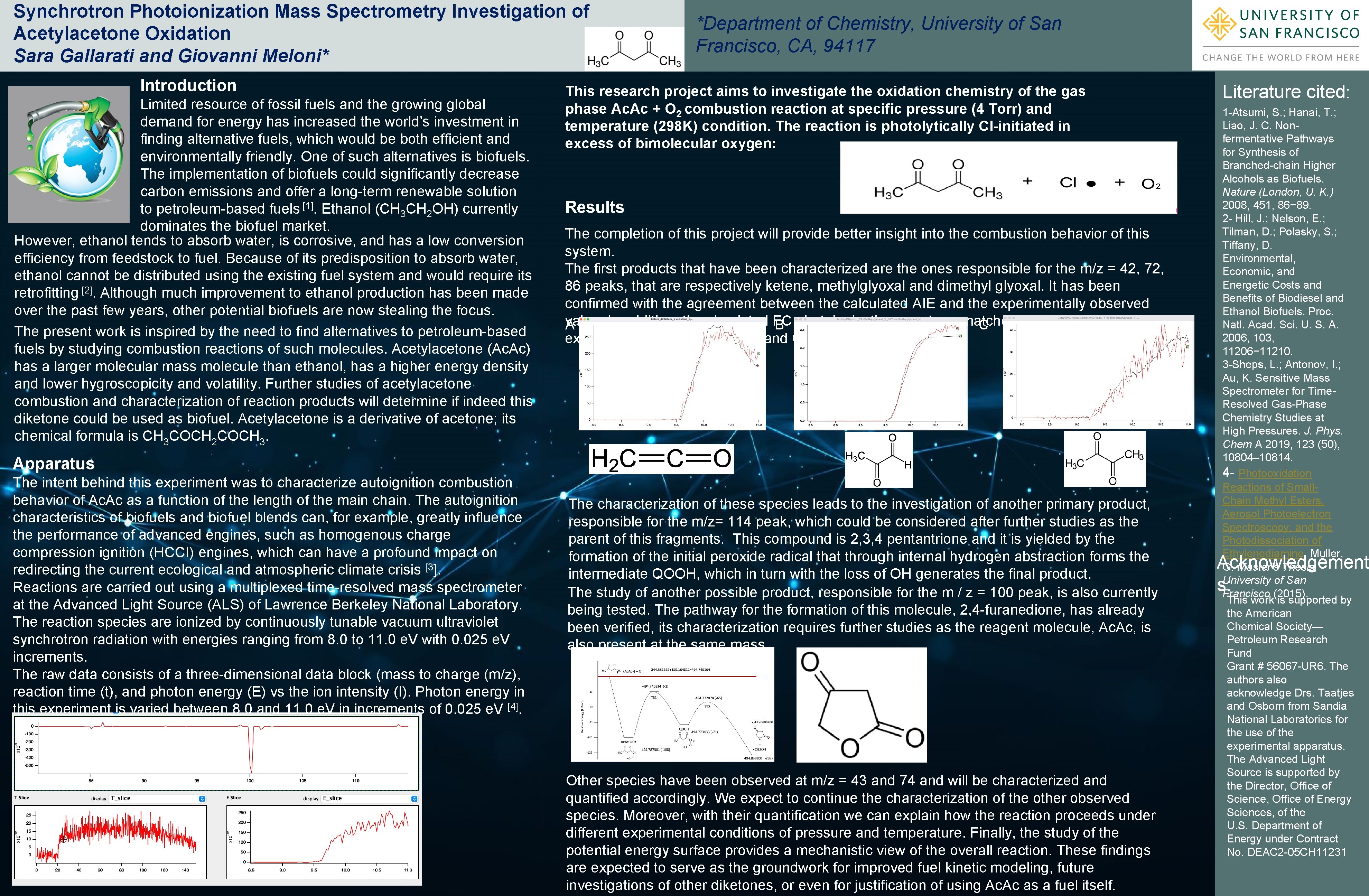
Synchrotron Photoionization Mass Spectrometry Investigation of Acetylacetone Oxidation Sara Gallarati and Giovanni Meloni* Introduction Limited resource of fossil fuels and the growing global demand for energy has increased the world’s investment in finding alternative fuels, which would be both efficient and environmentally friendly. One of such alternatives is biofuels. The implementation of biofuels could significantly decrease carbon emissions and offer a long-term renewable solution to petroleum-based fuels [1]. Ethanol (CH 3 CH 2 OH) currently dominates the biofuel market. However, ethanol tends to absorb water, is corrosive, and has a low conversion efficiency from feedstock to fuel. Because of its predisposition to absorb water, ethanol cannot be distributed using the existing fuel system and would require its retrofitting [2]. Although much improvement to ethanol production has been made over the past few years, other potential biofuels are now stealing the focus. The present work is inspired by the need to find alternatives to petroleum-based fuels by studying combustion reactions of such molecules. Acetylacetone (Ac. Ac) has a larger molecular mass molecule than ethanol, has a higher energy density and lower hygroscopicity and volatility. Further studies of acetylacetone combustion and characterization of reaction products will determine if indeed this diketone could be used as biofuel. Acetylacetone is a derivative of acetone; its chemical formula is CH 3 COCH 2 COCH 3. *Department of Chemistry, University of San Francisco, CA, 94117 This research project aims to investigate the oxidation chemistry of the gas phase Ac. Ac + O 2 combustion reaction at specific pressure (4 Torr) and temperature (298 K) condition. The reaction is photolytically Cl-initiated in excess of bimolecular oxygen: Results The completion of this project will provide better insight into the combustion behavior of this system. The first products that have been characterized are the ones responsible for the m/z = 42, 72, 86 peaks, that are respectively ketene, methylglyoxal and dimethyl glyoxal. It has been confirmed with the agreement between the calculated AIE and the experimentally observed value. In addition, the simulated FC perfectly the A B photoionization spectrum matches C experimental curve (figure A, B and C). Apparatus The intent behind this experiment was to characterize autoignition combustion behavior of Ac. Ac as a function of the length of the main chain. The autoignition characteristics of biofuels and biofuel blends can, for example, greatly influence the performance of advanced engines, such as homogenous charge compression ignition (HCCI) engines, which can have a profound impact on redirecting the current ecological and atmospheric climate crisis [3]. Reactions are carried out using a multiplexed time-resolved mass spectrometer at the Advanced Light Source (ALS) of Lawrence Berkeley National Laboratory. The reaction species are ionized by continuously tunable vacuum ultraviolet synchrotron radiation with energies ranging from 8. 0 to 11. 0 e. V with 0. 025 e. V increments. The raw data consists of a three-dimensional data block (mass to charge (m/z), reaction time (t), and photon energy (E) vs the ion intensity (I). Photon energy in this experiment is varied between 8. 0 and 11. 0 e. V in increments of 0. 025 e. V [4]. The characterization of these species leads to the investigation of another primary product, responsible for the m/z= 114 peak, which could be considered after further studies as the parent of this fragments. This compound is 2, 3, 4 pentantrione and it is yielded by the formation of the initial peroxide radical that through internal hydrogen abstraction forms the intermediate QOOH, which in turn with the loss of OH generates the final product. The study of another possible product, responsible for the m / z = 100 peak, is also currently being tested. The pathway for the formation of this molecule, 2, 4 -furanedione, has already been verified, its characterization requires further studies as the reagent molecule, Ac. Ac, is also present at the same mass. Other species have been observed at m/z = 43 and 74 and will be characterized and quantified accordingly. We expect to continue the characterization of the other observed species. Moreover, with their quantification we can explain how the reaction proceeds under different experimental conditions of pressure and temperature. Finally, the study of the potential energy surface provides a mechanistic view of the overall reaction. These findings are expected to serve as the groundwork for improved fuel kinetic modeling, future investigations of other diketones, or even for justification of using Ac. Ac as a fuel itself. Literature cited: 1 -Atsumi, S. ; Hanai, T. ; Liao, J. C. Nonfermentative Pathways for Synthesis of Branched-chain Higher Alcohols as Biofuels. Nature (London, U. K. ) 2008, 451, 86− 89. 2 - Hill, J. ; Nelson, E. ; Tilman, D. ; Polasky, S. ; Tiffany, D. Environmental, Economic, and Energetic Costs and Benefits of Biodiesel and Ethanol Biofuels. Proc. Natl. Acad. Sci. U. S. A. 2006, 103, 11206− 11210. 3 -Sheps, L. ; Antonov, I. ; Au, K. Sensitive Mass Spectrometer for Time. Resolved Gas-Phase Chemistry Studies at High Pressures. J. Phys. Chem A 2019, 123 (50), 10804– 10814. 4 - Photooxidation Reactions of Small. Chain Methyl Esters, Aerosol Photoelectron Spectroscopy, and the Photodissociation of Ethylenediamine, Muller, G. Master’s Thesis, University of San Francisco (2015). This work is supported by the American Chemical Society— Petroleum Research Fund Grant # 56067 -UR 6. The authors also acknowledge Drs. Taatjes and Osborn from Sandia National Laboratories for the use of the experimental apparatus. The Advanced Light Source is supported by the Director, Office of Science, Office of Energy Sciences, of the U. S. Department of Energy under Contract No. DEAC 2 -05 CH 11231 Acknowledgement s: