
Synchronous Versus Asynchronous Testing Vishwani D Agrawal James




- Slides: 21
Synchronous Versus Asynchronous Testing Vishwani D. Agrawal James J. Danaher Professor Electrical and Computer Engineering Auburn University, Auburn, AL 36849, USA Collaborator: Praveen Venkataramani Texas Instruments – Bangalore, July 11, 2012 TI, Bangalore, July 11, 2012 Agrawal: Synch. vs. Asynch. 1
Power Considerations in Design • A circuit is designed for certain function. Its design must allow the power consumption necessary to execute that function. • Low power design methods can reduce the power need. • Power buses are laid out to carry the maximum current necessary for the function. • Heat dissipation of package conforms to the average power consumption during the intended function. • Layout design and verification must account for “hot spots” and “voltage droop” – delay, coupling noise, weak signals. TI, Bangalore, July 11, 2012 Agrawal: Synch. vs. Asynch. 2
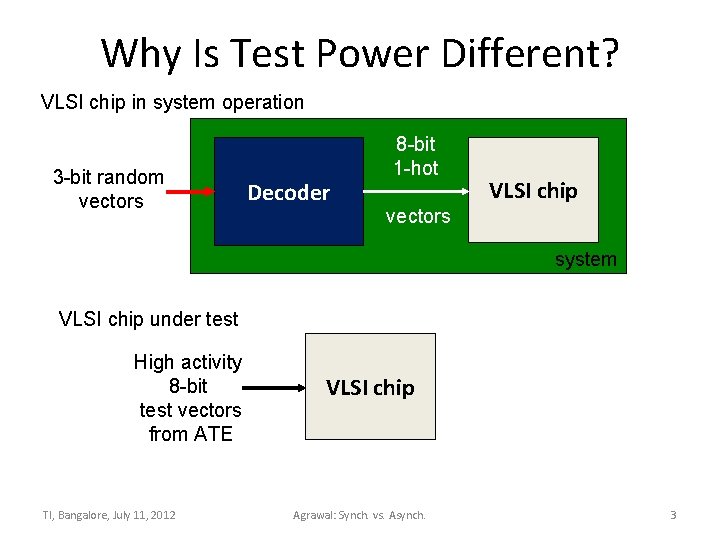
Why Is Test Power Different? VLSI chip in system operation 3 -bit random vectors Decoder 8 -bit 1 -hot VLSI chip vectors system VLSI chip under test High activity 8 -bit test vectors from ATE TI, Bangalore, July 11, 2012 VLSI chip Agrawal: Synch. vs. Asynch. 3
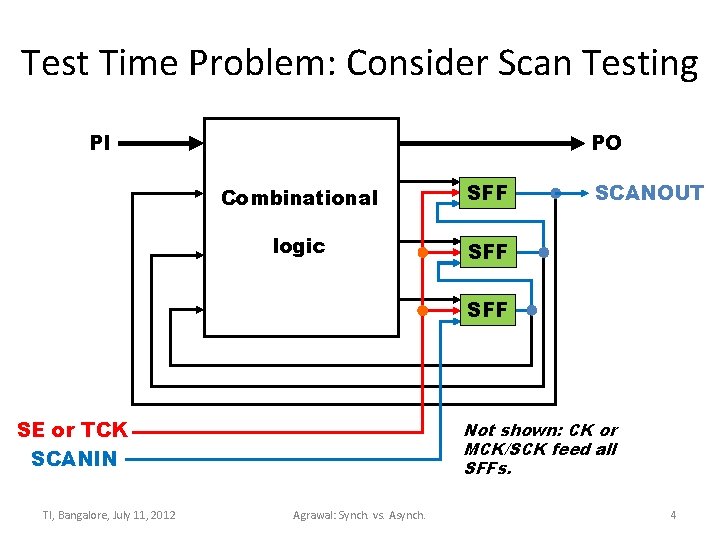
Test Time Problem: Consider Scan Testing PI PO Combinational SFF logic SFF SCANOUT SFF SE or TCK SCANIN TI, Bangalore, July 11, 2012 Not shown: CK or MCK/SCK feed all SFFs. Agrawal: Synch. vs. Asynch. 4
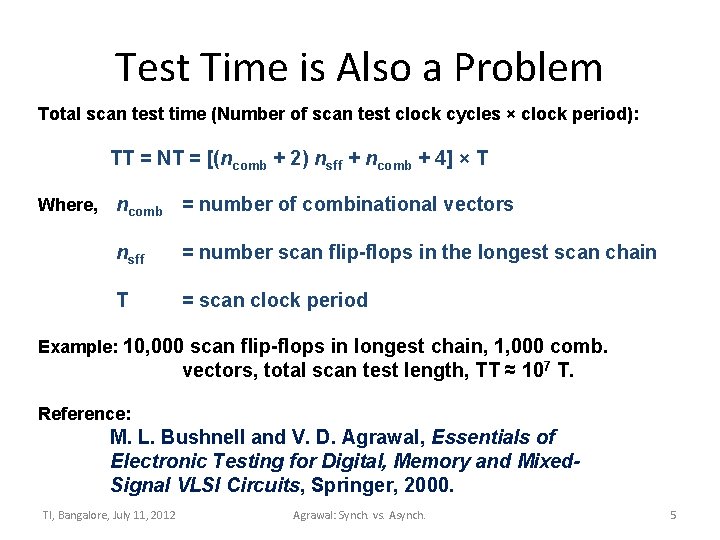
Test Time is Also a Problem Total scan test time (Number of scan test clock cycles × clock period): TT = NT = [(ncomb + 2) nsff + ncomb + 4] × T Where, ncomb = number of combinational vectors nsff = number scan flip-flops in the longest scan chain T = scan clock period Example: 10, 000 scan flip-flops in longest chain, 1, 000 comb. vectors, total scan test length, TT ≈ 107 T. Reference: M. L. Bushnell and V. D. Agrawal, Essentials of Electronic Testing for Digital, Memory and Mixed. Signal VLSI Circuits, Springer, 2000. TI, Bangalore, July 11, 2012 Agrawal: Synch. vs. Asynch. 5
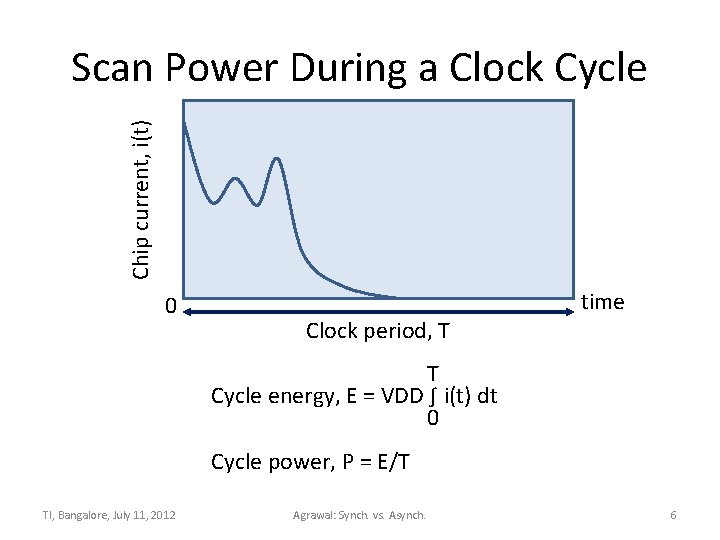
Chip current, i(t) Scan Power During a Clock Cycle 0 Clock period, T time T Cycle energy, E = VDD ∫ i(t) dt 0 Cycle power, P = E/T TI, Bangalore, July 11, 2012 Agrawal: Synch. vs. Asynch. 6
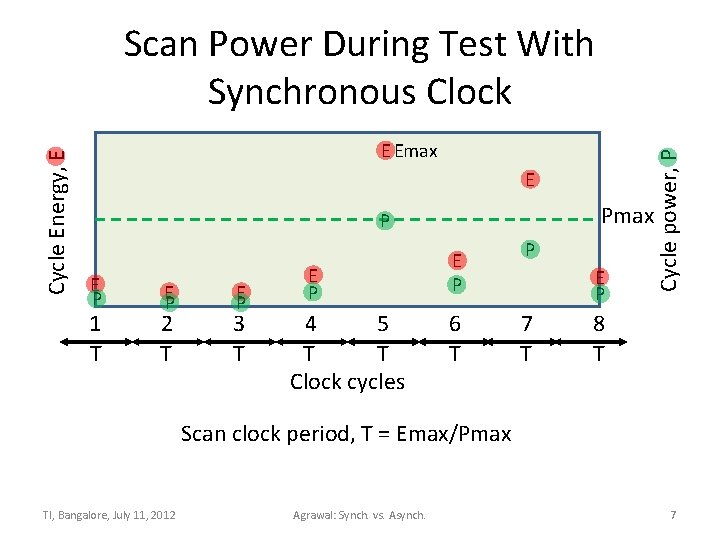
E Emax E Pmax P E P 1 T E P 2 T E P 3 T E P 4 5 T T Clock cycles Cycle power, P Cycle Energy, E Scan Power During Test With Synchronous Clock E P 6 T P E P 7 T 8 T Scan clock period, T = Emax/Pmax TI, Bangalore, July 11, 2012 Agrawal: Synch. vs. Asynch. 7
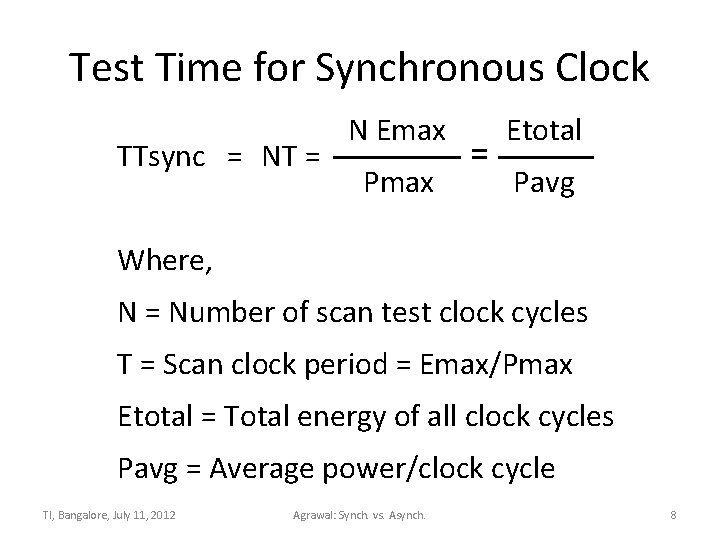
Test Time for Synchronous Clock N Emax Etotal TTsync = NT = ———— = ——— Pmax Pavg Where, N = Number of scan test clock cycles T = Scan clock period = Emax/Pmax Etotal = Total energy of all clock cycles Pavg = Average power/clock cycle TI, Bangalore, July 11, 2012 Agrawal: Synch. vs. Asynch. 8
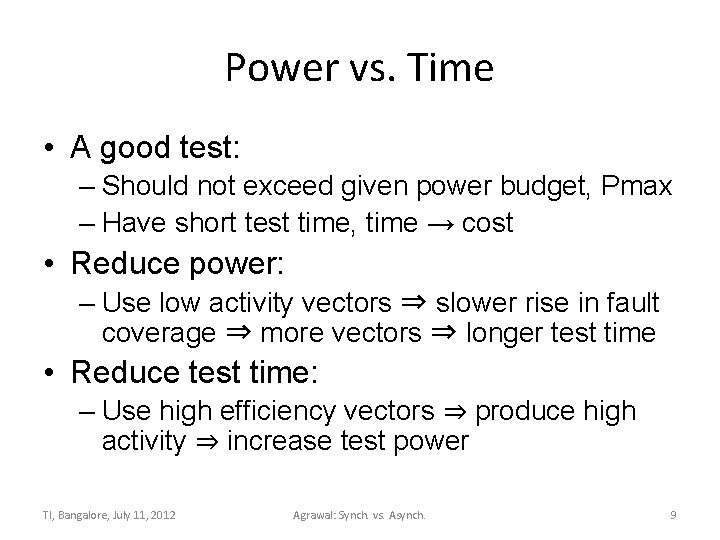
Power vs. Time • A good test: – Should not exceed given power budget, Pmax – Have short test time, time → cost • Reduce power: – Use low activity vectors ⇒ slower rise in fault coverage ⇒ more vectors ⇒ longer test time • Reduce test time: – Use high efficiency vectors ⇒ produce high activity ⇒ increase test power TI, Bangalore, July 11, 2012 Agrawal: Synch. vs. Asynch. 9
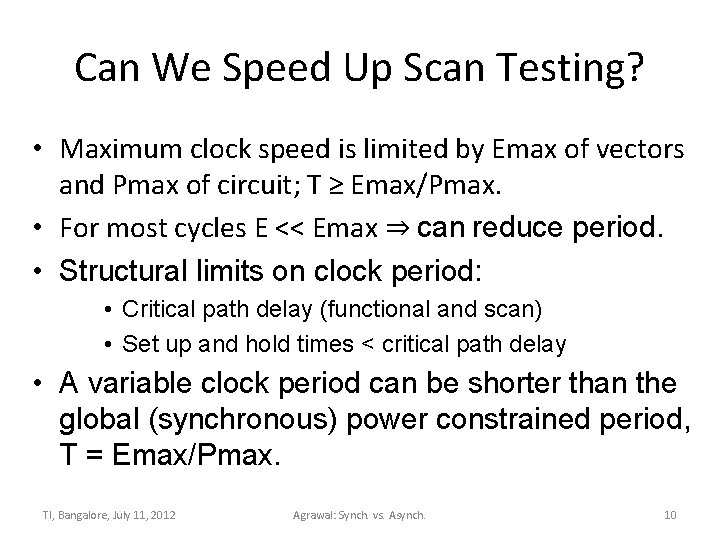
Can We Speed Up Scan Testing? • Maximum clock speed is limited by Emax of vectors and Pmax of circuit; T ≥ Emax/Pmax. • For most cycles E << Emax ⇒ can reduce period. • Structural limits on clock period: • Critical path delay (functional and scan) • Set up and hold times < critical path delay • A variable clock period can be shorter than the global (synchronous) power constrained period, T = Emax/Pmax. TI, Bangalore, July 11, 2012 Agrawal: Synch. vs. Asynch. 10
Asynchronous Scan • Pre-compute energy {Ei} for all clock cycles {i}. • For given power constrain Pmax of the circuit, set the period Ti of ith clock cycle as: Ti = max {Ei/Pmax, critical path delay} = Ei/Pmax, for power constrained testing Where critical path delay can be different for scan and normal mode cycles. TI, Bangalore, July 11, 2012 Agrawal: Synch. vs. Asynch. 11
E Emax E P P E P E E 1 2 3 4 T 1 T 2 T 3 T 4 P 5 T 5 P P E Cycle power, P Cycle Energy, E Scan Power During Test With Asynchronous Clock Pmax 6 7 8 T 6 T 7 T 8 Clock cycle, i Scan clock period, Ti = Ei/Pmax TI, Bangalore, July 11, 2012 Agrawal: Synch. vs. Asynch. 12
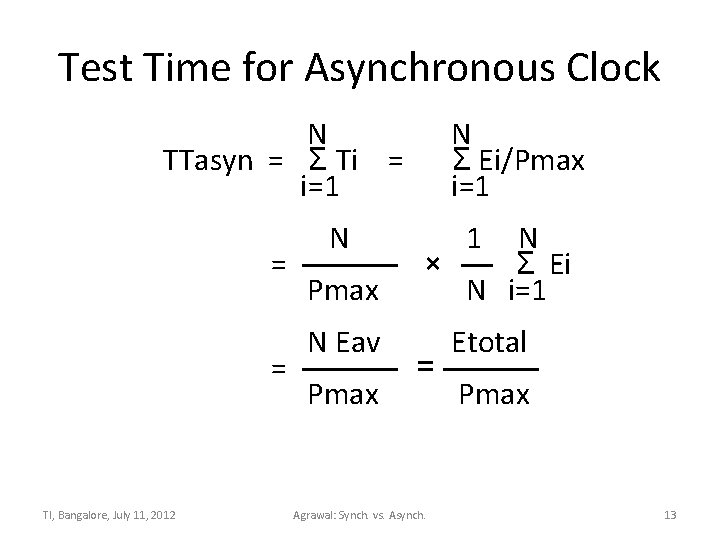
Test Time for Asynchronous Clock N TTasyn = Σ Ti = i=1 N Σ Ei/Pmax i=1 N = ——— × — Σ Ei Pmax N i=1 N Eav Etotal = ——— Pmax TI, Bangalore, July 11, 2012 Agrawal: Synch. vs. Asynch. 13
Two Theorems • TI, Bangalore, July 11, 2012 Agrawal: Synch. vs. Asynch. 14
Comparing Tests Energy 1. 0 0. 5 0. 0 1. 0 Energy Emax/Eav = 2 time Emax/Eav = 5 Low power test 0. 5 0. 0 TI, Bangalore, July 11, 2012 time Agrawal: Synch. vs. Asynch. 15
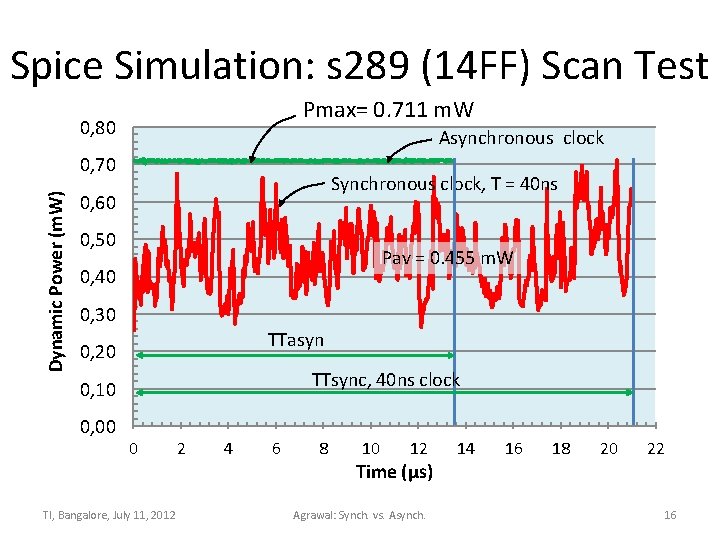
Spice Simulation: s 289 (14 FF) Scan Test Pmax= 0. 711 m. W 0, 80 Asynchronous clock Dynamic Power (m. W) 0, 70 Synchronous clock, T = 40 ns 0, 60 0, 50 Pav = 0. 455 m. W 0, 40 0, 30 TTasyn 0, 20 TTsync, 40 ns clock 0, 10 0, 00 0 TI, Bangalore, July 11, 2012 2 4 6 8 10 12 Time (µs) Agrawal: Synch. vs. Asynch. 14 16 18 20 22 16
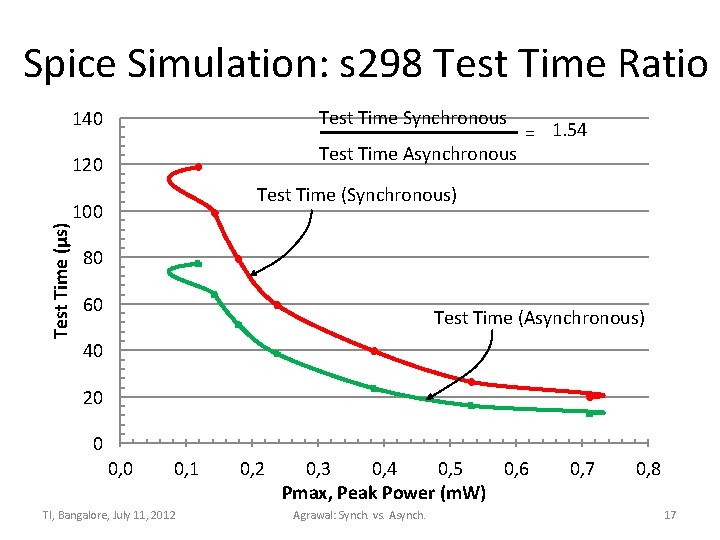
Spice Simulation: s 298 Test Time Ratio Test Time Synchronous 140 Test Time Asynchronous Test Time (µs) 120 = 1. 54 Test Time (Synchronous) 100 80 60 Test Time (Asynchronous) 40 20 0 0, 1 TI, Bangalore, July 11, 2012 0, 3 0, 4 0, 5 0, 6 Pmax, Peak Power (m. W) Agrawal: Synch. vs. Asynch. 0, 7 0, 8 17
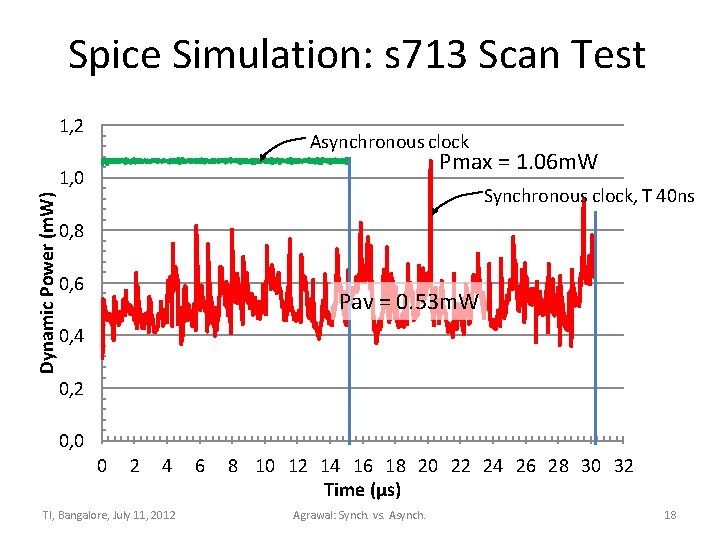
Spice Simulation: s 713 Scan Test 1, 2 Asynchronous clock Pmax = 1. 06 m. W Dynamic Power (m. W) 1, 0 Synchronous clock, T 40 ns 0, 8 0, 6 Pav = 0. 53 m. W 0, 4 0, 2 0, 0 0 2 4 TI, Bangalore, July 11, 2012 6 8 10 12 14 16 18 20 22 24 26 28 30 32 Time (µs) Agrawal: Synch. vs. Asynch. 18
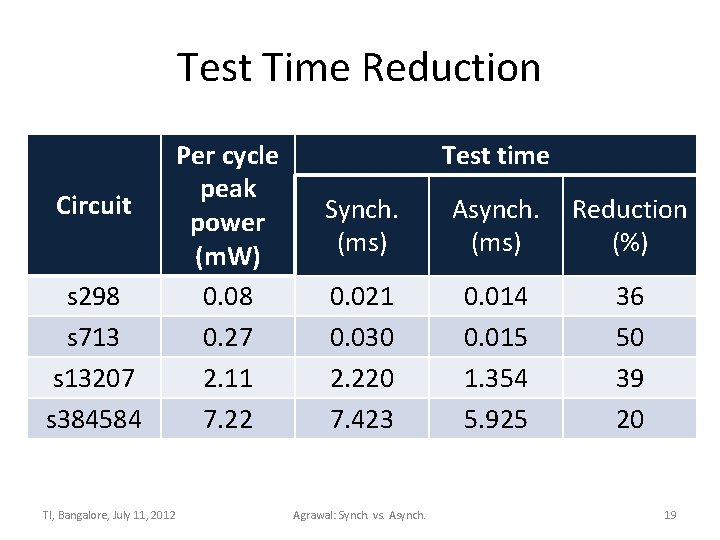
Test Time Reduction Circuit s 298 s 713 s 13207 s 384584 TI, Bangalore, July 11, 2012 Per cycle peak power (m. W) 0. 08 0. 27 2. 11 7. 22 Test time Synch. (ms) Asynch. (ms) Reduction (%) 0. 021 0. 030 2. 220 7. 423 0. 014 0. 015 1. 354 5. 925 36 50 39 20 Agrawal: Synch. vs. Asynch. 19
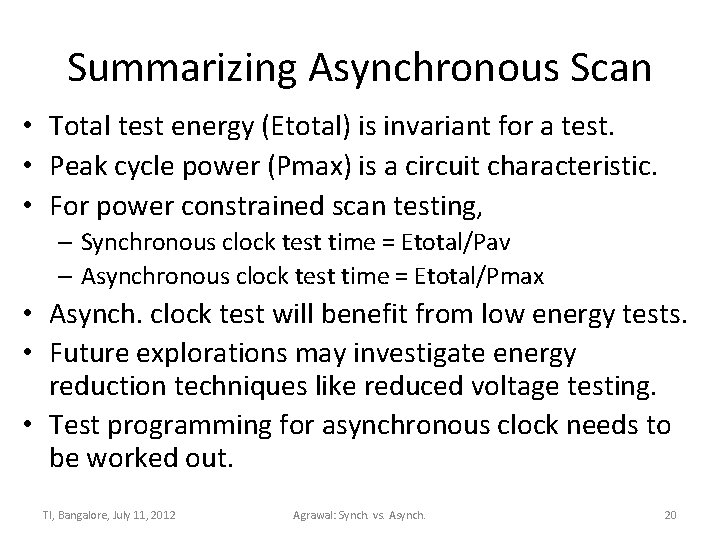
Summarizing Asynchronous Scan • Total test energy (Etotal) is invariant for a test. • Peak cycle power (Pmax) is a circuit characteristic. • For power constrained scan testing, – Synchronous clock test time = Etotal/Pav – Asynchronous clock test time = Etotal/Pmax • Asynch. clock test will benefit from low energy tests. • Future explorations may investigate energy reduction techniques like reduced voltage testing. • Test programming for asynchronous clock needs to be worked out. TI, Bangalore, July 11, 2012 Agrawal: Synch. vs. Asynch. 20
References • V. D. Agrawal, “Pre-Computed Asynchronous Scan (Invited Talk), ” 13 th IEEE Latin American Test Workshop, Quito, Ecuador, April 2012. • P. Venkataramani and V. D. Agrawal, “Test Time Reduction in ATE Using Asynchronous Clocking, ” Sixth IEEE International Workshop on Design for Manufacturability and Yield (DFM&Y), San Francisco, CA, June 4, 2012. • P. Venkataramani and V. D. Agrawal, “Reducing ATE Time of Power Constrained Test by Asynchronous Clocking, ” submitted to International Test Conf. Poster Session, Anaheim, CA, Nov. 6 -8, 2012. • P. Venkataramani and V. D. Agrawal, “Reducing Test Time of Power Constrained Test by Optimal Selection of Supply Voltage, ” submitted to 26 th International Conf. VLSI Design, Pune, Jan. 5 -10, 2013. TI, Bangalore, July 11, 2012 Agrawal: Synch. vs. Asynch. 21