
SYNCHRONOUS MACHINE By Nafees Ahamad Asstt Prof EECE
SYNCHRONOUS MACHINE By: Nafees Ahamad, Asstt. Prof. , EECE Deptt, DIT University, Dehradun © NAFEES AHAMAD
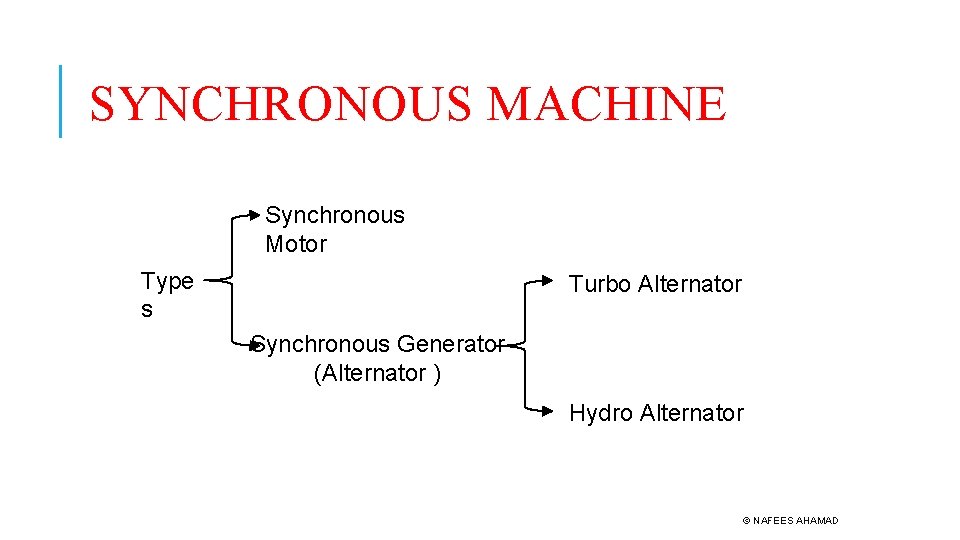
SYNCHRONOUS MACHINE Synchronous Motor Type s Turbo Alternator Synchronous Generator (Alternator ) Hydro Alternator © NAFEES AHAMAD
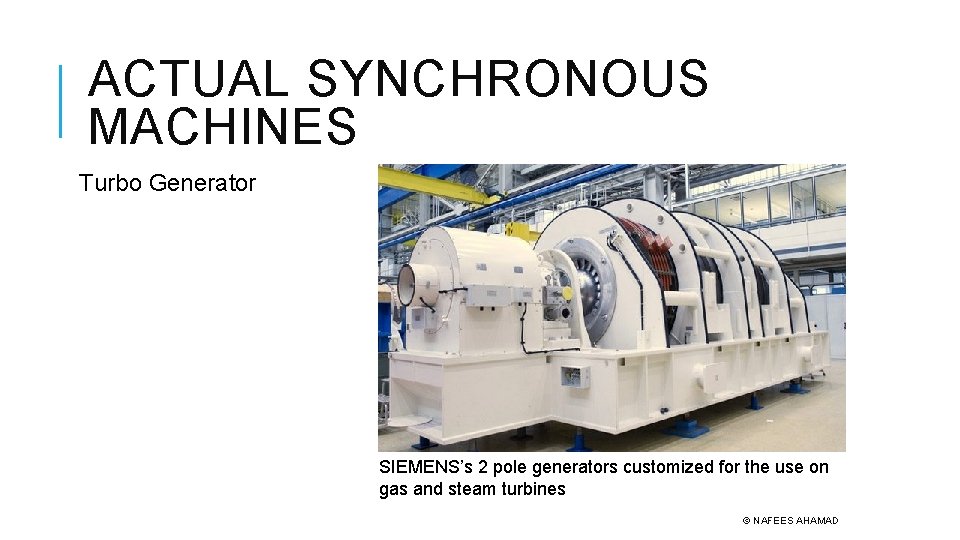
ACTUAL SYNCHRONOUS MACHINES Turbo Generator SIEMENS’s 2 pole generators customized for the use on gas and steam turbines © NAFEES AHAMAD
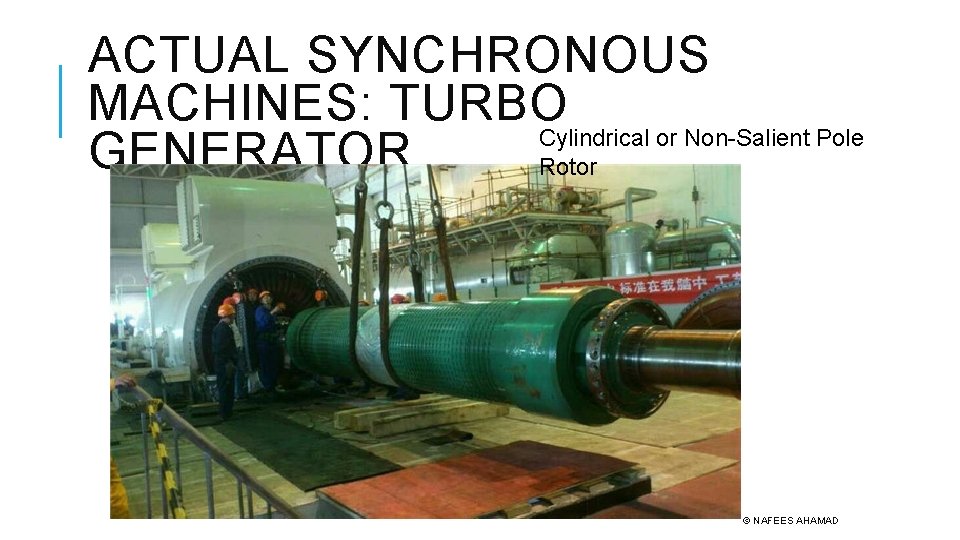
ACTUAL SYNCHRONOUS MACHINES: TURBO Cylindrical or Non-Salient Pole GENERATOR Rotor © NAFEES AHAMAD
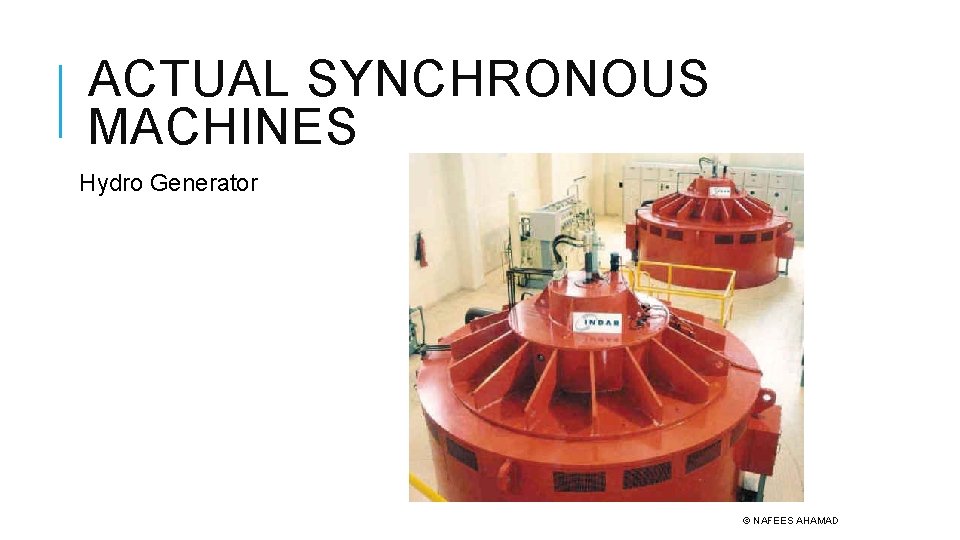
ACTUAL SYNCHRONOUS MACHINES Hydro Generator © NAFEES AHAMAD
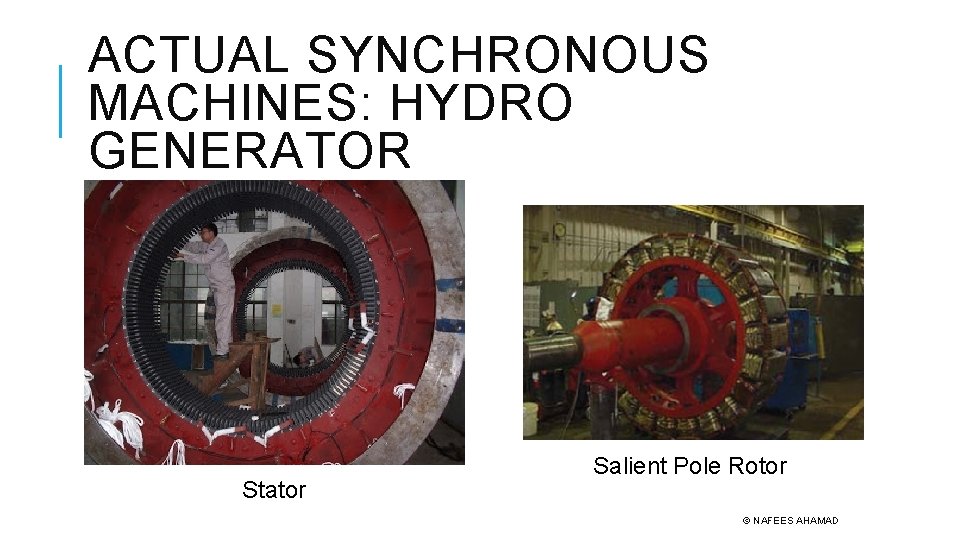
ACTUAL SYNCHRONOUS MACHINES: HYDRO GENERATOR Stator Salient Pole Rotor © NAFEES AHAMAD
CONSTRUCTION OF SYNCHRONOUS MACHINES: 1. Stator: • The stator is similar in construction that of a induction motor. • It is made up of laminated sheet steel having slot on its inner periphery. • Three phase winding is placed in the slot on stator and it serves as armature winding. © NAFEES AHAMAD
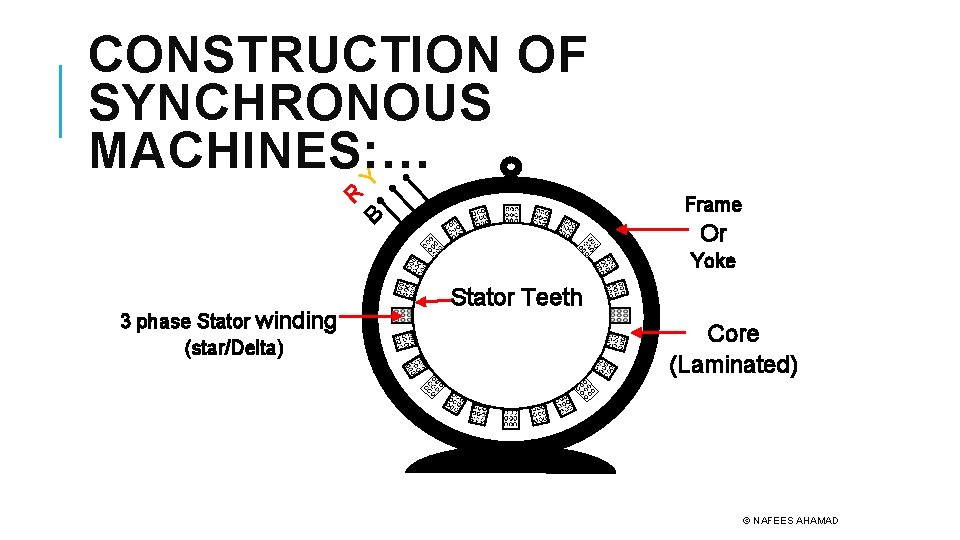
CONSTRUCTION OF SYNCHRONOUS MACHINES: … Y R Frame B Or Yoke 3 phase Stator winding (star/Delta) Stator Teeth Core (Laminated) © NAFEES AHAMAD
CONSTRUCTION OF SYNCHRONOUS MACHINES: … 2. Rotor: Two types a. Salient pole type: for low speed b. Non-Salient (cylindrical rotor) pole type: for high speed © NAFEES AHAMAD
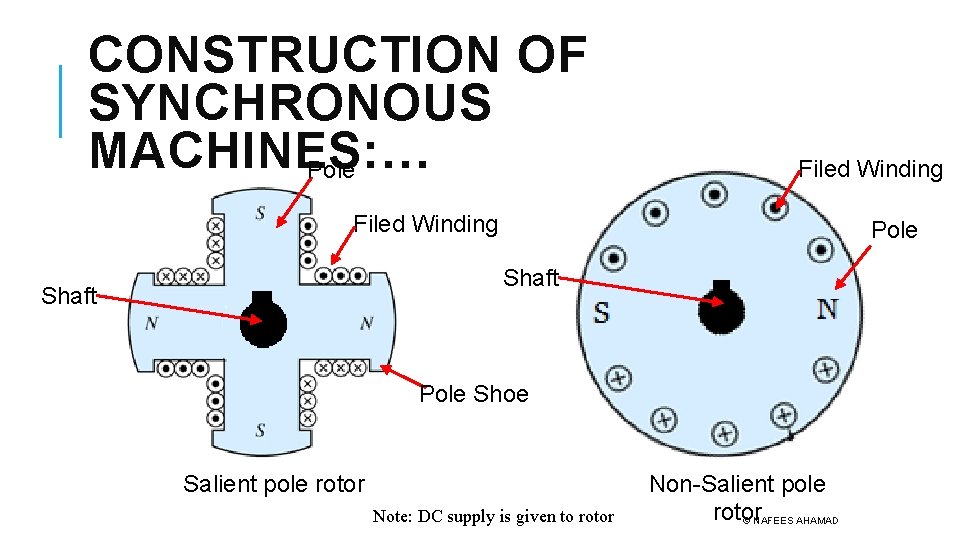
CONSTRUCTION OF SYNCHRONOUS MACHINES: … Pole Filed Winding Pole Shaft Pole Shoe Salient pole rotor Note: DC supply is given to rotor Non-Salient pole rotor © NAFEES AHAMAD
CONSTRUCTION OF SYNCHRONOUS MACHINES: … 3. 4. 5. 6. Slip rings: Two slip ring at rotor shaft to provide supply to field winding. Brushed: Two brushes. Shaft: Mild steel shaft with maximum breaking strength. Bearings: Ball bearing or roller bearing. © NAFEES AHAMAD
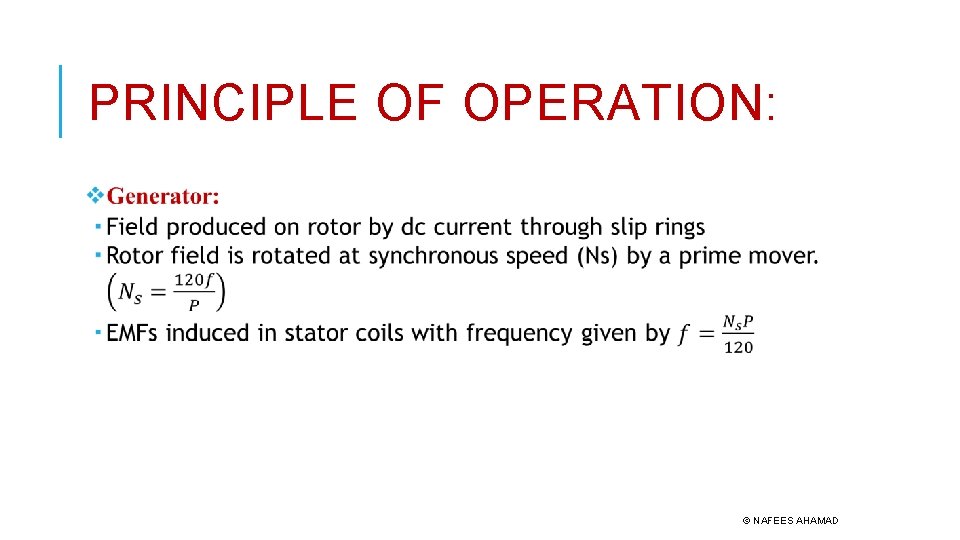
PRINCIPLE OF OPERATION: © NAFEES AHAMAD
PRINCIPLE OF OPERATION: v. Motor: The stator is wound for the similar number of poles as that of rotor, and fed with three phase AC supply. The 3 phase AC supply produces rotating magnetic field (RMF) in stator. The rotor winding is fed with DC supply which magnetizes the rotor. The rotor gets locked to the RMF and rotates (unlike induction motor) at synchronous speed under all load condition © NAFEES AHAMAD
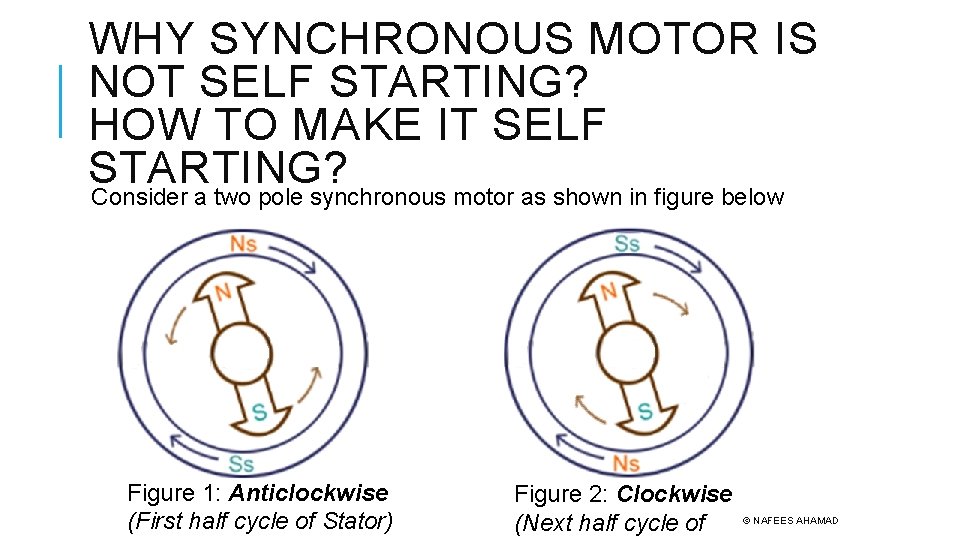
WHY SYNCHRONOUS MOTOR IS NOT SELF STARTING? HOW TO MAKE IT SELF STARTING? Consider a two pole synchronous motor as shown in figure below Figure 1: Anticlockwise (First half cycle of Stator) Figure 2: Clockwise (Next half cycle of © NAFEES AHAMAD
WHY SYNCHRONOUS MOTOR IS NOT SELF STARTING? . . . §Now, the stator poles are revolving with synchronous speed (lets say clockwise). If the rotor position is such that, N pole of the rotor is near the N pole of the stator (as shown in above figure 1), then the poles of the stator and rotor will repel each other, and the torque produced will be anticlockwise. §The stator poles are rotating with synchronous speed, and they rotate around very fast and interchange their position. But at this very soon, rotor can not rotate with the same angle (due to inertia), and the next position will be likely the second schematic in above figure 2. In this case, poles of the stator will attract the poles of rotor, and the torque produced will be clockwise. §Hence, the rotor will undergo to a rapidly reversing torque, and the motor will not start. © NAFEES AHAMAD
HOW TO MAKE IT SELF STARTING? §But, if the rotor is rotated up to the synchronous speed of the stator by means of an external force (in the direction of revolving field of the stator), and the rotor field is excited near the synchronous speed, the poles of stator will keep attracting the opposite poles of the rotor (See Figure 3 on next slide). Now, the rotor will undergo unidirectional torque. The opposite poles of the stator and rotor will get locked with each other, and the rotor will rotate at the synchronous speed. §A synchronous motor can be made self starting by using DC motor: Damper winding: © NAFEES AHAMAD
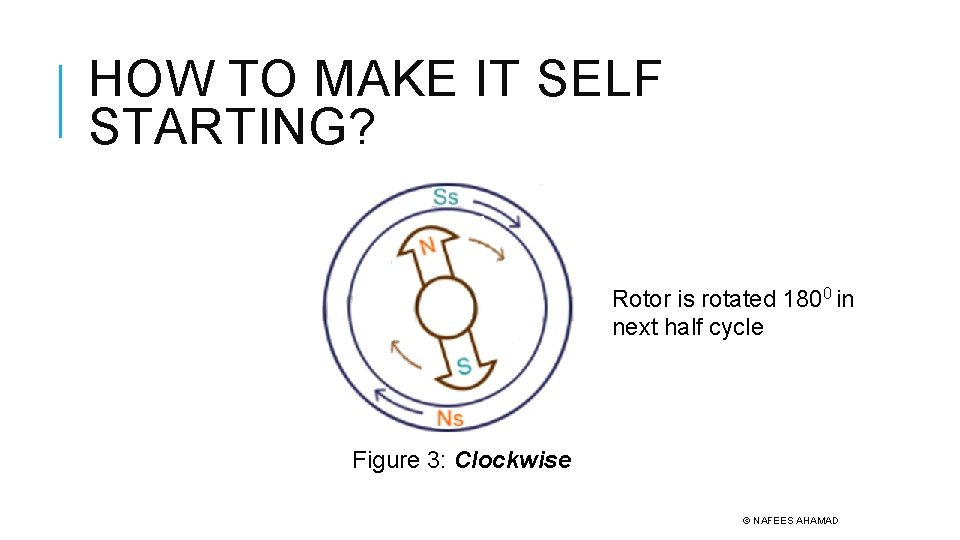
HOW TO MAKE IT SELF STARTING? Rotor is rotated 1800 in next half cycle Figure 3: Clockwise © NAFEES AHAMAD

THANKS © NAFEES AHAMAD
- Slides: 18