
Synchronous Generator Capability Curve EE 341 Energy Conversion
Synchronous Generator Capability Curve EE 341 Energy Conversion Ali Keyhani Synchronous Machines lecture #4 1
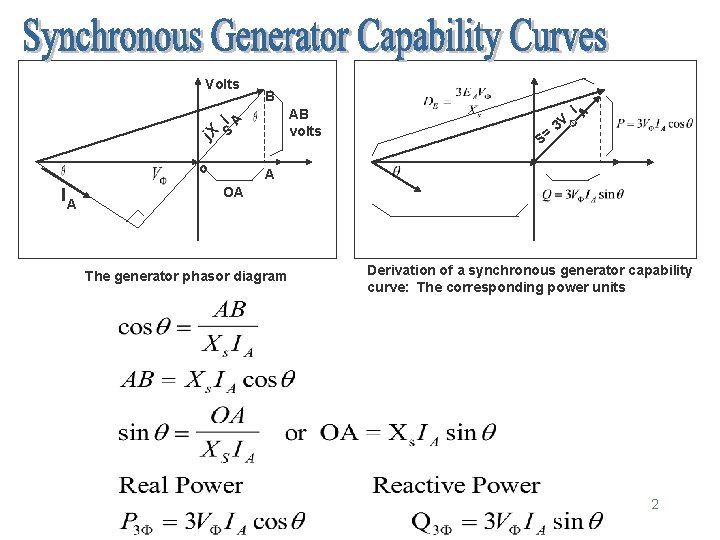
B AB volts A I j. X S o IA S= 3 V I A Volts A OA The generator phasor diagram Derivation of a synchronous generator capability curve: The corresponding power units 2
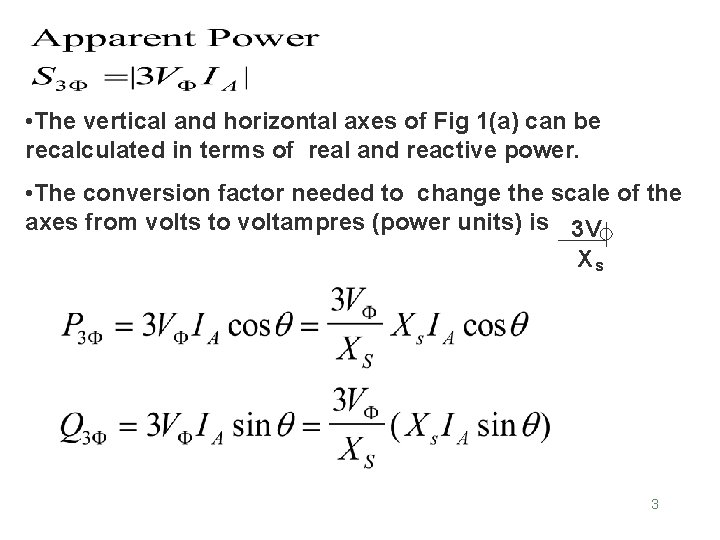
• The vertical and horizontal axes of Fig 1(a) can be recalculated in terms of real and reactive power. • The conversion factor needed to change the scale of the axes from volts to voltampres (power units) is 3 V Xs 3
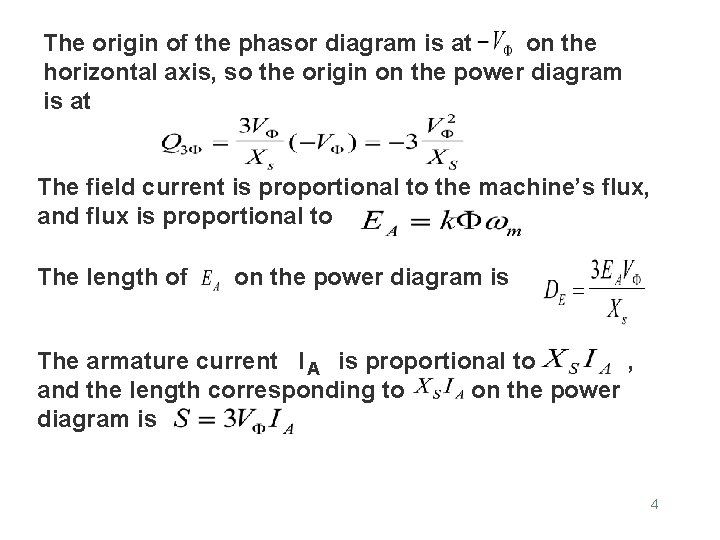
The origin of the phasor diagram is at on the horizontal axis, so the origin on the power diagram is at The field current is proportional to the machine’s flux, and flux is proportional to The length of on the power diagram is The armature current I A is proportional to , and the length corresponding to on the power diagram is 4
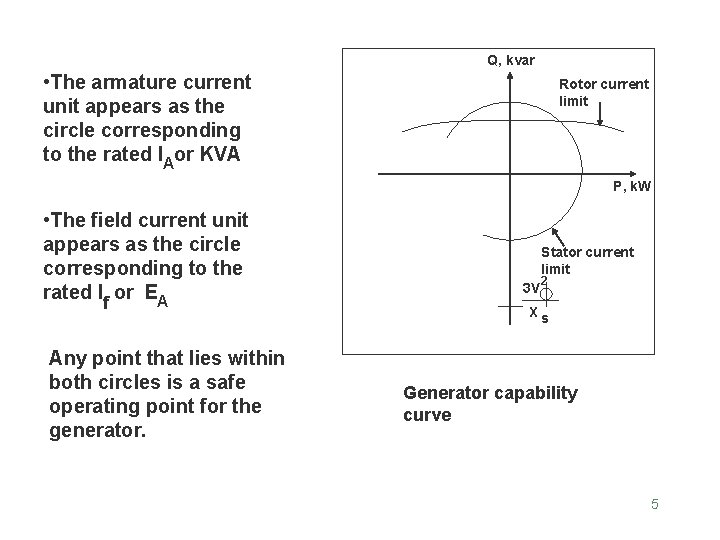
Q, kvar • The armature current unit appears as the circle corresponding to the rated IAor KVA Rotor current limit P, k. W • The field current unit appears as the circle corresponding to the rated I or EA f Any point that lies within both circles is a safe operating point for the generator. Stator current limit 3 V 2 Xs Generator capability curve 5
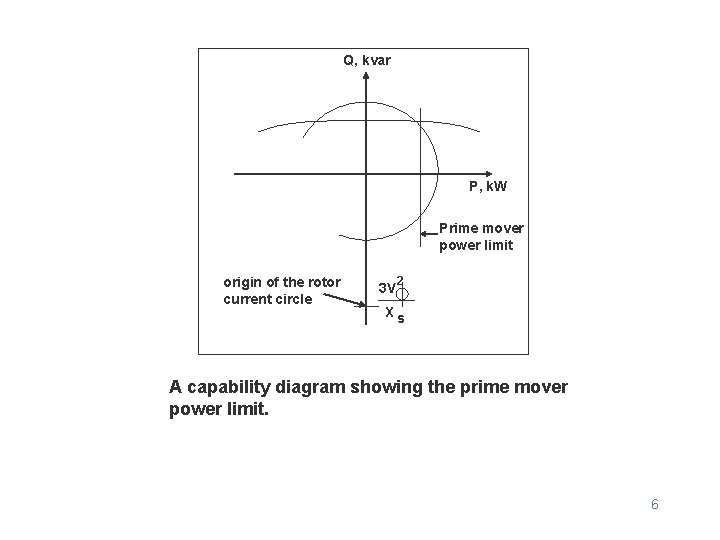
Q, kvar P, k. W Prime mover power limit origin of the rotor current circle 3 V 2 Xs A capability diagram showing the prime mover power limit. 6

Example A 480 V, 50 Hz Y-connected six pole synchronous generator is rated at 50 k. VA at 0. 8 PF lagging. It has a synchronous reactance of 1. 0 ohm per phase. Assume that this generator is connected to a steam turbine capable of supplying up to 45 k. W. The friction and windage losses are 1. 5 k. W, and the core losses are 1. 0 k. W. (a) Sketch the capability curve for this generator, including the prime mover limit. (b) Can this generator supply a line current of 56 A at 0. 7 lagging? Why or why not? (c) What is the maximum amount of reactive power this generator can produce? (d) If the generator supplies 30 k. W of real power, what is the maximum amount of reactive power that can be 7 simultaneously supplied?

The maximum current in this generator is given by: With this information, it is now possible to answer the questions. 8
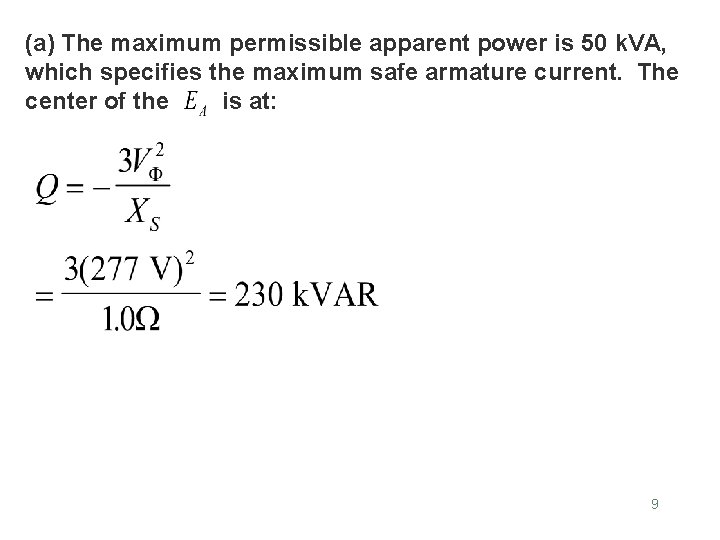
(a) The maximum permissible apparent power is 50 k. VA, which specifies the maximum safe armature current. The center of the is at: 9
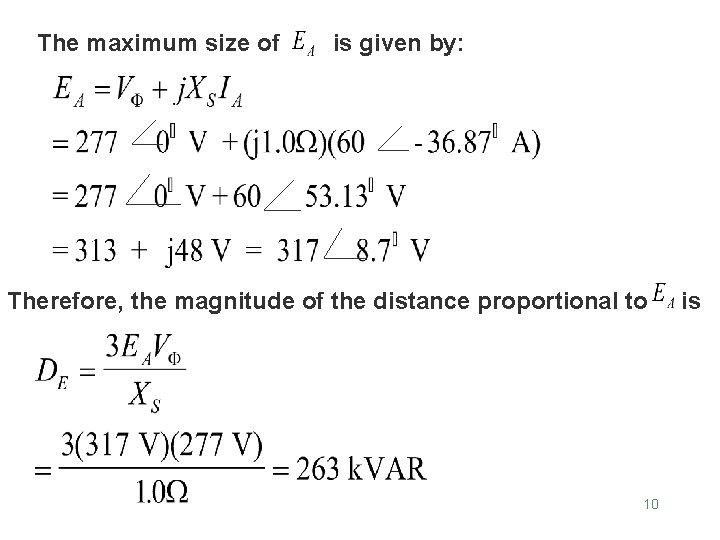
The maximum size of is given by: Therefore, the magnitude of the distance proportional to 10 is
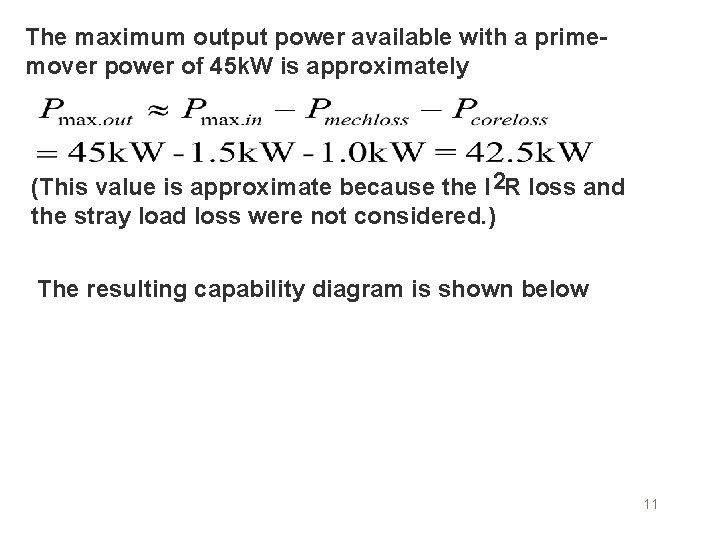
The maximum output power available with a primemover power of 45 k. W is approximately (This value is approximate because the I 2 R loss and the stray load loss were not considered. ) The resulting capability diagram is shown below 11
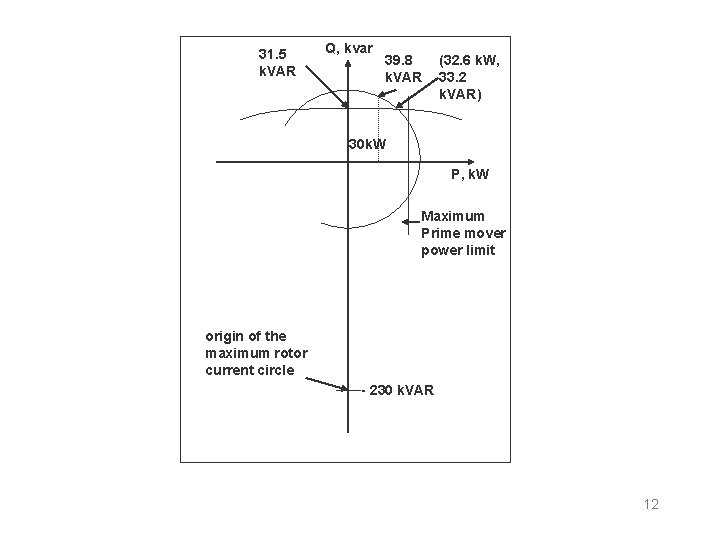
31. 5 k. VAR Q, kvar 39. 8 k. VAR (32. 6 k. W, 33. 2 k. VAR) 30 k. W P, k. W Maximum Prime mover power limit origin of the maximum rotor current circle - 230 k. VAR 12
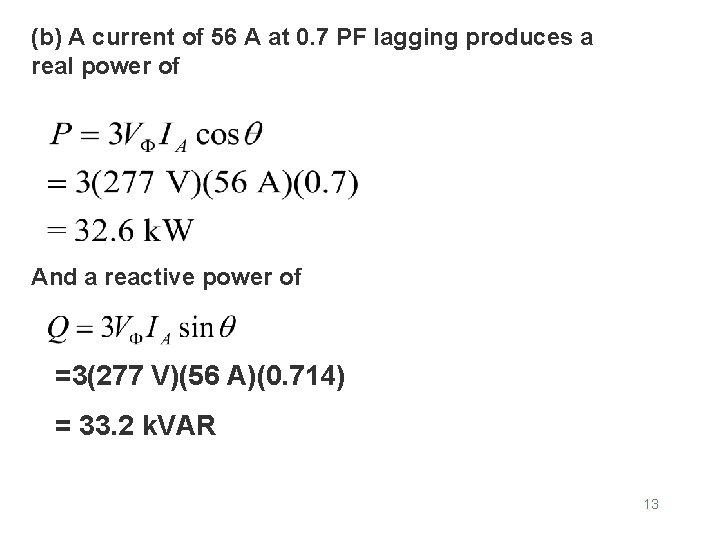
(b) A current of 56 A at 0. 7 PF lagging produces a real power of And a reactive power of =3(277 V)(56 A)(0. 714) = 33. 2 k. VAR 13
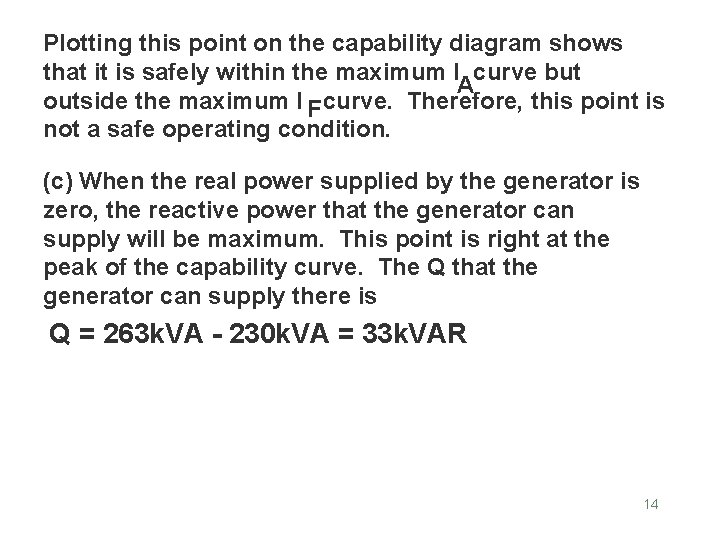
Plotting this point on the capability diagram shows that it is safely within the maximum I curve but A outside the maximum I F curve. Therefore, this point is not a safe operating condition. (c) When the real power supplied by the generator is zero, the reactive power that the generator can supply will be maximum. This point is right at the peak of the capability curve. The Q that the generator can supply there is Q = 263 k. VA - 230 k. VA = 33 k. VAR 14
(d) If the generator is supplying 30 k. W of real power, the maximum reactive power that the generator can supply is 31. 5 k. VAR. This value can be found by entering the capability diagram at 30 k. W and going up the constant kilowatt line until a limit is reached. The limiting factor in this case is the field current-the armature will be safe up to 39. 8 k. VAR 15
- Slides: 15