
SYNCHRONIZATION METHODS IN DIFFERENT ANIMAL SPECIES Main targets
- Slides: 18
SYNCHRONIZATION METHODS IN DIFFERENT ANIMAL SPECIES
• Main targets in animal breeding; Preserving and spreading high yield genotypes, Keeping fertility at the maximum level, Obtaining more offspring per animal, Acquiring better quality offspring.
In order to control breeding; Mating-artificial inseminations can be planned and grouped as required. Ovarian activities may be stimulated during the anestrus phase in seasonal polyestric animals and pregnancy may be obtained. Number and chances of ovulation may be increased resulting in increased twinning rates or superfolliculation may be obtained. Young animal may be tested to reach puberty and give birth earlier.
Sexual synchronization The planning of estrus and ovulation to fit a required time is called sexual synchronization. The advantages can be listed as; � � � � Estrusses are collected in a short period of time, To be able to do the inseminations and matings in a planned period, To ease artificial insemination and embryo transfer, To remove the problem of tracing the non-pregnant animals after the first insemination, To obtain more offspring in one year, To ease the vaccination, antiparatsitic drug administration and feed changing processes, To gather the parturitions in a specific time period, reduce the offspring loss, present uniform offsprings to the market, Using the shelter, workforce and materials in a more efficient way.
Syncronization Practices Large Ruminants
Estrus and Ovulation Control Planned artificial insemination methods (PAI): Increases heat detection rate and decreases time spent, Enables control of the most appropriate time for insemination, Reduces the calving interval, Allows post partum anestrus shortening and stimulation of estruses, Enables reproductive planning and management, Gathers insemination and parturition periods, Allows heifers to be synchronized and inseminated all together with bull semen which have «easy parturition» properties, Aids artificial insemination practices in large enterprises, Increases pregnancy rates, Enables detection and treatment of reproductive problems, Allows cynchronization of donor and recipients for embryo transfer.
The estrus cycle of a cow with active ovaries can be checked in 3 ways: 1. The early regression of active corpus luteum in the ovaries with prostaglandins and initiation of a new cycle. 2. Regression of corpus luteum with the sequenced use of prostaglandin and Gn. RH analogs and causing synchronized follicular development. 3. Forming an artificial corpus luteum effect with the use of progesterons.
Synchronizations done with Prostoglandins
Prostaglandine administration with ovarium control and artificial insemination: • is the program in which a corpus luteum which is active and will respond is determined with rectal palpation. • In this way, the cow whos ovaries are ready for prostaglandin effect will be determined with examinations done weekly or every other week.
Prostaglandin administration with ovary control and artificial insemination This program helps determine the first insemination period after parturition. Cows with active corpus luteum Show heat signs 2 to 5 days after prostaglandin injection. Different responses are recieved in different times of estrus and estrus observation may be 48 to 72 hours after the injection. This program is continued with ovary control once a week or two weeks until pregnancy is achieved or for 3 inseminations.
Prostaglandin administration without ovary control and artificial insemination • The cost of cycle loss and delay in pregnancy caused by missing/overlooking the cows with corpus luteum on ovaries, • is a lot more than the cost of wrong prostaglandin injection to cows without corpus luteum. • This is the reason this program was planned.
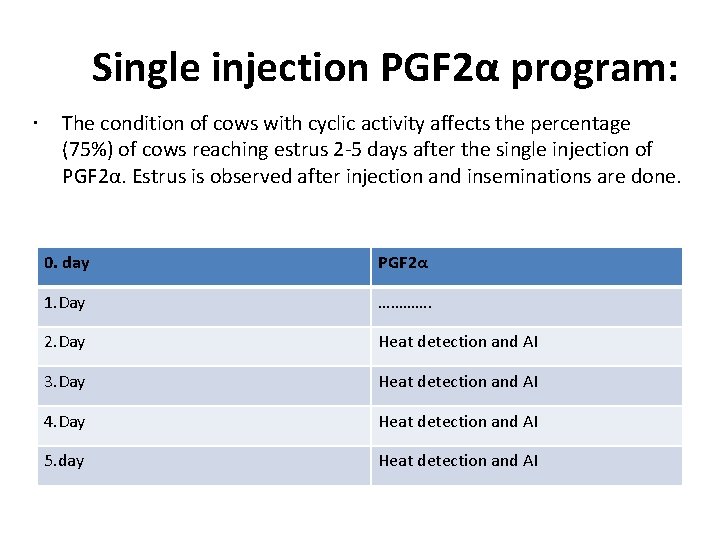
Single injection PGF 2α program: The condition of cows with cyclic activity affects the percentage (75%) of cows reaching estrus 2 -5 days after the single injection of PGF 2α. Estrus is observed after injection and inseminations are done. 0. day PGF 2α 1. Day …………. 2. Day Heat detection and AI 3. Day Heat detection and AI 4. Day Heat detection and AI 5. day Heat detection and AI
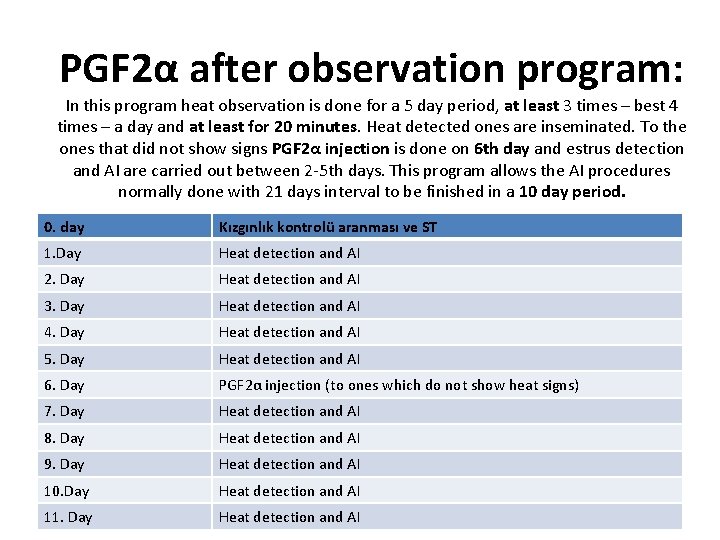
PGF 2α after observation program: In this program heat observation is done for a 5 day period, at least 3 times – best 4 times – a day and at least for 20 minutes. Heat detected ones are inseminated. To the ones that did not show signs PGF 2α injection is done on 6 th day and estrus detection and AI are carried out between 2 -5 th days. This program allows the AI procedures normally done with 21 days interval to be finished in a 10 day period. 0. day Kızgınlık kontrolü aranması ve ST 1. Day Heat detection and AI 2. Day Heat detection and AI 3. Day Heat detection and AI 4. Day Heat detection and AI 5. Day Heat detection and AI 6. Day PGF 2α injection (to ones which do not show heat signs) 7. Day Heat detection and AI 8. Day Heat detection and AI 9. Day Heat detection and AI 10. Day Heat detection and AI 11. Day Heat detection and AI
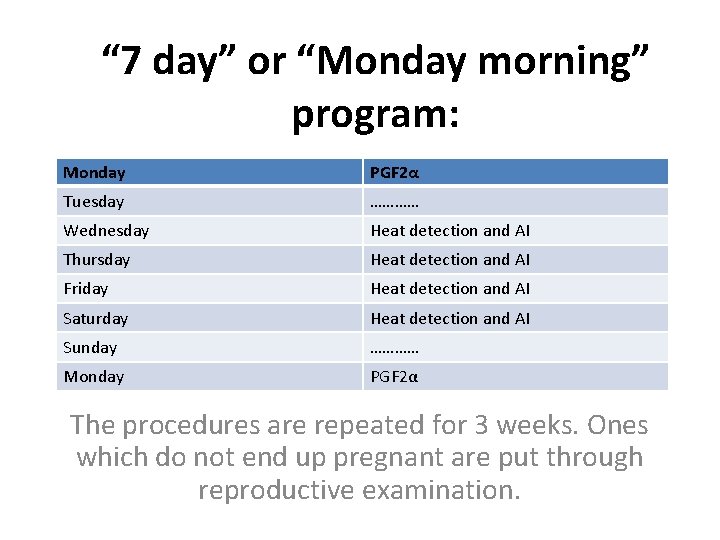
“ 7 day” or “Monday morning” program: Monday PGF 2α Tuesday ………… Wednesday Heat detection and AI Thursday Heat detection and AI Friday Heat detection and AI Saturday Heat detection and AI Sunday ………… Monday PGF 2α The procedures are repeated for 3 weeks. Ones which do not end up pregnant are put through reproductive examination.
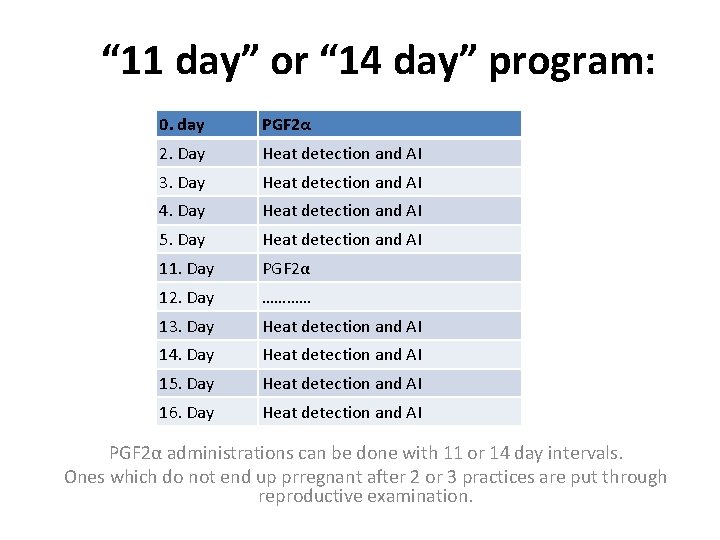
“ 11 day” or “ 14 day” program: 0. day PGF 2α 2. Day Heat detection and AI 3. Day Heat detection and AI 4. Day Heat detection and AI 5. Day Heat detection and AI 11. Day PGF 2α 12. Day ………… 13. Day Heat detection and AI 14. Day Heat detection and AI 15. Day Heat detection and AI 16. Day Heat detection and AI PGF 2α administrations can be done with 11 or 14 day intervals. Ones which do not end up prregnant after 2 or 3 practices are put through reproductive examination.
Gn. RH+prostaglandin based protocols Depending on the developing follicular structure after PGF 2α injection and the phase of the follicle estrus signs are spread over a 2 -5 day period. The shortening of this time will be advantageous in terms of the success of artificial insemination practices. In this respect, the «estrus control protocols» formed by PGF 2α used with Gn. RH are used.
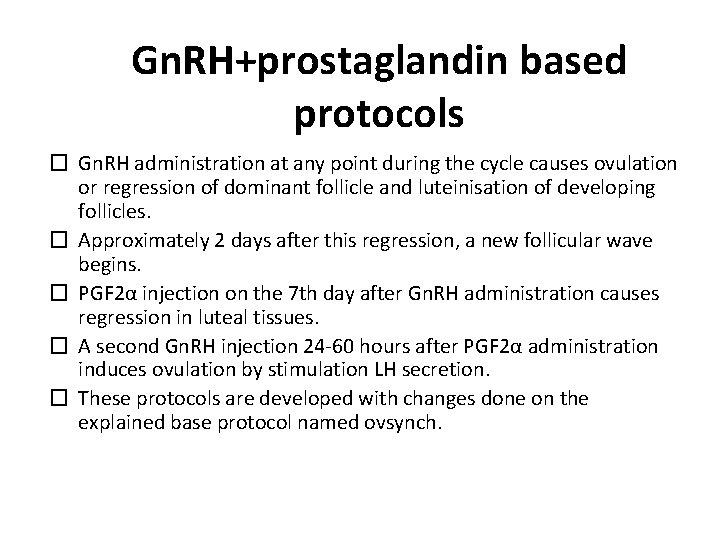
Gn. RH+prostaglandin based protocols � Gn. RH administration at any point during the cycle causes ovulation or regression of dominant follicle and luteinisation of developing follicles. � Approximately 2 days after this regression, a new follicular wave begins. � PGF 2α injection on the 7 th day after Gn. RH administration causes regression in luteal tissues. � A second Gn. RH injection 24 -60 hours after PGF 2α administration induces ovulation by stimulation LH secretion. � These protocols are developed with changes done on the explained base protocol named ovsynch.
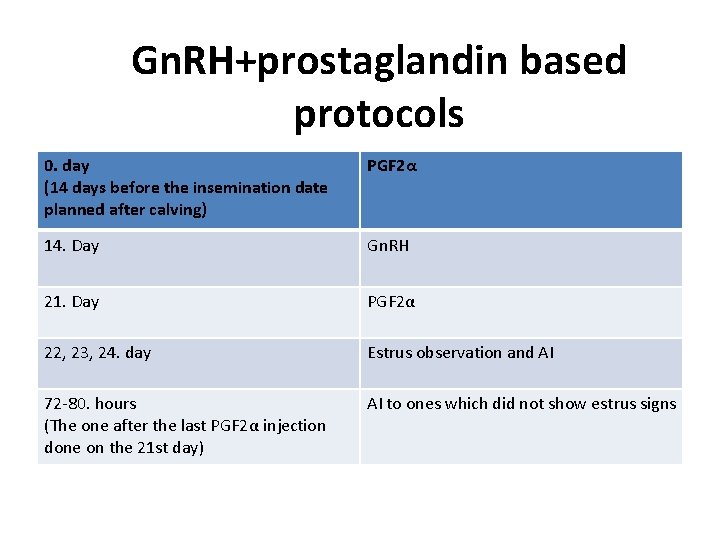
Gn. RH+prostaglandin based protocols 0. day (14 days before the insemination date planned after calving) PGF 2α 14. Day Gn. RH 21. Day PGF 2α 22, 23, 24. day Estrus observation and AI 72 -80. hours (The one after the last PGF 2α injection done on the 21 st day) AI to ones which did not show estrus signs