
Synchronization 2 CS 3410 Spring 2014 Computer Science


![Attempt#1: Producer/Consumer // invariant: // data is in A[h … t-1] char A[100]; int](https://slidetodoc.com/presentation_image_h2/a1299e01383cbda7081ae648906958dc/image-45.jpg "Attempt#1: Producer/Consumer // invariant: // data is in A[h … t-1] char A[100]; int")
- Slides: 53
Synchronization 2 CS 3410, Spring 2014 Computer Science Cornell University See P&H Chapter: 2. 11, 6. 4
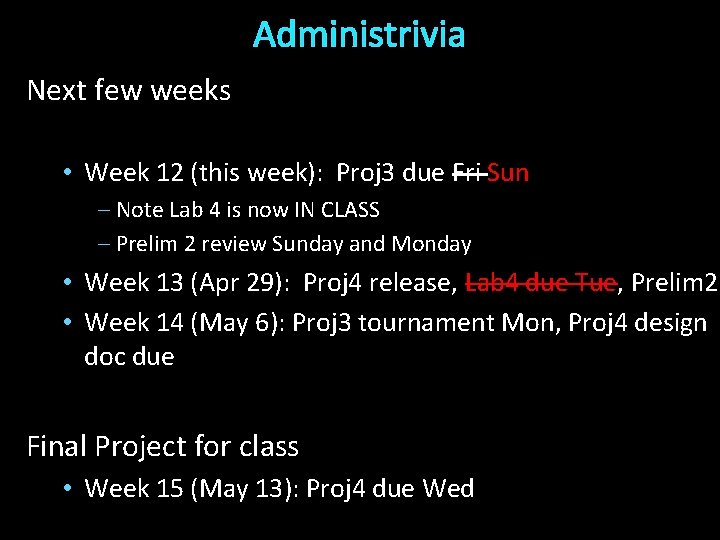
Administrivia Next few weeks • Week 12 (this week): Proj 3 due Fri Sun – Note Lab 4 is now IN CLASS – Prelim 2 review Sunday and Monday • Week 13 (Apr 29): Proj 4 release, Lab 4 due Tue, Prelim 2 • Week 14 (May 6): Proj 3 tournament Mon, Proj 4 design doc due Final Project for class • Week 15 (May 13): Proj 4 due Wed
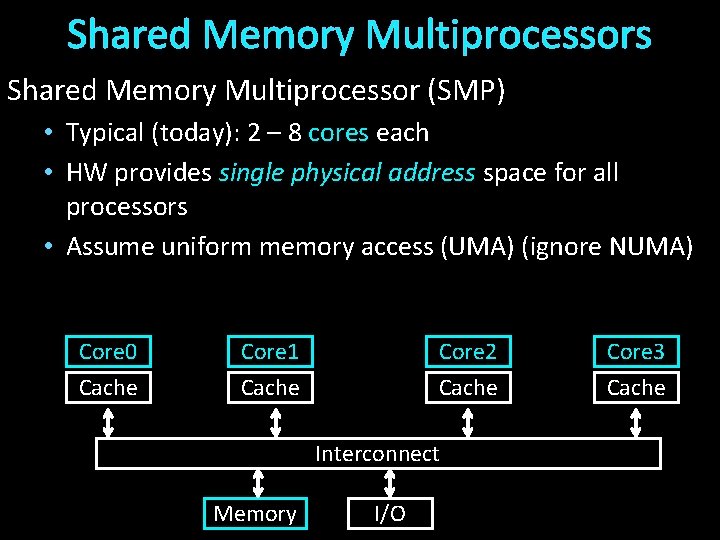
Shared Memory Multiprocessors Shared Memory Multiprocessor (SMP) • Typical (today): 2 – 8 cores each • HW provides single physical address space for all processors • Assume uniform memory access (UMA) (ignore NUMA) Core 0 Cache Core 1 Cache Core 2 Cache Interconnect Memory I/O Core 3 Cache
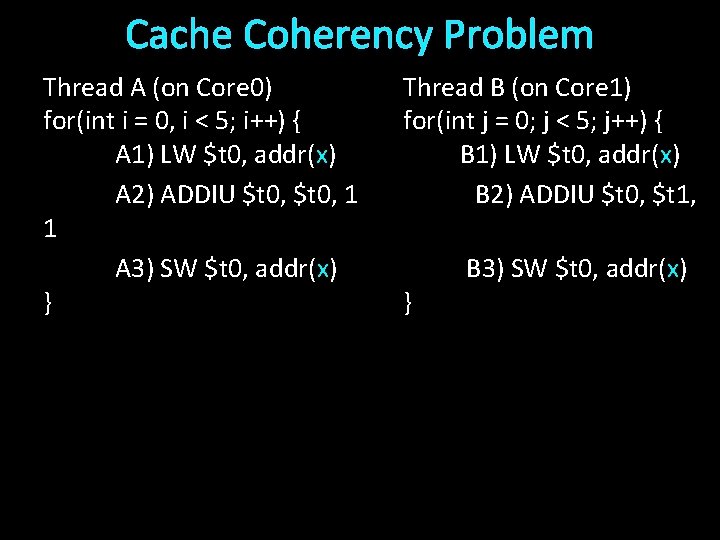
Cache Coherency Problem Thread A (on Core 0) for(int i = 0, i < 5; i++) { A 1) LW $t 0, addr(x) A 2) ADDIU $t 0, 1 1 A 3) SW $t 0, addr(x) } Thread B (on Core 1) for(int j = 0; j < 5; j++) { B 1) LW $t 0, addr(x) B 2) ADDIU $t 0, $t 1, } B 3) SW $t 0, addr(x)
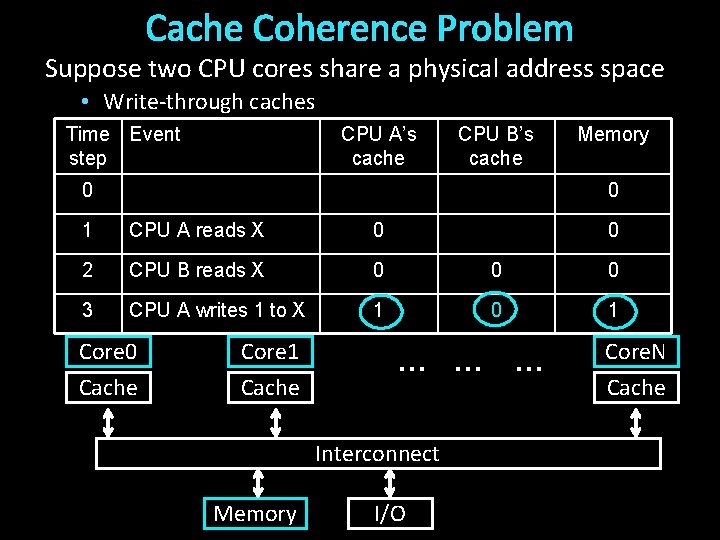
Cache Coherence Problem Suppose two CPU cores share a physical address space • Write-through caches Time Event step CPU A’s cache CPU B’s cache 0 Memory 0 1 CPU A reads X 0 2 CPU B reads X 0 0 0 3 CPU A writes 1 to X 1 0 1 Core 0 Cache Core 1 Cache 0 . . Interconnect Memory I/O Core. N Cache
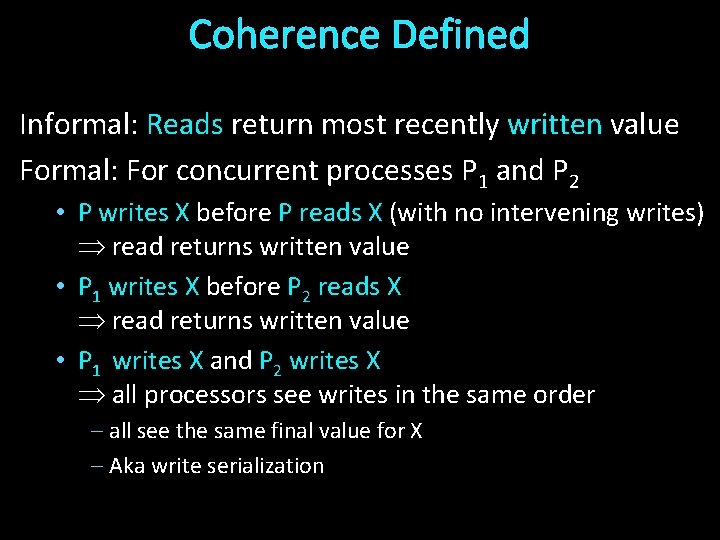
Coherence Defined Informal: Reads return most recently written value Formal: For concurrent processes P 1 and P 2 • P writes X before P reads X (with no intervening writes) read returns written value • P 1 writes X before P 2 reads X read returns written value • P 1 writes X and P 2 writes X all processors see writes in the same order – all see the same final value for X – Aka write serialization
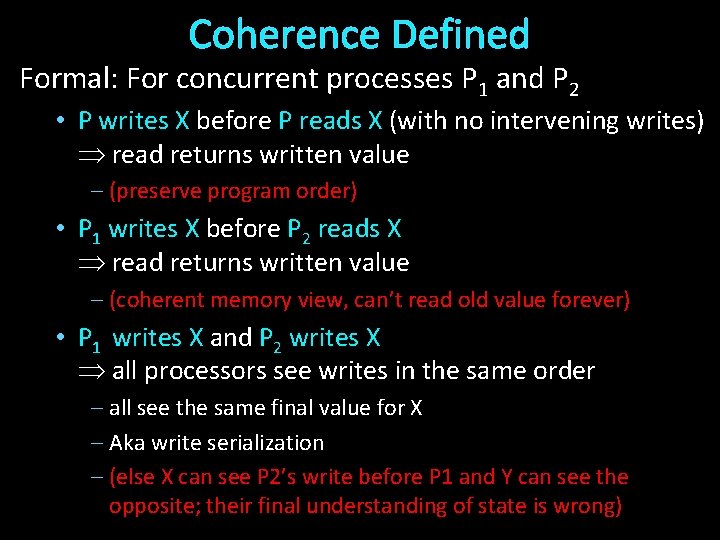
Coherence Defined Formal: For concurrent processes P 1 and P 2 • P writes X before P reads X (with no intervening writes) read returns written value – (preserve program order) • P 1 writes X before P 2 reads X read returns written value – (coherent memory view, can’t read old value forever) • P 1 writes X and P 2 writes X all processors see writes in the same order – all see the same final value for X – Aka write serialization – (else X can see P 2’s write before P 1 and Y can see the opposite; their final understanding of state is wrong)
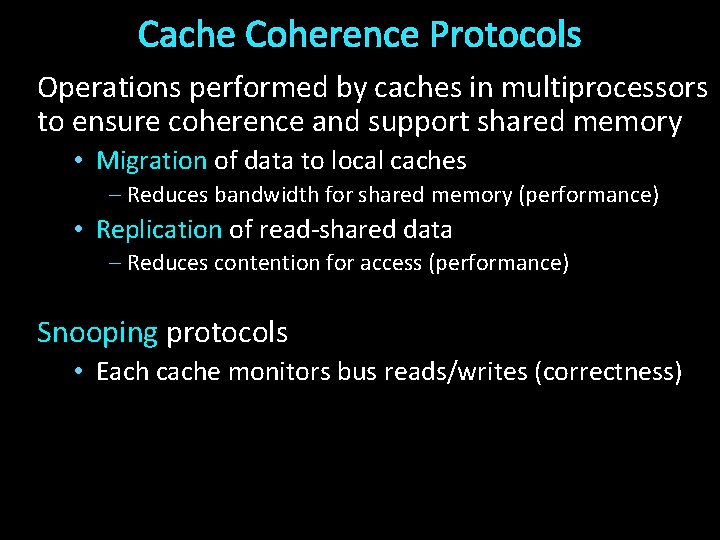
Cache Coherence Protocols Operations performed by caches in multiprocessors to ensure coherence and support shared memory • Migration of data to local caches – Reduces bandwidth for shared memory (performance) • Replication of read-shared data – Reduces contention for access (performance) Snooping protocols • Each cache monitors bus reads/writes (correctness)
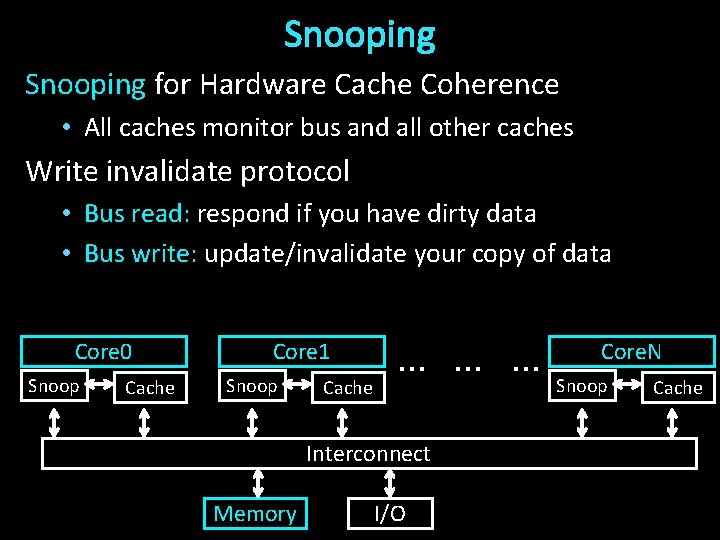
Snooping for Hardware Cache Coherence • All caches monitor bus and all other caches Write invalidate protocol • Bus read: respond if you have dirty data • Bus write: update/invalidate your copy of data Core 0 Snoop Cache Core 1 Snoop Cache . . Interconnect Memory I/O Core. N Snoop Cache
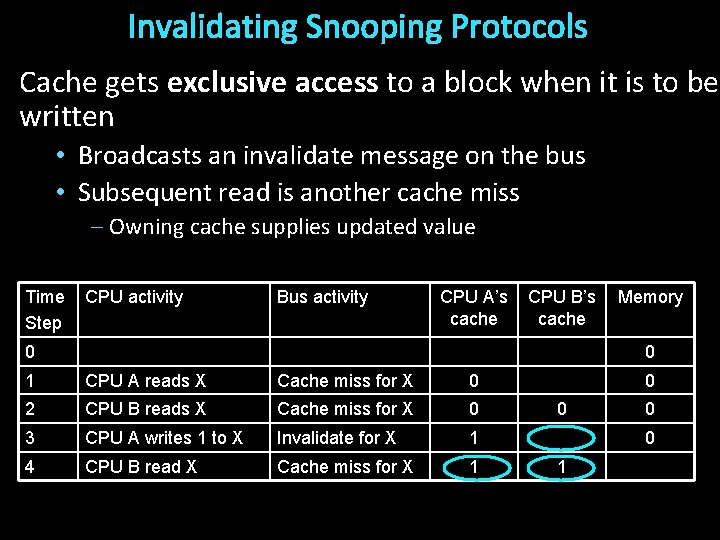
Invalidating Snooping Protocols Cache gets exclusive access to a block when it is to be written • Broadcasts an invalidate message on the bus • Subsequent read is another cache miss – Owning cache supplies updated value Time Step CPU activity Bus activity CPU A’s cache CPU B’s cache 0 Memory 0 1 CPU A reads X Cache miss for X 0 2 CPU B reads X Cache miss for X 0 3 CPU A writes 1 to X Invalidate for X 1 4 CPU B read X Cache miss for X 1 0 0 1
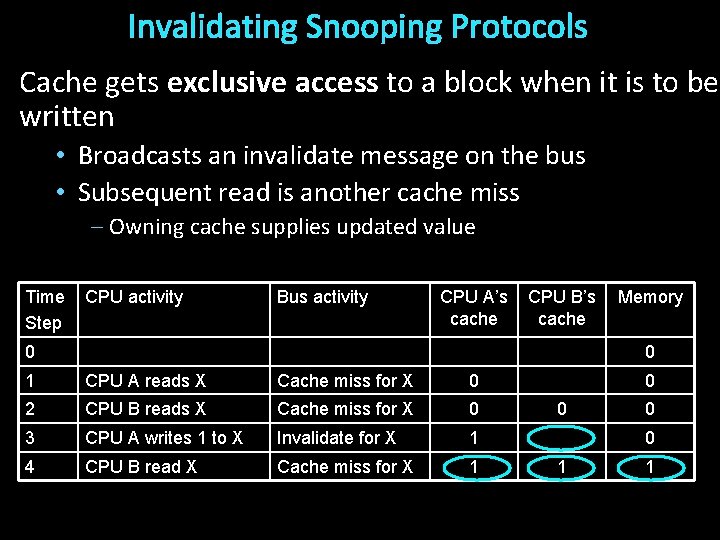
Invalidating Snooping Protocols Cache gets exclusive access to a block when it is to be written • Broadcasts an invalidate message on the bus • Subsequent read is another cache miss – Owning cache supplies updated value Time Step CPU activity Bus activity CPU A’s cache CPU B’s cache 0 Memory 0 1 CPU A reads X Cache miss for X 0 2 CPU B reads X Cache miss for X 0 3 CPU A writes 1 to X Invalidate for X 1 4 CPU B read X Cache miss for X 1 0 0 1 1
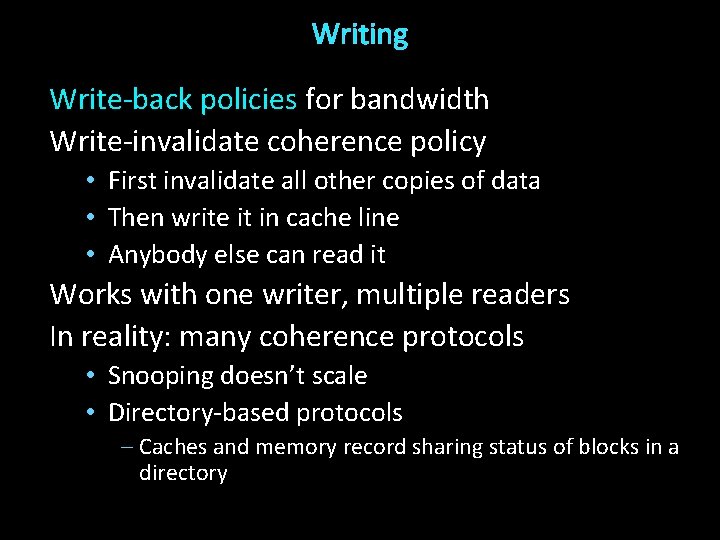
Writing Write-back policies for bandwidth Write-invalidate coherence policy • First invalidate all other copies of data • Then write it in cache line • Anybody else can read it Works with one writer, multiple readers In reality: many coherence protocols • Snooping doesn’t scale • Directory-based protocols – Caches and memory record sharing status of blocks in a directory
Summary of cache coherence Cache coherence requires that reads return most recently written value Cache coherence is hard Snooping protocols are one approach Complex: modified, owned, shared, etc. Cache coherence protocols alone are not enough Need more for consistency
Synchronization • Threads • Critical sections, race conditions, and mutexes • Atomic Instructions • • HW support for synchronization Using sync primitives to build concurrency-safe data structures • Example: thread-safe data structures • Language level synchronization • Threads and processes
Programming with Threads Need it to exploit multiple processing units …to parallelize for multicore …to write servers that handle many clients Problem: hard even for experienced programmers • Behavior can depend on subtle timing differences • Bugs may be impossible to reproduce Needed: synchronization of threads
Programming with threads Within a thread: execution is sequential Between threads? • No ordering or timing guarantees • Might even run on different cores at the same time Problem: hard to program, hard to reason about • Behavior can depend on subtle timing differences • Bugs may be impossible to reproduce Cache coherency isn’t sufficient… Need explicit synchronization to make sense of concurrency!
Programming with Threads Concurrency poses challenges for: Correctness • Threads accessing shared memory should not interfere with each other Liveness • Threads should not get stuck, should make forward progress Efficiency • Program should make good use of available computing resources (e. g. , processors). Fairness • Resources apportioned fairly between threads
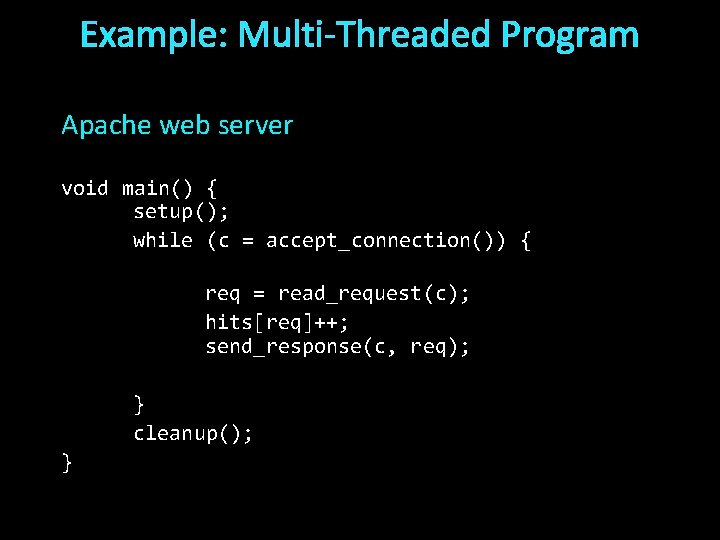
Example: Multi-Threaded Program Apache web server void main() { setup(); while (c = accept_connection()) { req = read_request(c); hits[req]++; send_response(c, req); } cleanup(); }
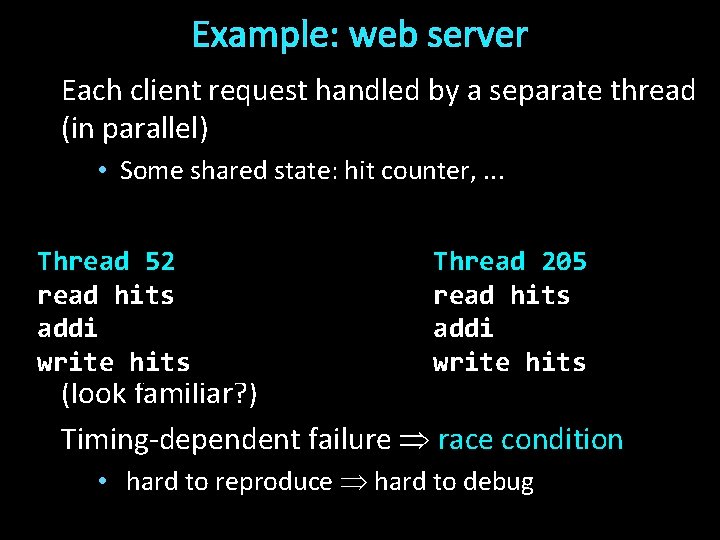
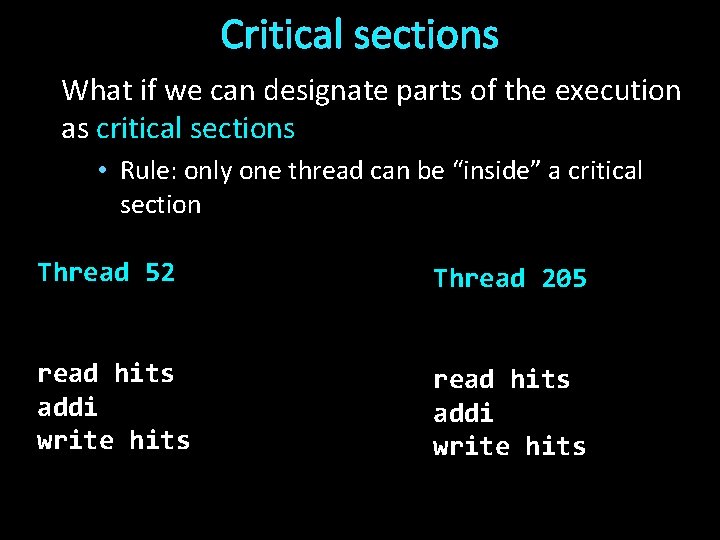
Example: web server Each client request handled by a separate thread (in parallel) • Some shared state: hit counter, . . . Thread 52. . . read hits addi = hits + 1; . . . write hits Thread 205. . . read hits addi = hits + 1; . . . write hits (look familiar? ) Timing-dependent failure race condition • hard to reproduce hard to debug
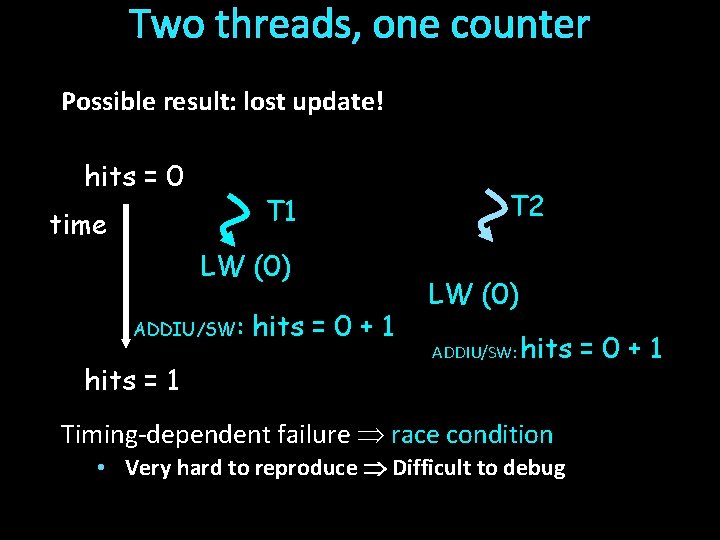
Two threads, one counter Possible result: lost update! hits = 0 T 1 time LW (0) ADDIU/SW: hits = 1 hits = 0 + 1 T 2 LW (0) ADDIU/SW: hits Timing-dependent failure race condition • Very hard to reproduce Difficult to debug =0+1
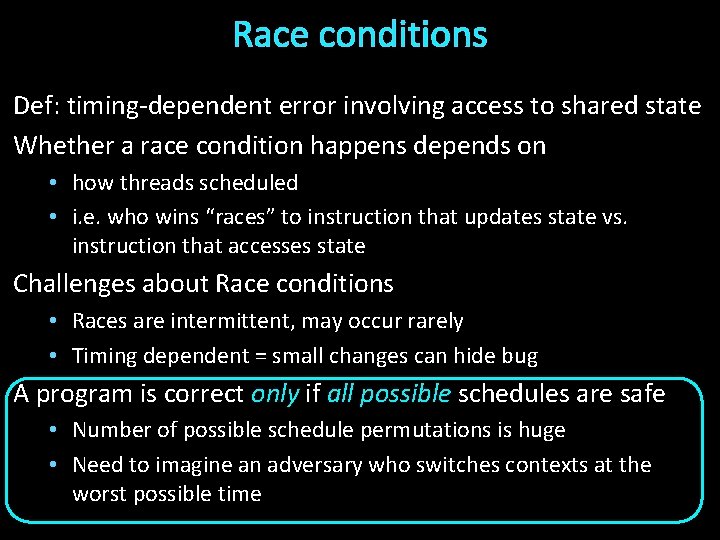
Race conditions Def: timing-dependent error involving access to shared state Whether a race condition happens depends on • how threads scheduled • i. e. who wins “races” to instruction that updates state vs. instruction that accesses state Challenges about Race conditions • Races are intermittent, may occur rarely • Timing dependent = small changes can hide bug A program is correct only if all possible schedules are safe • Number of possible schedule permutations is huge • Need to imagine an adversary who switches contexts at the worst possible time
Critical sections What if we can designate parts of the execution as critical sections • Rule: only one thread can be “inside” a critical section Thread 52 Thread 205 read hits addi write hits
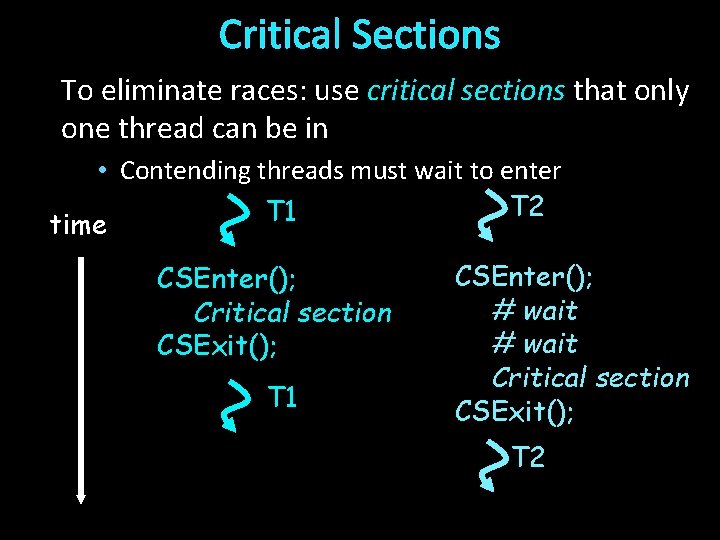
Critical Sections To eliminate races: use critical sections that only one thread can be in • Contending threads must wait to enter T 2 T 1 time CSEnter(); Critical section CSExit(); T 1 CSEnter(); # wait Critical section CSExit(); T 2
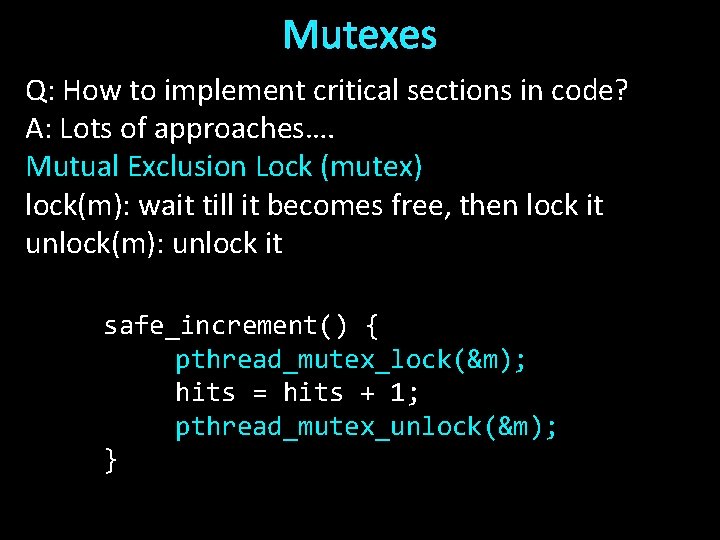
Mutexes Q: How to implement critical sections in code? A: Lots of approaches…. Mutual Exclusion Lock (mutex) lock(m): wait till it becomes free, then lock it unlock(m): unlock it safe_increment() { pthread_mutex_lock(&m); hits = hits + 1; pthread_mutex_unlock(&m); }
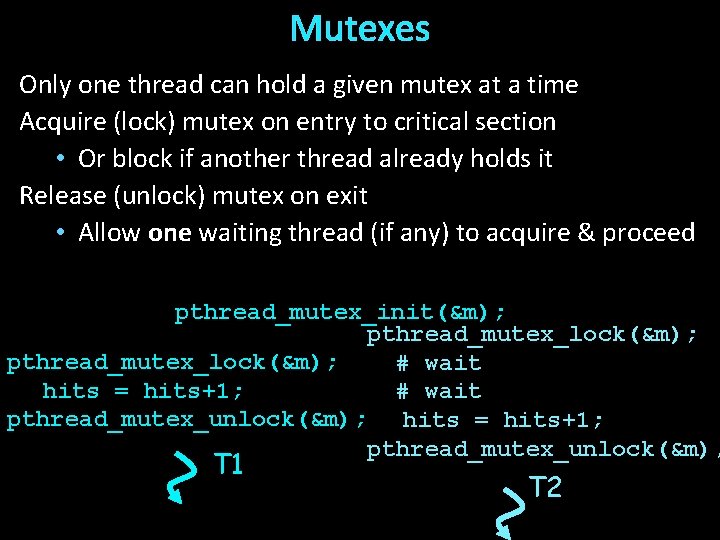
Mutexes Only one thread can hold a given mutex at a time Acquire (lock) mutex on entry to critical section • Or block if another thread already holds it Release (unlock) mutex on exit • Allow one waiting thread (if any) to acquire & proceed pthread_mutex_init(&m); pthread_mutex_lock(&m); # wait hits = hits+1; # wait pthread_mutex_unlock(&m); hits = hits+1; pthread_mutex_unlock(&m); T 1 T 2
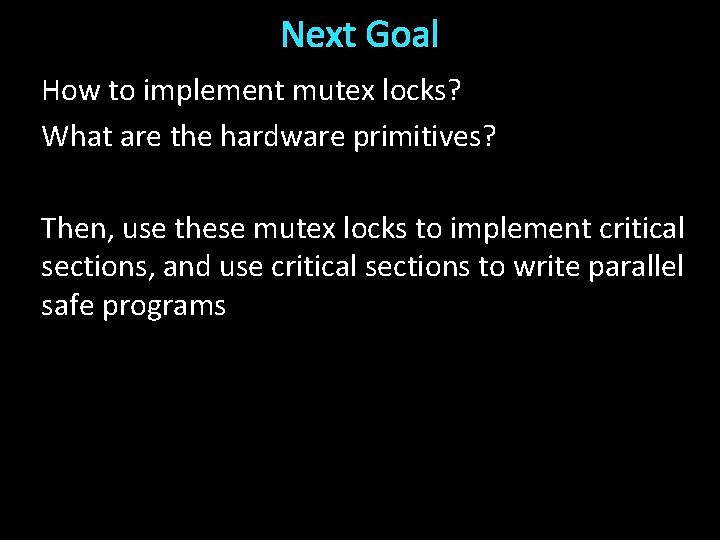
Next Goal How to implement mutex locks? What are the hardware primitives? Then, use these mutex locks to implement critical sections, and use critical sections to write parallel safe programs
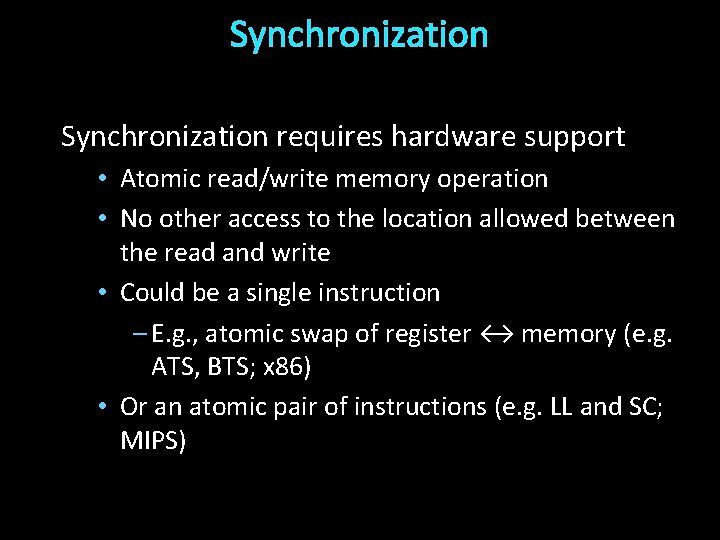
Synchronization requires hardware support • Atomic read/write memory operation • No other access to the location allowed between the read and write • Could be a single instruction – E. g. , atomic swap of register ↔ memory (e. g. ATS, BTS; x 86) • Or an atomic pair of instructions (e. g. LL and SC; MIPS)
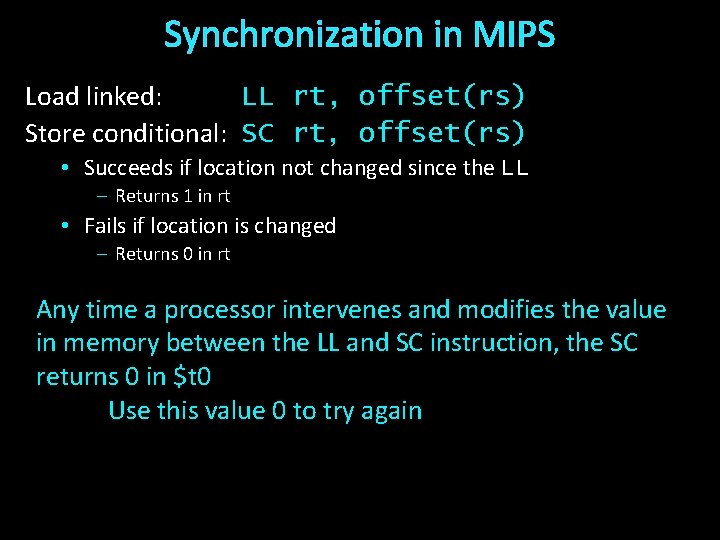
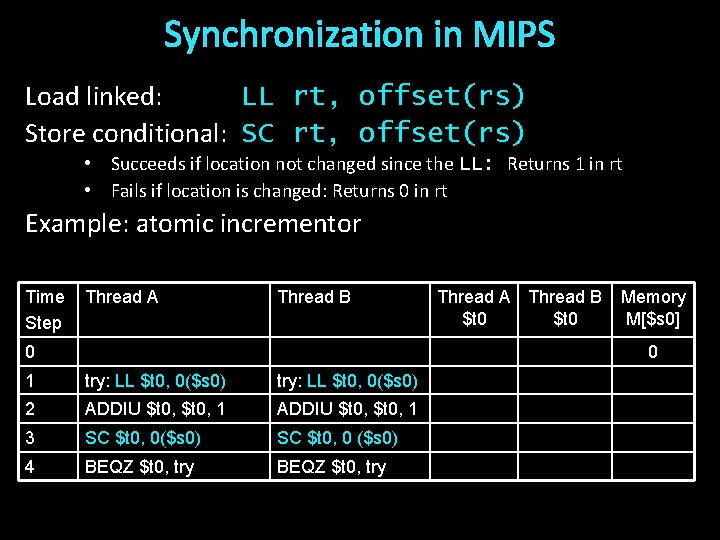
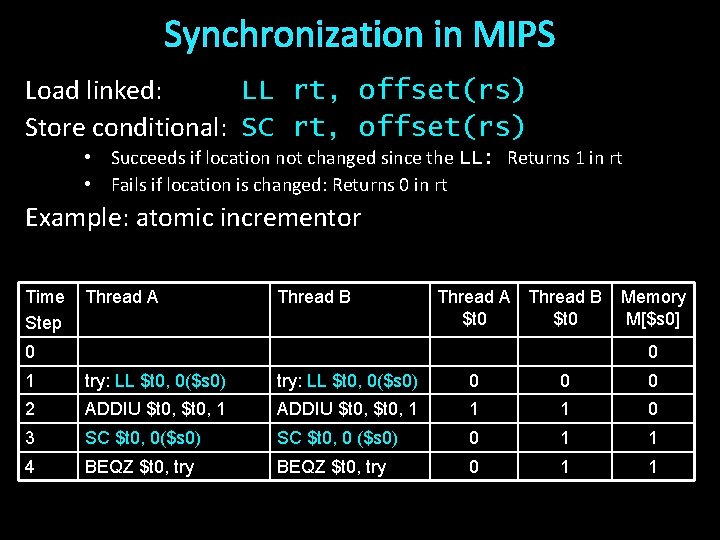
Synchronization in MIPS Load linked: LL rt, offset(rs) Store conditional: SC rt, offset(rs) • Succeeds if location not changed since the LL – Returns 1 in rt • Fails if location is changed – Returns 0 in rt Any time a processor intervenes and modifies the value in memory between the LL and SC instruction, the SC returns 0 in $t 0 Use this value 0 to try again
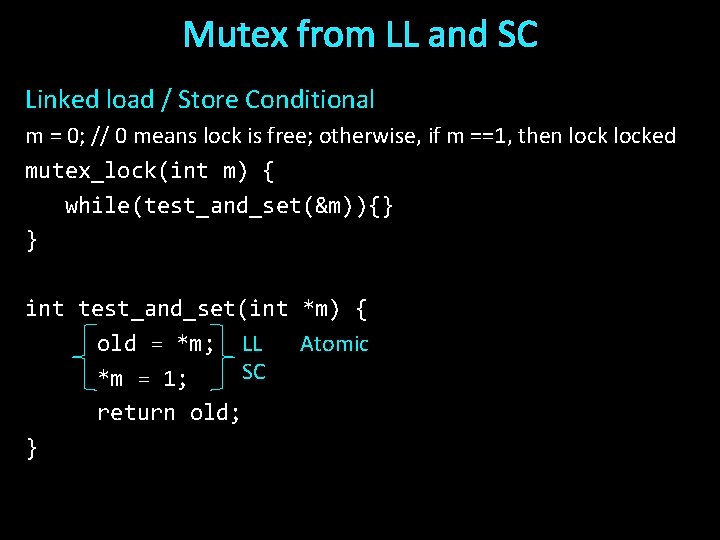
Mutex from LL and SC Linked load / Store Conditional m = 0; // 0 means lock is free; otherwise, if m ==1, then locked mutex_lock(int m) { while(test_and_set(&m)){} } int test_and_set(int *m) { Atomic old = *m; LL SC *m = 1; return old; }
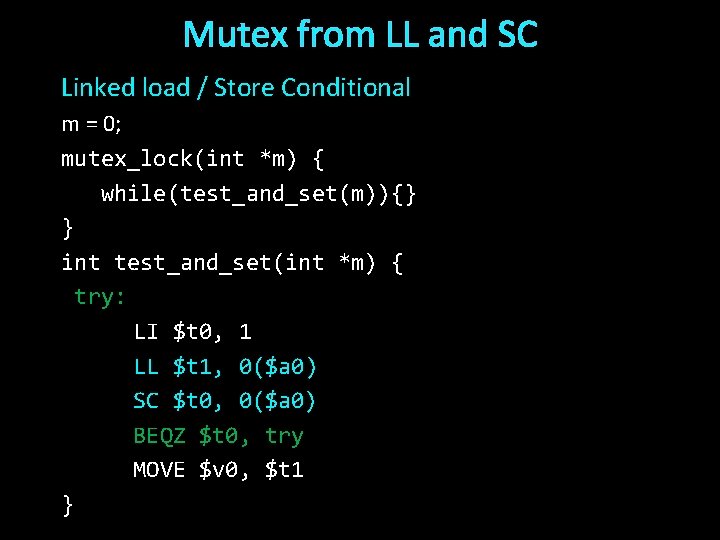
Mutex from LL and SC Linked load / Store Conditional m = 0; mutex_lock(int *m) { while(test_and_set(m)){} } int test_and_set(int *m) { try: LI $t 0, 1 LL $t 1, 0($a 0) SC $t 0, 0($a 0) BEQZ $t 0, try MOVE $v 0, $t 1 }
Synchronization in MIPS Load linked: LL rt, offset(rs) Store conditional: SC rt, offset(rs) • Succeeds if location not changed since the LL: Returns 1 in rt • Fails if location is changed: Returns 0 in rt Example: atomic incrementor Time Step Thread A Thread B 0 Thread A Thread B $t 0 Memory M[$s 0] 0 1 try: LL $t 0, 0($s 0) 2 ADDIU $t 0, 1 3 SC $t 0, 0($s 0) SC $t 0, 0 ($s 0) 4 BEQZ $t 0, try
Synchronization in MIPS Load linked: LL rt, offset(rs) Store conditional: SC rt, offset(rs) • Succeeds if location not changed since the LL: Returns 1 in rt • Fails if location is changed: Returns 0 in rt Example: atomic incrementor Time Step Thread A Thread B $t 0 0 Memory M[$s 0] 0 1 try: LL $t 0, 0($s 0) 0 0 0 2 ADDIU $t 0, 1 1 1 0 3 SC $t 0, 0($s 0) SC $t 0, 0 ($s 0) 0 1 1 4 BEQZ $t 0, try 0 1 1
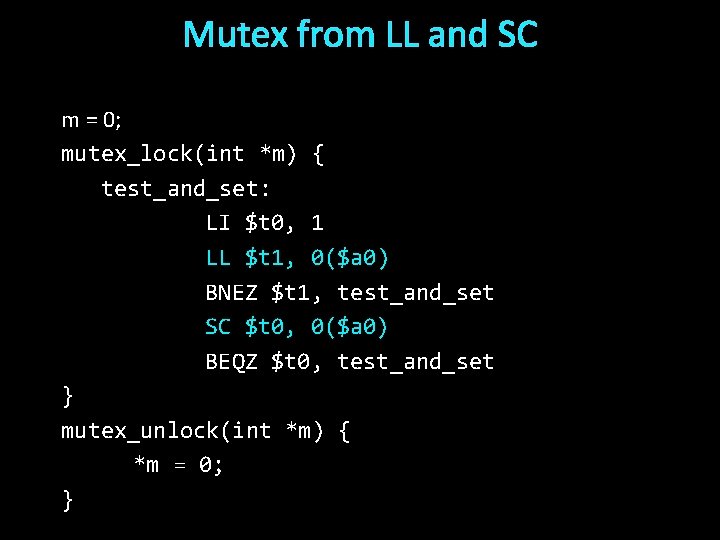
Mutex from LL and SC m = 0; mutex_lock(int *m) { test_and_set: LI $t 0, 1 LL $t 1, 0($a 0) BNEZ $t 1, test_and_set SC $t 0, 0($a 0) BEQZ $t 0, test_and_set } mutex_unlock(int *m) { *m = 0; }
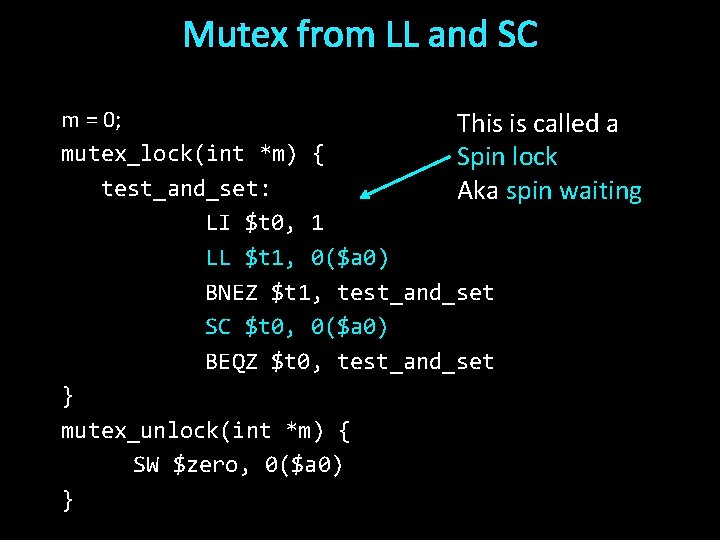
Mutex from LL and SC m = 0; This is called a mutex_lock(int *m) { Spin lock test_and_set: Aka spin waiting LI $t 0, 1 LL $t 1, 0($a 0) BNEZ $t 1, test_and_set SC $t 0, 0($a 0) BEQZ $t 0, test_and_set } mutex_unlock(int *m) { SW $zero, 0($a 0) }
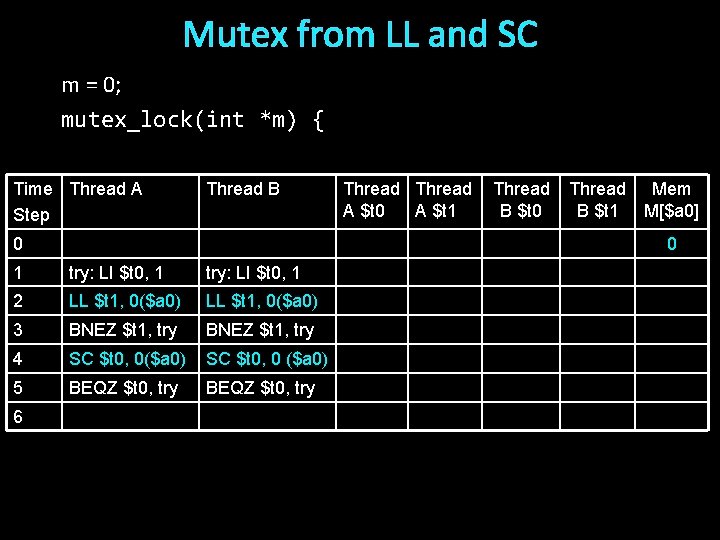
Mutex from LL and SC m = 0; mutex_lock(int *m) { Time Thread A Step Thread B 0 Thread B $t 0 Thread Mem B $t 1 M[$a 0] 0 1 try: LI $t 0, 1 2 LL $t 1, 0($a 0) 3 BNEZ $t 1, try 4 SC $t 0, 0($a 0) SC $t 0, 0 ($a 0) 5 BEQZ $t 0, try 6 Thread A $t 0 A $t 1
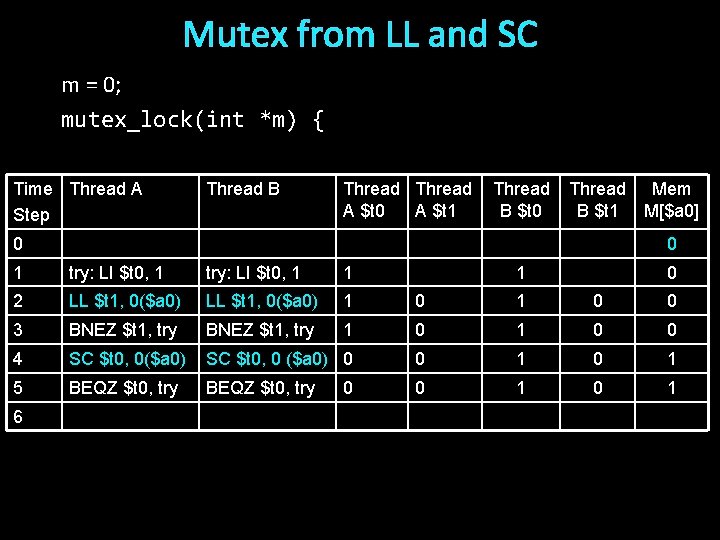
Mutex from LL and SC m = 0; mutex_lock(int *m) { Time Thread A Step Thread B Thread A $t 0 A $t 1 Thread B $t 0 Thread Mem B $t 1 M[$a 0] 0 0 1 try: LI $t 0, 1 1 2 LL $t 1, 0($a 0) 1 0 0 3 BNEZ $t 1, try 1 0 0 4 SC $t 0, 0($a 0) SC $t 0, 0 ($a 0) 0 0 1 5 BEQZ $t 0, try 0 1 6 0 1 0
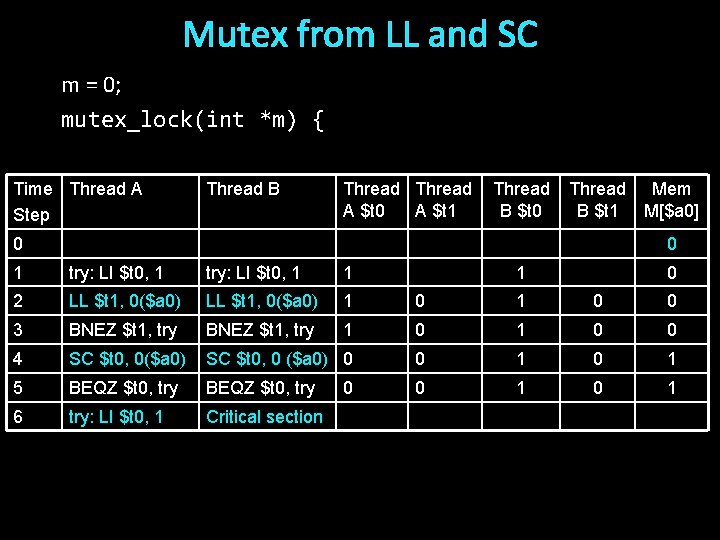
Mutex from LL and SC m = 0; mutex_lock(int *m) { Time Thread A Step Thread B Thread A $t 0 A $t 1 Thread B $t 0 Thread Mem B $t 1 M[$a 0] 0 0 1 try: LI $t 0, 1 1 2 LL $t 1, 0($a 0) 1 0 0 3 BNEZ $t 1, try 1 0 0 4 SC $t 0, 0($a 0) SC $t 0, 0 ($a 0) 0 0 1 5 BEQZ $t 0, try 0 1 6 try: LI $t 0, 1 Critical section 0 1 0
Alternative Atomic Instructions Other atomic hardware primitives - test and set (x 86) - atomic increment (x 86) - bus lock prefix (x 86) - compare and exchange (x 86, ARM deprecated) - linked load / store conditional (MIPS, ARM, Power. PC, DEC Alpha, …)
Summary Need parallel abstraction like for multicore Writing correct programs is hard Need to prevent data races Need critical sections to prevent data races Mutex, mutual exclusion, implements critical section Mutex often implemented using a lock abstraction Hardware provides synchronization primitives such as LL and SC (load linked and store conditional) instructions to efficiently implement locks
Topics Synchronization • Threads • Critical sections, race conditions, and mutexes • Atomic Instructions • • HW support for synchronization Using sync primitives to build concurrency-safe data structures • Example: thread-safe data structures • Language level synchronization • Threads and processes
Next Goal How do we use synchronization primitives to build concurrency-safe data structure?
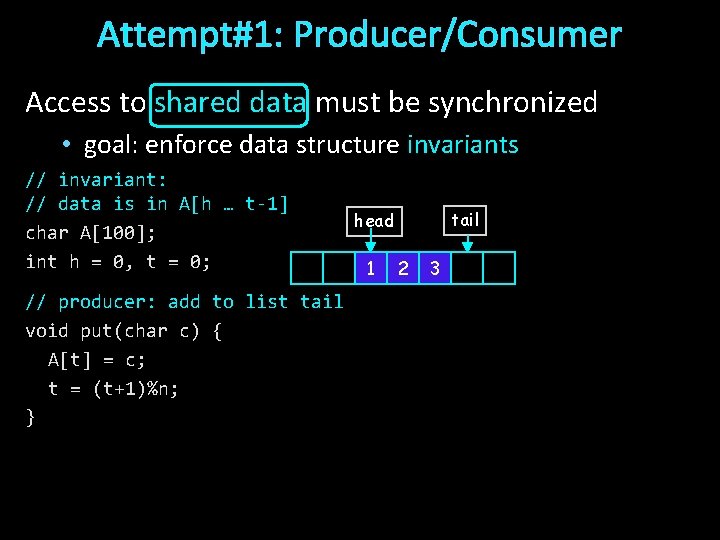
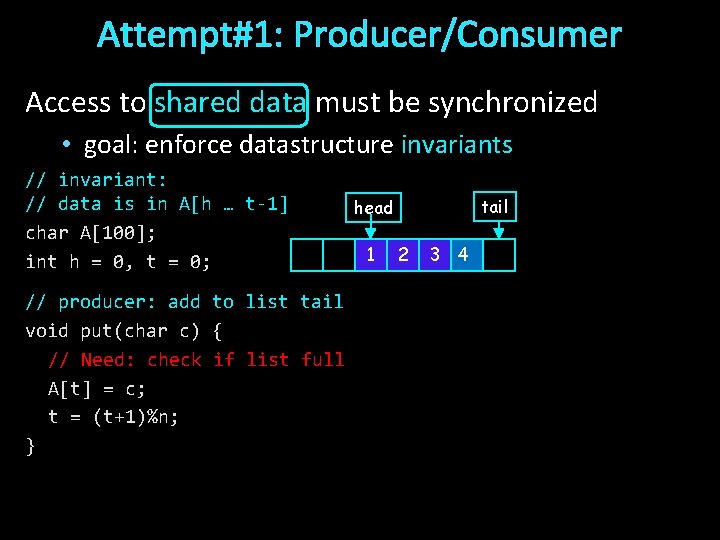
Attempt#1: Producer/Consumer Access to shared data must be synchronized • goal: enforce data structure invariants // invariant: // data is in A[h … t-1] char A[100]; int h = 0, t = 0; // producer: add to list tail void put(char c) { A[t] = c; t = (t+1)%n; } tail head 1 2 3
Attempt#1: Producer/Consumer Access to shared data must be synchronized • goal: enforce datastructure invariants // invariant: // data is in A[h … t-1] char A[100]; int h = 0, t = 0; // producer: add to list tail void put(char c) { // Need: check if list full A[t] = c; t = (t+1)%n; } tail head 1 2 3 4
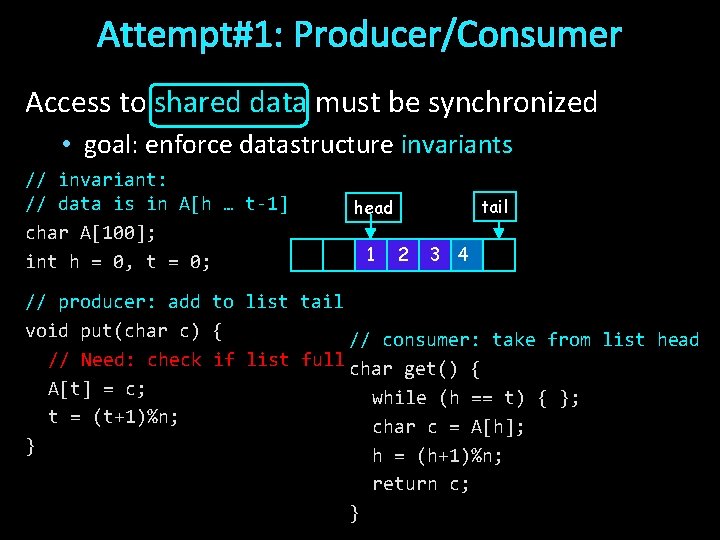
Attempt#1: Producer/Consumer Access to shared data must be synchronized • goal: enforce datastructure invariants // invariant: // data is in A[h … t-1] char A[100]; int h = 0, t = 0; tail head 1 2 3 4 // producer: add to list tail void put(char c) { // consumer: take from list head // Need: check if list full char get() { A[t] = c; while (h == t) { }; t = (t+1)%n; char c = A[h]; } h = (h+1)%n; return c; }
Attempt#1: Producer/Consumer // invariant: // data is in A[h … t-1] char A[100]; int h = 0, t = 0; head 2 tail 3 4 // producer: add to list tail // consumer: take from list head void put(char c) {. . . char get() { A[t] = c; while (h == t) { }; t = (t+1)%n; char c = A[h]; } h = (h+1)%n; return c; Error: could miss an update to t or}h due to lack of synchronization Current implementation will break invariant: only produce if not full and only consume if not empty Need to synchronize access to shared data
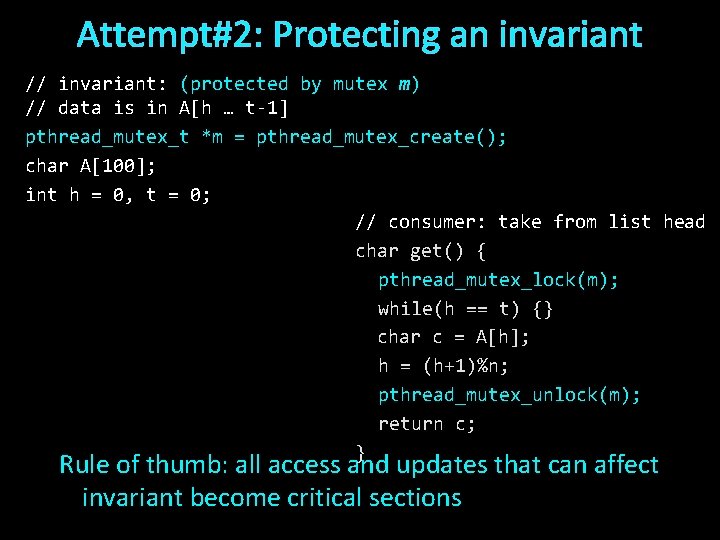
Attempt#2: Protecting an invariant // invariant: (protected by mutex m) // data is in A[h … t-1] pthread_mutex_t *m = pthread_mutex_create(); char A[100]; int h = 0, t = 0; // consumer: take from list head char get() { pthread_mutex_lock(m); while(h == t) {} char c = A[h]; h = (h+1)%n; pthread_mutex_unlock(m); return c; } Rule of thumb: all access and updates that can affect invariant become critical sections
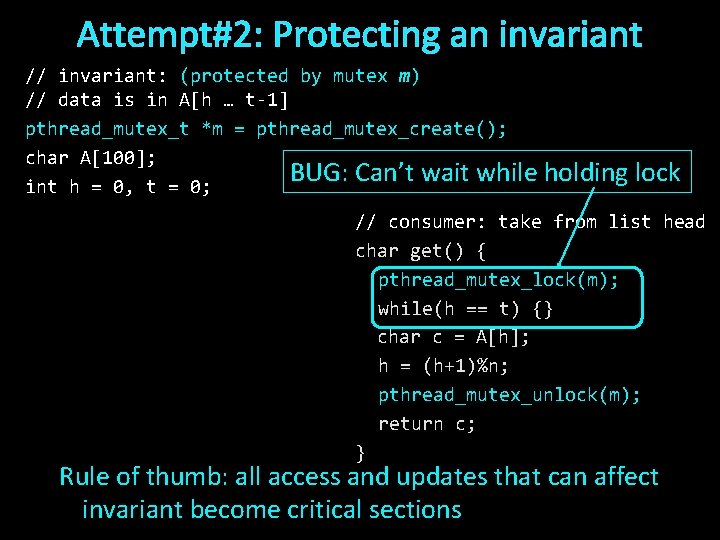
Attempt#2: Protecting an invariant // invariant: (protected by mutex m) // data is in A[h … t-1] pthread_mutex_t *m = pthread_mutex_create(); char A[100]; BUG: Can’t wait while int h = 0, t = 0; holding lock // consumer: take from list head char get() { pthread_mutex_lock(m); while(h == t) {} char c = A[h]; h = (h+1)%n; pthread_mutex_unlock(m); return c; } Rule of thumb: all access and updates that can affect invariant become critical sections
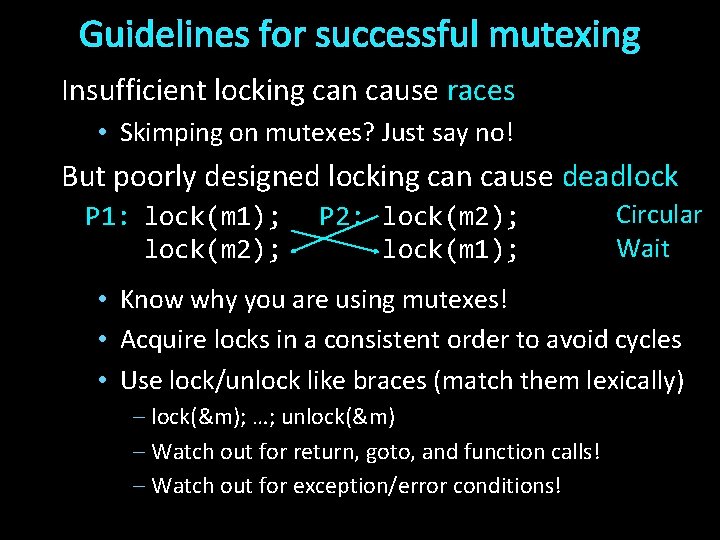
Guidelines for successful mutexing Insufficient locking can cause races • Skimping on mutexes? Just say no! But poorly designed locking can cause deadlock P 1: lock(m 1); lock(m 2); P 2: lock(m 2); lock(m 1); Circular Wait • Know why you are using mutexes! • Acquire locks in a consistent order to avoid cycles • Use lock/unlock like braces (match them lexically) – lock(&m); …; unlock(&m) – Watch out for return, goto, and function calls! – Watch out for exception/error conditions!
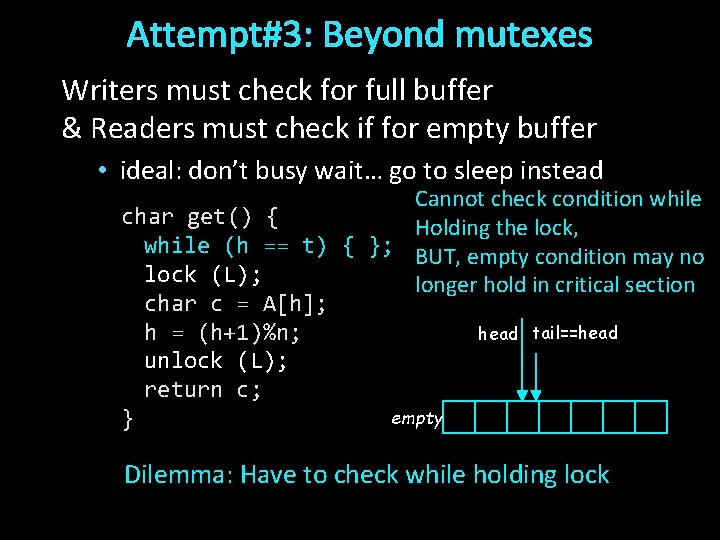
Attempt#3: Beyond mutexes Writers must check for full buffer & Readers must check if for empty buffer • ideal: don’t busy wait… go to sleep instead Cannot check condition while char get() { Holding the lock, while (h == t) { }; BUT, empty condition may no lock (L); longer hold in critical section char c = A[h]; h = (h+1)%n; head tail==head unlock (L); return c; empty } Dilemma: Have to check while holding lock
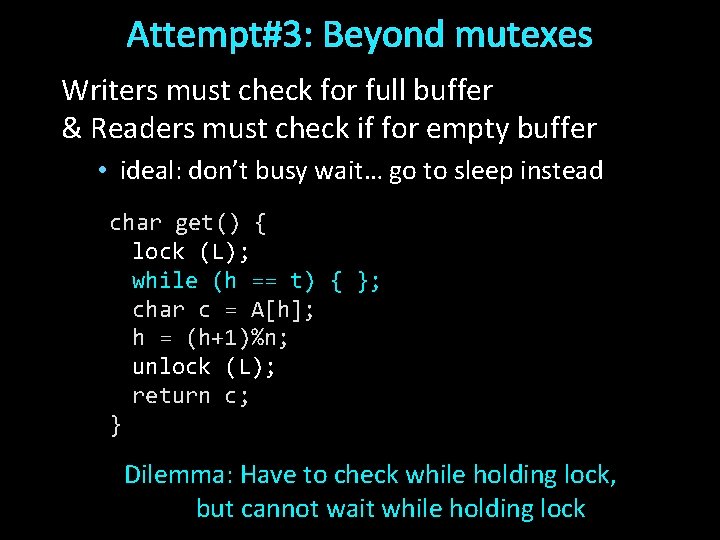
Attempt#3: Beyond mutexes Writers must check for full buffer & Readers must check if for empty buffer • ideal: don’t busy wait… go to sleep instead char get() { lock (L); while (h == t) { }; char c = A[h]; h = (h+1)%n; unlock (L); return c; } Dilemma: Have to check while holding lock, but cannot wait while holding lock
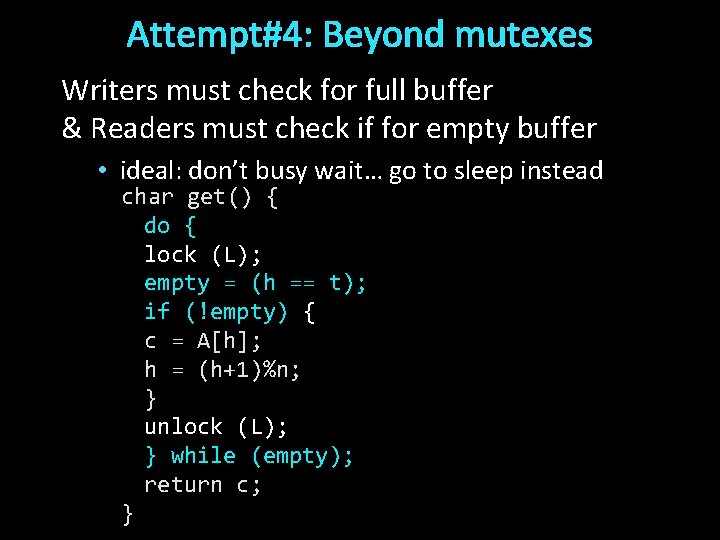
Attempt#4: Beyond mutexes Writers must check for full buffer & Readers must check if for empty buffer • ideal: don’t busy wait… go to sleep instead char get() { do { lock (L); empty = (h == t); if (!empty) { c = A[h]; h = (h+1)%n; } unlock (L); } while (empty); return c; }
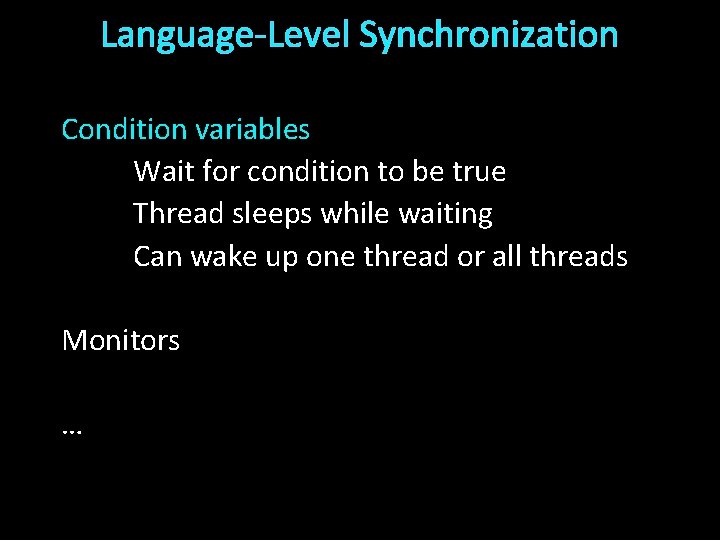
Language-Level Synchronization Condition variables Wait for condition to be true Thread sleeps while waiting Can wake up one thread or all threads Monitors …
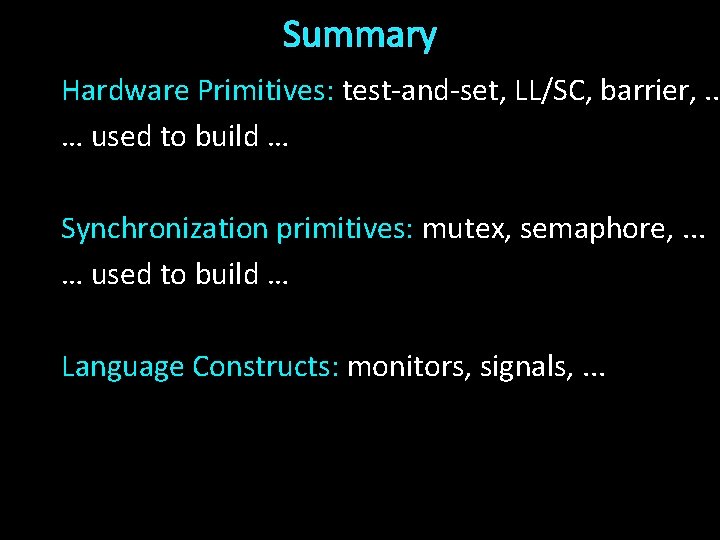
Summary Hardware Primitives: test-and-set, LL/SC, barrier, . . … used to build … Synchronization primitives: mutex, semaphore, . . . … used to build … Language Constructs: monitors, signals, . . .