
Synchronization 15 740 SPRING 18 NATHAN BECKMANN Types
Synchronization 15 -740 SPRING’ 18 NATHAN BECKMANN
Types of Synchronization Mutual Exclusion ◦ Locks Event Synchronization ◦ Global or group-based (barriers) ◦ Point-to-point (producer-consumer)

Simple Producer-Consumer Example Producer flag data Consumer Initially flag=0 st xdata, (xdatap) spin: ld xflag, (xflagp) ld xflag, 1 beqz xflag, spin st xflag, (xflagp) ld xdata, (xdatap) Is this correct? Can consumer read flag=1 before data written by producer? 3
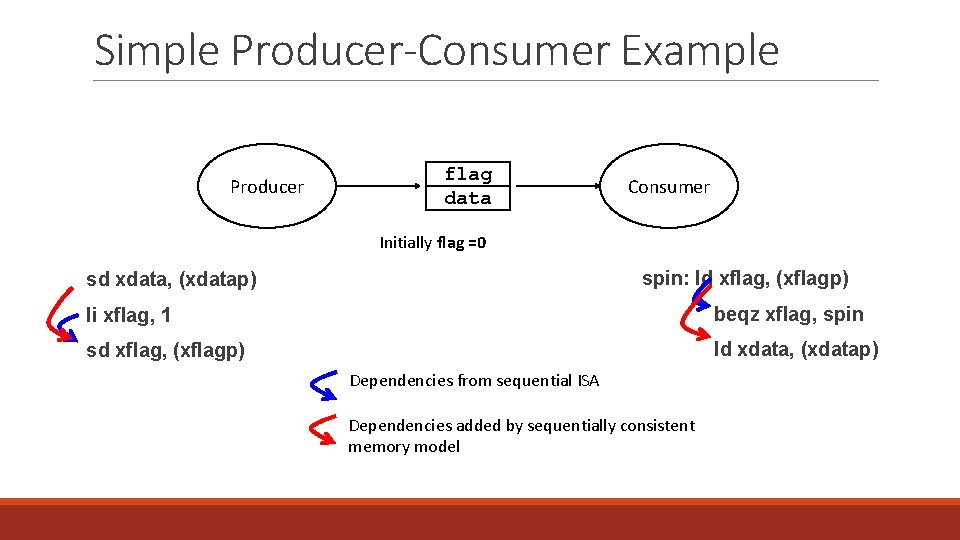
Simple Producer-Consumer Example Producer flag data Consumer Initially flag =0 spin: ld xflag, (xflagp) sd xdata, (xdatap) li xflag, 1 beqz xflag, spin sd xflag, (xflagp) ld xdata, (xdatap) Dependencies from sequential ISA Dependencies added by sequentially consistent memory model
Implementing SC in hardware Only a few commercial systems implemented SC ◦ Neither x 86 nor ARM are SC Requires either severe performance penalty ◦ Wait for stores to complete before issuing new store Or, complex hardware (MIPS R 10 K) ◦ Issue loads speculatively ◦ Detect inconsistency with later store ◦ Squash speculative load
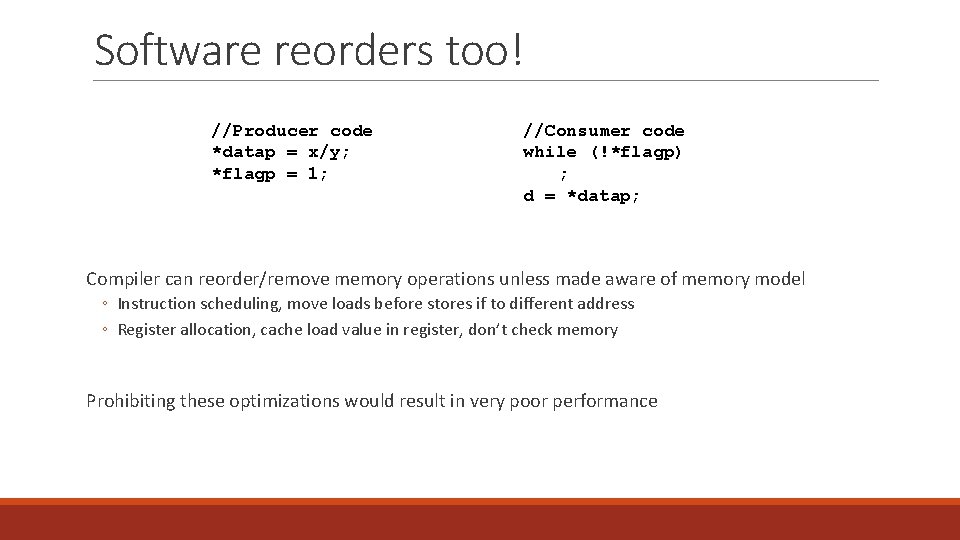
Software reorders too! //Producer code *datap = x/y; *flagp = 1; //Consumer code while (!*flagp) ; d = *datap; Compiler can reorder/remove memory operations unless made aware of memory model ◦ Instruction scheduling, move loads before stores if to different address ◦ Register allocation, cache load value in register, don’t check memory Prohibiting these optimizations would result in very poor performance
Relaxed memory models Not all dependencies assumed by SC are supported, and software has to explicitly insert additional dependencies were needed Which dependencies are dropped depends on the particular memory model ◦ IBM 370, TSO, PSO, WO, PC, Alpha, RMO, … How to introduce needed dependencies varies by system ◦ Explicit FENCE instructions (sometimes called sync or memory barrier instructions) ◦ Implicit effects of atomic memory instructions Programmers supposed to work with this? ?
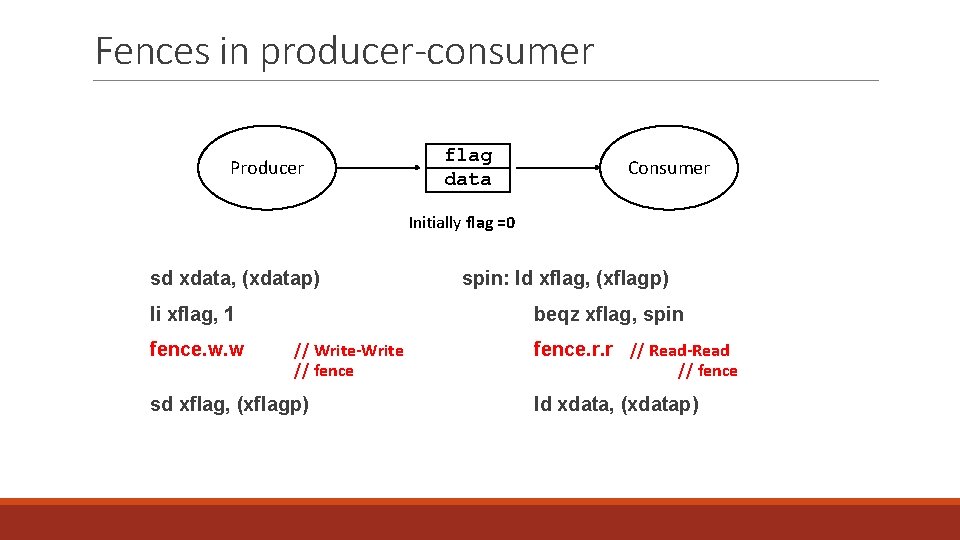
Fences in producer-consumer Producer flag data Consumer Initially flag =0 sd xdata, (xdatap) li xflag, 1 fence. w. w spin: ld xflag, (xflagp) beqz xflag, spin // Write-Write // fence sd xflag, (xflagp) fence. r. r // Read-Read // fence ld xdata, (xdatap)
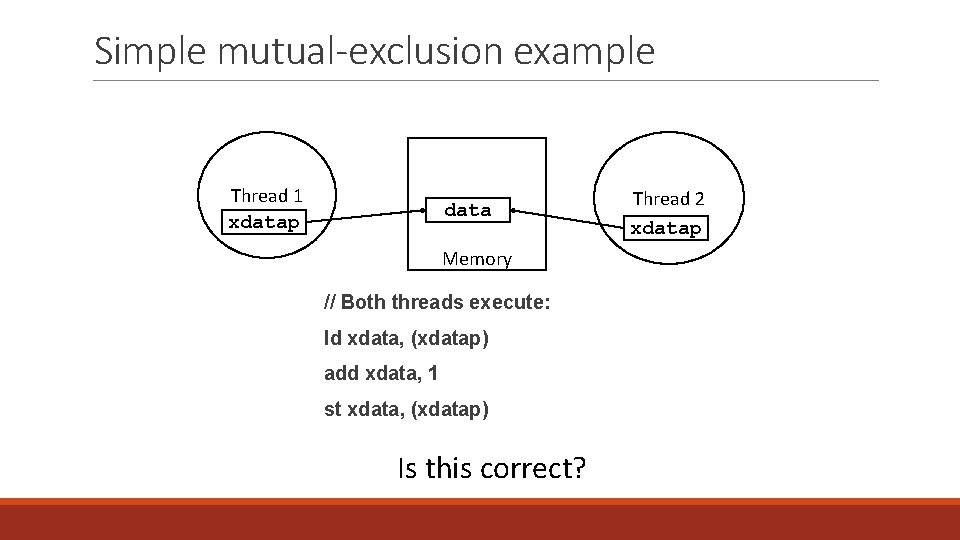
Simple mutual-exclusion example Thread 1 xdatap data Memory // Both threads execute: ld xdata, (xdatap) add xdata, 1 st xdata, (xdatap) Is this correct? Thread 2 xdatap
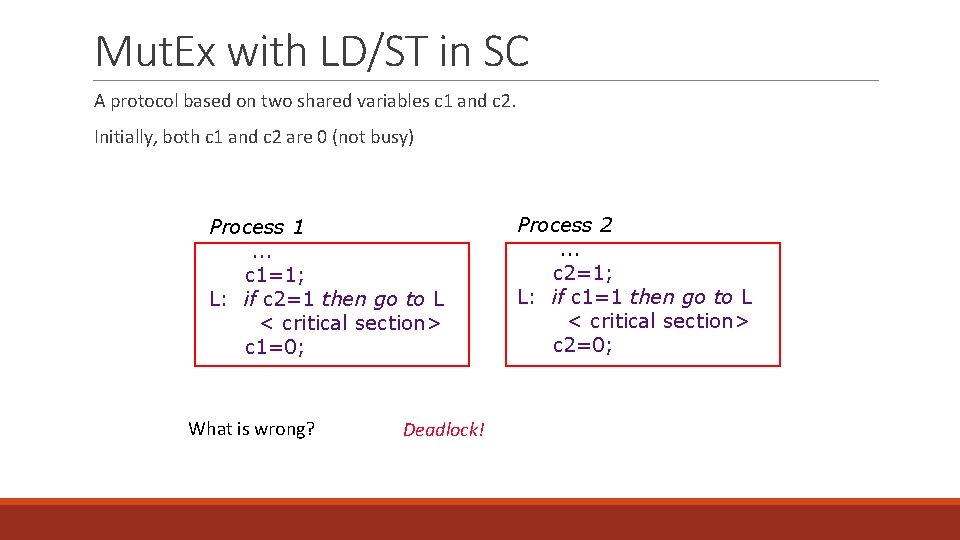
Mut. Ex with LD/ST in SC A protocol based on two shared variables c 1 and c 2. Initially, both c 1 and c 2 are 0 (not busy) Process 1. . . c 1=1; L: if c 2=1 then go to L < critical section> c 1=0; What is wrong? Deadlock! Process 2. . . c 2=1; L: if c 1=1 then go to L < critical section> c 2=0;
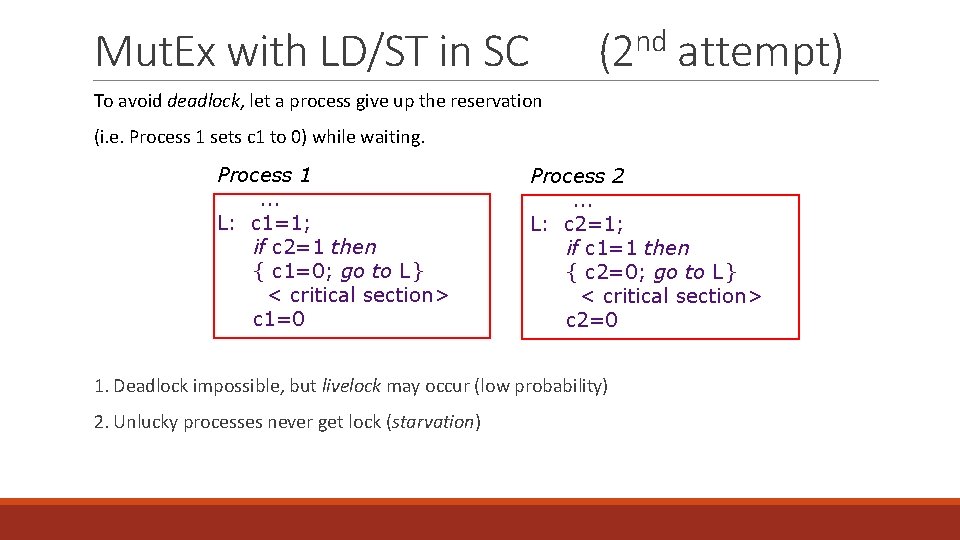
Mut. Ex with LD/ST in SC nd (2 attempt) To avoid deadlock, let a process give up the reservation (i. e. Process 1 sets c 1 to 0) while waiting. Process 1. . . L: c 1=1; if c 2=1 then { c 1=0; go to L} < critical section> c 1=0 Process 2. . . L: c 2=1; if c 1=1 then { c 2=0; go to L} < critical section> c 2=0 1. Deadlock impossible, but livelock may occur (low probability) 2. Unlucky processes never get lock (starvation)
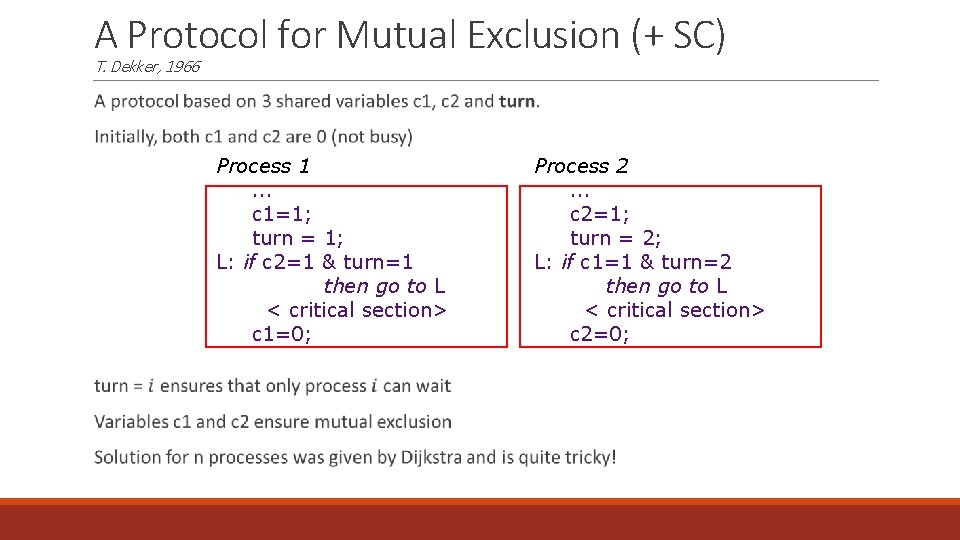
A Protocol for Mutual Exclusion (+ SC) T. Dekker, 1966 Process 1. . . c 1=1; turn = 1; L: if c 2=1 & turn=1 then go to L < critical section> c 1=0; Process 2. . . c 2=1; turn = 2; L: if c 1=1 & turn=2 then go to L < critical section> c 2=0;
Components of Mutual Exclusion Acquire ◦ How to get into critical section Wait algorithm ◦ What to do if acquire fails Release algorithm ◦ How to let next thread into critical section Can be implemented using LD/ST, but… ◦ Need fences in weaker models ◦ Doesn’t scale + complex
Busy Waiting vs. Blocking Threads spin in above algorithm if acquire fails Busy-waiting is preferable when: ◦ Scheduling overhead is larger than expected wait time ◦ Schedule-based blocking is inappropriate (eg, OS) Blocking is preferable when: ◦ Long wait time & other useful work to be done ◦ Especially if core is needed to release the lock! Hybrid spin-then-block often used
Need atomic primitive! Many choices… Test&Set – set to 1 and return old value Swap – atomic swap of register + memory location Fetch&Op ◦ E. g. , Fetch&Increment, Fetch&Add, … Compare&Swap – “if *mem == A then *mem == B” Load-linked/Store-Conditional (LL/SC)
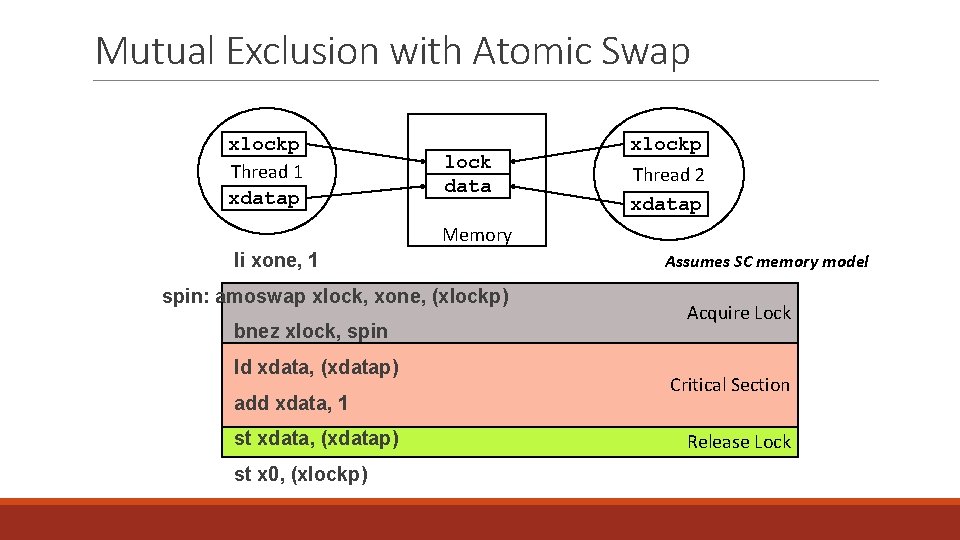
Mutual Exclusion with Atomic Swap xlockp Thread 1 xdatap lock data xlockp Thread 2 xdatap Memory li xone, 1 spin: amoswap xlock, xone, (xlockp) bnez xlock, spin ld xdata, (xdatap) add xdata, 1 st xdata, (xdatap) st x 0, (xlockp) Assumes SC memory model Acquire Lock Critical Section Release Lock
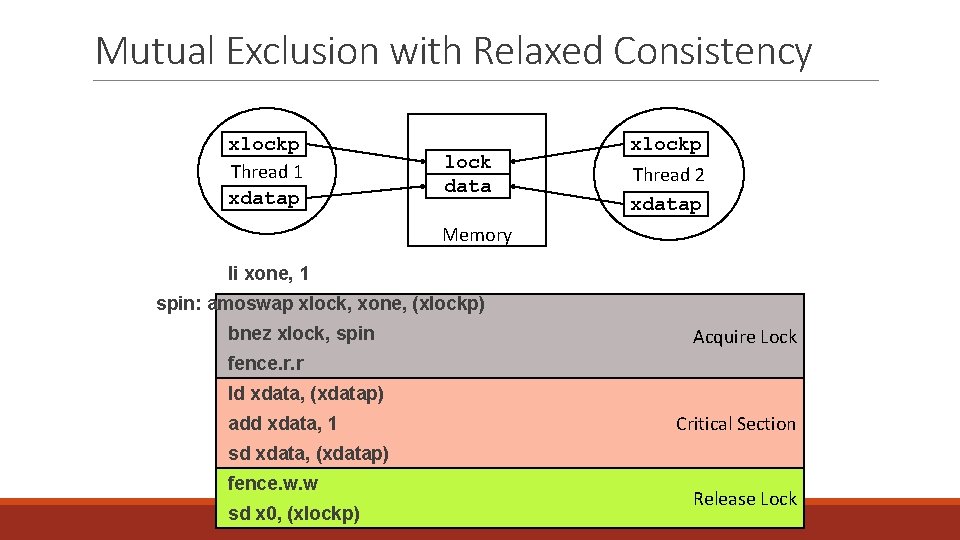
Mutual Exclusion with Relaxed Consistency xlockp Thread 1 xdatap lock data xlockp Thread 2 xdatap Memory li xone, 1 spin: amoswap xlock, xone, (xlockp) bnez xlock, spin Acquire Lock fence. r. r ld xdata, (xdatap) add xdata, 1 Critical Section sd xdata, (xdatap) fence. w. w sd x 0, (xlockp) Release Lock
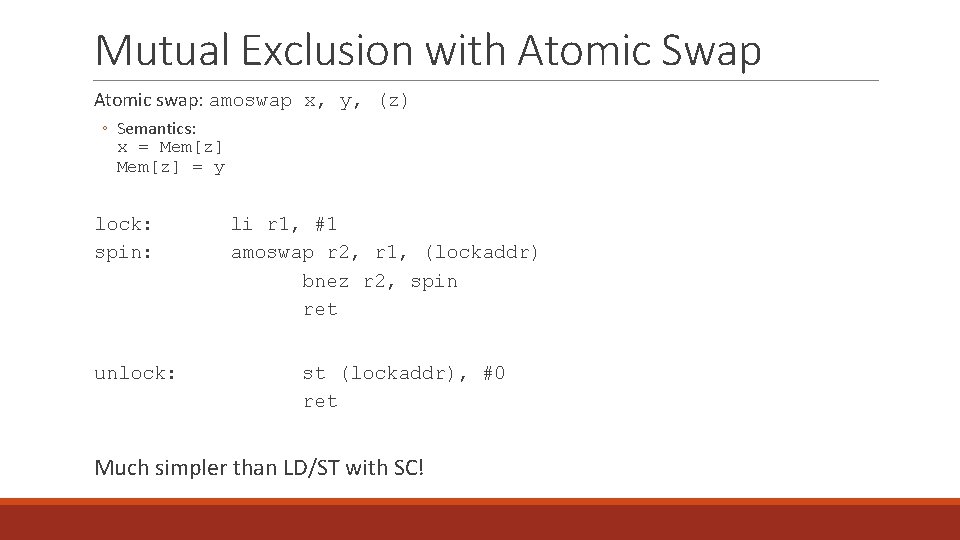
Mutual Exclusion with Atomic Swap Atomic swap: amoswap x, y, (z) ◦ Semantics: x = Mem[z] = y lock: spin: unlock: li r 1, #1 amoswap r 2, r 1, (lockaddr) bnez r 2, spin ret st (lockaddr), #0 ret Much simpler than LD/ST with SC!
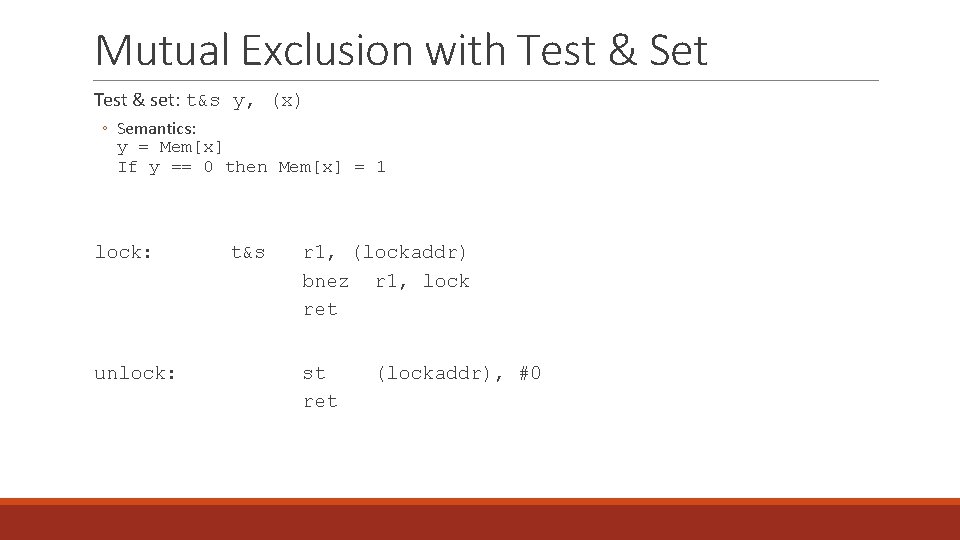
Mutual Exclusion with Test & Set Test & set: t&s y, (x) ◦ Semantics: y = Mem[x] If y == 0 then Mem[x] = 1 lock: unlock: t&s r 1, (lockaddr) bnez r 1, lock ret st ret (lockaddr), #0
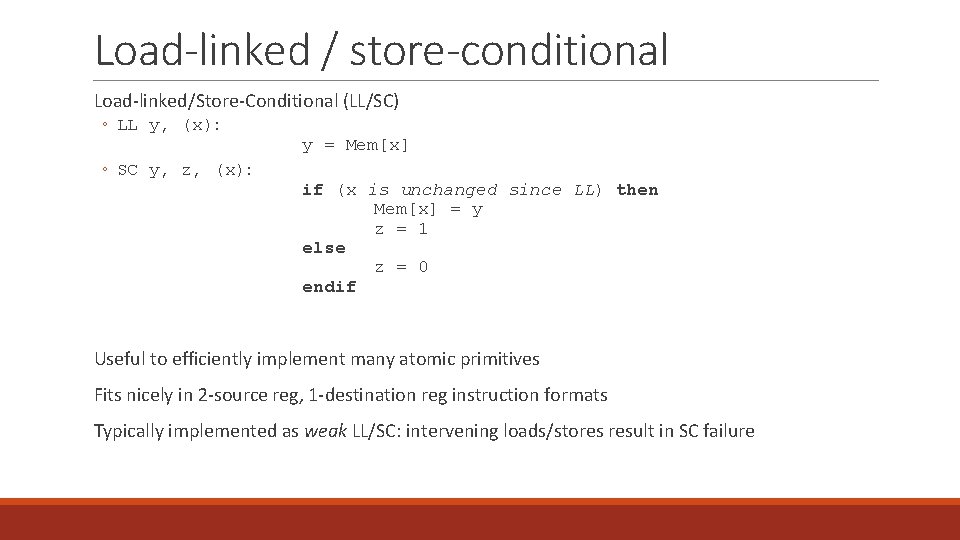
Load-linked / store-conditional Load-linked/Store-Conditional (LL/SC) ◦ LL y, (x): ◦ SC y, z, (x): y = Mem[x] if (x is unchanged since LL) then Mem[x] = y z = 1 else z = 0 endif Useful to efficiently implement many atomic primitives Fits nicely in 2 -source reg, 1 -destination reg instruction formats Typically implemented as weak LL/SC: intervening loads/stores result in SC failure
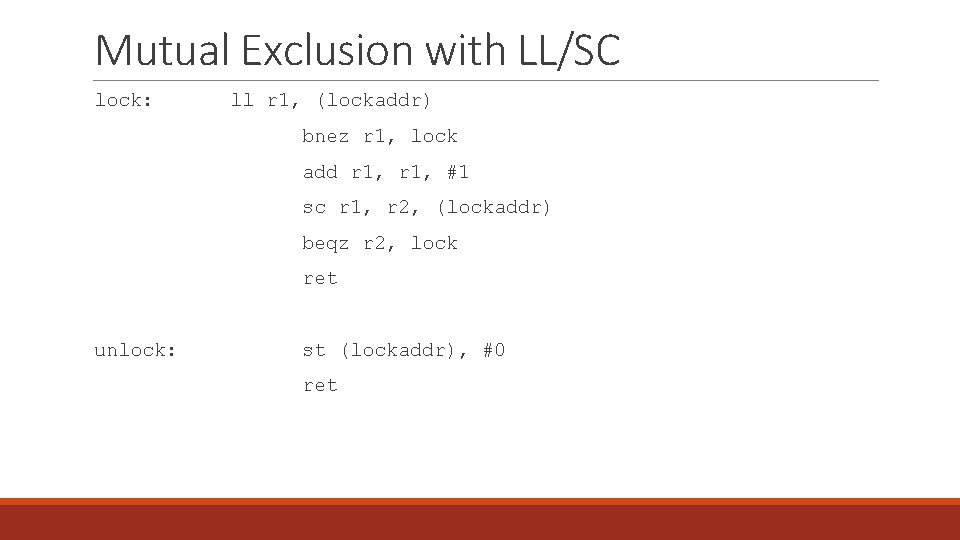
Mutual Exclusion with LL/SC lock: ll r 1, (lockaddr) bnez r 1, lock add r 1, #1 sc r 1, r 2, (lockaddr) beqz r 2, lock ret unlock: st (lockaddr), #0 ret
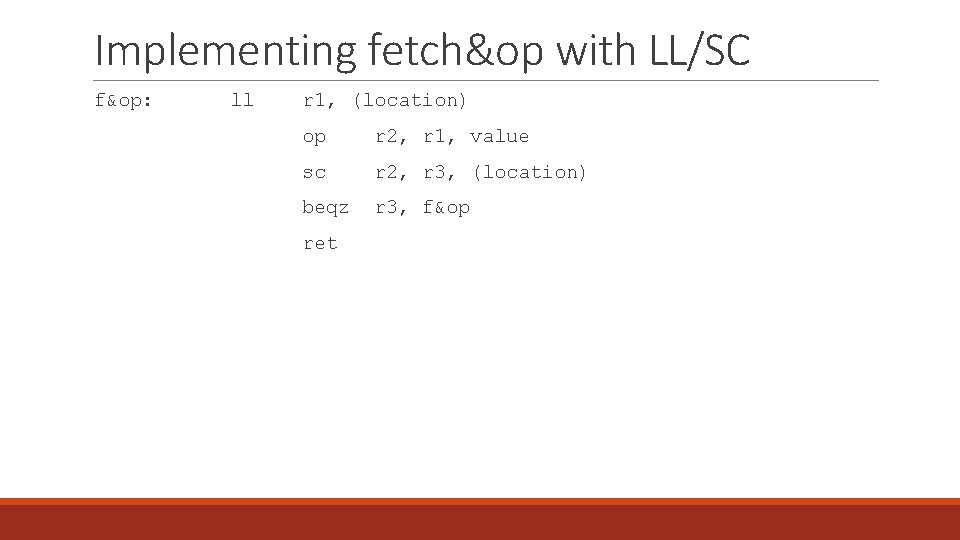
Implementing fetch&op with LL/SC f&op: ll r 1, (location) op r 2, r 1, value sc r 2, r 3, (location) beqz r 3, f&op ret
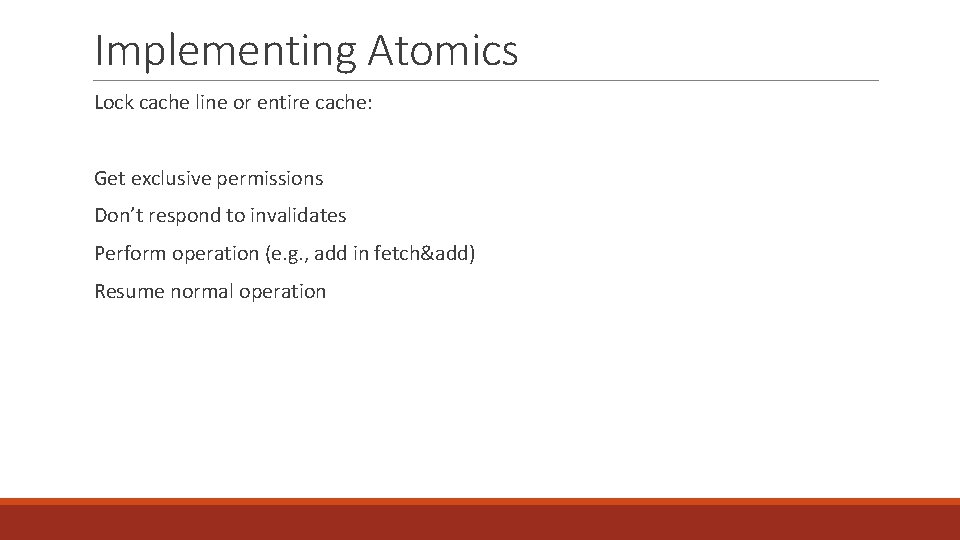
Implementing Atomics Lock cache line or entire cache: Get exclusive permissions Don’t respond to invalidates Perform operation (e. g. , add in fetch&add) Resume normal operation
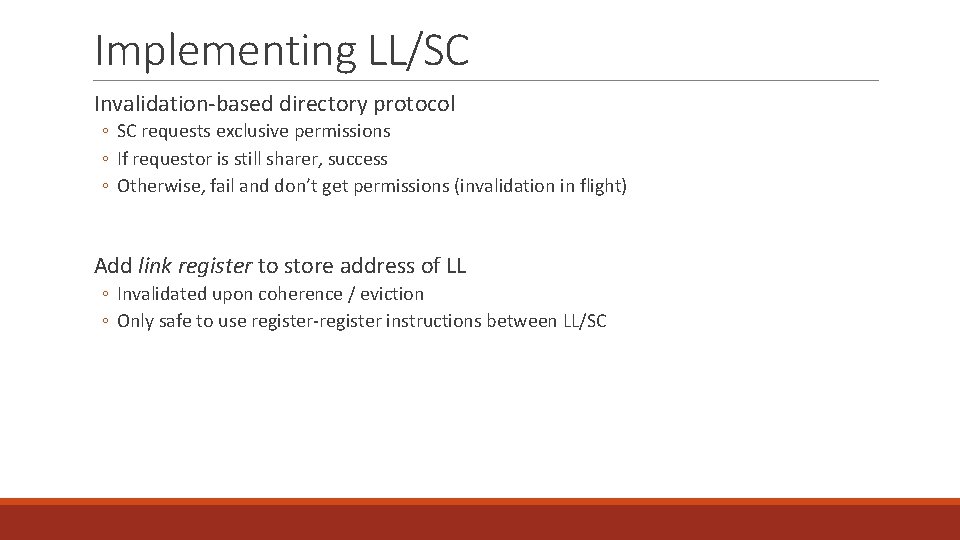
Implementing LL/SC Invalidation-based directory protocol ◦ SC requests exclusive permissions ◦ If requestor is still sharer, success ◦ Otherwise, fail and don’t get permissions (invalidation in flight) Add link register to store address of LL ◦ Invalidated upon coherence / eviction ◦ Only safe to use register-register instructions between LL/SC
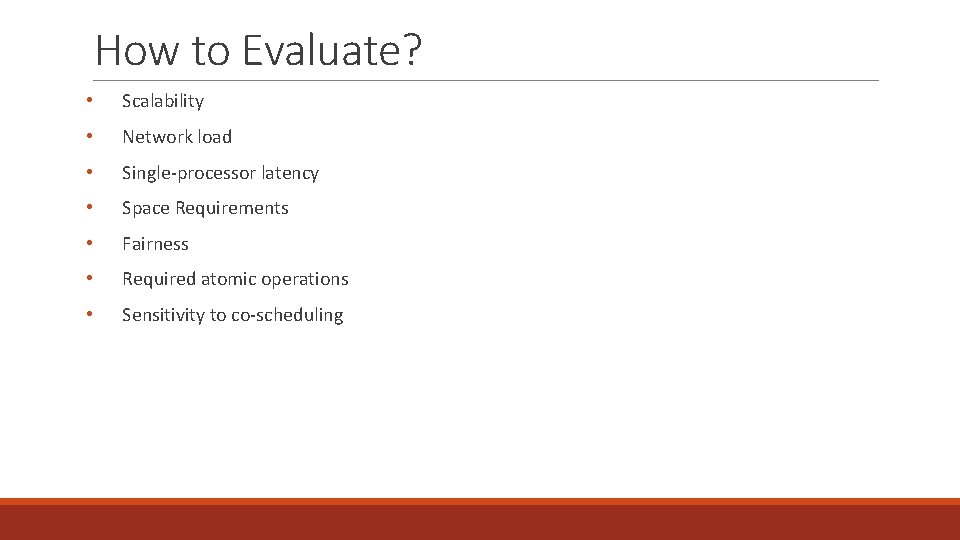
How to Evaluate? • Scalability • Network load • Single-processor latency • Space Requirements • Fairness • Required atomic operations • Sensitivity to co-scheduling
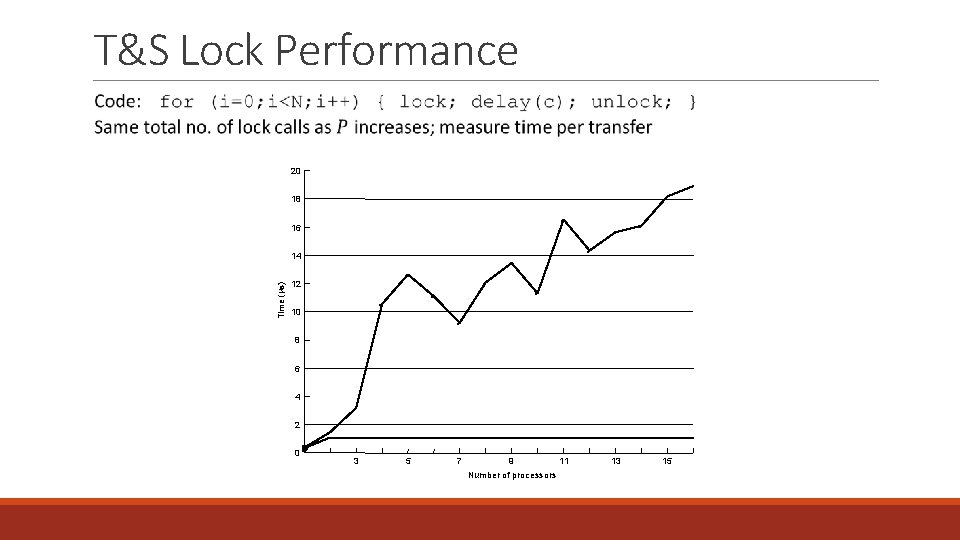
T&S Lock Performance 20 s s 18 s 16 s s 14 Time (ms) s s s 12 s s s 10 s s 8 6 4 s 2 n sl 0 u s 3 5 7 9 Number of processors 11 13 15
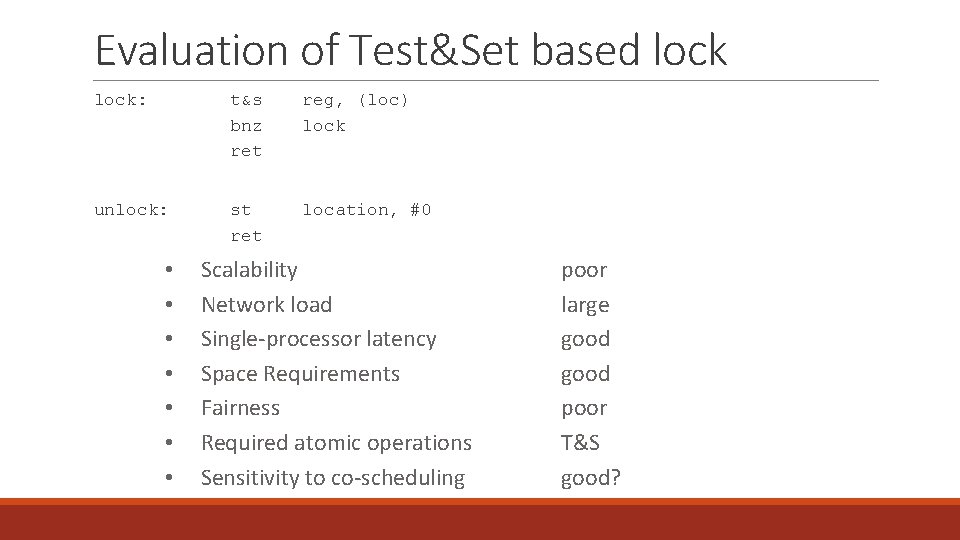
Evaluation of Test&Set based lock: t&s bnz ret reg, (loc) lock unlock: st ret location, #0 • • Scalability Network load Single-processor latency Space Requirements Fairness Required atomic operations Sensitivity to co-scheduling poor large good poor T&S good?
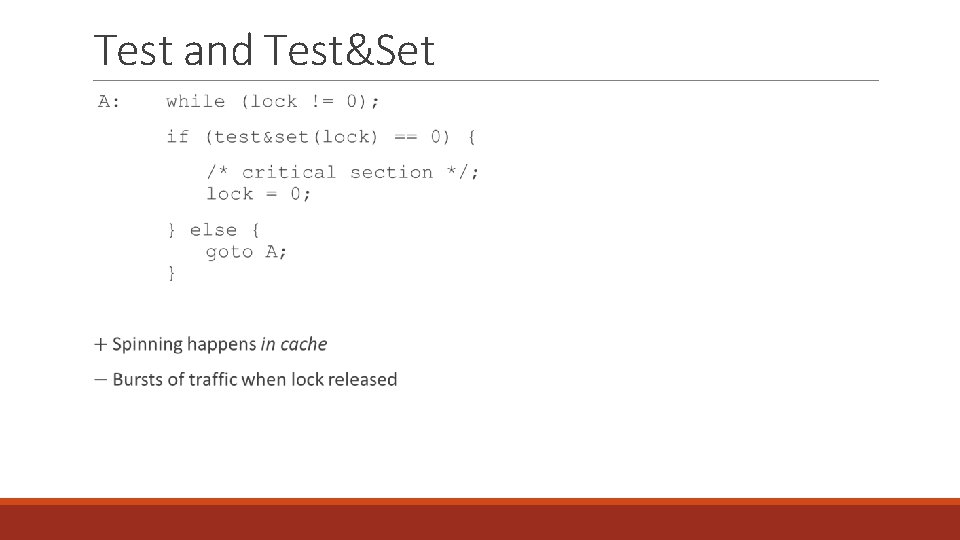
Test and Test&Set
Test&Set with Backoff Upon failure, delay for a while before retrying ◦ either constant delay or exponential backoff Tradeoffs: (+) much less network traffic (-) exponential backoff can cause starvation for high-contention locks ◦ new requestors back off for shorter times But exponential found to work best in practice
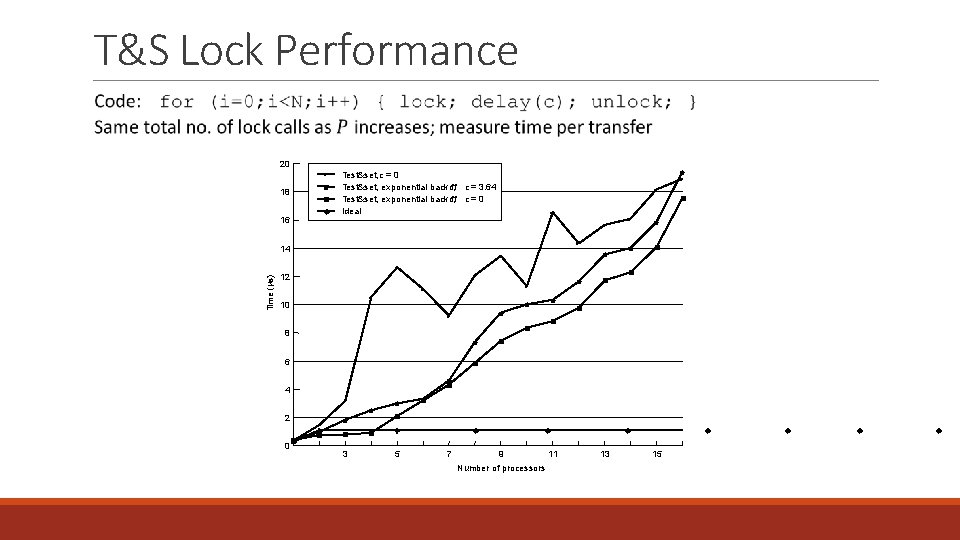
T&S Lock Performance 20 s l 18 n u 16 Time (ms) s s l s s 12 s l s s s 10 l s l l l 6 n s l l n n n 8 n n l n 4 s n sl 0 u s s 14 2 l s Test&set, c = 0 Test&set, exponential backof f, c = 3. 64 Test&set, exponential backof f, c = 0 Ideal l s U l n 3 n l l n n U 5 u 7 u 9 Number of processors 11 u 13 u 15 u u u
Test&Set with Update Test&Set sends updates to processors that cache the lock Tradeoffs: (+) good for bus-based machines (-) still lots of traffic on distributed networks Main problem with test&set-based schemes: ◦ a lock release causes all waiters to try to get the lock, using a test&set to try to get it.
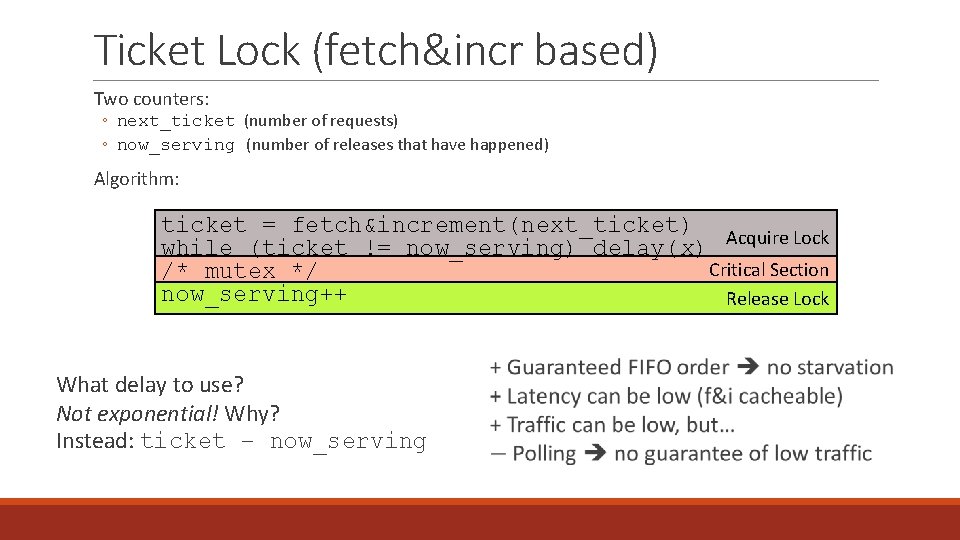
Ticket Lock (fetch&incr based) Two counters: ◦ next_ticket (number of requests) ◦ now_serving (number of releases that have happened) Algorithm: ticket = fetch&increment(next_ticket) Acquire Lock while (ticket != now_serving) delay(x) Critical Section /* mutex */ now_serving++ Release Lock What delay to use? Not exponential! Why? Instead: ticket – now_serving
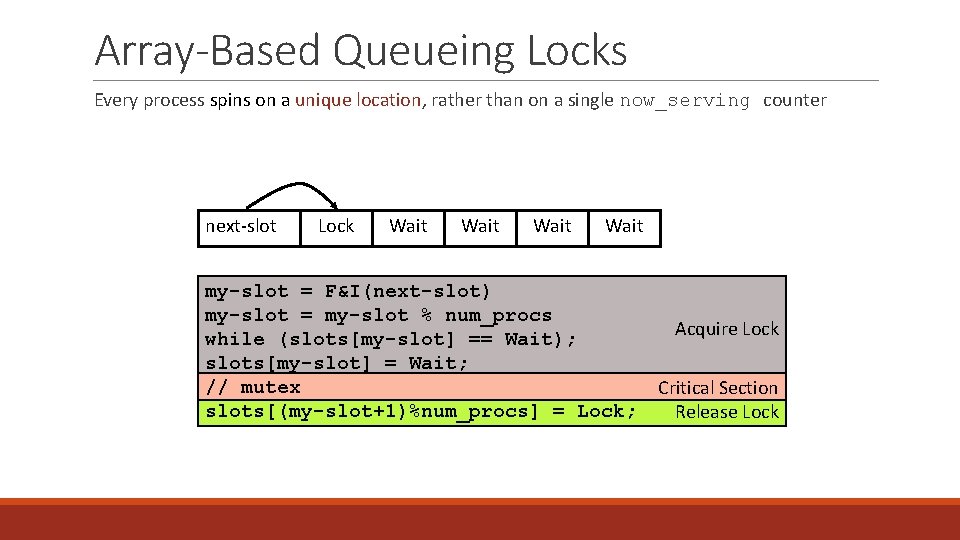
Array-Based Queueing Locks Every process spins on a unique location, rather than on a single now_serving counter next-slot Lock Wait my-slot = F&I(next-slot) my-slot = my-slot % num_procs while (slots[my-slot] == Wait); slots[my-slot] = Wait; // mutex slots[(my-slot+1)%num_procs] = Lock; Acquire Lock Critical Section Release Lock
List-Base Queueing Locks (MCS) All other good things + O(1) traffic even without coherent caches (spin locally) Uses compare&swap to build linked lists in software Locally-allocated flag per list node to spin on Can work with fetch&store, but loses FIFO guarantee Tradeoffs: (+) less storage than array-based locks (+) O(1) traffic even without coherent caches (-) compare&swap not easy to implement (three read-register operands)

Barriers
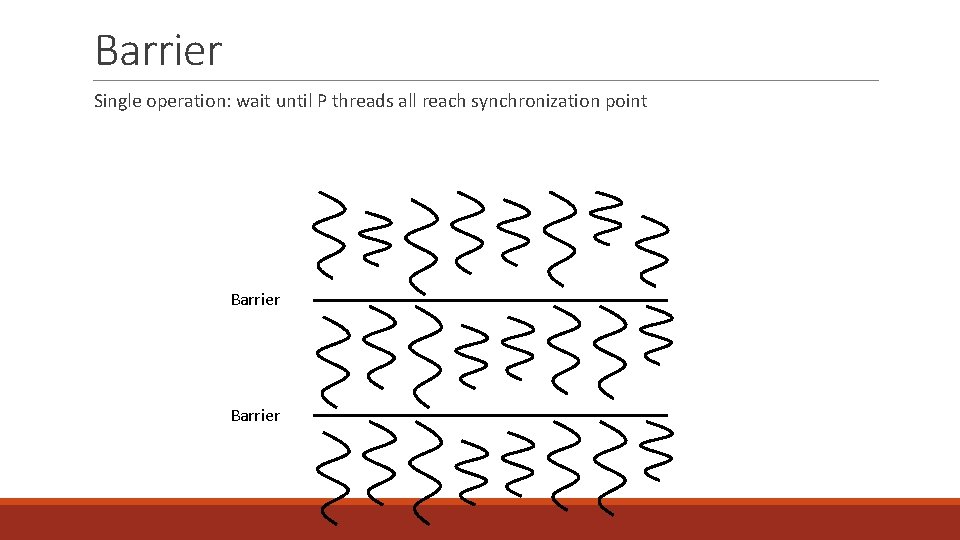
Barrier Single operation: wait until P threads all reach synchronization point Barrier
Barriers We will discuss five barriers: ◦ ◦ ◦ centralized software combining tree dissemination barrier tournament barrier MCS tree-based barrier
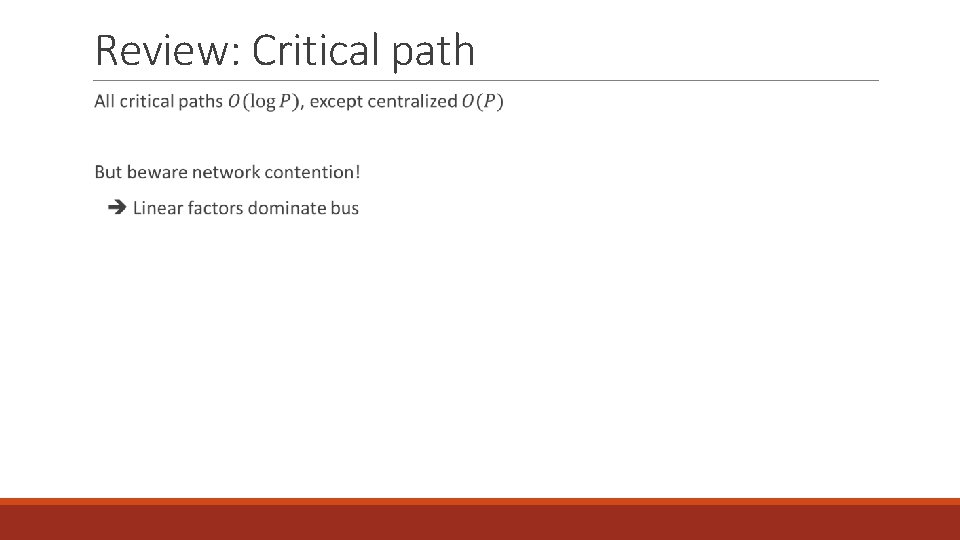
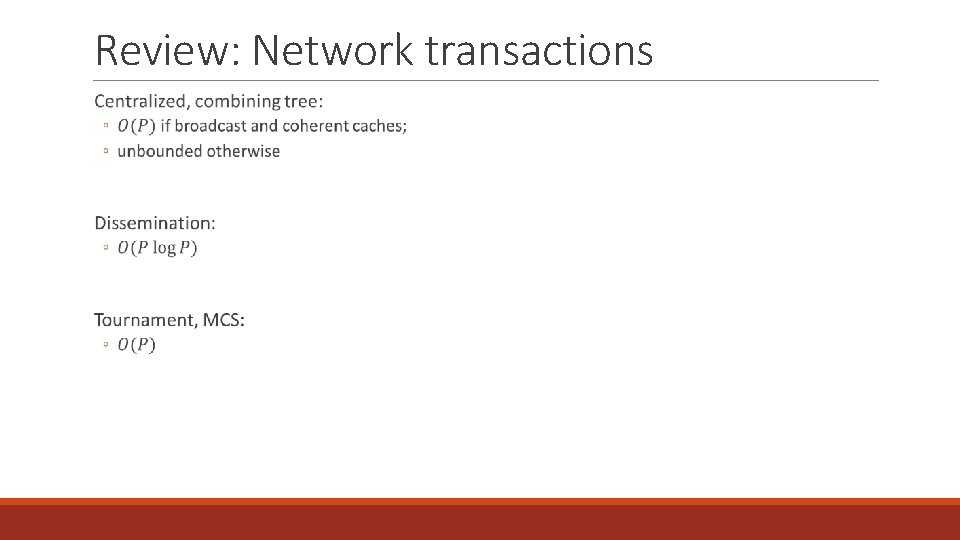
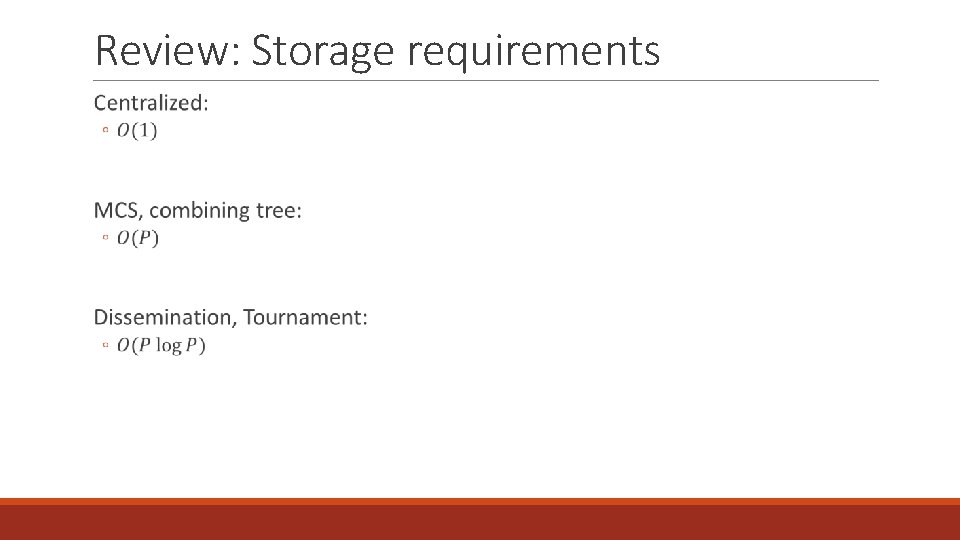
Barrier Criteria Length of critical path ◦ Determines performance on scalable network Total network communication ◦ Determines performance on non-scalable network (e. g. , bus) Storage requirements Implementation requirements (e. g. , atomic ops)
Critical Path Length Analysis assumes independent parallel network paths available May not apply in some systems ◦ Eg, communication serializes on bus ◦ In this case, total communication dominates critical path More generally, network contention can lengthen critical path
Centralized Barrier Basic idea: ◦ Notify a single shared counter when you arrive ◦ Poll that shared location until all have arrived ◦ Implemented using atomic fetch & op on counter
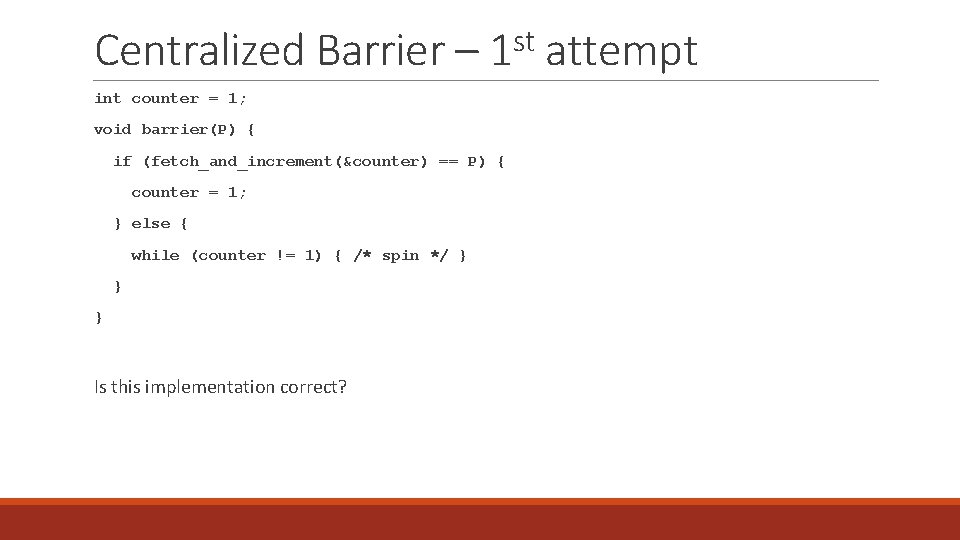
Centralized Barrier – st 1 int counter = 1; void barrier(P) { if (fetch_and_increment(&counter) == P) { counter = 1; } else { while (counter != 1) { /* spin */ } } } Is this implementation correct? attempt
Centralized Barrier Basic idea: ◦ Notify a single shared counter when you arrive ◦ Poll that shared location until all have arrived ◦ Implemented using atomic fetch & decrement on counter Simple solution requires polling/spinning twice: ◦ First to ensure that all procs have left previous barrier ◦ Second to ensure that all procs have arrived at current barrier
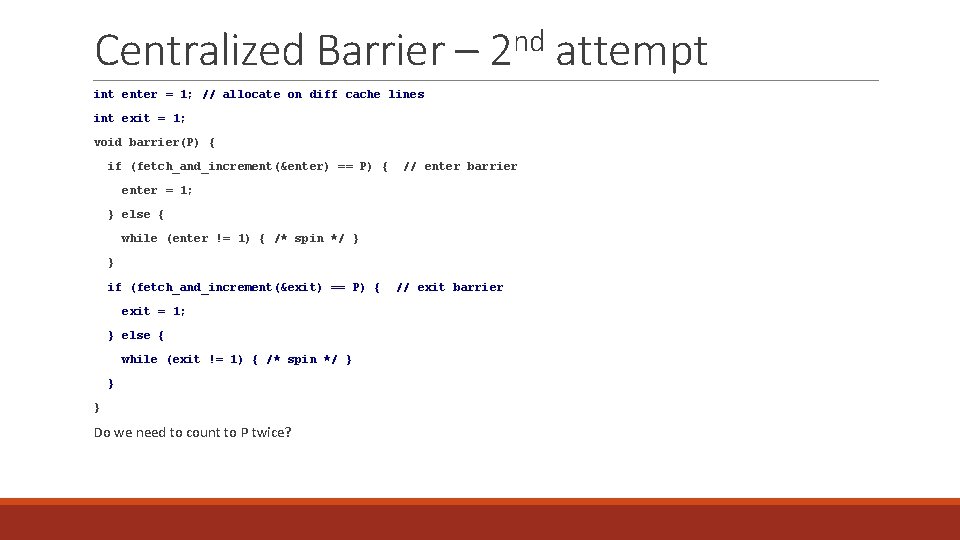
Centralized Barrier – nd 2 int enter = 1; // allocate on diff cache lines int exit = 1; void barrier(P) { if (fetch_and_increment(&enter) == P) { enter = 1; } else { while (enter != 1) { /* spin */ } } if (fetch_and_increment(&exit) == P) { exit = 1; } else { // enter barrier while (exit != 1) { /* spin */ } } } Do we need to count to P twice? // exit barrier attempt
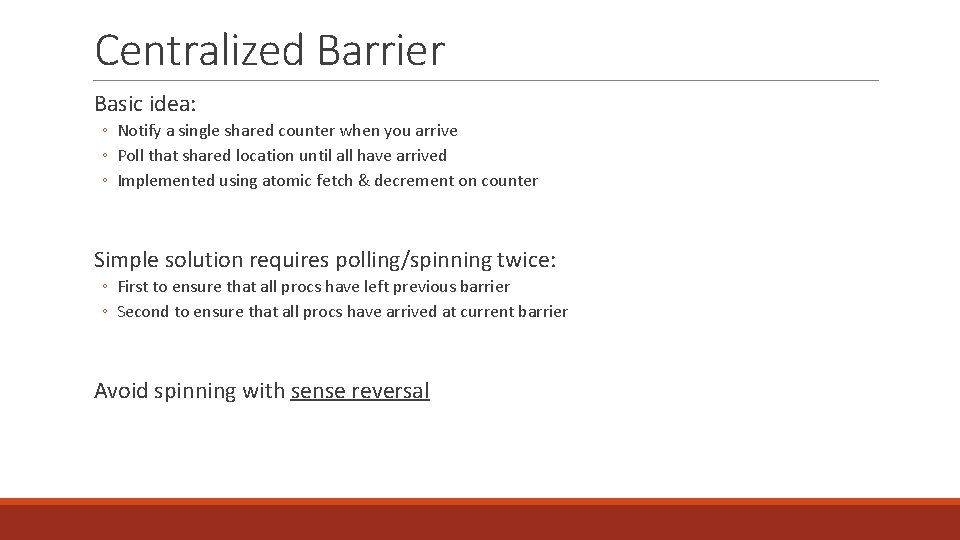
Centralized Barrier Basic idea: ◦ Notify a single shared counter when you arrive ◦ Poll that shared location until all have arrived ◦ Implemented using atomic fetch & decrement on counter Simple solution requires polling/spinning twice: ◦ First to ensure that all procs have left previous barrier ◦ Second to ensure that all procs have arrived at current barrier Avoid spinning with sense reversal
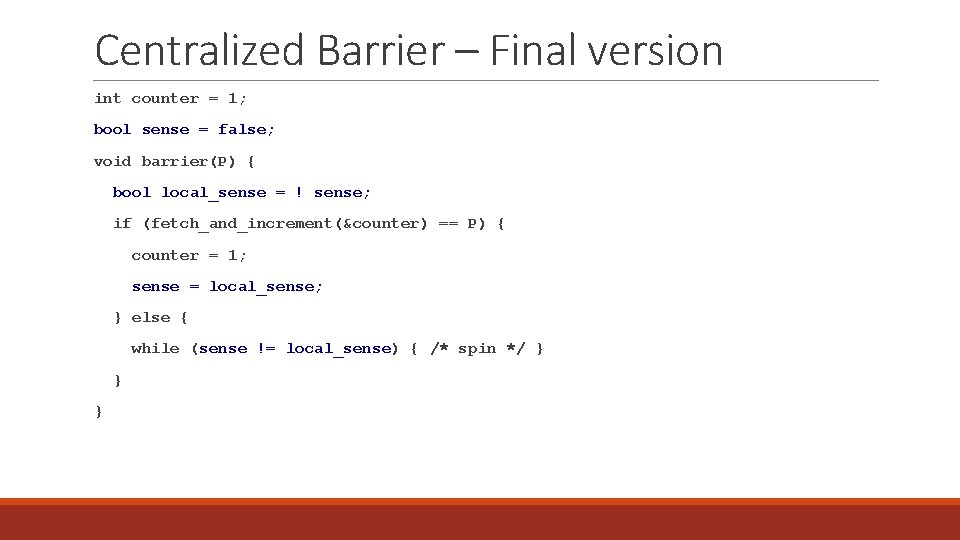
Centralized Barrier – Final version int counter = 1; bool sense = false; void barrier(P) { bool local_sense = ! sense; if (fetch_and_increment(&counter) == P) { counter = 1; sense = local_sense; } else { } while (sense != local_sense) { /* spin */ } }
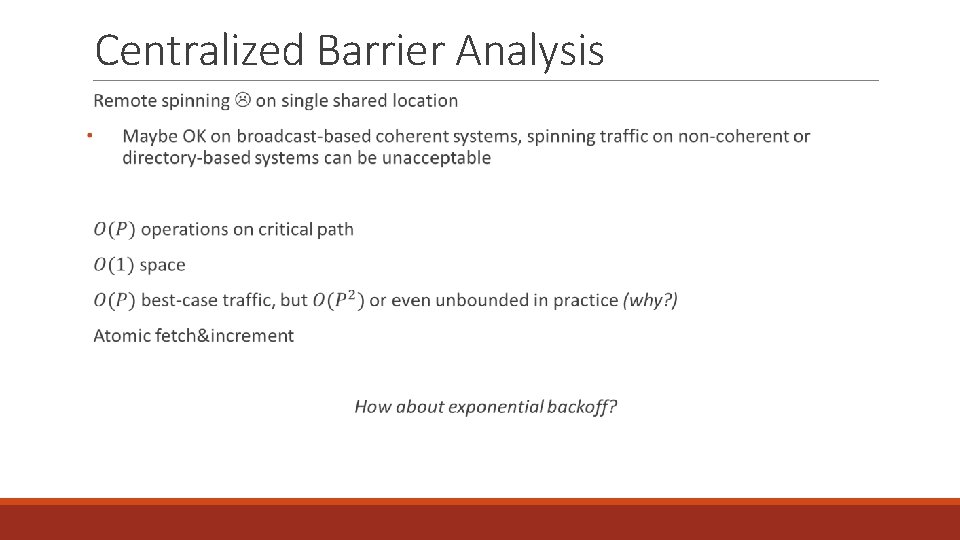
Centralized Barrier Analysis
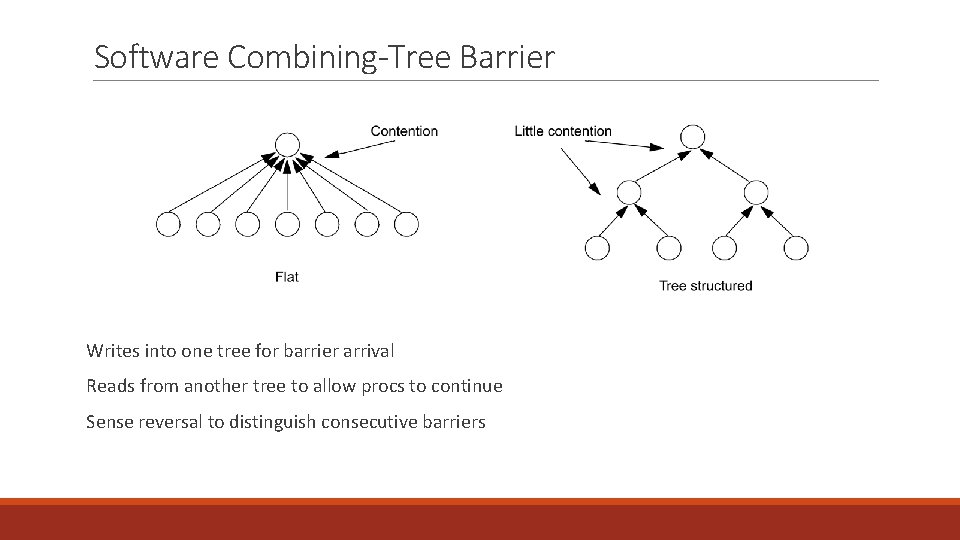
Software Combining-Tree Barrier Writes into one tree for barrier arrival Reads from another tree to allow procs to continue Sense reversal to distinguish consecutive barriers
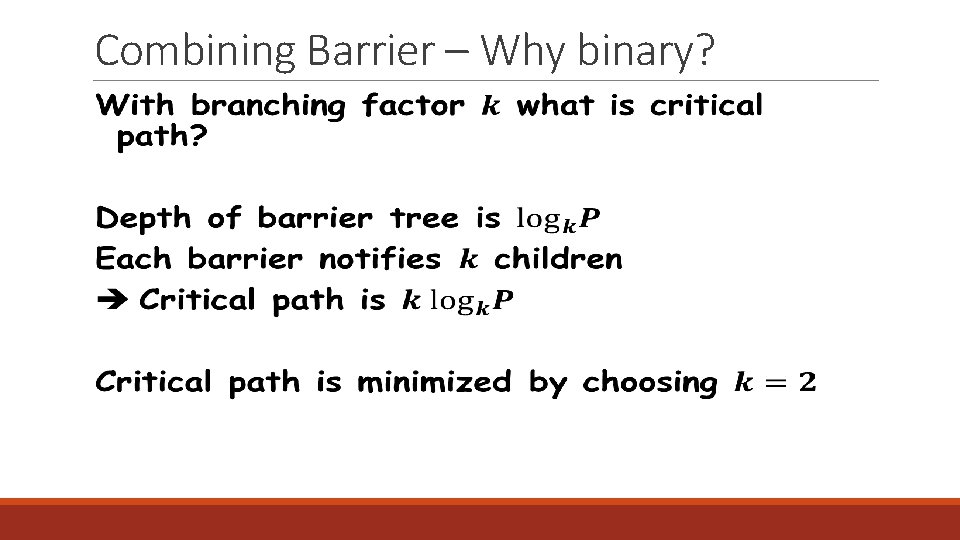
Combining Barrier – Why binary?
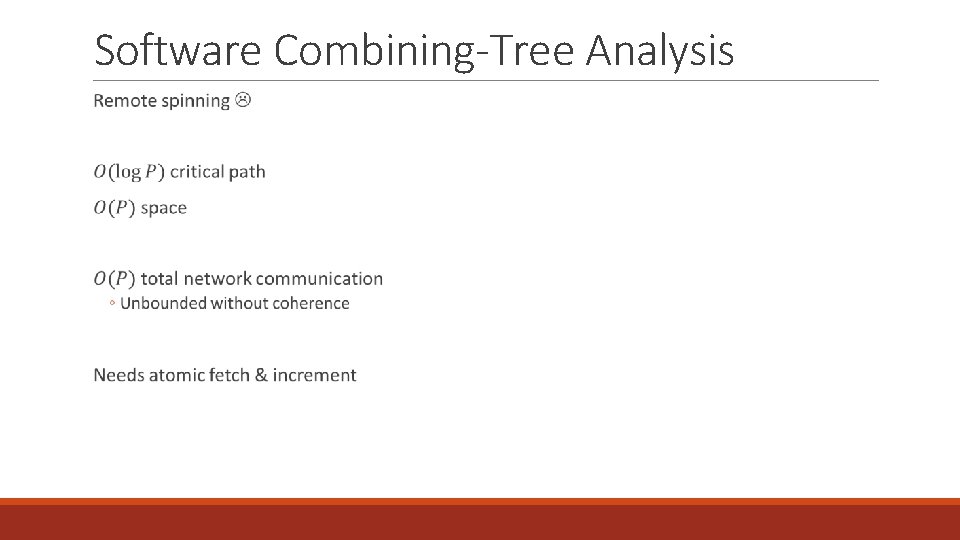
Software Combining-Tree Analysis
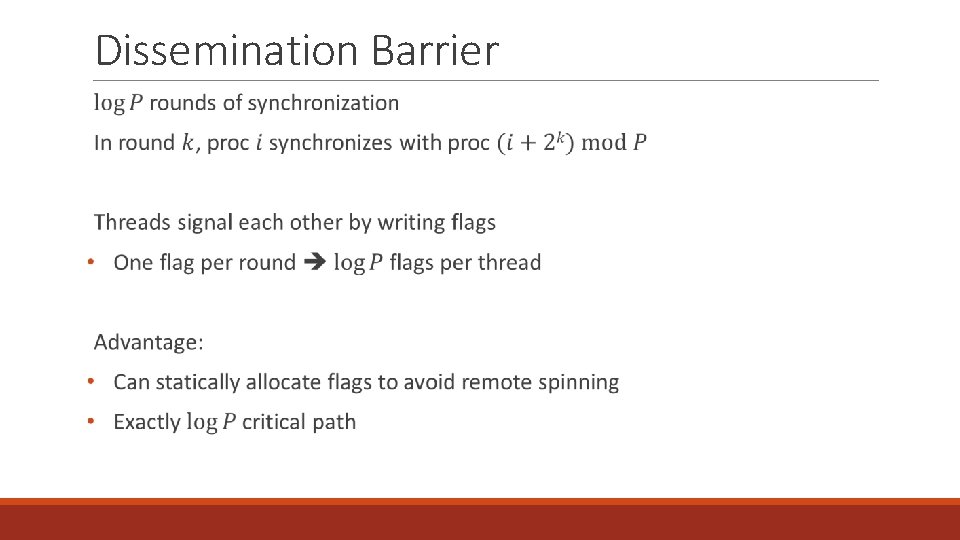
Dissemination Barrier
Dissemination Barrier with P=5 Barrier ? ? ?
Dissemination Barrier with P=5 Barrier
Dissemination Barrier with P=5 Barrier
Dissemination Barrier with P=5 Barrier
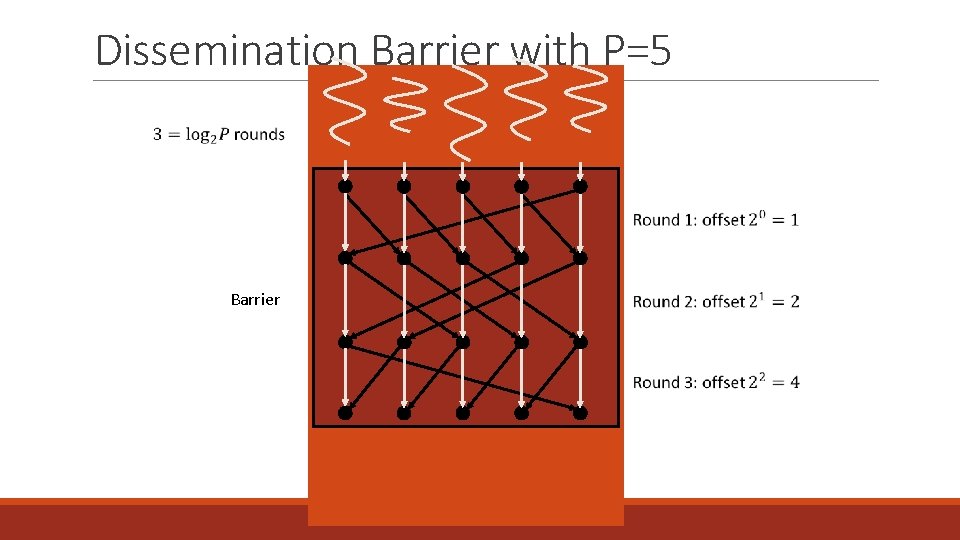
Dissemination Barrier with P=5 Barrier
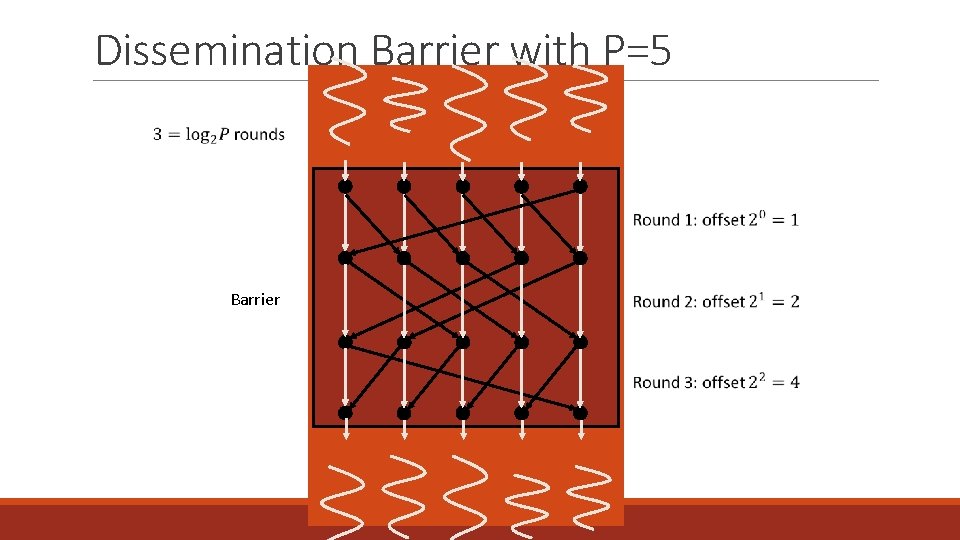
Dissemination Barrier with P=5 Barrier
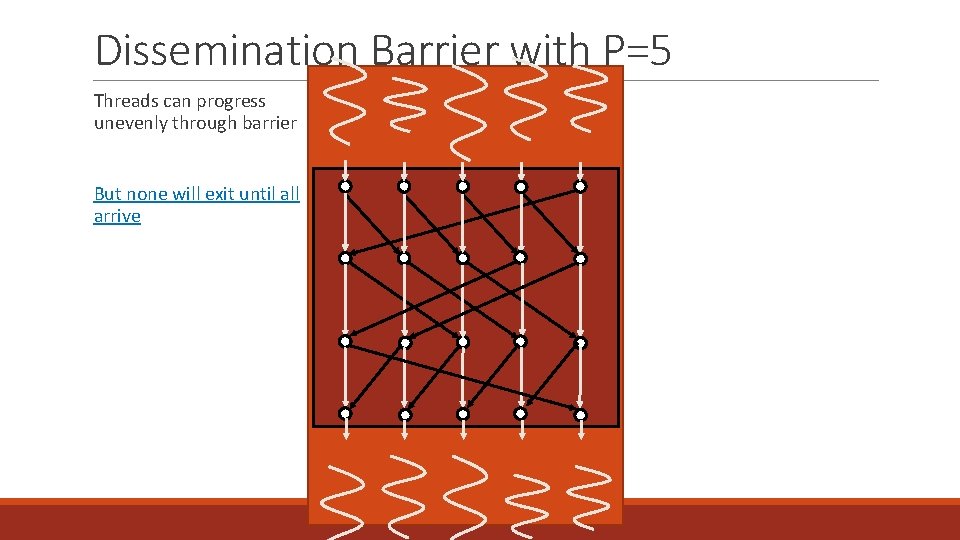
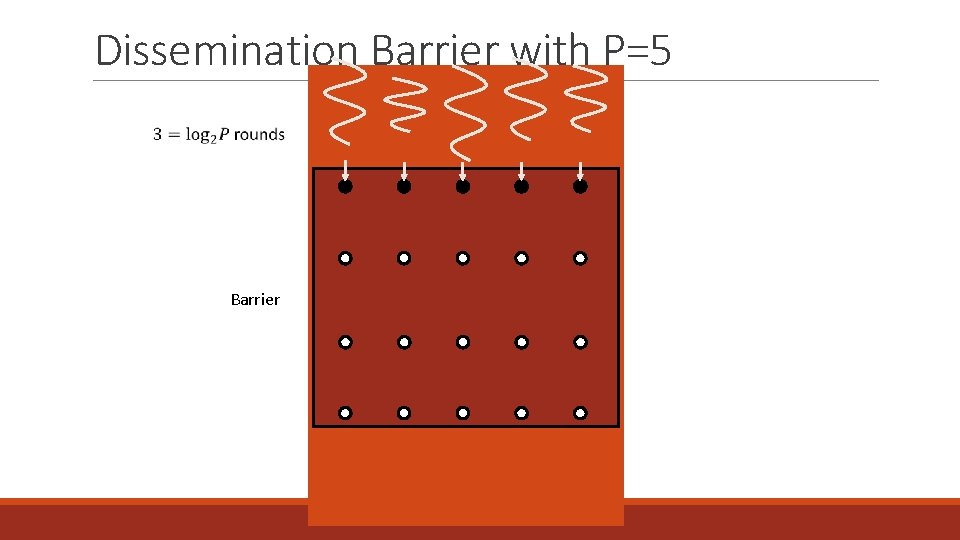
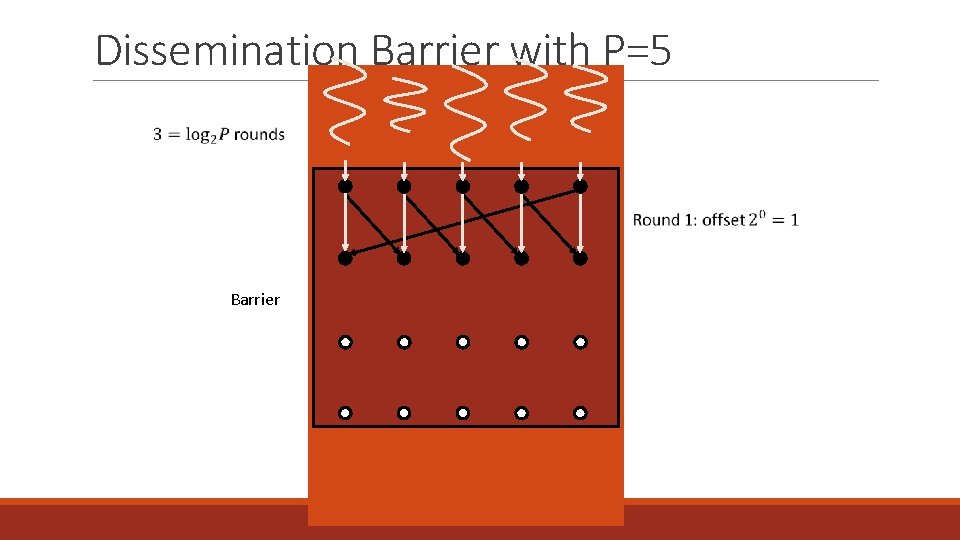
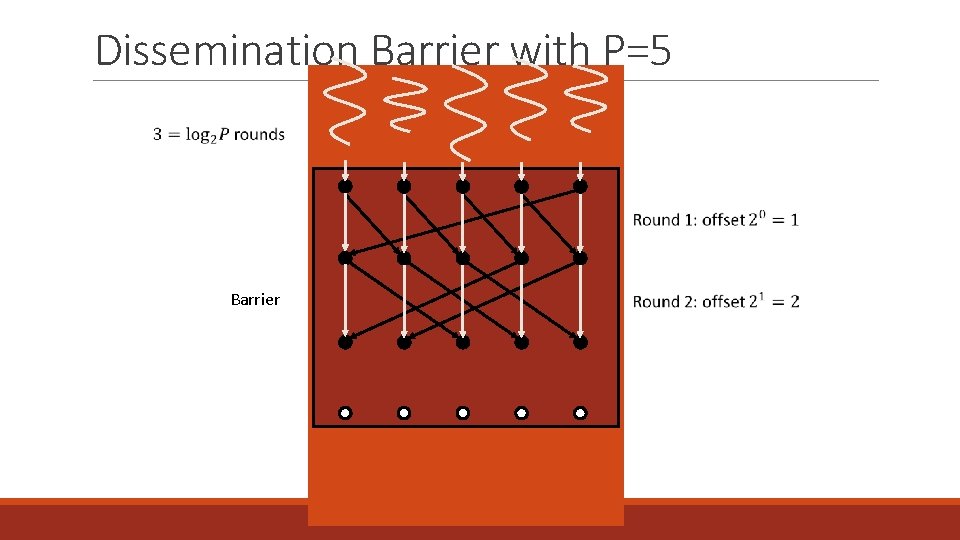
Dissemination Barrier with P=5 Threads can progress unevenly through barrier But none will exit until all arrive
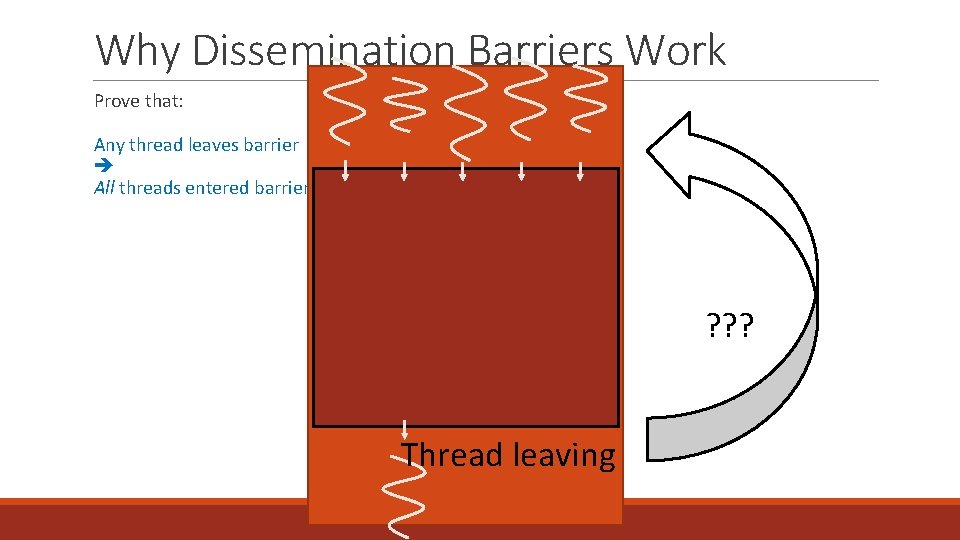
Why Dissemination Barriers Work Prove that: Any thread leaves barrier All threads entered barrier ? ? ? Thread leaving
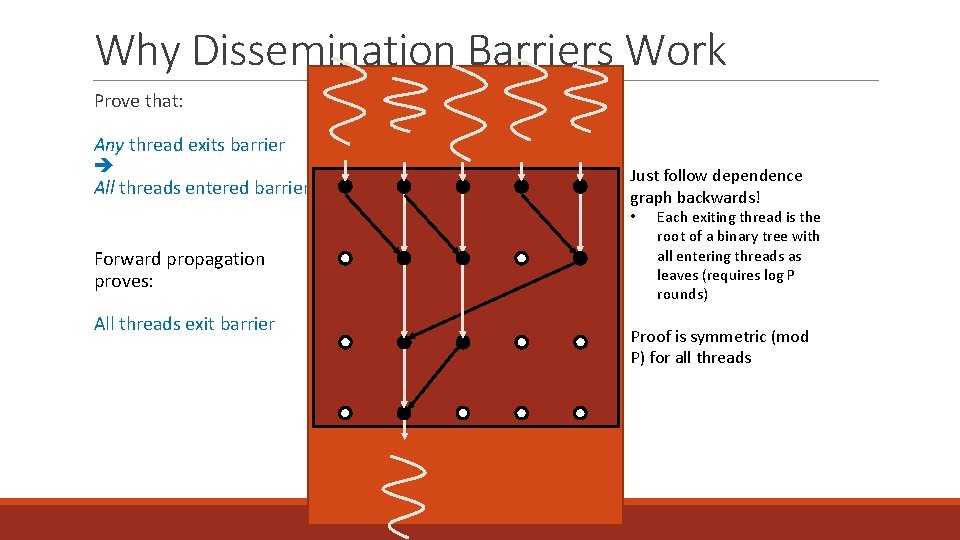
Why Dissemination Barriers Work Prove that: Any thread exits barrier All threads entered barrier Just follow dependence graph backwards! • Forward propagation proves: All threads exit barrier Each exiting thread is the root of a binary tree with all entering threads as leaves (requires log P rounds) Proof is symmetric (mod P) for all threads
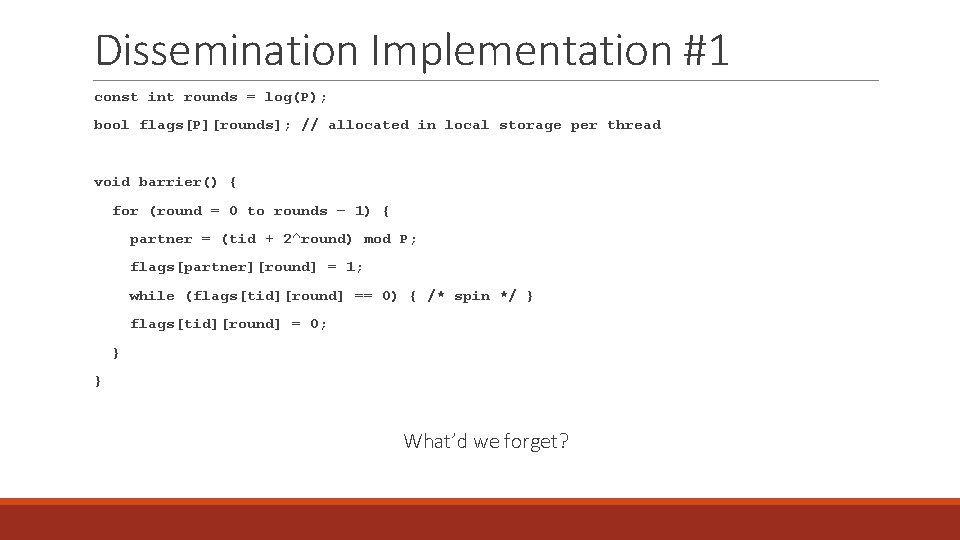
Dissemination Implementation #1 const int rounds = log(P); bool flags[P][rounds]; // allocated in local storage per thread void barrier() { for (round = 0 to rounds – 1) { partner = (tid + 2^round) mod P; flags[partner][round] = 1; while (flags[tid][round] == 0) { /* spin */ } flags[tid][round] = 0; } } What’d we forget?
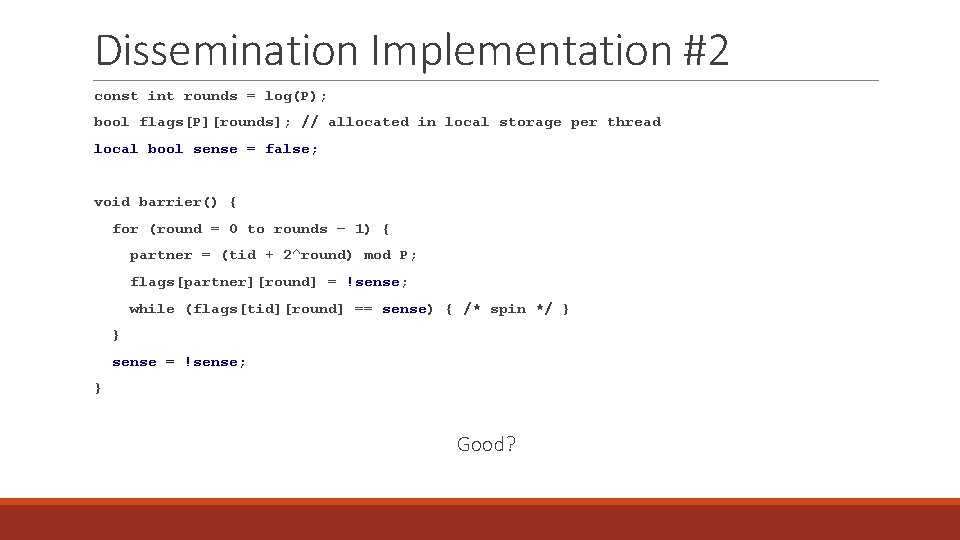
Dissemination Implementation #2 const int rounds = log(P); bool flags[P][rounds]; // allocated in local storage per thread local bool sense = false; void barrier() { for (round = 0 to rounds – 1) { partner = (tid + 2^round) mod P; flags[partner][round] = !sense; while (flags[tid][round] == sense) { /* spin */ } } sense = !sense; } Good?
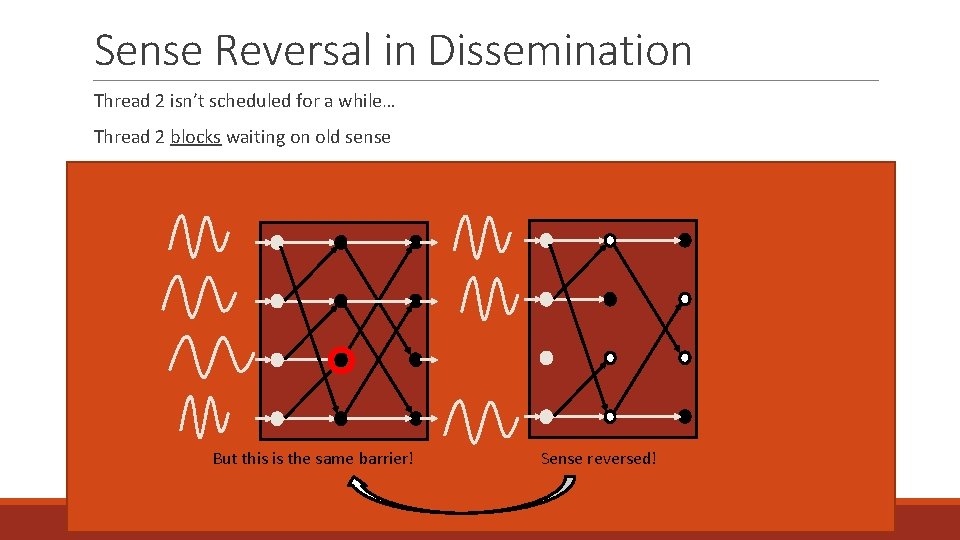
Sense Reversal in Dissemination Thread 2 isn’t scheduled for a while… Thread 2 blocks waiting on old sense But this is the same barrier! Sense reversed!
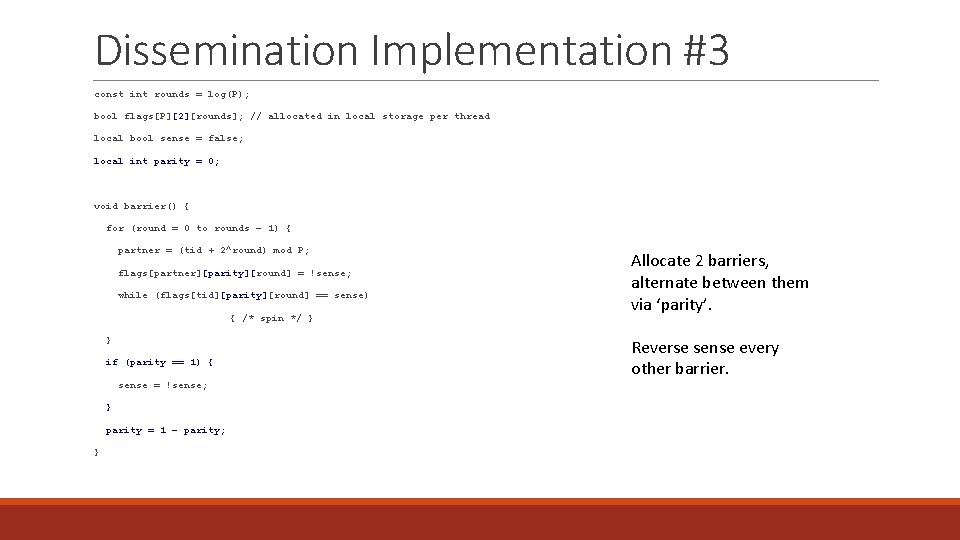
Dissemination Implementation #3 const int rounds = log(P); bool flags[P][2][rounds]; // allocated in local storage per thread local bool sense = false; local int parity = 0; void barrier() { for (round = 0 to rounds – 1) { partner = (tid + 2^round) mod P; flags[partner][parity][round] = !sense; while (flags[tid][parity][round] == sense) { /* spin */ } } if (parity == 1) { sense = !sense; } parity = 1 – parity; } Allocate 2 barriers, alternate between them via ‘parity’. Reverse sense every other barrier.
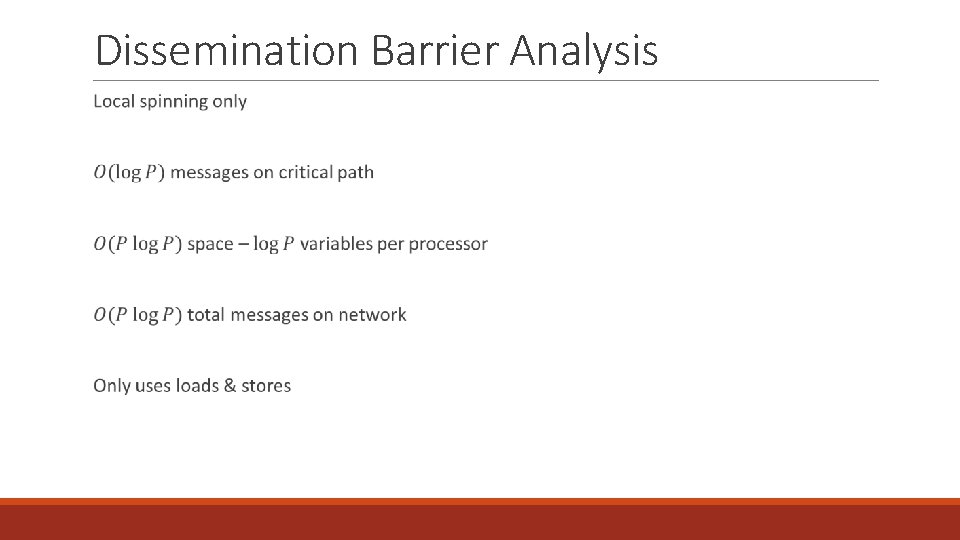
Dissemination Barrier Analysis
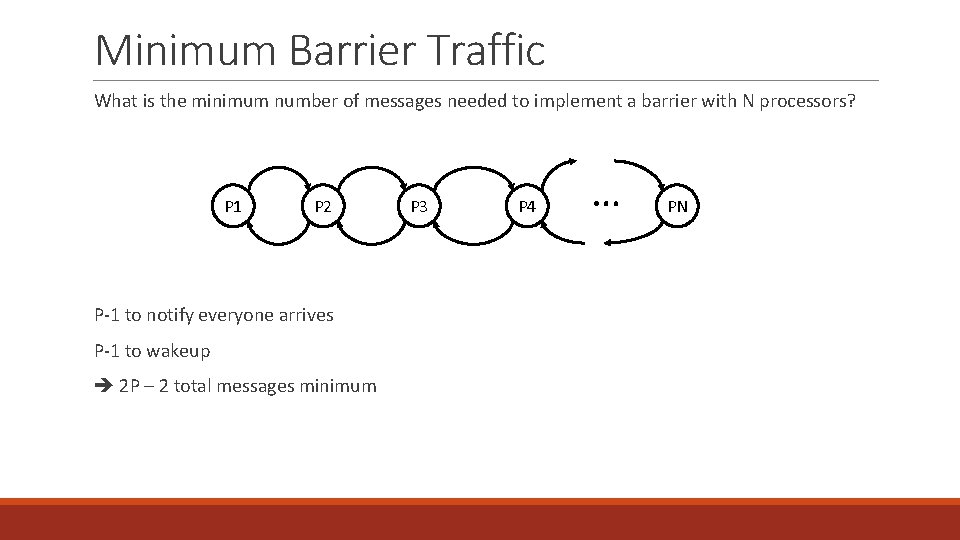
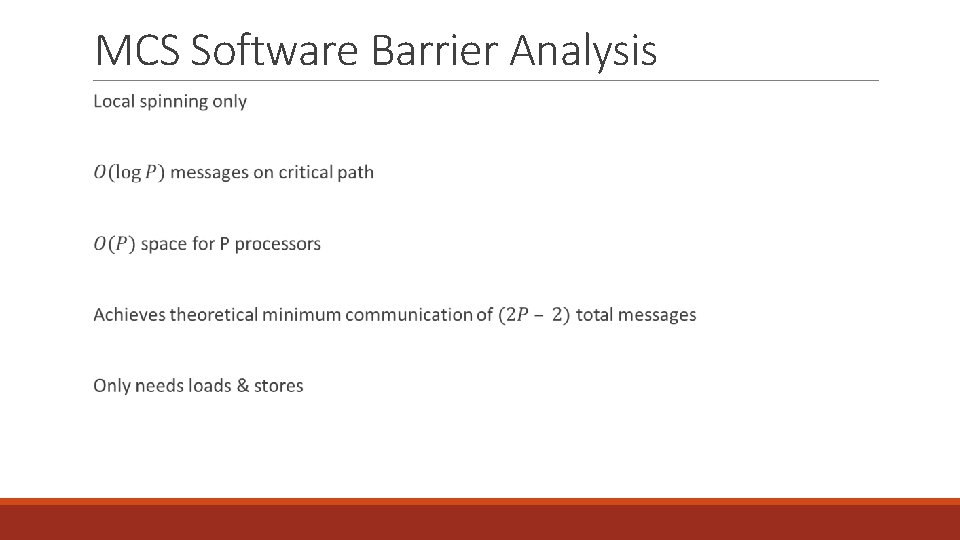
Minimum Barrier Traffic What is the minimum number of messages needed to implement a barrier with N processors? P 1 P 2 P-1 to notify everyone arrives P-1 to wakeup 2 P – 2 total messages minimum P 3 P 4 … PN
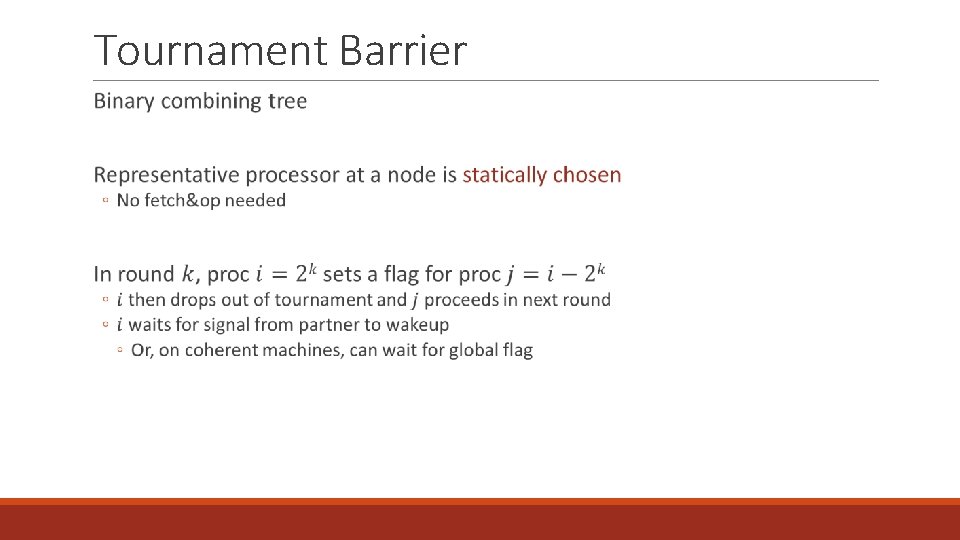
Tournament Barrier
Tournament Barrier with P=8
Tournament Barrier with P=8
Tournament Barrier with P=8
Tournament Barrier with P=8
Tournament Barrier with P=8
Tournament Barrier with P=8
Tournament Barrier with P=8
Tournament Barrier with P=8
Tournament Barrier with P=8
Tournament Barrier with P=8
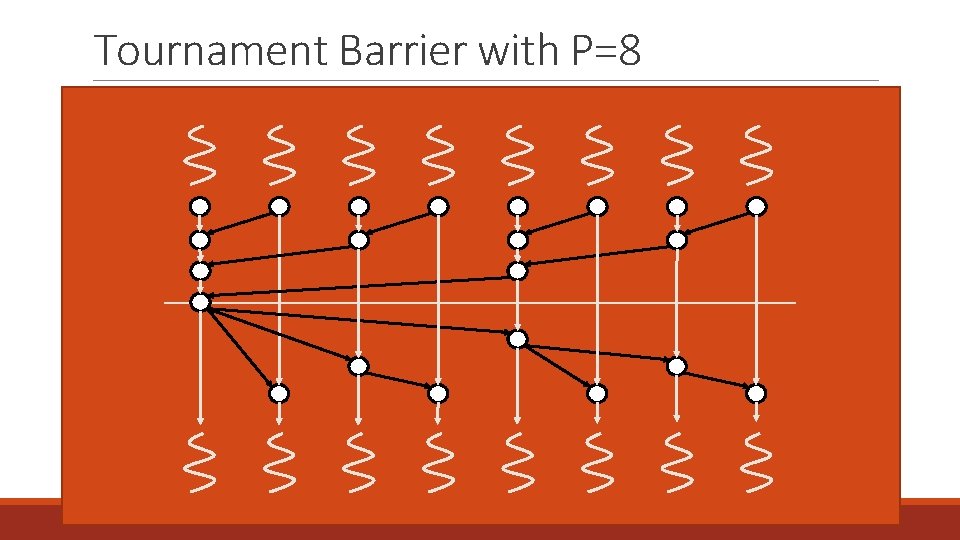
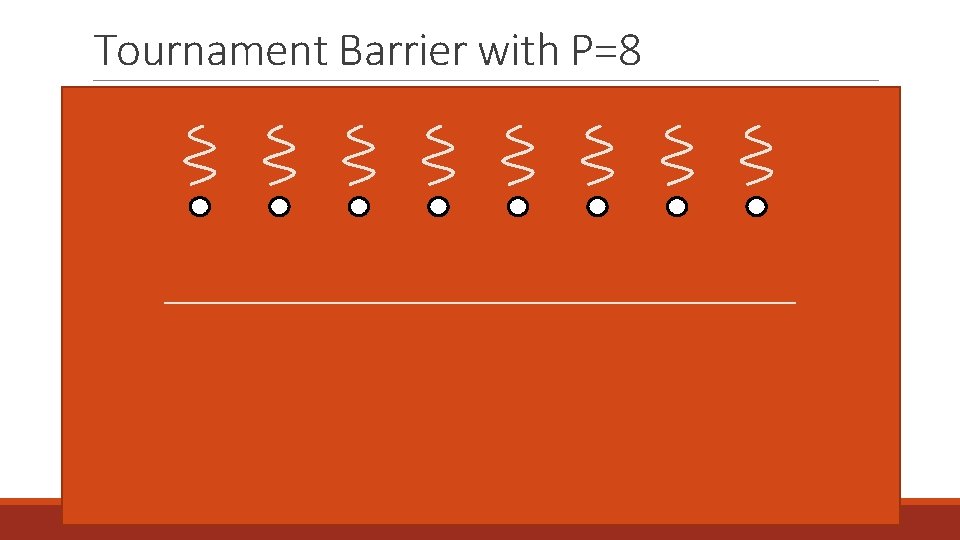
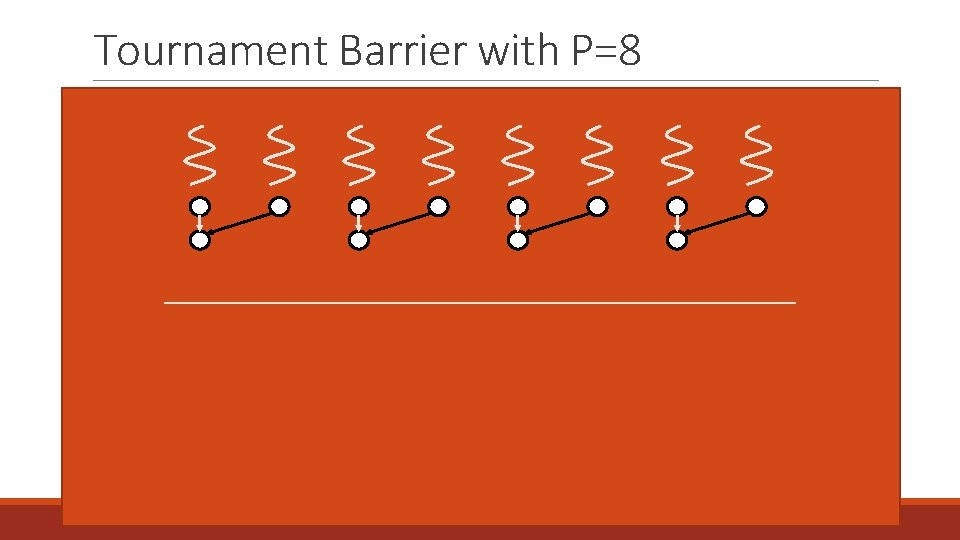
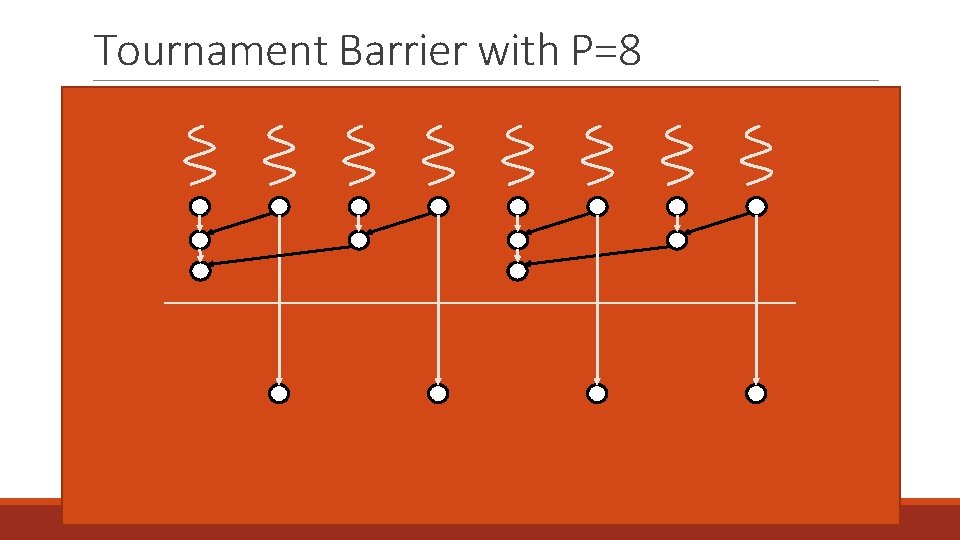
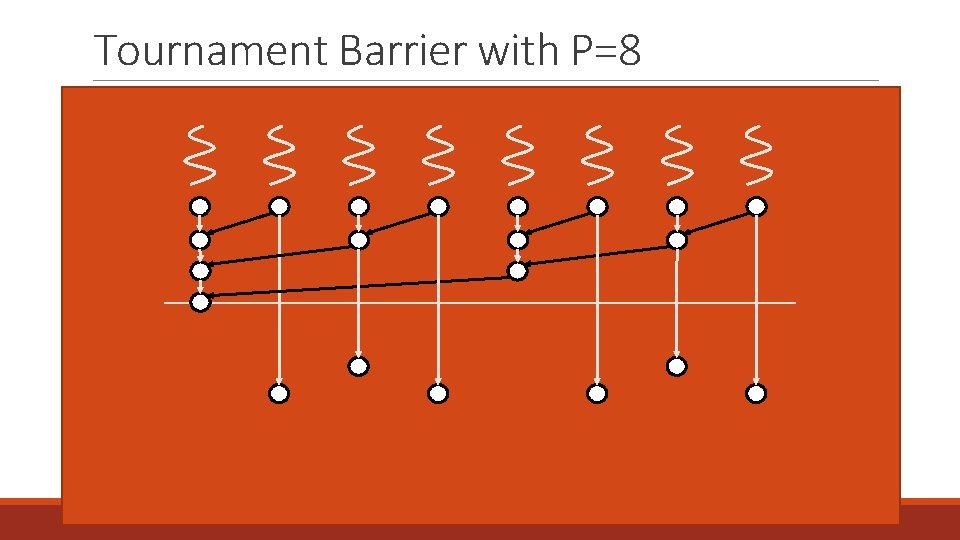
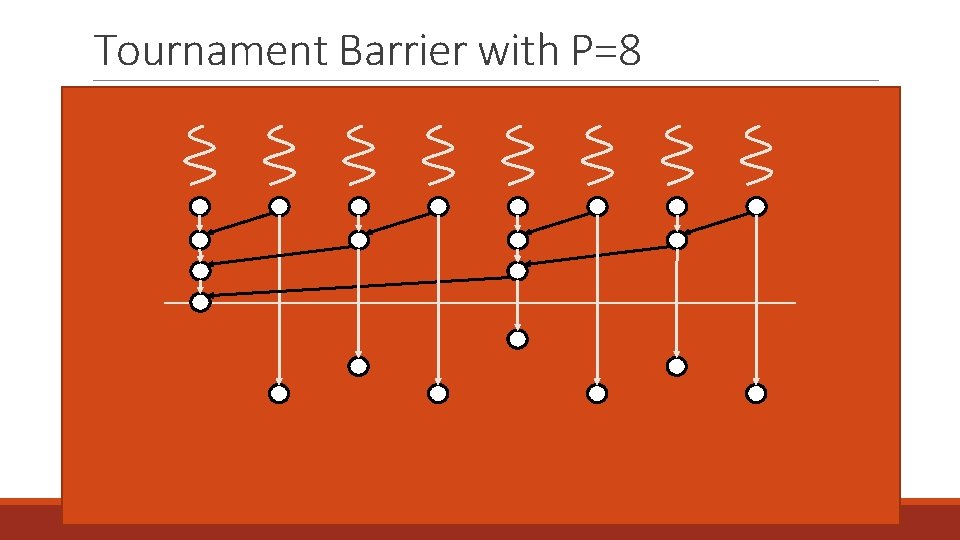
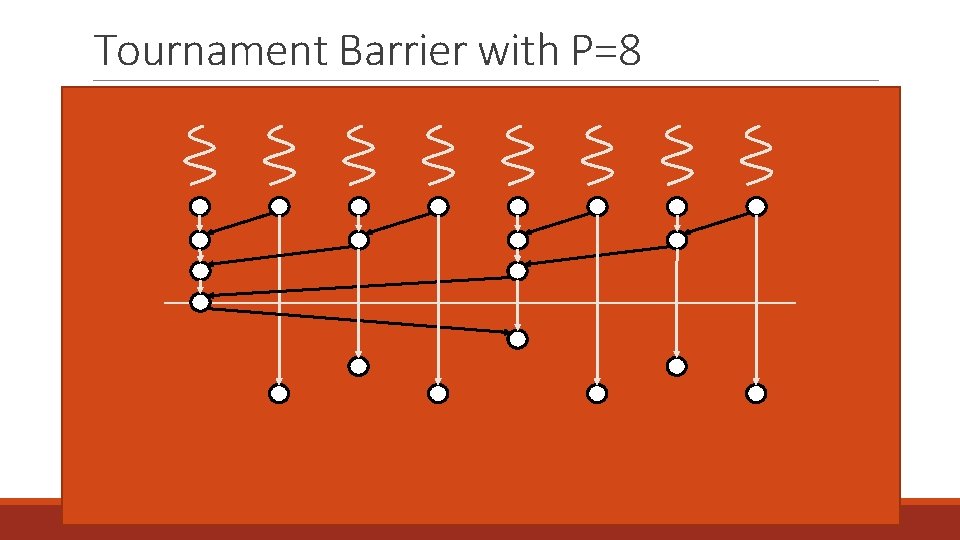
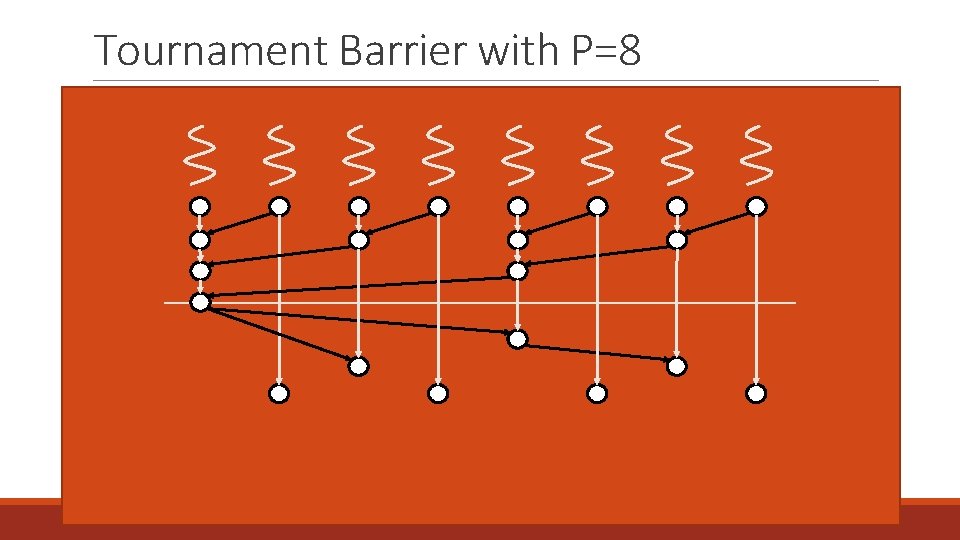
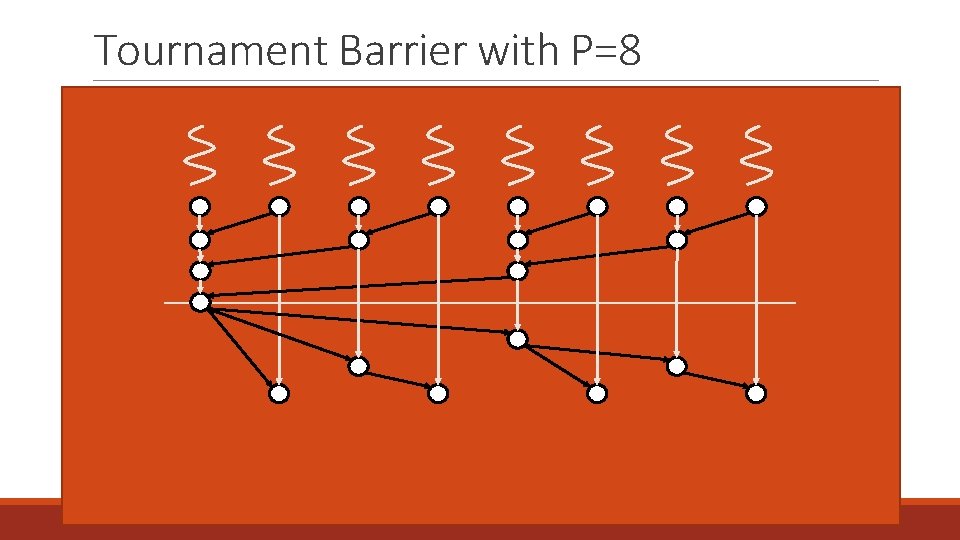
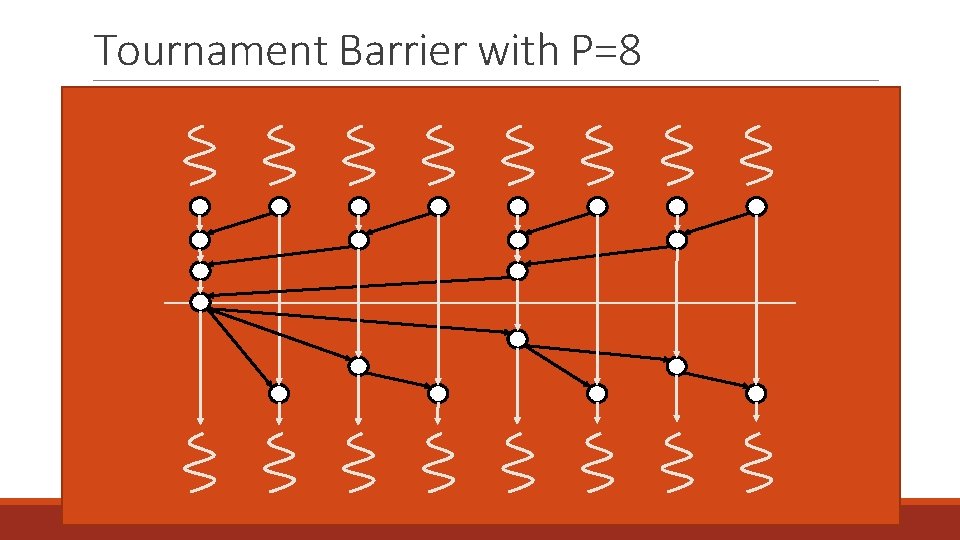
Why Tournament Barrier Works As before, threads can progress at different rates through tree Easy to show correctness: ◦ Tournament root must unblock for any thread to exit barrier ◦ Root depends on all threads (leaves of tree) Implemented by two loops, up & down tree Depth encoded by first 1 in thread id bits
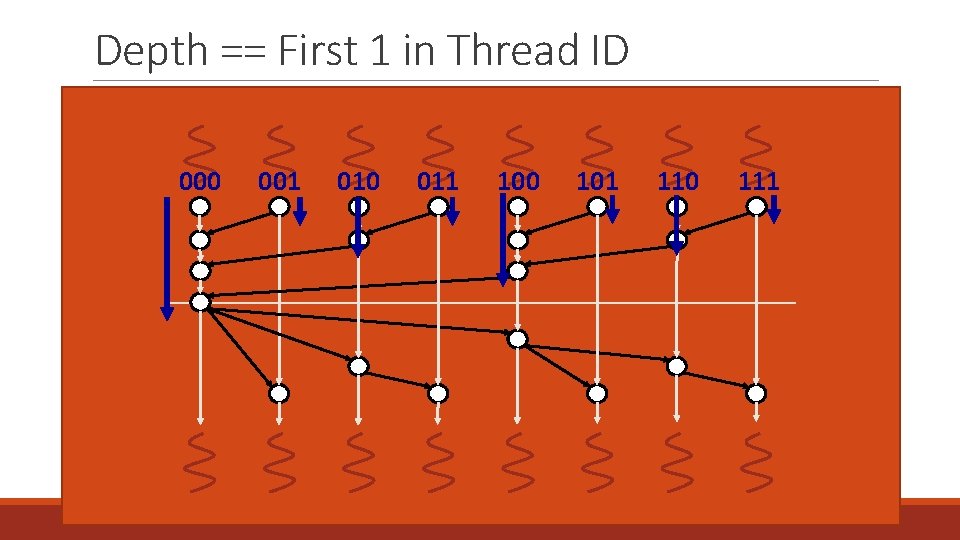
Depth == First 1 in Thread ID 000 001 010 011 100 101 110 111
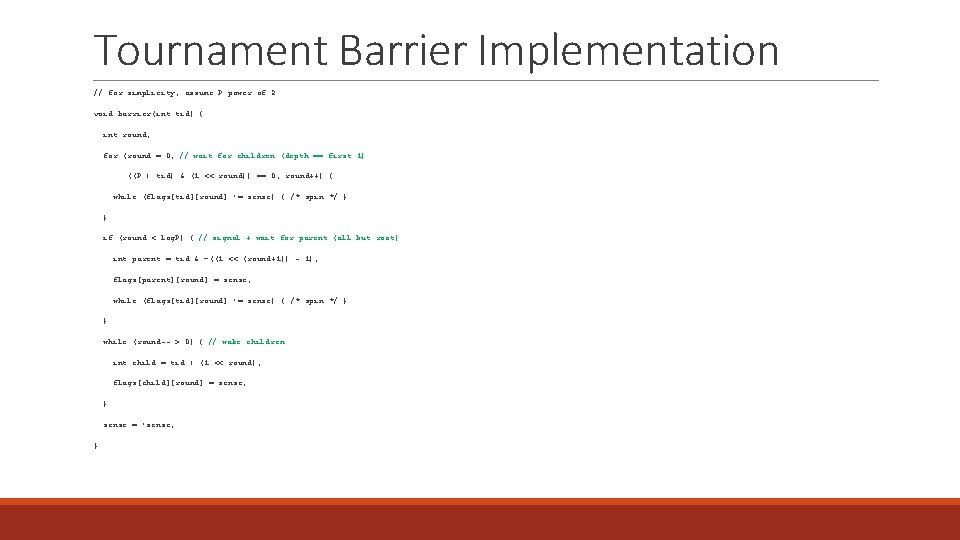
Tournament Barrier Implementation // for simplicity, assume P power of 2 void barrier(int tid) { int round; for (round = 0; // wait for children (depth == first 1) ((P | tid) & (1 << round)) == 0; round++) { while (flags[tid][round] != sense) { /* spin */ } } if (round < log. P) { // signal + wait for parent (all but root) int parent = tid & ~((1 << (round+1)) - 1); flags[parent][round] = sense; while (flags[tid][round] != sense) { /* spin */ } } while (round-- > 0) { // wake children int child = tid | (1 << round); flags[child][round] = sense; } sense = !sense; }
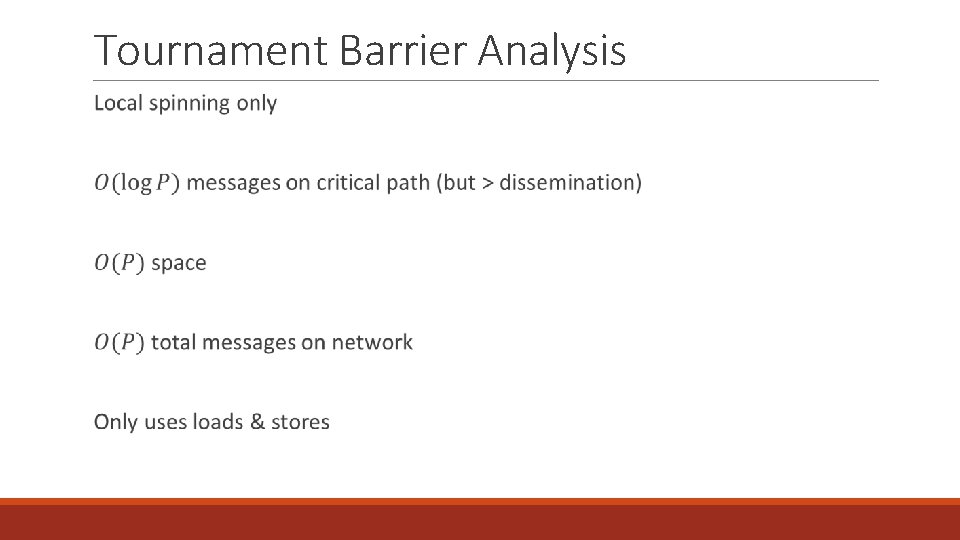
Tournament Barrier Analysis
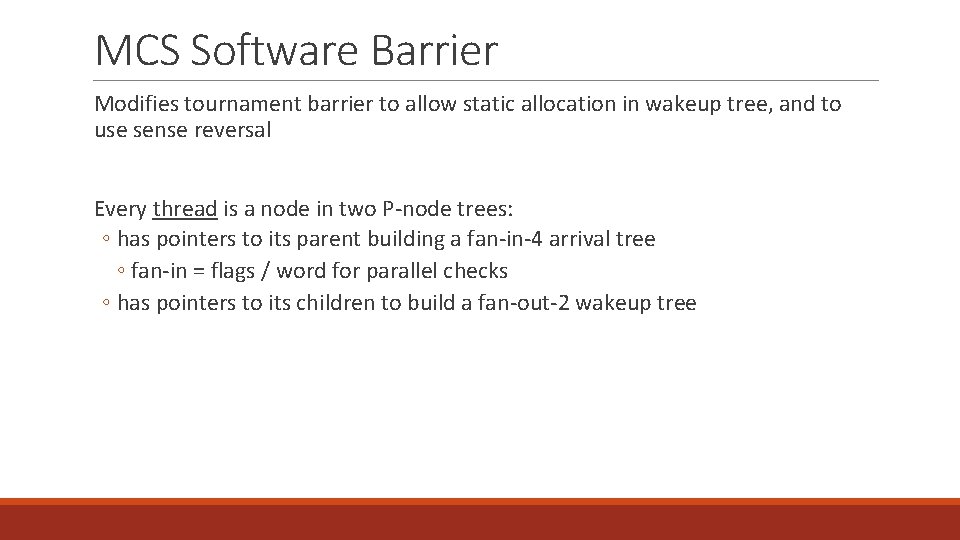
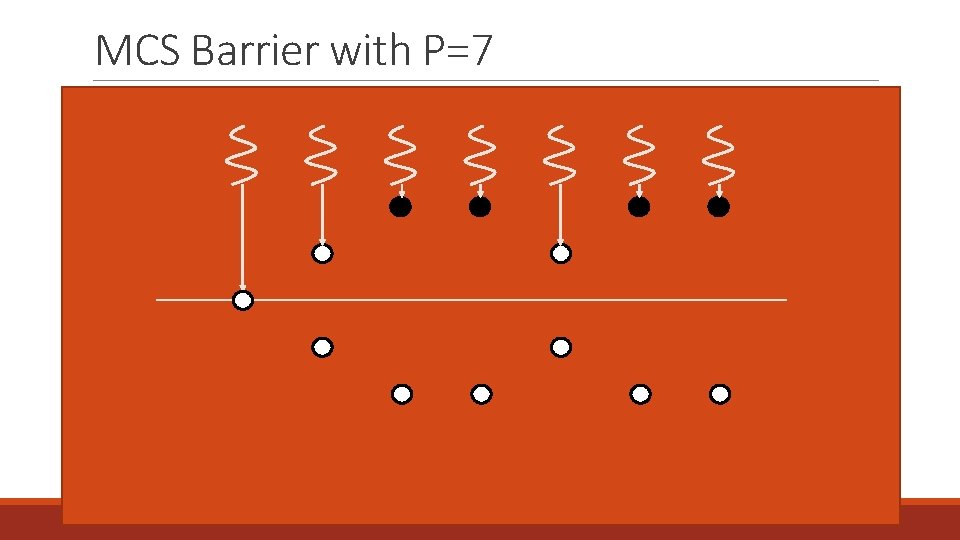
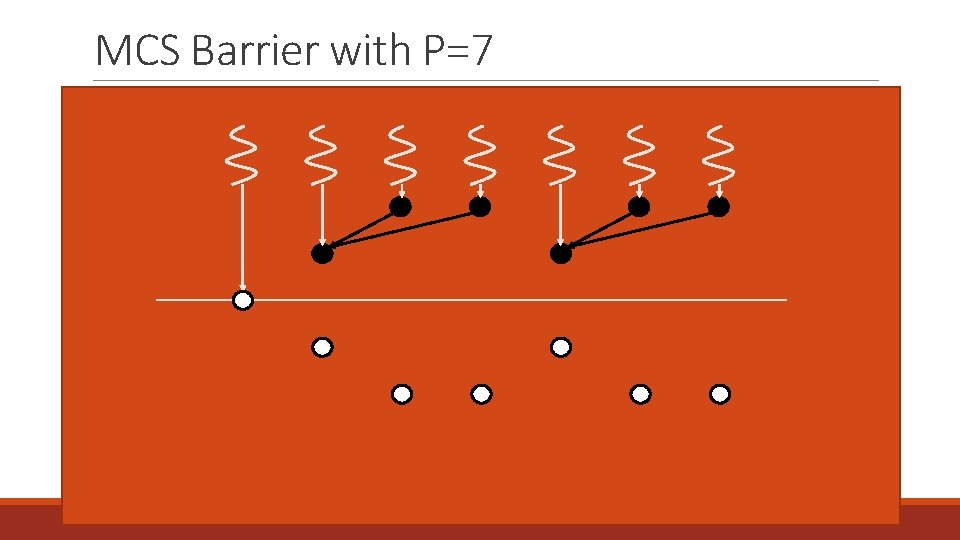
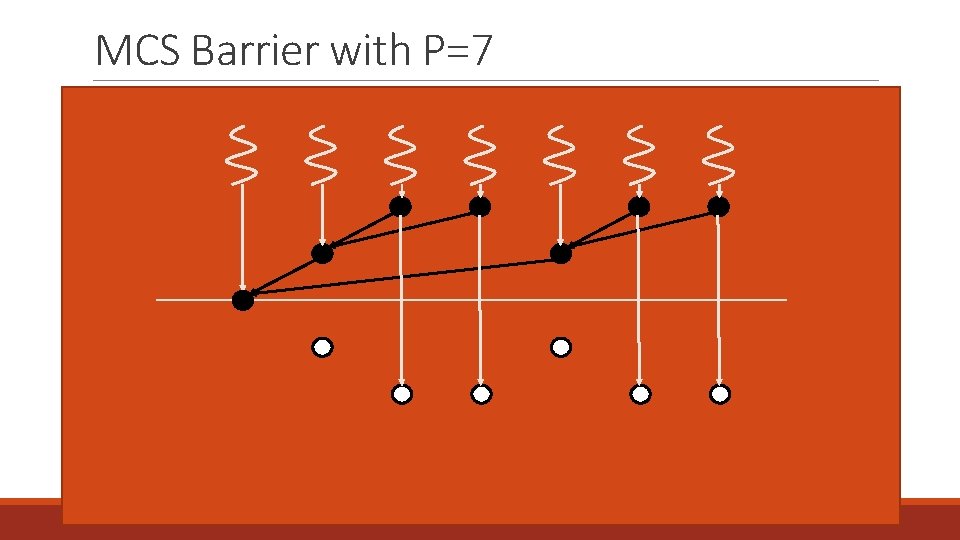
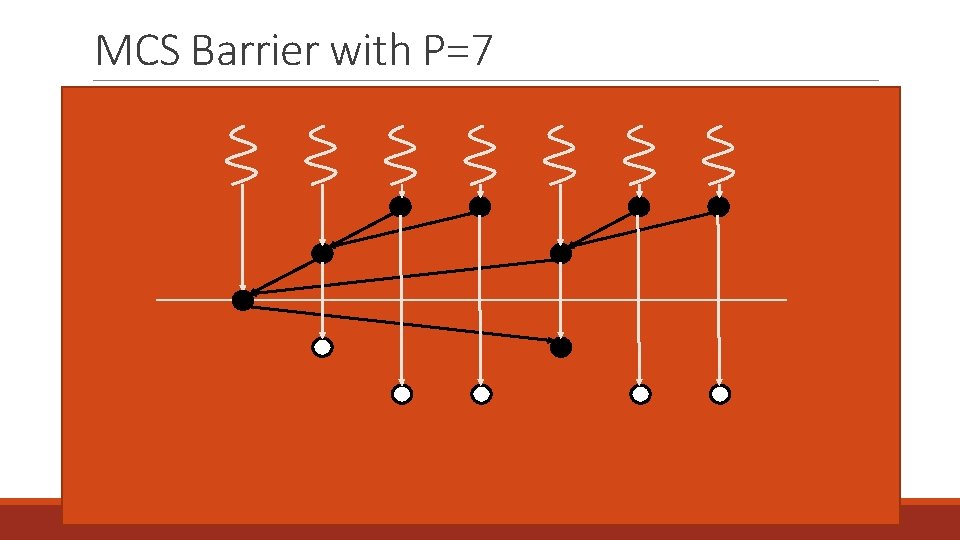
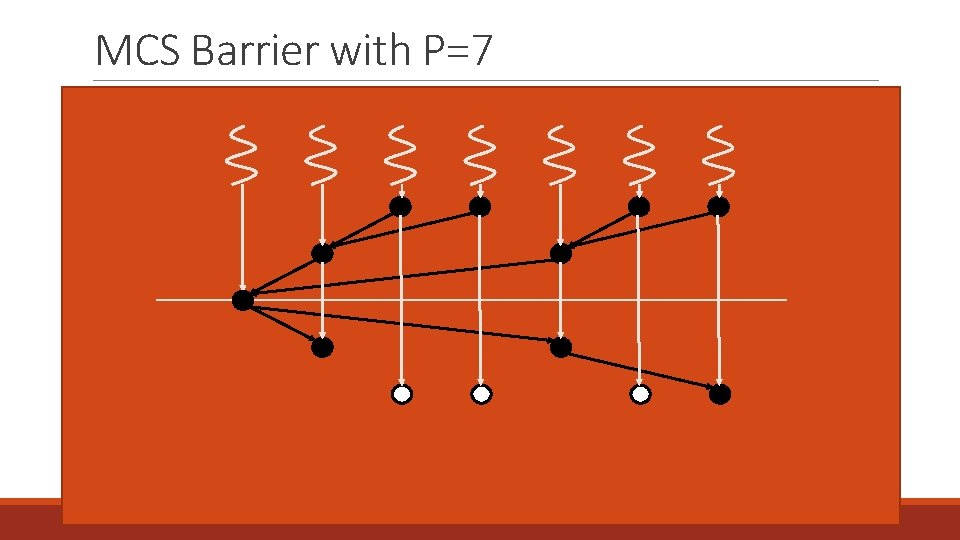
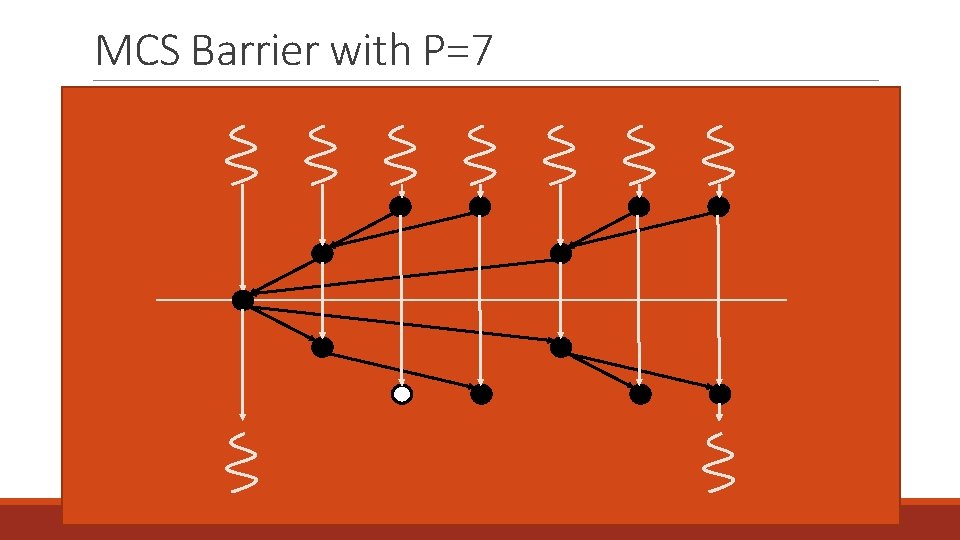
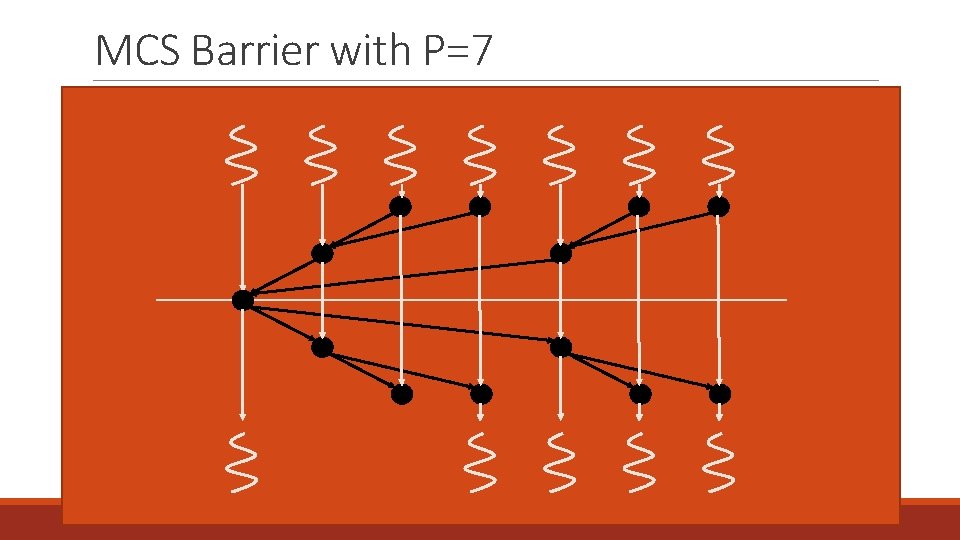
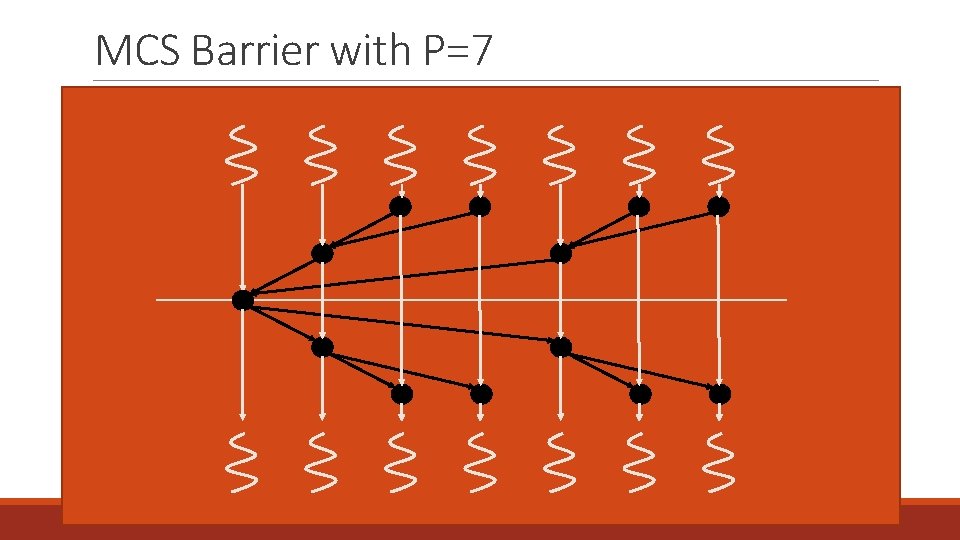
MCS Software Barrier Modifies tournament barrier to allow static allocation in wakeup tree, and to use sense reversal Every thread is a node in two P-node trees: ◦ has pointers to its parent building a fan-in-4 arrival tree ◦ fan-in = flags / word for parallel checks ◦ has pointers to its children to build a fan-out-2 wakeup tree
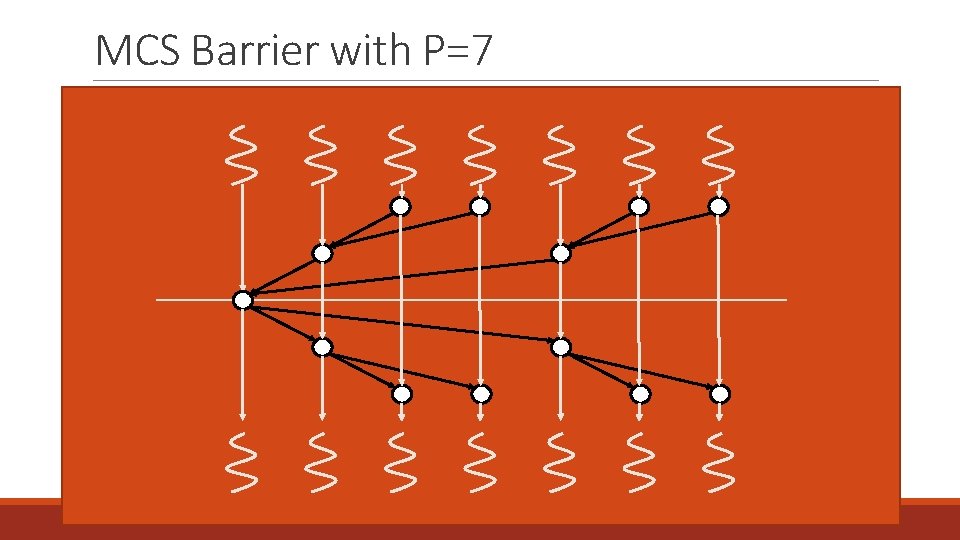
MCS Barrier with P=7
MCS Barrier with P=7
MCS Barrier with P=7
MCS Barrier with P=7
MCS Barrier with P=7
MCS Barrier with P=7
MCS Barrier with P=7
MCS Barrier with P=7
MCS Barrier with P=7
MCS Software Barrier Analysis
Review: Critical path
Review: Network transactions
Review: Storage requirements
Review: Primitives Needed Centralized and software combining tree: ◦ atomic increment / atomic decrement Others (dissemination, tournament, MCS): ◦ atomic read ◦ atomic write
Barrier recommendations Without broadcast on distributed memory: ◦ Dissemination ◦ MCS is good, only critical path length is about 1. 5 X longer (for wakeup tree) ◦ MCS has somewhat better network load and space requirements Cache coherence with broadcast (e. g. , a bus): ◦ MCS with flag wakeup ◦ But centralized is best for modest numbers of processors Big advantage of centralized barrier: ◦ Adapts to changing number of processors across barrier calls
Synchronization Summary Required for concurrent programs ◦ mutual exclusion ◦ producer-consumer ◦ barrier Hardware support ◦ ISA ◦ Cache ◦ Memory Complex interactions ◦ Scalability, Efficiency, Indirect effects ◦ What about message passing?
- Slides: 97