
Synaptic Transmission The actual process of crossing the
- Slides: 13
Synaptic Transmission • The actual process of crossing the “gap” at the synapse
Neurotransmitters: • React with receptors • Diffuse across the membrane • Make the impulse either excitatory or inhibitory
Excitatory: Inhibitory: -increase membrane permeability -decrease membrane permeability -lessens the chance that a nerve impulse will occur
Specific neurotransmitters: • Acetylocholine: stimulates skeletal muscle contractions • Monoamines: form modified amino acids (epinephrine/dopamine/serotonin) • Amino acids • Neuropeptides: short aa chains
What other factors can affect synaptic transmission? • Nerve impulses too quick: epileptic seizure • Caffeine: lower threshold synapse • Antidepressants: keep serotonin within synapse longer (Prozac/Paxil/Zoloft)
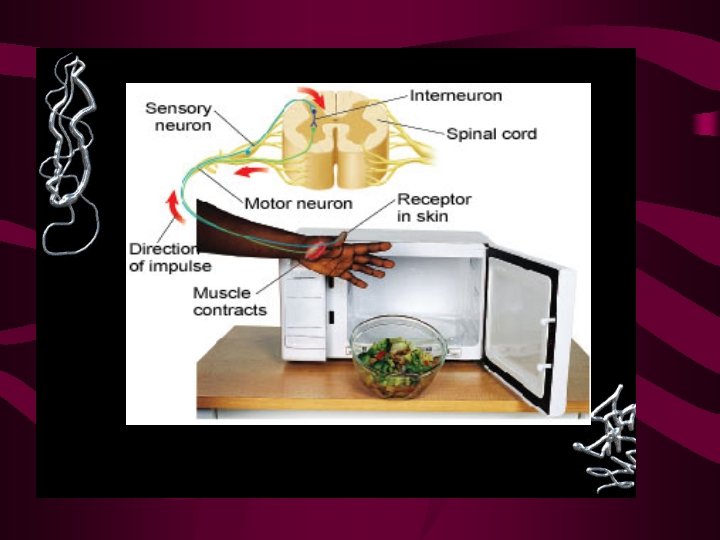
Reflex vs. Reflex arc • Reflex: automatic subconscous responses to stimuli within or outside body • Reflex arc: simplest nerve pathway that only includes a few neurons
Functions of reflexes: • • Help control heartrate Respiratory rate Blood pressure Digestion Examples: withdrawal, knee jerk
Meninges • Cover brain & spinal cord Dura mater: outermost layer -tough, white, fibrous tissue -contains many blood vessels & nerves -attaches to inside of cranial cavity epidural space: space between vertebrae & the dura mater (around spinal cord)
Arachnoid mater: thin, weblike -middle layer -lacks blood vessels -spreads over brain/SC, but not into grooves Subarachnoid space: contains CSF -located between aracnoid/pia CSF: Cerebrospinal fluid -clear, watery cushion
Pia mater: thin innermost layer -many nerves & blood vessels -nourishes cells of brain/SC -lines brain/SC (like visceral pleura of lungs) -dips into grooves
Subdural hematoma: -usually caused by head trauma/direct blow that breaks blood vessels -this escaping blood collects beneath dura mater -causes increased pressure between skull and meninges **Can be fatal**
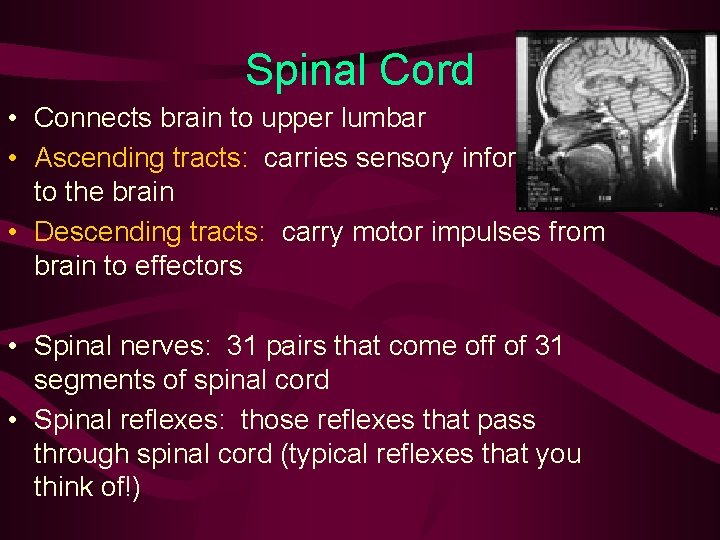
Spinal Cord • Connects brain to upper lumbar • Ascending tracts: carries sensory information to the brain • Descending tracts: carry motor impulses from brain to effectors • Spinal nerves: 31 pairs that come off of 31 segments of spinal cord • Spinal reflexes: those reflexes that pass through spinal cord (typical reflexes that you think of!)