
Symptoms of upper airway stenosis tracheotomy diseases of
- Slides: 43
Symptoms of upper airway stenosis, tracheotomy, diseases of the bronchial system and the oesophagus Department of Otorhinolaryngology Head & Neck Surgery, Univ. Med. School, Pécs Doc. Dr. Imre Gerlinger 14 th December, 2005.
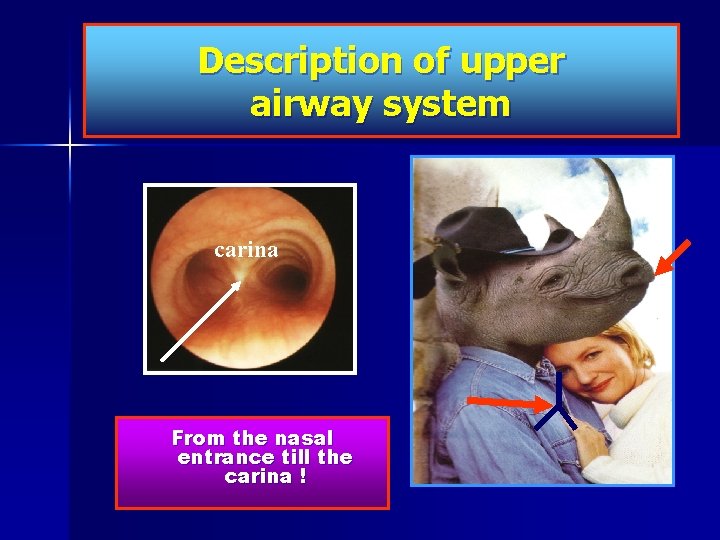
Description of upper airway system carina From the nasal entrance till the carina !
Anatomy and physiology of trachea Anatomy Ø Ø Ø Continuation of cric. cart. From VI-VII. vertebra (cervical spine) till IV. -V. vertebra (thoracal spine) 12 cm long, 1, 5 -2 cm Ø 15 -20 hyalin cartilage (horseshoe shaped) A. i ntercostales V. azygos Physiology Ø Ø Ø Ciliated cylindrical epithelium Self-cleaning: 4 -8 mm/min. Mucous carpet on the surface of the ciliated cylindrical epithelium
Symptoms of airway diseases q q q Difficulty in breathing, stridor Coughing Haemoptoe Cyanosis Hoarsness
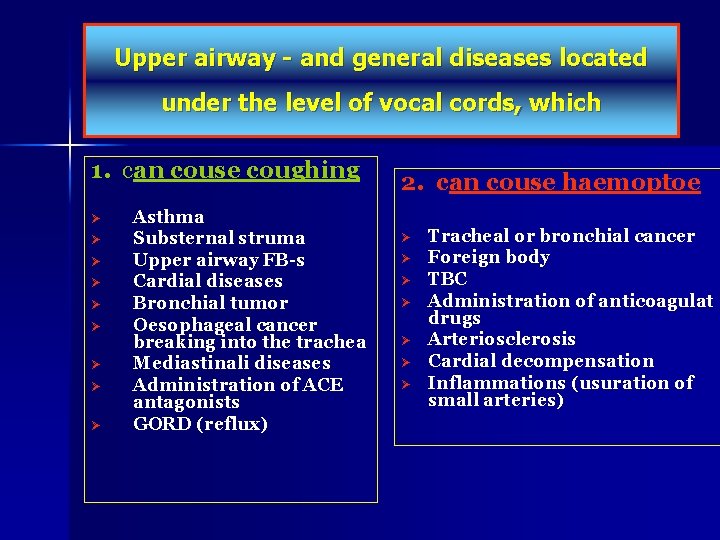
Upper airway - and general diseases located under the level of vocal cords, which 1. can couse coughing Ø Ø Ø Ø Ø Asthma Substernal struma Upper airway FB-s Cardial diseases Bronchial tumor Oesophageal cancer breaking into the trachea Mediastinali diseases Administration of ACE antagonists GORD (reflux) 2. can couse haemoptoe Ø Ø Ø Ø Tracheal or bronchial cancer Foreign body TBC Administration of anticoagulat drugs Arteriosclerosis Cardial decompensation Inflammations (usuration of small arteries)
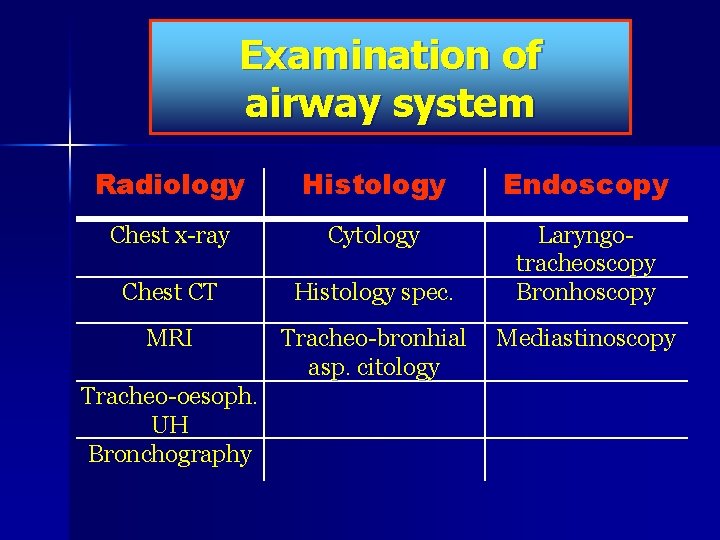
Examination of airway system Radiology Histology Endoscopy Chest x-ray Cytology Chest CT Histology spec. Laryngotracheoscopy Bronhoscopy MRI Tracheo-bronhial asp. citology Tracheo-oesoph. UH Bronchography Mediastinoscopy
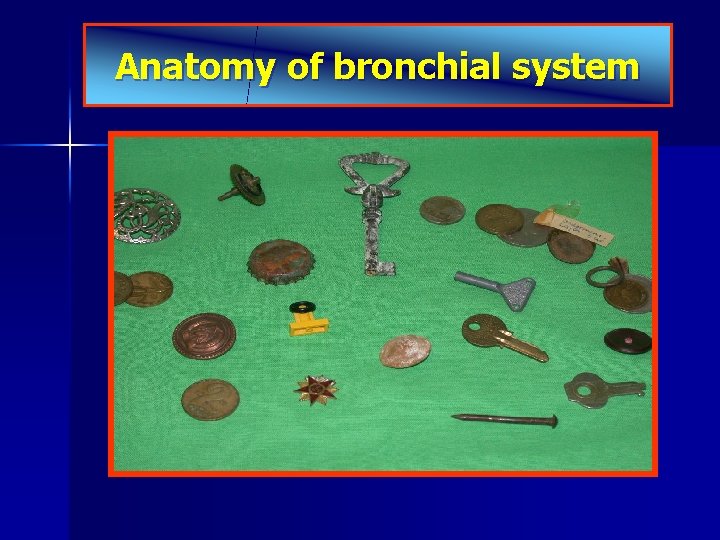
Anatomy of bronchial system
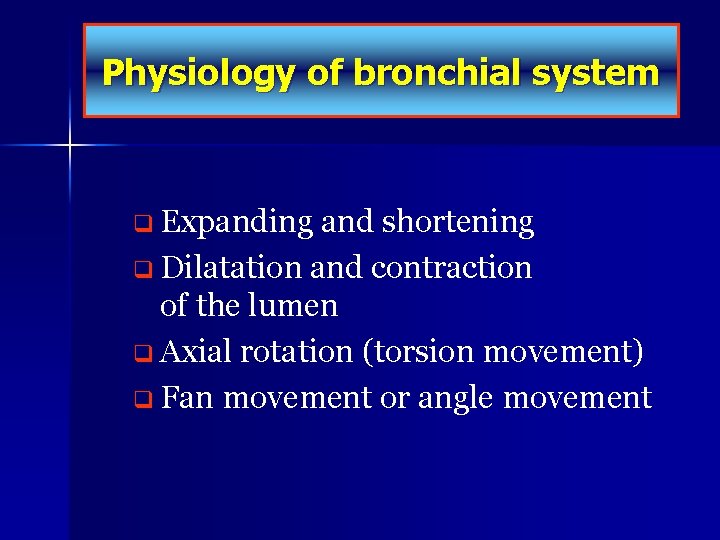
Physiology of bronchial system q Expanding and shortening q Dilatation and contraction of the lumen q Axial rotation (torsion movement) q Fan movement or angle movement
Endoscopic devices to examine the trachea and the brochial system q Rigid broncoscope + endoscop + controlled breathing: - easy to gain biopsy - optimal breathing - suction can be assured q Bronchofiberoscope
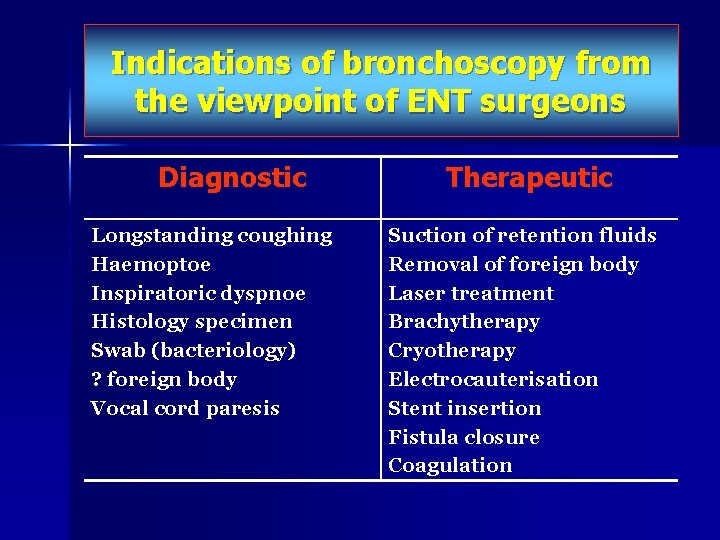
Indications of bronchoscopy from the viewpoint of ENT surgeons Diagnostic Longstanding coughing Haemoptoe Inspiratoric dyspnoe Histology specimen Swab (bacteriology) ? foreign body Vocal cord paresis Therapeutic Suction of retention fluids Removal of foreign body Laser treatment Brachytherapy Cryotherapy Electrocauterisation Stent insertion Fistula closure Coagulation
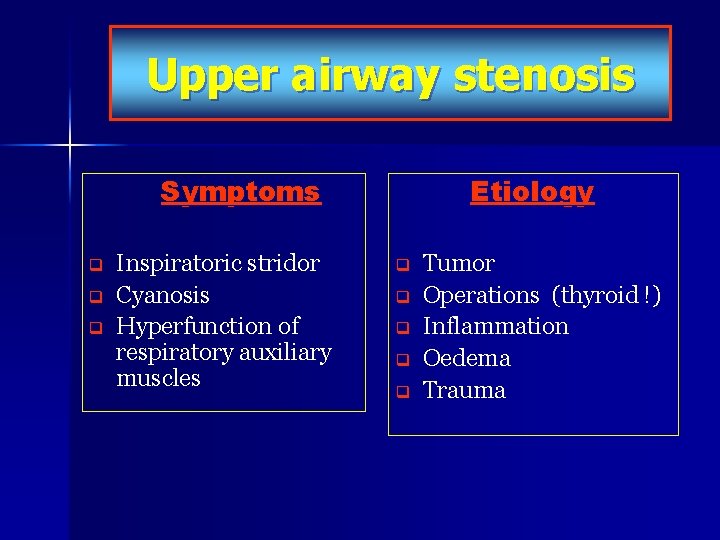
Upper airway stenosis Symptoms q q q Inspiratoric stridor Cyanosis Hyperfunction of respiratory auxiliary muscles Etiology q q q Tumor Operations (thyroid !) Inflammation Oedema Trauma
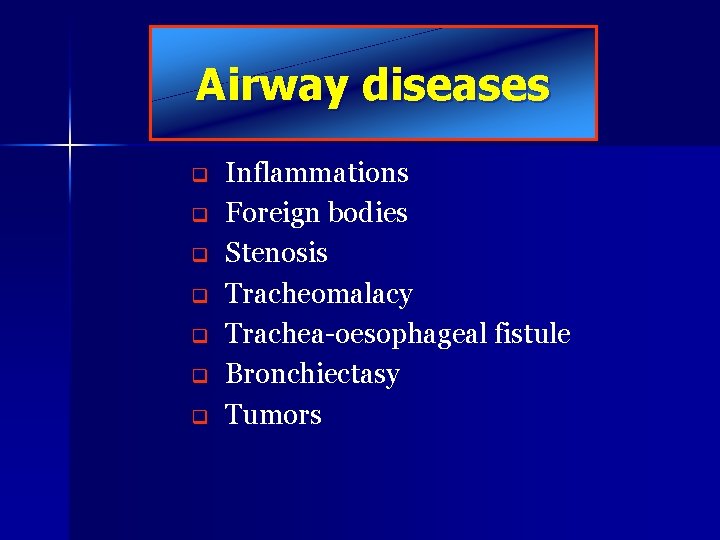
Airway diseases q q q q Inflammations Foreign bodies Stenosis Tracheomalacy Trachea-oesophageal fistule Bronchiectasy Tumors
Airway diseases q q q q Inflammations Foreign bodies Stenosis Tracheomalacy Trachea-oesophageal fistule Bronchiectasy Tumors § § § § § Tracheitis acuta Tracheitis chronica Rhinoscleroma Tracheobronhitis chr. Malignant tracheobronhitis Laryngotracheobronhitis (croup) Pneumonia Lung abscess TBC
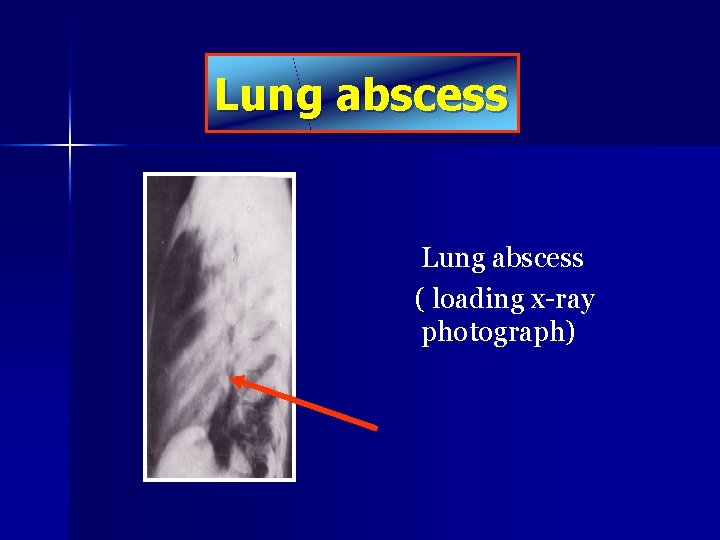
Lung abscess ( loading x-ray photograph)
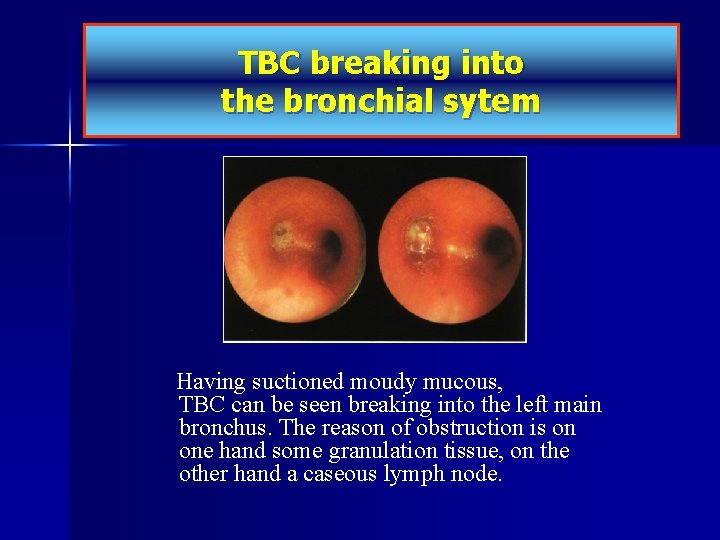
TBC breaking into the bronchial sytem Having suctioned moudy mucous, TBC can be seen breaking into the left main bronchus. The reason of obstruction is on one hand some granulation tissue, on the other hand a caseous lymph node.
Airway diseases q q q q Inflammations Foreign bodies Stenosis Tracheomalacy Trachea-oesophageal fistule Bronchiectasy Tumors Brochial foreign bodies Oesophageal foreign bodies
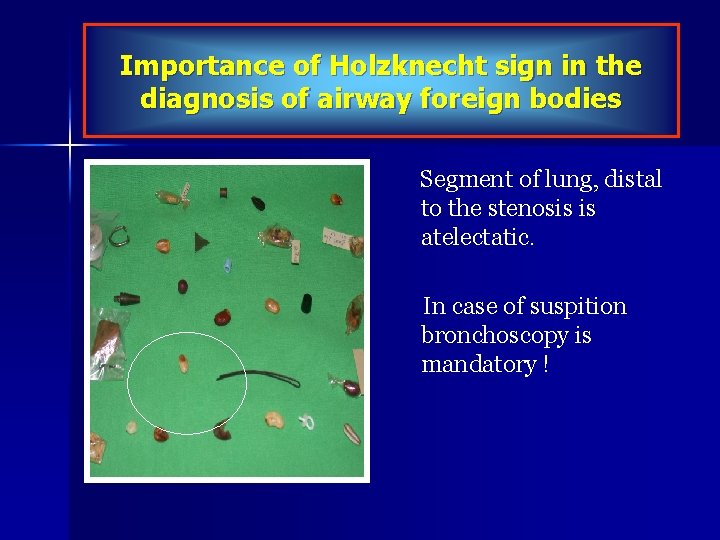
Importance of Holzknecht sign in the diagnosis of airway foreign bodies Segment of lung, distal to the stenosis is atelectatic. In case of suspition bronchoscopy is mandatory !
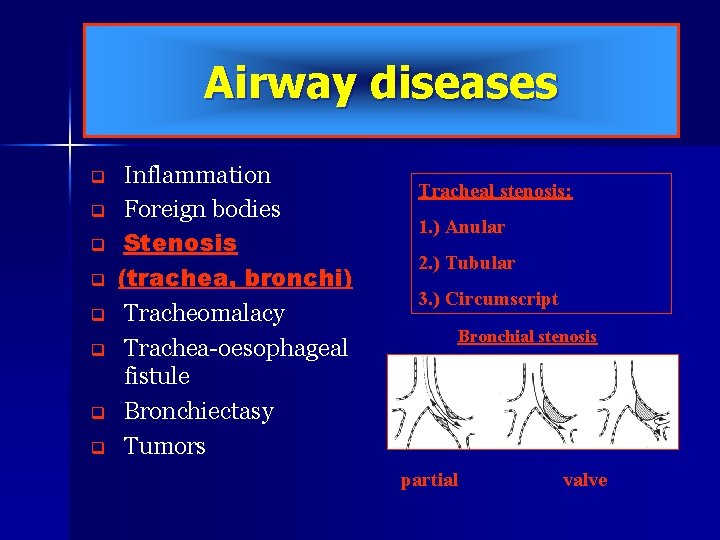
Airway diseases q q q q Inflammation Foreign bodies Stenosis (trachea, bronchi) Tracheomalacy Trachea-oesophageal fistule Bronchiectasy Tumors Tracheal stenosis: 1. ) Anular 2. ) Tubular 3. ) Circumscript Bronchial stenosis partial valve
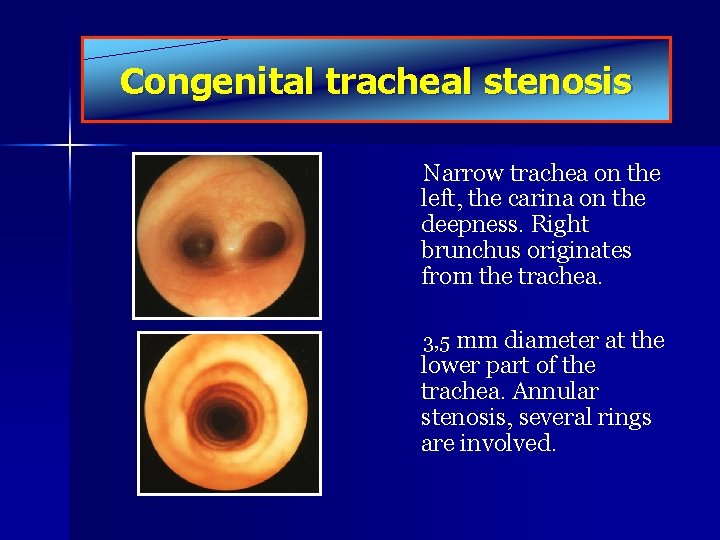
Congenital tracheal stenosis Narrow trachea on the left, the carina on the deepness. Right brunchus originates from the trachea. 3, 5 mm diameter at the lower part of the trachea. Annular stenosis, several rings are involved.
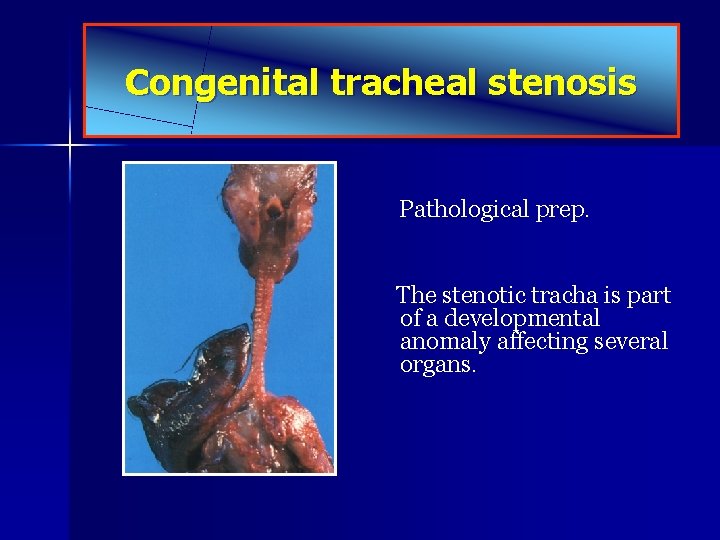
Congenital tracheal stenosis Pathological prep. The stenotic tracha is part of a developmental anomaly affecting several organs.
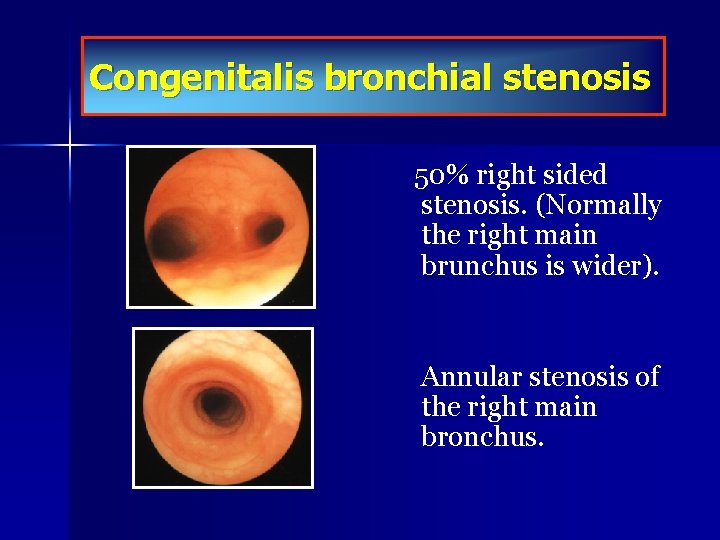
Congenitalis bronchial stenosis 50% right sided stenosis. (Normally the right main brunchus is wider). Annular stenosis of the right main bronchus.
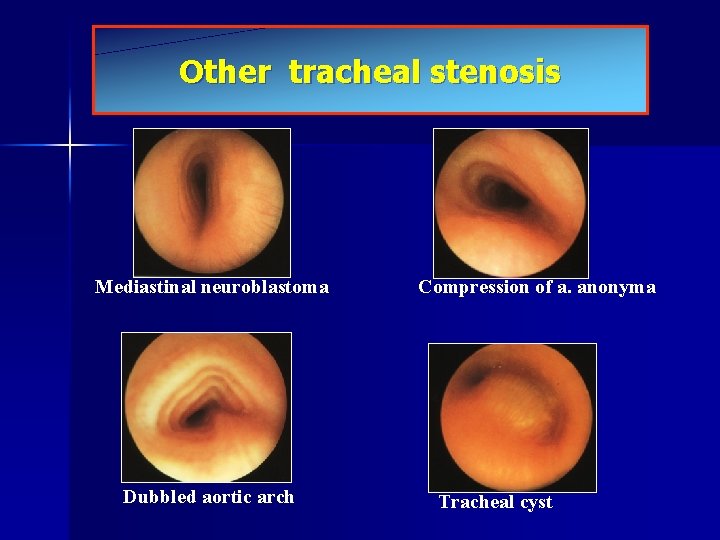
Other tracheal stenosis Mediastinal neuroblastoma Dubbled aortic arch Compression of a. anonyma Tracheal cyst
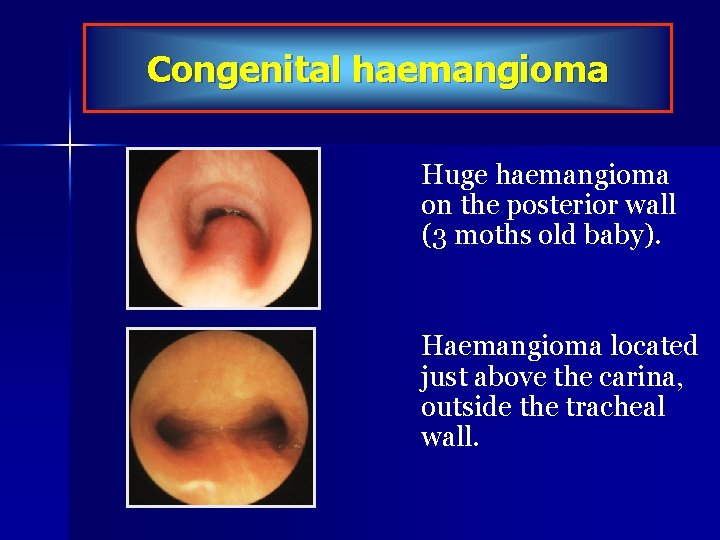
Congenital haemangioma Huge haemangioma on the posterior wall (3 moths old baby). Haemangioma located just above the carina, outside the tracheal wall.
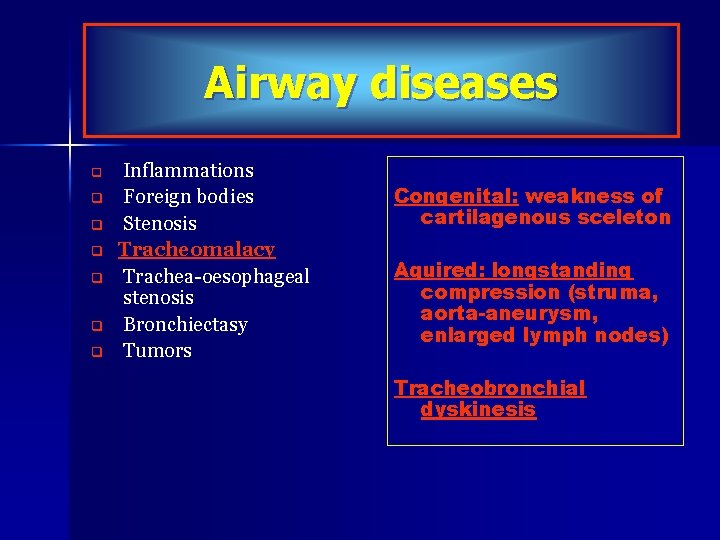
Airway diseases q q q q Inflammations Foreign bodies Stenosis Tracheomalacy Trachea-oesophageal stenosis Bronchiectasy Tumors Congenital: weakness of cartilagenous sceleton Aquired: longstanding compression (struma, aorta-aneurysm, enlarged lymph nodes) Tracheobronchial dyskinesis
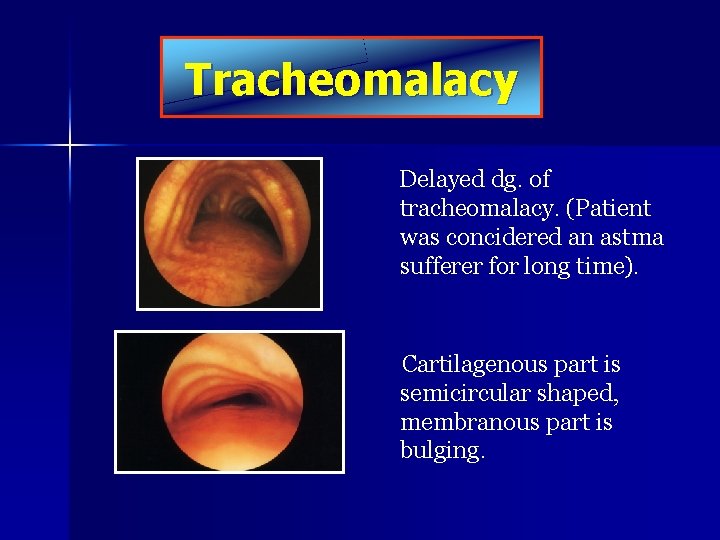
Tracheomalacy Delayed dg. of tracheomalacy. (Patient was concidered an astma sufferer for long time). Cartilagenous part is semicircular shaped, membranous part is bulging.
Airway diseases q Inflammations q Foreign bodies Stenoses Tracheomalacy Tracheooesophageal fistule Bronchiectasy Tumors q q q Congenitalis fistules q Acquired fistules
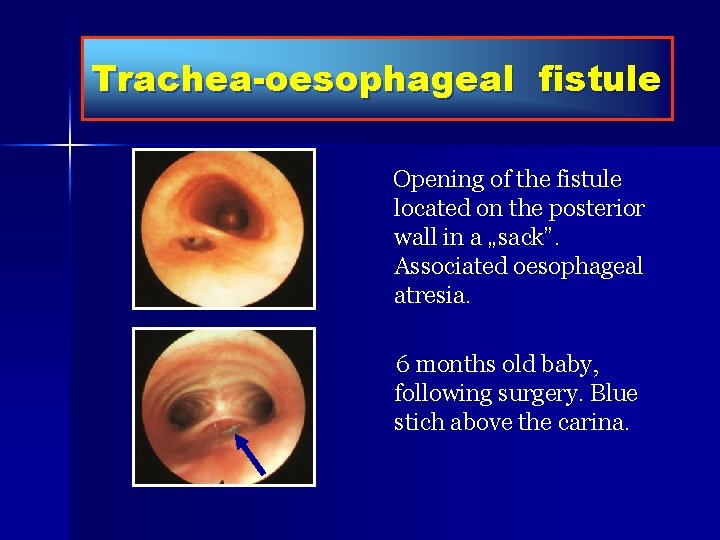
Trachea-oesophageal fistule Opening of the fistule located on the posterior wall in a „sack”. Associated oesophageal atresia. 6 months old baby, following surgery. Blue stich above the carina.
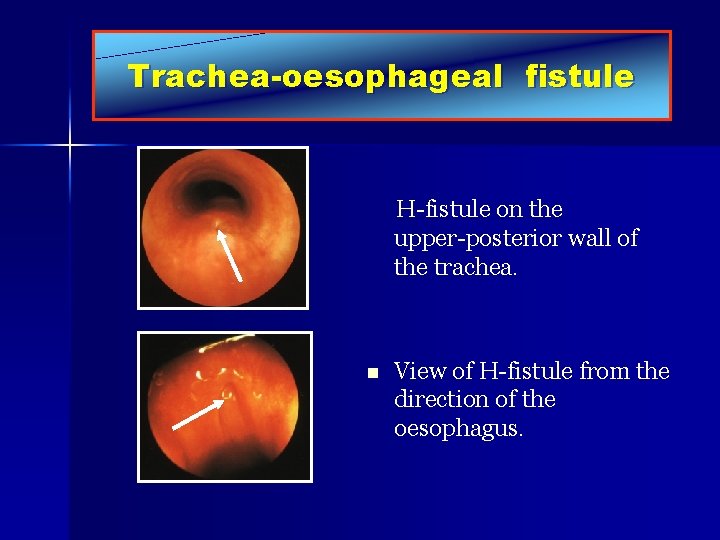
Trachea-oesophageal fistule H-fistule on the upper-posterior wall of the trachea. n View of H-fistule from the direction of the oesophagus.
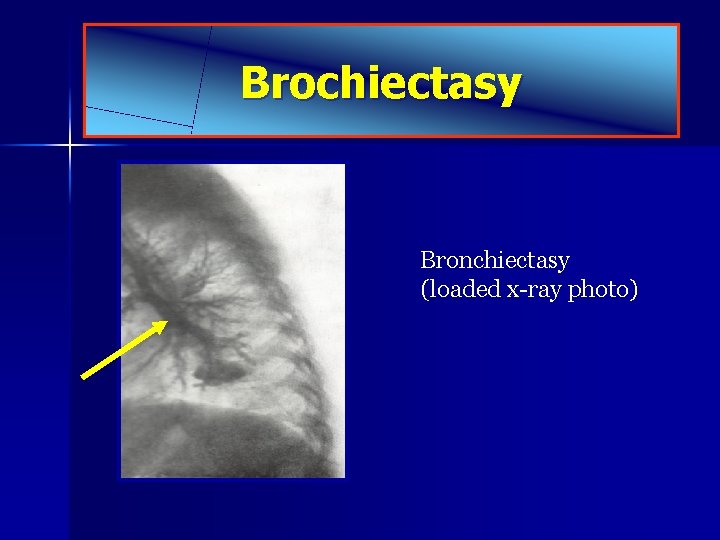
Airway diseases q q q q Most frequent after TBC! Inflammations Foreign bodies Congenital : Stenoses (polycystic lung) Tracheomalacy Trachea compression Acquired : Purulent inflammation of Tracheabrochial wall (bronchial oesophageal stenosis, foreign body, tumor, fistule atypical viral pneumony, chronic sinusitis) Bronchiectasy Symptoms: coughing up blood Tumors and pus Dg: bronchography Th: surgery and regular bronchoscopic suction
Brochiectasy Bronchiectasy (loaded x-ray photo)
Airway diseases q Inflammations Foreign bodies Stenosis Tracheomalacy Tracheaoesophageal stenosis Bronchiectasy q Tumors q q q Benign papilloma osteochondroma adenoma lipoma amyloid Malignant carcinoma sarcoma adenoid cystic cc.
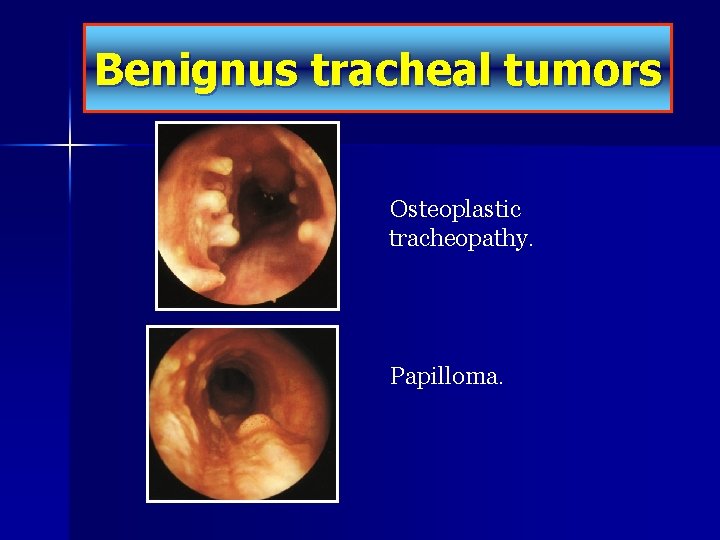
Benignus tracheal tumors Osteoplastic tracheopathy. Papilloma.
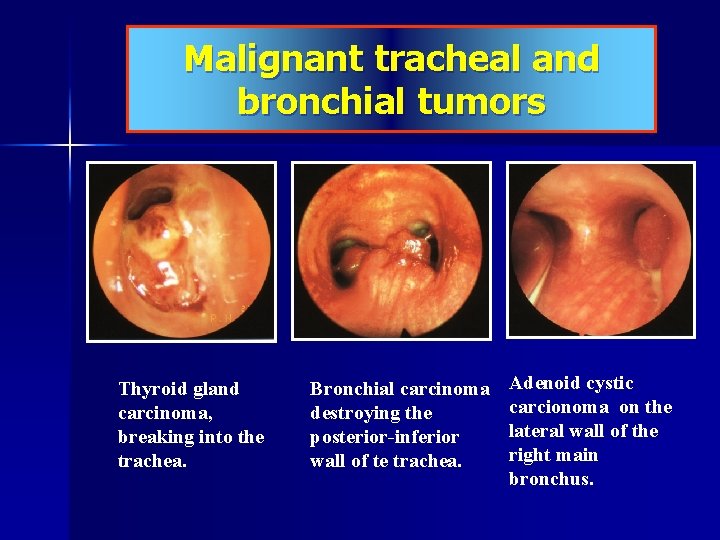
Malignant tracheal and bronchial tumors Thyroid gland carcinoma, breaking into the trachea. Bronchial carcinoma destroying the posterior-inferior wall of te trachea. Adenoid cystic carcionoma on the lateral wall of the right main bronchus.
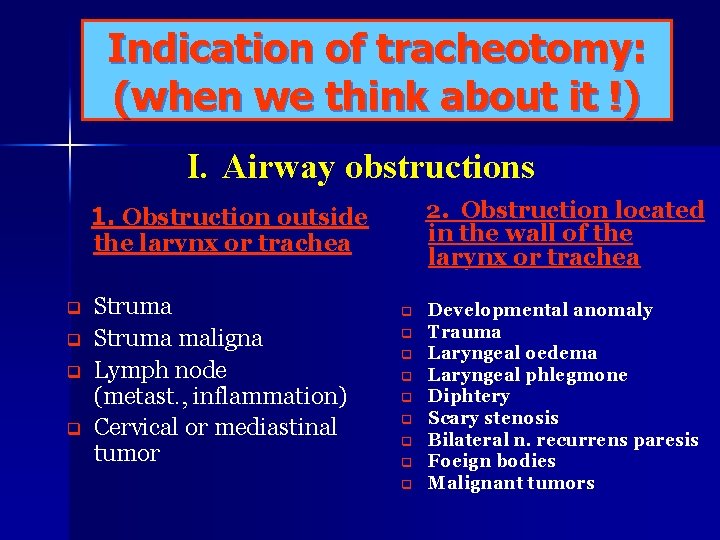
Indication of tracheotomy: (when we think about it !) I. Airway obstructions 2. Obstruction located in the wall of the larynx or trachea 1. Obstruction outside the larynx or trachea q q Struma maligna Lymph node (metast. , inflammation) Cervical or mediastinal tumor q q q q q Developmental anomaly Trauma Laryngeal oedema Laryngeal phlegmone Diphtery Scary stenosis Bilateral n. recurrens paresis Foeign bodies Malignant tumors
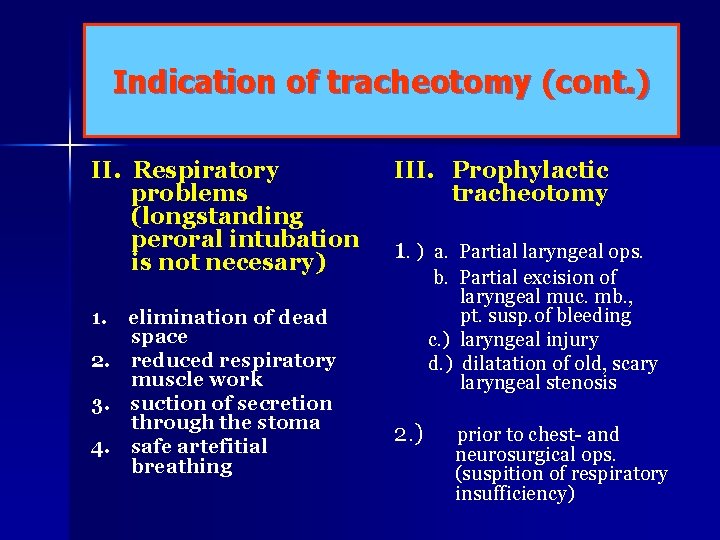
Indication of tracheotomy (cont. ) II. Respiratory problems (longstanding peroral intubation is not necesary) 1. elimination of dead space 2. reduced respiratory muscle work 3. suction of secretion through the stoma 4. safe artefitial breathing III. Prophylactic tracheotomy 1. ) 2. ) a. Partial laryngeal ops. b. Partial excision of laryngeal muc. mb. , pt. susp. of bleeding c. ) laryngeal injury d. ) dilatation of old, scary laryngeal stenosis prior to chest- and neurosurgical ops. (suspition of respiratory insufficiency)
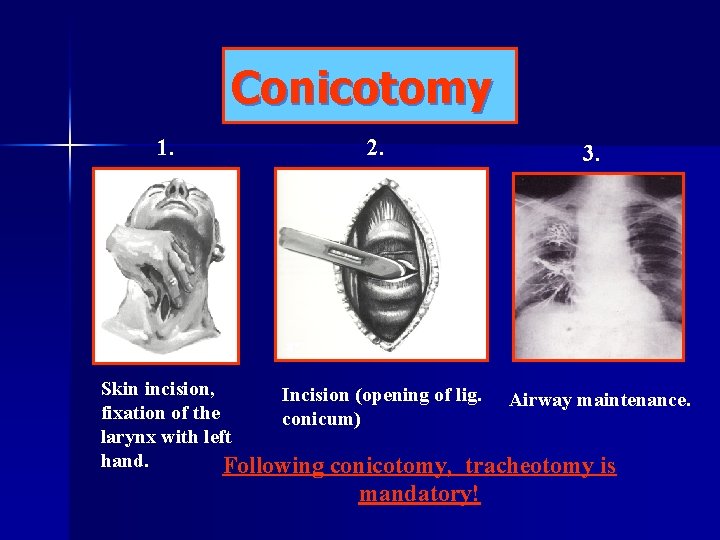
Conicotomy 1. 2. 3. Skin incision, Incision (opening of lig. Airway maintenance. fixation of the conicum) larynx with left hand. Following conicotomy, tracheotomy is mandatory!
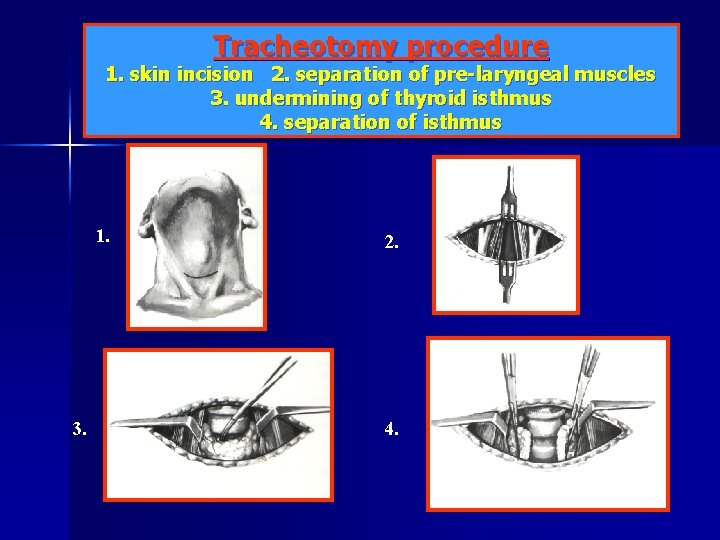
Tracheotomy procedure 1. skin incision 2. separation of pre-laryngeal muscles 3. undermining of thyroid isthmus 4. separation of isthmus 1. 3. 2. 4.
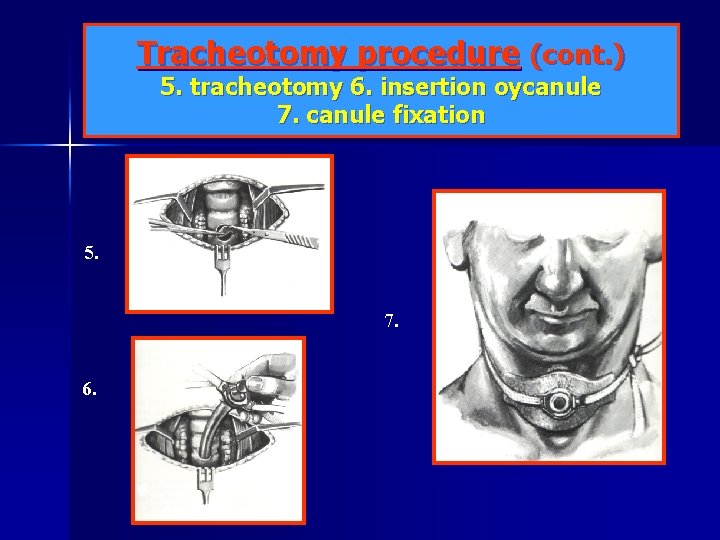
Tracheotomy procedure (cont. ) 5. tracheotomy 6. insertion oycanule 7. canule fixation 5. 7. 6.
Complications of thracheotomy q q Early complications: Paralysis of respiratory centers. Bleeading. Cervical emphysema. Tracheobronhial sicca. Late complications: Tracheal window is not on the proper place. Size of tracheal window is wrong. Size and longness of canule is wrong.
Oesophagus 25 cm long, VI. cervical vertebra XII. thoracal vertebra q cervical part q thoracal part q abdominal part q 3 layers: mucosa, submucosa, muscular q 3 phisyologic structures q
Indications of oesophagoscopia n Diagnostic n Therapeutic Insert feeding tube Cardia dilatation Removal of soft bening tumors Foreign bodires Inflammations Diverticuli Stenoses Space narrowing diseases Judge function Bleeding Dysphagia Rigid instrument and fiberoptic device !
Complications of oesophagoscopy Bleeding (mucous membrane) q Inflammation (not serious) q Perforation (thoracal pain, subfebrility, high temperature, consecutive mediastinitis ( x-ray: widening, air bubbles), in case of suspicion, swallowing test is mandatory with gastrographine (water soluble aterial) q
Many thanks for your attention !