
Symptomatic Management of MS Team Based Approach Visible
Symptomatic Management of MS: Team Based Approach Visible Symptoms
Goals of Symptom Management § Eliminate or reduce symptoms that impair functional abilities § Improve quality of life § Avoid secondary complications § Use targeted and individualized treatment of symptoms (essential in management of MS) Crayton H, et al. Neurology. 2004; 63(11 Suppl 5): S 12 -S 18.

Multi-Disciplinary Team Approach Neurologist Primary Care Physician Nurse/NP Pharmacist Physical Therapist Psychiatrist Occupational Therapist Orthotist Patient and Family Psychologist/ Neuropsychologist Social Worker PA Speech/Language Urologist Physiatrist Pathologist
Shared Roles of the MS Multidisciplinary Care Team § Assessment § Education § Patient Safety § Rehabilitation § Patient advocacy § Emotional support § Case coordination and continuity of care § Emotional Support § Discharge/home care planning § Medication management and skills training (eg. self injection) § Symptom management (eg. bowel, bladder, sexual function) § Nutrition/wellness § Family/caregiver support, education § Community resources
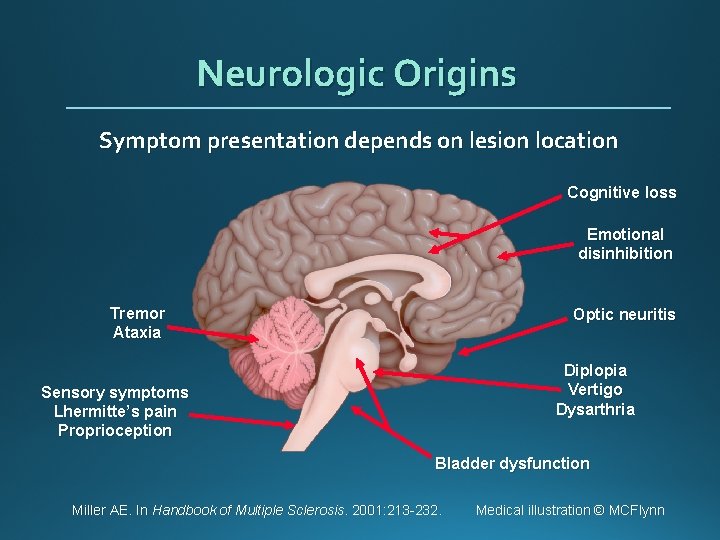
Neurologic Origins Symptom presentation depends on lesion location Cognitive loss Emotional disinhibition Tremor Ataxia Optic neuritis Diplopia Vertigo Dysarthria Sensory symptoms Lhermitte’s pain Proprioception Bladder dysfunction Miller AE. In Handbook of Multiple Sclerosis. 2001: 213 -232. Medical illustration © MCFlynn
Important Primary Symptoms of MS § Fatigue § Cognitive Problems § Bladder and Bowel Dysfunction § Sexual Dysfunction § Spasticity § Altered Mobility § Visual Disturbance § Altered Sensation Halper J, Harris C. Nursing Practice in Multiple Sclerosis: A Core Curriculum. 3 rd ed. New York: Springer Publishing Company, 2012. Ben-Zacharia AB. Therapeutics for multiple sclerosis symptoms. Mt Sinai J Med N Y. 2011; 78(2): 176 -191.

Secondary Symptoms of MS § Infections § Falls § Skin breakdown Halper J, Harris C. Nursing Practice in Multiple Sclerosis: A Core Curriculum. 3 rd ed. New York: Springer Publishing Company, 2012. Ben-Zacharia AB. Therapeutics for multiple sclerosis symptoms. Mt Sinai J Med N Y. 2011; 78(2): 176 -191.

Tertiary Symptoms § Job loss § Loss of intimacy § Role changes/family disruption § Social isolation Halper J, Harris C. Nursing Practice in Multiple Sclerosis: A Core Curriculum. 3 rd ed. New York: Springer Publishing Company, 2012. Ben-Zacharia AB. Therapeutics for multiple sclerosis symptoms. Mt Sinai J Med N Y. 2011; 78(2): 176 -191.

Case Study: Alan § 59 year old man § Diagnosis of MS 1999 (symptoms 1986) § Secondary Progressive course § Ambulates independently § Reports bladder frequency, urgency, nocturia q 2 hours
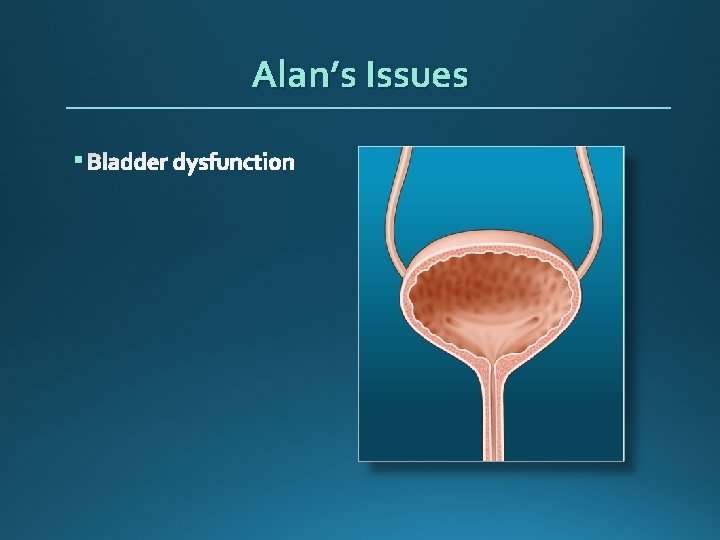
Alan’s Issues § Bladder dysfunction
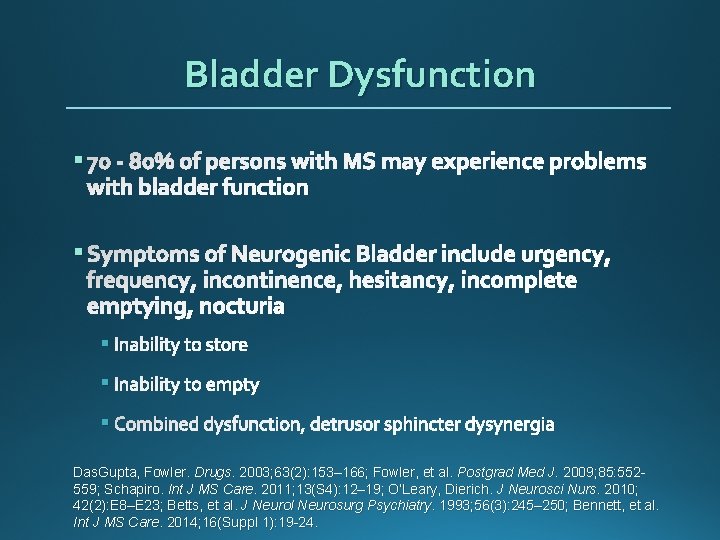
Bladder Dysfunction § 70 - 80% of persons with MS may experience problems with bladder function § Symptoms of Neurogenic Bladder include urgency, frequency, incontinence, hesitancy, incomplete emptying, nocturia § Inability to store § Inability to empty § Combined dysfunction, detrusor sphincter dysynergia Das. Gupta, Fowler. Drugs. 2003; 63(2): 153– 166; Fowler, et al. Postgrad Med J. 2009; 85: 552559; Schapiro. Int J MS Care. 2011; 13(S 4): 12– 19; O’Leary, Dierich. J Neurosci Nurs. 2010; 42(2): E 8–E 23; Betts, et al. J Neurol Neurosurg Psychiatry. 1993; 56(3): 245– 250; Bennett, et al. Int J MS Care. 2014; 16(Suppl 1): 19 -24.
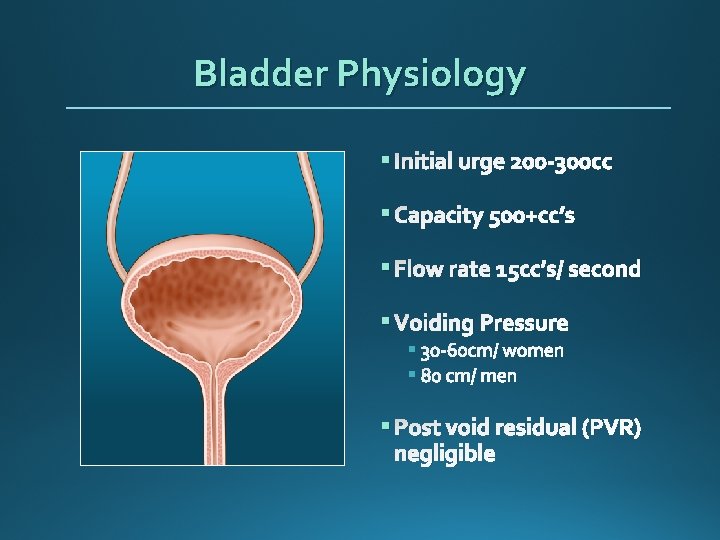
Bladder Physiology § Initial urge 200 -300 cc § Capacity 500+cc’s § Flow rate 15 cc’s/ second § Voiding Pressure § § § Post void residual (PVR) negligible
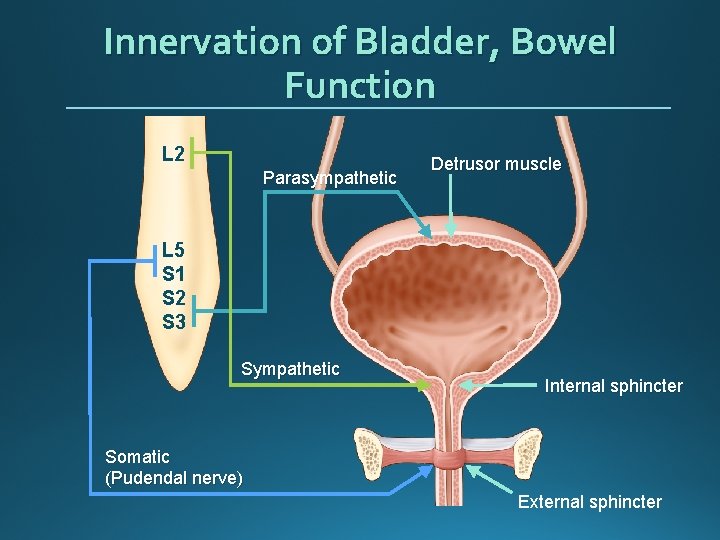
Innervation of Bladder, Bowel Function L 2 Parasympathetic Detrusor muscle L 5 S 1 S 2 S 3 Sympathetic Internal sphincter Somatic (Pudendal nerve) External sphincter
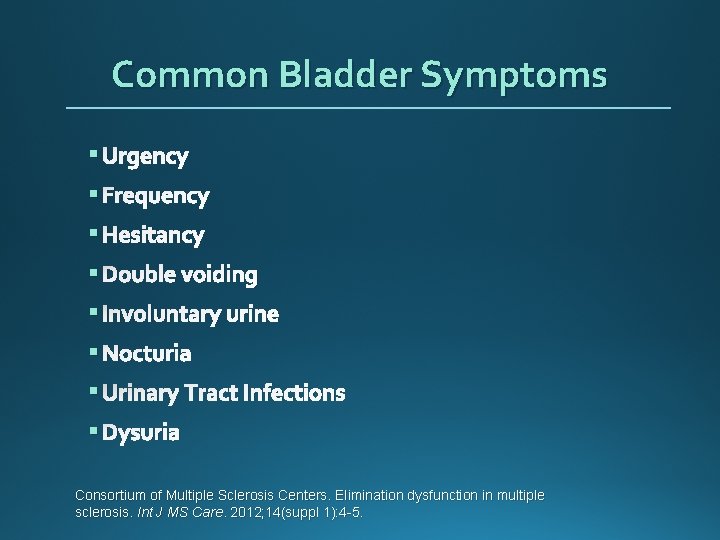
Common Bladder Symptoms § Urgency § Frequency § Hesitancy § Double voiding § Involuntary urine § Nocturia § Urinary Tract Infections § Dysuria Consortium of Multiple Sclerosis Centers. Elimination dysfunction in multiple sclerosis. Int J MS Care. 2012; 14(suppl 1): 4 -5.
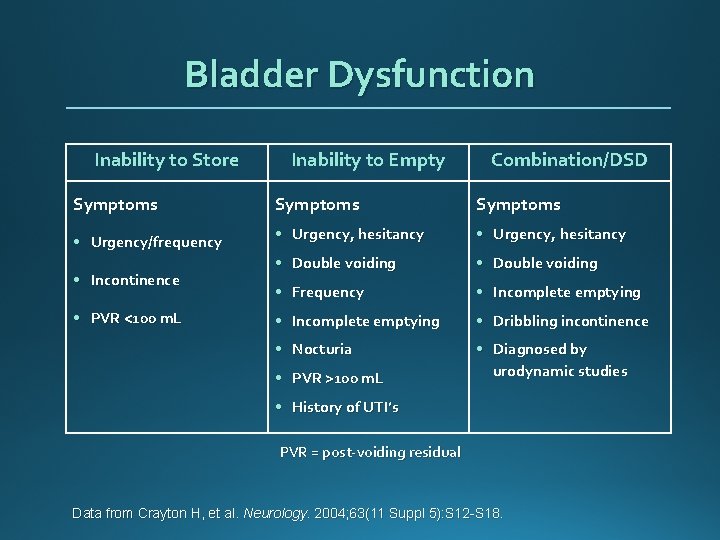
Bladder Dysfunction Inability to Store Inability to Empty Combination/DSD Symptoms • Urgency/frequency • Urgency, hesitancy • Double voiding • Frequency • Incomplete emptying • Dribbling incontinence • Nocturia • Diagnosed by urodynamic studies • Incontinence • PVR <100 m. L • PVR >100 m. L • History of UTI’s PVR = post-voiding residual Data from Crayton H, et al. Neurology. 2004; 63(11 Suppl 5): S 12 -S 18.
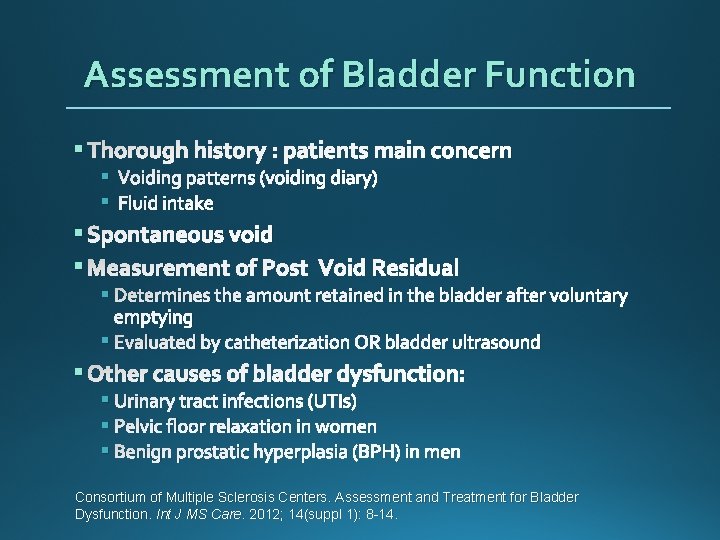
Assessment of Bladder Function § Thorough history : patients main concern § Voiding patterns (voiding diary) § Fluid intake § Spontaneous void § Measurement of Post Void Residual § Determines the amount retained in the bladder after voluntary emptying § Evaluated by catheterization OR bladder ultrasound § Other causes of bladder dysfunction: § Urinary tract infections (UTIs) § Pelvic floor relaxation in women § Benign prostatic hyperplasia (BPH) in men Consortium of Multiple Sclerosis Centers. Assessment and Treatment for Bladder Dysfunction. Int J MS Care. 2012; 14(suppl 1): 8 -14.
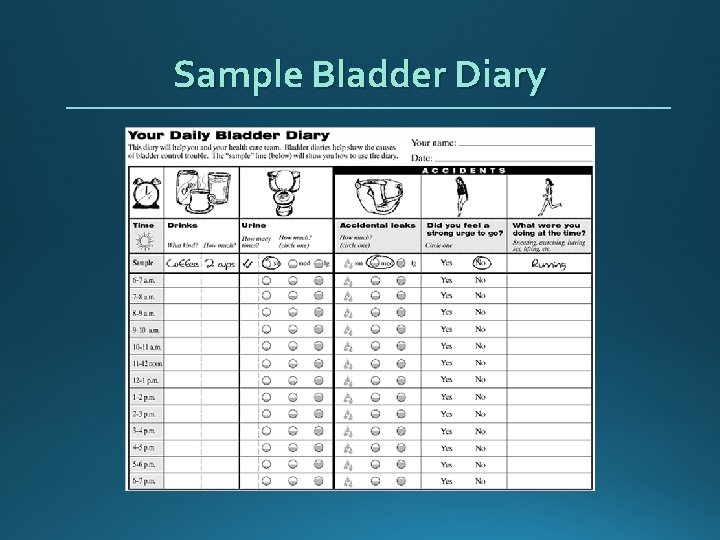
Sample Bladder Diary
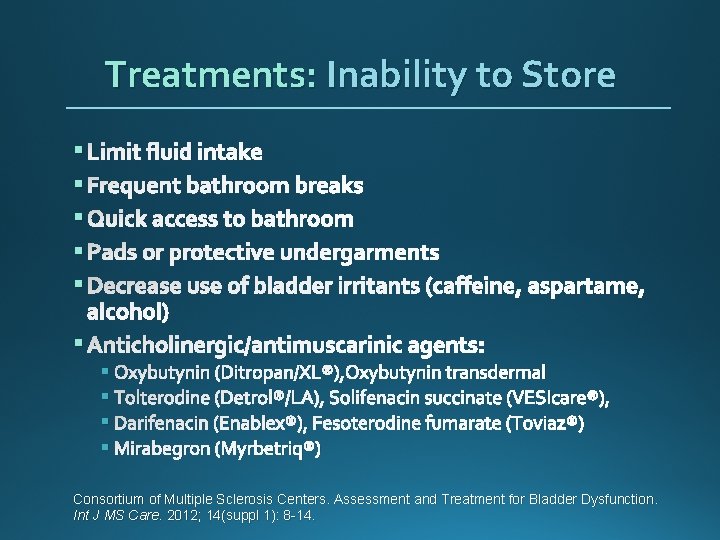
Treatments: Inability to Store § Limit fluid intake § Frequent bathroom breaks § Quick access to bathroom § Pads or protective undergarments § Decrease use of bladder irritants (caffeine, aspartame, alcohol) § Anticholinergic/antimuscarinic agents: § Oxybutynin (Ditropan/XL®), Oxybutynin transdermal § Tolterodine (Detrol®/LA), Solifenacin succinate (VESIcare®), § Darifenacin (Enablex®), Fesoterodine fumarate (Toviaz®) § Mirabegron (Myrbetriq®) Consortium of Multiple Sclerosis Centers. Assessment and Treatment for Bladder Dysfunction. Int J MS Care. 2012; 14(suppl 1): 8 -14.
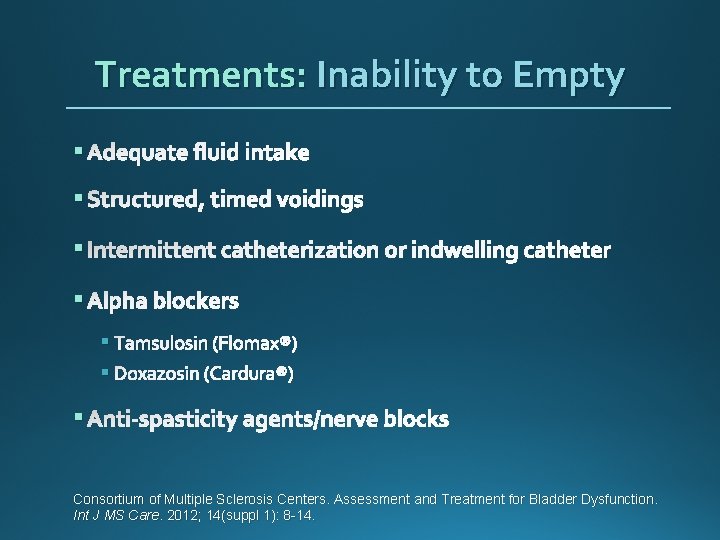
Treatments: Inability to Empty § Adequate fluid intake § Structured, timed voidings § Intermittent catheterization or indwelling catheter § Alpha blockers § Tamsulosin (Flomax®) § Doxazosin (Cardura®) § Anti-spasticity agents/nerve blocks Consortium of Multiple Sclerosis Centers. Assessment and Treatment for Bladder Dysfunction. Int J MS Care. 2012; 14(suppl 1): 8 -14.
Alan’s Case: Bladder Dysfunction § 59 year old man § Diagnosis of MS 1999 (symptoms 1986) § Exacerbating remitting course § Ambulates independently § Reports bladder frequency, urgency, nocturia q 2 hours
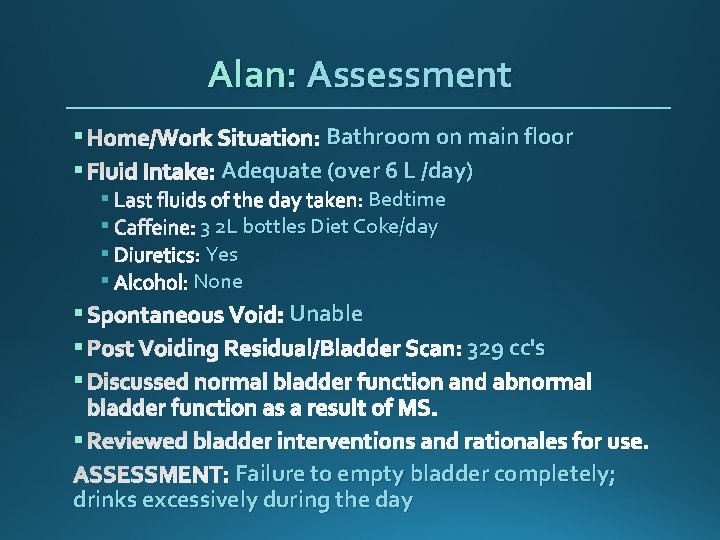
Alan: Assessment § Home/Work Situation: Bathroom on main floor § Fluid Intake: Adequate (over 6 L /day) § Last fluids of the day taken: Bedtime § Caffeine: 3 2 L bottles Diet Coke/day § Diuretics: Yes § Alcohol: None § Spontaneous Void: Unable § Post Voiding Residual/Bladder Scan: 329 cc's § Discussed normal bladder function and abnormal bladder function as a result of MS. § Reviewed bladder interventions and rationales for use. ASSESSMENT: Failure to empty bladder completely; drinks excessively during the day
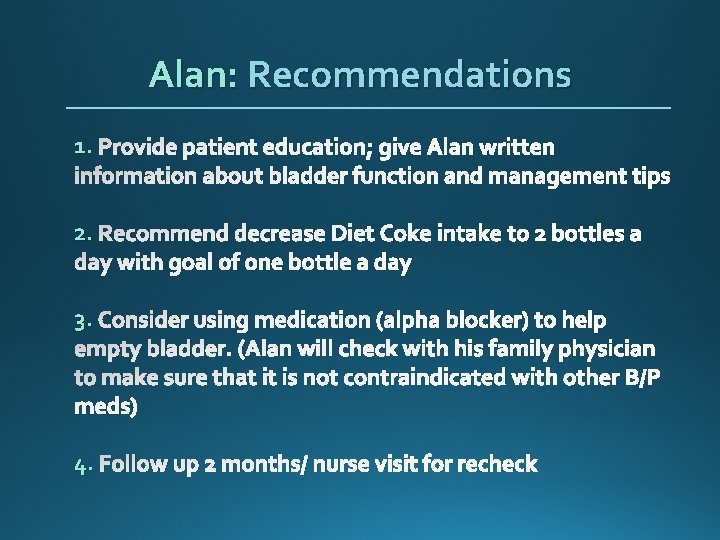
Alan: Recommendations 1. Provide patient education; give Alan written information about bladder function and management tips 2. Recommend decrease Diet Coke intake to 2 bottles a day with goal of one bottle a day 3. Consider using medication (alpha blocker) to help empty bladder. (Alan will check with his family physician to make sure that it is not contraindicated with other B/P meds) 4. Follow up 2 months/ nurse visit for recheck

What Patients Need to Know § Adequate fluid intake is 1 1/2 - 2 quarts/day (48 -64 oz) Water is best (decaf tea or fruit juice is OK) § Urge to void occurs about 1 1/2 - 2 hours after drinking something § Caffeine, aspartame and alcohol are bladder irritants § Smoking is a bladder irritant § Limiting fluid intake is harmful Consortium of Multiple Sclerosis Centers. Assessment and Treatment for Bladder Dysfunction. Int J MS Care. 2012; 14(suppl 1): 8 -14.
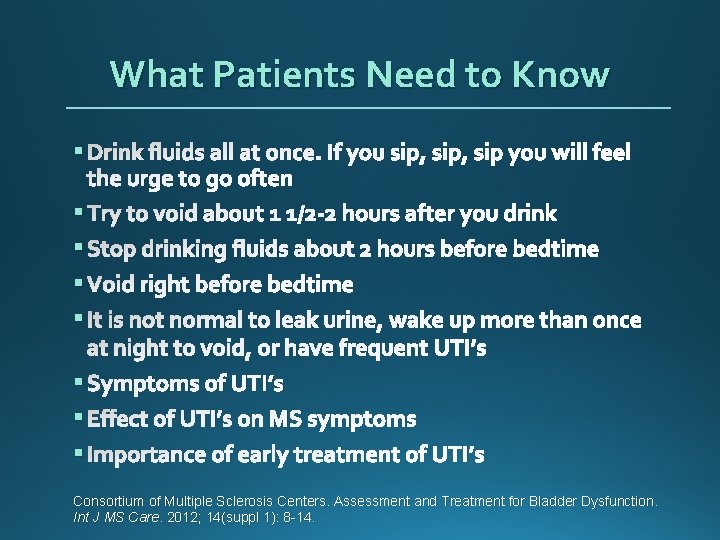
What Patients Need to Know § Drink fluids all at once. If you sip, sip you will feel the urge to go often § Try to void about 1 1/2 -2 hours after you drink § Stop drinking fluids about 2 hours before bedtime § Void right before bedtime § It is not normal to leak urine, wake up more than once at night to void, or have frequent UTI’s § Symptoms of UTI’s § Effect of UTI’s on MS symptoms § Importance of early treatment of UTI’s Consortium of Multiple Sclerosis Centers. Assessment and Treatment for Bladder Dysfunction. Int J MS Care. 2012; 14(suppl 1): 8 -14.
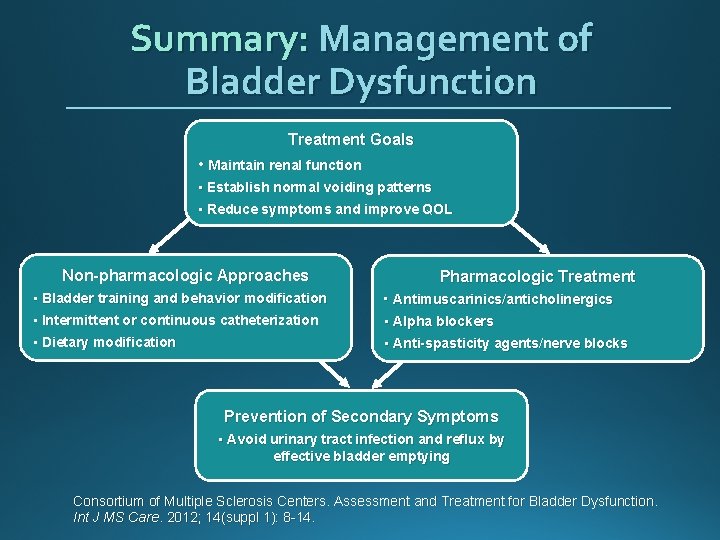
Summary: Management of Bladder Dysfunction Treatment Goals • Maintain renal function • Establish normal voiding patterns • Reduce symptoms and improve QOL Non-pharmacologic Approaches Pharmacologic Treatment • Bladder training and behavior modification • Intermittent or continuous catheterization • Antimuscarinics/anticholinergics • Alpha blockers • Dietary modification • Anti-spasticity agents/nerve blocks Prevention of Secondary Symptoms • Avoid urinary tract infection and reflux by effective bladder emptying Consortium of Multiple Sclerosis Centers. Assessment and Treatment for Bladder Dysfunction. Int J MS Care. 2012; 14(suppl 1): 8 -14.
Bowel Dysfunction § 60% of persons with MS may experience problems with bowel function § Common symptoms include constipation, diarrhea, incontinence § Symptoms may be intermittent or constant § Symptoms can occur at any time in the disease Das. Gupta, Fowler. Drugs. 2003; 63(2): 153– 166. Bennett, et al. Int J MS Care. 2014; 16(Suppl 1): 19 -24.
Bowel Symptoms in MS § Constipation § Slow bowel § Medications § Impaired motility § Bowel incontinence § Diminished sphincter control § Hyperreflexic bowel Consortium of Multiple Sclerosis Centers. Assessment and Treatment for Bowel Dysfunction. Int J MS Care. 2012; 14(suppl 1): 15 -20.
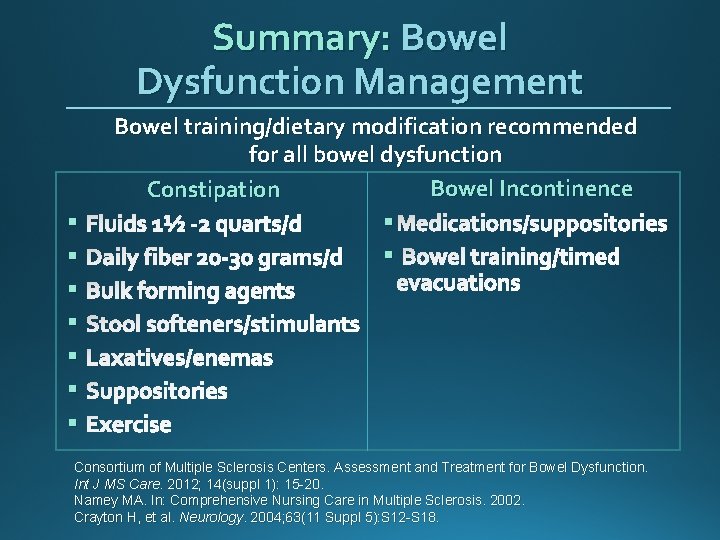
Summary: Bowel Dysfunction Management § § § § Bowel training/dietary modification recommended for all bowel dysfunction Bowel Incontinence Constipation § Medications/suppositories Fluids 1½ -2 quarts/d § Bowel training/timed Daily fiber 20 -30 grams/d evacuations Bulk forming agents Stool softeners/stimulants Laxatives/enemas Suppositories Exercise Consortium of Multiple Sclerosis Centers. Assessment and Treatment for Bowel Dysfunction. Int J MS Care. 2012; 14(suppl 1): 15 -20. Namey MA. In: Comprehensive Nursing Care in Multiple Sclerosis. 2002. Crayton H, et al. Neurology. 2004; 63(11 Suppl 5): S 12 -S 18.
Sexual Dysfunction in MS § Approximately 50% of women with MS § Approximately 75% of men with MS § A significant impact on QOL § Often an overlooked symptom of MS Demirkiran M, et al. Mult Scler. 2006; 12(2): 209 -214. Crayton H, et al. Neurology. 2004; 63(11 Suppl 5): S 12 -S 18.
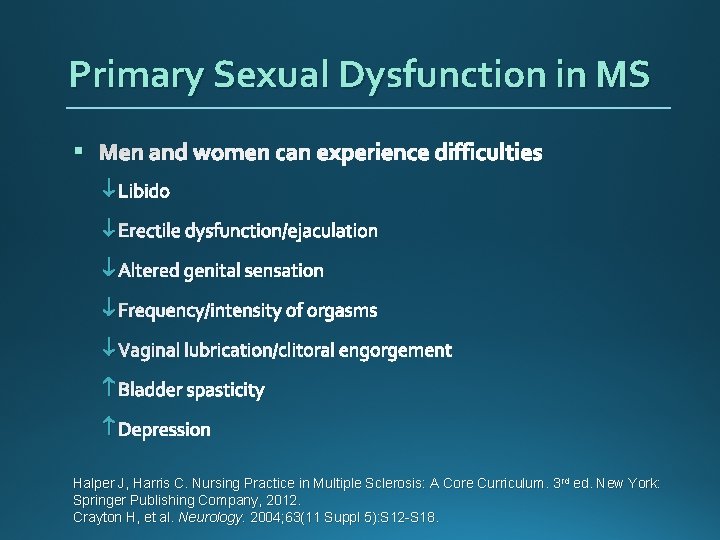
Primary Sexual Dysfunction in MS § Men and women can experience difficulties Libido Erectile dysfunction/ejaculation Altered genital sensation Frequency/intensity of orgasms Vaginal lubrication/clitoral engorgement Bladder spasticity Depression Halper J, Harris C. Nursing Practice in Multiple Sclerosis: A Core Curriculum. 3 rd ed. New York: Springer Publishing Company, 2012. Crayton H, et al. Neurology. 2004; 63(11 Suppl 5): S 12 -S 18.
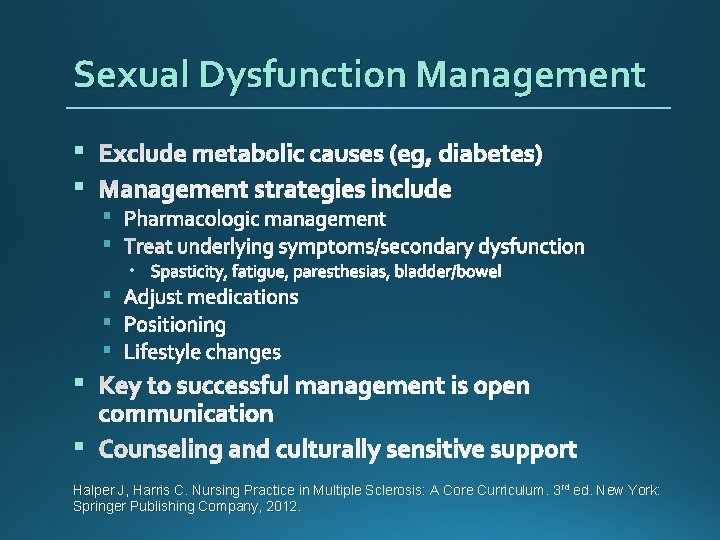
Sexual Dysfunction Management § Exclude metabolic causes (eg, diabetes) § Management strategies include § Pharmacologic management § Treat underlying symptoms/secondary dysfunction • Spasticity, fatigue, paresthesias, bladder/bowel § Adjust medications § Positioning § Lifestyle changes § Key to successful management is open communication § Counseling and culturally sensitive support Halper J, Harris C. Nursing Practice in Multiple Sclerosis: A Core Curriculum. 3 rd ed. New York: Springer Publishing Company, 2012.
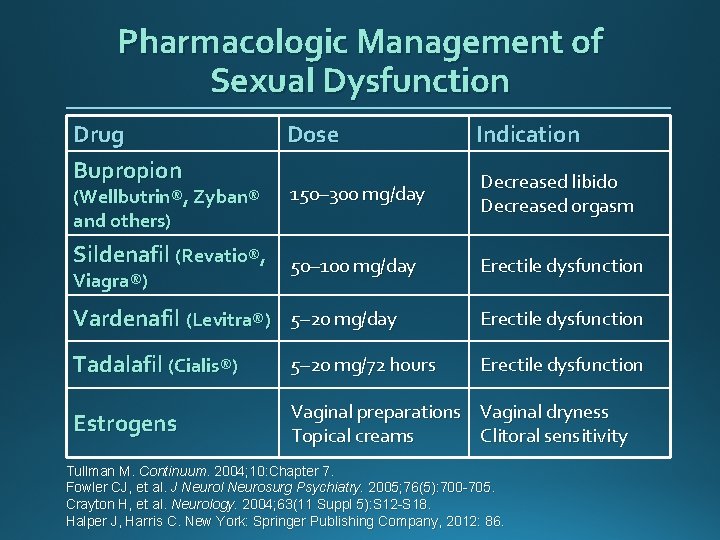
Pharmacologic Management of Sexual Dysfunction Drug Bupropion (Wellbutrin®, Zyban® and others) Dose Indication 150– 300 mg/day Decreased libido Decreased orgasm Sildenafil (Revatio®, 50– 100 mg/day Erectile dysfunction Vardenafil (Levitra®) 5– 20 mg/day Erectile dysfunction Tadalafil (Cialis®) 5– 20 mg/72 hours Erectile dysfunction Estrogens Vaginal preparations Vaginal dryness Topical creams Clitoral sensitivity Viagra®) Tullman M. Continuum. 2004; 10: Chapter 7. Fowler CJ, et al. J Neurol Neurosurg Psychiatry. 2005; 76(5): 700 -705. Crayton H, et al. Neurology. 2004; 63(11 Suppl 5): S 12 -S 18. Halper J, Harris C. New York: Springer Publishing Company, 2012: 86.

Case Study: Ursula § 58 year old woman § Diagnosis 2003; progressive MS § Treatments: steroids § Walks with bilateral assistance § Upper extremity ataxia, Lower extremity weakness with spasticity § Lives alone; has home care

Ursula’s Issues § Mobility § Stiffness § Tremor/ataxia
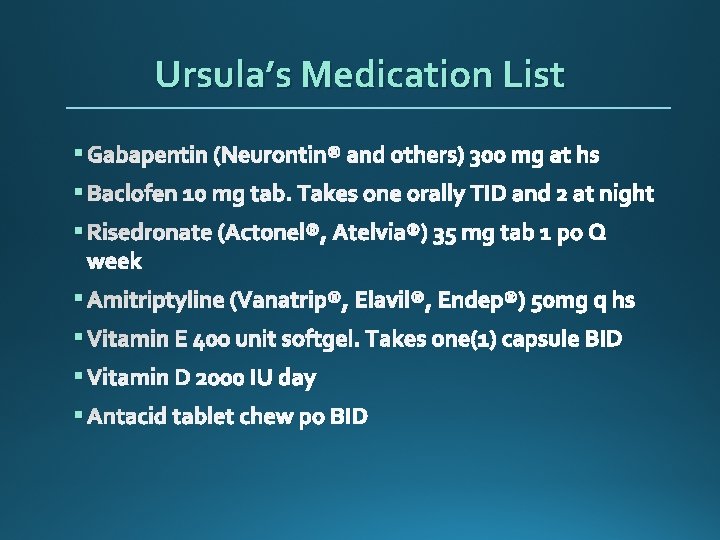
Ursula’s Medication List § Gabapentin (Neurontin® and others) 300 mg at hs § Baclofen 10 mg tab. Takes one orally TID and 2 at night § Risedronate (Actonel®, Atelvia®) 35 mg tab 1 po Q week § Amitriptyline (Vanatrip®, Elavil®, Endep®) 50 mg q hs § Vitamin E 400 unit softgel. Takes one(1) capsule BID § Vitamin D 2000 IU day § Antacid tablet chew po BID
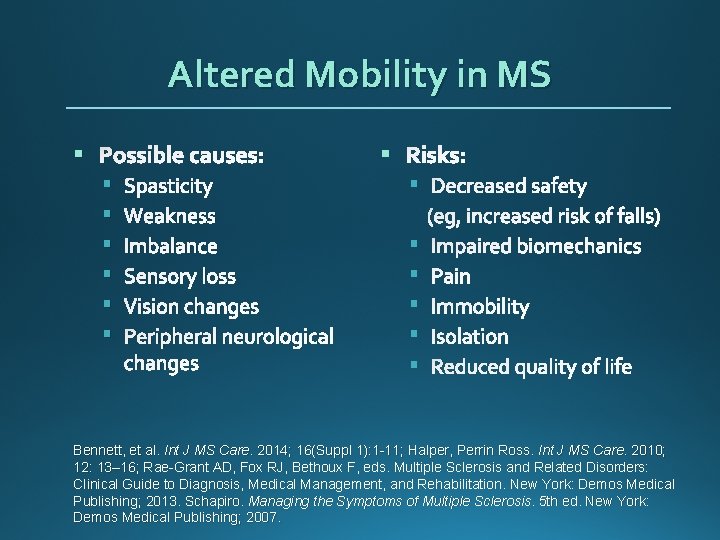
Altered Mobility in MS § Possible causes: § § § Spasticity Weakness Imbalance Sensory loss Vision changes Peripheral neurological changes § § § § Bennett, et al. Int J MS Care. 2014; 16(Suppl 1): 1 -11; Halper, Perrin Ross. Int J MS Care. 2010; 12: 13– 16; Rae-Grant AD, Fox RJ, Bethoux F, eds. Multiple Sclerosis and Related Disorders: Clinical Guide to Diagnosis, Medical Management, and Rehabilitation. New York: Demos Medical Publishing; 2013. Schapiro. Managing the Symptoms of Multiple Sclerosis. 5 th ed. New York: Demos Medical Publishing; 2007.
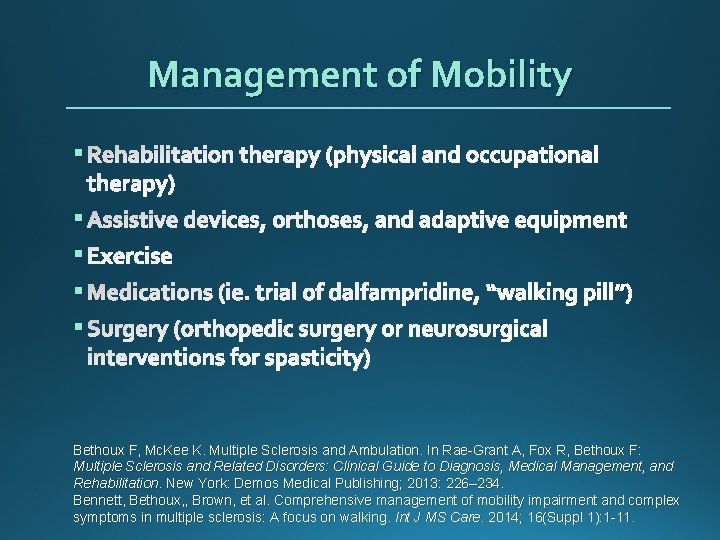
Management of Mobility § Rehabilitation therapy (physical and occupational therapy) § Assistive devices, orthoses, and adaptive equipment § Exercise § Medications (ie. trial of dalfampridine, “walking pill”) § Surgery (orthopedic surgery or neurosurgical interventions for spasticity) Bethoux F, Mc. Kee K. Multiple Sclerosis and Ambulation. In Rae-Grant A, Fox R, Bethoux F: Multiple Sclerosis and Related Disorders: Clinical Guide to Diagnosis, Medical Management, and Rehabilitation. New York: Demos Medical Publishing; 2013: 226– 234. Bennett, Bethoux, , Brown, et al. Comprehensive management of mobility impairment and complex symptoms in multiple sclerosis: A focus on walking. Int J MS Care. 2014; 16(Suppl 1): 1 -11.
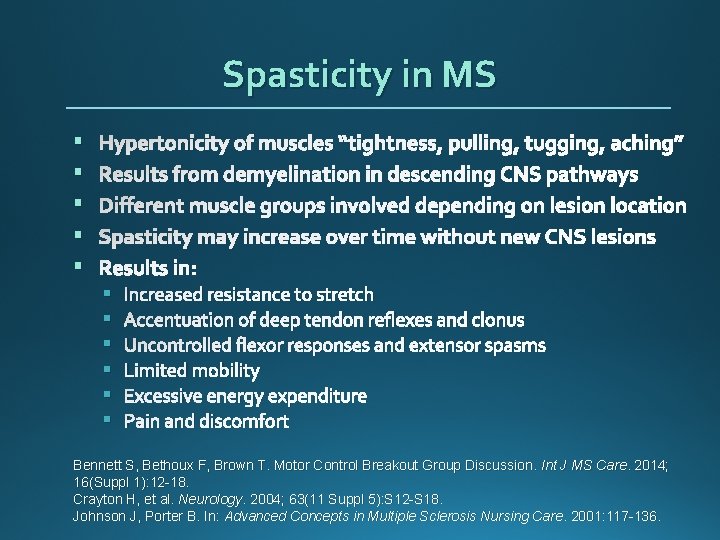
Spasticity in MS § § § Hypertonicity of muscles “tightness, pulling, tugging, aching” Results from demyelination in descending CNS pathways Different muscle groups involved depending on lesion location Spasticity may increase over time without new CNS lesions Results in: § § § Increased resistance to stretch Accentuation of deep tendon reflexes and clonus Uncontrolled flexor responses and extensor spasms Limited mobility Excessive energy expenditure Pain and discomfort Bennett S, Bethoux F, Brown T. Motor Control Breakout Group Discussion. Int J MS Care. 2014; 16(Suppl 1): 12 -18. Crayton H, et al. Neurology. 2004; 63(11 Suppl 5): S 12 -S 18. Johnson J, Porter B. In: Advanced Concepts in Multiple Sclerosis Nursing Care. 2001: 117 -136.
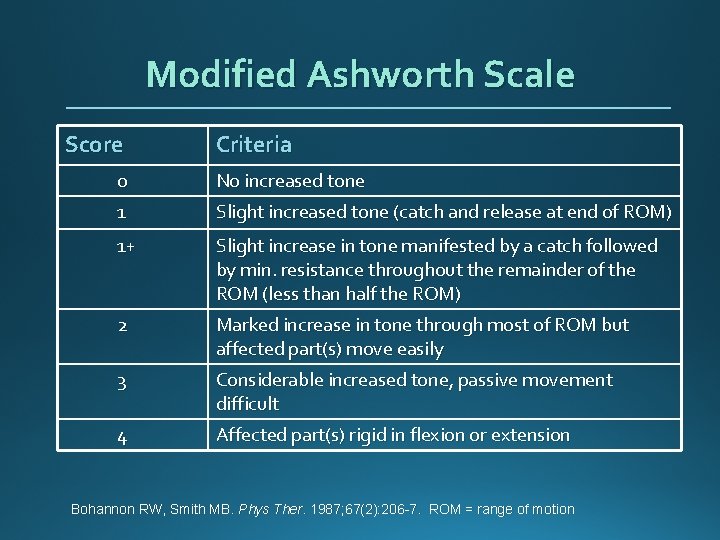
Modified Ashworth Scale Score Criteria 0 No increased tone 1 Slight increased tone (catch and release at end of ROM) 1+ Slight increase in tone manifested by a catch followed by min. resistance throughout the remainder of the ROM (less than half the ROM) 2 Marked increase in tone through most of ROM but affected part(s) move easily 3 Considerable increased tone, passive movement difficult 4 Affected part(s) rigid in flexion or extension Bohannon RW, Smith MB. Phys Ther. 1987; 67(2): 206 -7. ROM = range of motion
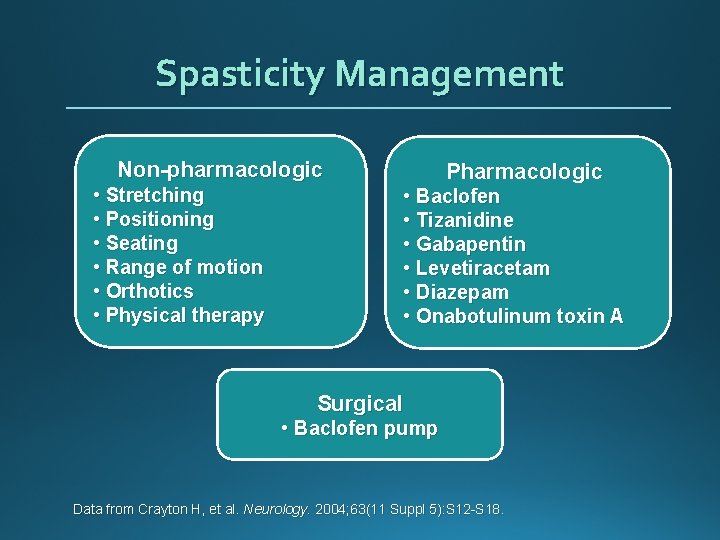
Spasticity Management Non-pharmacologic • Stretching • Positioning • Seating • Range of motion • Orthotics • Physical therapy Pharmacologic • Baclofen • Tizanidine • Gabapentin • Levetiracetam • Diazepam • Onabotulinum toxin A Surgical • Baclofen pump Data from Crayton H, et al. Neurology. 2004; 63(11 Suppl 5): S 12 -S 18.
Spasticity Management Non-pharmacologic Interventions § Early intervention § Stretching, exercising § Orthotics § Relaxation techniques Bennett S, Bethoux F, Brown T. Motor Control Breakout Group Discussion. Int J MS Care. 2014; 16(Suppl 1): 12 -18. Bethoux F, Willis MA. Spasticity Management in Multiple Sclerosis. In Rae-Grant A, Fox R, Bethoux F: Multiple Sclerosis and Related Disorders: Clinical Guide to Diagnosis, Medical Management, and Rehabilitation. New York: Demos Medical Publishing; 2013: 217– 225.
Spasticity Management Baclofen Pharmacologic Interventions § Stimulates gamma-aminobutyric acid (GABA) receptors § Initiated at 5 mg bid-tid and titrated upward § Typical effective dose 30 -90 mg/day § Adverse events (AEs): drowsiness, dry mouth, and lightheadedness § Do not discontinue abruptly (seizures, hallucinations, agitation) Bethoux F, Willis MA. Spasticity Management in Multiple Sclerosis. In Rae-Grant A, Fox R, Bethoux F: Multiple Sclerosis and Related Disorders: Clinical Guide to Diagnosis, Medical Management, and Rehabilitation. New York: Demos Medical Publishing; 2013: 217– 225. Crayton H, et al. Neurology. 2004; 63(11 Suppl 5): S 12 -S 18.
Spasticity Management Pharmacologic Interventions Tizanidine (Zanaflex®) § Centrally acting α 2 -adrenergic receptor agonist § Initiate at bedtime (sedation) 1 -4 mg if possible; if initiate at daytime 1 -2 mg QID, then titrate up to 4 -8 mg QID (max 36 mg/day in 3 -4 divided doses) § AE: sedation, hypotension, weakness, constipation, dry mouth § Counsel patient about activities requiring alertness (driving, etc. ) and use of alcohol § Liver function test and CBC should be performed Bethoux F, Willis MA. Spasticity Management in Multiple Sclerosis. In Rae-Grant A, Fox R, Bethoux F: Multiple Sclerosis and Related Disorders: Clinical Guide to Diagnosis, Medical Management, and Rehabilitation. New York: Demos Medical Publishing; 2013: 217– 225. Crayton H, et al. Neurology. 2004; 63(11 Suppl 5): S 12 -S 18.
Spasticity Management Pharmacologic Interventions § Benzodiazepines (diazepam, clonazepam, etc. ) § May cause daytime sedation; therefore, take at bedtime § Gabapentin § Combination of baclofen, tizanidine, and benzodiazpines may help those patients who are unresponsive to monotherapy § For combination therapy, lower doses are used, which may minimize adverse events (AEs) Bethoux F, Willis MA. Spasticity Management in Multiple Sclerosis. In Rae-Grant A, Fox R, Bethoux F: Multiple Sclerosis and Related Disorders: Clinical Guide to Diagnosis, Medical Management, and Rehabilitation. New York: Demos Medical Publishing; 2013: 217– 225. Crayton H, et al. Neurology. 2004; 63(11 Suppl 5): S 12 -S 18.
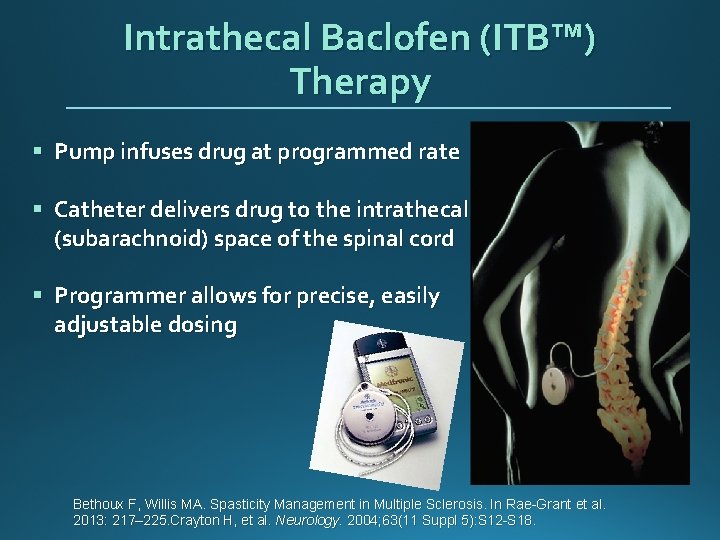
Intrathecal Baclofen (ITB™) Therapy § Pump infuses drug at programmed rate § Catheter delivers drug to the intrathecal (subarachnoid) space of the spinal cord § Programmer allows for precise, easily adjustable dosing Bethoux F, Willis MA. Spasticity Management in Multiple Sclerosis. In Rae-Grant et al. 2013: 217– 225. Crayton H, et al. Neurology. 2004; 63(11 Suppl 5): S 12 -S 18.
Tremor in MS § Caused by MS lesions in cerebellum and its pathways § Can affect head, limbs, trunk, eye movements, and speech § Titubation § Difficult to treat Halper J, Harris C. Nursing Practice in Multiple Sclerosis: A Core Curriculum. 3 rd ed. New York: Springer Publishing Company, 2012. Frenette J, et al. In: Symptom Management in Advanced Concepts in Multiple Sclerosis Nursing Care. 2001: 200 -204.
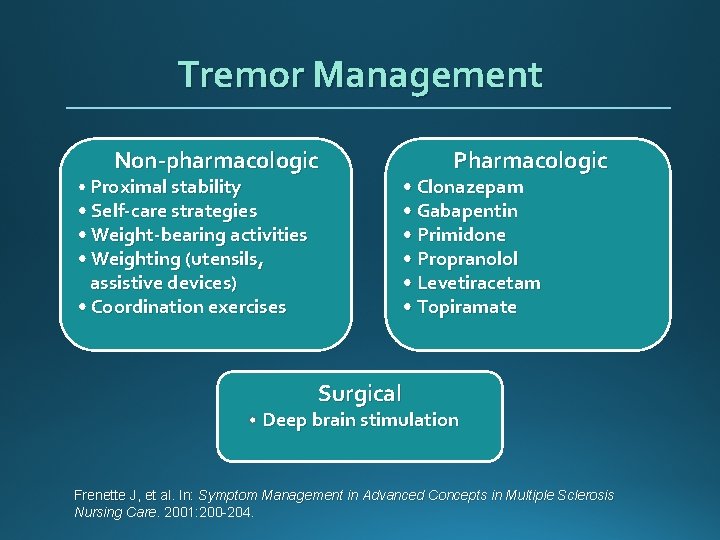
Tremor Management Non-pharmacologic • Proximal stability • Self-care strategies • Weight-bearing activities • Weighting (utensils, assistive devices) • Coordination exercises Pharmacologic • Clonazepam • Gabapentin • Primidone • Propranolol • Levetiracetam • Topiramate Surgical Deep brain stimulation Frenette J, et al. In: Symptom Management in Advanced Concepts in Multiple Sclerosis Nursing Care. 2001: 200 -204.
Ursula’s Issues/ Interventions § Mobility issues § Use assistive devices as needed, PT locally, focus on safety § Tremor/ataxia § Did not tolerate medications § Spasticity § Daily stretching, low dose baclofen
Nursing Implications § Symptom management follows the same general rules as disease management § Diagnose the problem and intervene early § Identification of symptoms is key § Need to confirm the nature of the symptoms and link to MS (MS or not MS) § Secondary causes (comorbidities may contribute to symptoms) § Use multimodal, multidisciplinary management § Identify interventions (non-pharmacologic and pharmacologic) § Monitor and adjust treatment plan as needed over time
Summary: Symptom Management § Clinical approach to symptom management is what health care providers do best and most often § MS symptoms affect quality of life of individuals with multiple sclerosis § Left untreated, symptoms may worsen or precipitate other symptoms, producing a cycle of inter-related symptoms. § Nurses listen, respond with care and concern, treat, and make referrals
Nursing Perspective § Many new treatment options § Promising research on the horizon § Choices for patients § Improved control § Hope for the future
- Slides: 51