
Symptomatic Management of MS Team Based Approach Invisible
Symptomatic Management of MS: Team Based Approach Invisible Symptoms

Multi-Disciplinary Team Approach Neurologist Primary Care Physician Nurse/NP Pharmacist Physical Therapist Psychiatrist Occupational Therapist Orthotist Patient and Family Psychologist/ Neuropsychologist Social Worker PA Speech/Language Urologist Physiatrist Pathologist

MS Symptom Overview § Fatigue (most common) § Loss of sensation § Decreased visual acuity, diplopia § Pain § Sexual dysfunction § Paresthesias § Emotional disturbances § Cognitive difficulties (memory, attention, processing) § Heat sensitivity § Spasticity § Gait, balance, and coordination problems § Speech/swallowing problems § Tremor § Weakness § Bladder and/or bowel dysfunction Halper J, Harris C. Nursing Practice in Multiple Sclerosis: A Core Curriculum. 3 rd ed. New York: Springer Publishing Company, 2012.
FATIGUE
Fatigue “a subjective lack of physical and/or mental energy that is perceived by the individual or caregiver to interfere with usual and desired activities” Multiple Sclerosis Council for Clinical Practice Guidelines, Paralyzed Veterans of America. Fatigue and Multiple Sclerosis. Evidence-Based Management Strategies for Fatigue in Multiple Sclerosis. Washington, DC: Paralyzed Veterans of America; 1998.
Fatigue § The most common and disabling symptom of MS 1, 3 § Experienced by up to 95% of patients 2 § 50 -60% describe it as on of their most troubling symptoms 2 § Reported in all disease stages and subtypes 2 § Some evidence that lesions in the basal ganglia and hypothalamus may play an important role 2 1. Schapiro. Managing the Symptoms of Multiple Sclerosis. (6 th ed). New York: Demos Medical Publishing, 2014. 2. Amato, Portaccio. Expert Opin Pharmacother. 2012 Feb; 13(2): 207 -216. 3. Halper, Harris. Nursing Practice in MS: A Core Curriculum. 3 rd ed. NY: Springer Publishing, 2012.
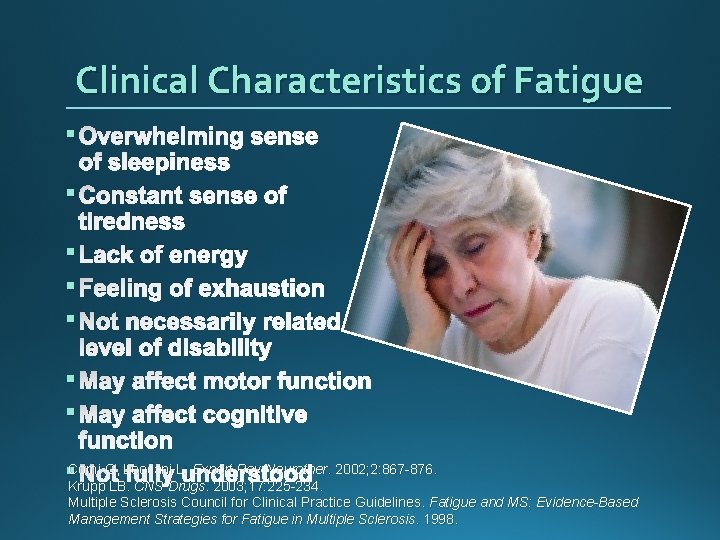
Clinical Characteristics of Fatigue § Overwhelming sense of sleepiness § Constant sense of tiredness § Lack of energy § Feeling of exhaustion § Not necessarily related to level of disability § May affect motor function § May affect cognitive function G, Leocani L. understood Expert Rev Neurother. 2002; 2: 867 -876. §Comi Not fully Krupp LB. CNS Drugs. 2003; 17: 225 -234. Multiple Sclerosis Council for Clinical Practice Guidelines. Fatigue and MS: Evidence-Based Management Strategies for Fatigue in Multiple Sclerosis. 1998.
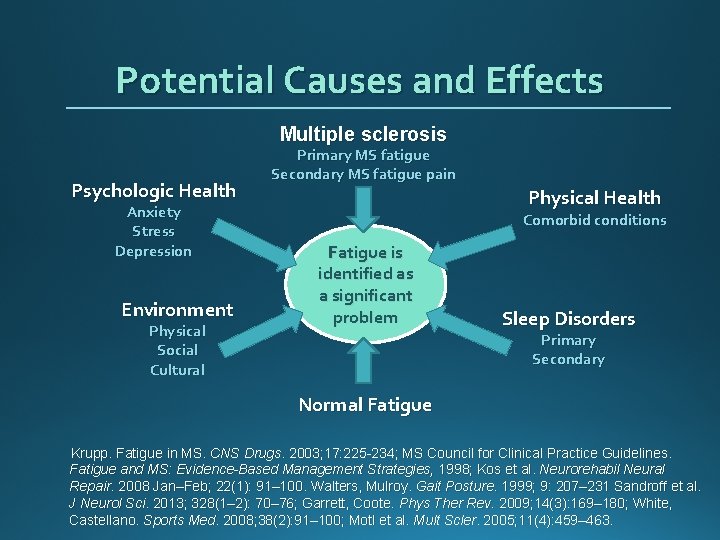
Potential Causes and Effects Multiple sclerosis Psychologic Health Anxiety Stress Depression Environment Physical Social Cultural Primary MS fatigue Secondary MS fatigue pain Physical Health Comorbid conditions Fatigue is identified as a significant problem Sleep Disorders Primary Secondary Normal Fatigue Krupp. Fatigue in MS. CNS Drugs. 2003; 17: 225 -234; MS Council for Clinical Practice Guidelines. Fatigue and MS: Evidence-Based Management Strategies, 1998; Kos et al. Neurorehabil Neural Repair. 2008 Jan–Feb; 22(1): 91– 100. Walters, Mulroy. Gait Posture. 1999; 9: 207– 231 Sandroff et al. J Neurol Sci. 2013; 328(1– 2): 70– 76; Garrett, Coote. Phys Ther Rev. 2009; 14(3): 169– 180; White, Castellano. Sports Med. 2008; 38(2): 91– 100; Motl et al. Mult Scler. 2005; 11(4): 459– 463.
Assessment Tools § Fatigue Severity Scale § Fatigue Impact Scale § Modified Impact Scale § Fatigue Descriptive Scale § Fatigue Scale for Motor and Cognitive Functions Amato, Portaccio. Expert Opin. Pharmachother. 2012; 13(2): 207 -216. Bennett et al. Int J MS Care. 2014; 16(Suppl 1): 25 -32.
Fatigue Management § Exercise § Address secondary causes § Cooling techniques § OT/PT: energy conservation techniques § Pacing § Stress management Amato, Portaccio. Expert Opin. Pharmachother. 2012; 13(2): 207 -216. Bennett et al. Int J MS Care. 2014; 16(Suppl 1): 25 -32.
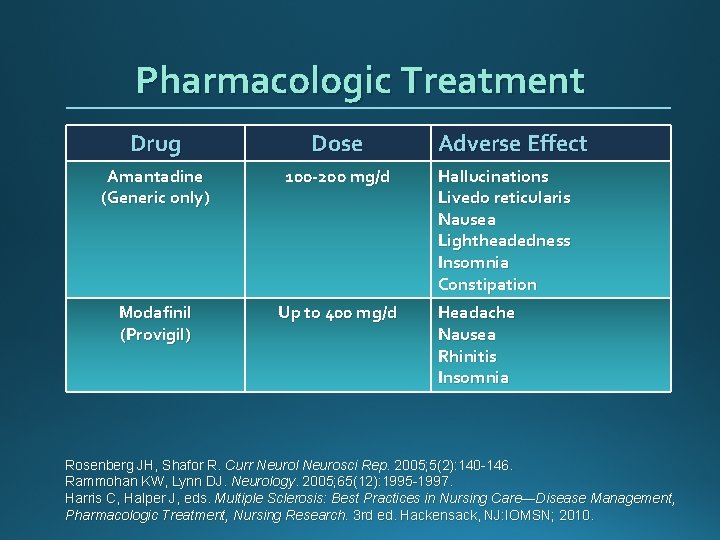
Pharmacologic Treatment Drug Dose Amantadine (Generic only) 100 -200 mg/d Modafinil (Provigil) Up to 400 mg/d Adverse Effect Hallucinations Livedo reticularis Nausea Lightheadedness Insomnia Constipation Headache Nausea Rhinitis Insomnia Rosenberg JH, Shafor R. Curr Neurol Neurosci Rep. 2005; 5(2): 140 -146. Rammohan KW, Lynn DJ. Neurology. 2005; 65(12): 1995 -1997. Harris C, Halper J, eds. Multiple Sclerosis: Best Practices in Nursing Care—Disease Management, Pharmacologic Treatment, Nursing Research. 3 rd ed. Hackensack, NJ: IOMSN; 2010.
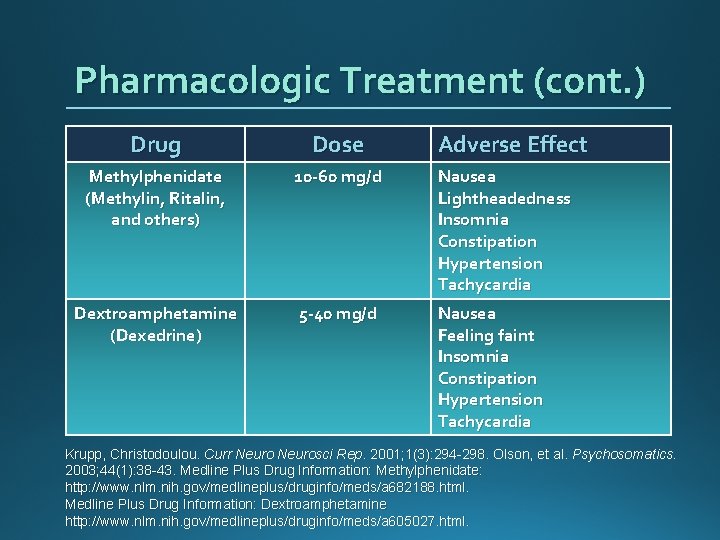
Pharmacologic Treatment (cont. ) Drug Dose Adverse Effect Methylphenidate (Methylin, Ritalin, and others) 10 -60 mg/d Nausea Lightheadedness Insomnia Constipation Hypertension Tachycardia Dextroamphetamine (Dexedrine) 5 -40 mg/d Nausea Feeling faint Insomnia Constipation Hypertension Tachycardia Krupp, Christodoulou. Curr Neurosci Rep. 2001; 1(3): 294 -298. Olson, et al. Psychosomatics. 2003; 44(1): 38 -43. Medline Plus Drug Information: Methylphenidate: http: //www. nlm. nih. gov/medlineplus/druginfo/meds/a 682188. html. Medline Plus Drug Information: Dextroamphetamine http: //www. nlm. nih. gov/medlineplus/druginfo/meds/a 605027. html.
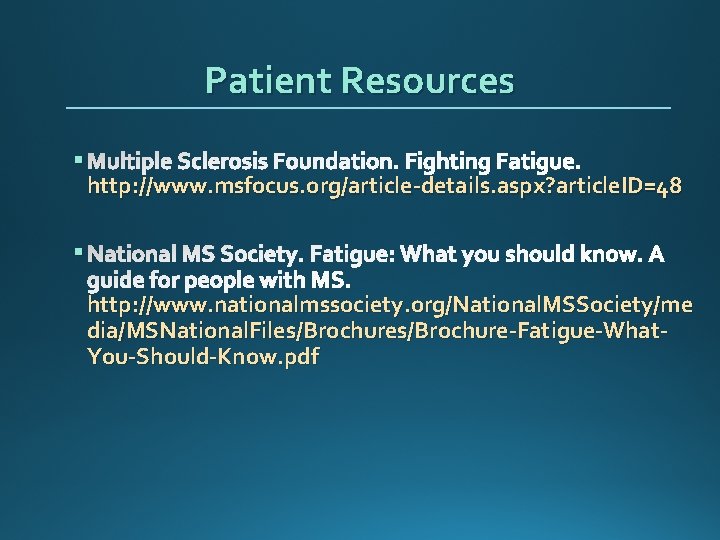
Patient Resources § Multiple Sclerosis Foundation. Fighting Fatigue. http: //www. msfocus. org/article-details. aspx? article. ID=48 § National MS Society. Fatigue: What you should know. A guide for people with MS. http: //www. nationalmssociety. org/National. MSSociety/me dia/MSNational. Files/Brochure-Fatigue-What. You-Should-Know. pdf
COGNITION
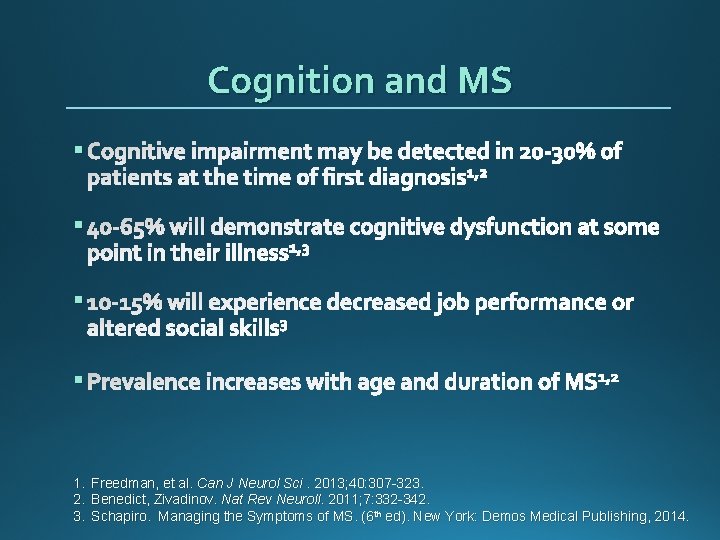
Cognition and MS § Cognitive impairment may be detected in 20 -30% of patients at the time of first diagnosis 1, 2 § 40 -65% will demonstrate cognitive dysfunction at some point in their illness 1, 3 § 10 -15% will experience decreased job performance or altered social skills 3 § Prevalence increases with age and duration of MS 1, 2 1. 2. 3. Freedman, et al. Can J Neurol Sci. 2013; 40: 307 -323. Benedict, Zivadinov. Nat Rev Neuroll. 2011; 7: 332 -342. Schapiro. Managing the Symptoms of MS. (6 th ed). New York: Demos Medical Publishing, 2014.
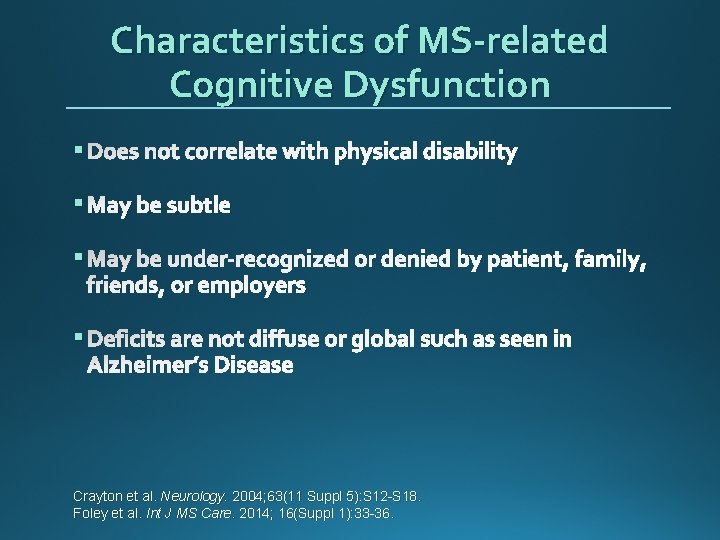
Characteristics of MS-related Cognitive Dysfunction § Does not correlate with physical disability § May be subtle § May be under-recognized or denied by patient, family, friends, or employers § Deficits are not diffuse or global such as seen in Alzheimer’s Disease Crayton et al. Neurology. 2004; 63(11 Suppl 5): S 12 -S 18. Foley et al. Int J MS Care. 2014; 16(Suppl 1): 33 -36.
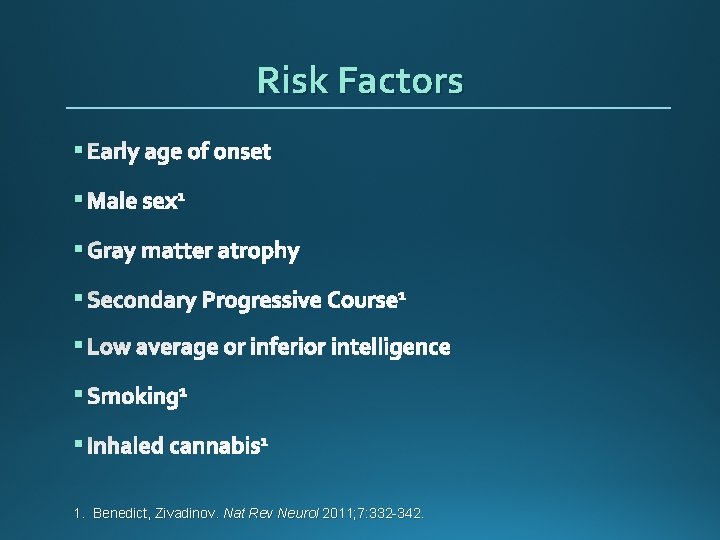
Risk Factors § Early age of onset § Male sex 1 § Gray matter atrophy § Secondary Progressive Course 1 § Low average or inferior intelligence § Smoking 1 § Inhaled cannabis 1 1. Benedict, Zivadinov. Nat Rev Neurol 2011; 7: 332 -342.
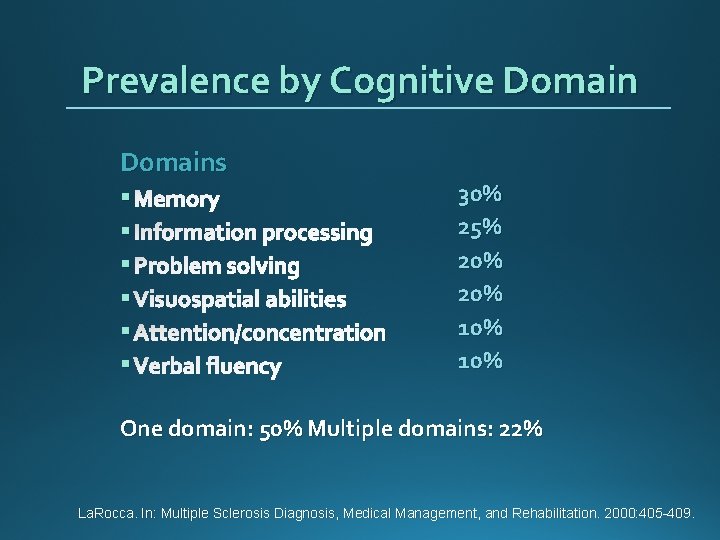
Prevalence by Cognitive Domains § Memory § Information processing § Problem solving § Visuospatial abilities § Attention/concentration § Verbal fluency 30% 25% 20% 10% One domain: 50% Multiple domains: 22% La. Rocca. In: Multiple Sclerosis Diagnosis, Medical Management, and Rehabilitation. 2000: 405 -409.
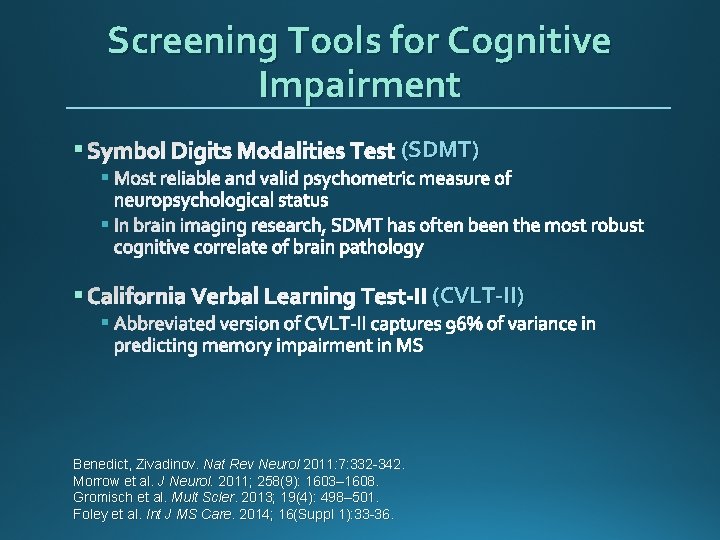
Screening Tools for Cognitive Impairment § Symbol Digits Modalities Test (SDMT) § § § California Verbal Learning Test-II (CVLT-II) § Benedict, Zivadinov. Nat Rev Neurol 2011: 7: 332 -342. Morrow et al. J Neurol. 2011; 258(9): 1603– 1608. Gromisch et al. Mult Scler. 2013; 19(4): 498– 501. Foley et al. Int J MS Care. 2014; 16(Suppl 1): 33 -36.
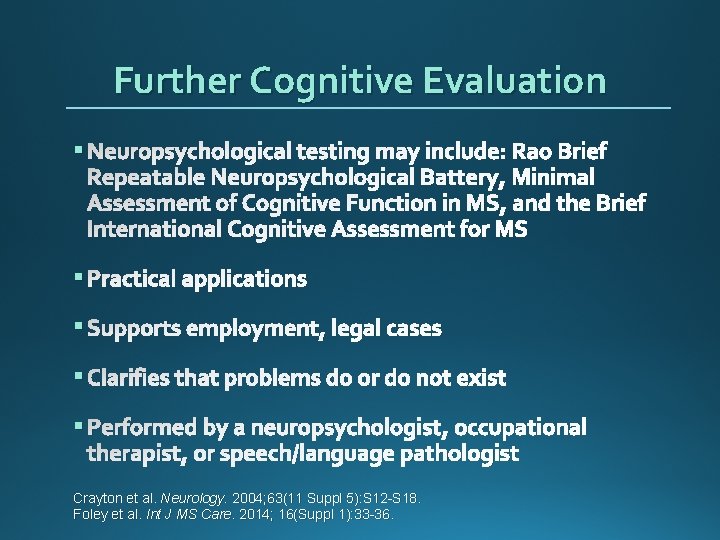
Further Cognitive Evaluation § Neuropsychological testing may include: Rao Brief Repeatable Neuropsychological Battery, Minimal Assessment of Cognitive Function in MS, and the Brief International Cognitive Assessment for MS § Practical applications § Supports employment, legal cases § Clarifies that problems do or do not exist § Performed by a neuropsychologist, occupational therapist, or speech/language pathologist Crayton et al. Neurology. 2004; 63(11 Suppl 5): S 12 -S 18. Foley et al. Int J MS Care. 2014; 16(Suppl 1): 33 -36.
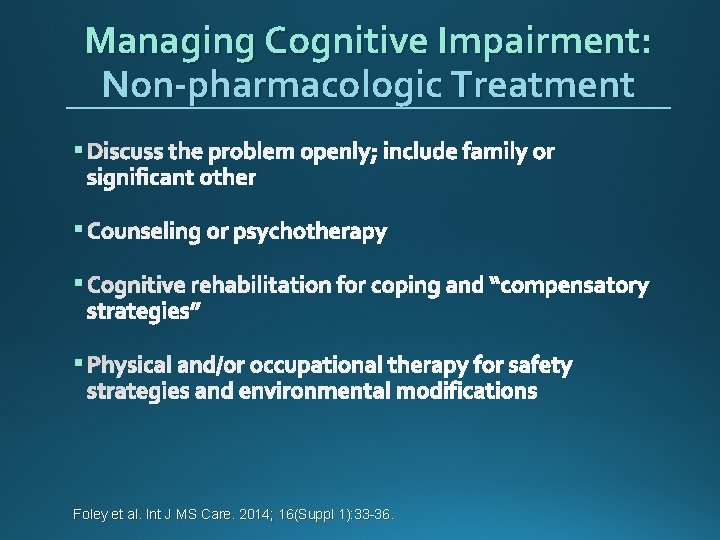
Managing Cognitive Impairment: Non-pharmacologic Treatment § Discuss the problem openly; include family or significant other § Counseling or psychotherapy § Cognitive rehabilitation for coping and “compensatory strategies” § Physical and/or occupational therapy for safety strategies and environmental modifications Foley et al. Int J MS Care. 2014; 16(Suppl 1): 33 -36.
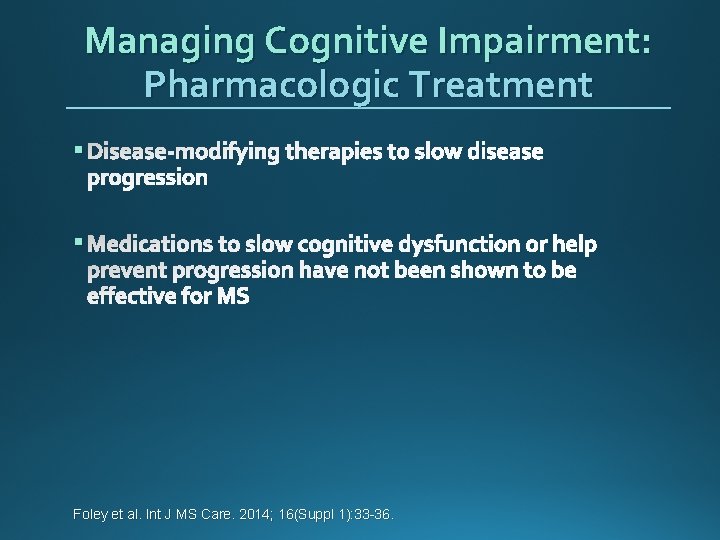
Managing Cognitive Impairment: Pharmacologic Treatment § Disease-modifying therapies to slow disease progression § Medications to slow cognitive dysfunction or help prevent progression have not been shown to be effective for MS Foley et al. Int J MS Care. 2014; 16(Suppl 1): 33 -36.
Patient Resources § Multiple Sclerosis Foundation. Cognitive Deficits in Multiple Sclerosis. http: //www. msfocus. org/articledetails. aspx? article. ID=46 § National MS Society. Solving Cognitive Problems: Managing Specific Issues. http: //www. nationalmssociety. org/National. MSSociety/ media/MSNational. Files/Brochure-Solving. Cognitive-Problems. pdf

PAIN
Acute Pain is the normal, predicted physiological response to a noxious chemical, thermal, or mechanical stimulus and typically is associated with invasive procedures, trauma, and disease. It is generally time-limited. (North Carolina Board of Medicine)
Chronic Pain (Non-malignant) Generally considered to be pain that lasts more than 6 months, is ongoing, is due to non-life threatening causes, has not responded to current available treatment methods, and may continue for the remainder of the person’s life. (American Pain Society)
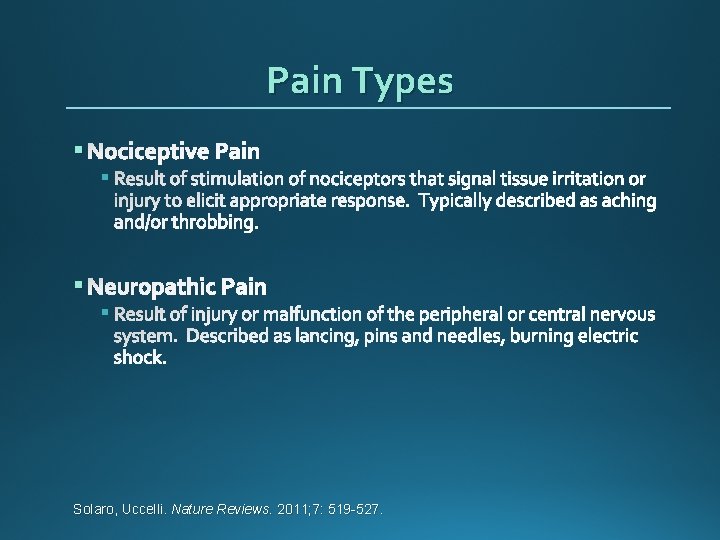
Pain Types § Nociceptive Pain § § Neuropathic Pain § Solaro, Uccelli. Nature Reviews. 2011; 7: 519 -527.
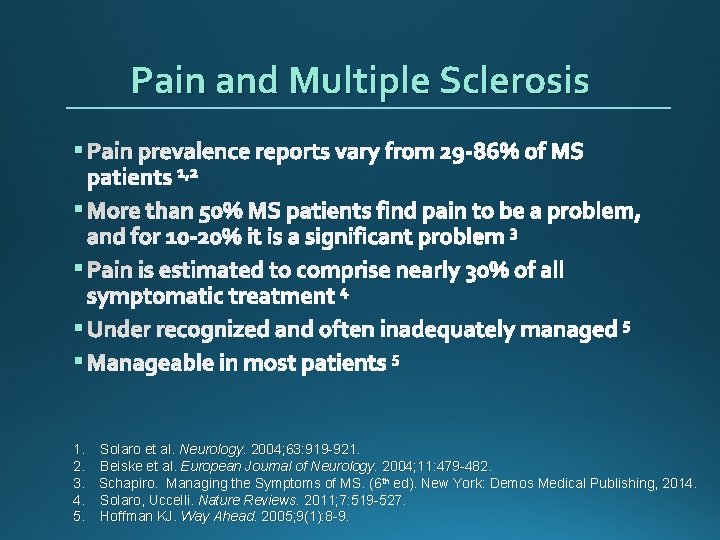
Pain and Multiple Sclerosis § Pain prevalence reports vary from 29 -86% of MS patients 1, 2 § More than 50% MS patients find pain to be a problem, and for 10 -20% it is a significant problem 3 § Pain is estimated to comprise nearly 30% of all symptomatic treatment 4 § Under recognized and often inadequately managed 5 § Manageable in most patients 5 1. 2. 3. 4. 5. Solaro et al. Neurology. 2004; 63: 919 -921. Beiske et al. European Journal of Neurology. 2004; 11: 479 -482. Schapiro. Managing the Symptoms of MS. (6 th ed). New York: Demos Medical Publishing, 2014. Solaro, Uccelli. Nature Reviews. 2011; 7: 519 -527. Hoffman KJ. Way Ahead. 2005; 9(1): 8 -9.
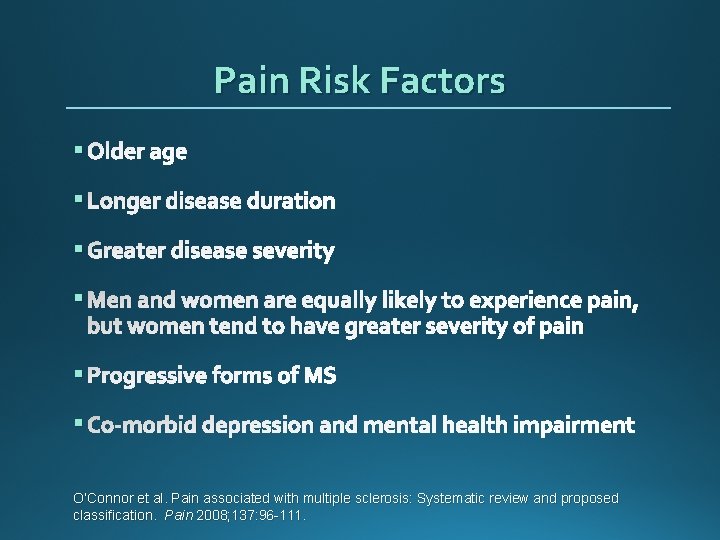
Pain Risk Factors § Older age § Longer disease duration § Greater disease severity § Men and women are equally likely to experience pain, but women tend to have greater severity of pain § Progressive forms of MS § Co-morbid depression and mental health impairment O’Connor et al. Pain associated with multiple sclerosis: Systematic review and proposed classification. Pain 2008; 137: 96 -111.
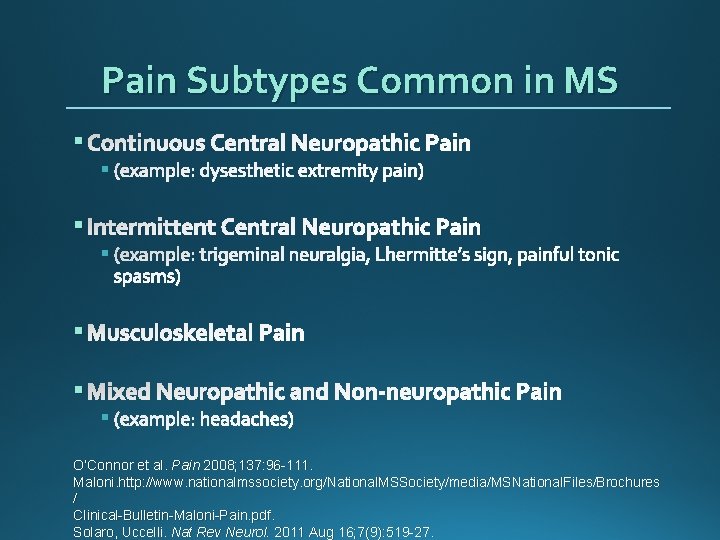
Pain Subtypes Common in MS § Continuous Central Neuropathic Pain § § Intermittent Central Neuropathic Pain § § Musculoskeletal Pain § Mixed Neuropathic and Non-neuropathic Pain § O’Connor et al. Pain 2008; 137: 96 -111. Maloni. http: //www. nationalmssociety. org/National. MSSociety/media/MSNational. Files/Brochures / Clinical-Bulletin-Maloni-Pain. pdf. Solaro, Uccelli. Nat Rev Neurol. 2011 Aug 16; 7(9): 519 -27.
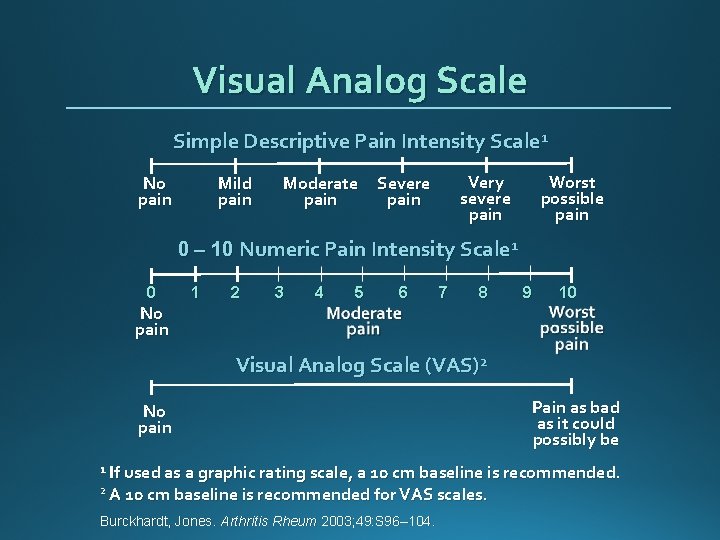
Visual Analog Scale Simple Descriptive Pain Intensity Scale 1 No pain Mild pain Moderate pain Worst possible pain Very severe pain Severe pain 0 – 10 Numeric Pain Intensity Scale 1 0 No pain 1 2 3 4 5 6 7 8 9 10 Visual Analog Scale (VAS)2 No pain Pain as bad as it could possibly be 1 If used as a graphic rating scale, a 10 cm baseline is recommended. 2 A 10 cm baseline is recommended for VAS scales. Burckhardt, Jones. Arthritis Rheum 2003; 49: S 96– 104.
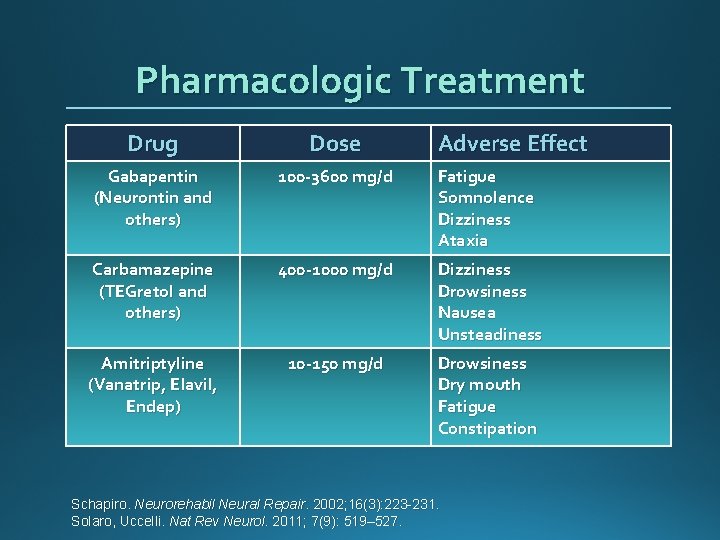
Pharmacologic Treatment Drug Dose Adverse Effect Gabapentin (Neurontin and others) 100 -3600 mg/d Fatigue Somnolence Dizziness Ataxia Carbamazepine (TEGretol and others) 400 -1000 mg/d Dizziness Drowsiness Nausea Unsteadiness Amitriptyline (Vanatrip, Elavil, Endep) 10 -150 mg/d Drowsiness Dry mouth Fatigue Constipation Schapiro. Neurorehabil Neural Repair. 2002; 16(3): 223 -231. Solaro, Uccelli. Nat Rev Neurol. 2011; 7(9): 519– 527.
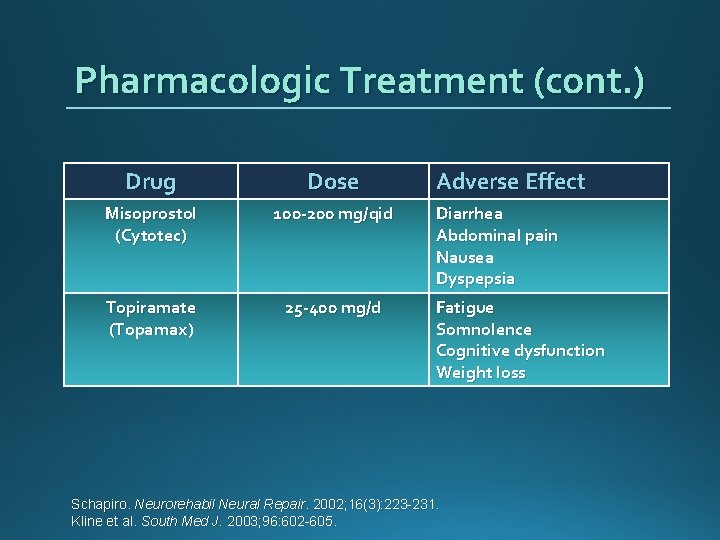
Pharmacologic Treatment (cont. ) Drug Dose Misoprostol (Cytotec) 100 -200 mg/qid Topiramate (Topamax) 25 -400 mg/d Adverse Effect Diarrhea Abdominal pain Nausea Dyspepsia Fatigue Somnolence Cognitive dysfunction Weight loss Schapiro. Neurorehabil Neural Repair. 2002; 16(3): 223 -231. Kline et al. South Med J. 2003; 96: 602 -605.
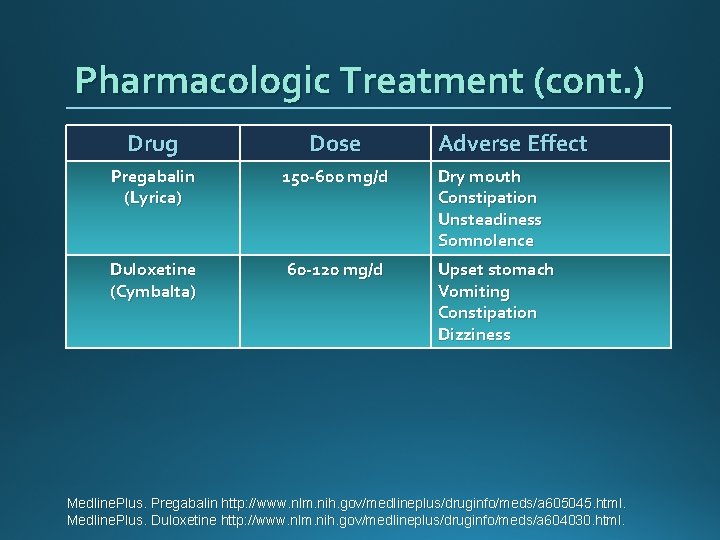
Pharmacologic Treatment (cont. ) Drug Dose Adverse Effect Pregabalin (Lyrica) 150 -600 mg/d Dry mouth Constipation Unsteadiness Somnolence Duloxetine (Cymbalta) 60 -120 mg/d Upset stomach Vomiting Constipation Dizziness Medline. Plus. Pregabalin http: //www. nlm. nih. gov/medlineplus/druginfo/meds/a 605045. html. Medline. Plus. Duloxetine http: //www. nlm. nih. gov/medlineplus/druginfo/meds/a 604030. html.
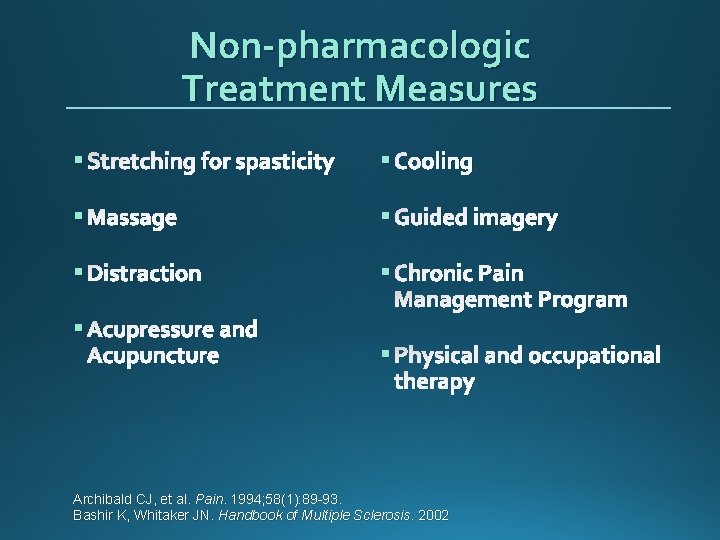
Non-pharmacologic Treatment Measures § Stretching for spasticity § Cooling § Massage § Guided imagery § Distraction § Chronic Pain Management Program § Acupressure and Acupuncture § Physical and occupational therapy Archibald CJ, et al. Pain. 1994; 58(1): 89 -93. Bashir K, Whitaker JN. Handbook of Multiple Sclerosis. 2002
Patient Resources § National MS Society. Pain: The Basic Facts. Multiple Sclerosis. http: //www. nationalmssociety. org/National. MSSociety/ media/MSNational. Files/Brochure-Pain-The. Basic-Facts. pdf

DEPRESSION
Depression A common mental disorder characterized by sadness, loss of interest or pleasure, feelings of guilt or low self-worth, disturbed sleep or appetite, feelings of tiredness, and poor concentration. (World Health Organization)
Depression in MS § Up to 50% lifetime risk for Major Depressive Disorder (MDD) in the MS population 1, 2 § Incidence of depression is three times greater than the general population 2 § Etiology is unknown (related to MS pathophysiology, meds used to treat MS, or the challenges of living with MS) 3 § Presence of depressive symptoms does not correlate well with the severity of disability 1, 2 § Suicide has been indicated as cause of death for up to 15% of MS patients 1 1. 2. 3. Goldman Consensus Group. Multiple Sclerosis 2005; 11: 328 -337. Paparrigopoulos et al. International Review of Psychiatry 2010; 22(1): 14 -21. Crayton et al. Neurology. 2004; 63(11 Suppl 5): S 12 -S 18.
Depression in MS § Weak association may exist between depression and disease-modifying therapies 1 § Fatigue, psychomotor retardation, poor concentration, sleep and appetite disturbances overlap both MDD and MS 2, 3 § MDD continues to be under- diagnosed and undertreated 2, 4 1. 2. 3. 4. Crayton et al. Neurology. 2004; 63(11 Suppl 5): S 12 -S 18. Paparrigopoulos et al. International Review of Psychiatry 2010; 22(1): 14 -21. Goldman Consensus Group. Multiple Sclerosis 2005; 11: 328 -337. Majmudar, Schiffer. Int J MS Care 2009; 11: 154 -159.
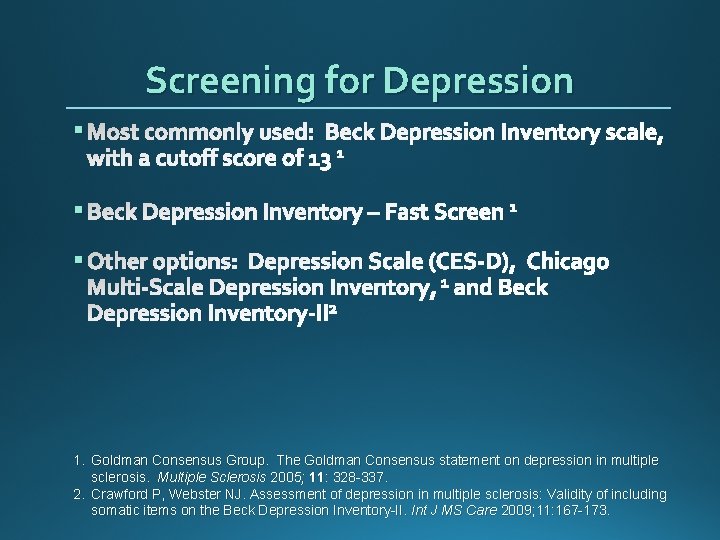
Screening for Depression § Most commonly used: Beck Depression Inventory scale, with a cutoff score of 13 1 § Beck Depression Inventory – Fast Screen 1 § Other options: Depression Scale (CES-D), Chicago Multi-Scale Depression Inventory, 1 and Beck Depression Inventory-II 2 1. Goldman Consensus Group. The Goldman Consensus statement on depression in multiple sclerosis. Multiple Sclerosis 2005; 11: 328 -337. 2. Crawford P, Webster NJ. Assessment of depression in multiple sclerosis: Validity of including somatic items on the Beck Depression Inventory-II. Int J MS Care 2009; 11: 167 -173.
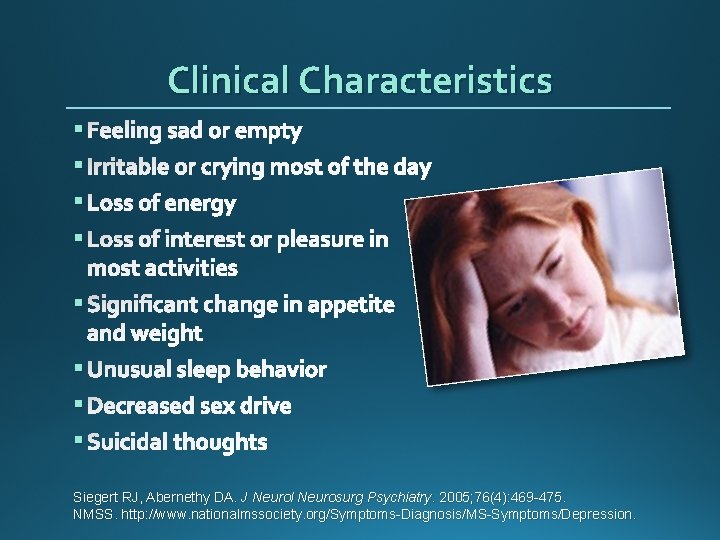
Clinical Characteristics § Feeling sad or empty § Irritable or crying most of the day § Loss of energy § Loss of interest or pleasure in most activities § Significant change in appetite and weight § Unusual sleep behavior § Decreased sex drive § Suicidal thoughts Siegert RJ, Abernethy DA. J Neurol Neurosurg Psychiatry. 2005; 76(4): 469 -475. NMSS. http: //www. nationalmssociety. org/Symptoms-Diagnosis/MS-Symptoms/Depression.
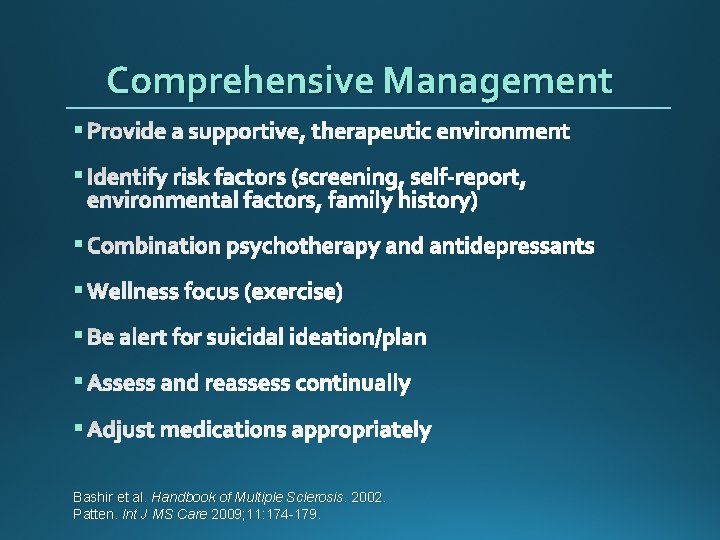
Comprehensive Management § Provide a supportive, therapeutic environment § Identify risk factors (screening, self-report, environmental factors, family history) § Combination psychotherapy and antidepressants § Wellness focus (exercise) § Be alert for suicidal ideation/plan § Assess and reassess continually § Adjust medications appropriately Bashir et al. Handbook of Multiple Sclerosis. 2002. Patten. Int J MS Care 2009; 11: 174 -179.
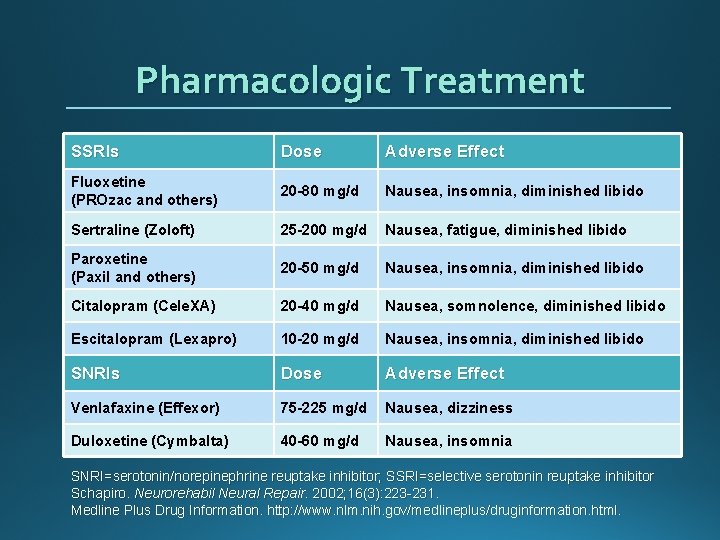
Pharmacologic Treatment SSRIs Dose Adverse Effect Fluoxetine (PROzac and others) 20 -80 mg/d Nausea, insomnia, diminished libido Sertraline (Zoloft) 25 -200 mg/d Nausea, fatigue, diminished libido Paroxetine (Paxil and others) 20 -50 mg/d Nausea, insomnia, diminished libido Citalopram (Cele. XA) 20 -40 mg/d Nausea, somnolence, diminished libido Escitalopram (Lexapro) 10 -20 mg/d Nausea, insomnia, diminished libido SNRIs Dose Adverse Effect Venlafaxine (Effexor) 75 -225 mg/d Nausea, dizziness Duloxetine (Cymbalta) 40 -60 mg/d Nausea, insomnia SNRI=serotonin/norepinephrine reuptake inhibitor; SSRI=selective serotonin reuptake inhibitor Schapiro. Neurorehabil Neural Repair. 2002; 16(3): 223 -231. Medline Plus Drug Information. http: //www. nlm. nih. gov/medlineplus/druginformation. html.
Patient Resources § Multiple Sclerosis Foundation. The many shadows of MS related depression. http: //www. msfocus. org/articledetails. aspx? article. ID=413 § Multiple Sclerosis Foundation. Caring for your emotional health. http: //www. msfocus. org/articledetails. aspx? article. ID=414 § National MS Society. Depression & multiple sclerosis. http: //www. nationalmssociety. org/National. MSSociety/ media/MSNational. Files/Brochure. Depression. pdf

CONCLUSION
Nursing Implications § It is important to acknowledge that many MS symptoms overlap § It is essential to educate patients regarding role of contributing factors (i. e. medications, infections, heat, deconditioning, etc. ) § When a symptom is new or suddenly worsens, reevaluate for contributing factors both internal (disease activity), or external (environmental issues).
Nursing Implications § Lifestyle matters! Reinforce importance of exercise, nutrition, stress management, smoking cessation, adequate sleep § Gauge impact of symptom(s) on patients’ lifestyle before recommending treatment § Lifestyle modifications may be all that is needed/desired to address symptom(s)
Nursing Implications § When possible, include family/loved ones in the discussion § Up to 80% information given at an office visit is forgotten as soon as a patient leaves the office § Provide more than one form of instruction, especially when cognitive impairment is suspected (verbal, written, handouts, website information)
- Slides: 49