
Symposium on MultiHazard Early Warning Systems for Integrated
- Slides: 24
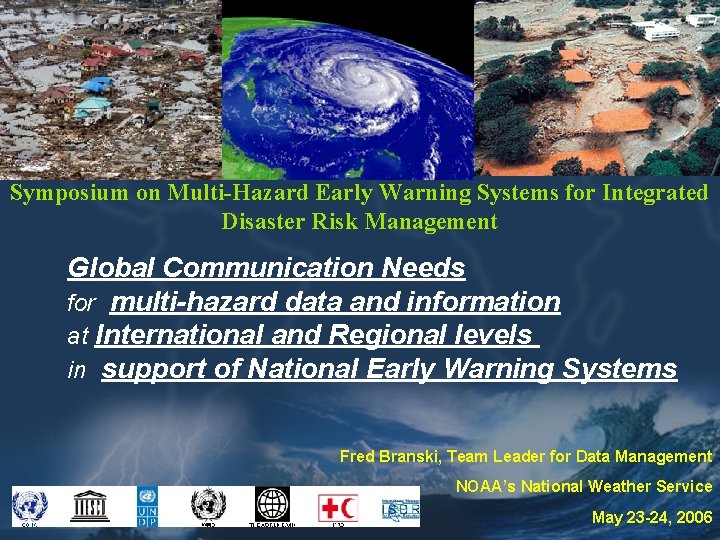
Symposium on Multi-Hazard Early Warning Systems for Integrated Disaster Risk Management Global Communication Needs for multi-hazard data and information at International and Regional levels in support of National Early Warning Systems Fred Branski, Team Leader for Data Management NOAA’s National Weather Service May 23 -24, 2006
Global Communication Needs The critical issues are: • Data collection • Coordination • Dissemination Hold this thought, we’ll come back to it.
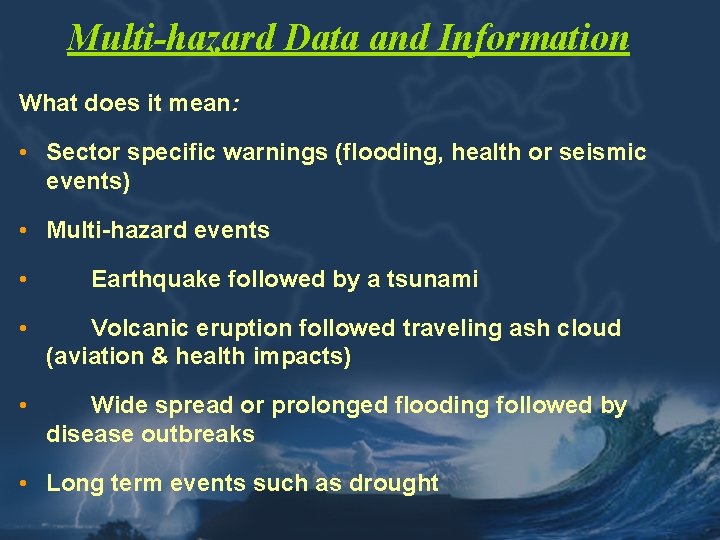
Multi-hazard Data and Information What does it mean: • Sector specific warnings (flooding, health or seismic events) • Multi-hazard events • Earthquake followed by a tsunami • Volcanic eruption followed traveling ash cloud (aviation & health impacts) • Wide spread or prolonged flooding followed by disease outbreaks • Long term events such as drought
International and Regional levels • Effective coordination can be inhibited by: Language, cultural & political barriers • Roll for international agencies: Coordination Brokerage Support • National will to cooperate for a better good
Support of National Early Warning Systems “Last Mile” This is the component having the greatest impact on outreach to people Building or improving international / regional systems does little good without reliable robust national systems. And vice versa!
Global Communication Needs Data collection: Observations – roll for GEOSS Model output Supporting products & guidance
Global Communication Needs Coordination: Between nations & regions Between agencies both intra and inter-nationally Between currently disparate communities Scientific disciplines such as hydrometeorology, seismology, oceanography & human & animal healt With the Emergency Management community With civil and political decision makers
Global Communication Needs Dissemination: International, Regional & National aspects To decision makers To agencies responsible for preparatory and response activities To the public (What do I do? Not science) 3 types of communications: Pre-event (only for some events) Real-time Post event (Is the danger over? What do I do know? ) Integrated risk information Automated alerting mechanisms: CAP - Common Alerting Protocol
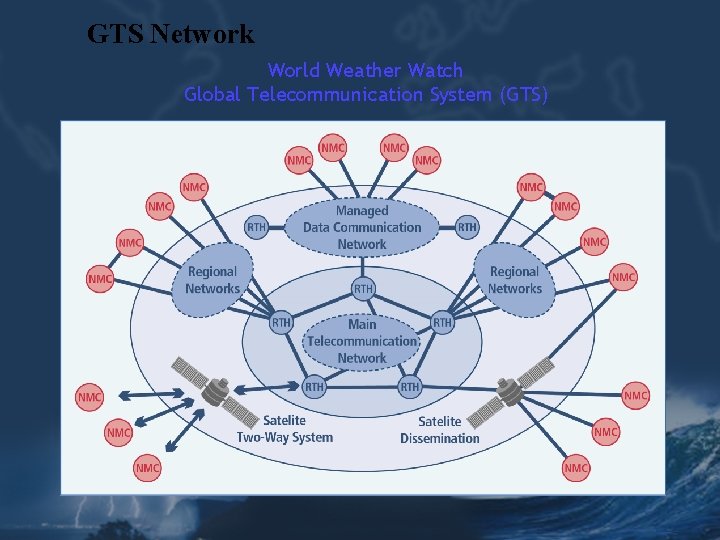
Key issue i) Need for proven operational telecommunication mechanisms at international and regional levels for exchange of critical data and information in support of early warnings for multi-hazards? Issues, needs, challenges, capabilities. GTS/WIS is a key global infrastructure An existing competency which should be leveraged for EWS and disaster risk and impact reduction
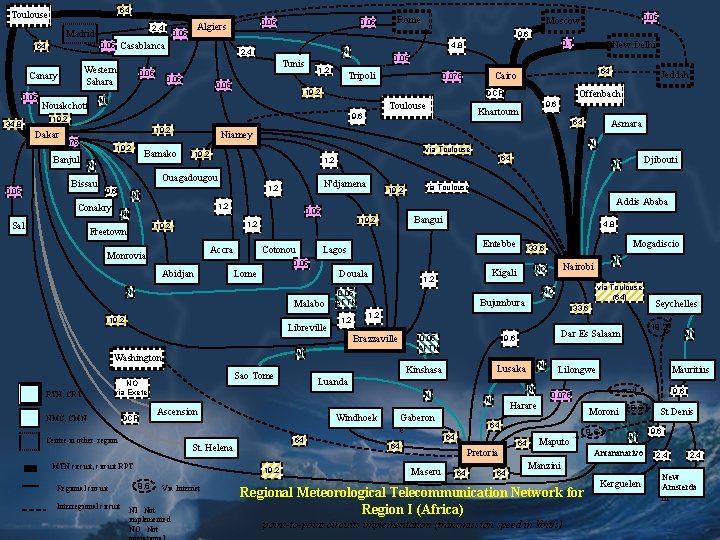
64 Toulouse 2. 4 Madrid Western Sahara Canary 0. 05 34. 8 0. 05 1. 2 0. 1 Tripoli 0. 075 Banjul 19. 2 Khartoum Conakry 1. 2 NI Accra Lome Douala Libreville NO via Exeter Bujumbura Brazzaville Windhoek 64 St. Helena MTN circuit, circuit RPT 19. 2 Via Internet NI Not implemented NO Not Gaberon e NI NI Harare Lilongwe Pretoria 64 64 64 Moroni Maputo 9. 6 NI Mauritius email 0. 075 64 64 64 Maseru NI Seychelles 19. 2 Dar Es Salaam Lusaka NI Centre in other region 33. 6 9. 6 0. 05 AFTN Luanda Ascension via Toulouse (64) 1. 2 Kinshasa Sao Tome NI Nairobi NO NO 0. 05 AFTN 1. 2 Mogadiscio 33. 6 Kigali 1. 2 NI Washington Interregional circuit Entebbe 0. 05 19. 2 9. 6 4. 8 Lagos Malabo Regional circuit via Toulouse Bangui 19. 2 Cotonou Djibouti NI Addis Ababa NI DCP 19. 2 0. 05 1. 2 19. 2 Abidjan NMC, CMN 64 N'djamena 1. 2 Monrovia RTH, CRT Asmara NI 1. 2 NI Freetown 64 via Toulouse 19. 2 Ouagadougou 9. 6 Niamey NI Bissau Sal Bamako Jeddah Offenbach DCP 9. 6 19. 2 64 Cairo 0. 075 Toulouse 19. 2 New Delhi 0. 05 19. 2 NI Nouakchott 0. 05 Moscow 4. 8 NI 2. 4 0. 05 Rome 9. 6 Tunis 0. 05 Dakar 0. 05 Casablanca 0. 05 64 0. 05 Algiers 9. 6 NI Antananarivo 9. 6 St Denis 9. 6 2. 4 Manzini Regional Meteorological Telecommunication Network for Region I (Africa) point-to-point circuits implementation (transmission speed in kbit/s) Kerguelen New Amsterda m
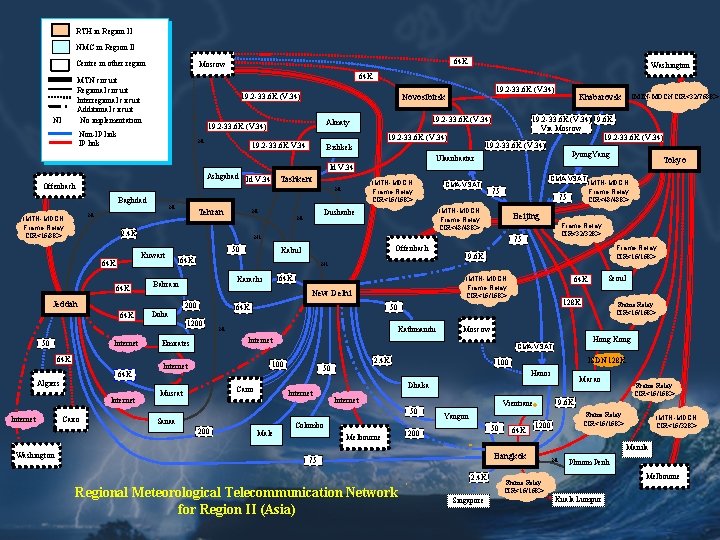
RTH in Region II NMC in Region II Centre in other region 19. 2 -33. 6 K (V. 34) NI 19. 2 -33. 6 K (V. 34) 19. 2 -33. 6 K V. 34 Ashgabad Id V. 34 Bishkek Ulaanbaatar NI Tehran NI 64 K Internet Cairo 50 Offenbach Kabul NI Doha 64 K Karachi Bahrain 75 75 1200 Frame Relay CIR<16/16 K> 9. 6 K Kathmandu NI Cairo Muscat 128 K 2. 4 K 50 Internet Sanaa Male ISDN 128 K 100 Hanoi Macao Dhaka Internet 50 Colombo Melbourne 50 200 64 K Frame Relay CIR<16/16 K> 1200 Bangkok 2. 4 K Singapore Frame Relay CIR<16/16 K> 9. 6 K Vientiane Yangon 75 Regional Meteorological Telecommunication Network for Region II (Asia) Frame Relay CIR<16/16 K> Hong Kong CMA-VSAT 100 Internet Seoul 64 K Moscow Internet Emirates Frame Relay CIR<32/32 K> 50 64 K IMTN-MDCN Frame Relay CIR<48/48 K> Beijing IMTN-MDCN Frame Relay CIR<16/16 K> New Delhi 200 Washington CMA-VSAT 75 64 K Jeddah 64 K Tokyo IMTN-MDCN Frame Relay CIR<48/48 K> Dushanbe NI IMTN-MDCN CIR<32/768 K> 19. 2 -33. 6 K (V. 34) 9. 6 K Via Moscow 19. 2 -33. 6 K (V. 34) Pyong. Yang NI Kuwait 64 K Internet NI 2. 4 K Algiers IMTN-MDCN Frame Relay CIR<16/16 K> NI Baghdad 50 Tashkent Khabarovsk 19. 2 -33. 6 K (V. 34) Almaty Id V. 34 Offenbach 19. 2 -33. 6 K (V. 34) Novosibirsk 19. 2 -33. 6 K (V. 34) Non-IP link IMTN-MDCN Frame Relay CIR<16/8 K> Washington 64 K MTN circuit Regional circuit Interregional circuit Additional circuit No implementation NI 64 K Moscow IMTN-MDCN CIR<16/32 K> Manila NI Phnom Penh Melbourne Frame Relay CIR<16/16 K> Kuala Lumpur
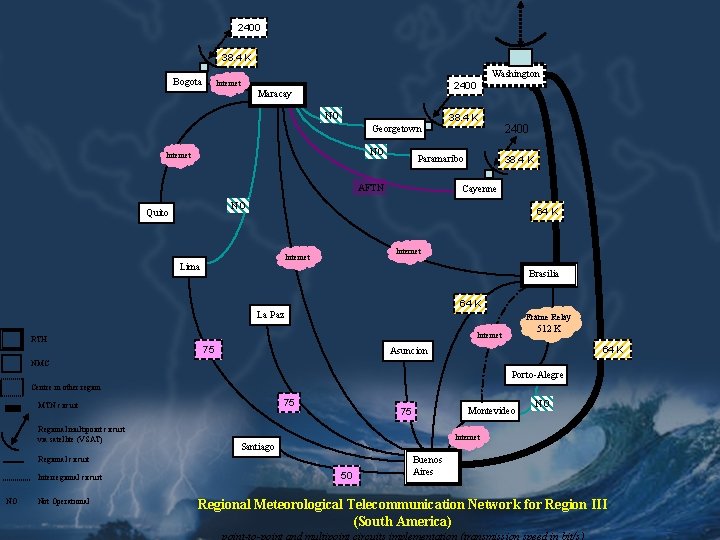
2400 38. 4 K Bogota Internet Washington 2400 Maracay NO 38. 4 K Georgetown NO Internet Paramaribo AFTN 2400 38. 4 K Cayenne NO Quito 64 K Internet Lima Brasilia 64 K La Paz RTH Frame Relay 512 K Internet 75 64 K Asuncion NMC Porto-Alegre Centre in other region 75 MTN circuit Regional multipoint circuit via satellite (VSAT) NO Not Operational NO Internet Santiago Regional circuit Interregional circuit Montevideo 75 50 Buenos Aires Regional Meteorological Telecommunication Network for Region III (South America) point-to-point and multipoint circuits implementation (transmission speed in bit/s)
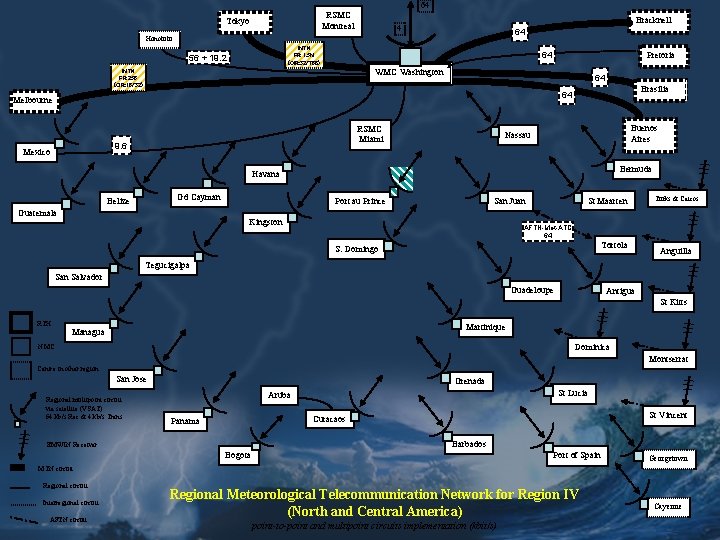
64 RSMC Montreal Tokyo Bracknell 4 64 Honolulu IMTN FR 1. 5 M (CIR: 32/768) 56 + 19. 2 Pretoria 64 WMC Washington IMTN FR 256 (CIR: 16/32) 64 Brasilia 64 Melbourne RSMC Miami 9. 6 Mexico Buenos Aires Nassau Bermuda Havana Gd Cayman Belize Guatemala St Maarten San Juan Port au Prince Kingston Turks & Caicos AFTN-Met-ATC 64 Tortola S. Domingo Anguilla Tegucigalpa San Salvador Guadeloupe Antigua St Kitts RTH Martinique Managua Dominica NMC Montserrat Centre in other region San Jose Regional multipoint circuit via satellite (VSAT) 64 kb/s Rec & 4 kb/s Trans Grenada St Lucia Aruba St Vincent Curacaos Panama Barbados EMWIN Receiver Bogota Port of Spain Georgetown MTN circuit Regional circuit Interregional circuit AFTN circuit Regional Meteorological Telecommunication Network for Region IV (North and Central America) point-to-point and multipoint circuits implementation (kbit/s) Cayenne
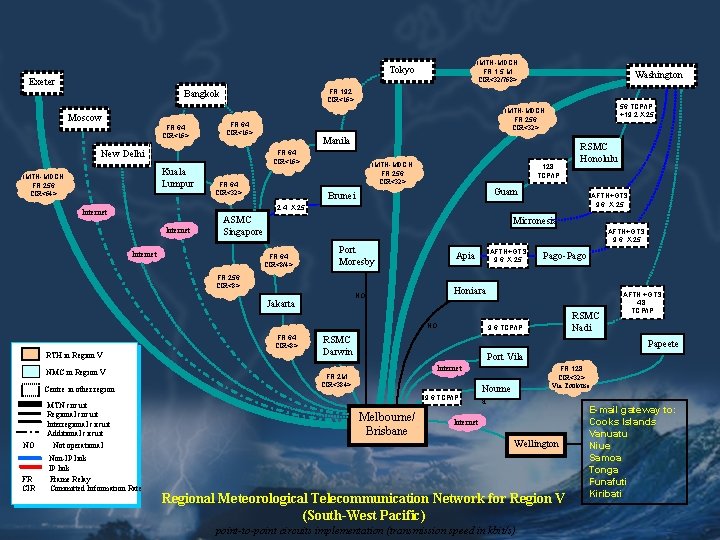
IMTN-MDCN FR 1. 5 M CIR<32/768> Tokyo Exeter FR 192 CIR<16> Bangkok Moscow FR 64 CIR<16> Manila FR 64 CIR<16> Kuala Lumpur 56 TCP/IP +19. 2 X. 25 IMTN-MDCN FR 256 CIR<32> FR 64 CIR<16> New Delhi IMTN-MDCN FR 256 CIR<64> Washington FR 64 CIR<32> IMTN-MDCN FR 256 CIR<32> 128 TCP/IP RSMC Honolulu Guam Brunei AFTN+GTS 9. 6 X. 25 2. 4 X. 25 Internet ASMC Singapore Internet Micronesia AFTN+GTS 9. 6 X. 25 FR 64 CIR<8/4> Port Moresby FR 256 CIR<8> NO FR 64 CIR<8> RTH in Region V NMC in Region V Centre in other region NO MTN circuit Regional circuit Interregional circuit Additional circuit Not operational FR CIR Non-IP link Frame Relay Committed Information Rate Pago-Pago Honiara NO Jakarta AFTN+GTS 9. 6 X. 25 Apia RSMC Nadi 9. 6 TCP/IP RSMC Darwin AFTN +GTS 4. 8 TCP/IP Papeete Port Vila Internet FR 2 M CIR<384> 9. 6 TCP/IP Melbourne/ Brisbane FR 128 CIR<32> Via Toulouse Noume a Internet Wellington Regional Meteorological Telecommunication Network for Region V (South-West Pacific) point-to-point circuits implementation (transmission speed in kbit/s) E-mail gateway to: Cooks Islands Vanuatu Niue Samoa Tonga Funafuti Kiribati
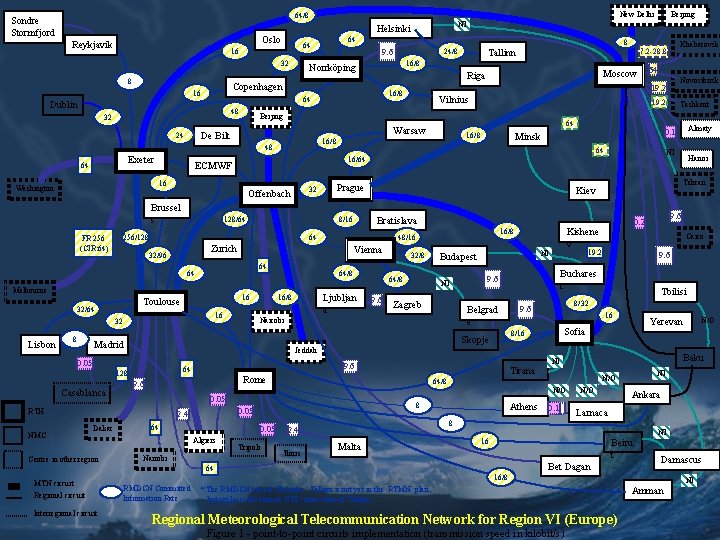
New Delhi 64/8 Sondre Stormfjord Oslo Reykjavik 32 8 48 32 128/64 16 32 8 Zagreb Tbilisi 16 0. 05 Algiers Nairobi RMDCN Committed Information Rate Athens 8 0. 05 64 Tripoli Baku NI 0. 1 N/O Ankara Larnaca 8 2. 4 Tunis NI N/O 0. 05 N/O Yerevan Sofia 8/16 64/8 Malta 64 Interregional circuit 9. 6 8/32 9. 6 Tirana Rome 9. 6 2. 4 MTN circuit Regional circuit Belgrad e 9. 6 64 RTH Centre in other region 9. 6 Cairo Buchares t 9. 6 NI Skopje 128 Dakar 64/8 9. 6 0. 2 19. 2 NI Budapest Hanoi Tehran Jeddah 0. 05 NMC Ljubljan a 32/8 Almaty NI Kishene v 16/8 Nairobi Madrid Casablanca 64/8 16/8 Tashkent 0. 1 Bratislava Vienna 64 Toulouse 64 Minsk 16/8 48/16 Zurich Melbourne 19. 2 Kiev 64 32/96 Vilnius Prague 8/16 256/128 64 Lisbon 32 Novosibirsk 19. 2 16/8 64 Offenbach FR 256 (CIR: 64) 64 16/64 ECMWF Brussel s Moscow Riga 16/8 16 Washington 16/8 Warsaw De Bilt Khabarovsk 7. 2 -28. 8 Beijing 48 64 8 Tallinn 24/8 Norrköping 64 Dublin Exeter 9. 6 Copenhagen 16 24 64 64 16 Beijing NI Helsinki Beiru t 16 Bet Dagan NI Damascus 16/8 * The RMDCN circuit Helsinki - Tallinn is not yet in the RTMN plan, but replaces the former GTS connection of Tallinn Regional Meteorological Telecommunication Network for Region VI (Europe) Figure 1 - point-to-point circuits implementation (transmission speed in kilobit/s) Amman NI
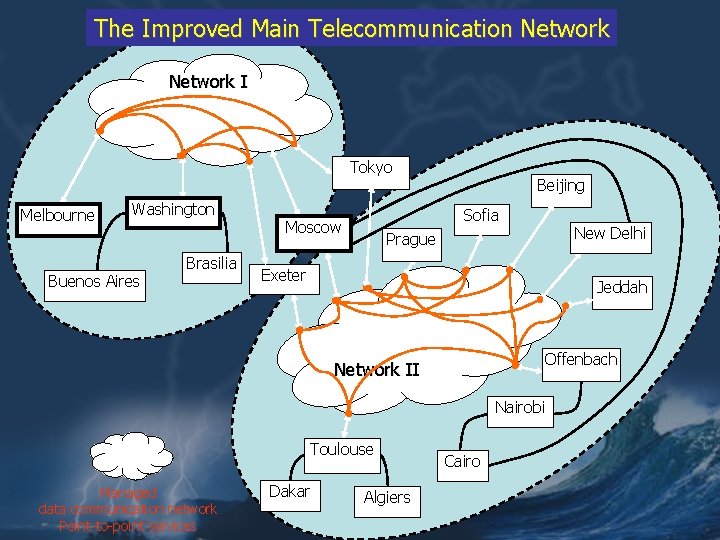
The Improved Main Telecommunication Network I Tokyo Melbourne Washington Buenos Aires Brasilia Beijing Sofia Moscow Prague Exeter Jeddah Offenbach Network II Nairobi Toulouse Managed data communication network Point-to-point services New Delhi Dakar Algiers Cairo
GTS Network World Weather Watch Global Telecommunication System (GTS)
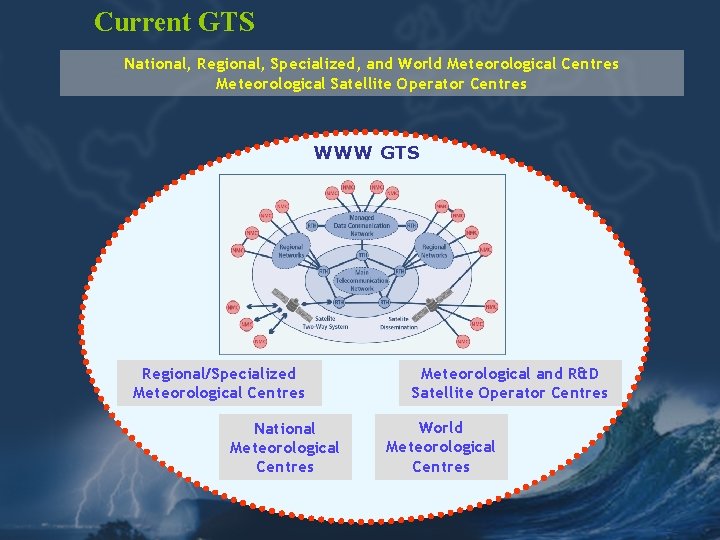
Current GTS National, Regional, Specialized, and World Meteorological Centres Meteorological Satellite Operator Centres WWW GTS Regional/Specialized Meteorological Centres National Meteorological Centres Meteorological and R&D Satellite Operator Centres World Meteorological Centres
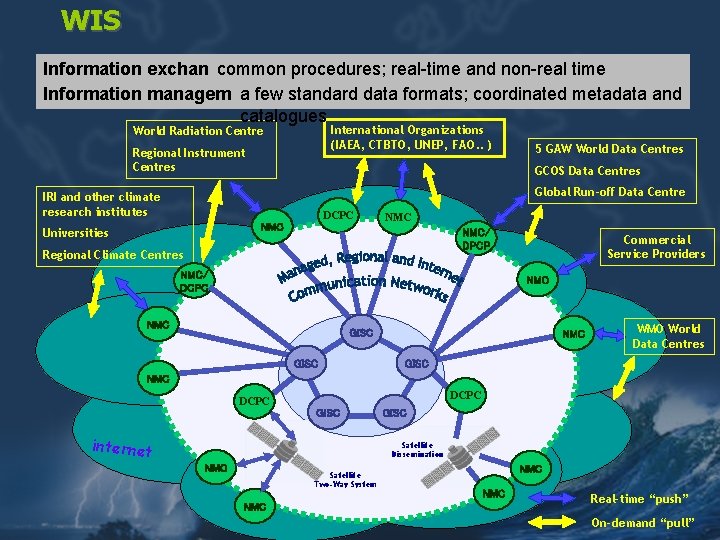
WIS Information exchange common – procedures; real-time and non-real time Information management a few – standard data formats; coordinated metadata and catalogues International Organizations (IAEA, CTBTO, UNEP, FAO. . ) World Radiation Centre Regional Instrument Centres 5 GAW World Data Centres GCOS Data Centres Global Run-off Data Centre IRI and other climate research institutes DCPC NMC Universities NMC/ DPCP Regional Climate Centres NMC/ DCPC Commercial Service Providers NMC GISC NMC WMO World Data Centres GISC NMC DCPC GISC i n te r n e t GISC Satellite Dissemination NMC Satellite Two-Way System NMC NMC Real-time “push” On-demand “pull”
WIS brings new features and opportunities Common information exchange standards, functions and services for all WMO programmes Inter-disciplinary discovery, retrieval and exchange of information in real and non-real time On-line catalogues using metadata based on ISO 19100 (geographic information standard) Industry standards and off-the-shelf hardware and software systems to ensure cost-effectiveness and inter-operability Interoperability of Information Systems
GTS / WIS What does it offer? Top down, Bottom up? Within the GTS we work from the middle out. We provide the infrastructure & basis to enable all the combined activities we support to be effective! The GTS/WIS can provide the middleware of an effective, sustained, reliable multi-hazard EWS as part of an integrated disaster risk management / reduction strategy!
GTS / WIS What does it offer? Data availability is a critical need both for local data getting “out” and “outside” data getting in! These programs we are discussing simply will not be effective or sustainable without sound infrastructure – middleware! The GTS/WIS today reaches out to and supports 187 countries and numerous organizations!
Key issue iii) Challenges of developed and developing countries, related to resource requirements for development of warning communication and dissemination capabilities? Don’t forget legacy technologies. Low tech is often affordable tech as well as maintainable tech and often already exists. Utilize existing capabilities while growing new ones. Identify existing core capabilities and build to create sustainable EWS
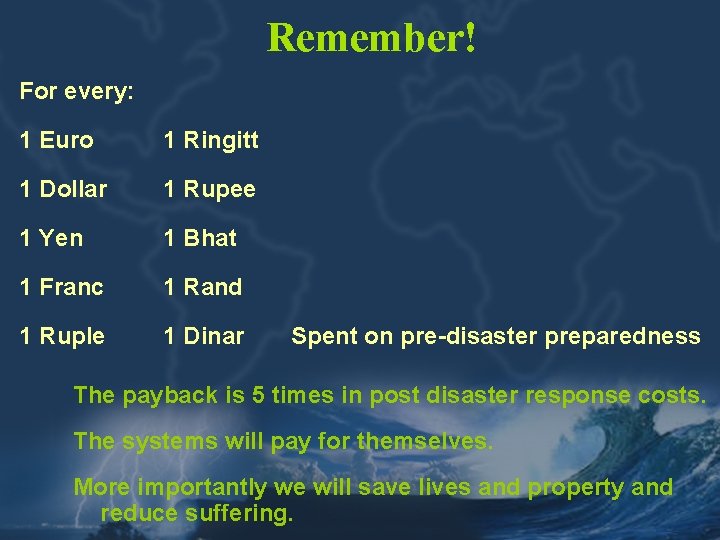
Remember! For every: 1 Euro 1 Ringitt 1 Dollar 1 Rupee 1 Yen 1 Bhat 1 Franc 1 Rand 1 Ruple 1 Dinar Spent on pre-disaster preparedness The payback is 5 times in post disaster response costs. The systems will pay for themselves. More importantly we will save lives and property and reduce suffering.