
Symmetric Cryptography Asymmetric Cryptography and Digital Signatures Symmetric
- Slides: 17
Symmetric Cryptography, Asymmetric Cryptography, and Digital Signatures
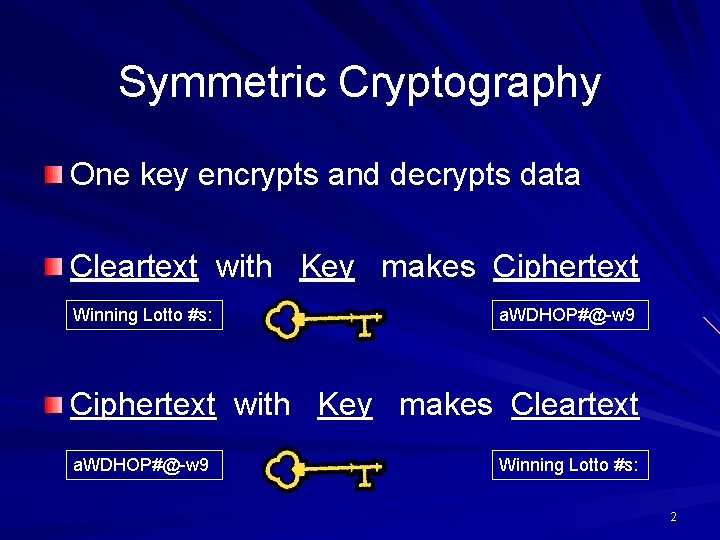
Symmetric Cryptography One key encrypts and decrypts data Cleartext with Key makes Ciphertext Winning Lotto #s: a. WDHOP#@-w 9 Ciphertext with Key makes Cleartext a. WDHOP#@-w 9 Winning Lotto #s: 2
Symmetric Cryptography Algorithms Symmetric algorithms have one key that encrypts and decrypts data Advantages – Symmetric algorithms are fast – They are difficult to break if a large key size is used – Only one key needed 3
Symmetric Cryptography Algorithms Disadvantages – Symmetric keys must remain secret – Difficult to deliver keys (key distribution) – Symmetric algorithms don’t support authenticity or nonrepudiation You can’t know for sure who sent the message, since two people have the same key 4
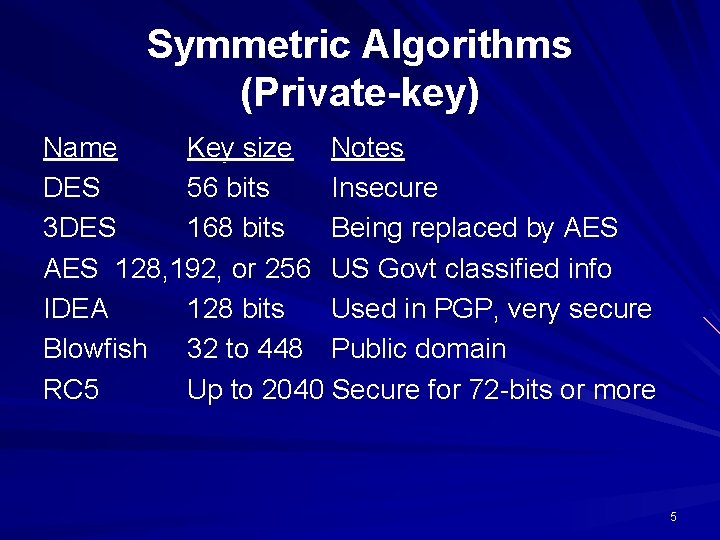
Symmetric Algorithms (Private-key) Name Key size Notes DES 56 bits Insecure 3 DES 168 bits Being replaced by AES 128, 192, or 256 US Govt classified info IDEA 128 bits Used in PGP, very secure Blowfish 32 to 448 Public domain RC 5 Up to 2040 Secure for 72 -bits or more 5
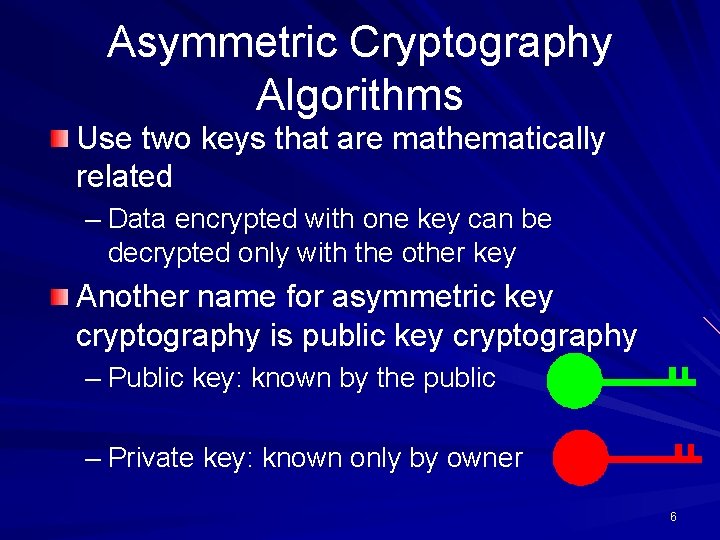
Asymmetric Cryptography Algorithms Use two keys that are mathematically related – Data encrypted with one key can be decrypted only with the other key Another name for asymmetric key cryptography is public key cryptography – Public key: known by the public – Private key: known only by owner 6
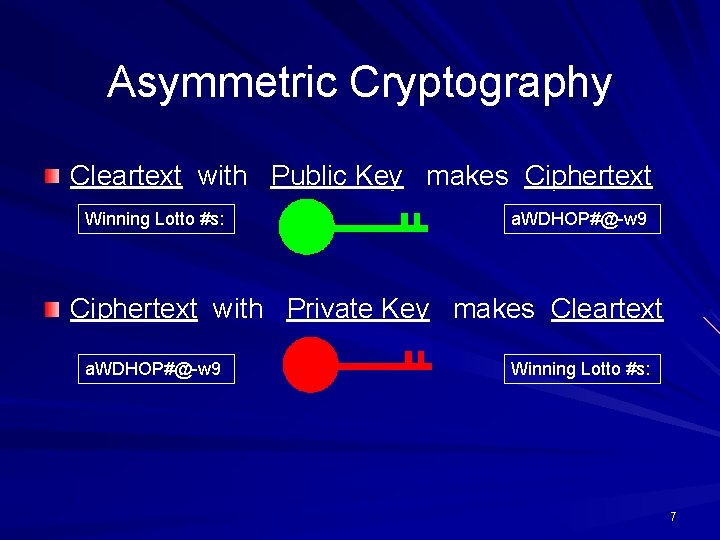
Asymmetric Cryptography Cleartext with Public Key makes Ciphertext Winning Lotto #s: a. WDHOP#@-w 9 Ciphertext with Private Key makes Cleartext a. WDHOP#@-w 9 Winning Lotto #s: 7
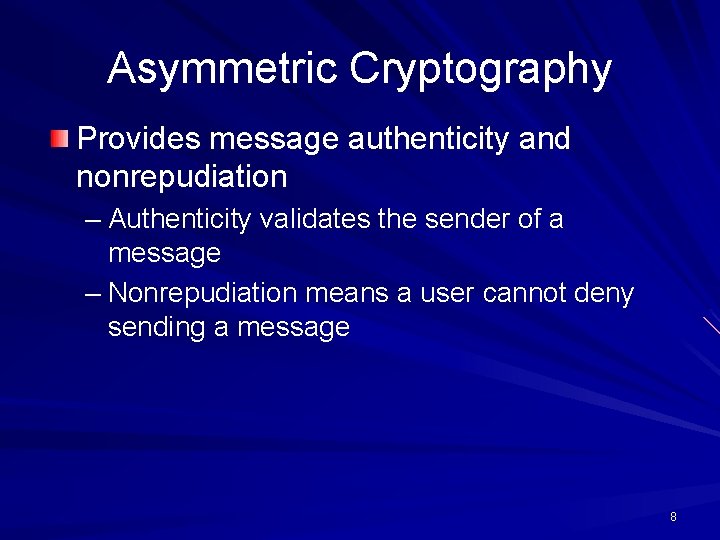
Asymmetric Cryptography Provides message authenticity and nonrepudiation – Authenticity validates the sender of a message – Nonrepudiation means a user cannot deny sending a message 8
Asymmetric Cryptography Asymmetric algorithms are more scalable but slower than symmetric algorithms – Scalable: can adapt to larger networks – Each person needs only one key pair Everyone can use the same public key to send you data Each person signs messages with their own private key 9
RSA Developed in 1977 by Ronald L. Rivest, Adi Shamir, and Leonard M. Adleman The algorithm is based on the difficulty of factoring large numbers The Secure Socket Layer (SSL) protocol uses the RSA algorithm 10
Diffie-Hellman Developed by Whitfield Diffie and Martin Hellman Does not provide encryption but is used for key exchange – Two parties agree on a key without ever sending it directly over the network – The numbers transmitted can be used to compute the key, but only by the parties holding secret private numbers Prevents sniffing attacks 11
Elliptic Curve Cryptosystems (ECC) It is an efficient algorithm requiring few resources – Memory – Disk space – Bandwidth ECC is used for encryption as well as digital signatures and key distribution 12
Elgamal Public key algorithm used to – Encrypt data – Create digital signature – Exchange secret keys Written by Taher Elgamal in 1985 The algorithm uses discrete logarithm problems – Solving a discrete logarithm problem can take many years and require CPU-intensive operations 13
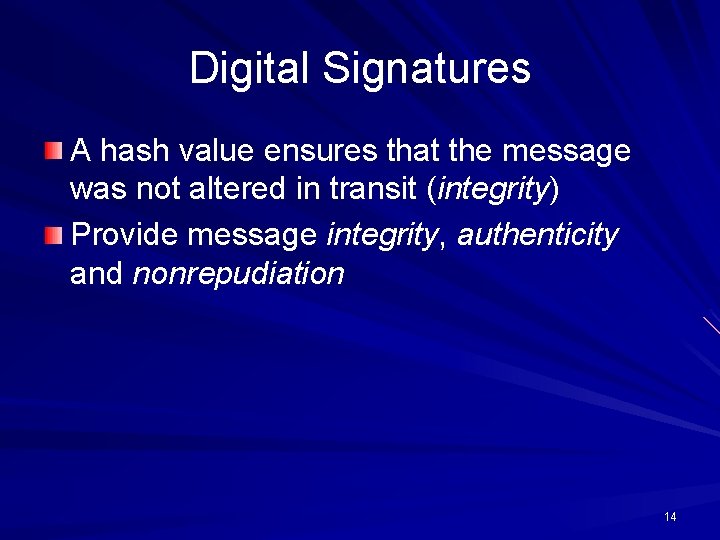
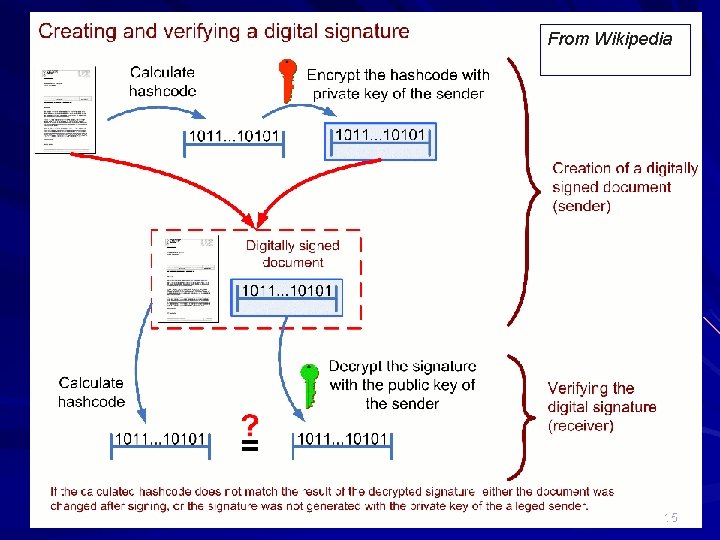
Digital Signatures A hash value ensures that the message was not altered in transit (integrity) Provide message integrity, authenticity and nonrepudiation 14
From Wikipedia 15
Digital Signature Standard (DSS) Established by the NIST in 1991 – Ensures that digital signatures rather than written signatures can be verified Federal government requirements – RSA and Digital Signature Algorithm (DSA) must be used for all digital signatures – Hashing algorithm must be used to ensure the integrity of the message NIST required that the Secure Hash Algorithm (SHA) be used 16
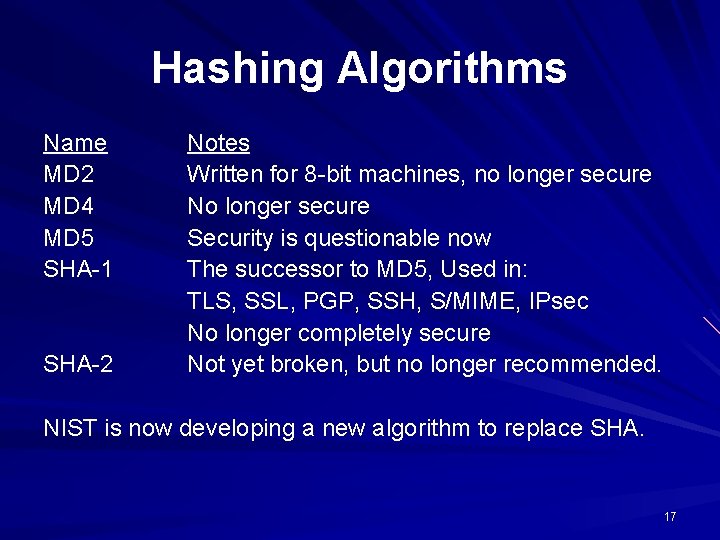
Hashing Algorithms Name MD 2 MD 4 MD 5 SHA-1 SHA-2 Notes Written for 8 -bit machines, no longer secure No longer secure Security is questionable now The successor to MD 5, Used in: TLS, SSL, PGP, SSH, S/MIME, IPsec No longer completely secure Not yet broken, but no longer recommended. NIST is now developing a new algorithm to replace SHA. 17