
Symbolic vs Concrete Testing Mooly Sagiv Program Path
Symbolic vs. Concrete Testing Mooly Sagiv
Program Path • Program Path – A path in the control flow of the program • Can start and end at any point • Appropriate for imperative programs • Feasible program path – There exists an input that leads to the execution of this path • Infeasible program path • No input that leads to the execution

45 Infeasible Paths e< A sco r void grade(int score) { A: if (score <45) { B: printf(“fail”); } else C: printf(“pass”); } D: if (score > 85) { E: printf(“with honors”); } F: } B e 45 C pr int f(“ fai l”) 5 8 > e s”) s a “p ( tf n i r p D r sco sc or E prin tf(“w ith h ono F rs”)
Concrete vs. Symbolic Executions • Real programs have many infeasible paths – Ineffective concrete testing • Symbolic execution aims to find rare errors
![Symbolic Testing Tools • • • EFFIGY [King, IBM 76] PEX [MSR] SAGE [MSR]](http://slidetodoc.com/presentation_image_h2/02e3025f8c11d65f61a008ccfead42ce/image-5.jpg "Symbolic Testing Tools • • • EFFIGY [King, IBM 76] PEX [MSR] SAGE [MSR]")
Symbolic Testing Tools • • • EFFIGY [King, IBM 76] PEX [MSR] SAGE [MSR] SATURN[Stanford] KLEE[Stanford] Java pathfinder[NASA] Bitscope [Berkeley] Cute [UIUC, Berkeley] Calysto [UBC]

45 Finding Infeasible Paths Via SMT e< A sco r void grade(int score) { A: if (score <45) { B: printf(“fail”); } else C: printf(“pass”); } D: if (score > 85) { E: printf(“with honors”); } F: } score < 45 score > 85 UNSAT B e 45 C pr int f(“ fai l”) 5 8 > e s”) s a “p ( tf n i r p D r sco sc or E prin tf(“w ith h ono F rs”)
Plan • Random Testing • Symbolic Testing • Concolic Testing
![Fuzzing [Miller 1990] • Test programs on random unexpected data • Can be realized](http://slidetodoc.com/presentation_image_h2/02e3025f8c11d65f61a008ccfead42ce/image-8.jpg "Fuzzing [Miller 1990] • Test programs on random unexpected data • Can be realized")
Fuzzing [Miller 1990] • Test programs on random unexpected data • Can be realized using black/white testing • Can be quite effective – Operating Systems – Networks • … • Usually implemented via instrumentation • Tricky to scale for programs with many paths If (x == 10001) { …. if (f(*y) == *z) { …. int f(int *p) { if (p !=NULL) { return q ; }
Symbolic Exploration • Execute a program on symbolic inputs • Track set of values symbolically • Update symbolic states when instructions are executed • Whenever a branch is encountered check if the path is feasible using a theorem prover call
Symbolic Execution Tree • The constructed symbolic execution paths • Nodes – Symbolic Program States • Edges – Potential Transitions • Constructed during symbolic evaluation • Each edge requires a theorem prover call
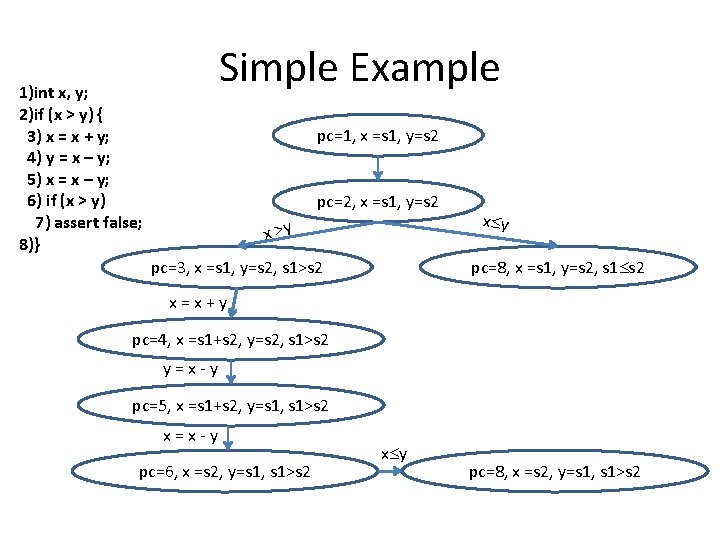
Simple Example 1)int x, y; 2)if (x > y) { 3) x = x + y; 4) y = x – y; 5) x = x – y; 6) if (x > y) 7) assert false; 8)} pc=1, x =s 1, y=s 2 pc=2, x =s 1, y=s 2 x >y pc=3, x =s 1, y=s 2, s 1>s 2 x y pc=8, x =s 1, y=s 2, s 1 s 2 x=x+y pc=4, x =s 1+s 2, y=s 2, s 1>s 2 y=x-y pc=5, x =s 1+s 2, y=s 1, s 1>s 2 x=x-y pc=6, x =s 2, y=s 1, s 1>s 2 x y pc=8, x =s 2, y=s 1, s 1>s 2
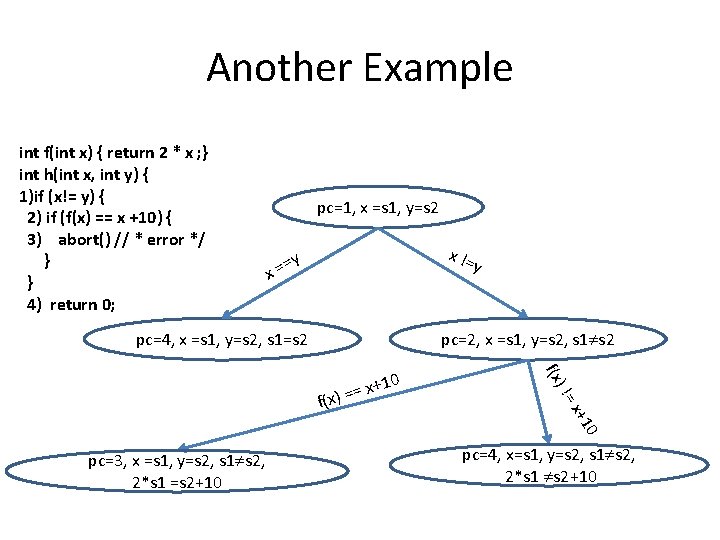
Another Example int f(int x) { return 2 * x ; } int h(int x, int y) { 1)if (x!= y) { 2) if (f(x) == x +10) { 3) abort() // * error */ } } 4) return 0; pc=1, x =s 1, y=s 2 x x != y == y pc=4, x =s 1, y=s 2, s 1=s 2 pc=2, x =s 1, y=s 2, s 1 s 2 ) != f(x 0 0 1 x+ x+1 = = ) f(x pc=3, x =s 1, y=s 2, s 1 s 2, 2*s 1 =s 2+10 pc=4, x=s 1, y=s 2, s 1 s 2, 2*s 1 s 2+10
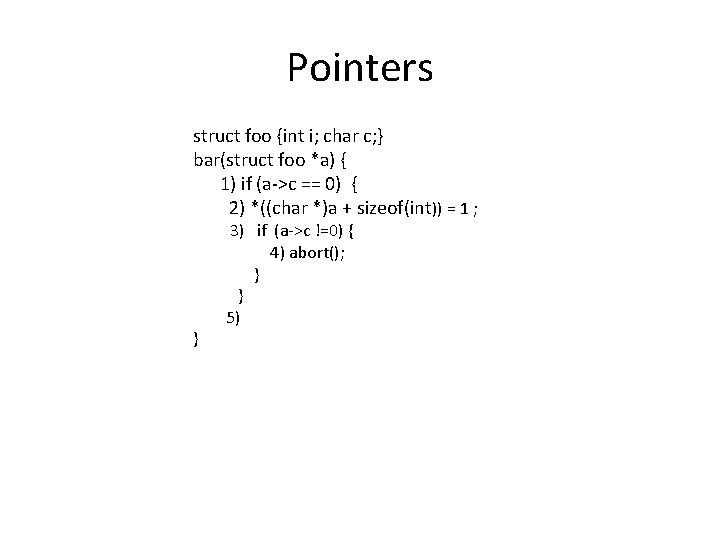
Pointers struct foo {int i; char c; } bar(struct foo *a) { 1) if (a->c == 0) { 2) *((char *)a + sizeof(int)) = 1 ; } 3) if (a->c !=0) { 4) abort(); } } 5)
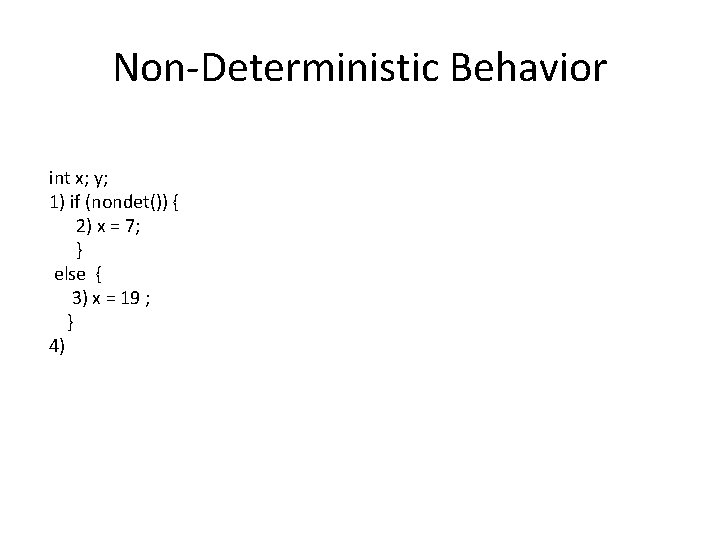
Non-Deterministic Behavior int x; y; 1) if (nondet()) { 2) x = 7; } else { 3) x = 19 ; } 4)
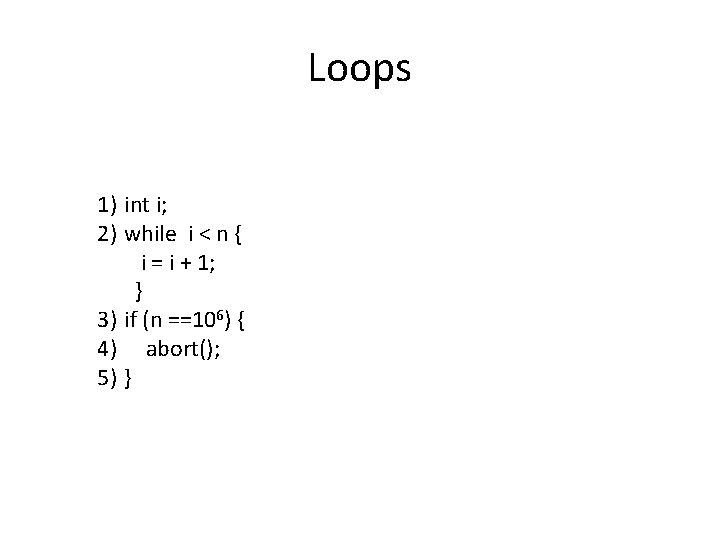
Loops 1) int i; 2) while i < n { i = i + 1; } 3) if (n ==106) { 4) abort(); 5) }
Scaling Issues for Symbolic Exploration
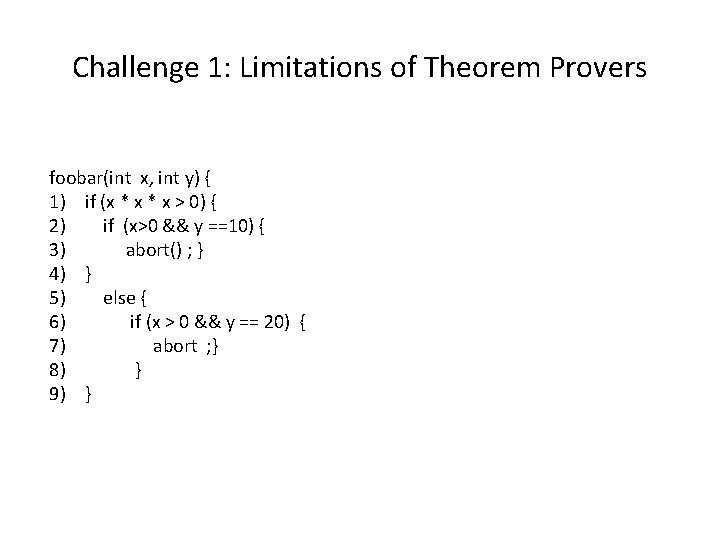
Challenge 1: Limitations of Theorem Provers foobar(int x, int y) { 1) if (x * x > 0) { 2) if (x>0 && y ==10) { 3) abort() ; } 4) } 5) else { 6) if (x > 0 && y == 20) { 7) abort ; } 8) } 9) }
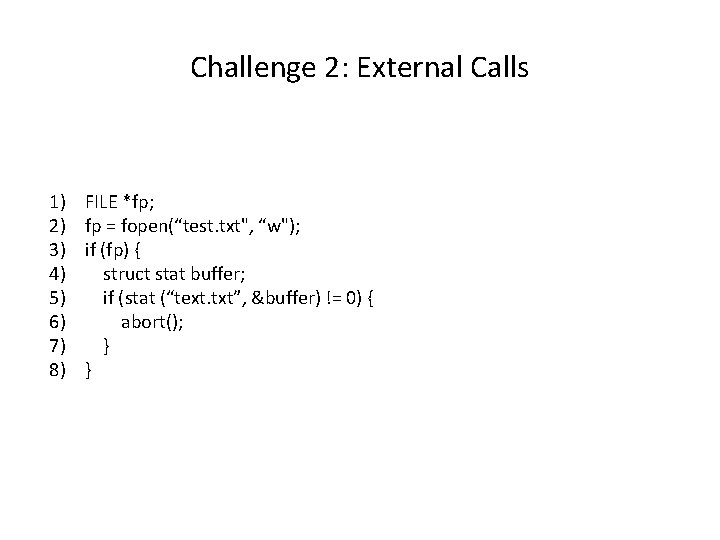
Challenge 2: External Calls 1) 2) 3) 4) 5) 6) 7) 8) FILE *fp; fp = fopen(“test. txt", “w"); if (fp) { struct stat buffer; if (stat (“text. txt”, &buffer) != 0) { abort(); } }
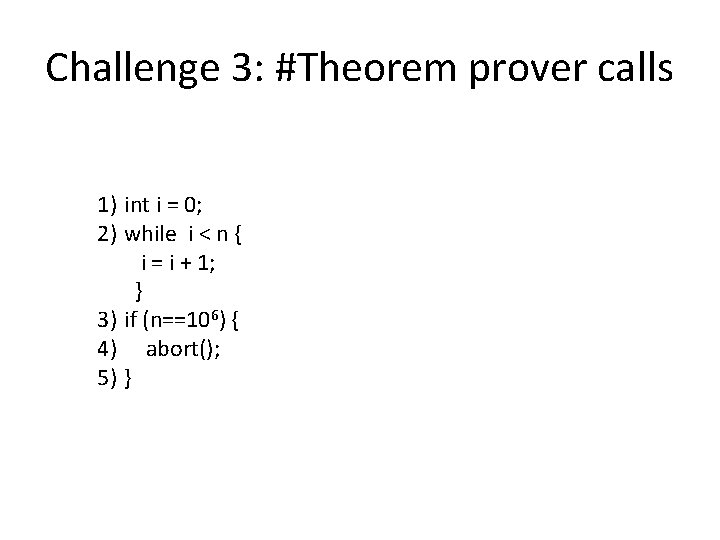
Challenge 3: #Theorem prover calls 1) int i = 0; 2) while i < n { i = i + 1; } 3) if (n==106) { 4) abort(); 5) }
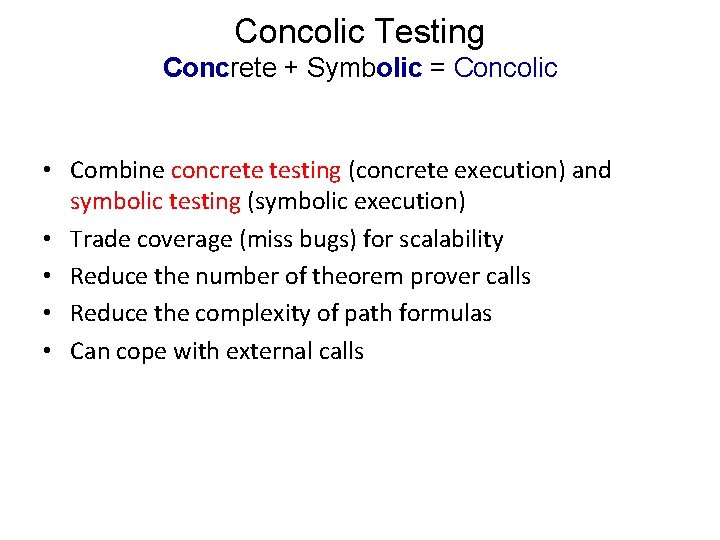
Concolic Testing Concrete + Symbolic = Concolic • Combine concrete testing (concrete execution) and symbolic testing (symbolic execution) • Trade coverage (miss bugs) for scalability • Reduce the number of theorem prover calls • Reduce the complexity of path formulas • Can cope with external calls
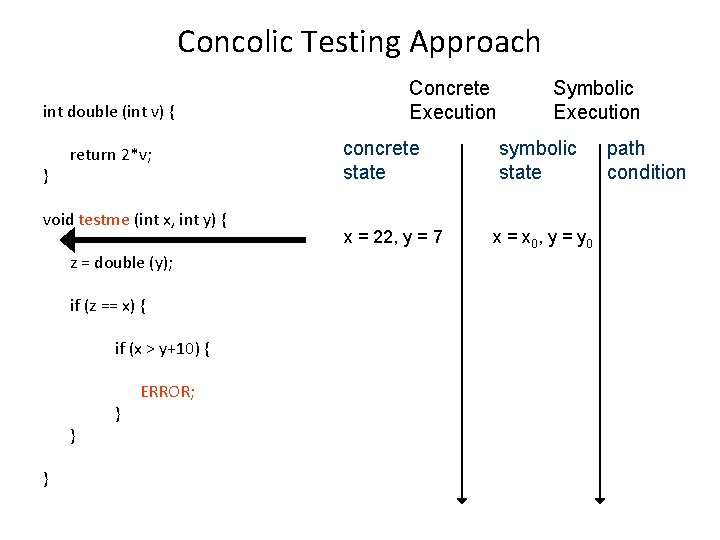
Concolic Testing Approach int double (int v) { } return 2*v; void testme (int x, int y) { z = double (y); if (z == x) { if (x > y+10) { } } } ERROR; Concrete Execution concrete state x = 22, y = 7 Symbolic Execution symbolic state x = x 0, y = y 0 path condition
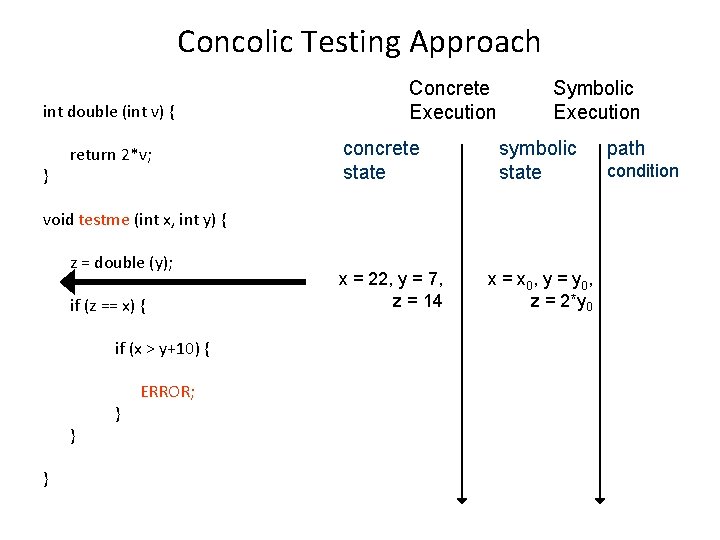
Concolic Testing Approach int double (int v) { } return 2*v; Concrete Execution concrete state Symbolic Execution symbolic state void testme (int x, int y) { z = double (y); if (z == x) { if (x > y+10) { } } } ERROR; x = 22, y = 7, z = 14 x = x 0, y = y 0, z = 2*y 0 path condition
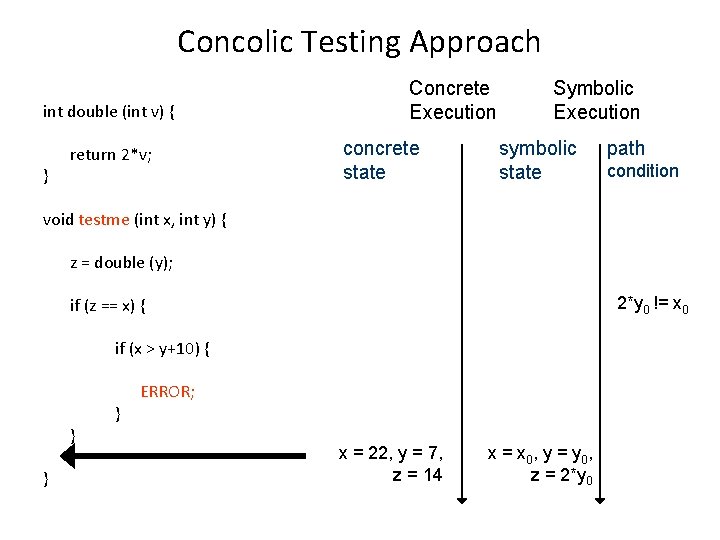
Concolic Testing Approach int double (int v) { } return 2*v; Concrete Execution concrete state Symbolic Execution symbolic state path condition void testme (int x, int y) { z = double (y); 2*y 0 != x 0 if (z == x) { if (x > y+10) { } } } ERROR; x = 22, y = 7, z = 14 x = x 0, y = y 0, z = 2*y 0
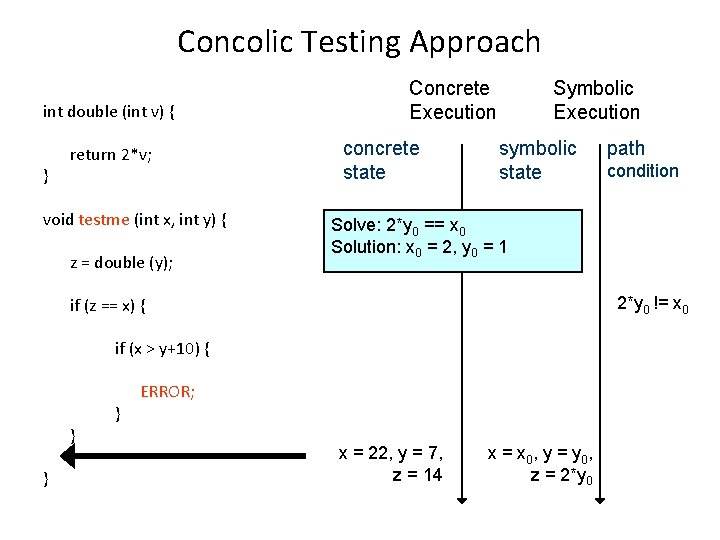
Concolic Testing Approach int double (int v) { } return 2*v; void testme (int x, int y) { z = double (y); Concrete Execution concrete state Symbolic Execution symbolic state 2*y 0 != x 0 if (x > y+10) { } } condition Solve: 2*y 0 == x 0 Solution: x 0 = 2, y 0 = 1 if (z == x) { } path ERROR; x = 22, y = 7, z = 14 x = x 0, y = y 0, z = 2*y 0
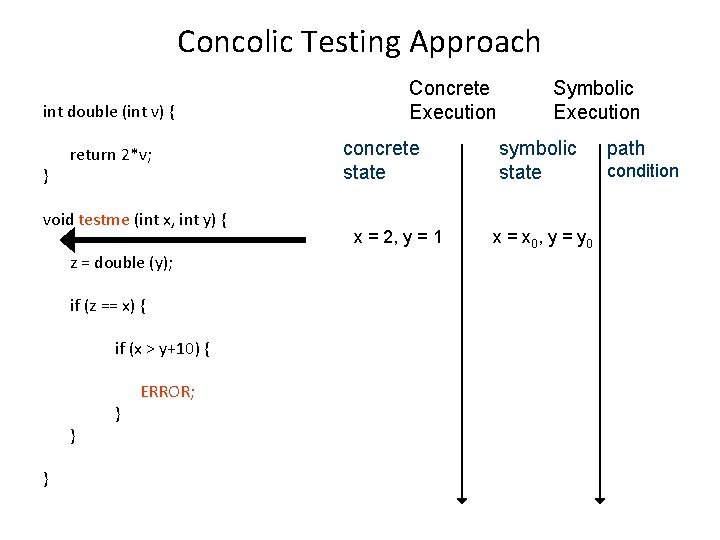
Concolic Testing Approach int double (int v) { } return 2*v; void testme (int x, int y) { z = double (y); if (z == x) { if (x > y+10) { } } } ERROR; Concrete Execution concrete state x = 2, y = 1 Symbolic Execution symbolic state x = x 0, y = y 0 path condition
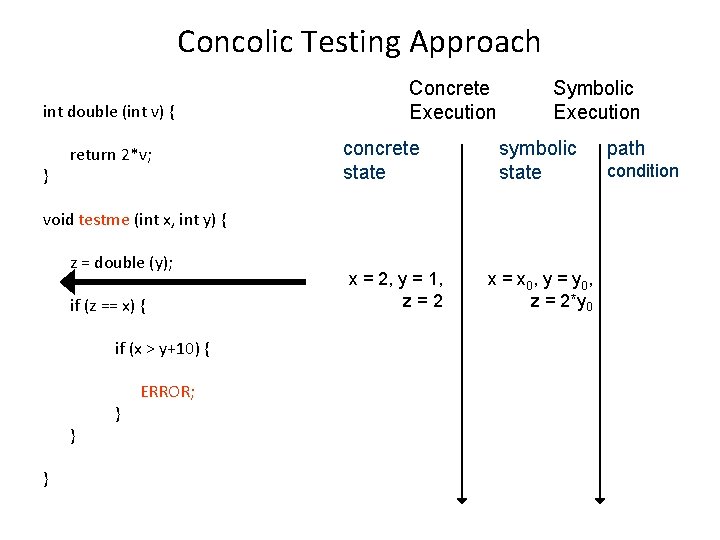
Concolic Testing Approach int double (int v) { } return 2*v; Concrete Execution concrete state Symbolic Execution symbolic state void testme (int x, int y) { z = double (y); if (z == x) { if (x > y+10) { } } } ERROR; x = 2, y = 1, z=2 x = x 0, y = y 0, z = 2*y 0 path condition
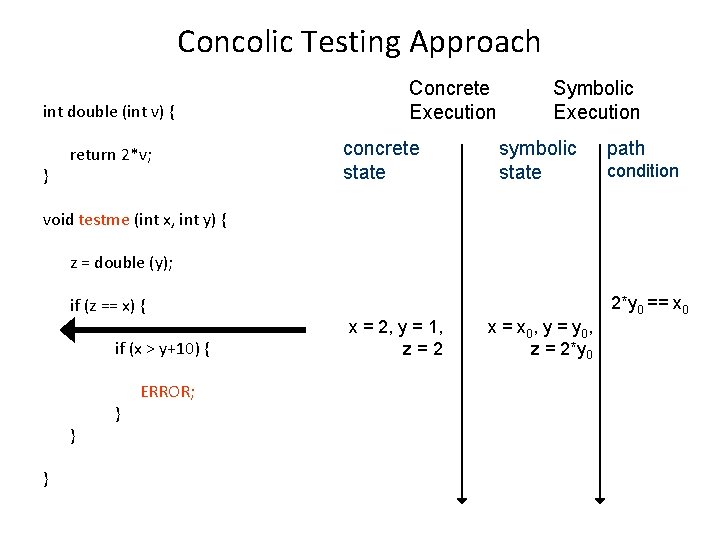
Concolic Testing Approach int double (int v) { } return 2*v; Concrete Execution concrete state Symbolic Execution symbolic state path condition void testme (int x, int y) { z = double (y); 2*y 0 == x 0 if (z == x) { if (x > y+10) { } } } ERROR; x = 2, y = 1, z=2 x = x 0, y = y 0, z = 2*y 0
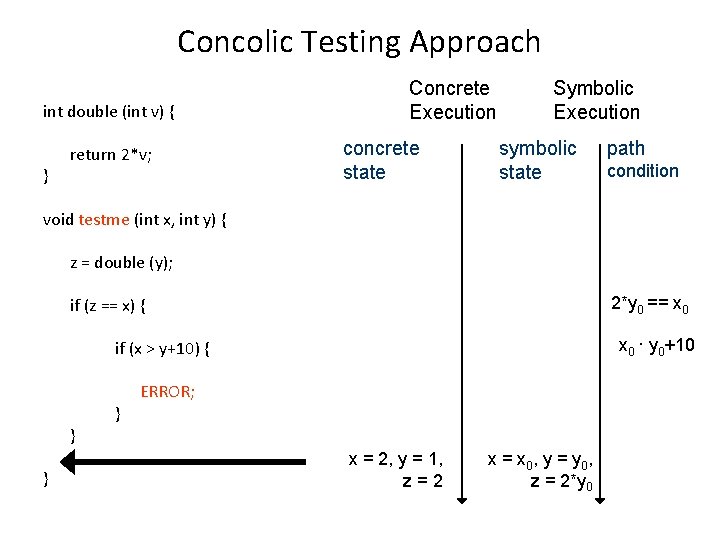
Concolic Testing Approach int double (int v) { } return 2*v; Concrete Execution concrete state Symbolic Execution symbolic state path condition void testme (int x, int y) { z = double (y); 2*y 0 == x 0 if (z == x) { x 0 · y 0+10 if (x > y+10) { } } } ERROR; x = 2, y = 1, z=2 x = x 0, y = y 0, z = 2*y 0
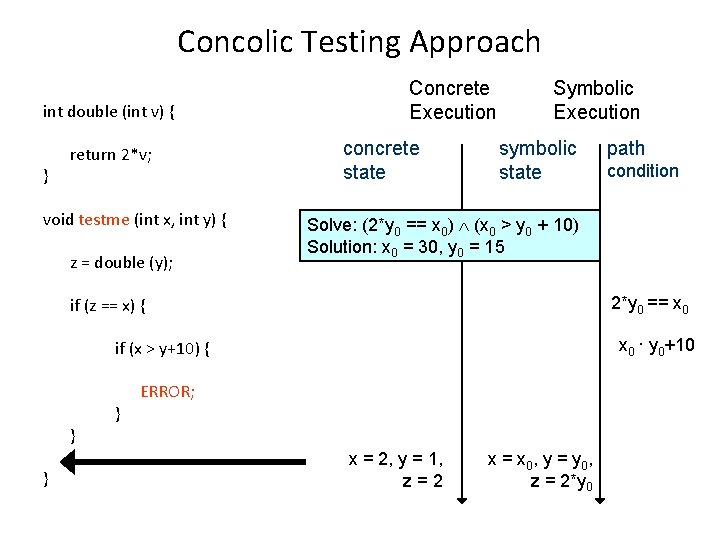
Concolic Testing Approach int double (int v) { } return 2*v; void testme (int x, int y) { z = double (y); Concrete Execution concrete state Symbolic Execution symbolic state 2*y 0 == x 0 · y 0+10 if (x > y+10) { } } condition Solve: (2*y 0 == x 0) (x 0 > y 0 + 10) Solution: x 0 = 30, y 0 = 15 if (z == x) { } path ERROR; x = 2, y = 1, z=2 x = x 0, y = y 0, z = 2*y 0
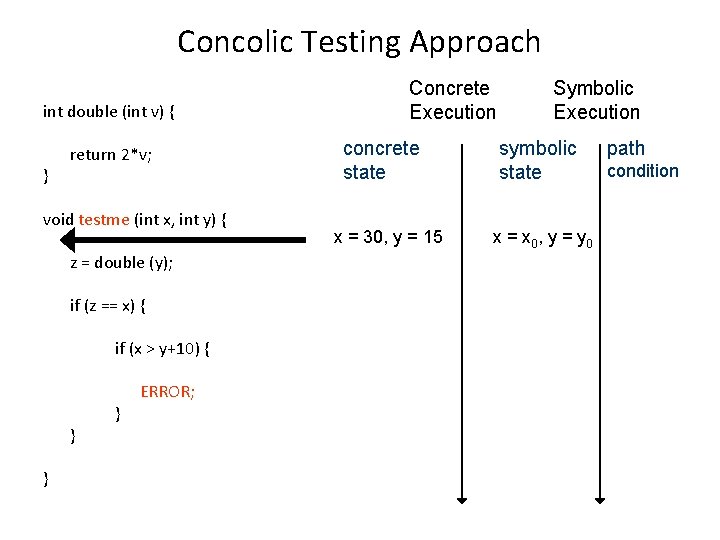
Concolic Testing Approach int double (int v) { } return 2*v; void testme (int x, int y) { z = double (y); if (z == x) { if (x > y+10) { } } } ERROR; Concrete Execution concrete state x = 30, y = 15 Symbolic Execution symbolic state x = x 0, y = y 0 path condition
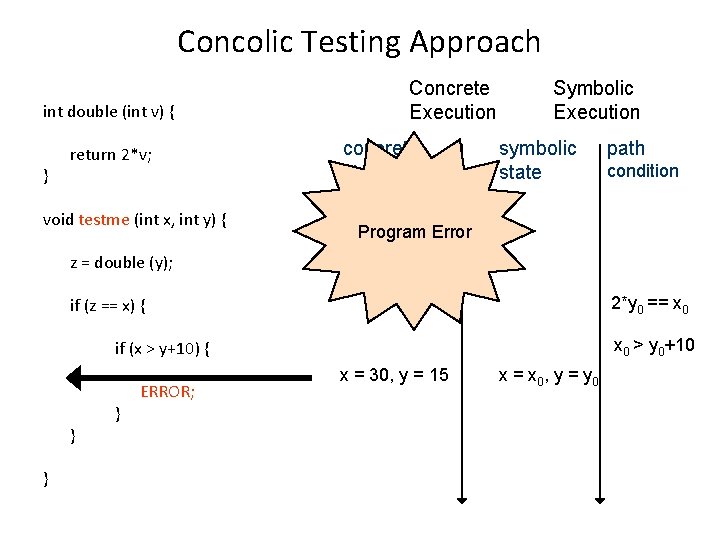
Concolic Testing Approach int double (int v) { } return 2*v; void testme (int x, int y) { Concrete Execution concrete state Symbolic Execution symbolic state path condition Program Error z = double (y); 2*y 0 == x 0 if (z == x) { x 0 > y 0+10 if (x > y+10) { } } } ERROR; x = 30, y = 15 x = x 0, y = y 0
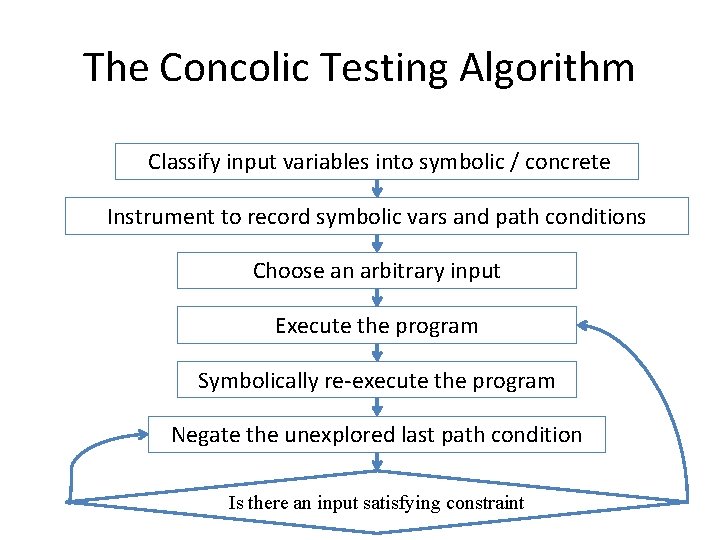
The Concolic Testing Algorithm Classify input variables into symbolic / concrete Instrument to record symbolic vars and path conditions Choose an arbitrary input Execute the program Symbolically re-execute the program Negate the unexplored last path condition F Is there an input satisfying constraint T
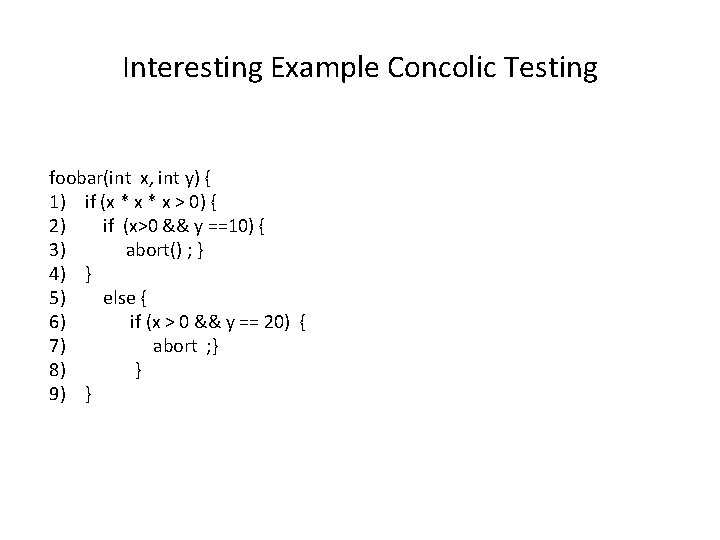
Interesting Example Concolic Testing foobar(int x, int y) { 1) if (x * x > 0) { 2) if (x>0 && y ==10) { 3) abort() ; } 4) } 5) else { 6) if (x > 0 && y == 20) { 7) abort ; } 8) } 9) }
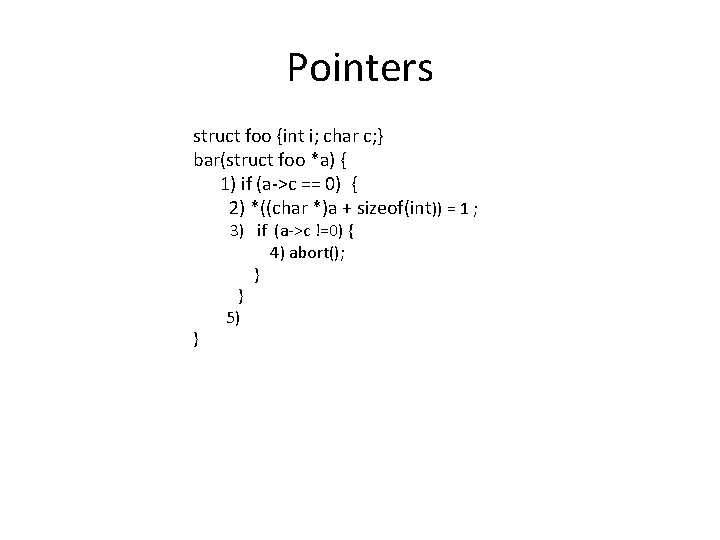
Pointers struct foo {int i; char c; } bar(struct foo *a) { 1) if (a->c == 0) { 2) *((char *)a + sizeof(int)) = 1 ; } 3) if (a->c !=0) { 4) abort(); } } 5)
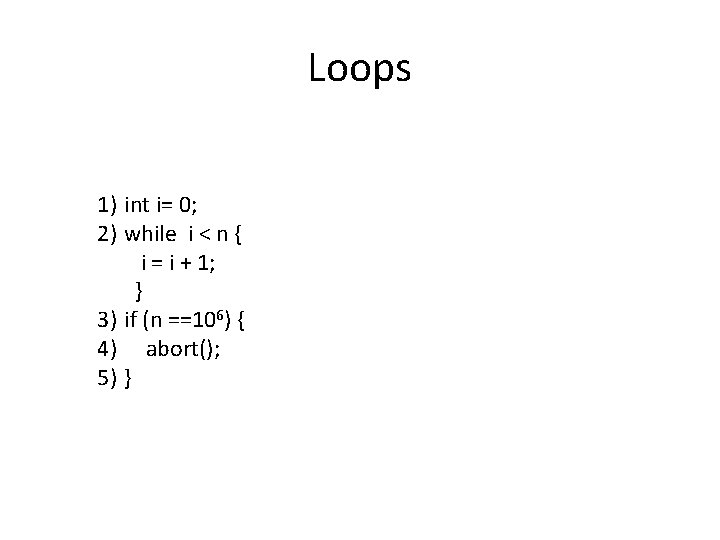
Loops 1) int i= 0; 2) while i < n { i = i + 1; } 3) if (n ==106) { 4) abort(); 5) }
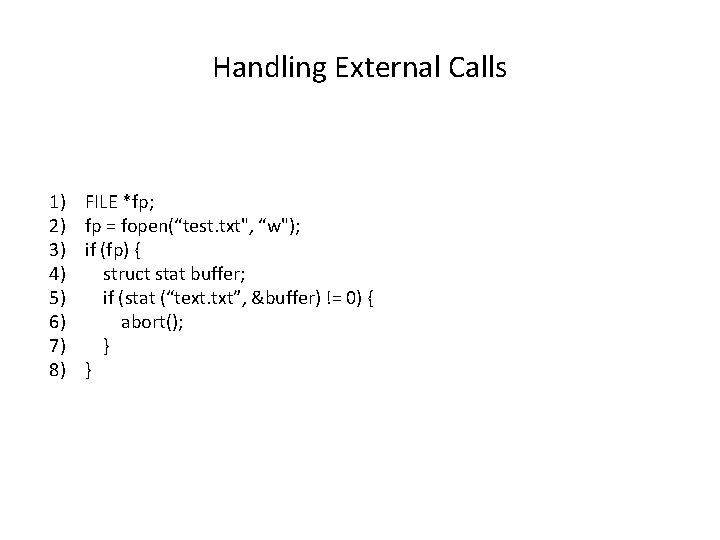
Handling External Calls 1) 2) 3) 4) 5) 6) 7) 8) FILE *fp; fp = fopen(“test. txt", “w"); if (fp) { struct stat buffer; if (stat (“text. txt”, &buffer) != 0) { abort(); } }
Concolic Testing Techniques • Linear underapproximation • Modeling System call models • Simple heuristics – Two possible values for pointers –… • • Efficient instrumentation Interface extraction Generating random inputs of arbitrary types …
![Original DART Approach [PLDI’ 05] • Tailored for C • Three types of functions](http://slidetodoc.com/presentation_image_h2/02e3025f8c11d65f61a008ccfead42ce/image-38.jpg "Original DART Approach [PLDI’ 05] • Tailored for C • Three types of functions")
Original DART Approach [PLDI’ 05] • Tailored for C • Three types of functions – Program functions – External functions handled non-deterministically – Library functions handled as black-box (concrete only)
SAGE: Whitebox Fuzzing for Security Testing • • • Check correctness of Win’ 7, Win’ 8 200+ machine years 1 Billion+ SMT constraints 100 s of apps, 100 s of bugs 1/3 of all Win 7 WEX security bugs found Millions of dollars saved
Summary • Concolic testing is powerful • Scaling is an issue • Future progress in symbolic reasoning can help – Example: handling dynamically allocated memory
- Slides: 40