
Symbolic Integration Lecture 14 Richard Fateman CS 282
Symbolic Integration Lecture 14 Richard Fateman CS 282 Lecture 14 1
The problem of integration in finite terms 1. The Freshman Calculus Problem 2. The Artificial Intelligence Problem 3. The Algebraic (Rational Function) Problem (Tobey, Horowitz, Rothstein, Trager) 4. The Decision Problem (Liouville, Ritt, Rosenlicht, Risch, Cherry, Trager, Davenport, Bronstein, others) 5. The Computer Algebra System problem. 6. Extensions to definite integration, numerical integration, approximation by Taylor series, Laurent series, asymptotic series. Richard Fateman CS 282 Lecture 14 2
The Freshman Calculus Problem. Find the flaws. 1. Humans are intelligent 2. MIT students are especially intelligent humans. 3. Freshmen study integral calculus (this is in 1960’s before Advanced Placement). 4. Therefore solving calculus problems requires intelligence. 5. If a computer can solve calculus problems, then it is intelligent (An example of Artificial Intelligence). 6. To solve these problems, imitate a freshman student. 7. Future extensions: do the rest of math, and the rest of AI. Richard Fateman CS 282 Lecture 14 3
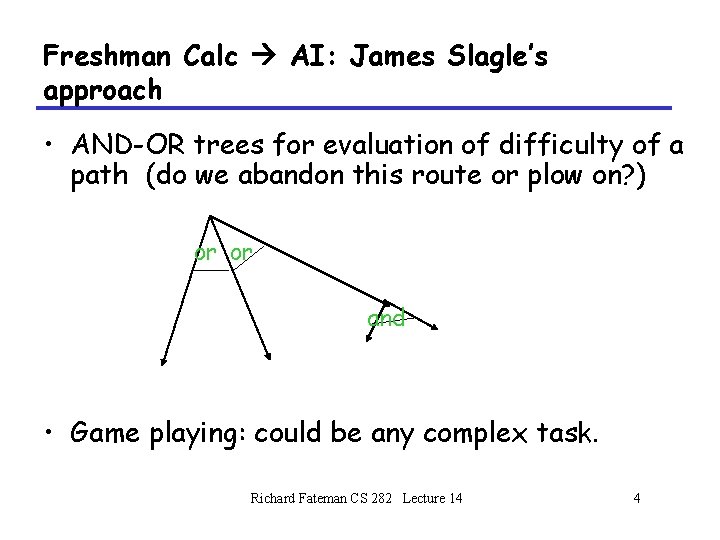
Freshman Calc AI: James Slagle’s approach • AND-OR trees for evaluation of difficulty of a path (do we abandon this route or plow on? ) or or and • Game playing: could be any complex task. Richard Fateman CS 282 Lecture 14 4

Slagle’s program SAINT Symbolic Automatic INTegrator • ELINST: elementary instance expression pattern matching (in assembler). • Simplification program (in assembler). • Used lisp prefix expressions (* x (sin x)) • First major lisp program (in Lisp 1. 5). • Took about a minute per problem (about the same time as a student!) running uncompiled on an IBM 7090 (32 k word x 36 bits/word). • Could not do rational function integration (out of space. ) Richard Fateman CS 282 Lecture 14 5
The Algebraic (Rational Function) Problem • Many attempts to do this right, e. g. Theses of R. Tobey, E. Horowitz, and with extensions, M. Rothstein, B. Trager. • Main idea is to take a rational expression q(x)/r(x), express it as a polynomial + “proper” fraction P+Q/R with deg(Q)<= deg(R). Integrate P, a polynomial, trivially. Expand Q/R in partial fractions. Richard Fateman CS 282 Lecture 14 6
Partial fractions “trivialized” • From Q/R Find all the complex roots of R, a 0, . . . , an. Express Q/R as å ci/(x-ai) which integrates to å ci log(x-ai). multiple roots are simple: c*(x-a)-n c/(1 -n)*(x-a)1 -n Can we always find {ai}? Complex roots can be found numerically. Can we find ci? It turns out that we can expand the summation and solve everywhere. . . with a big problem. . Richard Fateman CS 282 Lecture 14 7

an example of the general cubic. . . Richard Fateman CS 282 Lecture 14 8
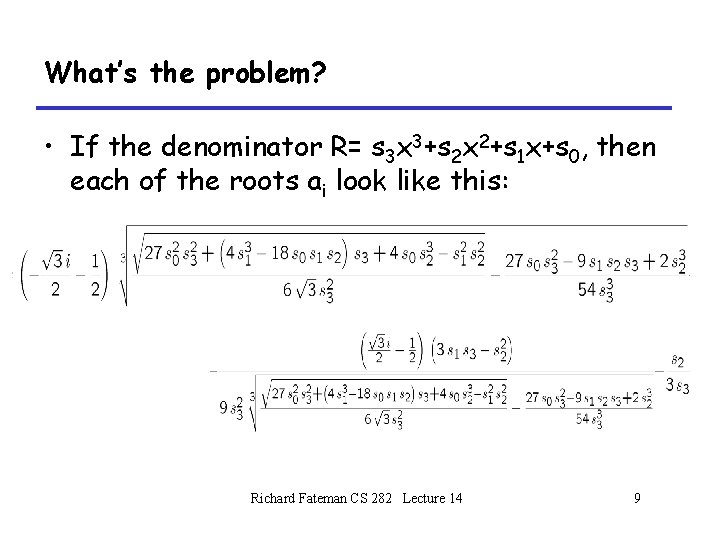
What’s the problem? • If the denominator R= s 3 x 3+s 2 x 2+s 1 x+s 0, then each of the roots ai look like this: Richard Fateman CS 282 Lecture 14 9
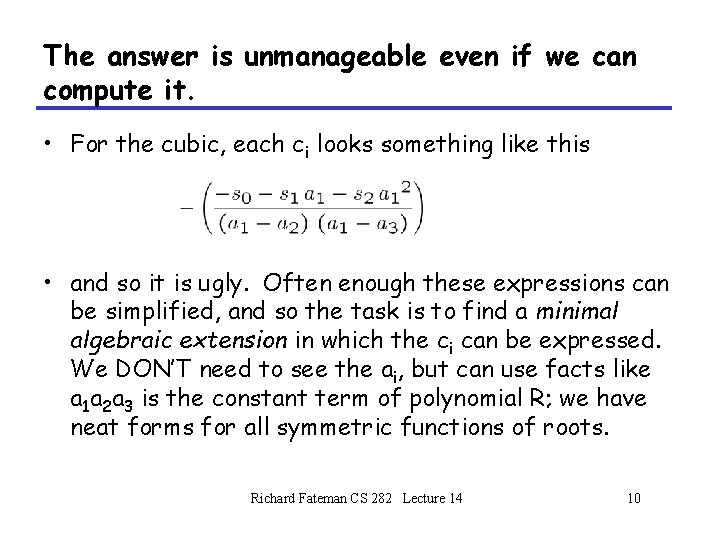
The answer is unmanageable even if we can compute it. • For the cubic, each ci looks something like this • and so it is ugly. Often enough these expressions can be simplified, and so the task is to find a minimal algebraic extension in which the ci can be expressed. We DON’T need to see the ai, but can use facts like a 1 a 2 a 3 is the constant term of polynomial R; we have neat forms for all symmetric functions of roots. Richard Fateman CS 282 Lecture 14 10
For a general quartic, it gets worse. • For order 5 or more there is in general no formula “in radicals” for the roots. That is, we can’t expect to represent the ai for symbolic polynomials without extra notation (Elliptic Fns (not radicals) will do). • We can find approximate numerical roots in C if the problem has a “numeric” denominator solely in Q[x], but all bets are off “symbolically”. • The solution is “Root. Sum(f(x), poly, x)” expressions where we have å f(ai) where {ai} are the roots of the polynomial poly. Richard Fateman CS 282 Lecture 14 11
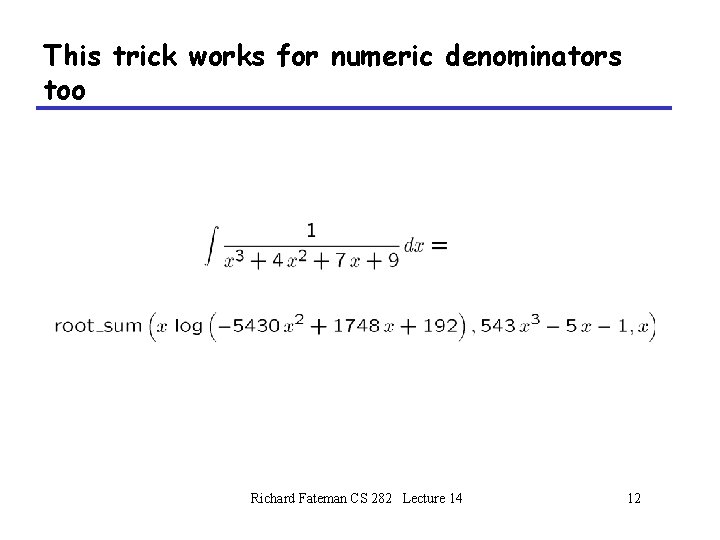
This trick works for numeric denominators too Richard Fateman CS 282 Lecture 14 12
Rothstein/Trager/Rioboo/Lazard (et al), find the ci easier • Let B(x) be square free and of degree >= A(x), • then s (A/B)dx = ci log(vi) • where ci, are the distinct roots of the polynomial R(c)=Resultant(x, A(x)-c. B’(x), B(x)) and vi=gcd(A(x)-ci. B’(x), B(x)) for i = 1, . . . n. • We need Square-free computation and Resultant wrt x • (Good reference: Geddes/Czapor/Labahn) Richard Fateman CS 282 Lecture 14 13
Squarefree isn’t a problem • Let the problem be s. A(x)/B(x)n with deg(A)<=deg(B). • Since B itself is square free, its GCD with B’=d. B/dx is 1. Thus we can compute c, e such that c*B+e*B’=1. • Now multiply through by A to get c. AB+e. B’A=A, and substitute in the original s. A(x)/B(x)n to get s(c. AB+e. B’A)/B(x)n. Now dividing through we get s c. A/Bn-1 + s e. A* (B’/Bn) where the second term can be integrated by parts to lower the power of Bn in the denominator. (reminder: s u dv = uv-s v du. Let u =e. A, dv=B’/Bn, v=1/((1 -n)Bn-1), du=(e. A)’, so s v du comes out as <something>/Bn-1+ s <something>/Bn-1. Iterate until Bn = B 1. ) Richard Fateman CS 282 Lecture 14 14
Resultant isn’t a problem • Well, actually it is something we’d prefer not to do since it takes a while, but we have algorithms for it. • Conclusion: we can do rational function integration pretty well. But it took us into the mid-1980 s to do it right. Richard Fateman CS 282 Lecture 14 15
The decision problem • Liouville [1809 -1882] During the period (1833 -1841) presented a theory of integration; proved elliptic integrals cannot have elementary expressions. • Various other writers advanced the subject in late 1800’s • J. Ritt (1948) Integration in Finite Terms Columbia Univ. Press • M. Rosenlicht (AMM. 1972) Integration in Finite Terms • R. Risch (1968, 69) Solution to the problem of IFT [unreadable] • B. Trager, J. Davenport, M. Bronstein [implementation] Richard Fateman CS 282 Lecture 14 16
Risch’s result Theorem: Let K be a differential field and f be from K. Then an elementary extension of the field K which has the same field of constants as K and contains an element g such that g’ = f exists if and only if there exist constants c 1. . cn from K and functions u 0, . . , un from K such that f= u 0’+ åi=1, . . . , nci(ui’/ui) or g=s fdx = u 0+ å i=1. . , n ci log(ui) note: this allows additional logs in the answer, but that’s all. The structure of the integral is specified. And the notation g’ means “the derivative of g”. Richard Fateman CS 282 Lecture 14 17
What’s a Differential Field? • Equip a field with an additional operator D which satisfies identities parallel to the rules for differentiation of functions. These structures obviously include various fields of functions (e. g. the field of rational functions in one variable over the real field). • The goal is to provide a setting to answer concretely such questions as, "Does this function have an elementary antiderivative? ” Richard Fateman CS 282 Lecture 14 18
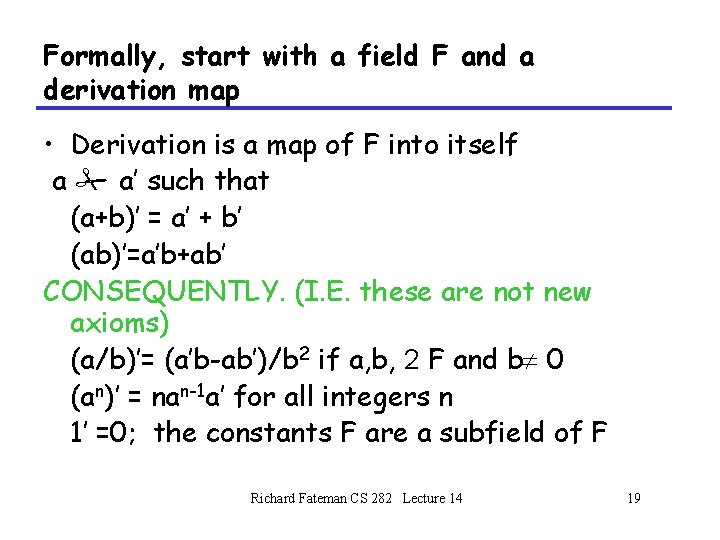
Formally, start with a field F and a derivation map • Derivation is a map of F into itself a a’ such that (a+b)’ = a’ + b’ (ab)’=a’b+ab’ CONSEQUENTLY. (I. E. these are not new axioms) (a/b)’= (a’b-ab’)/b 2 if a, b, 2 F and b¹ 0 (an)’ = nan-1 a’ for all integers n 1’ =0; the constants F are a subfield of F Richard Fateman CS 282 Lecture 14 19
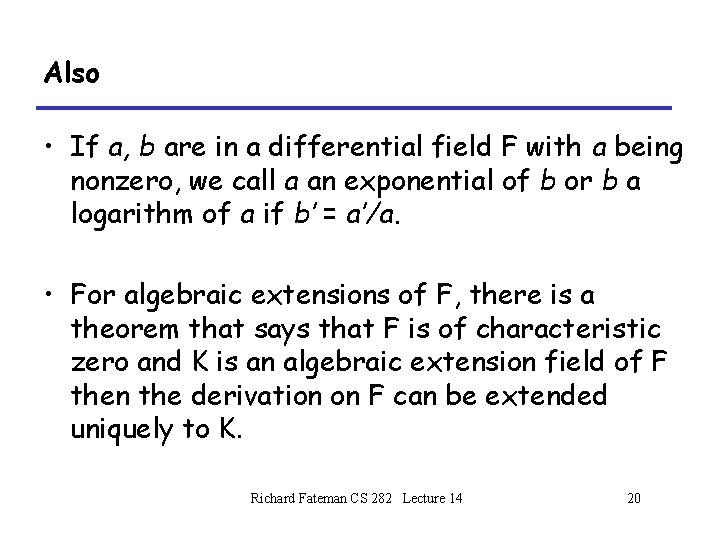
Also • If a, b are in a differential field F with a being nonzero, we call a an exponential of b or b a logarithm of a if b’ = a’/a. • For algebraic extensions of F, there is a theorem that says that F is of characteristic zero and K is an algebraic extension field of F then the derivation on F can be extended uniquely to K. Richard Fateman CS 282 Lecture 14 20
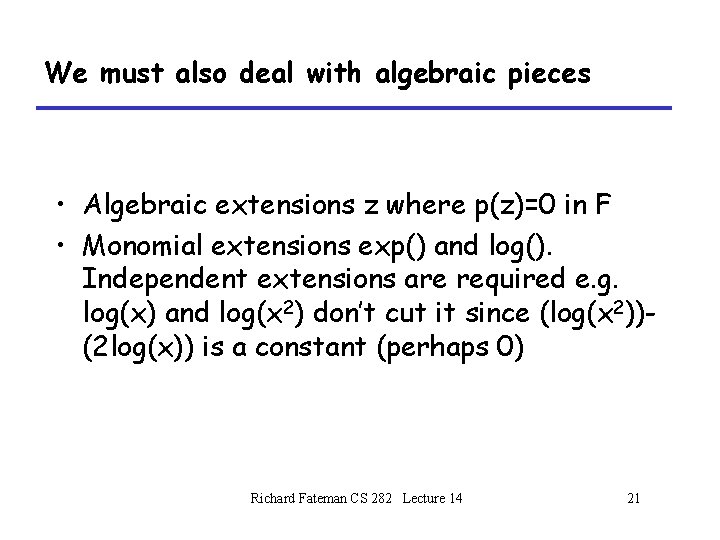
We must also deal with algebraic pieces • Algebraic extensions z where p(z)=0 in F • Monomial extensions exp() and log(). Independent extensions are required e. g. log(x) and log(x 2) don’t cut it since (log(x 2))(2 log(x)) is a constant (perhaps 0) Richard Fateman CS 282 Lecture 14 21
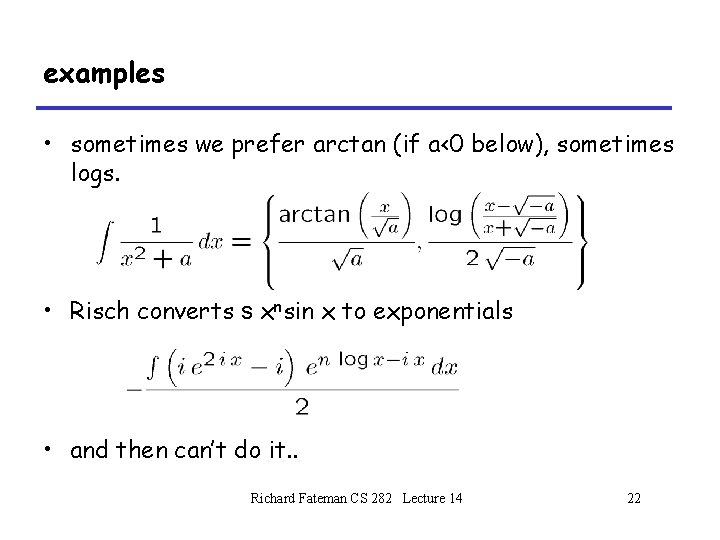
examples • sometimes we prefer arctan (if a<0 below), sometimes logs. • Risch converts s xnsin x to exponentials • and then can’t do it. . Richard Fateman CS 282 Lecture 14 22
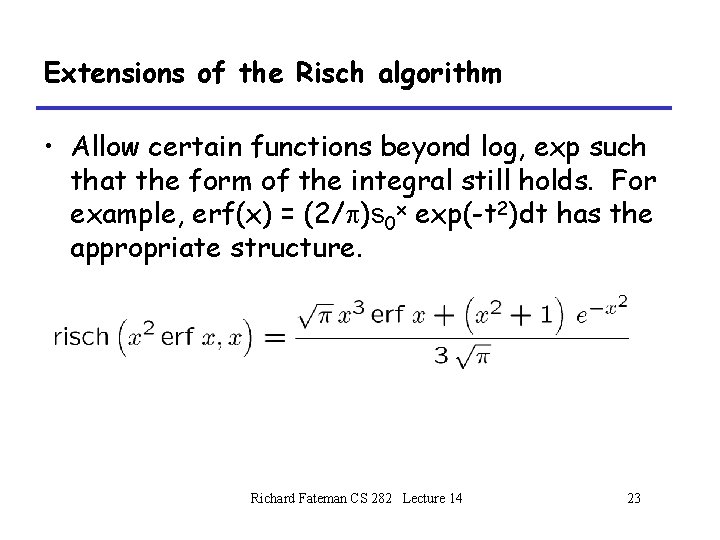
Extensions of the Risch algorithm • Allow certain functions beyond log, exp such that the form of the integral still holds. For example, erf(x) = (2/p)s 0 x exp(-t 2)dt has the appropriate structure. Richard Fateman CS 282 Lecture 14 23
The Risch Algorithm: two steps back. • • • There is a fallacy in claiming the Risch "algorithm" is an algorithm at all: it depends, for solution of subproblems, on heuristics to tell if certain expressions are equivalent to zero. We know from Richardson’s work that the zeroequivalence problem over a class of expressions much smaller than that of interest for integration is recursively unsolvable. But that is not the problem with most implementations of the Risch algorithm. They mostly have not been programmed completely, because, even assuming you can solve the zero-equivalence problem, the procedure is hard to program. Richard Fateman CS 282 Lecture 14 24
The Risch Algorithm: answers are not ncessarily what you expect • • It is not nearly as useful as you might think, because it returns algebraic antiderivatives whose validity may be on a set of measure zero. Work by D. Jeffrey A. Rich (among others) on removing gratuitous discontinuities, is helpful. The Risch algorithm may also, in the vast majority of problems, simply say, after an impressive pause, nope. can't do it. There is no reasonable complexity analysis for the process, which is probably why certain authors ignore it. Richard Fateman CS 282 Lecture 14 25
The Risch Algorithm: answering wrong problem • • Also, most people are interested in definite, not indefinite integrals, at least once they've finished with Freshman calculus. And in cases where approximate solutions are easily obtained for the corresponding definite integral, the Risch algorithm may grind on for a long while and then say there is no closed form. Or if there is a closed form, if it is to be ultimately evaluated numerically, the closed form may be less useful than the quadrature formula! Richard Fateman CS 282 Lecture 14 26
Nevertheless, the Risch Algorithm fascinates us • • • The theory of algebraic integration, and its corresponding history is interesting. The “solution” to calculus problems can probably be presented this way. It’s a good advertising slogan. The definite integration problem is also a classic in the applied mathematics literature: It would seem that vast tables (20, 000 entries) could be replaced with a computer program. (Actually Risch alg. is almost irrelevant here) Richard Fateman CS 282 Lecture 14 27
It also eludes us. It is in some sense at the pinnacle of CAS algorithms: it uses more mechanisms of a computer algebra system than nearly any other program. – – Rational function manipulation (GCD, partial fractions, factoring) Simplification in a differential field (algebraic, exponential/log, complex extensions) Solving certain ODEs J. Moses, J. Davenport, B. Trager, D. Lazard, R. Rioboo, A. Norman, G. Cherry, M. Bronstein, Richard Fateman CS 282 Lecture 14 28
Go over examples of Risch in Moses’ paper • Detailed understanding of Risch’s original presentation is a challenge. Richard Fateman CS 282 Lecture 14 29
How should one write an integration program? (Moses) • • • Quick solution to easy problems A collection of methods and transformations Radical methods (less known, table lookup) consider approximate or numerical approaches expand integrand in Taylor series, orthogonal polynomials, Fourier series, or asymptotic series or even approximate as rational functions. (for rational functions), approximate the roots of the denominator and do partial fraction expansion. do the whole task by quadrature (a well-studied area) treating the integrand as a “black box” capable only of returning a value at a point. [difficulties with infinite range or nasty behaviors. ] Richard Fateman CS 282 Lecture 14 30
Losing numerically • Try integrating x*sin(x) between 0 and 5000. • Numerically, it’s tough unless you guess that it is periodic (certainly possible, but somewhat of a leap of faith if you just have a “black box integrand”). • Symbolically it is – 5000 cos (5000)+sin(5000) • Mathematica gives -774. 31 (symbolic number) vs NIntegrate -- -210450) Richard Fateman CS 282 Lecture 14 31
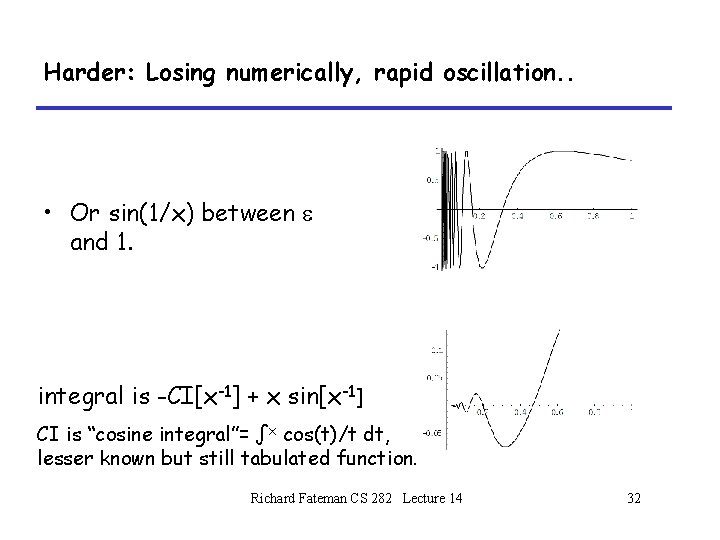
Harder: Losing numerically, rapid oscillation. . • Or sin(1/x) between and 1. integral is -CI[x-1] + x sin[x-1] CI is “cosine integral”= ∫x cos(t)/t dt, lesser known but still tabulated function. Richard Fateman CS 282 Lecture 14 32
Harder: integrating through singularity Examples… take the difference or quotient of functions whose singularities cancel, or which have integrable singularities. Richard Fateman CS 282 Lecture 14 33
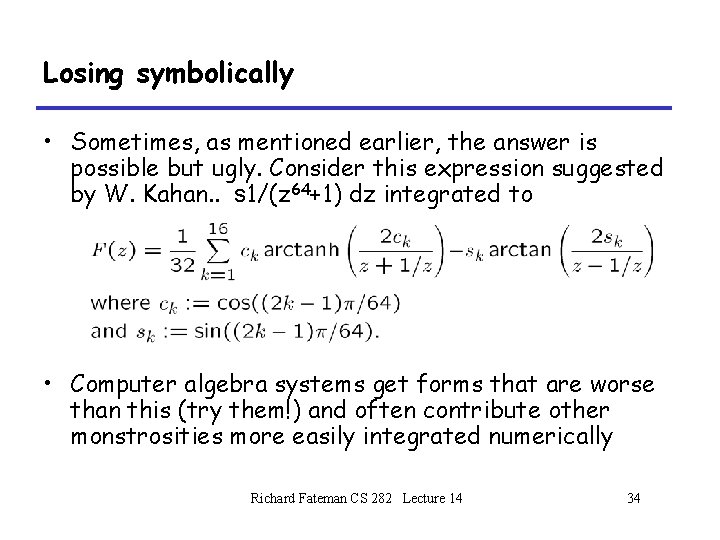
Losing symbolically • Sometimes, as mentioned earlier, the answer is possible but ugly. Consider this expression suggested by W. Kahan. . s 1/(z 64+1) dz integrated to • Computer algebra systems get forms that are worse than this (try them!) and often contribute other monstrosities more easily integrated numerically Richard Fateman CS 282 Lecture 14 34
- Slides: 34