
Symbolic AI 2 0 Yi Zhou Content AI
Symbolic AI 2. 0 Yi Zhou
Content • • • AI – a brief introduction Connectionism, Behaviourism, Symbolism Where are we? Symbolic AI 2. 0 Concluding remarks 2
Content • • • AI – a brief introduction Connectionism, Behaviourism, Symbolism Where are we? Symbolic AI 2. 0 Concluding remarks 3
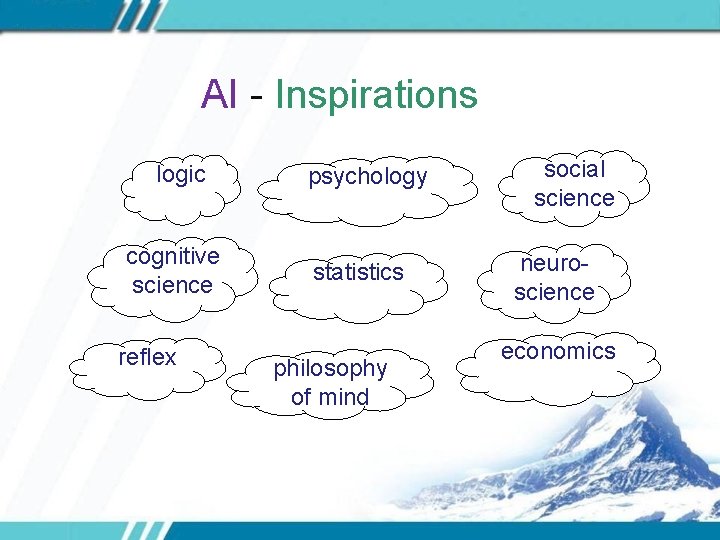
AI - Inspirations logic cognitive science reflex psychology statistics philosophy of mind social science neuroscience economics
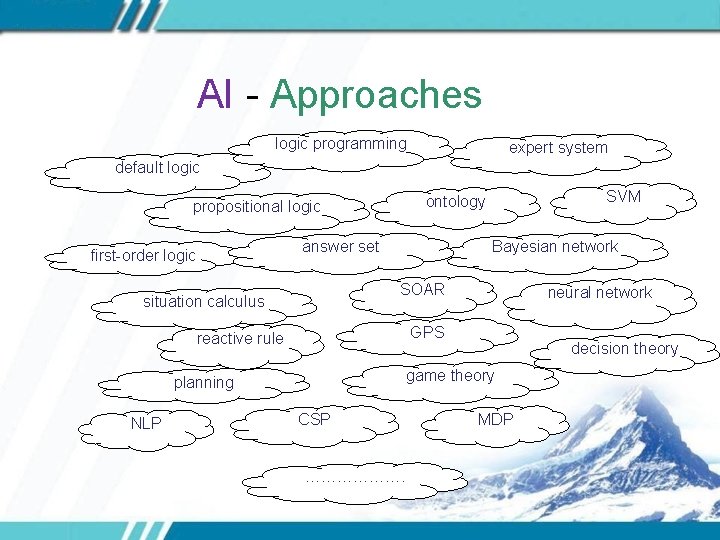
AI - Approaches logic programming expert system default logic answer set first-order logic Bayesian network SOAR situation calculus neural network GPS reactive rule decision theory game theory planning NLP SVM ontology propositional logic CSP ………………. MDP
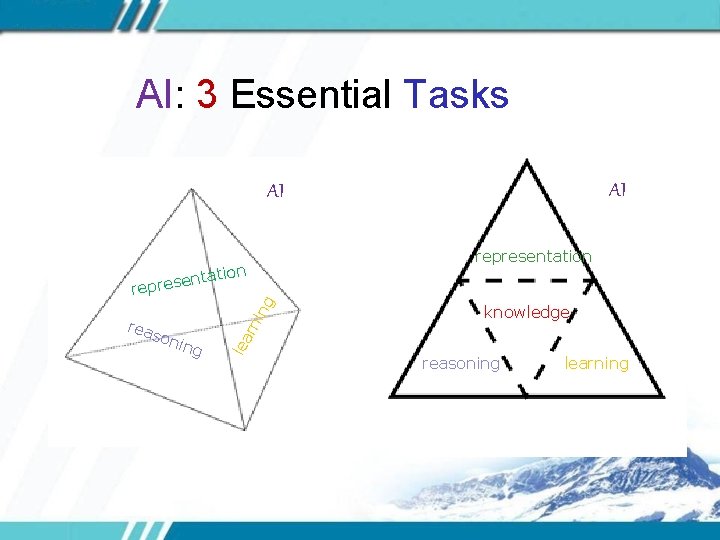
AI: 3 Essential Tasks AI AI ing knowledge rn son lea rea ing tation n e s e r representation reasoning learning
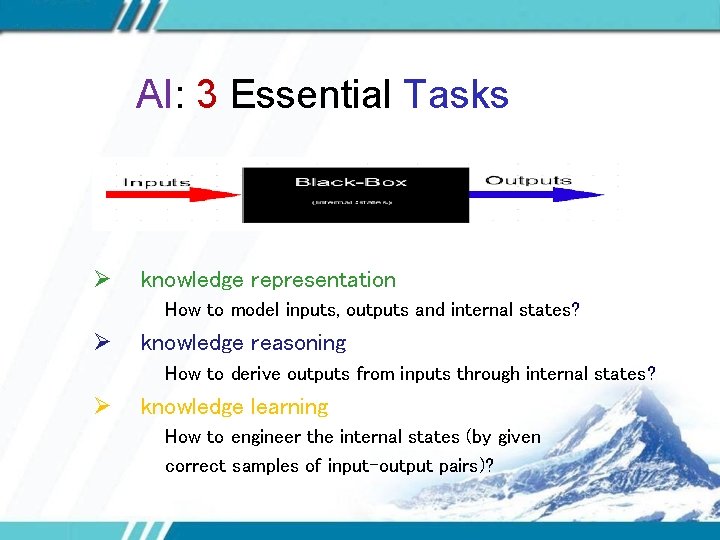
AI: 3 Essential Tasks Ø knowledge representation How to model inputs, outputs and internal states? Ø knowledge reasoning How to derive outputs from inputs through internal states? Ø knowledge learning How to engineer the internal states (by given correct samples of input-output pairs)?
Content • • • AI – a brief introduction Connectionism, Behaviourism, Symbolism Where are we? Symbolic AI 2. 0 Concluding remarks 8
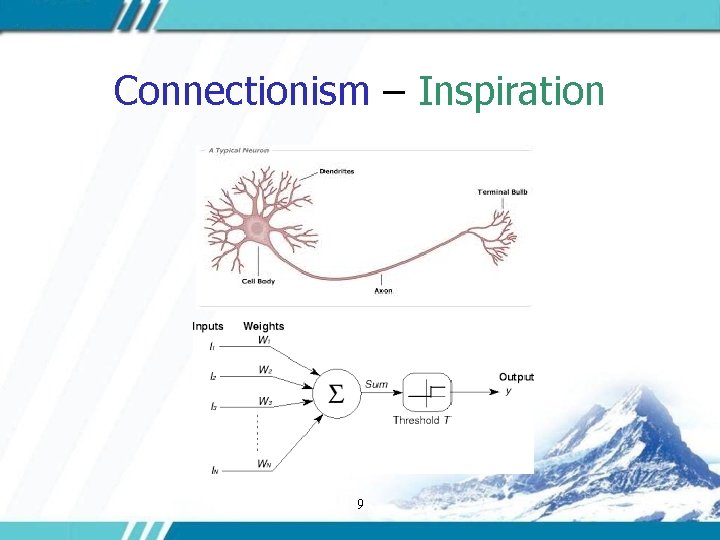
Connectionism – Inspiration 9

Connectionism – Origin 10
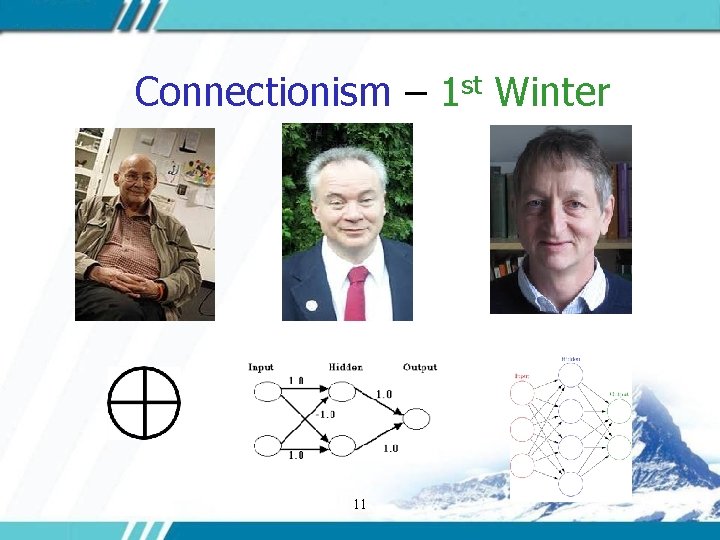
Connectionism – 1 st Winter 11
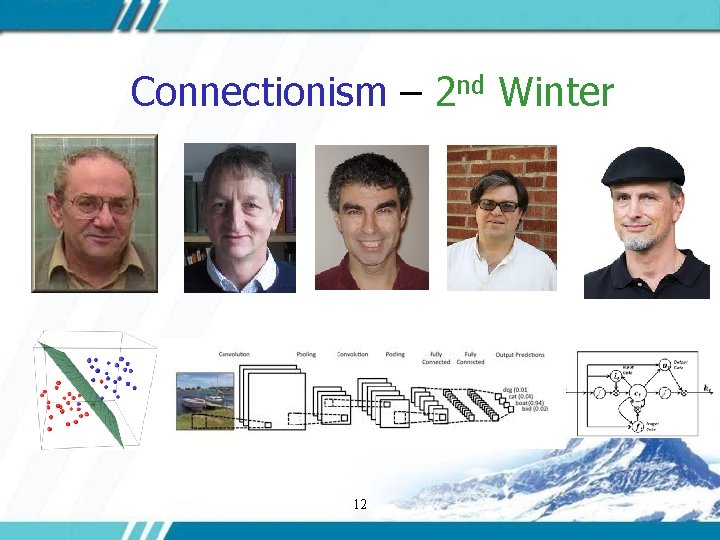
Connectionism – 2 nd Winter 12
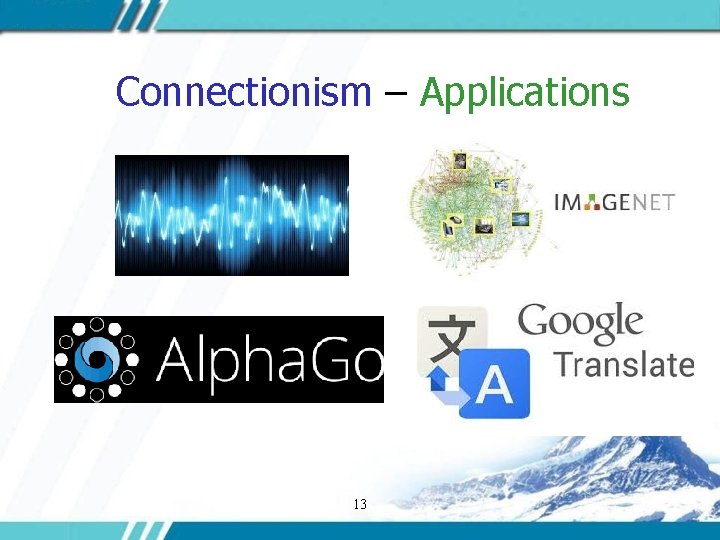
Connectionism – Applications 13
Connectionism – RRL Ø knowledge representation How to model inputs, outputs and internal states? (deep) (convolutional, recurrent) neural network Ø knowledge reasoning How to derive outputs from inputs through internal states? forward propagation Ø knowledge learning How to engineer the internal states (by given correct samples of input-output pairs)? backward propagation 14
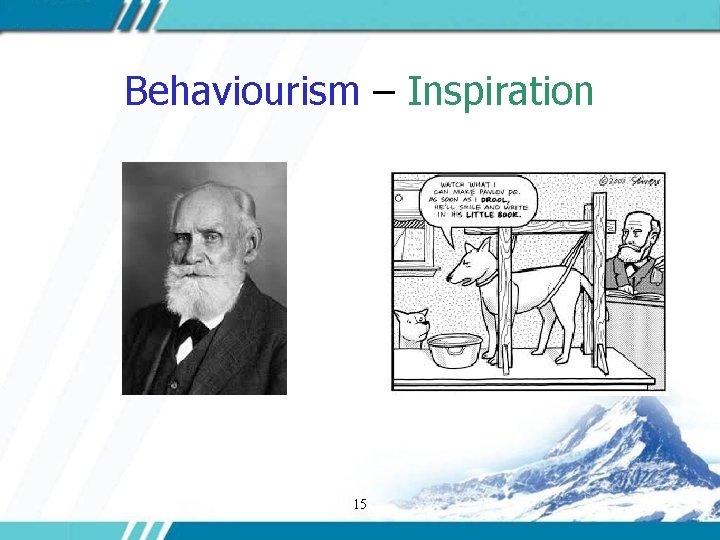
Behaviourism – Inspiration 15
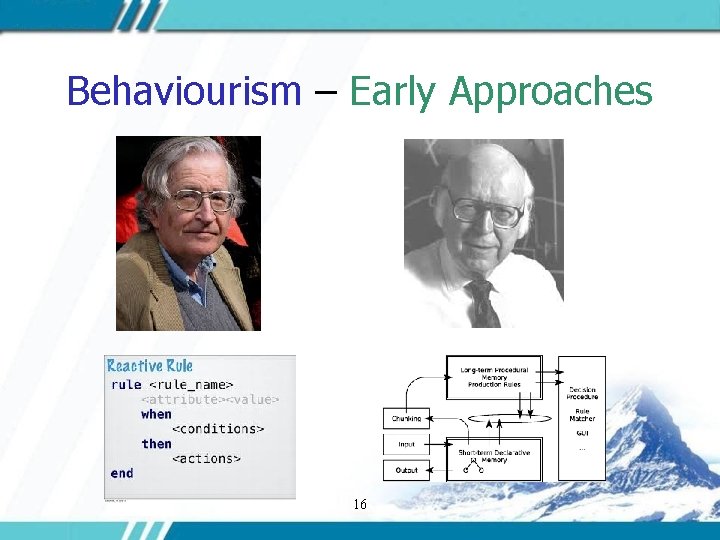
Behaviourism – Early Approaches 16
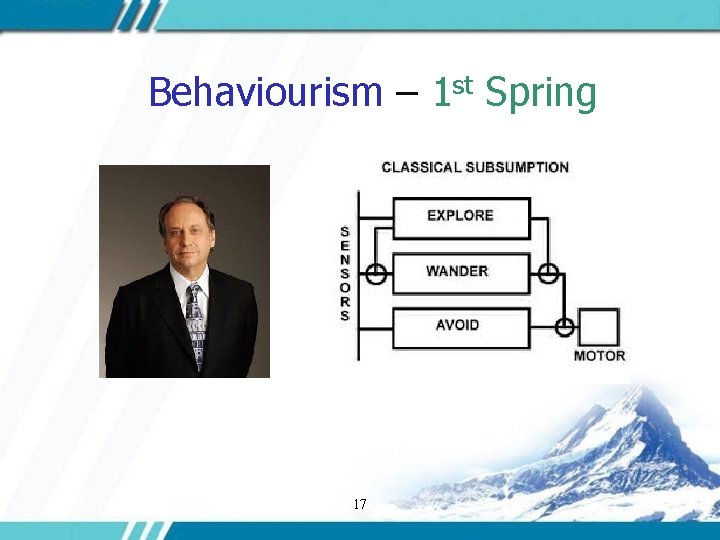
Behaviourism – 1 st Spring 17
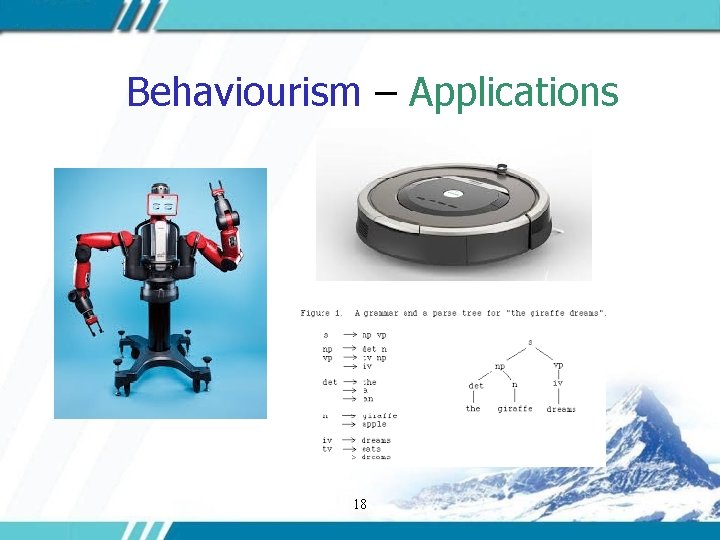
Behaviourism – Applications 18
Behaviourism – RRL Ø knowledge representation How to model inputs, outputs and internal states? (multi-layer) reactive rules Ø knowledge reasoning How to derive outputs from inputs through internal states? reaction Ø knowledge learning How to engineer the internal states (by given correct samples of input-output pairs)? hand-coded 19
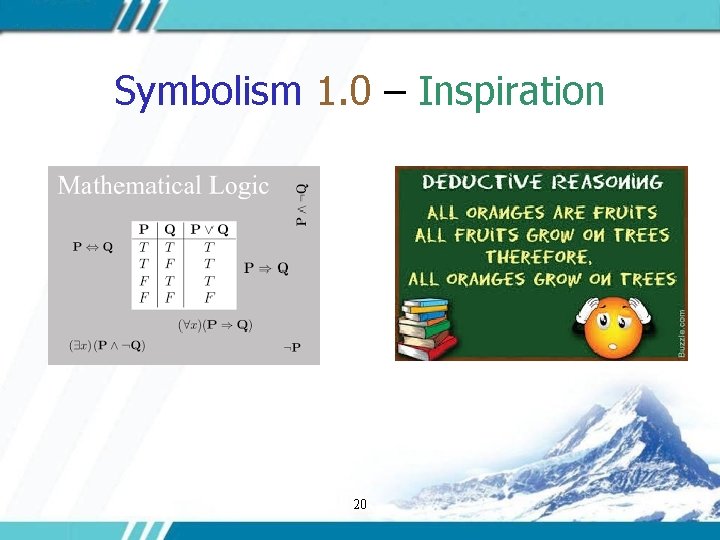
Symbolism 1. 0 – Inspiration 20
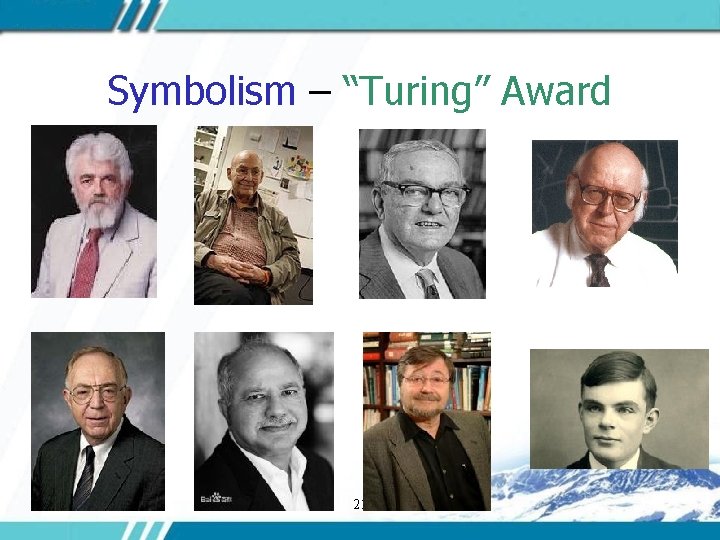
Symbolism – “Turing” Award 21

Symbolism – IJCAI Award for Research Excellence 22
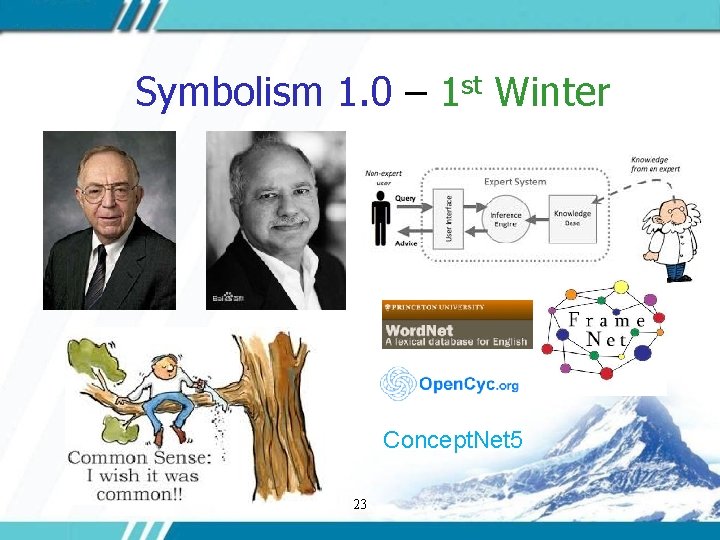
Symbolism 1. 0 – 1 st Winter Concept. Net 5 23
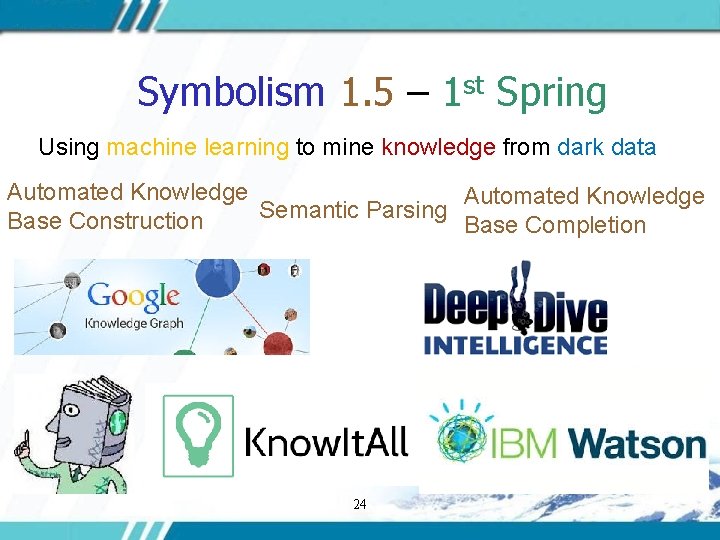
Symbolism 1. 5 – 1 st Spring Using machine learning to mine knowledge from dark data Automated Knowledge Semantic Parsing Base Construction Base Completion 24
Symbolism 1. 5 – Applications 25
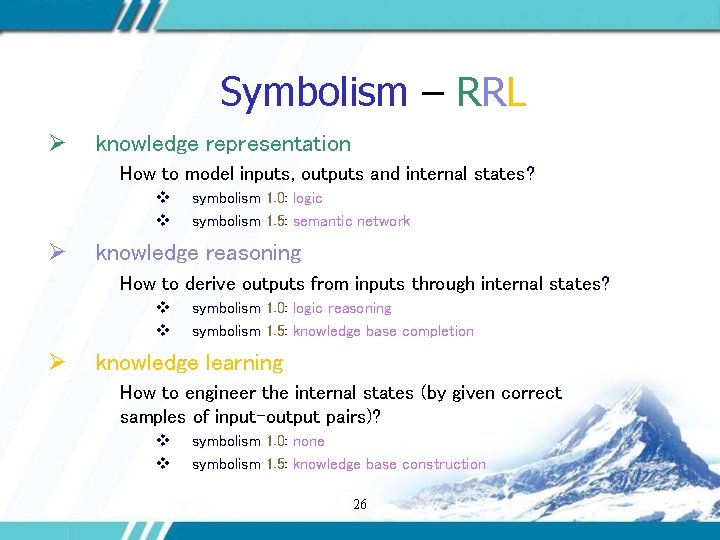
Symbolism – RRL Ø knowledge representation How to model inputs, outputs and internal states? v v Ø symbolism 1. 0: logic symbolism 1. 5: semantic network knowledge reasoning How to derive outputs from inputs through internal states? v v Ø symbolism 1. 0: logic reasoning symbolism 1. 5: knowledge base completion knowledge learning How to engineer the internal states (by given correct samples of input-output pairs)? v v symbolism 1. 0: none symbolism 1. 5: knowledge base construction 26
Content • • • AI – a brief introduction Connectionism, Behaviourism, Symbolism Where are we? Symbolic AI 2. 0 Concluding remarks 27
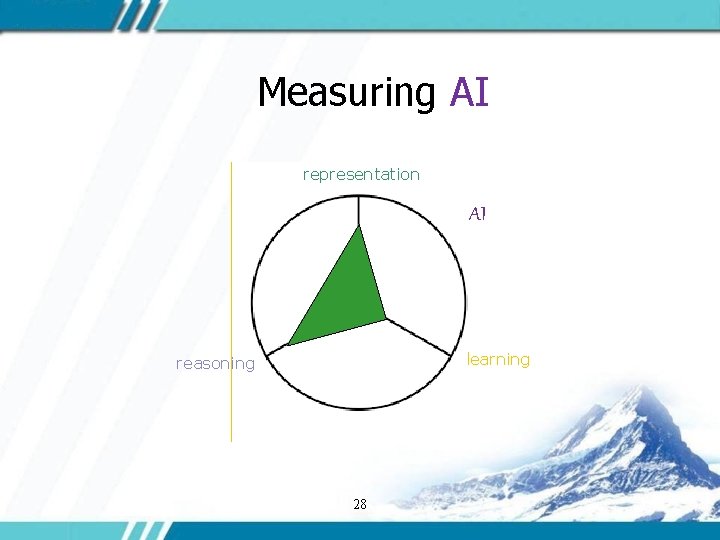
Measuring AI representation AI learning reasoning 28
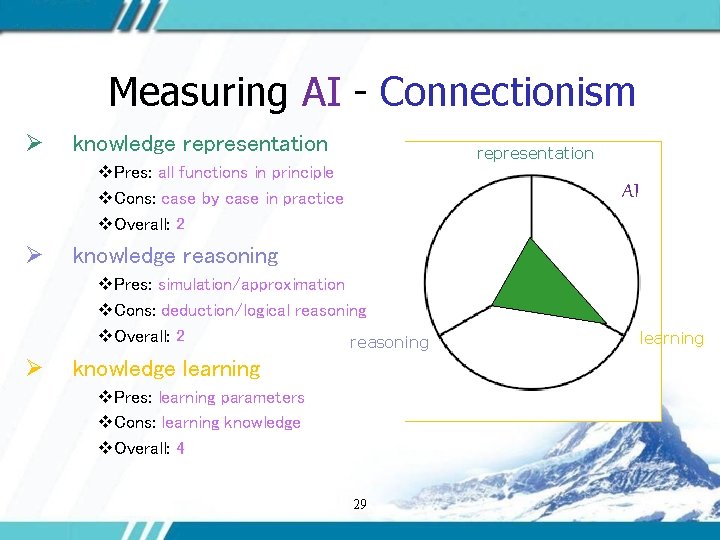
Measuring AI - Connectionism Ø knowledge representation v. Pres: all functions in principle v. Cons: case by case in practice v. Overall: 2 Ø AI knowledge reasoning v. Pres: simulation/approximation v. Cons: deduction/logical reasoning v. Overall: 2 reasoning Ø knowledge learning v. Pres: learning parameters v. Cons: learning knowledge v. Overall: 4 29 learning
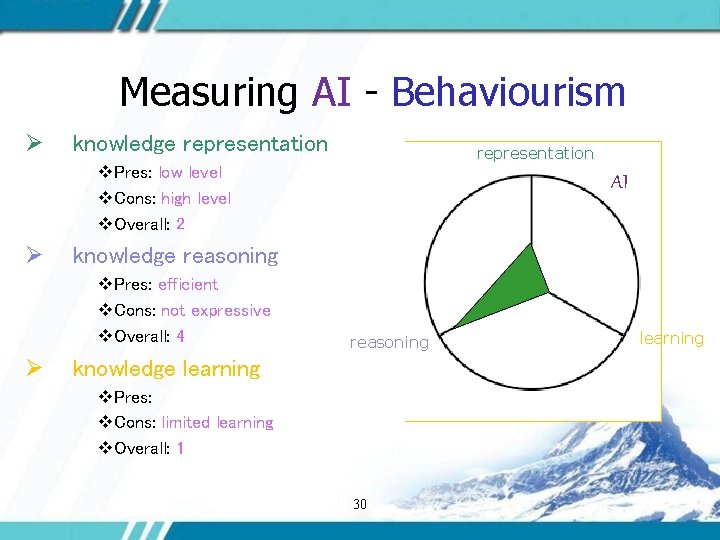
Measuring AI - Behaviourism Ø knowledge representation v. Pres: low level v. Cons: high level v. Overall: 2 Ø knowledge reasoning v. Pres: efficient v. Cons: not expressive v. Overall: 4 Ø AI reasoning knowledge learning v. Pres: v. Cons: limited learning v. Overall: 1 30 learning
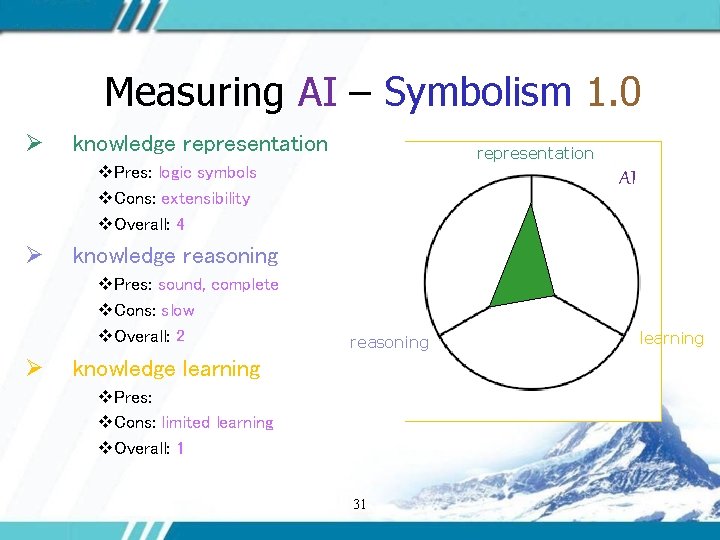
Measuring AI – Symbolism 1. 0 Ø knowledge representation v. Pres: logic symbols v. Cons: extensibility v. Overall: 4 Ø knowledge reasoning v. Pres: sound, complete v. Cons: slow v. Overall: 2 Ø AI reasoning knowledge learning v. Pres: v. Cons: limited learning v. Overall: 1 31 learning
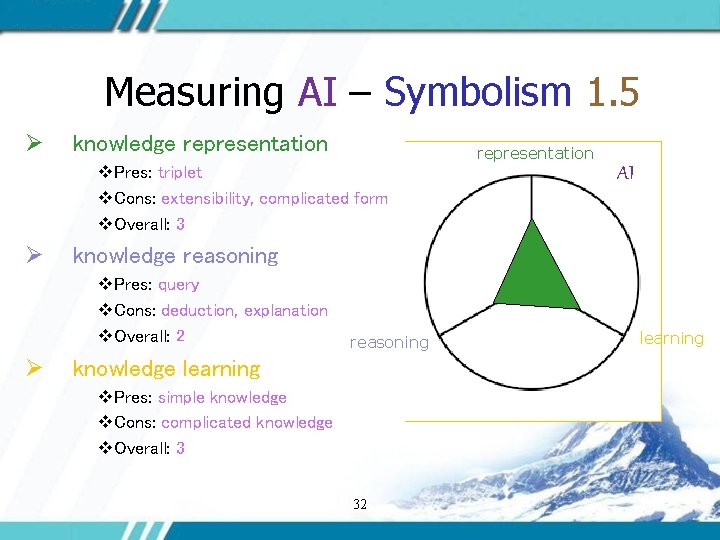
Measuring AI – Symbolism 1. 5 Ø knowledge representation v. Pres: triplet v. Cons: extensibility, complicated form v. Overall: 3 Ø AI knowledge reasoning v. Pres: query v. Cons: deduction, explanation v. Overall: 2 Ø representation reasoning knowledge learning v. Pres: simple knowledge v. Cons: complicated knowledge v. Overall: 3 32 learning
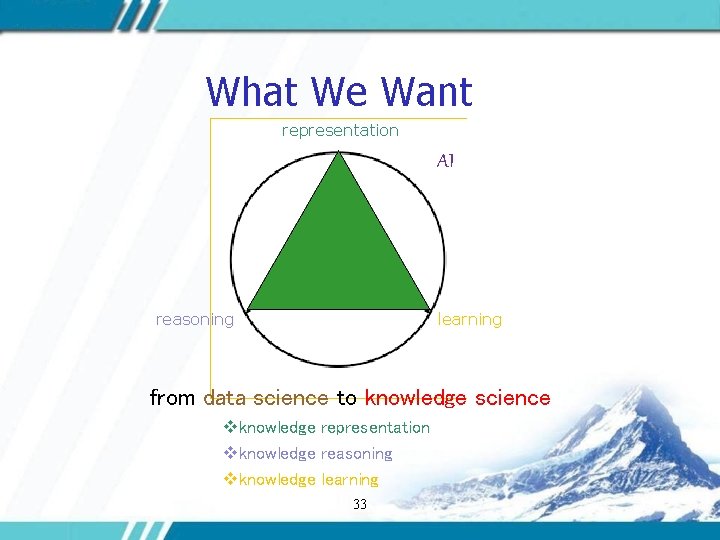
What We Want representation AI reasoning learning from data science to knowledge science vknowledge representation vknowledge reasoning vknowledge learning 33
Content • • • AI – a brief introduction Connectionism, Behaviourism, Symbolism Where are we? Symbolic AI 2. 0 Concluding remarks 34
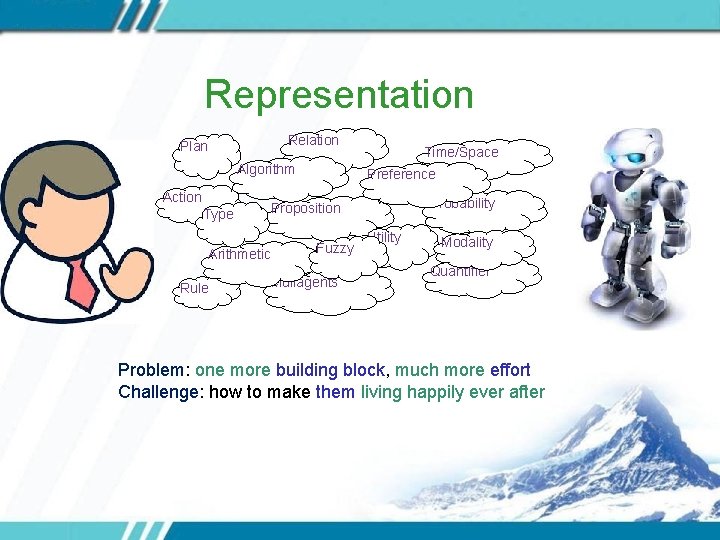
Representation Relation Plan Algorithm Action Type Arithmetic Rule Time/Space Preference Probability Proposition Fuzzy Muliagents Utility Modality Quantifier Problem: one more building block, much more effort Challenge: how to make them living happily ever after
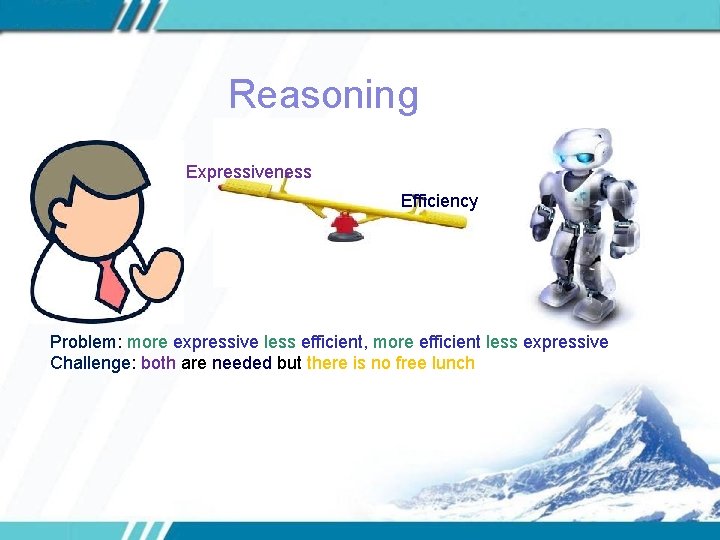
Reasoning Expressiveness Efficiency Problem: more expressive less efficient, more efficient less expressive Challenge: both are needed but there is no free lunch
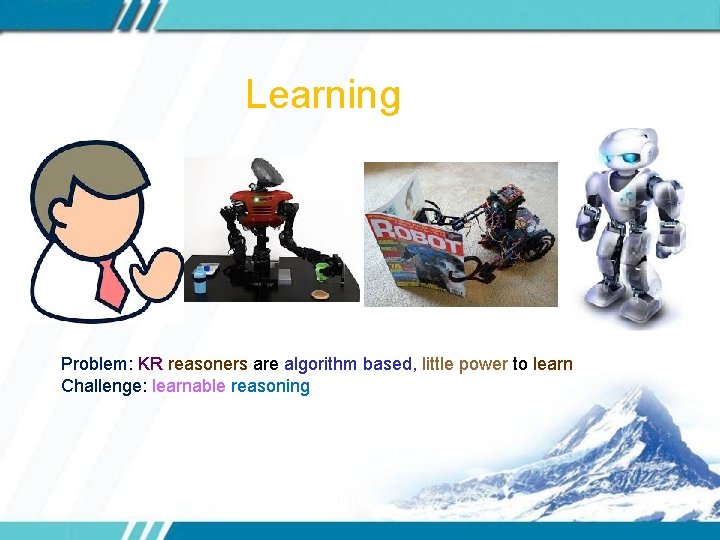
Learning Problem: KR reasoners are algorithm based, little power to learn Challenge: learnable reasoning
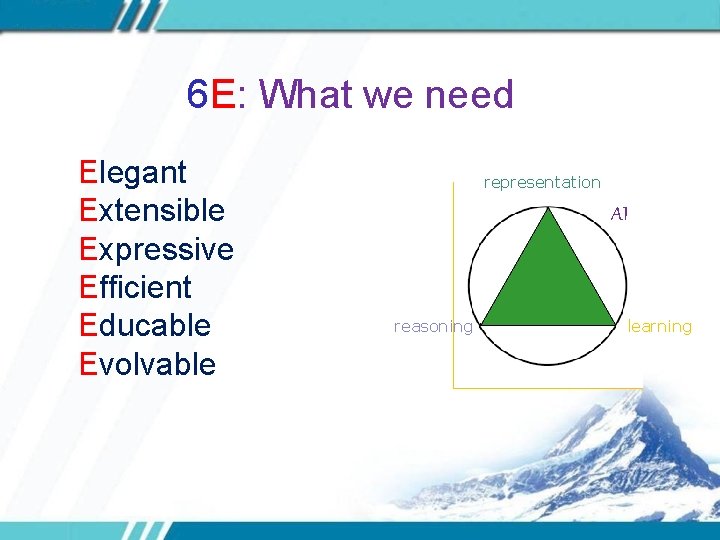
6 E: What we need Elegant Extensible Expressive Efficient Educable Evolvable representation AI reasoning learning
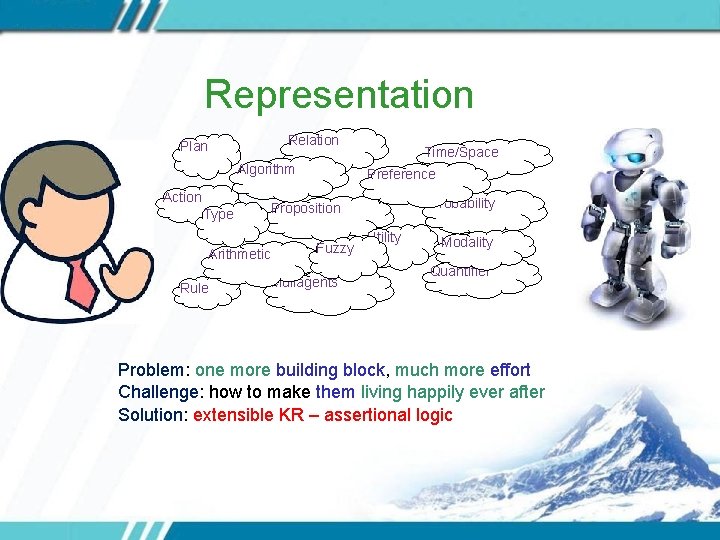
Representation Relation Plan Algorithm Action Type Arithmetic Rule Time/Space Preference Probability Proposition Fuzzy Muliagents Utility Modality Quantifier Problem: one more building block, much more effort Challenge: how to make them living happily ever after Solution: extensible KR – assertional logic
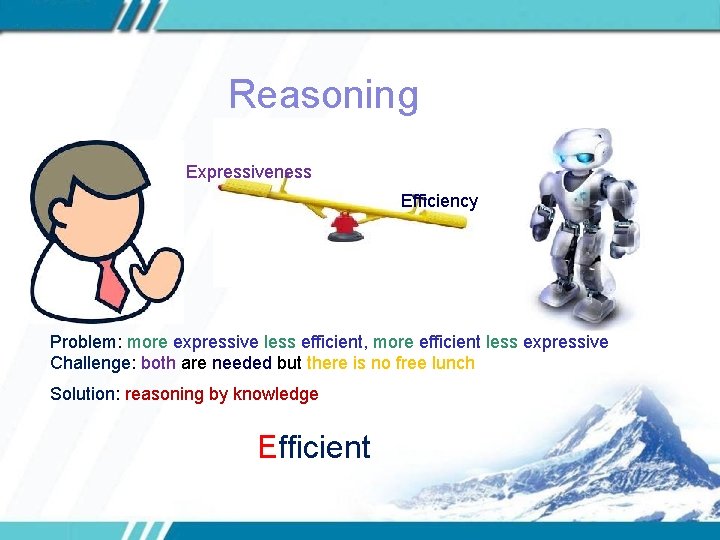
Reasoning Expressiveness Efficiency Problem: more expressive less efficient, more efficient less expressive Challenge: both are needed but there is no free lunch Solution: reasoning by knowledge Efficient
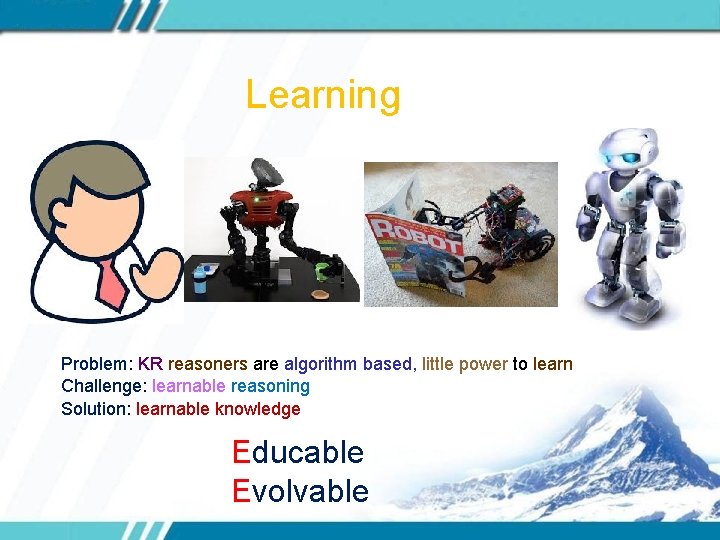
Learning Problem: KR reasoners are algorithm based, little power to learn Challenge: learnable reasoning Solution: learnable knowledge Educable Evolvable
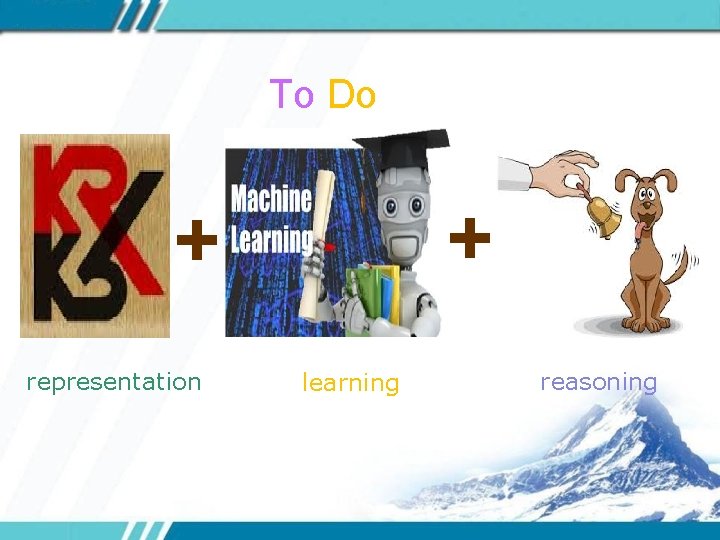
To Do + + representation learning reasoning
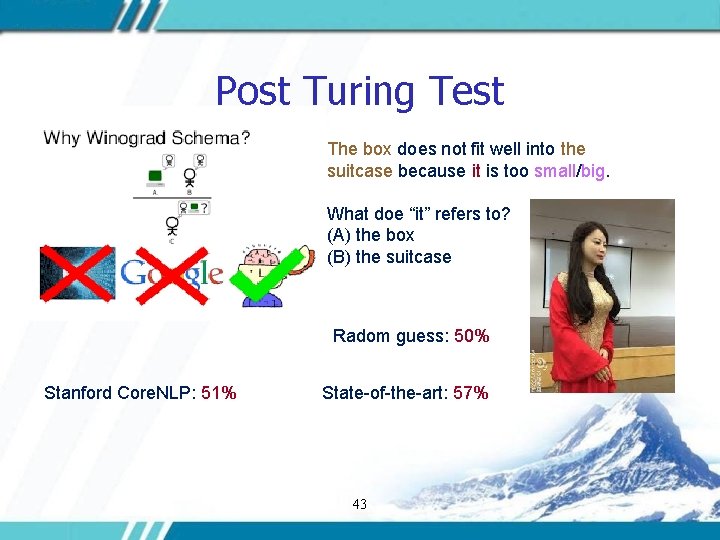
Post Turing Test The box does not fit well into the suitcase because it is too small/big. What doe “it” refers to? (A) the box (B) the suitcase Radom guess: 50% Stanford Core. NLP: 51% State-of-the-art: 57% 43
Intelligence Test 44
IBM Watson XPRIZE 45
Star. Craft II 46
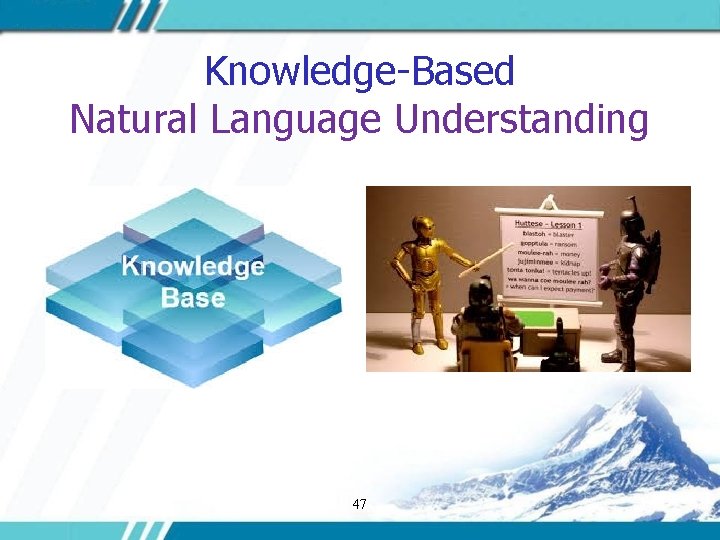
Knowledge-Based Natural Language Understanding 47
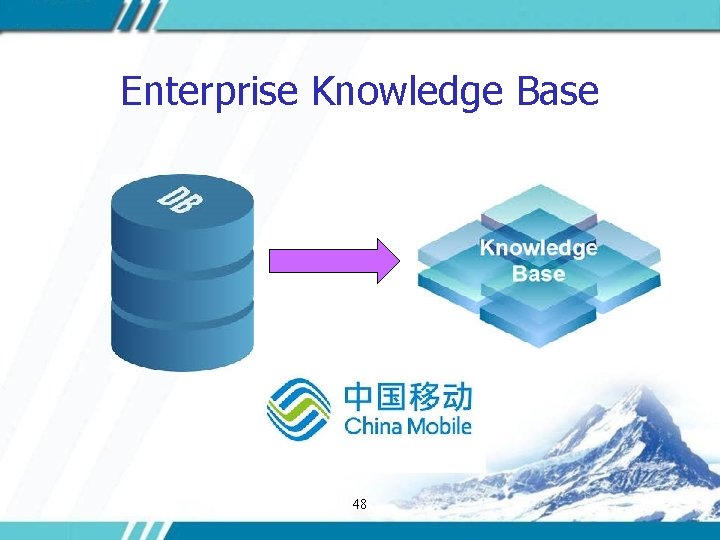
Enterprise Knowledge Base 48
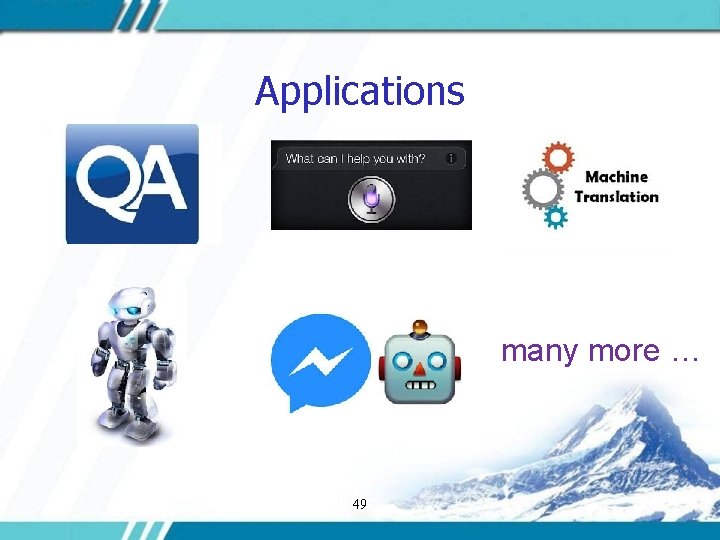
Applications many more … 49
Content • • • AI – a brief introduction Connectionism, Behaviourism, Symbolism Where are we? Symbolic AI 2. 0 Concluding remarks 50
Concluding Remarks Ø Ø Ø AI = representation + reasoning + learning (knowledge) AI: connectionism, behaviourism, symbolism All experienced winter and spring so far so good, but a long way to go symbolic AI 2. 0: the 6 E’s symbolic AI 2. 0: the next generation 51

Thank you!
- Slides: 52