
Symbol Tables COMP 2521 18 x 1 Searching
Symbol Tables COMP 2521 18 x 1
Searching: like sorting, searching is a fundamental element of many computational tasks • data bases • dictionaries • compiler symbol tables
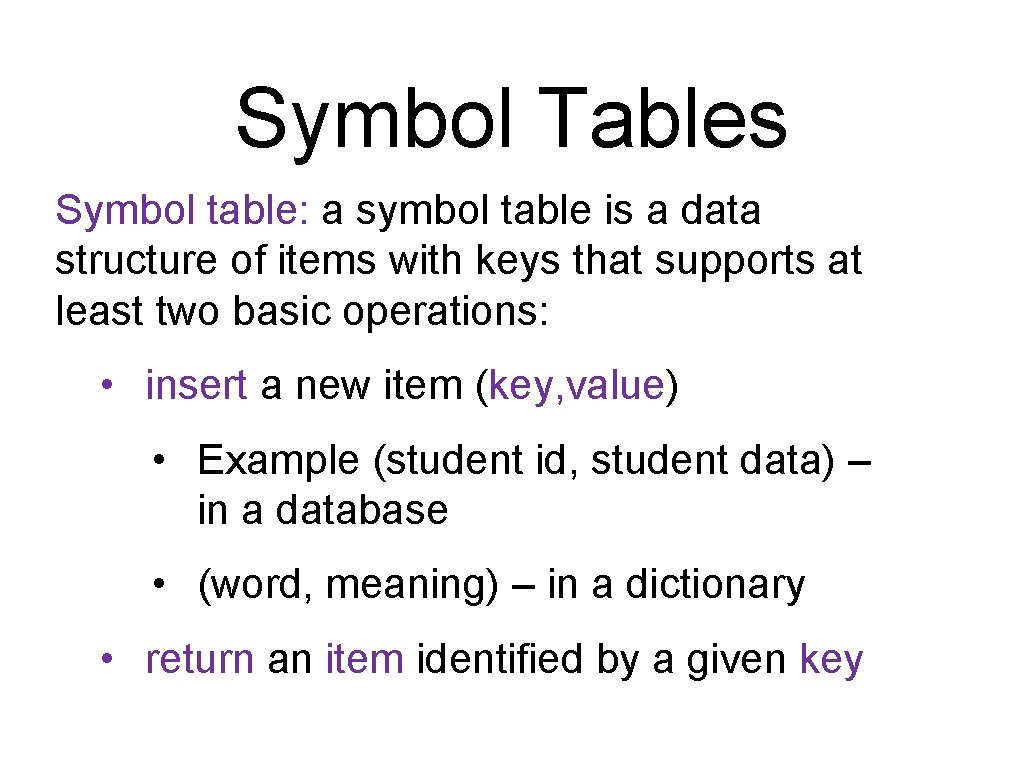
Symbol Tables Symbol table: a symbol table is a data structure of items with keys that supports at least two basic operations: • insert a new item (key, value) • Example (student id, student data) – in a database • (word, meaning) – in a dictionary • return an item identified by a given key
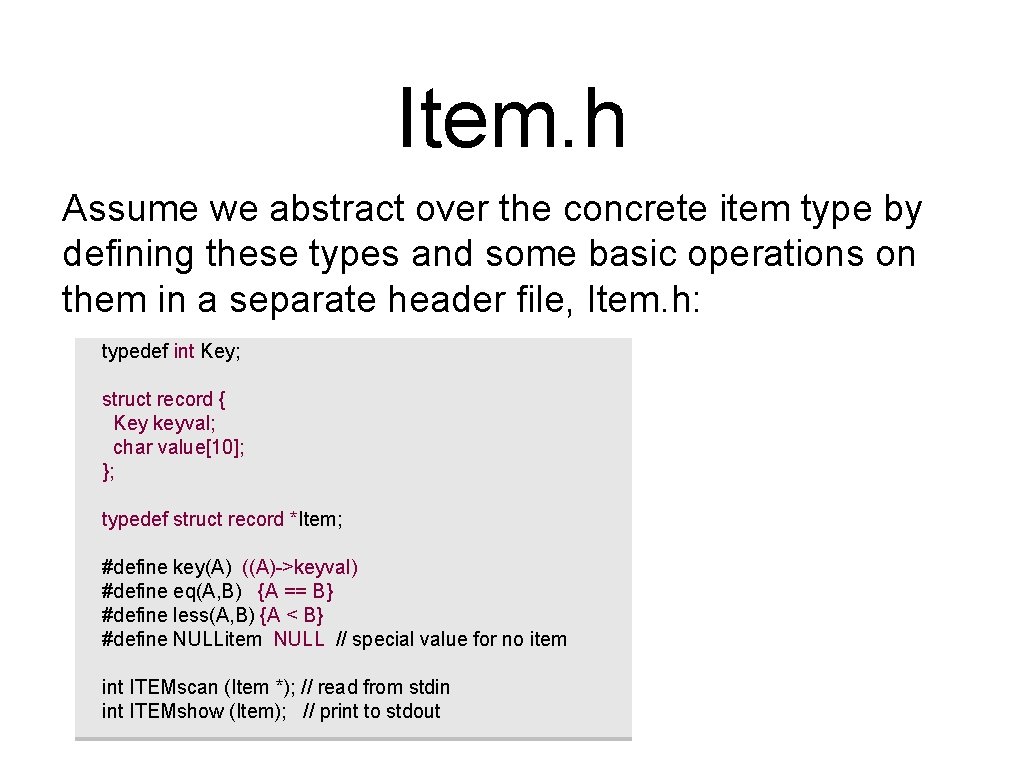
Item. h Assume we abstract over the concrete item type by defining these types and some basic operations on them in a separate header file, Item. h: typedef int Key; struct record { Key keyval; char value[10]; }; typedef struct record *Item; #define key(A) ((A)->keyval) #define eq(A, B) {A == B} #define less(A, B) {A < B} #define NULLitem NULL // special value for no item int ITEMscan (Item *); // read from stdin int ITEMshow (Item); // print to stdout
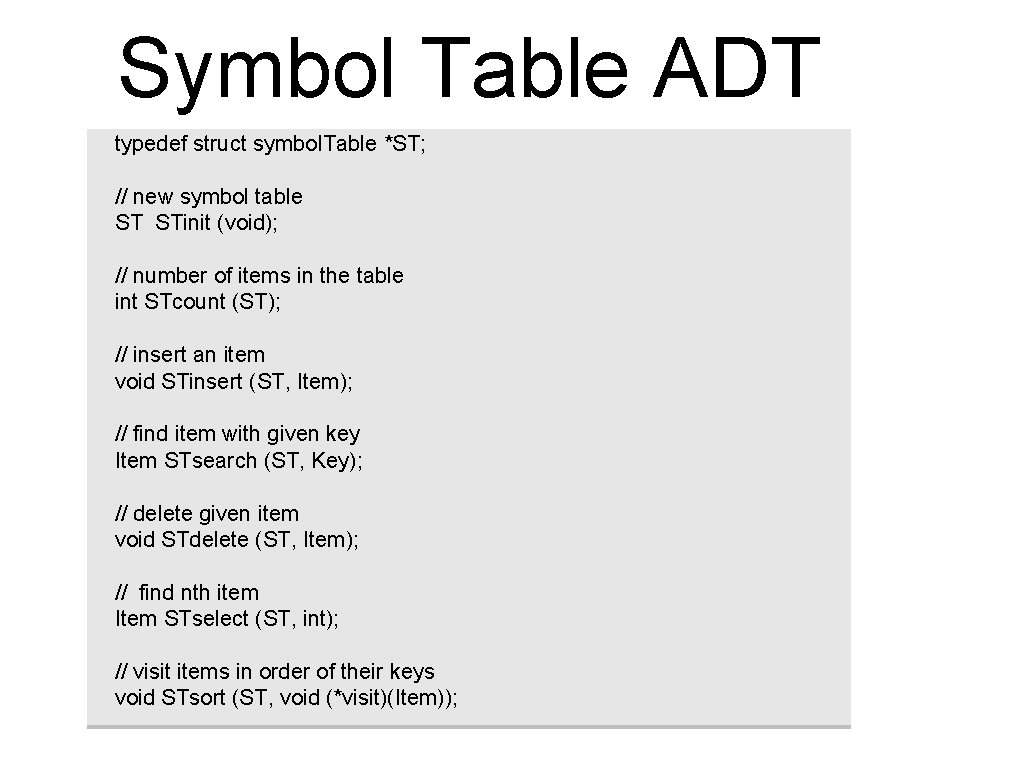
Symbol Table ADT typedef struct symbol. Table *ST; // new symbol table ST STinit (void); // number of items in the table int STcount (ST); // insert an item void STinsert (ST, Item); // find item with given key Item STsearch (ST, Key); // delete given item void STdelete (ST, Item); // find nth item Item STselect (ST, int); // visit items in order of their keys void STsort (ST, void (*visit)(Item));
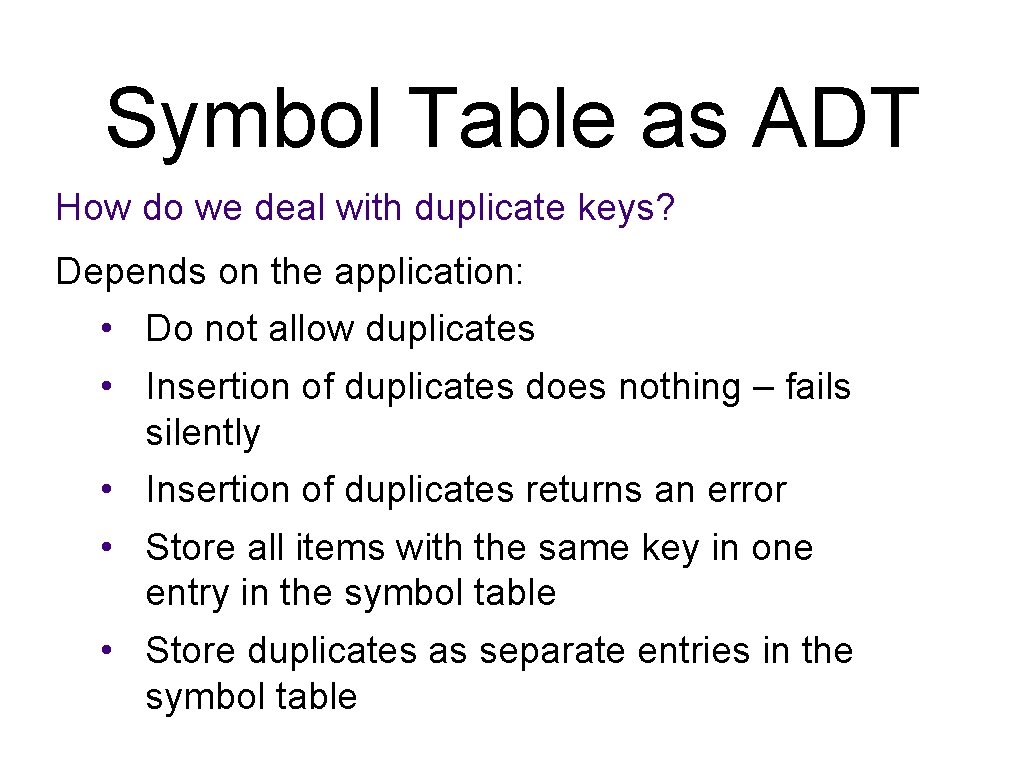
Symbol Table as ADT How do we deal with duplicate keys? Depends on the application: • Do not allow duplicates • Insertion of duplicates does nothing – fails silently • Insertion of duplicates returns an error • Store all items with the same key in one entry in the symbol table • Store duplicates as separate entries in the symbol table
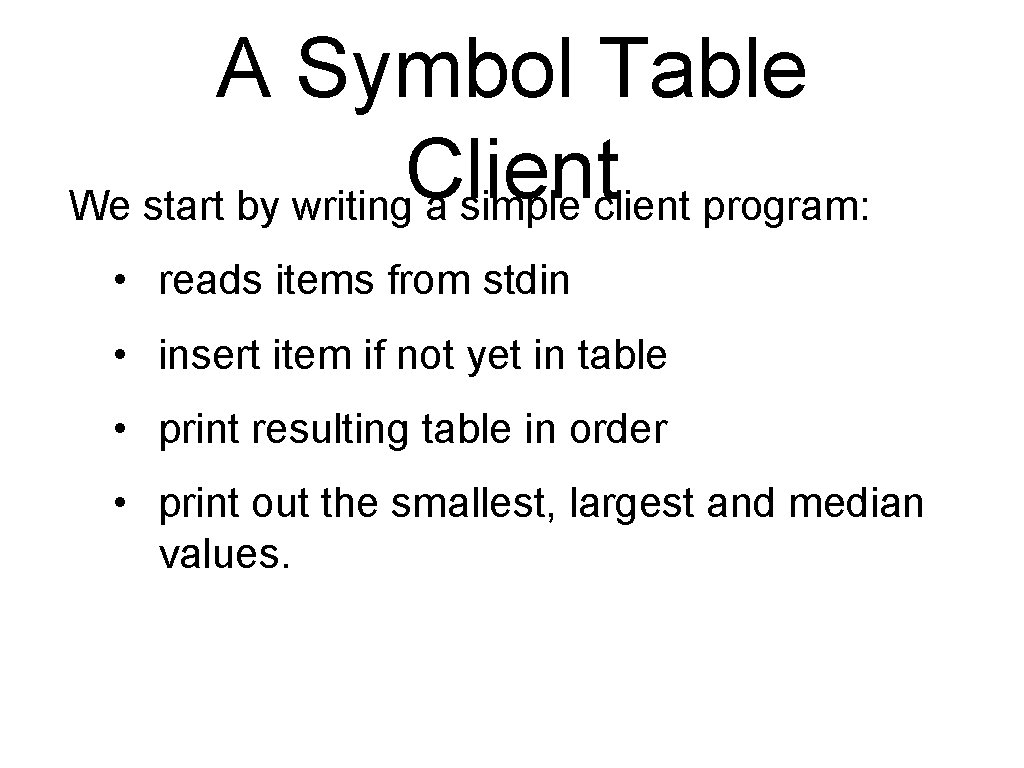
A Symbol Table Client We start by writing a simple client program: • reads items from stdin • insert item if not yet in table • print resulting table in order • print out the smallest, largest and median values.
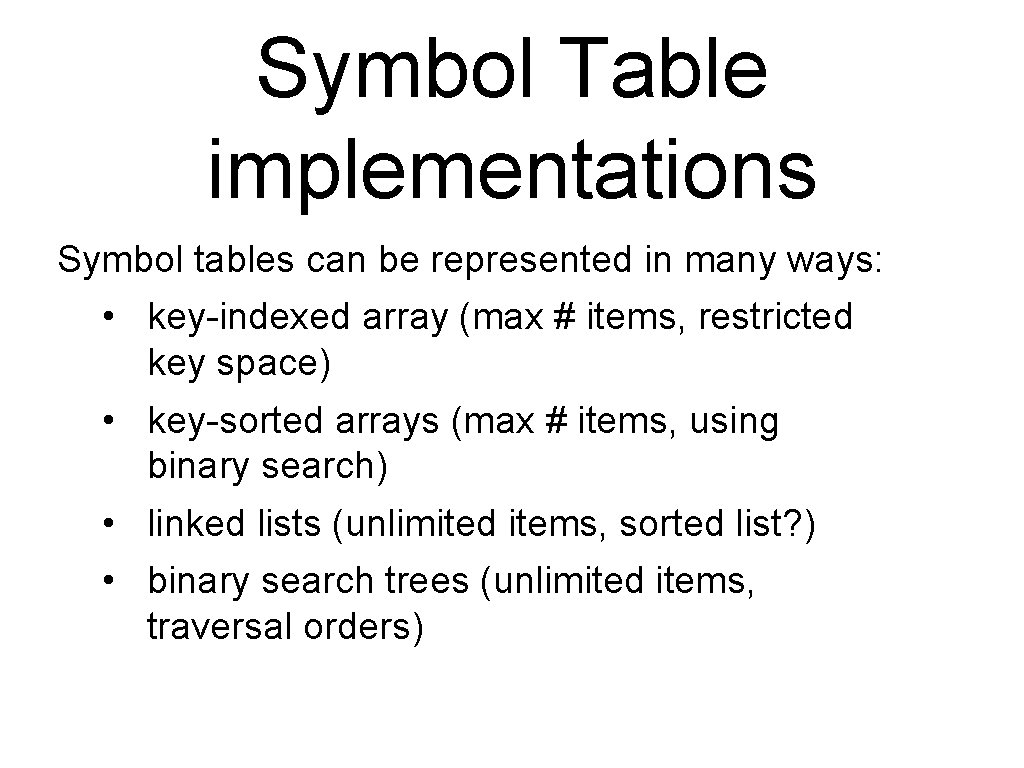
Symbol Table implementations Symbol tables can be represented in many ways: • key-indexed array (max # items, restricted key space) • key-sorted arrays (max # items, using binary search) • linked lists (unlimited items, sorted list? ) • binary search trees (unlimited items, traversal orders)
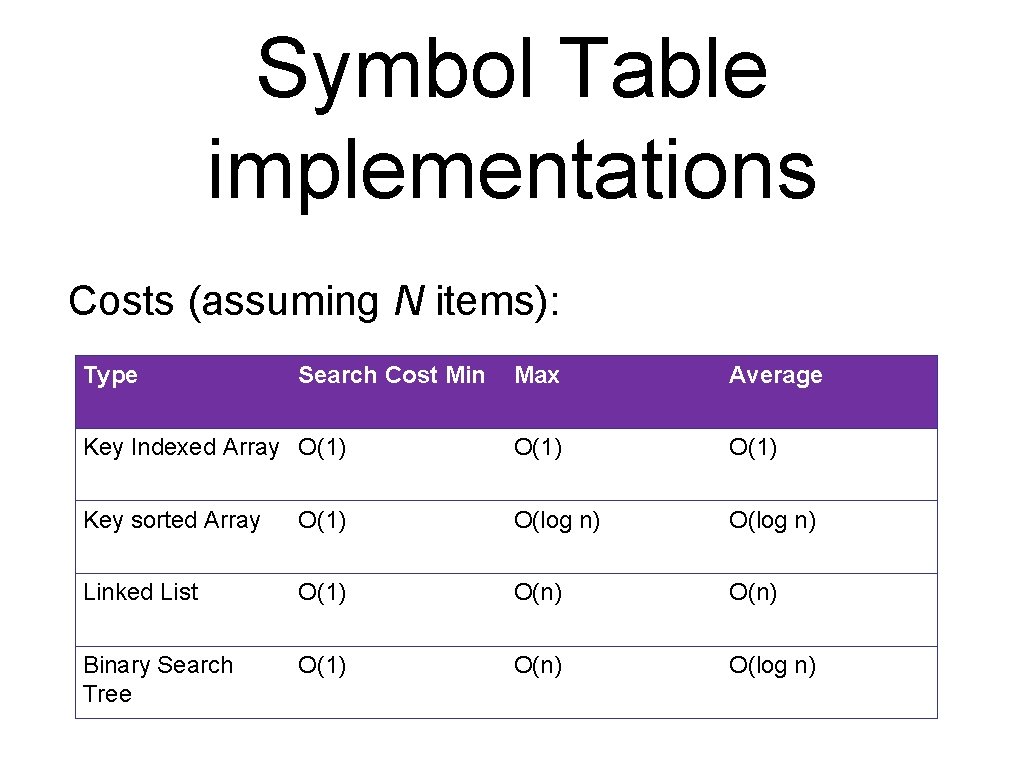
Symbol Table implementations Costs (assuming N items): Type Search Cost Min Max Average Key Indexed Array O(1) Key sorted Array O(1) O(log n) Linked List O(1) O(n) Binary Search Tree O(1) O(n) O(log n)
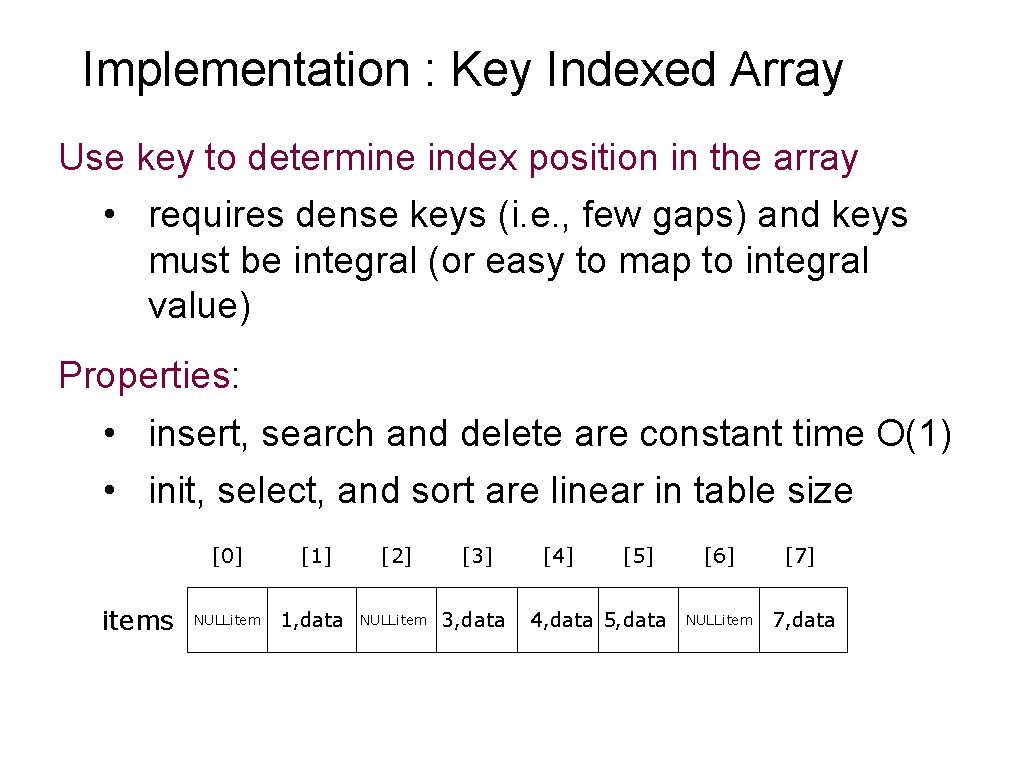
Implementation : Key Indexed Array Use key to determine index position in the array • requires dense keys (i. e. , few gaps) and keys must be integral (or easy to map to integral value) Properties: • insert, search and delete are constant time O(1) • init, select, and sort are linear in table size items [0] [1] [2] [3] NULLitem 1, data NULLitem 3, data [4] [5] 4, data 5, data [6] [7] NULLitem 7, data
Implementation : BST key (and maybe items) in internal nodes key in a node • is larger than any key in its left subtree • smaller than any key in its right subtree Properties: • init & count are constant time • insert, delete, search & select are logarithmic in the number of stored items in average case, linear in worst case (degenerate tree) • sort linear in numbers of stored items
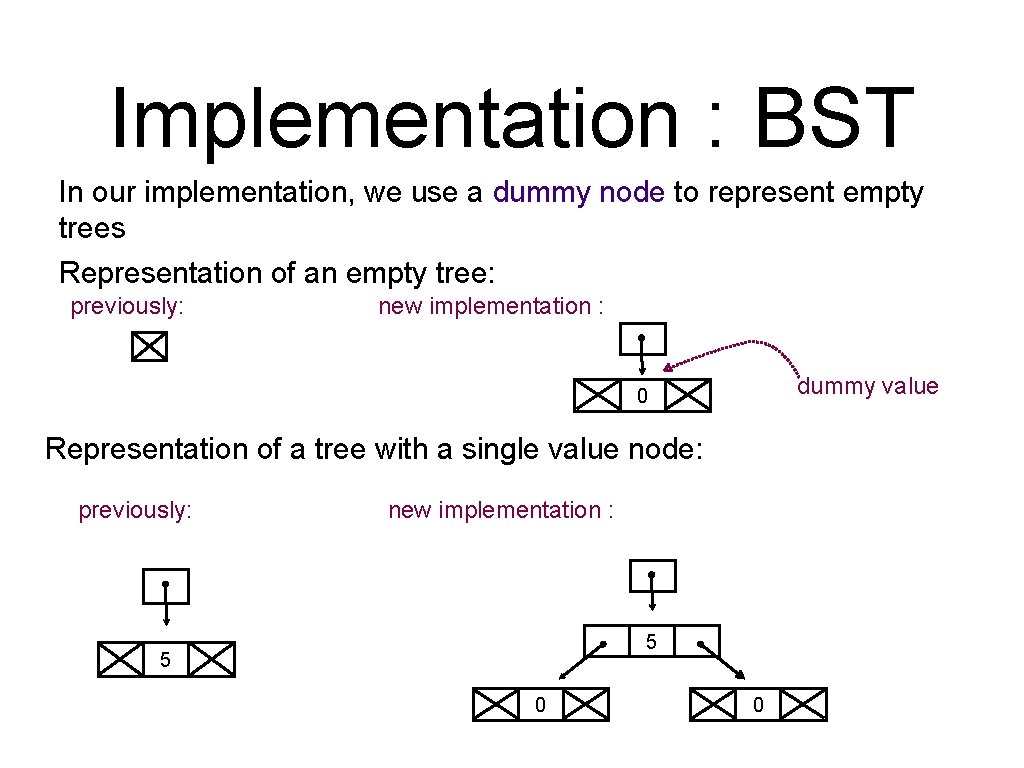
Implementation : BST In our implementation, we use a dummy node to represent empty trees Representation of an empty tree: previously: new implementation : dummy value 0 Representation of a tree with a single value node: previously: new implementation : 5 5 0 0
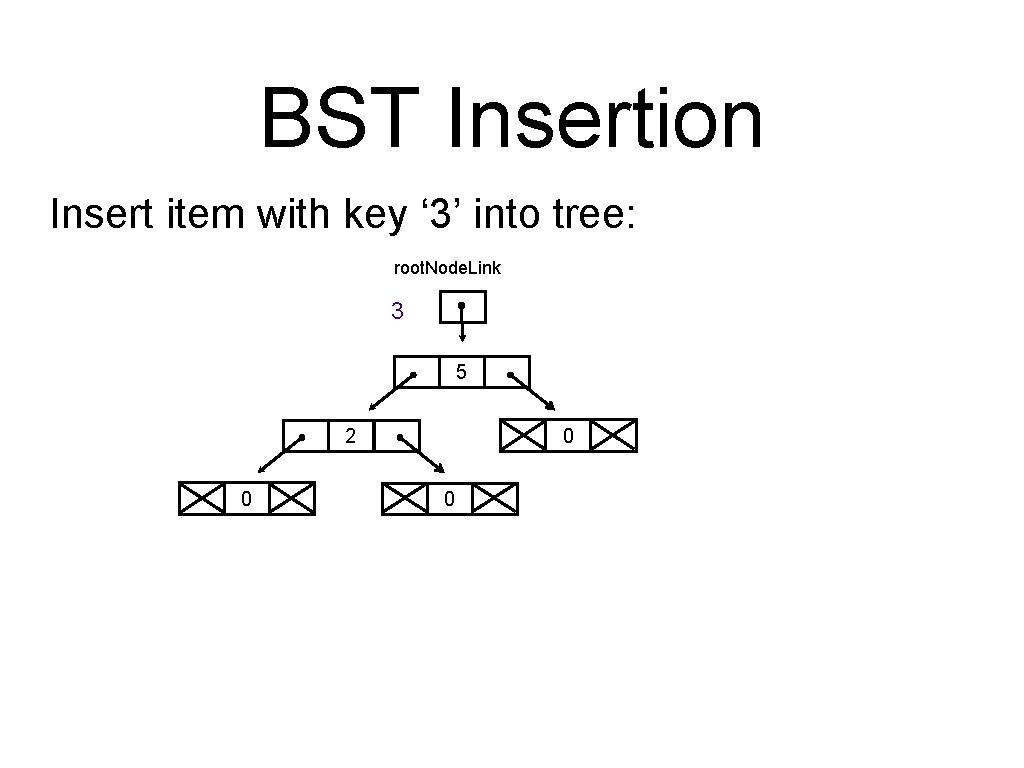
BST Insertion Insert item with key ‘ 3’ into tree: root. Node. Link 3 5 0 2 0 0
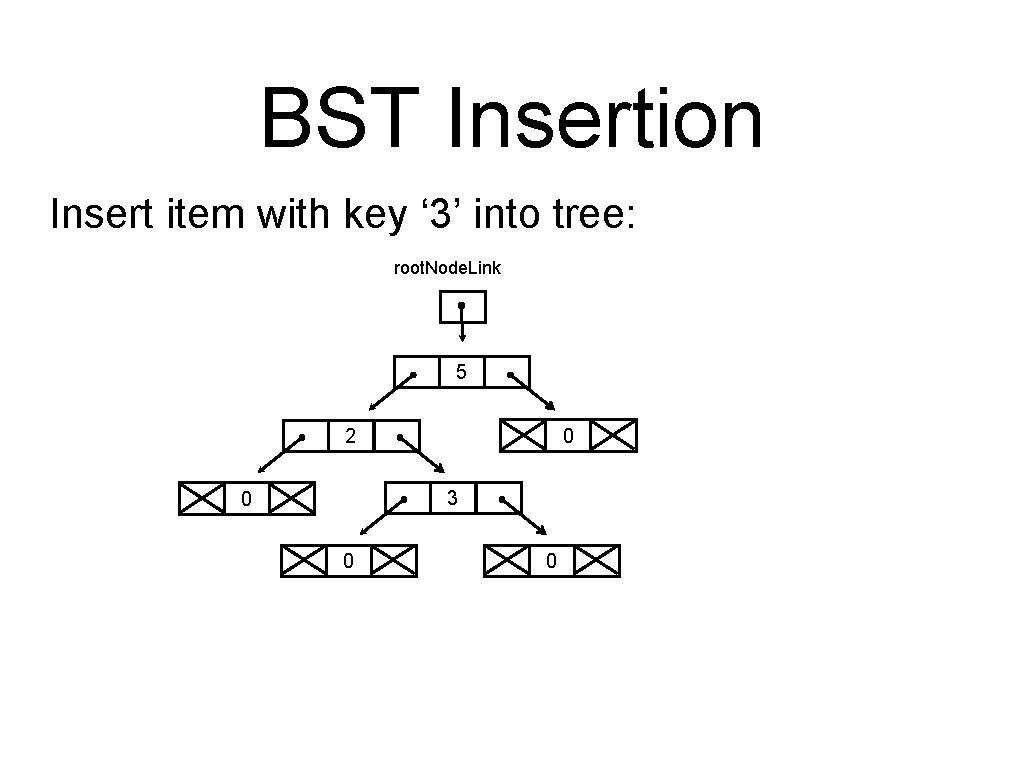
BST Insertion Insert item with key ‘ 3’ into tree: root. Node. Link 5 0 2 3 0 0 0
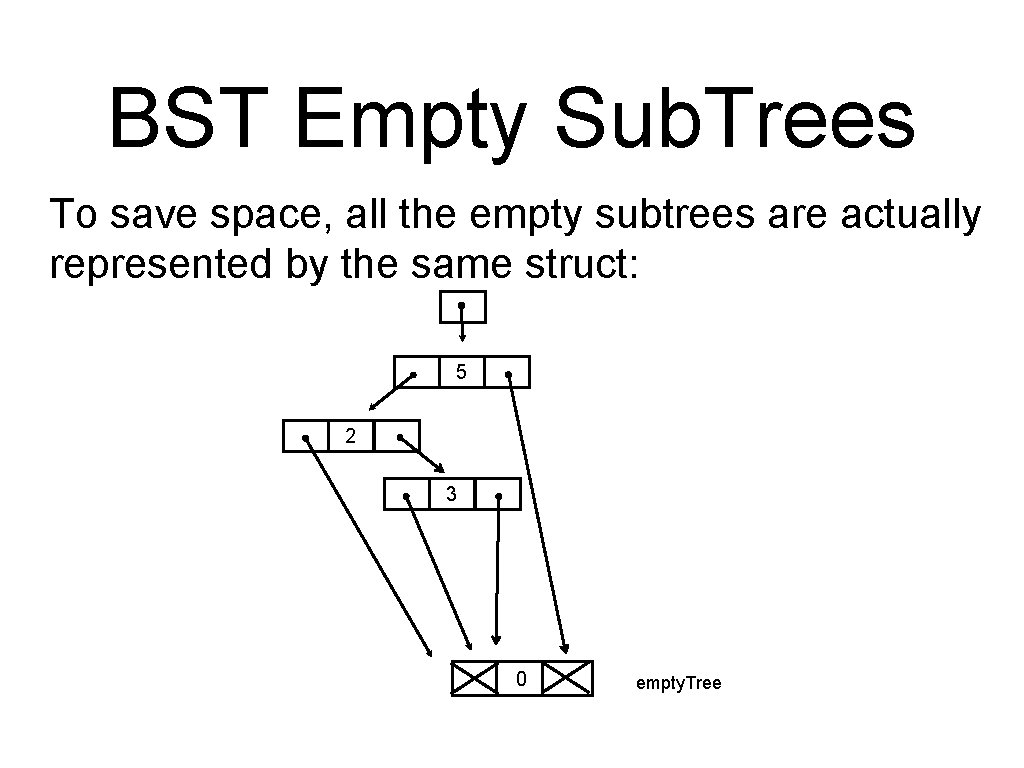
BST Empty Sub. Trees To save space, all the empty subtrees are actually represented by the same struct: 5 2 3 0 empty. Tree
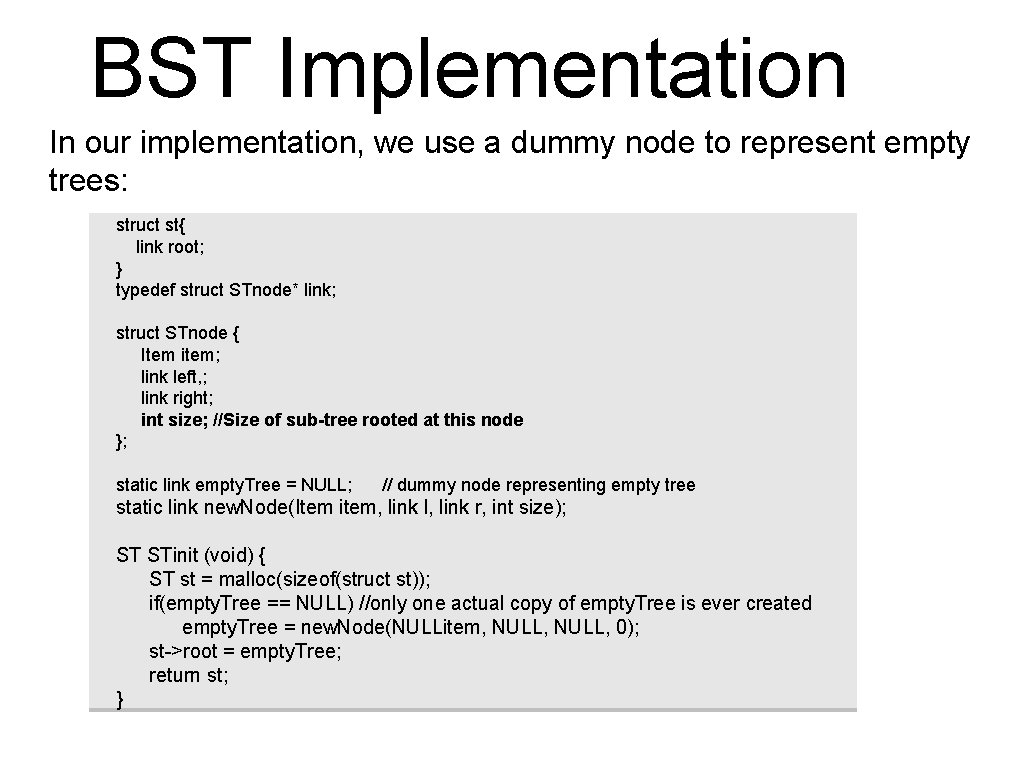
BST Implementation In our implementation, we use a dummy node to represent empty trees: struct st{ link root; } typedef struct STnode* link; struct STnode { Item item; link left, ; link right; int size; //Size of sub-tree rooted at this node }; static link empty. Tree = NULL; // dummy node representing empty tree static link new. Node(Item item, link l, link r, int size); ST STinit (void) { ST st = malloc(sizeof(struct st)); if(empty. Tree == NULL) //only one actual copy of empty. Tree is ever created empty. Tree = new. Node(NULLitem, NULL, 0); st->root = empty. Tree; return st; }
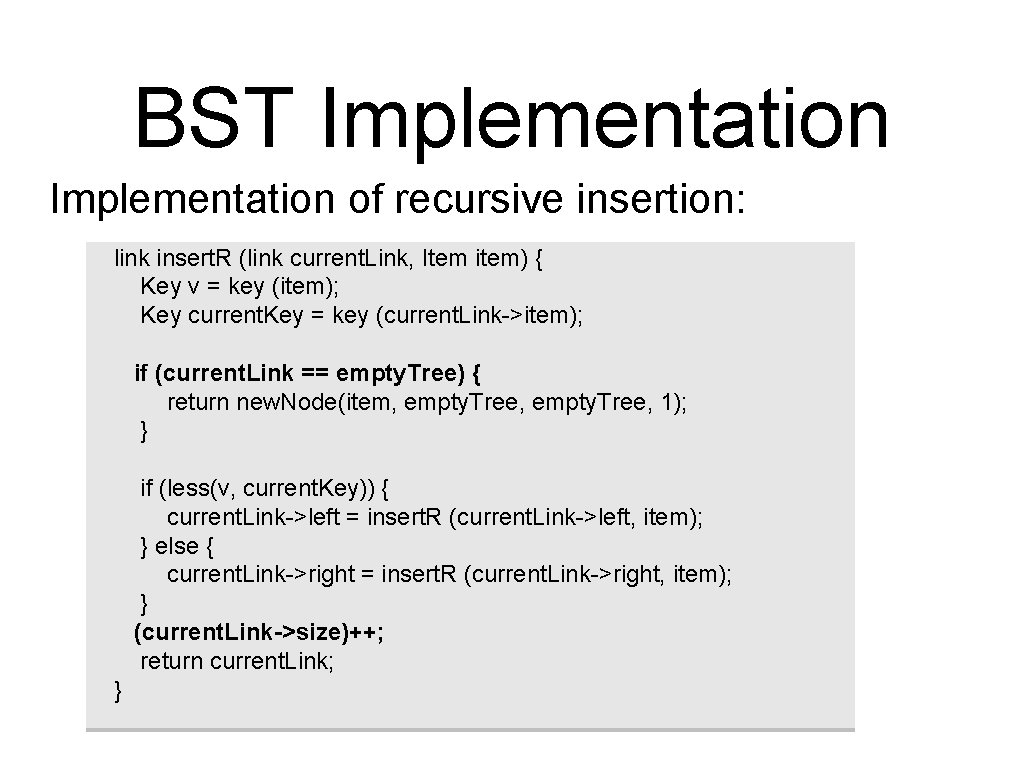
BST Implementation of recursive insertion: link insert. R (link current. Link, Item item) { Key v = key (item); Key current. Key = key (current. Link->item); if (current. Link == empty. Tree) { return new. Node(item, empty. Tree, 1); } if (less(v, current. Key)) { current. Link->left = insert. R (current. Link->left, item); } else { current. Link->right = insert. R (current. Link->right, item); } (current. Link->size)++; return current. Link; }
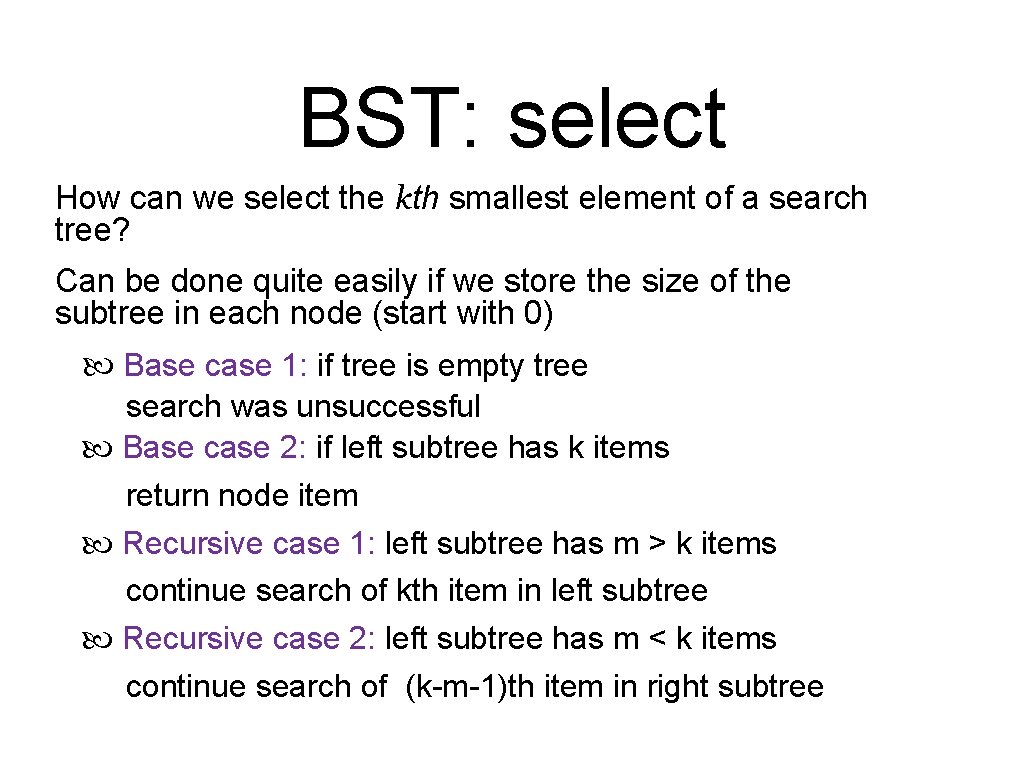
BST: select How can we select the kth smallest element of a search tree? Can be done quite easily if we store the size of the subtree in each node (start with 0) Base case 1: if tree is empty tree search was unsuccessful Base case 2: if left subtree has k items return node item Recursive case 1: left subtree has m > k items continue search of kth item in left subtree Recursive case 2: left subtree has m < k items continue search of (k-m-1)th item in right subtree
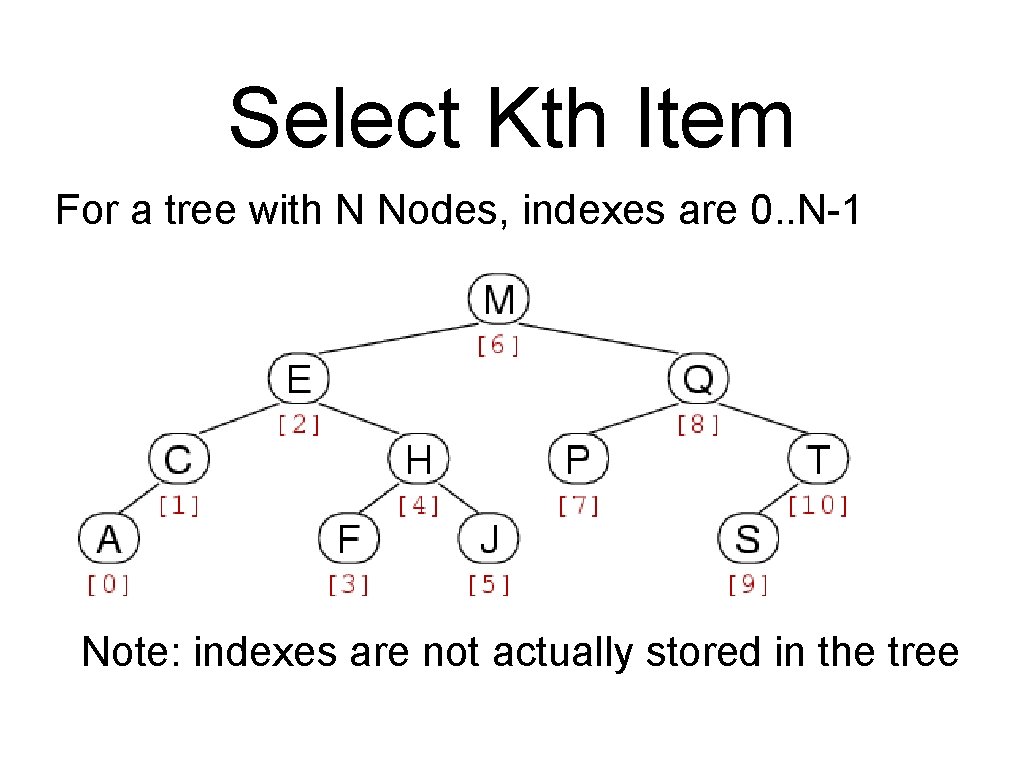
Select Kth Item For a tree with N Nodes, indexes are 0. . N-1 Note: indexes are not actually stored in the tree
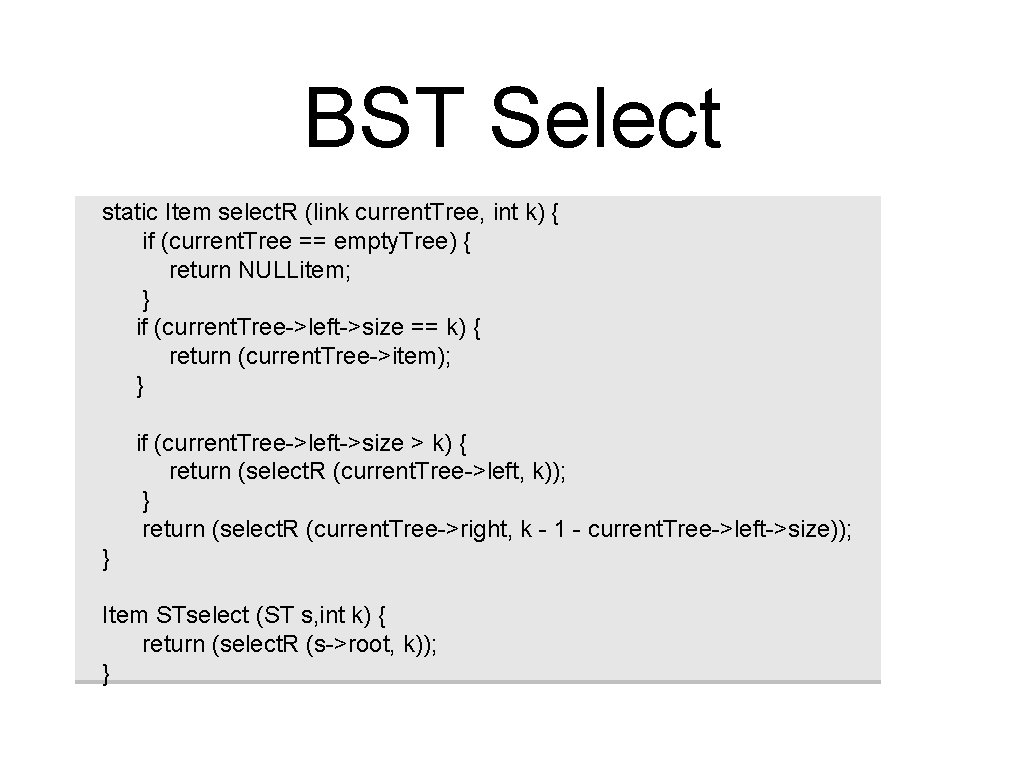
BST Select static Item select. R (link current. Tree, int k) { if (current. Tree == empty. Tree) { return NULLitem; } if (current. Tree->left->size == k) { return (current. Tree->item); } if (current. Tree->left->size > k) { return (select. R (current. Tree->left, k)); } return (select. R (current. Tree->right, k - 1 - current. Tree->left->size)); } Item STselect (ST s, int k) { return (select. R (s->root, k)); }
Performance of BSTs We already discussed the performance of binary search trees: Best case: • O(log n) steps to search, insert in a tree with n items Worst case: (degenerate tree) • O(n) steps
Symbol Tables as Indexes Scenario: • large set of items; • need efficient access via key • but also need sequential access to items • items might be stored in very large array or file
Symbol Tables as Indexes Solution: • leave items in place • use symbol table holding (key, ref) pairs Commonly used as an access mechanism in databases.
- Slides: 23