
Sybil Attacks and Their Defenses in the Internet
Sybil Attacks and Their Defenses in the Internet of Things Kuan Zhang, Student Member, IEEE, Xiaohui Liang, Member, IEEE, Rongxing Lu, Member, IEEE, and Xuemin Shen, Fellow, IEEE Presented by Ahmed Saaudi
List Of Contents Introduction IOT Domains And Applications Sybil attacks Social Graph-based Sybil Detection Behavior Classification-based Sybil Detection Research Challenges Conclusion
Introduction NTERNET-OF-THINGS (Io. T), which can expand the traditional Internet to a ubiquitous network connecting objects in the physical world, starts an evolution to enhance the interaction among people and the objects However, the emerging Io. T is vulnerable to Sybil attacks where attackers can manipulate fake identities.
Io. T Domains And Applications According to different Io. T applications, there are three domains of Io. T as follows: Sensing Domain Social Domain Mobile Domain
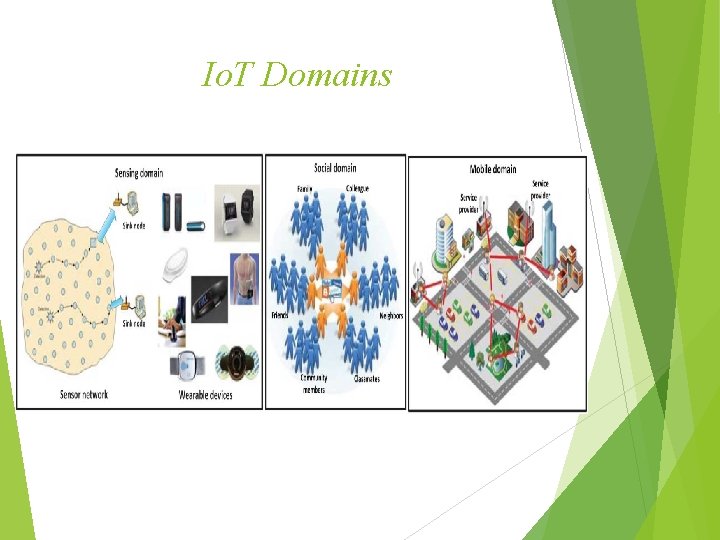
Io. T Domains
Sensing Domain A large volume of embedded sensors are deployed in the target area to monitor the environmental conditions or human biologic information. For example, smart meters are used to measure the appliance usage or power condition of the building or home area, and periodically send the power usage of individual unit to the control center. According to the metering data, the control center can effectively schedule the power distribution to save the unnecessary energy consumption.
Social Domain social domain provides the Io. T applications to facilitate the social interaction among users could form virtual online community or society to exchange information and share multimedia resources users in social domain have the Internet access and can interact with both the online servers and other users.
Mobile Domain users may not always have the Internet due to the constraints of the Internet coverage and user mobility users can take the advantage of their mobility to interact with others in the physical proximity and share their interests in a device-to-device pattern by using short-range wireless communications, bluetooth, Wi. Fi, etc. These features can also provide Io. T applications, such as mobile social network (MSN), vehicular ad hoc network (VANET), and delay tolerant network.
Sybil Attacks Sybil attacks exist in the Io. T to maliciously manipulate the systems
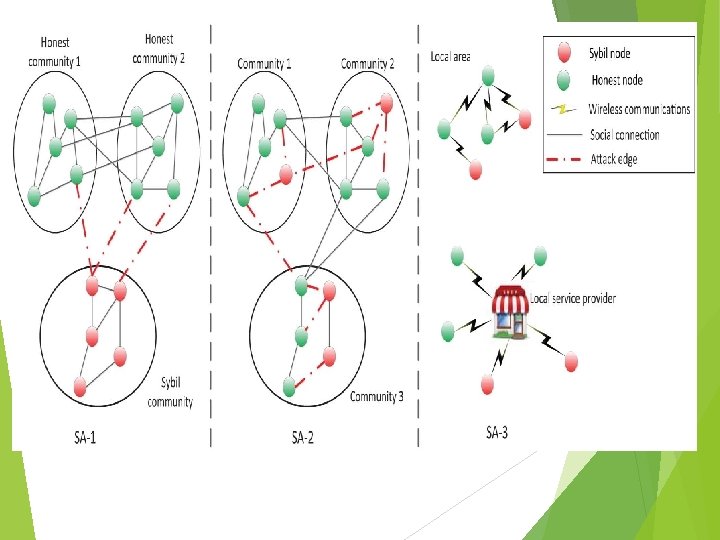
SA-1 Sybil Attacks The SA-1 attackers usually build connections within the Sybil community as shown in Fig. above. i. e. , Sybil nodes tightly connect with other Sybil nodes. However, the SA-1’s capability of building social connections with honest nodes is not strong.
Con… The SA-1 attackers usually exist in sensing domain and social domain, i. e. , OSN, voting, or mobile sensing The main goal is to manipulate the overall option or popularity. For example, in an online voting system, SA-1 can illegally forge a massive number of identities to act as normal users and submit the votes with the biased options So, the final voting result might be manipulated by the SA-1 attackers
SA-1 Attackers In Mobile Sensing . Similarly, in mobile sensing system, SA-1 can forge the false sensing data and indirectly change the aggregated data. Therefore, in some cases, the behaviors of Sybil attackers are indistinguishable from the normal users.
SA-2 Sybil Attacks SA-2 attackers usually exist in social domain. Unlike SA-1, SA-2 is able to build the social connections not only among Sybil identities but also with the normal users. The capability of SA-2 is strong to mimic the normal user’s social structures from the perspective of social graph. Therefore, the number of attack edges is large.
The goals of SA-2 disseminate spam, advertisements, malware; steal and violate user’s privacy; and maliciously manipulate the reputation system. For example, in OSNs, SA-2 can forge the profiles and friend list as normal users, but purposely spread spam, advertisements, and malware. In addition, SA-2 could generate plenty of positive review comments in a service evaluation system to exaggerate the advantages of service, or generate many negative comments.
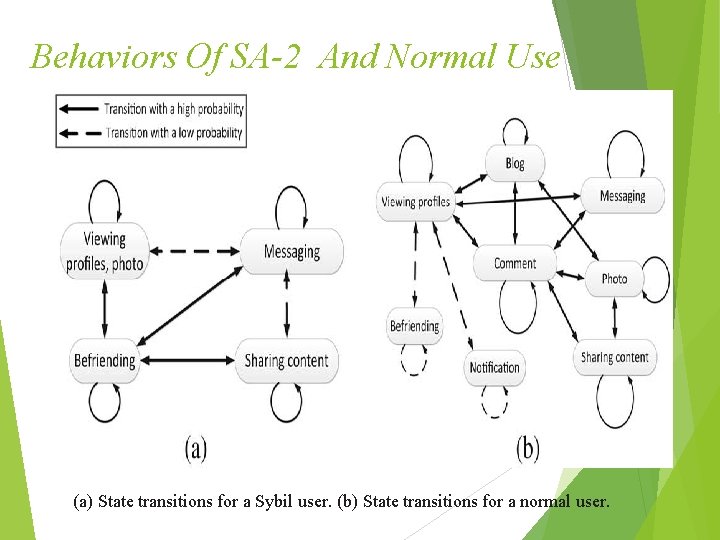
Behaviors Of SA-2 And Normal Use (a) State transitions for a Sybil user. (b) State transitions for a normal user.
SA-3 Sybil Attacks SA-3 Sybil attackers are centered in mobile networks (i. e. , mobile domain). The primary goal of SA-3 is similar to that of SA-2. However, the impact of SA-3 may be in a local area or within a short period. Due to the dynamics of mobile networks, mobile users cannot keep connections with others for the long time, or the connections are intermittent.
unlike that in the online system, the social relationships, global social structure, topology, and historical behavior patterns in mobile networks are not easy to obtain for Sybil defense toward SA-3. The mobility and lack of global information result in difficulties in SA-3 defense compared with the defense on SA-1 and SA-2. In Table I, we compare all of them
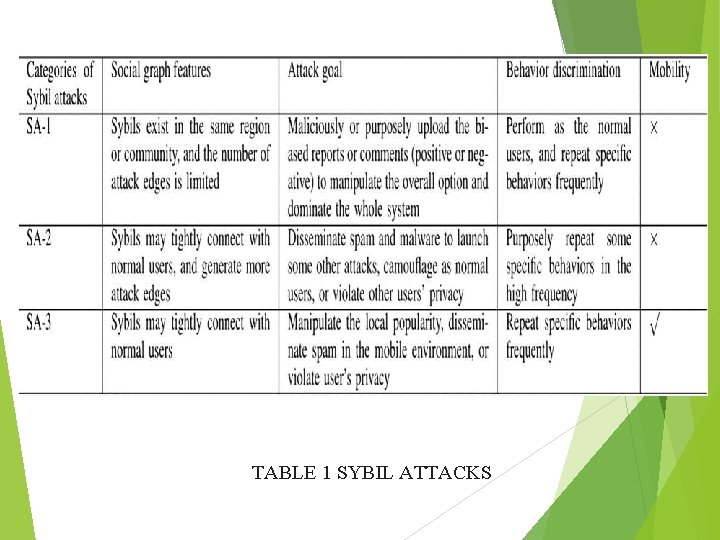
TABLE 1 SYBIL ATTACKS
Social Graph-based Sybil Detection (SGSD ) SGSD is to enable the known honest node H to either label any other node S as “Sybil” or “honest, ” or Detect SA-1 according to community detection. Types of SGSD: v Social network-based Sybil detection (SNSD) v social community-based detection (SCSD)
Social Network-Based Sybil Defense SNSD is a kind of Sybil defenses based on “social network, ” which is a social structure linking social relationships among nodes. term “social network” indicates the user’s social graph and structure, which can reflect user’s social relationships and the social trustworthiness among users
Social Network-Based Sybil Defense Assumption 1 There are two assumptions that describe the relations between social graph nodes are adapted by the authors. Assumption 1: Although the Sybil nodes can tightly connect with other Sybil ones, the number of social connections among Sybil nodes and honest ones is limited.
Famous SNSD Schemes Sybil. Guard v v partition the whole social graph into honest regions and Sybil one which contains Sybil nodes within it. Sybil. Guard relies on the assumption 1 Operational scenario: Each node detects the Sybil one in a distributed manner. Specifically, a node with degree R generates totally R random routes starting from itself along its edges with a fixed length L. If a route reaches a known honest node, it is verified by this known honest node.
Operation Scenario (con. . ) Particularly, a Sybil node S may be accepted as a verified one (i. e. , the route from S to H is called verifier) if one of the routes from S reaches the known honest node V. Then, given a threshold T <= R, S could be accepted as an honest node when more than T routes from S are verified. With Assumption 1, the limited number of attack edges makes the number of verifiers greater than T if T is properly selected.
Sybil. Limit In Sybil. Limit, each node generates R radom routes with length L =Theta(log n). Using the random walk algorithm , the Sybil or honest nodes can be determined which is similar to Sybil. Guard. Different from Sybil. Guard: Sybil. Limit leverages the intersections on edges instead of vertex (node), and performs short random routes with multiple independent instances of random walk.
Properties of Social Structures To understand the properties of social structures, we need to investigate several structural properties of social graph: popularity distribution small world property clustering coefficient conductance
More SNSD schems … Sybil. Fence: leverages users’ negative feedbacks on Sybil attackers and adjusts the edge weight in the social graph. For example: if a user ui receives negative comments from others, u’s edge weights are reduced correspondingly.
More SNSD schemes with directed social graph Sum. Up : It is an SNSD scheme for the vote aggregation problem in an online content rating system. also relies on credit network Sum. Up leverages online user’s voting history in order to restrict the attacker’s voting capability if he continuously misbehaves. In Sum. Up, a trusted node computes a set of maxflow paths on the trusted graph and then aggregates the votes. It allows the votes from the trusted users to be effectively aggregated, whereas limits the votes from untrusted users.
Social Community-Based Sybil Detection SCSD explores social community detection to facilitate Sybil detection. social community detection algorithms is used to detect first analyze the SNSD schemes and summarizes them to a ranking problem. Since the SNSD schemes usually partition Sybil nodes and honest ones into two parts: Sybil region and honest one, these would be viewed as a graph partitioning problem. For these SNSD schemes, each unknown node is ranked according to its social connections with the known trusted nodes.
Problem with social network partiton problem comes out: if a node slightly connects with the current known trusted nodes, it is more likely to be detected as a Sybil node no matter how tightly it connects with other unknown trusted nodes. Therefore, leveraging community detection to detect Sybil nodes becomes promising and could enhance the Sybil detection accuracy.
Sybil. Defender is a typical SCSD scheme, which relies on performing a limited number of random walks for Sybil identification and community detection. Sybil identification can detect whether a node is Sybil or not, similar to the existing SNSD schemes. After the Sybil identification, a community detection algorithm is adopted to detect the neighboring Sybil nodes around the detected Sybil one.
Con … Sybil. Defender also includes a mechanism to limit the number of attack edges. This attack edge limiting mechanism enables users to rate their friend’s relationships as “Friend” or “Stranger”. The attack edges could be further removed since Sybil attackers are probably “Stranger” from the view of normal users. Note: Sybil. Shield relies on Assumption 1
Sybil. Shield leverages trust relationships among users to form the social graph. However, due to the fact that two honest nodes belonging to the two different social communities may not tightly connect with each Other. Sybil. Shield exploits the agents and ensures the honest nodes tightly connect with other honest ones. The first random walk is adopted as Sybil. Guard. Then, some agents of a verifier are selected to run a second round of random walk, called agent walk. where the agents traverse all of the verifier’s edges to confirm the suspect nodes. Sybil. Shield relies on Assumption 2.
Assumption 2: Sybil nodes cannot tightly connect with honest nodes in the multiple honest communities since honest nodes would not trust Sybil ones. Honest nodes can tightly inter-connect with others in the honest community.
Vote. Trust It is a novel SCSD scheme, leverages a trustbased vote assignment, and global vote aggregation to estimate the probability of a Sybil attacker. Vote. Trust combines the social graph structure and user’s feedback (accept or reject friend requests) to establish a directed graph. It bases on an assumption that the Sybil users cannot receive more than a certain number of friend requests from normal users

Con … The global aggregation of the votes for every node can be used to estimate its global rating. With this two-way (voting and feedback) mechanism (e. g. , in a directed graph), Sybil detection would be more effective compared others schemes.
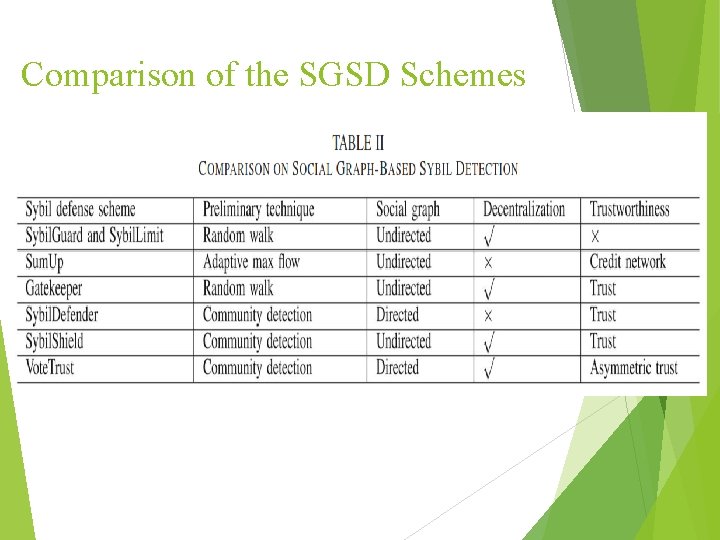
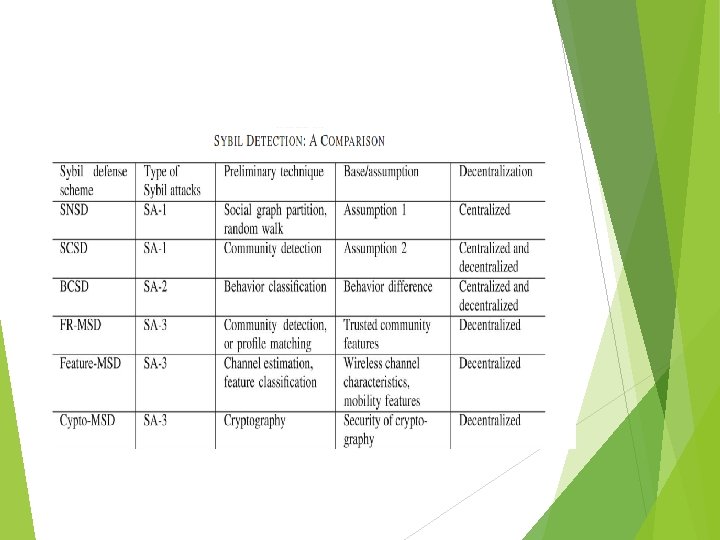
Comparison of the SGSD Schemes
Behavior Classification-based Sybil Detection (BCSD) Sybil users in Ren, a popular OSN in China, can generate an exponential number of social connections with the normal (or honest) users. it shows that the Sybil users rarely establish social connections with other Sybil users in Ren. Therefore, only relying on the SGSD schemes cannot effectively detect Sybil attacks since Assumptions 1 and 2 may not always hold. Therefore, some novel Sybil
Con … We need to investigate the OSN user’s browsing and clicking habits, and differentiate the Sybil users by comparing their abnormal behaviors with the normal users.
Basic behavior of OSN user 1. 2. 3. 1. 2. the primary activities of Sybil users are: friending (especially, sending friend requests) Viewing photos and profiles of others sharing contents with others. On the contrary, the normal users: pend a large portion of time to view photo. perform other activities, such as viewing profiles, sending messages, sharing contents with a similar frequency
Con … Both Sybils and normal users share content or send messages at similar frequencies. Note that sharing content or sending messages are the common approaches for Sybils to disseminate spam in OSNs. This observation indicates that the traditional spam detection schemes cannot simply leverage numeric thresholds to resist spam.
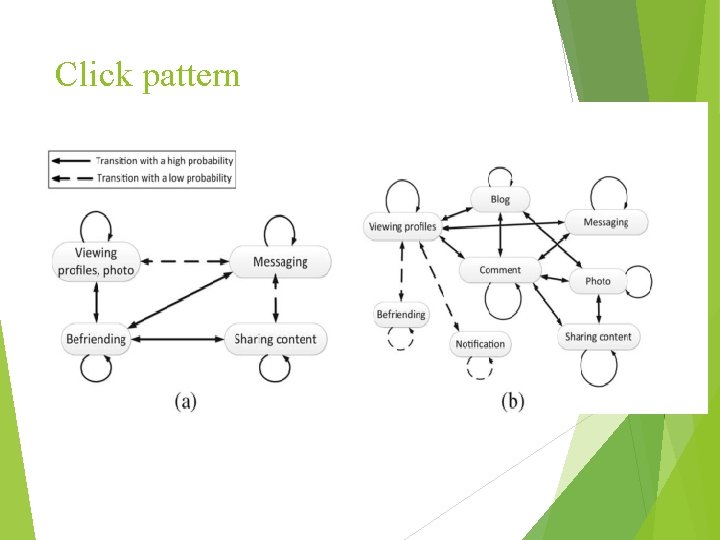
Click pattern
From Fig above, the click transitions could be modeled by Markov chain with each state as a click pattern. Normal users usually perform diverse OSN behaviors, and the transitions among states are really complicated the Sybil users are involved in some specific activities in a high frequency.
Distributed Sybil detection scheme With crowds and social Turing tests, Sybil detection scheme significantly improves the detection accuracy. For a Sybil attacker, he cannot pass “social Turing test” with different attack strategies. Furthermore, crowdsourcing provides an adaptive platform for normal users (e. g. , “turker”) to complete the Sybil profile detection with a reasonable cost.
More BCSD schemes Dsybil: exploits the heavy-tail distribution of the classical voting behavior from the honest users to detect Sybil identities. In summary, these BCSD schemes can detect SA-2 according to the user’s behavior learning and classification.
If Sybil attackers are familiar with the normal user’s click patterns or habits, i. e. , Sybil attackers could truly mimic the normal users, the BCSD cannot effectively detect them as well. However, it is obvious that Sybil attackers have to consume a large portion of time to mimic the normal users so that the attack behaviors are partially limited.
Mobile Sybil Defense (MSD) Without the global social graph for Sybil detection, MSD aims to either detect SA-3 or restrict Sybil attacker’s behaviors. MSD types are: Ø Friend Relationship-Based Sybil Detection (FRSD) Ø Cryptography-Based Mobile Sybil Detection Ø Feature-Based Mobile Sybil Detection
Friend Relationship-Based Sybil Detection (FRSD) MSD scheme works to match mobile user’s communities and label the users from the Sybil community as Sybil attackers. one assumption is that each mobile maintains two lists: friend list containing the trusted mobile users, and foe list with the untrusted users in it. When two users are encountered in the network, they match their communities. If a user is not in the trusted communities, this user would be considered as a Sybil user. FR-MSD schemes requires mobile users to maintain the trusted community information in advance.
Cryptography-Based Mobile Sybil Detection (crypto-MSD) VANET: is one kind of the internet of vehicles, characterized by the high-speed mobility. When Sybil attacks are launched VANET, an added challenge in detecting SA-3 is the mobility that makes it increasingly difficult. LSR scheme is proposed to resist local Sybil attackers and mitigate zero-day Sybil vulnerability in sparse and privacy preserving VANET. The local vehicle users are not capable to effectively detect Sybil attackers before they are revoked.
Con … every user ui should sign on the event that ui posts. Using group signature if a user signs on the same event for multiple times (e. g. , more than one), these signatures may be invalid. Then, the user can be simply linked by other users and detected as Sybil attackers
Con … Since the pseudonym techniques are widely applied in wireless and mobile networks, there are two sides to the pseudonyms: Ø on one hand, the pseudonym can protect legitimate user’s real identity from being identified and linked; Ø on the other hand, the use of pseudonymous identities may hinder the Sybil detection since it is quite difficult to trace the Sybil identities
Feature-Based Mobile Sybil Detection Some specific features, such as channel characteristics, and mobility features, in mobile networks, could be investigated to classify Sybil attackers and normal users. For xample, in a typical wireless network, channel features are studied to effectively detect Sybil attackers.
Mobility is an important characteristic of mobile network, and can be adopted to detect Sybil attackers in the mobile environment. In the mobile ad hoc network, the Sybil identities related to a single Sybil attacker are bound to a single physical node. In other words, a large number of Sybil identities move together. By monitoring the user’s mobility, Sybil identities can be detected.
Research Challenges In this section, they present some research challenges and potential solutions on Sybil defense. Sybil Defense in MSNs Privacy and Sybil Defense Cooperative Sybil Defense
Sybil Defense in MSNs They cannot effectively detect Sybil attackers due to the lack of global social graph or historical behaviors for detection schemes to learn. Furthermore, the traceability on the detected Sybil attackers may not be guaranteed due to the dynamic mobility of MSN users. Unlike OSNs, the social structure in MSNs is hard to obtain due to the dynamically changing network topology and privacy concerns, as depicted in Table IV. The existing MSD schemes can either partially differentiate Sybil attackers and normal users, or design some cryptographic schemes, i. e. , group signature, to constrain Sybil attacker’s behaviors.
Privacy and Sybil Defense It is critical to address the privacy leakage during Sybil defense, especially in a mobile environment. For example, when the contact information is used to detect SA-3, user’s contact history might be disclosed to others, including mobile users and Sybil attackers
Con. . encryption, i. e. , homomorphic encryption, it is possible to hide the real information in the ciphertext and enable addition or multiplication operations on the ciphertexts. However, th computation and communication overheads have to be dramatically increased, especially in a mobile environment where
Cooperative Sybil Defense Due to the lack of sufficient knowledge or the capability of users, Sybil defense may be ineffective and inefficient in some scenarios. For example, in a mobile network, mobile user’s capability is not as powerful as that on the server side, or even weak compared with online users.
Con. . The centralized servers would be an assistance to process the complicated operations, such as user behavior learning, social graph or community detection. The servers could take the advantages of the computation and storage capability and confirm the Sybil detection from mobile users.
Conclusion They have provided a survey of Sybil attacks and their defense schemes in Io. T. Specifically, they have defined three types of Sybil attacks in the distributed Io. T and presented some Sybil defense schemes with the comparison.
Any question?
- Slides: 62