
Sy NAPSE Phase I Candidate Model HippocampalEntorhinalPrefrontal Decision




- Slides: 23
Sy. NAPSE Phase I Candidate Model Hippocampal-Entorhinal-Prefrontal Decision Making HRL 0011 -09 -C-001 Computational Neuroscience, Vision and Acoustic Systems HRL Labs, Malibu, June 17 -18, 2010 Phil Goodman 1, 2 & Mathias Quoy 3 1 Brain Computation Laboratory, School of Medicine, UNR of Computer Science & Engineering, UNR 3 Dept. of Epileptology, University of Bonn, Germany 4 Brain Mind Institute, EPFL, Lausanne, Switzerland 2 Dept.
Contributors Graduate Students Brain models Laurence Jayet Sridhar Reddy Investigators Phil Goodman Mathias Quoy U de Cergy-Pontoise Paris
Outline 1. Biology • Wakeful activity dynamics • Hippocamptal-Prefrontal Short-Term Memory 2. Model Assumptions 3. Equations 4. DARPA Aspects 5. Status/Results
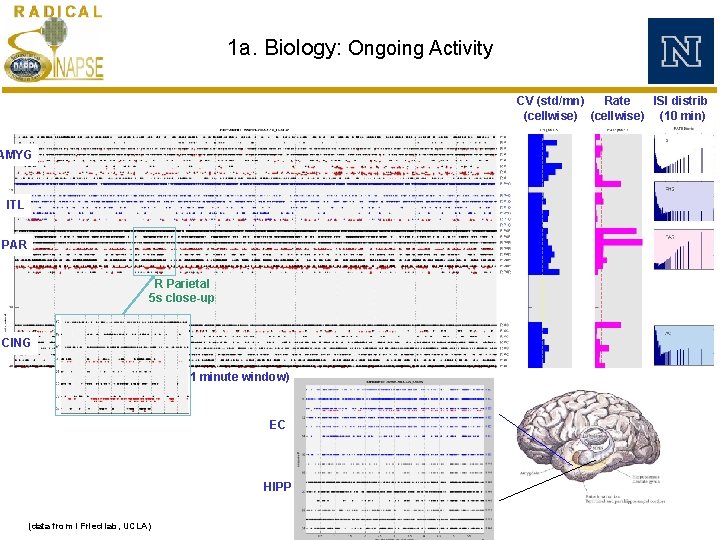
1 a. Biology: Ongoing Activity CV (std/mn) Rate ISI distrib (cellwise) (10 min) AMYG ITL PAR R Parietal 5 s close-up CING (1 minute window) EC HIPP (data from I Fried lab, UCLA)
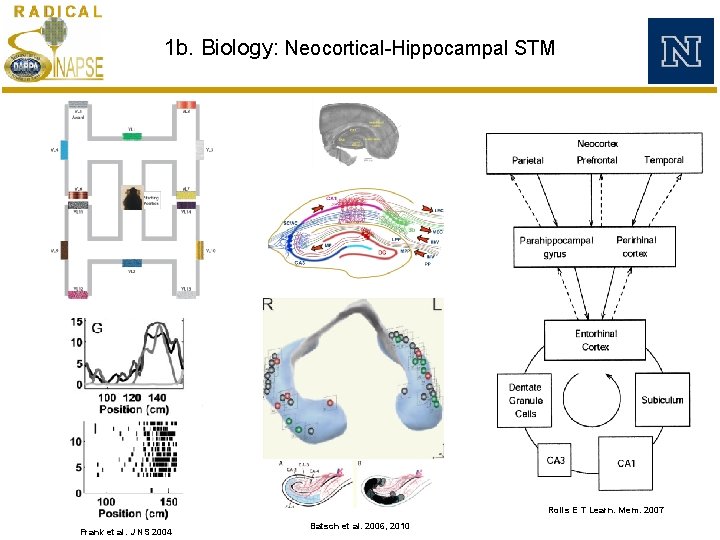
1 b. Biology: Neocortical-Hippocampal STM Rolls E T Learn. Mem. 2007 Frank et al. J NS 2004 Batsch et al. 2006, 2010
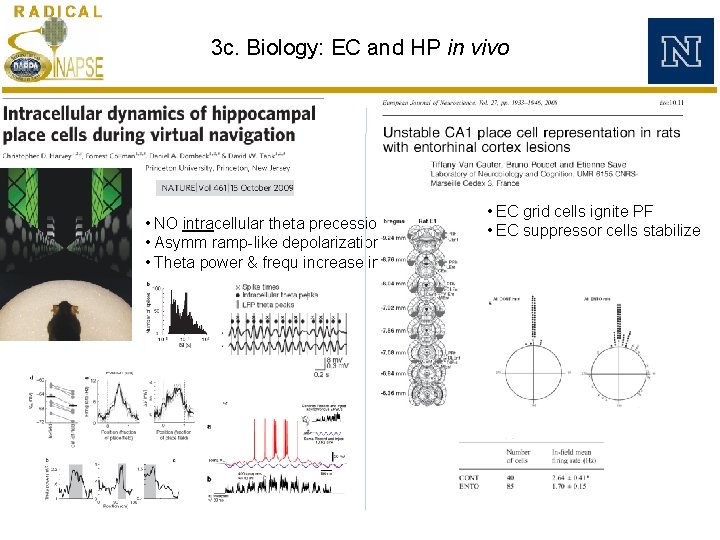
3 c. Biology: EC and HP in vivo • NO intracellular theta precession • Asymm ramp-like depolarization • Theta power & frequ increase in PF • EC grid cells ignite PF • EC suppressor cells stabilize
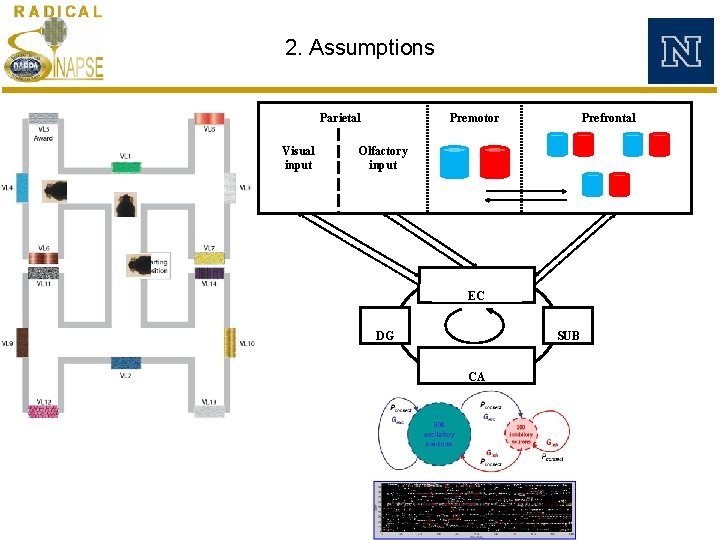
2. Assumptions Parietal Visual input Premotor Prefrontal Olfactory input EC DG SUB CA
RAIN Activity
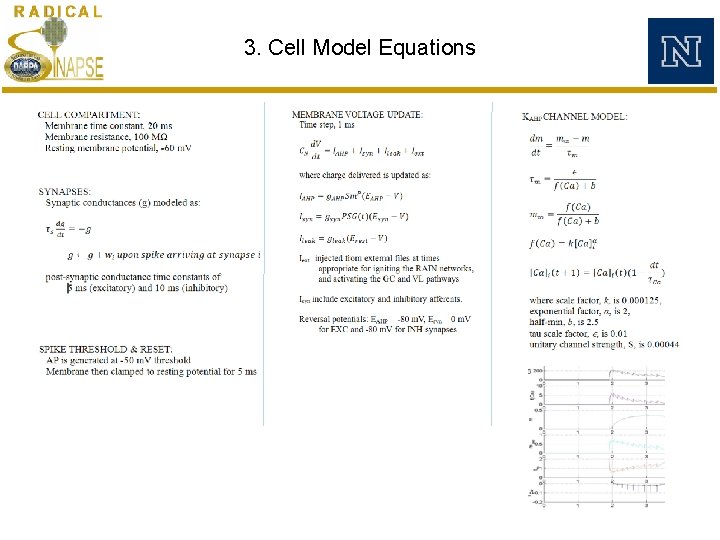
3. Cell Model Equations
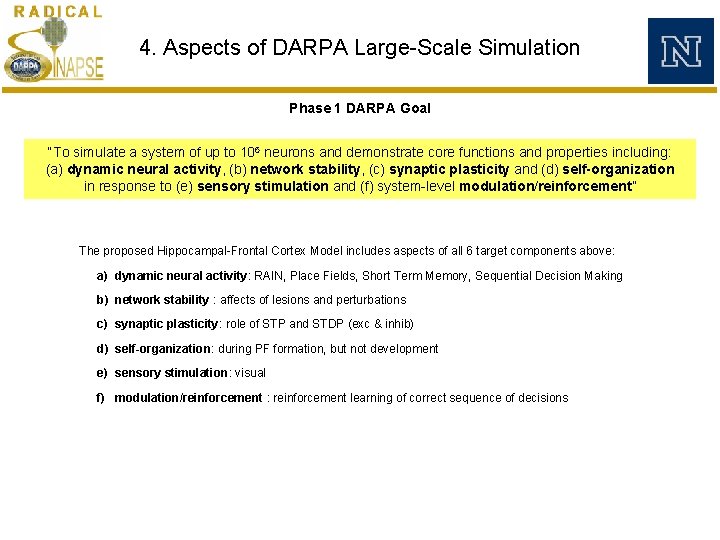
4. Aspects of DARPA Large-Scale Simulation Phase 1 DARPA Goal “To simulate a system of up to 106 neurons and demonstrate core functions and properties including: (a) dynamic neural activity, (b) network stability, (c) synaptic plasticity and (d) self-organization in response to (e) sensory stimulation and (f) system-level modulation/reinforcement” The proposed Hippocampal-Frontal Cortex Model includes aspects of all 6 target components above: a) dynamic neural activity: RAIN, Place Fields, Short Term Memory, Sequential Decision Making b) network stability : affects of lesions and perturbations c) synaptic plasticity: role of STP and STDP (exc & inhib) d) self-organization: during PF formation, but not development e) sensory stimulation: visual f) modulation/reinforcement : reinforcement learning of correct sequence of decisions
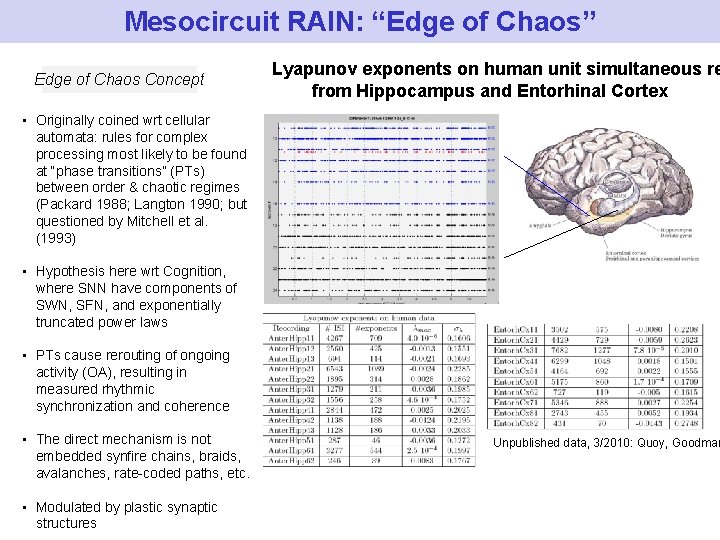
Mesocircuit RAIN: “Edge of Chaos” Edge of Chaos Concept Lyapunov exponents on human unit simultaneous re from Hippocampus and Entorhinal Cortex • Originally coined wrt cellular automata: rules for complex processing most likely to be found at “phase transitions” (PTs) between order & chaotic regimes (Packard 1988; Langton 1990; but questioned by Mitchell et al. (1993) • Hypothesis here wrt Cognition, where SNN have components of SWN, SFN, and exponentially truncated power laws • PTs cause rerouting of ongoing activity (OA), resulting in measured rhythmic synchronization and coherence • The direct mechanism is not embedded synfire chains, braids, avalanches, rate-coded paths, etc. • Modulated by plastic synaptic structures Unpublished data, 3/2010: Quoy, Goodman
Early Results A Circuit-Level Model of Hippocampal Place Field Dynamics Modulated by Entorhinal Grid and Suppression-Generating Cells Laurence C. Jayet 1*, and Mathias Quoy 2, Philip H. Goodman 1 1 University of Nevada, Reno 2 Université de Cergy-Pontoise, Paris Explained findings of Harvey et al. (2009) Nature 461: 941 • NO intracellular theta precession • Asymm ramp-like depolarization • Theta power & frequ increase in PF Explained findings of Van Cauter et al. (2008) EJNeurosci 17: 1933 • EC grid cells ignite PF • EC suppressor cells stabilize w/o Kahp channels EC lesion
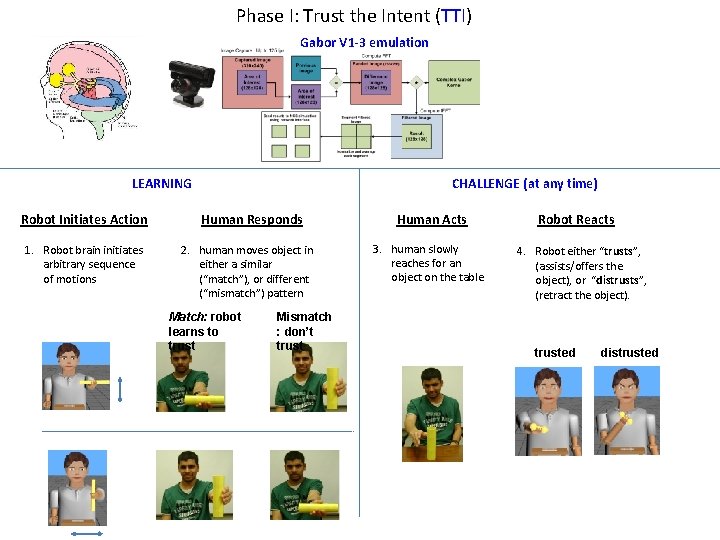
Phase I: Trust the Intent (TTI) Gabor V 1 -3 emulation CHALLENGE (at any time) LEARNING Robot Initiates Action 1. Robot brain initiates arbitrary sequence of motions Human Responds 2. human moves object in either a similar (“match”), or different (“mismatch”) pattern Match: robot learns to trust Mismatch : don’t trust Human Acts 3. human slowly reaches for an object on the table Robot Reacts 4. Robot either “trusts”, (assists/offers the object), or “distrusts”, (retract the object). trusted distrusted
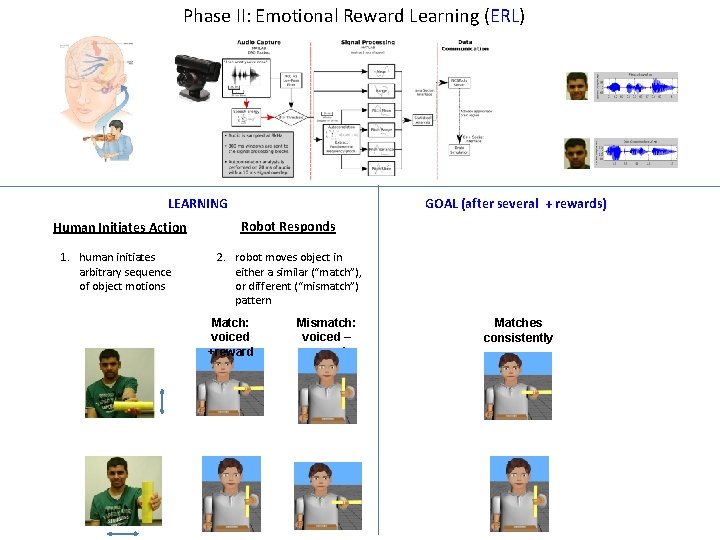
Phase II: Emotional Reward Learning (ERL) LEARNING Human Initiates Action 1. human initiates arbitrary sequence of object motions GOAL (after several + rewards) Robot Responds 2. robot moves object in either a similar (“match”), or different (“mismatch”) pattern Match: voiced +reward Mismatch: voiced – reward Matches consistently
Early ITI Results Discordant > Distrust Concordant > Trust mean synaptic strength
The Quad at UNR
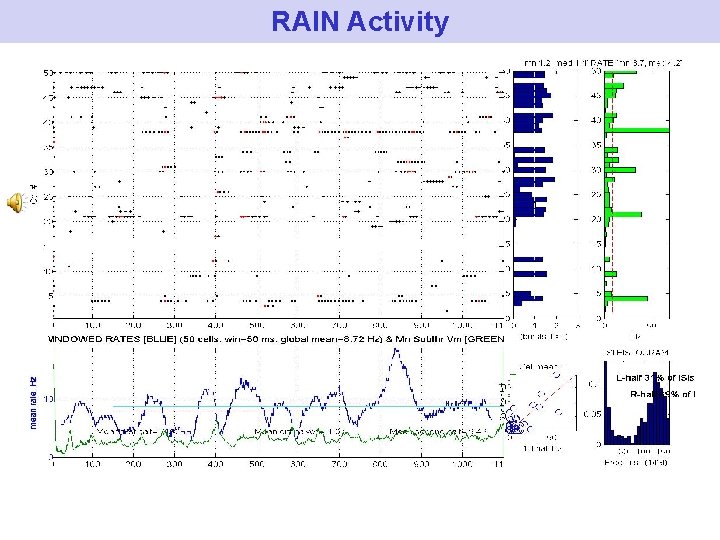
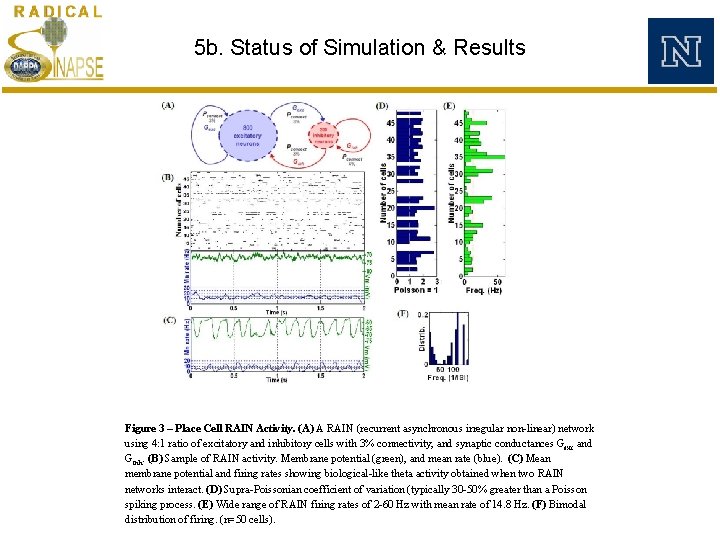
5 b. Status of Simulation & Results Figure 3 – Place Cell RAIN Activity. (A) A RAIN (recurrent asynchronous irregular non-linear) network using 4: 1 ratio of excitatory and inhibitory cells with 3% connectivity, and synaptic conductances Gexc and Ginh. (B) Sample of RAIN activity. Membrane potential (green), and mean rate (blue). (C) Mean membrane potential and firing rates showing biological-like theta activity obtained when two RAIN networks interact. (D) Supra-Poissonian coefficient of variation (typically 30 -50% greater than a Poisson spiking process. (E) Wide range of RAIN firing rates of 2 -60 Hz with mean rate of 14. 8 Hz. (F) Bimodal distribution of firing. (n=50 cells).
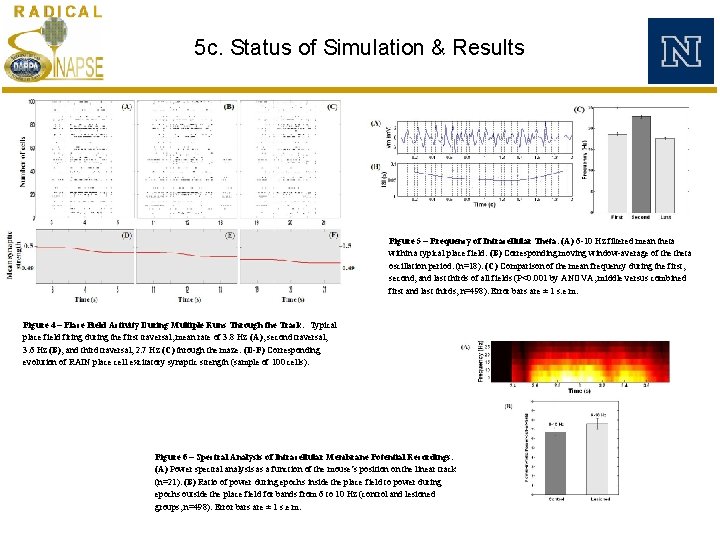
5 c. Status of Simulation & Results Figure 5 – Frequency of Intracellular Theta. (A) 6 -10 Hz filtered mean theta within a typical place field. (B) Corresponding moving window-average of theta oscillation period. (n=18). (C) Comparison of the mean frequency during the first, second, and last thirds of all fields (P<0. 001 by ANOVA, middle versus combined first and last thirds, n=498). Error bars are ± 1 s. e. m. Figure 4 – Place Field Activity During Multiple Runs Through the Track. Typical place field firing during the first traversal, mean rate of 3. 8 Hz (A), second traversal, 3. 6 Hz (B), and third traversal, 2. 7 Hz (C) through the maze. (D-F) Corresponding evolution of RAIN place cell excitatory synaptic strength (sample of 100 cells). Figure 6 – Spectral Analysis of Intracellular Membrane Potential Recordings. (A) Power spectral analysis as a function of the mouse’s position on the linear track (n=21). (B) Ratio of power during epochs inside the place field to power during epochs outside the place field for bands from 6 to 10 Hz (control and lesioned groups, n=498). Error bars are ± 1 s. e. m.
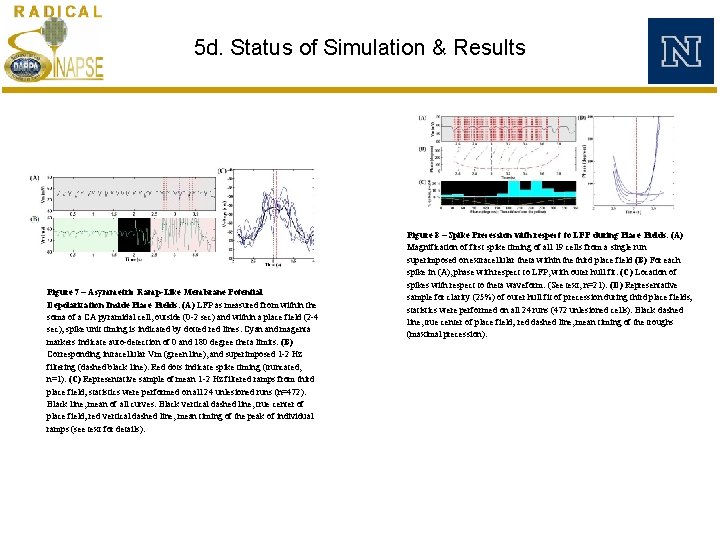
5 d. Status of Simulation & Results Figure 7 – Asymmetric Ramp-Like Membrane Potential Depolarization Inside Place Fields. (A) LFP as measured from within the soma of a CA pyramidal cell, outside (0 -2 sec) and within a place field (2 -4 sec); spike unit timing is indicated by dotted red lines. Cyan and magenta markers indicate auto-detection of 0 and 180 degree theta limits. (B) Corresponding intracellular Vm (green line), and superimposed 1 -2 Hz filtering (dashed black line). Red dots indicate spike timing (truncated, n=1). (C) Representative sample of mean 1 -2 Hz filtered ramps from third place field; statistics were performed on all 24 unlesioned runs (n=472). Black line, mean of all curves. Black vertical dashed line, true center of place field; red vertical dashed line, mean timing of the peak of individual ramps (see text for details). Figure 8 – Spike Precession with respect to LFP during Place Fields. (A) Magnification of first spike timing of all 19 cells from a single run superimposed on extracellular theta within the third place field (B) For each spike in (A), phase with respect to LFP, with outer hull fit. (C) Location of spikes with respect to theta waveform. (See text, n=21). (D) Representative sample for clarity (25%) of outer hull fit of precession during third place fields; statistics were performed on all 24 runs (472 unlesioned cells). Black dashed line, true center of place field; red dashed line, mean timing of the troughs (maximal precession).
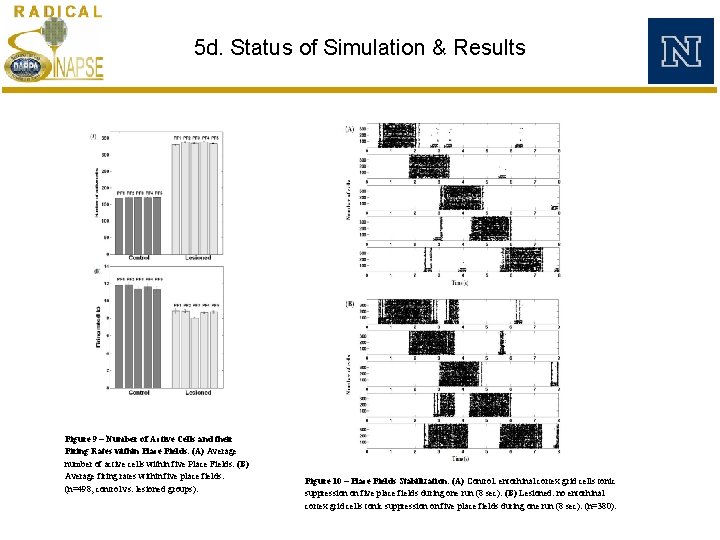
5 d. Status of Simulation & Results Figure 9 – Number of Active Cells and their Firing Rates within Place Fields. (A) Average number of active cells within five Place Fields. (B) Average firing rates within five place fields. (n=498, control vs. lesioned groups). Figure 10 – Place Fields Stabilization. (A) Control: entorhinal cortex grid cells tonic suppression on five place fields during one run (8 sec). (B) Lesioned: no entorhinal cortex grid cells tonic suppression on five place fields during one run (8 sec). (n=380).
6. Challenges & Issues
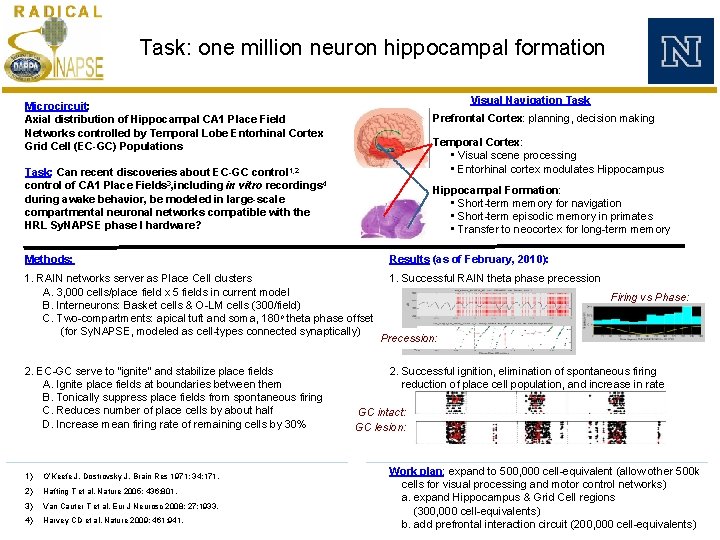
Task: one million neuron hippocampal formation Visual Navigation Task Microcircuit: Axial distribution of Hippocampal CA 1 Place Field Networks controlled by Temporal Lobe Entorhinal Cortex Grid Cell (EC-GC) Populations Prefrontal Cortex: planning, decision making Temporal Cortex: • Visual scene processing • Entorhinal cortex modulates Hippocampus Task: Can recent discoveries about EC-GC control 1, 2 control of CA 1 Place Fields 3, including in vitro recordings 4 during awake behavior, be modeled in large-scale compartmental neuronal networks compatible with the HRL Sy. NAPSE phase I hardware? Hippocampal Formation: • Short-term memory for navigation • Short-term episodic memory in primates • Transfer to neocortex for long-term memory Methods: Results (as of February, 2010): 1. RAIN networks server as Place Cell clusters A. 3, 000 cells/place field x 5 fields in current model B. Interneurons: Basket cells & O-LM cells (300/field) C. Two-compartments: apical tuft and soma, 180 o theta phase offset (for Sy. NAPSE, modeled as cell-types connected synaptically) 1. Successful RAIN theta phase precession 2. EC-GC serve to “ignite” and stabilize place fields A. Ignite place fields at boundaries between them B. Tonically suppress place fields from spontaneous firing C. Reduces number of place cells by about half D. Increase mean firing rate of remaining cells by 30% 1) O’Keefe J, Dostrovsky J. Brain Res 1971; 34: 171. 2) Hafting T et al. Nature 2005; 436: 801. 3) Van Cauter T et al. Eur J Neurosc 2008; 27: 1933. 4) Harvey CD et al. Nature 2009; 461: 941. Firing vs Phase: Precession: 2. Successful ignition, elimination of spontaneous firing reduction of place cell population, and increase in rate GC intact: GC lesion: Work plan: expand to 500, 000 cell-equivalent (allow other 500 k cells for visual processing and motor control networks) a. expand Hippocampus & Grid Cell regions (300, 000 cell-equivalents) b. add prefrontal interaction circuit (200, 000 cell-equivalents)
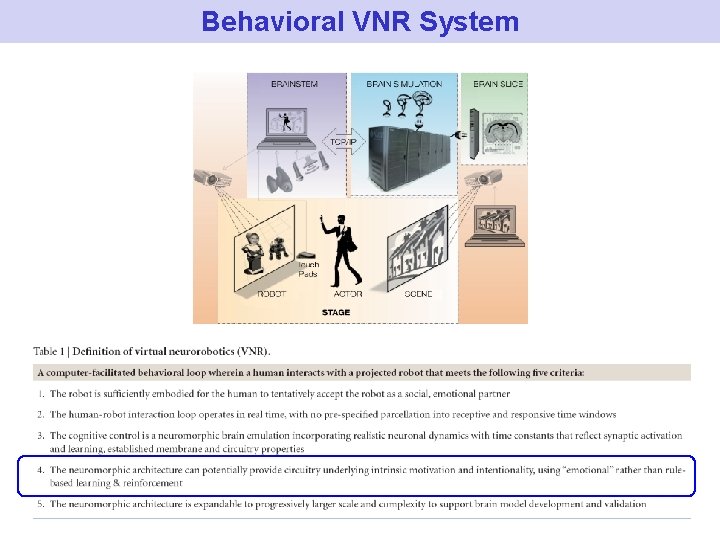
Behavioral VNR System