
SWOT Analysis Click on the speaker symbol on
SWOT Analysis Click on the speaker symbol on each slide To hear the presentation
What is SWOT Analysis • Stands for Strengths, Weaknesses, Opportunities and Threats • A tool to identify and summarize strengths, weaknesses, opportunities and threats of a strategic environment • Tool credited to Albert Humphrey, who led a research project at Stanford University in the 1960’s • Divides factors into internal and external factors and positive and negative influences ( Morrison, 2012)
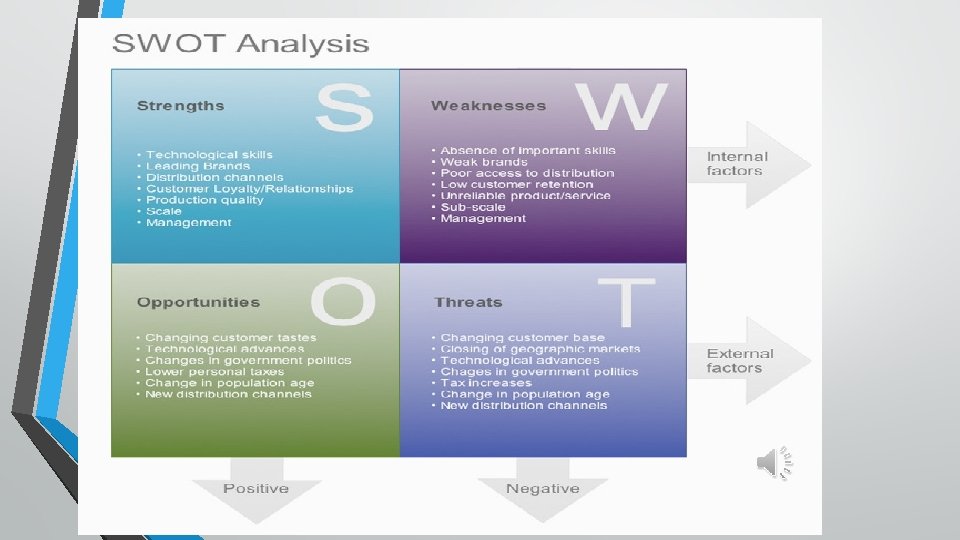
Strengths • Positive tangible and intangible attributes, internal to the organization • Includes capabilities of the organization, staff competencies, financial resources, products and services, goodwill and brand loyalty • Characteristics of the business that give it an advantage over others in the industry • Examples: brand name, high quality scores, employee loyalty, strong physician network
Weaknesses • Any characteristic that is a disadvantage compared to others in the industry • Characteristic or factor that does not meet the standard they should meet • Detract from the ability to reach goals and influence growth • Examples: Limited financial resources, lower quality scores, lower patient perception of care, narrow physician network, aging equipment, weak market image
Opportunities • External attractive factors • Market, competition, technology or industry factors that could be leveraged as a positive growth factor for the organization • Examples: Financial boom for area, growth in market, new industries in region that would supplement business, specialized physician group opening in region
Threats ! • External factors that would cause a problem for the business and place the operation at risk • Any factor that puts the profitability of the organization at risk • Examples: New competitors in the market, changes in governmental regulations, regional economic downturn
How do we conduct a SWOT analysis? • Determine the why – what is the purpose of the analysis • Determine the who – who are the stakeholders that should be involved • Determine the how – Research and information gathering • Determine the where – a non-threatening environment • Compile your list, refine and carry forward in to the strategic planning process
After you have your list • A free form listing of thoughts of strengths, weaknesses, opportunities and threats will be compiled based on brainstorming • This listing must be sorted and items given some priority • Each section should be prioritized and limited to the top four or five factors • The factors in each section can then be used to determine your goals and objectives and the action steps to reach those goals

Thank you
Reference Morrison, M. (2012). History of the SWOT analysis. Retrieved from https: //rapidbi. com/history-of-the-swot-analysis/
- Slides: 11