
Switching Power Supply Component Selection 7 1 a
- Slides: 15
Switching Power Supply Component Selection 7. 1 a Capacitor Selection – Overview
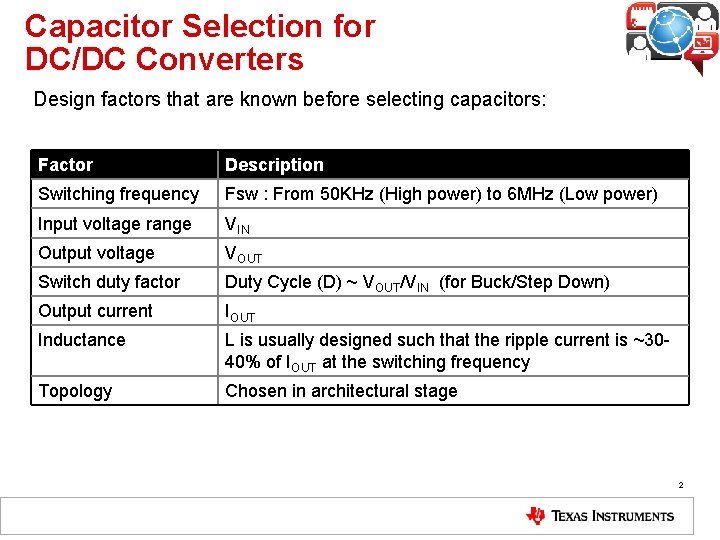
Capacitor Selection for DC/DC Converters Design factors that are known before selecting capacitors: Factor Description Switching frequency Fsw : From 50 KHz (High power) to 6 MHz (Low power) Input voltage range VIN Output voltage VOUT Switch duty factor Duty Cycle (D) ~ VOUT/VIN (for Buck/Step Down) Output current IOUT Inductance L is usually designed such that the ripple current is ~3040% of IOUT at the switching frequency Topology Chosen in architectural stage 2
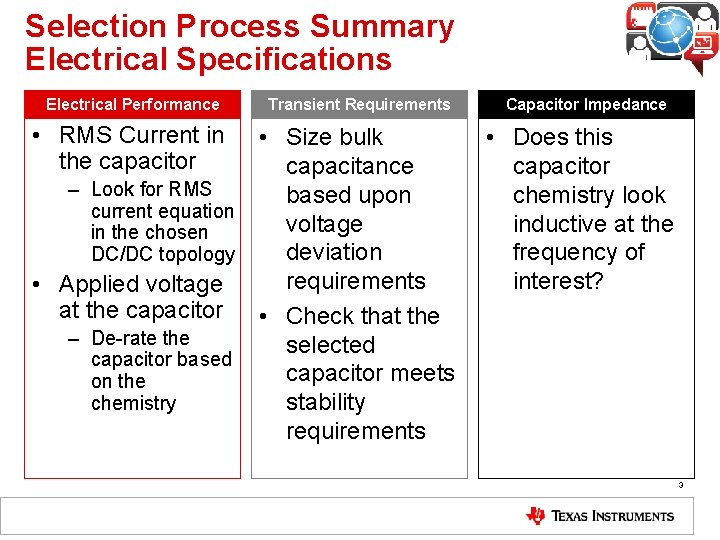
Selection Process Summary Electrical Specifications Electrical Performance • RMS Current in the capacitor Transient Requirements • Size bulk capacitance – Look for RMS based upon current equation voltage in the chosen deviation DC/DC topology requirements • Applied voltage at the capacitor • Check that the – De-rate the selected capacitor based capacitor meets on the chemistry stability requirements Capacitor Impedance • Does this capacitor chemistry look inductive at the frequency of interest? 3
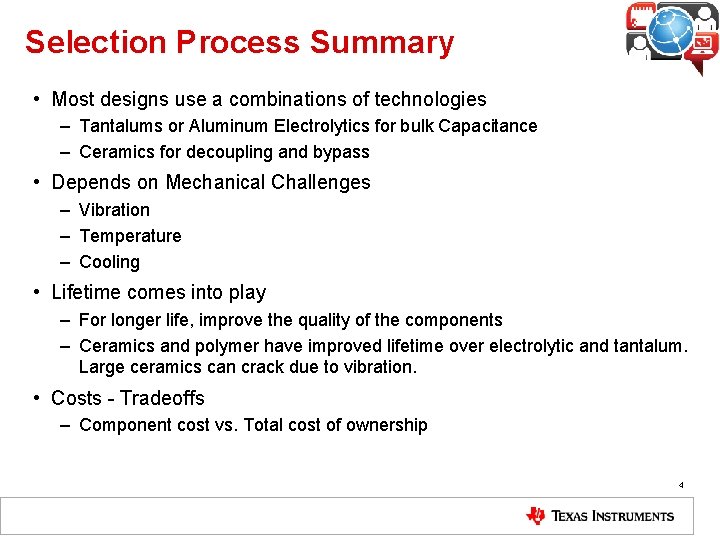
Selection Process Summary • Most designs use a combinations of technologies – Tantalums or Aluminum Electrolytics for bulk Capacitance – Ceramics for decoupling and bypass • Depends on Mechanical Challenges – Vibration – Temperature – Cooling • Lifetime comes into play – For longer life, improve the quality of the components – Ceramics and polymer have improved lifetime over electrolytic and tantalum. Large ceramics can crack due to vibration. • Costs - Tradeoffs – Component cost vs. Total cost of ownership 4
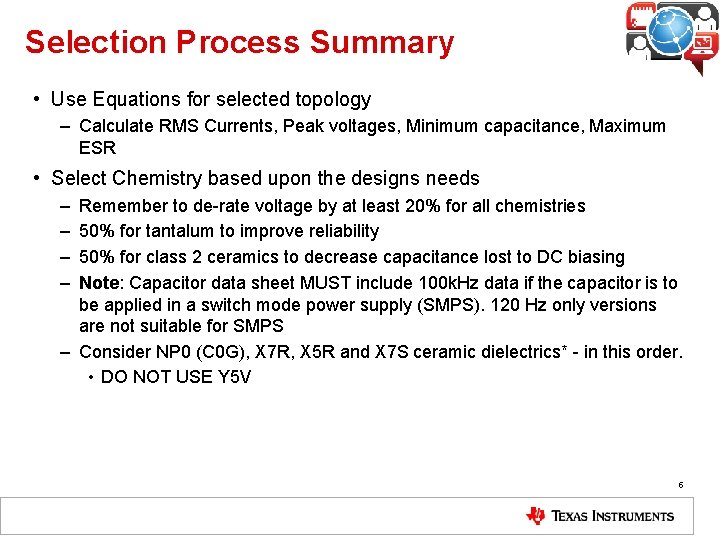
Selection Process Summary • Use Equations for selected topology – Calculate RMS Currents, Peak voltages, Minimum capacitance, Maximum ESR • Select Chemistry based upon the designs needs – – Remember to de-rate voltage by at least 20% for all chemistries 50% for tantalum to improve reliability 50% for class 2 ceramics to decrease capacitance lost to DC biasing Note: Capacitor data sheet MUST include 100 k. Hz data if the capacitor is to be applied in a switch mode power supply (SMPS). 120 Hz only versions are not suitable for SMPS – Consider NP 0 (C 0 G), X 7 R, X 5 R and X 7 S ceramic dielectrics* - in this order. • DO NOT USE Y 5 V 5
Selection Process Summary • Place additional units in parallel if one is not enough – Combine chemistries to benefit from their various advantages • Use polymer, electrolytic and tantalum for bulk • Use Ceramics as your primary decoupling capacitor 6
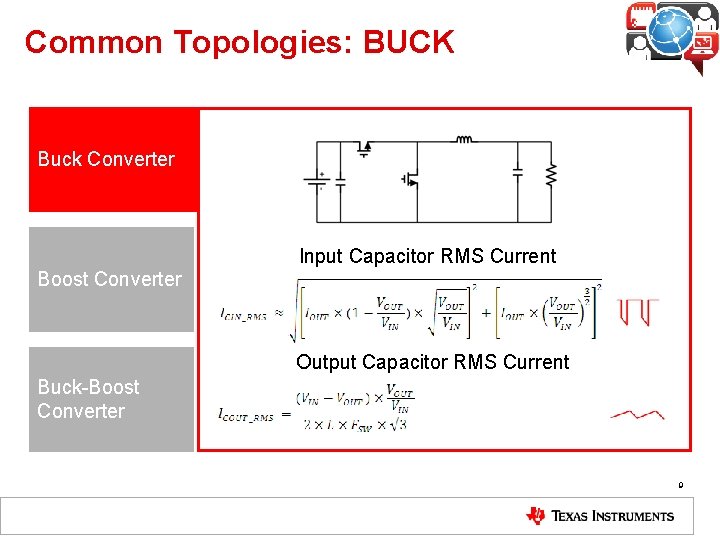
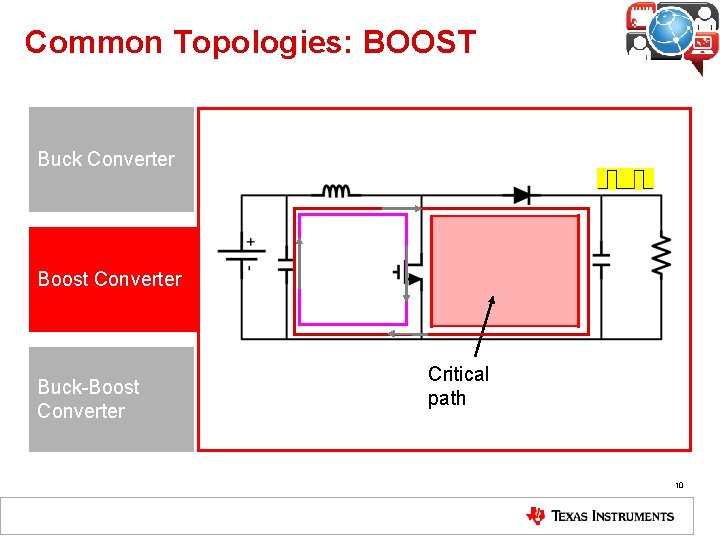
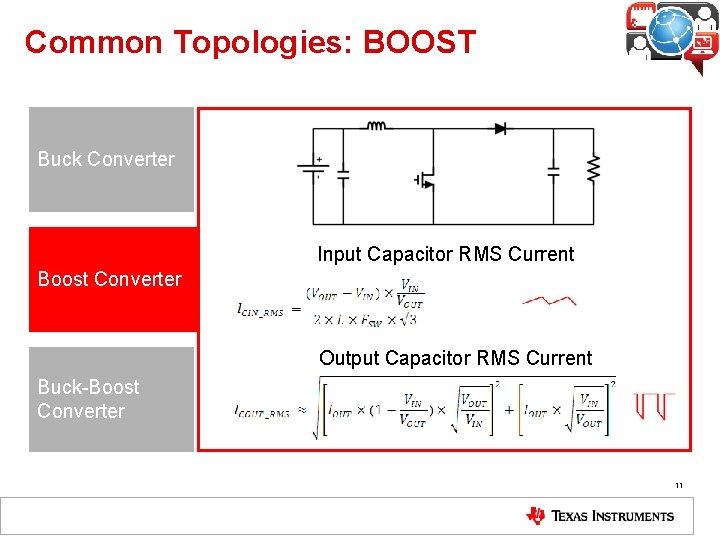
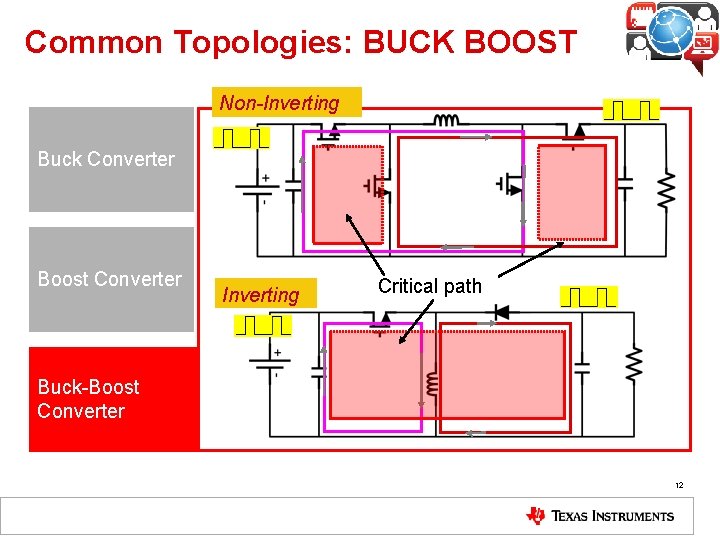
Capacitor RMS Current • RMS current of a capacitor is one of the most important specifications for capacitor reliability • It also effects the converters performance, and varies by topology – Self-Heating: Proportional to RMS Current and Internal Losses – Voltage Ripple: Higher RMS Current leads to larger voltage ripple • Let’s calculate RMS current for different topologies 7
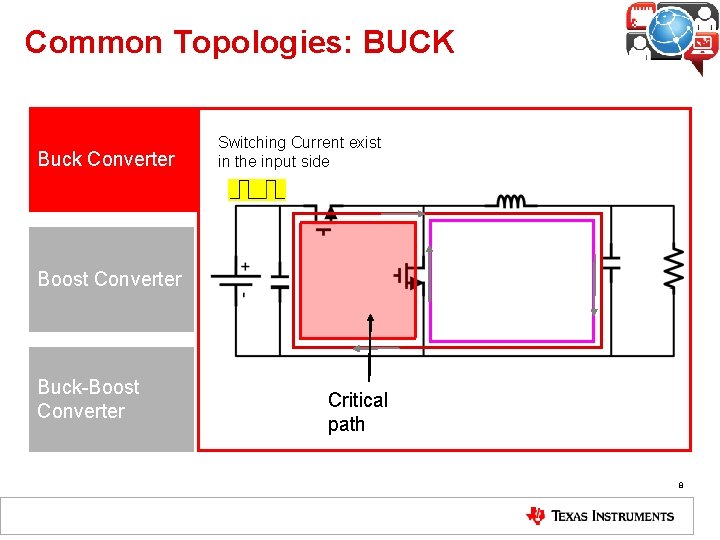
Common Topologies: BUCK Buck Converter Switching Current exist in the input side Boost Converter Buck-Boost Converter Critical path 8
Common Topologies: BUCK Buck Converter Input Capacitor RMS Current Boost Converter Output Capacitor RMS Current Buck-Boost Converter 9
Common Topologies: BOOST Buck Converter Boost Converter Buck-Boost Converter Critical path 10
Common Topologies: BOOST Buck Converter Input Capacitor RMS Current Boost Converter Output Capacitor RMS Current Buck-Boost Converter 11
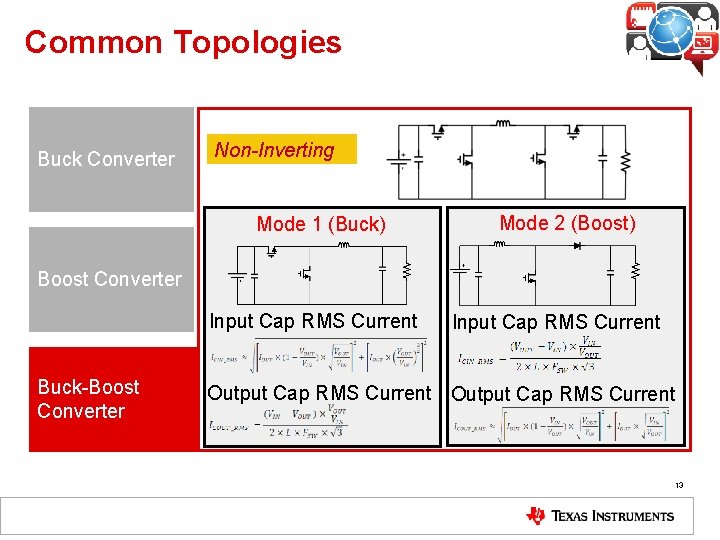
Common Topologies: BUCK BOOST Non-Inverting Buck Converter Boost Converter Inverting Critical path Buck-Boost Converter 12
Common Topologies Buck Converter Non-Inverting Mode 1 (Buck) Mode 2 (Boost) Boost Converter Input Cap RMS Current Buck-Boost Converter Input Cap RMS Current Output Cap RMS Current 13
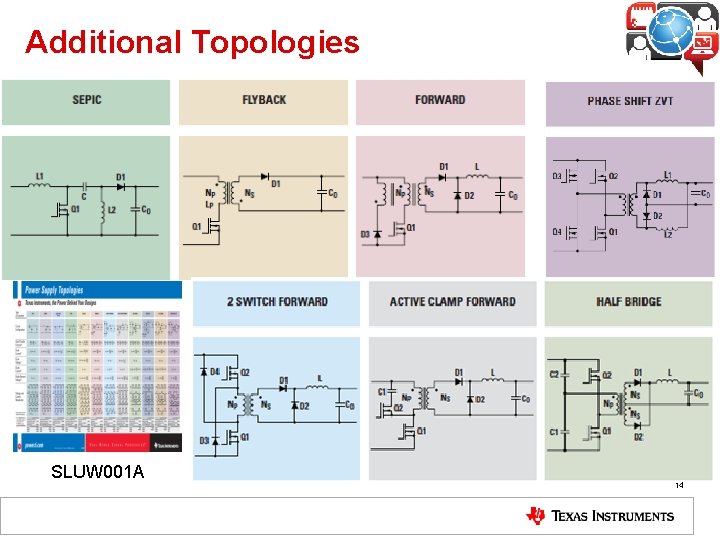
Additional Topologies SLUW 001 A 14
Thank you! 15