
Switching A network consists of many switching devices

- Slides: 10
Switching • A network consists of many switching devices. • In order to connect multiple devices, one solution could be to have a point to point connection in between pair of devices. But this increases the number of connection. • The other solution could be to have a central device and connect every device to each other via the central device which is generally known as Star Topology. • Both these methods are wasteful and impractical for very large network. • The other topology also can not be used at this stage. • Hence a better solution for this situation is SWITCHING. • A switched network is made up of a series of interconnected nodes called switches.
Types of Switching Techniques • There are basically three types of switching methods are made available • Circuit Switching • Packet Switching • Message Switching • Out of three methods, circuit switching and packet switching are commonly used but the message switching has been opposed out in the general communication procedure but is still used in the networking application.
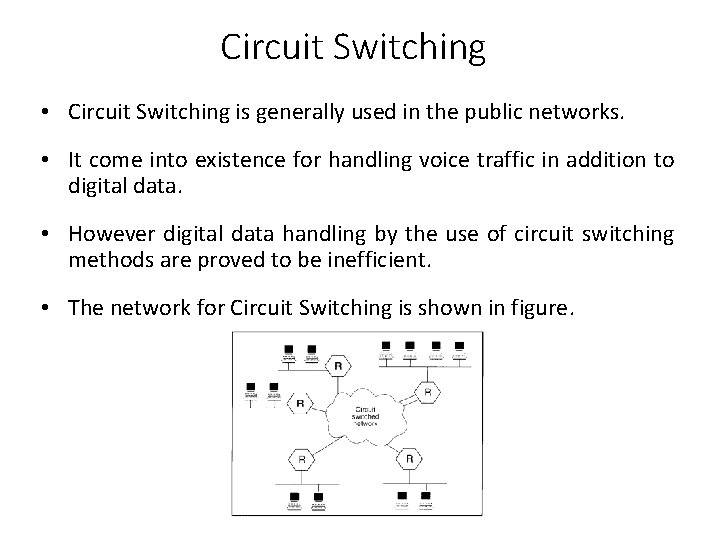
Circuit Switching • Circuit Switching is generally used in the public networks. • It come into existence for handling voice traffic in addition to digital data. • However digital data handling by the use of circuit switching methods are proved to be inefficient. • The network for Circuit Switching is shown in figure.
Circuit Switching • Here the network connection allows the electrical current and the associated voice with it to flow in between the two respective users. • The end to end communication was established during the duration of call. • In circuit switching the routing decision is made when the path is set up across the given network. • After the link has been sets in between the sender and the receiver then the information is forwarded continuously over the provided link. • In Circuit Switching a dedicated link/path is established across the sender and the receiver which is maintained for the entire duration of conversation.
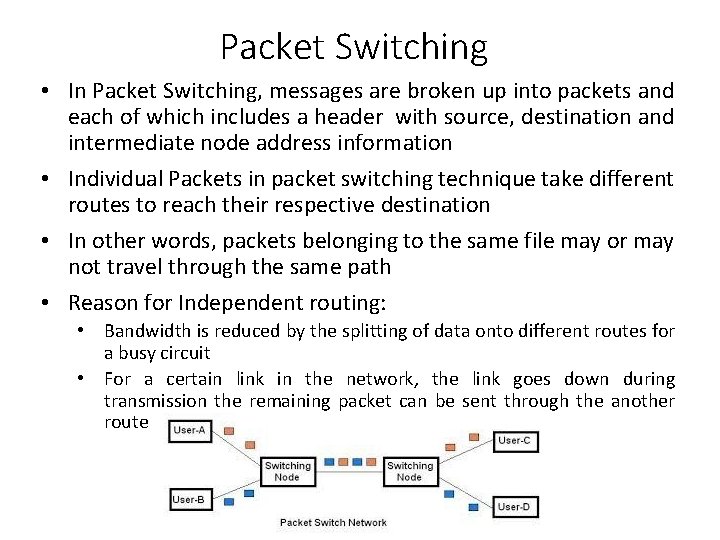
Packet Switching • In Packet Switching, messages are broken up into packets and each of which includes a header with source, destination and intermediate node address information • Individual Packets in packet switching technique take different routes to reach their respective destination • In other words, packets belonging to the same file may or may not travel through the same path • Reason for Independent routing: • Bandwidth is reduced by the splitting of data onto different routes for a busy circuit • For a certain link in the network, the link goes down during transmission the remaining packet can be sent through the another route
Packet Switching • Packet Switching uses Store and Forward technique while switching the packets; while forwarding the packet each hop first store that packet then forward • This technique is very beneficial because packets may get discarded at any hop due to some reason • If there is congestion at some path, packets are allowed to choose different path possible over existing network
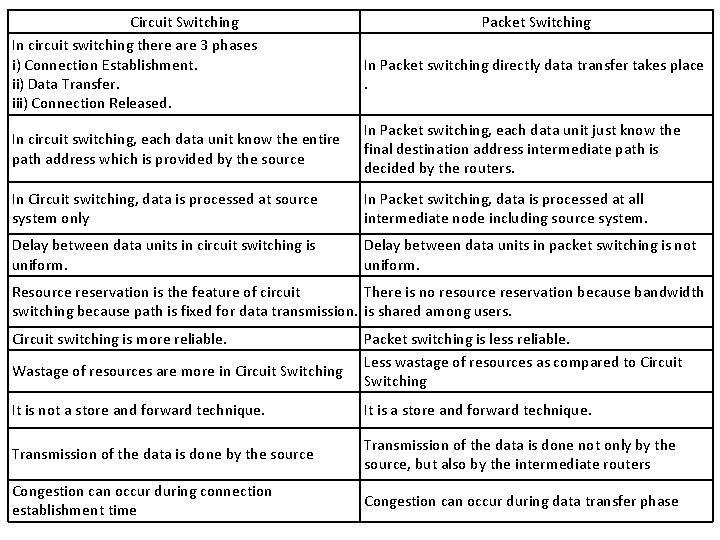
Circuit Switching In circuit switching there are 3 phases i) Connection Establishment. ii) Data Transfer. iii) Connection Released. Packet Switching In Packet switching directly data transfer takes place. In circuit switching, each data unit know the entire path address which is provided by the source In Packet switching, each data unit just know the final destination address intermediate path is decided by the routers. In Circuit switching, data is processed at source system only In Packet switching, data is processed at all intermediate node including source system. Delay between data units in circuit switching is uniform. Delay between data units in packet switching is not uniform. Resource reservation is the feature of circuit There is no resource reservation because bandwidth switching because path is fixed for data transmission. is shared among users. Circuit switching is more reliable. Wastage of resources are more in Circuit Switching Packet switching is less reliable. Less wastage of resources as compared to Circuit Switching It is not a store and forward technique. It is a store and forward technique. Transmission of the data is done by the source Transmission of the data is done not only by the source, but also by the intermediate routers Congestion can occur during connection establishment time Congestion can occur during data transfer phase
Message Switching • Message switching was a technique developed as an alternate to circuit switching, before packet switching was introduced • In message switching, end users communicate by sending and receiving messages that included the entire data to be shared. Messages are the smallest individual unit • Also, the sender and receiver are not directly connected. There a number of intermediate nodes transfer data and ensure that the message reaches its destination • Message switched data networks are hence called hop-by-hop systems
Message Switching • They provide 2 distinct and important characteristics: • Store and forward – The intermediate nodes have the responsibility of transferring the entire message to the next node. Hence, each node must have storage capacity. A message will only be delivered if the next hop and the link connecting it are both available, otherwise it’ll be stored indefinitely. This is called the store-and-forward property. • Message delivery – This implies wrapping the entire information in a single message and transferring it from the source to the destination node. Each message must have a header that contains the message routing information, including the source and destination • Message switching network consists of transmission links (channels), store-andforward switch nodes and end stations as shown in the following picture:
Message Switching Advantages: • Message switching is advantageous as it enables efficient usage of network resources • Also, because of the store-and-forward capability of intermediary nodes, traffic can be efficiently regulated and controlled • Message delivery as one unit, rather than in pieces, is another benefit Disadvantages: • Since messages are stored indefinitely at each intermediate node, switches require large storage capacity • These are pretty slow, because at each node, first the node has to wait till the entire message is received, then it must be stored and transmitted after processing the next node and links to it depending on availability and channel traffic • Hence, message switching cannot be used for real time or interactive applications like video conference