
Swiss Apprenticeship Model An Employer Driven System of
- Slides: 21
Swiss Apprenticeship Model An Employer Driven System of Education & Training
Swiss Profile • 3. 2% unemployment • <4% youth unemployment rate • 8. 2 million population • 580, 000 businesses • 70% of all students choose apprenticeships, no stigma – most CEO's have been apprentices • 40% of companies participate in the program • About 97% of all students have graduated with a VET Diploma (Vocational Education & Training) or other high school degree
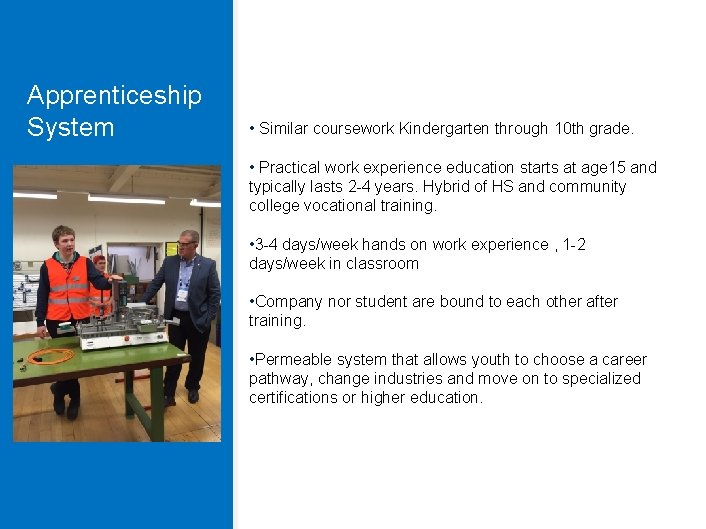
Apprenticeship System • Similar coursework Kindergarten through 10 th grade. • Practical work experience education starts at age 15 and typically lasts 2 -4 years. Hybrid of HS and community college vocational training. • 3 -4 days/week hands on work experience , 1 -2 days/week in classroom • Company nor student are bound to each other after training. • Permeable system that allows youth to choose a career pathway, change industries and move on to specialized certifications or higher education.
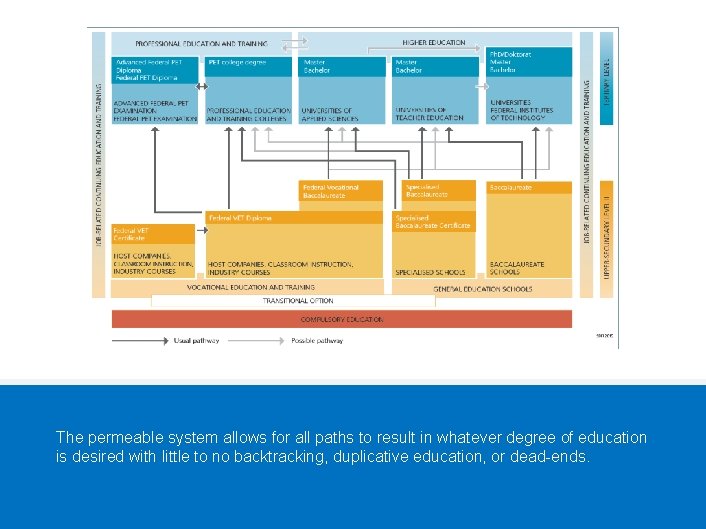
The permeable system allows for all paths to result in whatever degree of education is desired with little to no backtracking, duplicative education, or dead-ends.
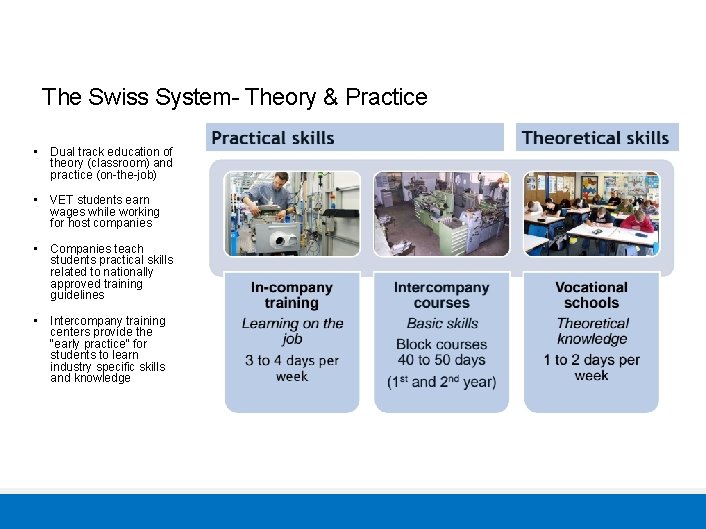
The Swiss System- Theory & Practice • Dual track education of theory (classroom) and practice (on-the-job) • VET students earn wages while working for host companies • Companies teach students practical skills related to nationally approved training guidelines • Intercompany training centers provide the “early practice” for students to learn industry specific skills and knowledge
System Elements • Federal responsibilities: system oversight, apprenticeship accreditation and testing • Cantons (states): Local governments similar to our School Districts that are responsible for running the classroom curriculum and providing career guidance to students • Private Companies: Over 230 approved occupations trained in apprenticeships at over 40% of all companies in Switzerland • Many models for private sector training but most industry clusters belong to an association that provides standardized training approved by both industry and government • Industry Associations include banking & finance, healthcare, technology, transportation, manufacturing, hospitality, etc.
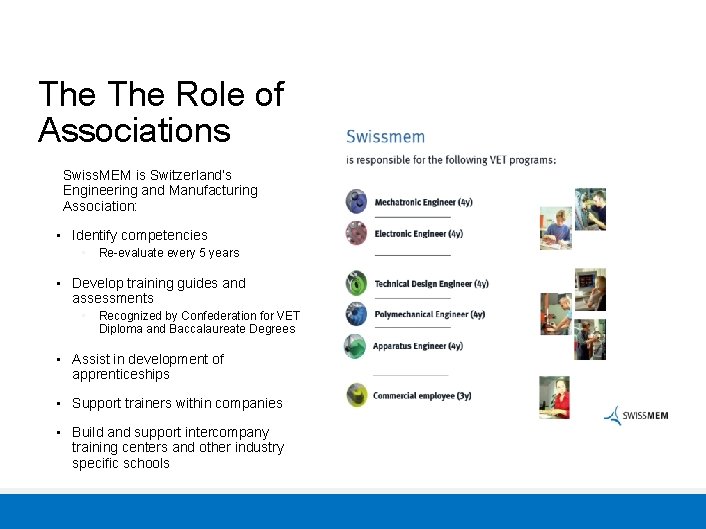
The Role of Associations Swiss. MEM is Switzerland’s Engineering and Manufacturing Association: • Identify competencies • Re-evaluate every 5 years • Develop training guides and assessments • Recognized by Confederation for VET Diploma and Baccalaureate Degrees • Assist in development of apprenticeships • Support trainers within companies • Build and support intercompany training centers and other industry specific schools
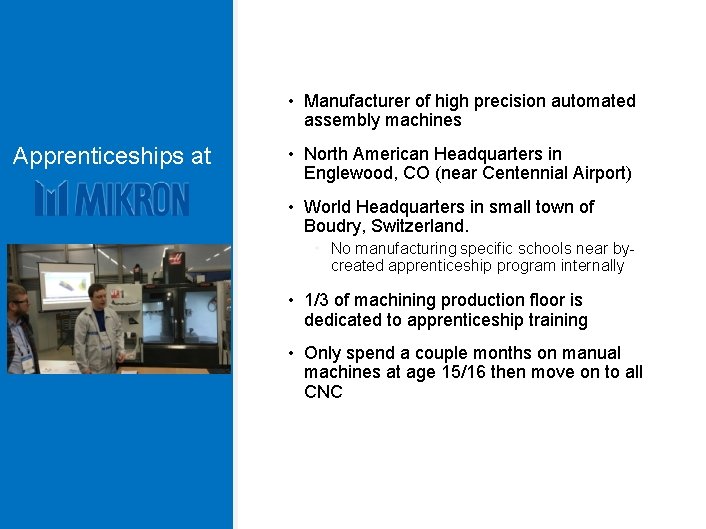
• Manufacturer of high precision automated assembly machines Apprenticeships at • North American Headquarters in Englewood, CO (near Centennial Airport) • World Headquarters in small town of Boudry, Switzerland. • No manufacturing specific schools near bycreated apprenticeship program internally • 1/3 of machining production floor is dedicated to apprenticeship training • Only spend a couple months on manual machines at age 15/16 then move on to all CNC
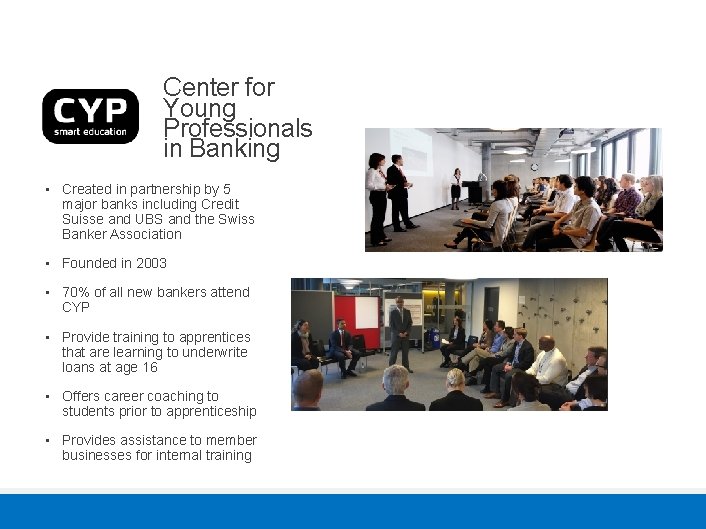
Center for Young Professionals in Banking • Created in partnership by 5 major banks including Credit Suisse and UBS and the Swiss Banker Association • Founded in 2003 • 70% of all new bankers attend CYP • Provide training to apprentices that are learning to underwrite loans at age 16 • Offers career coaching to students prior to apprenticeship • Provides assistance to member businesses for internal training
Business ROI • Savings on recruiting costs • Training to industry standards = savings on retraining = higher productivity • Loyalty to company. Typically 30% stay with training company (or return after college) • Sustainable learning model through paid internships • Aligned supply and demand of skilled workforce = number of apprenticeships dependent on market demand • <4% youth unemployment rate • Costs: depending on industry can be $20, 000 - $100, 000 per apprentice for coaches, curriculum and material/equipment • Canton pays for classroom training (secondary and upper-secondary school)
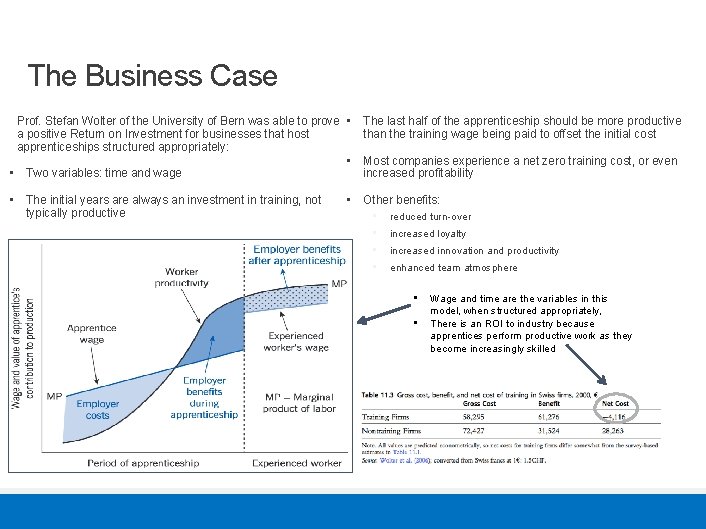
The Business Case Prof. Stefan Wolter of the University of Bern was able to prove • a positive Return on Investment for businesses that host apprenticeships structured appropriately: • • Two variables: time and wage • The initial years are always an investment in training, not typically productive The last half of the apprenticeship should be more productive than the training wage being paid to offset the initial cost Most companies experience a net zero training cost, or even increased profitability • Other benefits: • reduced turn-over • increased loyalty • increased innovation and productivity • enhanced team atmosphere • • Wage and time are the variables in this model, when structured appropriately, There is an ROI to industry because apprentices perform productive work as they become increasingly skilled
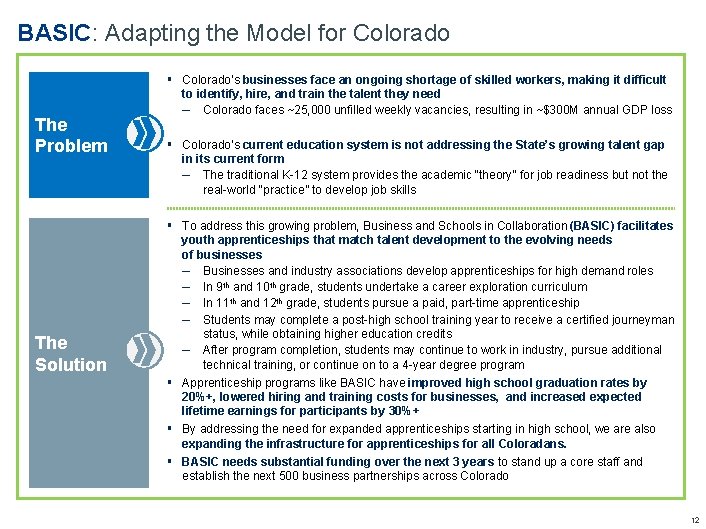
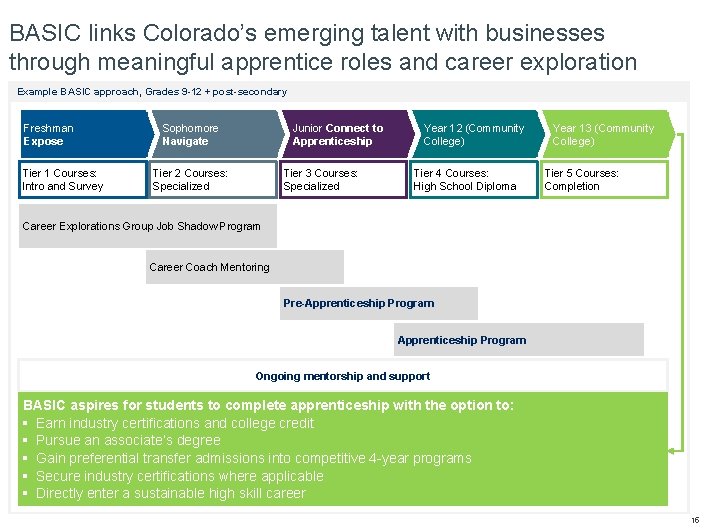
BASIC: Adapting the Model for Colorado The Problem The Solution ▪ Colorado’s businesses face an ongoing shortage of skilled workers, making it difficult to identify, hire, and train the talent they need – Colorado faces ~25, 000 unfilled weekly vacancies, resulting in ~$300 M annual GDP loss ▪ Colorado’s current education system is not addressing the State’s growing talent gap in its current form – The traditional K-12 system provides the academic “theory” for job readiness but not the real-world “practice” to develop job skills ▪ To address this growing problem, Business and Schools in Collaboration (BASIC) facilitates youth apprenticeships that match talent development to the evolving needs of businesses – Businesses and industry associations develop apprenticeships for high demand roles – In 9 th and 10 th grade, students undertake a career exploration curriculum – In 11 th and 12 th grade, students pursue a paid, part-time apprenticeship – Students may complete a post-high school training year to receive a certified journeyman status, while obtaining higher education credits – After program completion, students may continue to work in industry, pursue additional technical training, or continue on to a 4 -year degree program ▪ Apprenticeship programs like BASIC have improved high school graduation rates by 20%+, lowered hiring and training costs for businesses, and increased expected lifetime earnings for participants by 30%+ ▪ By addressing the need for expanded apprenticeships starting in high school, we are also expanding the infrastructure for apprenticeships for all Coloradans. ▪ BASIC needs substantial funding over the next 3 years to stand up a core staff and establish the next 500 business partnerships across Colorado 12
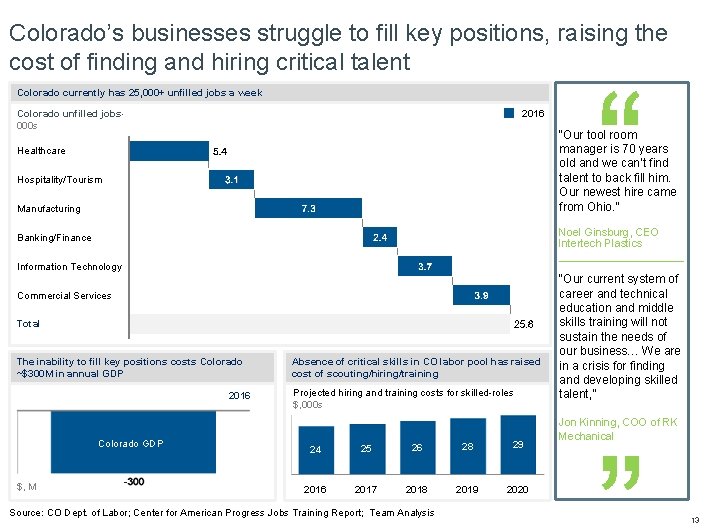
Colorado’s businesses struggle to fill key positions, raising the cost of finding and hiring critical talent Colorado currently has 25, 000+ unfilled jobs a week Colorado unfilled jobs, 000 s 2016 “Our tool room manager is 70 years old and we can’t find talent to back fill him. Our newest hire came from Ohio. ” Healthcare Hospitality/Tourism Manufacturing Noel Ginsburg, CEO Intertech Plastics Banking/Finance Information Technology Commercial Services Total The inability to fill key positions costs Colorado ~$300 M in annual GDP 2016 Colorado GDP $, M Absence of critical skills in CO labor pool has raised cost of scouting/hiring/training Projected hiring and training costs for skilled-roles $, 000 s 24 25 26 28 29 2016 2017 2018 2019 2020 Source: CO Dept. of Labor; Center for American Progress Jobs Training Report; Team Analysis “Our current system of career and technical education and middle skills training will not sustain the needs of our business… We are in a crisis for finding and developing skilled talent, ” Jon Kinning, COO of RK Mechanical 13
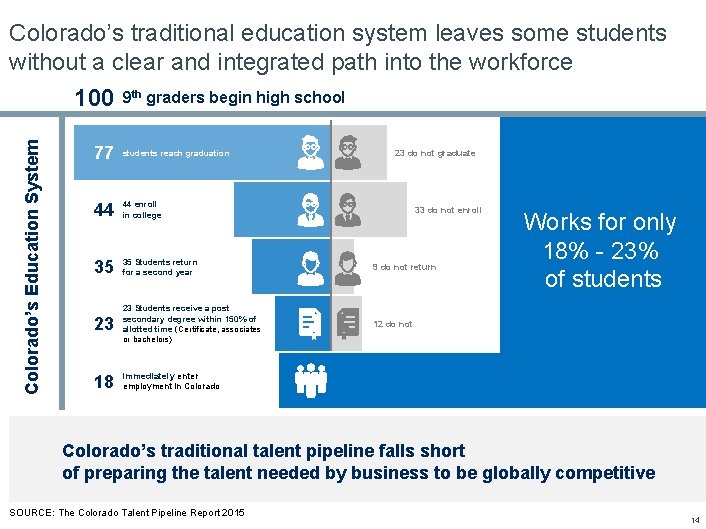
Colorado’s Education System Colorado’s traditional education system leaves some students without a clear and integrated path into the workforce 100 9 th graders begin high school 77 students reach graduation 44 44 enroll in college 35 35 Students return for a second year 9 do not return 23 23 Students receive a post secondary degree within 150% of allotted time (Certificate, associates or bachelors) 12 do not 18 immediately enter employment in Colorado 23 do not graduate 33 do not enroll Works for only 18% - 23% of students Colorado’s traditional talent pipeline falls short of preparing the talent needed by business to be globally competitive SOURCE: The Colorado Talent Pipeline Report 2015 14
BASIC links Colorado’s emerging talent with businesses through meaningful apprentice roles and career exploration Example BASIC approach, Grades 9 -12 + post-secondary Freshman Expose Tier 1 Courses: Intro and Survey Sophomore Navigate Junior Connect to Apprenticeship Tier 2 Courses: Specialized Tier 3 Courses: Specialized Year 12 (Community College) Tier 4 Courses: High School Diploma Year 13 (Community College) Tier 5 Courses: Completion Career Explorations Group Job Shadow Program Career Coach Mentoring Pre-Apprenticeship Program Ongoing mentorship and support BASIC aspires for students to complete apprenticeship with the option to: § Earn industry certifications and college credit § Pursue an associate’s degree § Gain preferential transfer admissions into competitive 4 -year programs § Secure industry certifications where applicable § Directly enter a sustainable high skill career 15
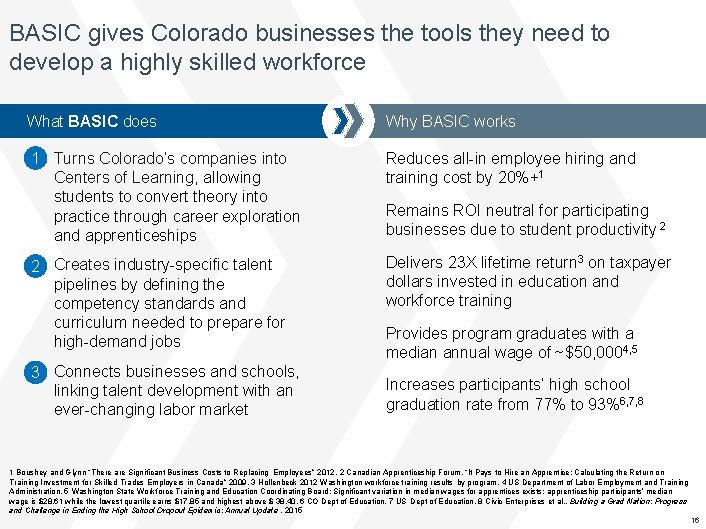
BASIC gives Colorado businesses the tools they need to develop a highly skilled workforce What BASIC does Why BASIC works 1▪ Turns Colorado’s companies into Centers of Learning, allowing students to convert theory into practice through career exploration and apprenticeships Reduces all-in employee hiring and training cost by 20%+1 2▪ Creates industry-specific talent pipelines by defining the competency standards and curriculum needed to prepare for high-demand jobs Delivers 23 X lifetime return 3 on taxpayer dollars invested in education and workforce training 3▪ Connects businesses and schools, linking talent development with an ever-changing labor market Remains ROI neutral for participating businesses due to student productivity 2 Provides program graduates with a median annual wage of ~$50, 0004, 5 Increases participants’ high school graduation rate from 77% to 93%6, 7, 8 1 Boushey and Glynn “There are Significant Business Costs to Replacing Employees” 2012. 2 Canadian Apprenticeship Forum, “It Pays to Hire an Apprentice: Calculating the Return on Training Investment for Skilled Trades Employers in Canada” 2009. 3 Hollenbeck 2012 Washington workforce training results by program. 4 US Department of Labor Employment and Training Administration. 5 Washington State Workforce Training and Education Coordinating Board: Significant variation in median wages for apprentices exists; apprenticeship participants’ median wage is $28. 61 while the lowest quartile earns $17. 85 and highest above $ 38. 40. 6 CO Dept of Education. 7 US Dept of Education. 8 Civic Enterprises et al. , Building a Grad Nation: Progress and Challenge in Ending the High School Dropout Epidemic: Annual Update , 2015 16
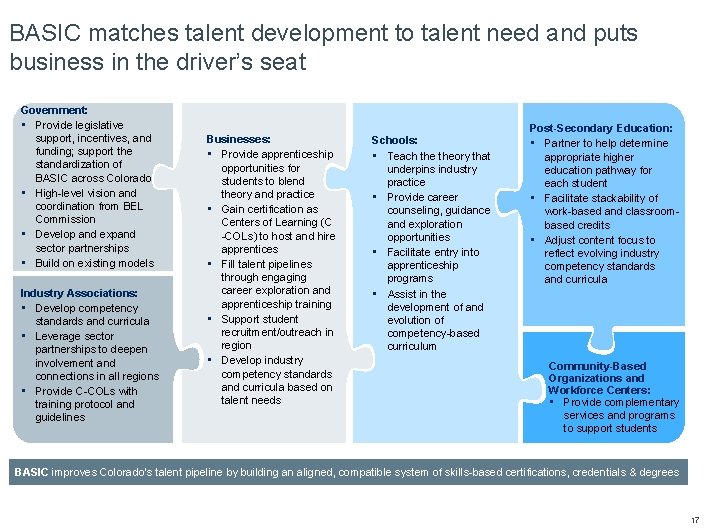
BASIC matches talent development to talent need and puts business in the driver’s seat Government: ▪ Provide legislative support, incentives, and funding; support the standardization of BASIC across Colorado ▪ High-level vision and coordination from BEL Commission ▪ Develop and expand sector partnerships ▪ Build on existing models Industry Associations: ▪ Develop competency standards and curricula ▪ Leverage sector partnerships to deepen involvement and connections in all regions ▪ Provide C-COLs with training protocol and guidelines Businesses: ▪ Provide apprenticeship opportunities for students to blend theory and practice ▪ Gain certification as Centers of Learning (C -COLs) to host and hire apprentices ▪ Fill talent pipelines through engaging career exploration and apprenticeship training ▪ Support student recruitment/outreach in region ▪ Develop industry competency standards and curricula based on talent needs Schools: ▪ Teach theory that underpins industry practice ▪ Provide career counseling, guidance and exploration opportunities ▪ Facilitate entry into apprenticeship programs ▪ Assist in the development of and evolution of competency-based curriculum Post-Secondary Education: ▪ Partner to help determine appropriate higher education pathway for each student ▪ Facilitate stackability of work-based and classroombased credits ▪ Adjust content focus to reflect evolving industry competency standards and curricula Community-Based Organizations and Workforce Centers: ▪ Provide complementary services and programs to support students BASIC improves Colorado’s talent pipeline by building an aligned, compatible system of skills-based certifications, credentials & degrees 17
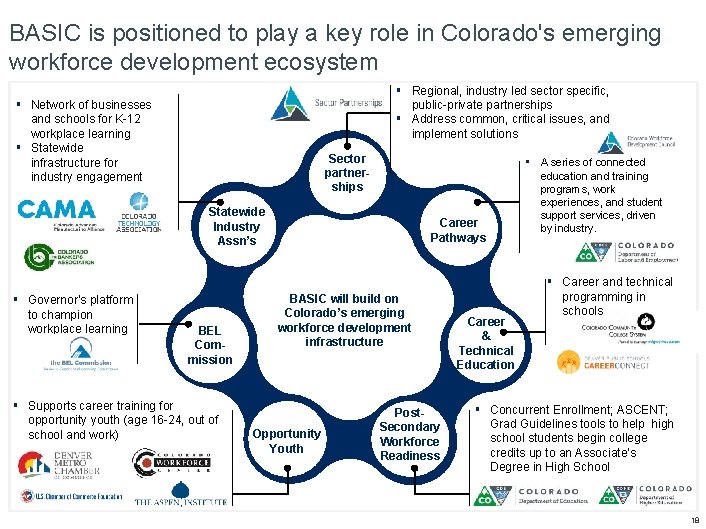
BASIC is positioned to play a key role in Colorado's emerging workforce development ecosystem ▪ ▪ ▪ Network of businesses and schools for K-12 workplace learning Statewide infrastructure for industry engagement ▪ Regional, industry led sector specific, public-private partnerships Address common, critical issues, and implement solutions Sector partnerships ▪ Statewide Industry Assn’s Career Pathways A series of connected education and training programs, work experiences, and student support services, driven by industry. ▪ ▪ ▪ Governor’s platform to champion workplace learning BEL Commission Supports career training for opportunity youth (age 16 -24, out of school and work) BASIC will build on Colorado’s emerging workforce development infrastructure Opportunity Youth Post. Secondary Workforce Readiness Career & Technical Education ▪ Career and technical programming in schools Concurrent Enrollment; ASCENT; Grad Guidelines tools to help high school students begin college credits up to an Associate’s Degree in High School 18
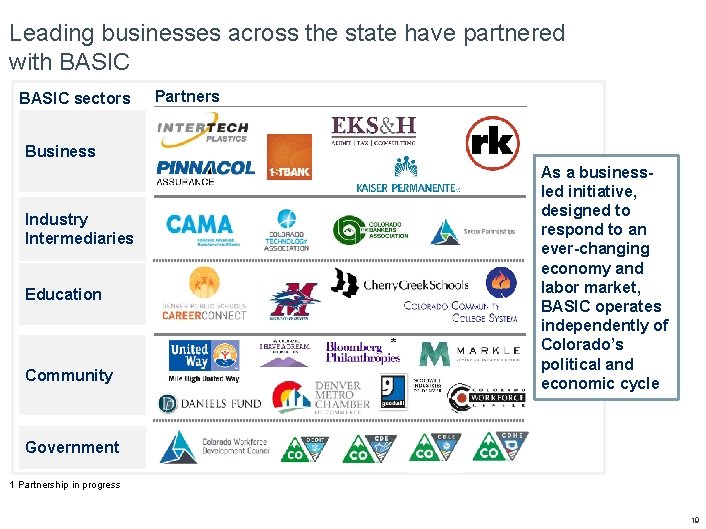
Leading businesses across the state have partnered with BASIC sectors Partners Business Industry Intermediaries Education * Community As a businessled initiative, designed to respond to an ever-changing economy and labor market, BASIC operates independently of Colorado’s political and economic cycle Government 1 Partnership in progress 19
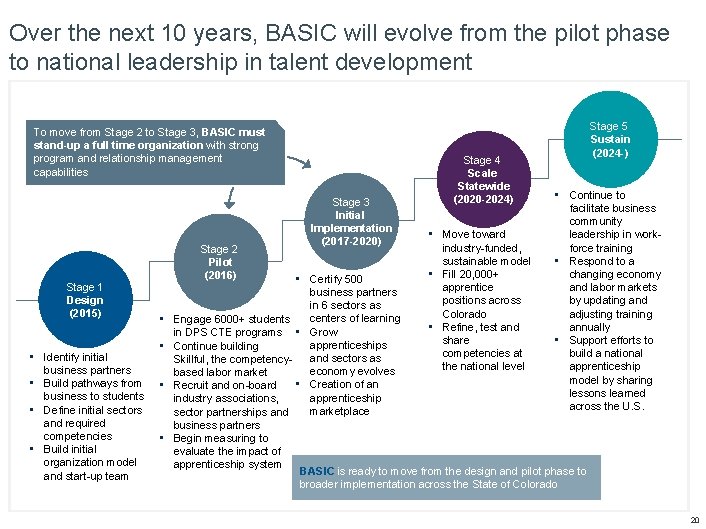
Over the next 10 years, BASIC will evolve from the pilot phase to national leadership in talent development To move from Stage 2 to Stage 3, BASIC must stand-up a full time organization with strong program and relationship management capabilities Stage 1 Design (2015) ▪ ▪ Identify initial business partners Build pathways from business to students Define initial sectors and required competencies Build initial organization model and start-up team Stage 2 Pilot (2016) ▪ ▪ Stage 3 Initial Implementation (2017 -2020) ▪ Certify 500 business partners in 6 sectors as centers of learning Grow apprenticeships and sectors as economy evolves Creation of an apprenticeship marketplace Stage 4 Scale Statewide (2020 -2024) ▪ ▪ Move toward industry-funded, sustainable model Fill 20, 000+ apprentice positions across Colorado Refine, test and share competencies at the national level Stage 5 Sustain (2024 -) ▪ ▪ Continue to facilitate business community leadership in workforce training Respond to a changing economy and labor markets by updating and adjusting training annually Support efforts to build a national apprenticeship model by sharing lessons learned across the U. S. Engage 6000+ students ▪ in DPS CTE programs ▪ ▪ Continue building Skillful, the competencybased labor market ▪ Recruit and on-board industry associations, sector partnerships and business partners Begin measuring to evaluate the impact of apprenticeship system BASIC is ready to move from the design and pilot phase to broader implementation across the State of Colorado 20
Thank you for your time. Please email info@basic. org for more information 21