
Swine Nutrition Management An S 320 Fall 2006


- Slides: 73
Swine Nutrition & Management An. S 320 Fall 2006
Feeding Pigs -- Major Biological Processes n Maintenance n n n Repair or replacement of body tissues and fluids Voluntary (walking) and involuntary (heart contractions) activities Generation of body heat for warmth Regulation of immune systems Growth n Production of body tissues (muscle, bone), organs (mammary glands), fluids (milk), fluid components (red blood cells) 2
Factors Affecting Nutrient Requirements of Pigs n Environment n n n Temperature, weather, housing, competition Breed, sex, and genetic background Health status of the herd Presence of molds, toxins, or inhibitors Availability and absorption of dietary nutrients 3
Factors Affecting Nutrient Requirements of Pigs n n Variation of nutrient content and availability in the feed Level of feed additives or growth promotants Energy concentration in the diet Level of feeding – limit feeding vs. ad libitum 4
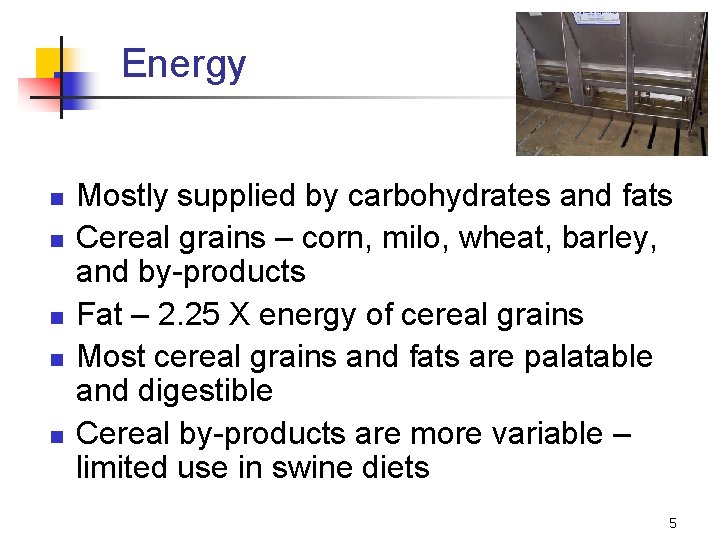
Energy n n n Mostly supplied by carbohydrates and fats Cereal grains – corn, milo, wheat, barley, and by-products Fat – 2. 25 X energy of cereal grains Most cereal grains and fats are palatable and digestible Cereal by-products are more variable – limited use in swine diets 5
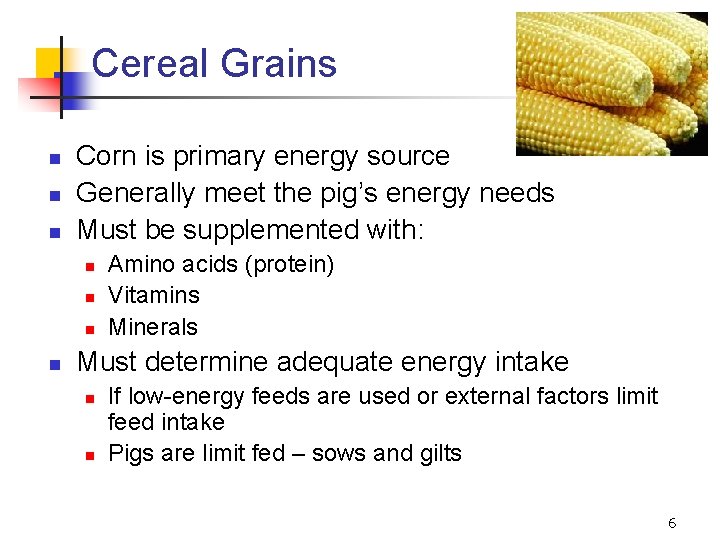
Cereal Grains n n n Corn is primary energy source Generally meet the pig’s energy needs Must be supplemented with: n n Amino acids (protein) Vitamins Minerals Must determine adequate energy intake n n If low-energy feeds are used or external factors limit feed intake Pigs are limit fed – sows and gilts 6
Additional Energy Sources n n n Milo – equal substitute for corn – primarily used in Southwest Wheat – excellent feed grain, usually not competitive in price Barley – less energy and more fiber – improves meat quality? ? ? Oats – more lysine, more fiber High-lysine corn – selected for improved protein quality 7
Fat in Swine Diets n n n n Choice white grease, beef tallow, corn oil, soybean oil 2. 25 X metabolizable energy of cereal grains 3 – 5% fat in grow-finish diets will improve ADG and FE Tends to increase backfat Reduces dust and wear on equipment Potential handling and storage problems Economic decision 8
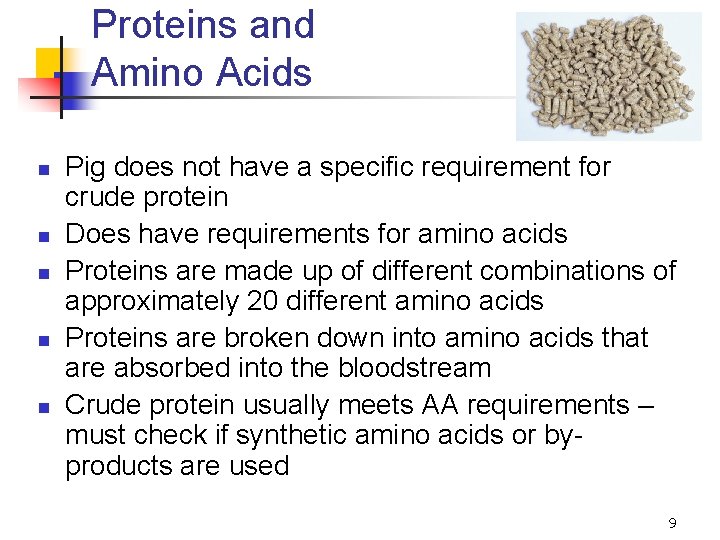
Proteins and Amino Acids n n n Pig does not have a specific requirement for crude protein Does have requirements for amino acids Proteins are made up of different combinations of approximately 20 different amino acids Proteins are broken down into amino acids that are absorbed into the bloodstream Crude protein usually meets AA requirements – must check if synthetic amino acids or byproducts are used 9
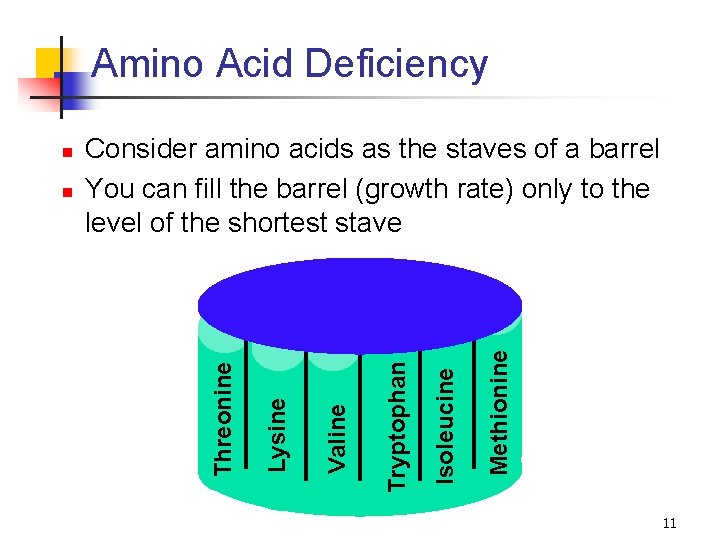
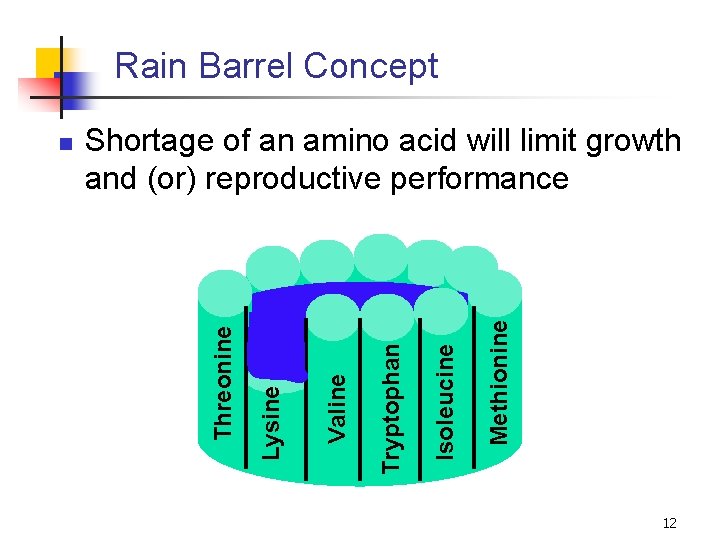
Essential Amino Acids n 10 essential amino acids n n Most cereal grains are limiting in lysine, tryptophan, threonine, and methionine Level determines protein quality – lysine is most important Limiting amino acid – protein synthesis cannot proceed beyond level of any essential amino acid Deficiency results in lower ADG, reduced FE, unthriftiness, and reduced reproductive performance 10
Amino Acid Deficiency Methionine Isoleucine Tryptophan Valine Lysine n Consider amino acids as the staves of a barrel You can fill the barrel (growth rate) only to the level of the shortest stave Threonine n 11
Rain Barrel Concept Methionine Isoleucine Tryptophan Valine Lysine Shortage of an amino acid will limit growth and (or) reproductive performance Threonine n 12
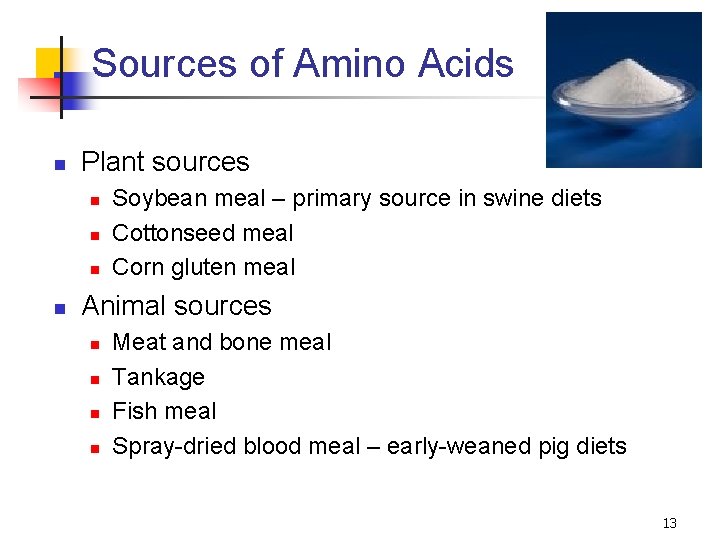
Sources of Amino Acids n Plant sources n n Soybean meal – primary source in swine diets Cottonseed meal Corn gluten meal Animal sources n n Meat and bone meal Tankage Fish meal Spray-dried blood meal – early-weaned pig diets 13
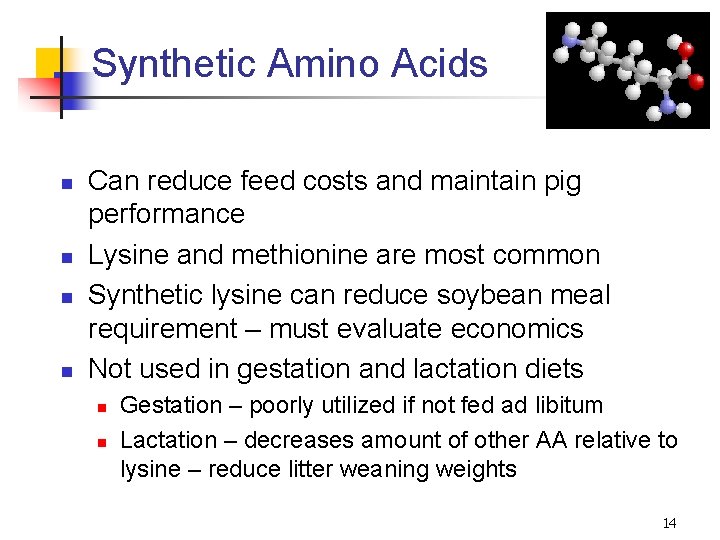
Synthetic Amino Acids n n Can reduce feed costs and maintain pig performance Lysine and methionine are most common Synthetic lysine can reduce soybean meal requirement – must evaluate economics Not used in gestation and lactation diets n n Gestation – poorly utilized if not fed ad libitum Lactation – decreases amount of other AA relative to lysine – reduce litter weaning weights 14
Minerals n n Role ranges from structural functions to wide variety of regulatory functions Important for health and well-being of the pig Importance increased with confinement due to reduced access to soil and forages Macrominerals – major minerals n n Calcium, phosphorus, sodium, chlorine, magnesium, potassium Microminerals – minor or trace minerals n Zinc, copper, iron, manganese, iodine, selenium, chromium 15
Minerals to Swine Diets n n n Should not be added haphazardly “If a little is good, more is better” does not hold true Some minerals, if added in excess, will interfere with absorption of other minerals All minerals have a toxic level Impact on environment 16
Calcium and Phosphorus n n Important in skeletal structure and development Essential for blood clotting, muscle contraction, energy metabolism Deficiency will result in impaired bone mineralization, reduced bone growth, and poor growth rate “Downer Sows” may result if sows are fed diets low in Ca and P – sows remove Ca and P from the bone, decreasing bone strength 17
Calcium and Phosphorus n Calcium n n n Most grains are low in calcium Limestone is source of supplemental Ca Phosphorus n n n Mainly supplied by dicalcium phosphate or monocalcium phosphate Feeds of animal origin are high in calcium and available phosphorus P content of cereal grains is mainly phytate phosphorus – poorly utilized by swine 18
Phytate Phosphorus – Unavailable Form of Phosphorus n n 50 to 70% of P in plant products is unavailable to the pig Not digested and is excreted in manure Excess phosphorus excretion into the environment – formulate diets based on available P Phytase – enzyme that increases digestibility of phytate phosphorus n n Use to reduce phosphorus excretions Evaluate economics 19
Vitamins n n n Required for normal metabolic function Development of normal tissues Growth and maintenance Some are produced by the pig, some are present in commonly used feed ingredients, several must be added to swine diets Natural sources – very few are used today n n n Green leafy plants, grasses, alfalfa Less variety in feed ingredients to supply vitamins Vitamin content of grain and protein sources may be unavailable or lost during storage 20
Important Vitamins n Fat-soluble n n Water-soluble or B-complex n n n Pantothenic acid Riboflavin Niacin B 12 Gestation/Lactation Diets n n A, D, E, and K Folic acid, pyridoxine, choline, biotin Synthetic vitamins added in form of vitamin premix 21
Changes in Vitamin/Mineral Nutrition n n n Increased confinement – no access to growing crops and soil Increased use of slotted floors – less recycling of feces Fewer protein sources in diets Reduced daily feed intake in gestation Early weaning of pigs – diet is more critical Availability of nutrients in heat-dried grains and feed ingredients varies widely 22
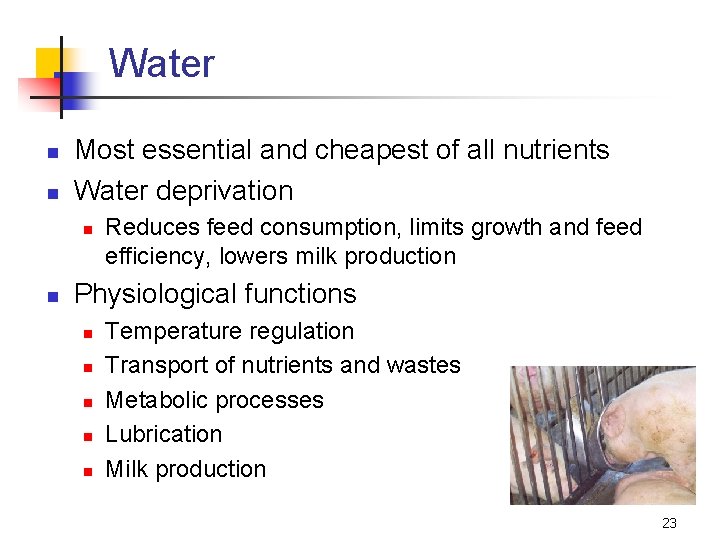
Water n n Most essential and cheapest of all nutrients Water deprivation n n Reduces feed consumption, limits growth and feed efficiency, lowers milk production Physiological functions n n n Temperature regulation Transport of nutrients and wastes Metabolic processes Lubrication Milk production 23
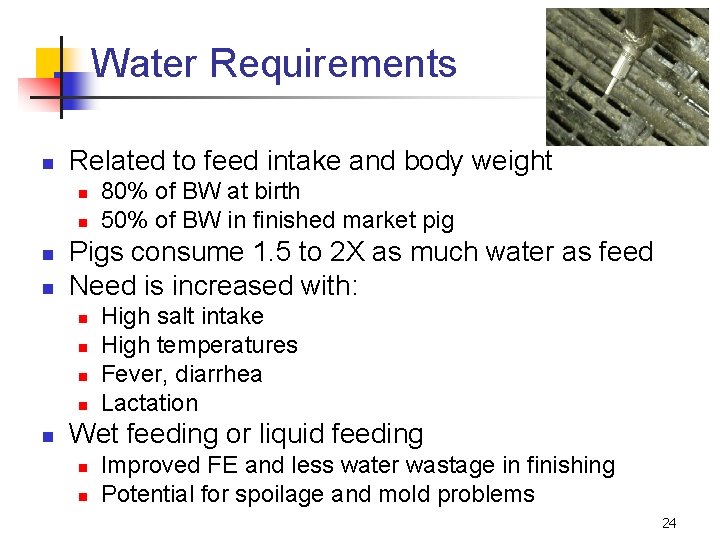
Water Requirements n Related to feed intake and body weight n n Pigs consume 1. 5 to 2 X as much water as feed Need is increased with: n n n 80% of BW at birth 50% of BW in finished market pig High salt intake High temperatures Fever, diarrhea Lactation Wet feeding or liquid feeding n n Improved FE and less water wastage in finishing Potential for spoilage and mold problems 24
Feed Additives n Animal drugs – antibiotics, dewormers n n Growth-promoting minerals n n Withdrawal time Copper sulfate, zinc oxide Enzymes – phytase Organic acids – may improve digestibility for early weaned pigs Probiotics – organisms that stimulate growth of desirable organisms in the gut n Lactobacillus, streptococcus, etc. 25
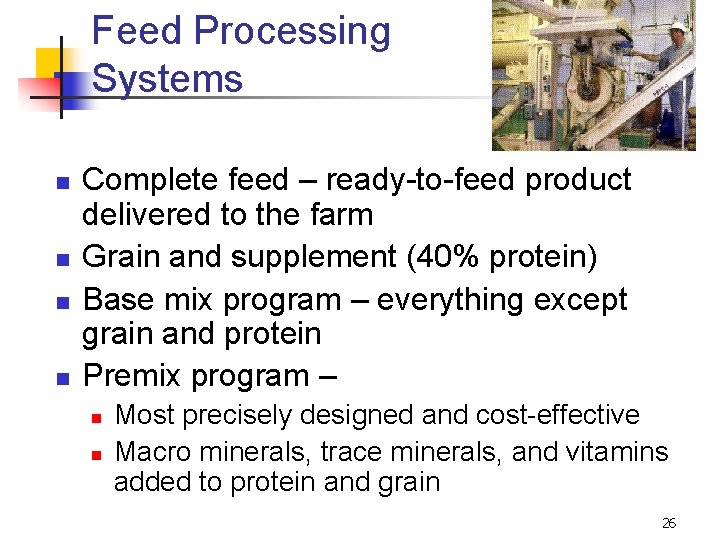
Feed Processing Systems n n Complete feed – ready-to-feed product delivered to the farm Grain and supplement (40% protein) Base mix program – everything except grain and protein Premix program – n n Most precisely designed and cost-effective Macro minerals, trace minerals, and vitamins added to protein and grain 26
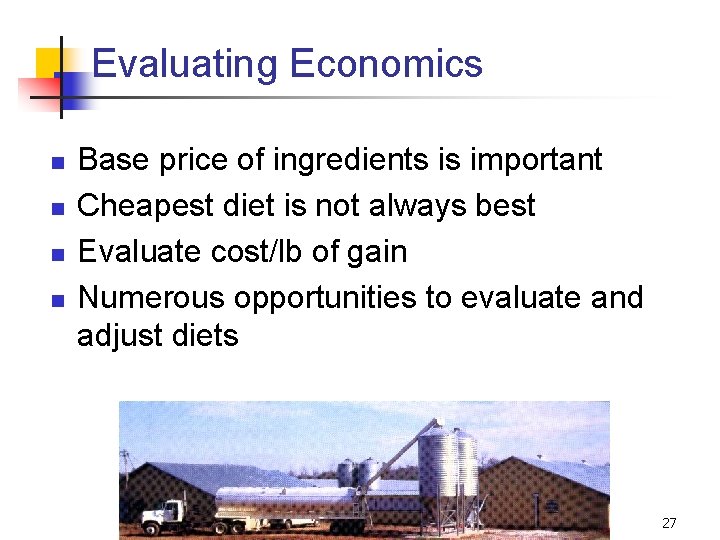
Evaluating Economics n n Base price of ingredients is important Cheapest diet is not always best Evaluate cost/lb of gain Numerous opportunities to evaluate and adjust diets 27
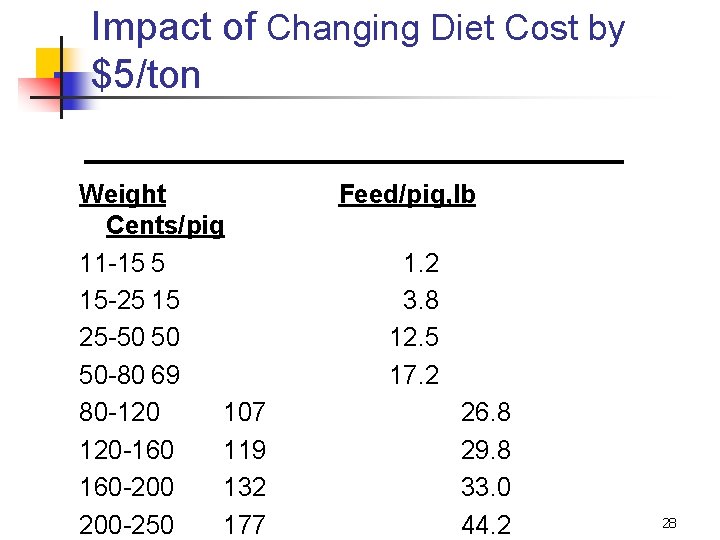
Impact of Changing Diet Cost by $5/ton Weight Cents/pig 11 -15 5 15 -25 15 25 -50 50 50 -80 69 80 -120 107 120 -160 119 160 -200 132 200 -250 177 Feed/pig, lb 1. 2 3. 8 12. 5 17. 2 26. 8 29. 8 33. 0 44. 2 28
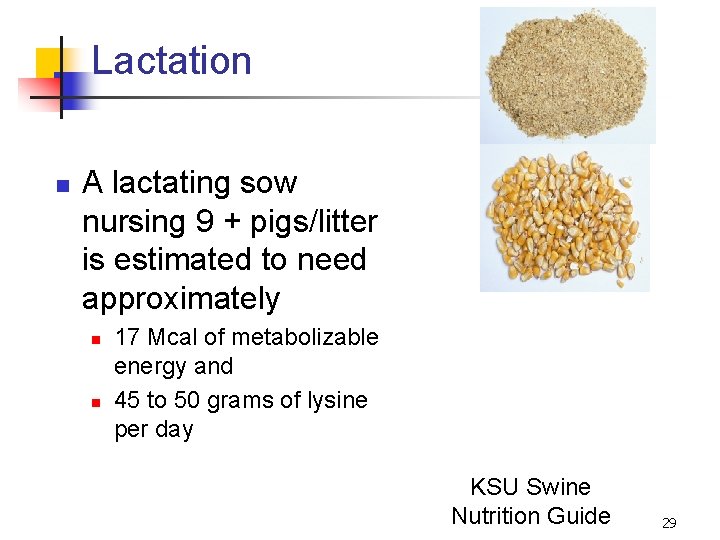
Lactation n A lactating sow nursing 9 + pigs/litter is estimated to need approximately n n 17 Mcal of metabolizable energy and 45 to 50 grams of lysine per day KSU Swine Nutrition Guide 29
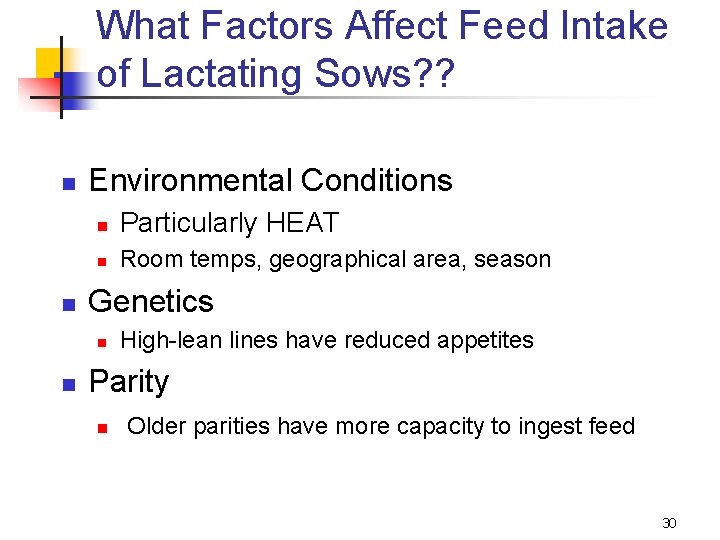
What Factors Affect Feed Intake of Lactating Sows? ? n n Environmental Conditions n Particularly HEAT n Room temps, geographical area, season Genetics n n High-lean lines have reduced appetites Parity n Older parities have more capacity to ingest feed 30
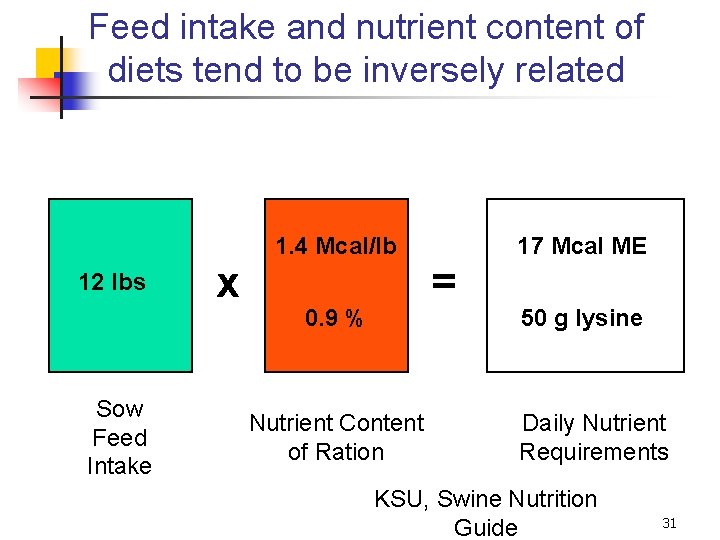
Feed intake and nutrient content of diets tend to be inversely related 1212 lbslbs Sow Feed Intake x 1. 4 Mcal/lb 0. 9 % Nutrient Content of Ration = 17 Mcal ME 50 g lysine Daily Nutrient Requirements KSU, Swine Nutrition Guide 31
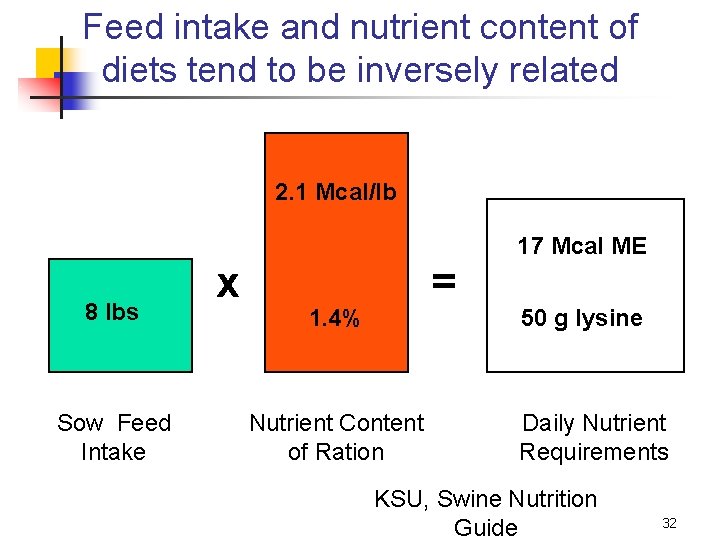
Feed intake and nutrient content of diets tend to be inversely related 2. 1 Mcal/lb 12 lbs 8 lbs Sow Feed Intake x = 1. 4% Nutrient Content of Ration 17 Mcal ME 50 g lysine Daily Nutrient Requirements KSU, Swine Nutrition Guide 32
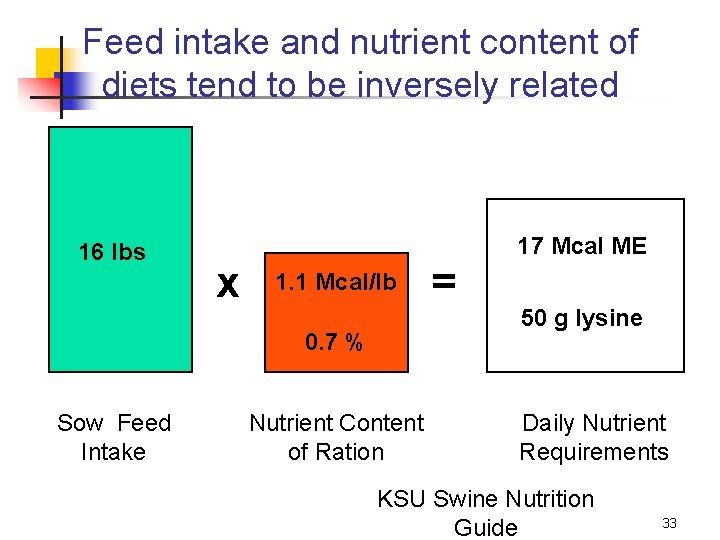
Feed intake and nutrient content of diets tend to be inversely related 16 lbs 12 lbs x 1. 1 Mcal/lb 0. 7 % Sow Feed Intake Nutrient Content of Ration = 17 Mcal ME 50 g lysine Daily Nutrient Requirements KSU Swine Nutrition Guide 33
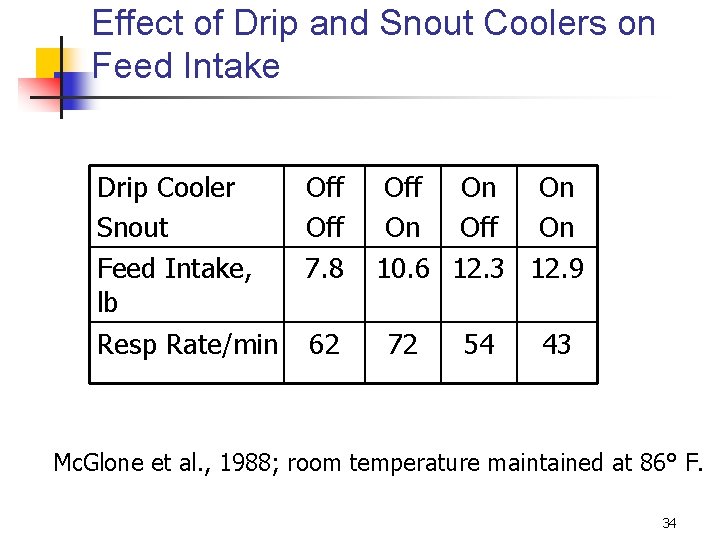
Effect of Drip and Snout Coolers on Feed Intake Drip Cooler Snout Feed Intake, lb Off 7. 8 Resp Rate/min 62 Off On On On Off On 10. 6 12. 3 12. 9 72 54 43 Mc. Glone et al. , 1988; room temperature maintained at 86° F. 34
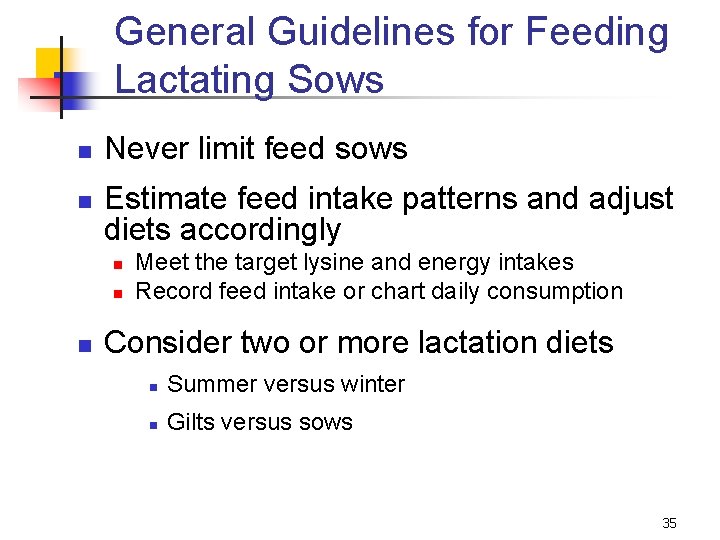
General Guidelines for Feeding Lactating Sows n n Never limit feed sows Estimate feed intake patterns and adjust diets accordingly n n n Meet the target lysine and energy intakes Record feed intake or chart daily consumption Consider two or more lactation diets n Summer versus winter n Gilts versus sows 35
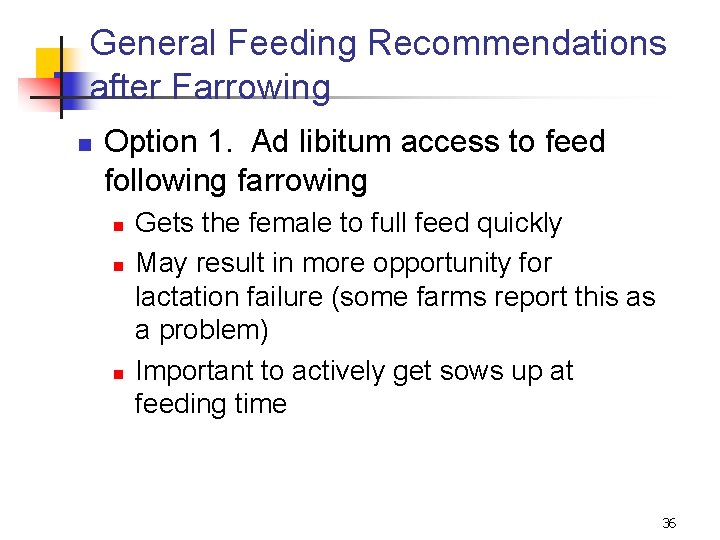
General Feeding Recommendations after Farrowing n Option 1. Ad libitum access to feed following farrowing n n n Gets the female to full feed quickly May result in more opportunity for lactation failure (some farms report this as a problem) Important to actively get sows up at feeding time 36
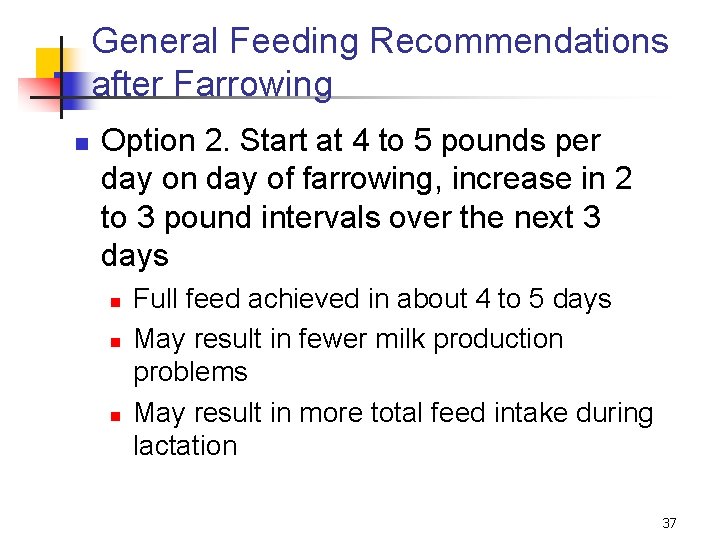
General Feeding Recommendations after Farrowing n Option 2. Start at 4 to 5 pounds per day on day of farrowing, increase in 2 to 3 pound intervals over the next 3 days n n n Full feed achieved in about 4 to 5 days May result in fewer milk production problems May result in more total feed intake during lactation 37
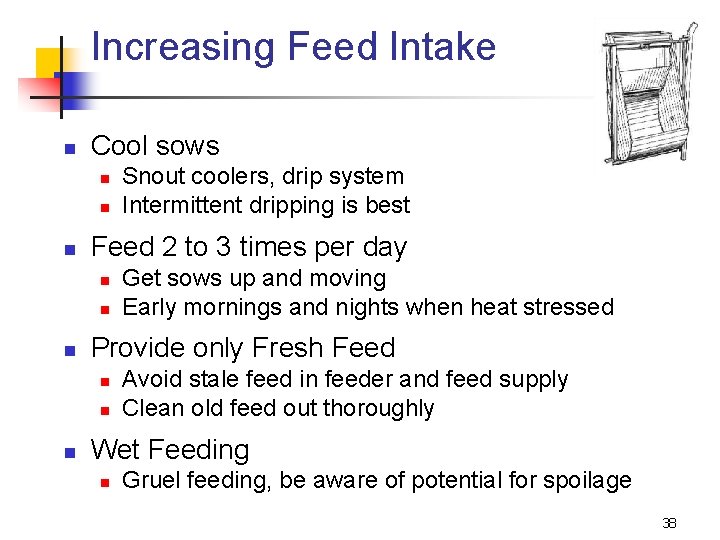
Increasing Feed Intake n Cool sows n n n Feed 2 to 3 times per day n n n Get sows up and moving Early mornings and nights when heat stressed Provide only Fresh Feed n n n Snout coolers, drip system Intermittent dripping is best Avoid stale feed in feeder and feed supply Clean old feed out thoroughly Wet Feeding n Gruel feeding, be aware of potential for spoilage 38
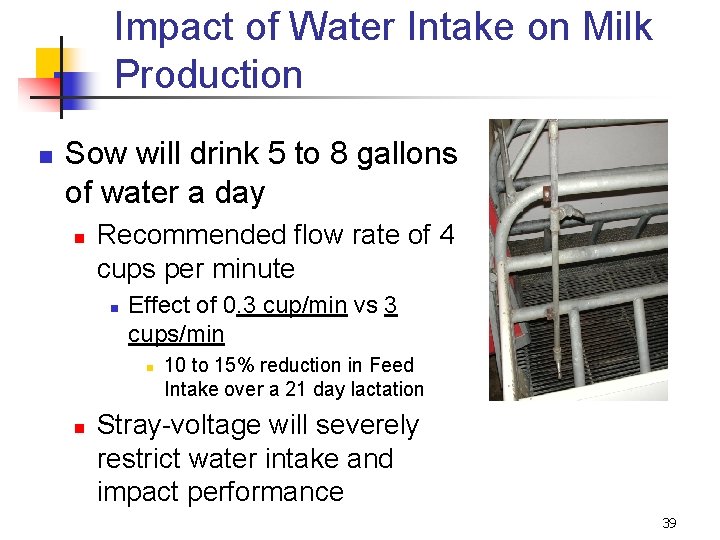
Impact of Water Intake on Milk Production n Sow will drink 5 to 8 gallons of water a day n Recommended flow rate of 4 cups per minute n Effect of 0. 3 cup/min vs 3 cups/min n n 10 to 15% reduction in Feed Intake over a 21 day lactation Stray-voltage will severely restrict water intake and impact performance 39
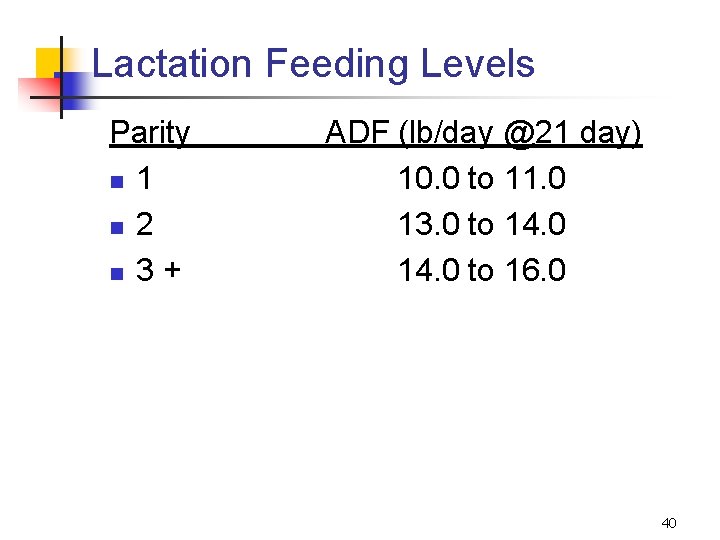
Lactation Feeding Levels Parity n 1 n 2 n 3 + ADF (lb/day @21 day) 10. 0 to 11. 0 13. 0 to 14. 0 to 16. 0 40
Early Weaning Technology n n n Goal -- to control chronic swine diseases by isolating the young pig from its dam at an early age Pigs are free of many chronic pathogens at birth Colostral antibodies are important 41
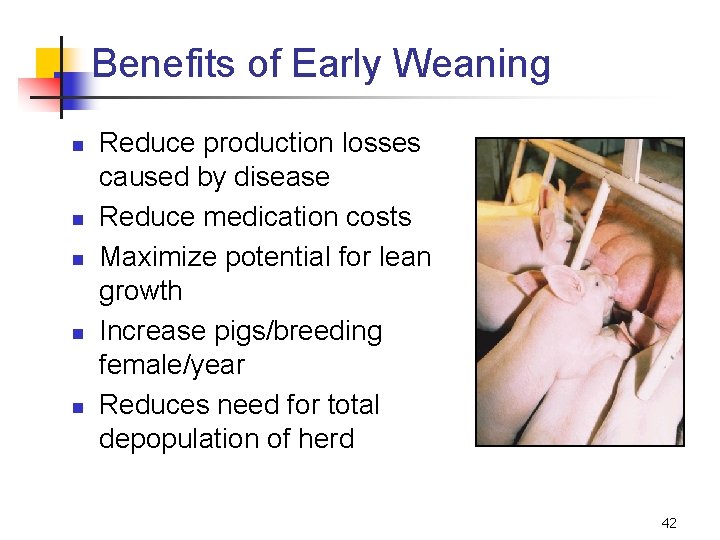
Benefits of Early Weaning n n n Reduce production losses caused by disease Reduce medication costs Maximize potential for lean growth Increase pigs/breeding female/year Reduces need for total depopulation of herd 42
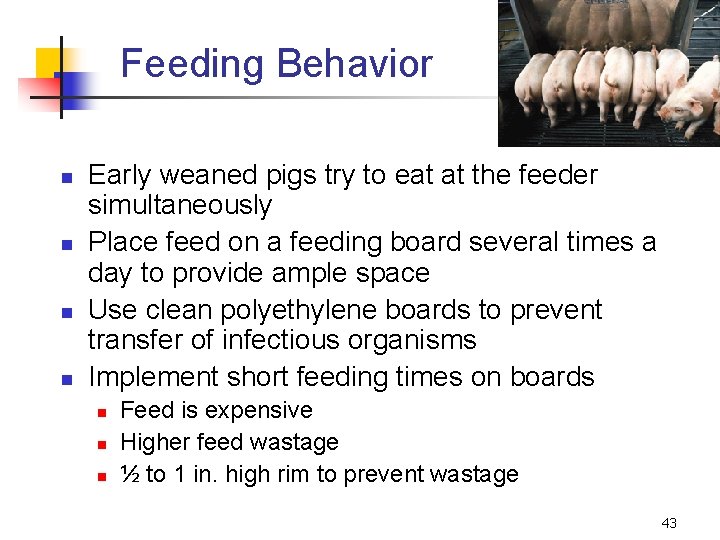
Feeding Behavior n n Early weaned pigs try to eat at the feeder simultaneously Place feed on a feeding board several times a day to provide ample space Use clean polyethylene boards to prevent transfer of infectious organisms Implement short feeding times on boards n n n Feed is expensive Higher feed wastage ½ to 1 in. high rim to prevent wastage 43
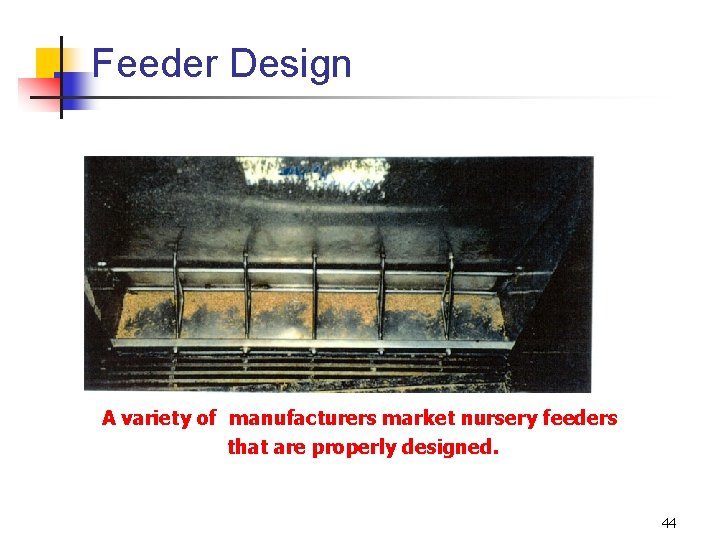
Feeder Design A variety of manufacturers market nursery feeders that are properly designed. 44
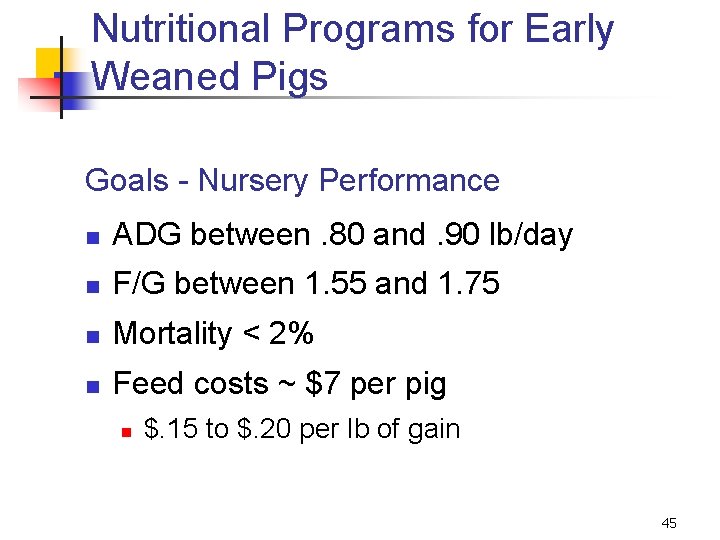
Nutritional Programs for Early Weaned Pigs Goals - Nursery Performance n ADG between. 80 and. 90 lb/day n F/G between 1. 55 and 1. 75 n Mortality < 2% n Feed costs ~ $7 per pig n $. 15 to $. 20 per lb of gain 45
Early-Weaned Pigs n Good nutrition is critical immediately after weaning 1) Good nutrition increases average daily gain through market 2) Good nutrition maximizes lean growth potential 3) Good nutrition decreases the risk of enteric disease 46
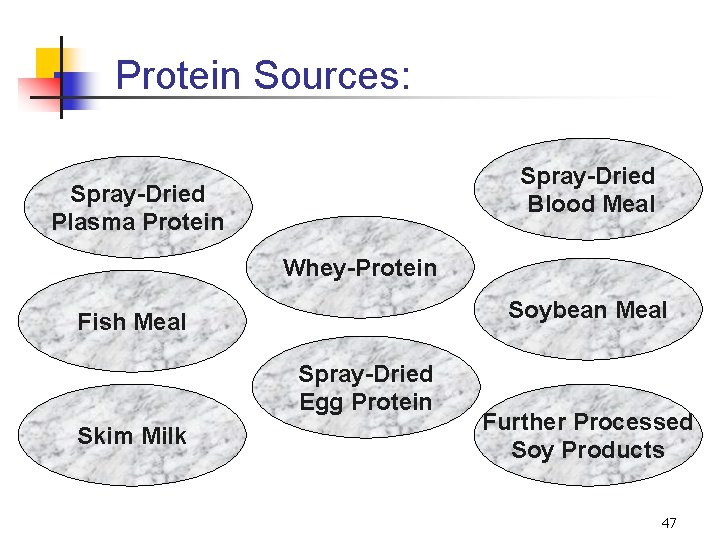
Protein Sources: Spray-Dried Blood Meal Spray-Dried Plasma Protein Whey-Protein Soybean Meal Fish Meal Spray-Dried Egg Protein Skim Milk Further Processed Soy Products 47
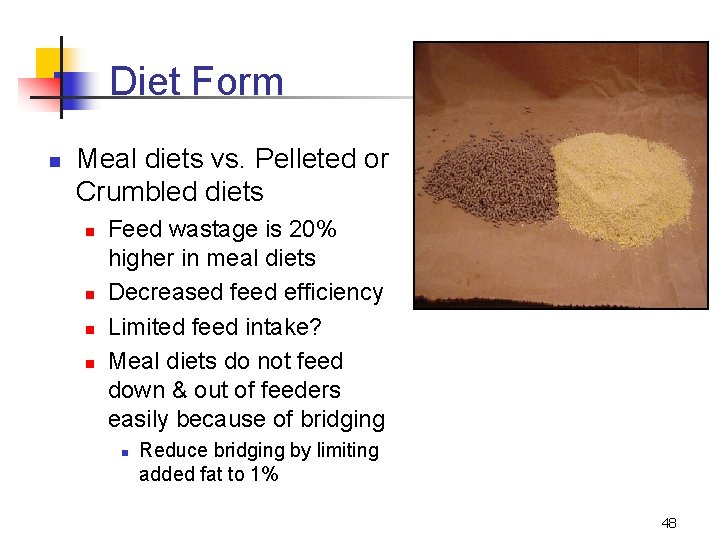
Diet Form n Meal diets vs. Pelleted or Crumbled diets n n Feed wastage is 20% higher in meal diets Decreased feed efficiency Limited feed intake? Meal diets do not feed down & out of feeders easily because of bridging n Reduce bridging by limiting added fat to 1% 48
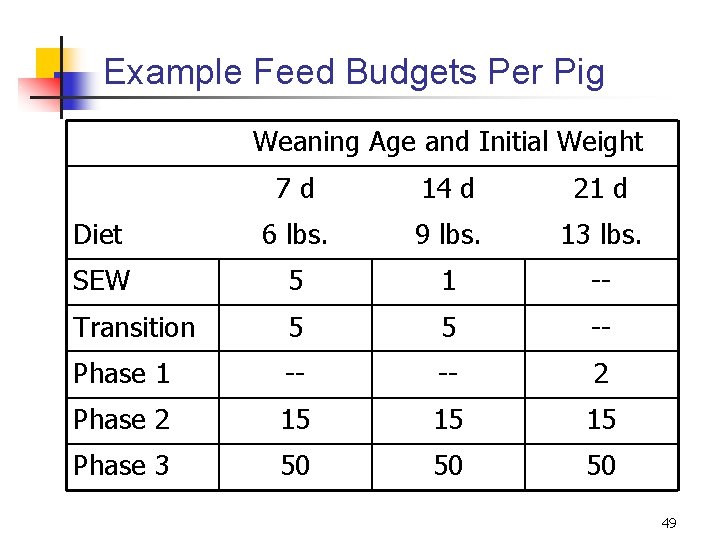
Example Feed Budgets Per Pig Weaning Age and Initial Weight 7 d 14 d 21 d Diet 6 lbs. 9 lbs. 13 lbs. SEW 5 1 -- Transition 5 5 -- Phase 1 -- -- 2 Phase 2 15 15 15 Phase 3 50 50 50 49
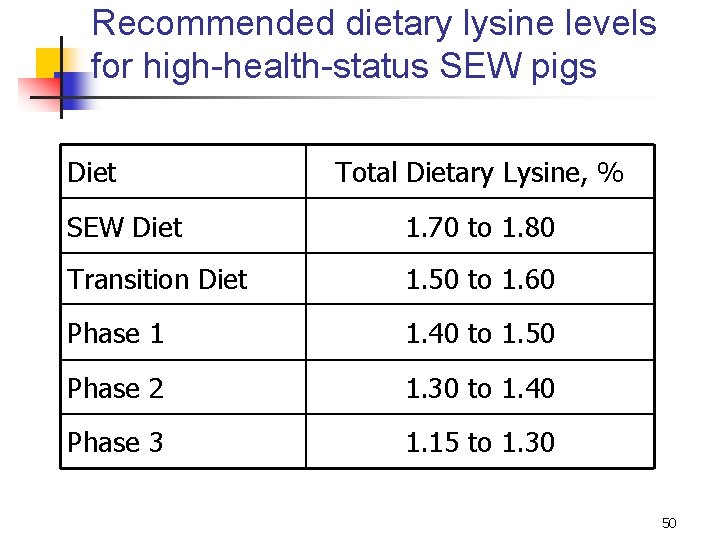
Recommended dietary lysine levels for high-health-status SEW pigs Diet Total Dietary Lysine, % SEW Diet 1. 70 to 1. 80 Transition Diet 1. 50 to 1. 60 Phase 1 1. 40 to 1. 50 Phase 2 1. 30 to 1. 40 Phase 3 1. 15 to 1. 30 50
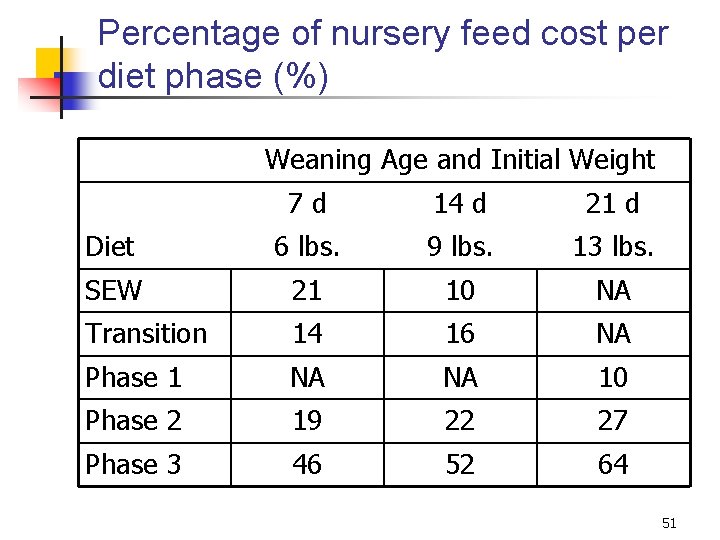
Percentage of nursery feed cost per diet phase (%) Weaning Age and Initial Weight 7 d 14 d 21 d Diet 6 lbs. 9 lbs. 13 lbs. SEW 21 10 NA Transition 14 16 NA Phase 1 NA NA 10 Phase 2 19 22 27 Phase 3 46 52 64 51
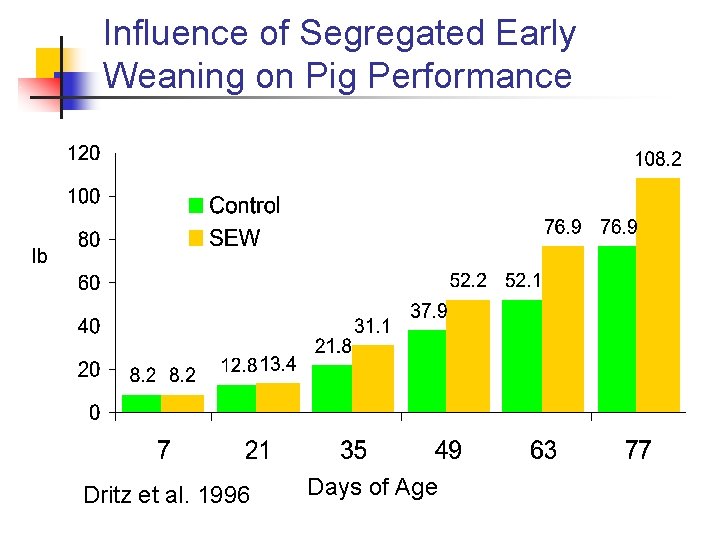
Influence of Segregated Early Weaning on Pig Performance lb Dritz et al. 1996 Days of Age
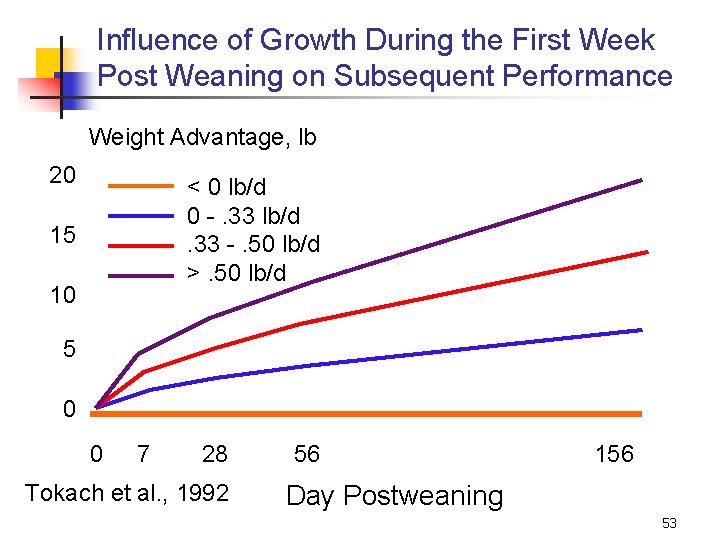
Influence of Growth During the First Week Post Weaning on Subsequent Performance Weight Advantage, lb 20 < 0 lb/d 0 -. 33 lb/d. 33 -. 50 lb/d >. 50 lb/d 15 10 5 0 0 7 28 Tokach et al. , 1992 56 156 Day Postweaning 53
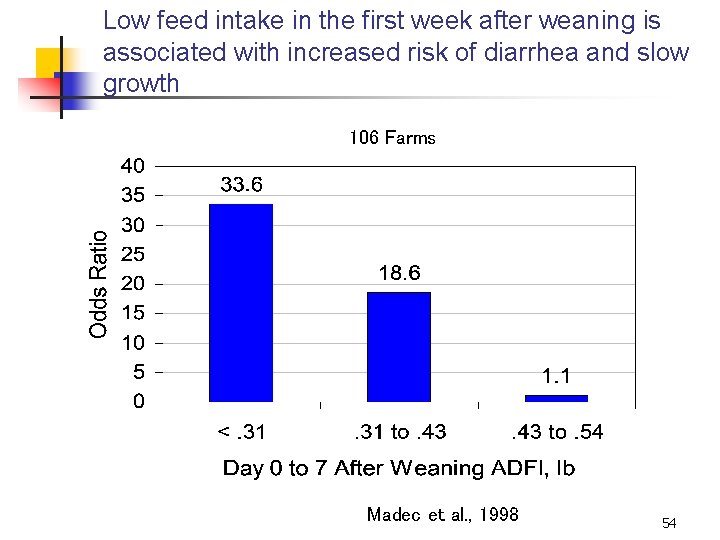
Low feed intake in the first week after weaning is associated with increased risk of diarrhea and slow growth 106 Farms Madec et al. , 1998 54
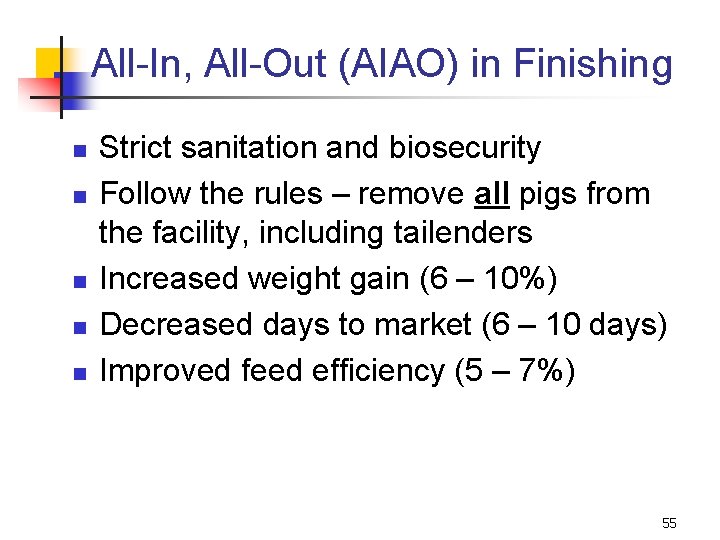
All-In, All-Out (AIAO) in Finishing n n n Strict sanitation and biosecurity Follow the rules – remove all pigs from the facility, including tailenders Increased weight gain (6 – 10%) Decreased days to market (6 – 10 days) Improved feed efficiency (5 – 7%) 55
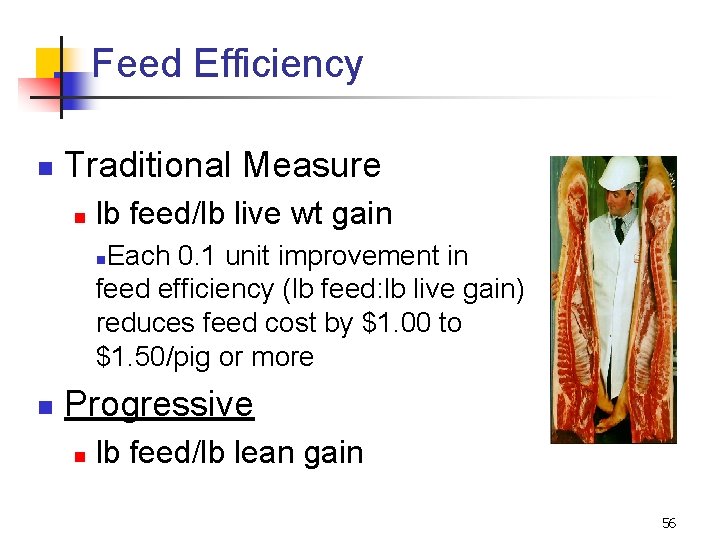
Feed Efficiency n Traditional Measure n lb feed/lb live wt gain Each 0. 1 unit improvement in feed efficiency (lb feed: lb live gain) reduces feed cost by $1. 00 to $1. 50/pig or more n n Progressive n lb feed/lb lean gain 56
Factors Influencing Feed Efficiency n Non-nutritional factors n n n Feed wastage Stress (temperature, crowding) Health status Adequacy of feed preparation (particle size and form) Nutritional Factors n n Nutrient composition of diet Adequacy of diet for genetic type and production environment 57
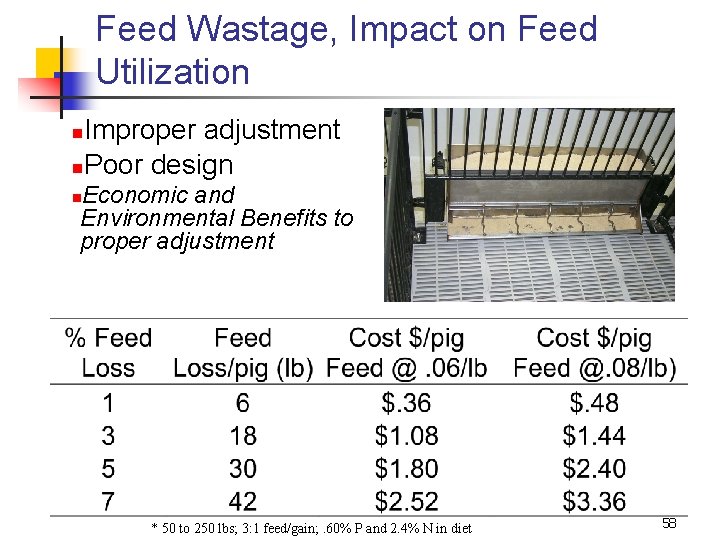
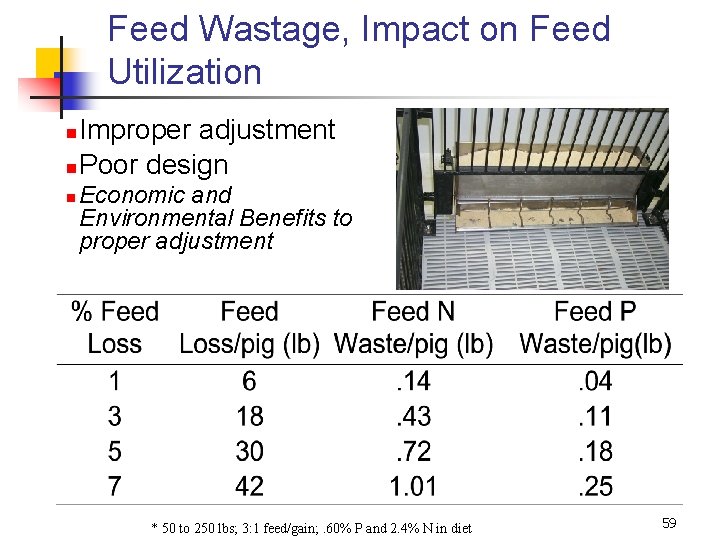
Feed Wastage, Impact on Feed Utilization Improper adjustment n. Poor design n Economic and Environmental Benefits to proper adjustment n * 50 to 250 lbs; 3: 1 feed/gain; . 60% P and 2. 4% N in diet 58
Feed Wastage, Impact on Feed Utilization Improper adjustment n Poor design n n Economic and Environmental Benefits to proper adjustment * 50 to 250 lbs; 3: 1 feed/gain; . 60% P and 2. 4% N in diet 59
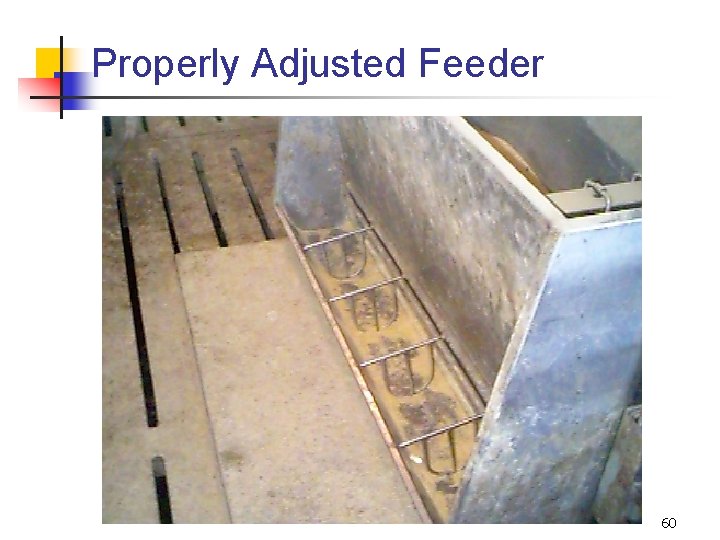
Properly Adjusted Feeder 60
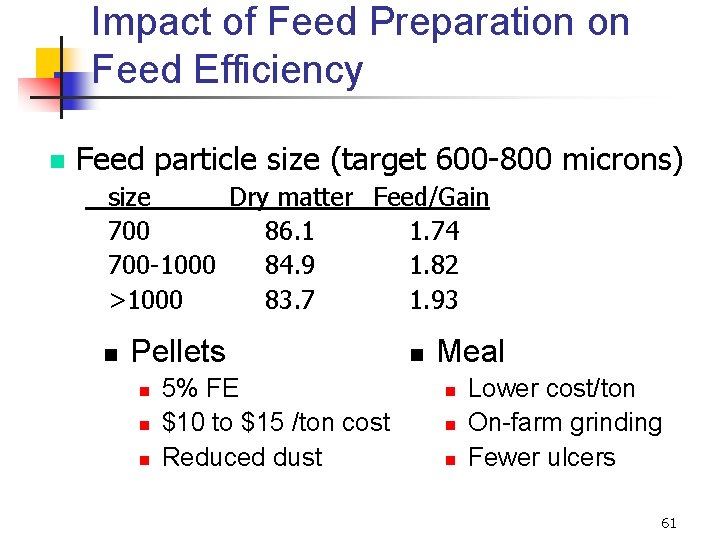
Impact of Feed Preparation on Feed Efficiency n Feed particle size (target 600 -800 microns) size Dry matter Feed/Gain 700 86. 1 1. 74 700 -1000 84. 9 1. 82 >1000 83. 7 1. 93 n Pellets n n n 5% FE $10 to $15 /ton cost Reduced dust n Meal n n n Lower cost/ton On-farm grinding Fewer ulcers 61
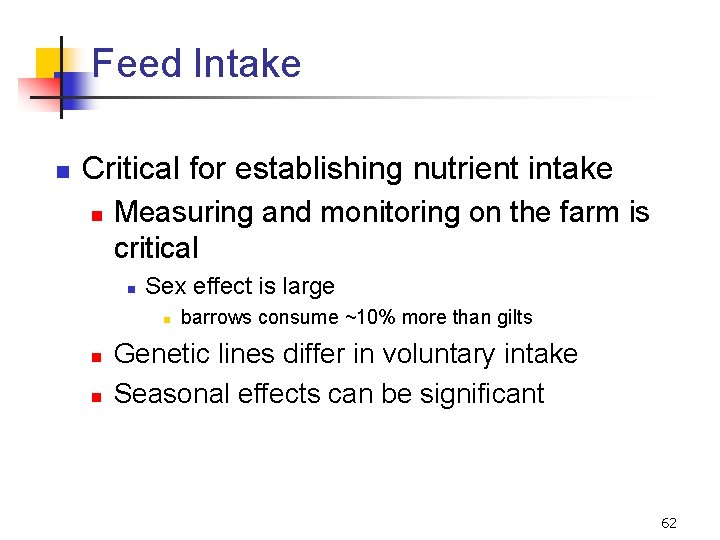
Feed Intake n Critical for establishing nutrient intake n Measuring and monitoring on the farm is critical n Sex effect is large n n n barrows consume ~10% more than gilts Genetic lines differ in voluntary intake Seasonal effects can be significant 62
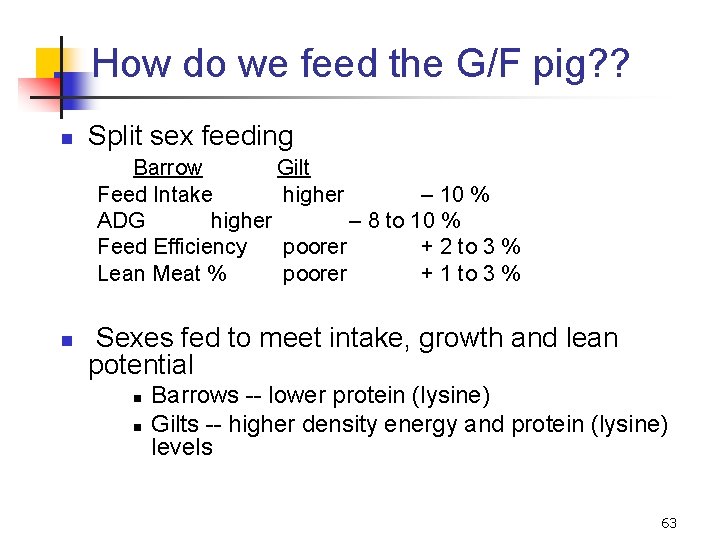
How do we feed the G/F pig? ? n Split sex feeding Barrow Gilt Feed Intake higher – 10 % ADG higher – 8 to 10 % Feed Efficiency poorer + 2 to 3 % Lean Meat % poorer + 1 to 3 % n Sexes fed to meet intake, growth and lean potential n n Barrows -- lower protein (lysine) Gilts -- higher density energy and protein (lysine) levels 63
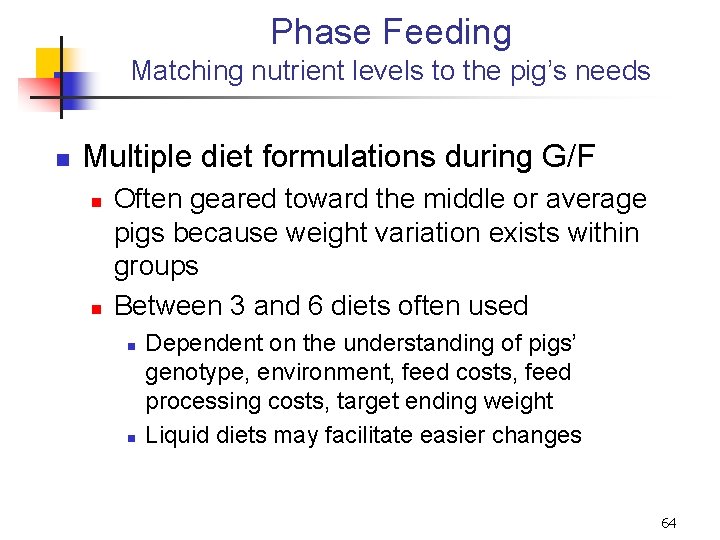
Phase Feeding Matching nutrient levels to the pig’s needs n Multiple diet formulations during G/F n n Often geared toward the middle or average pigs because weight variation exists within groups Between 3 and 6 diets often used n n Dependent on the understanding of pigs’ genotype, environment, feed costs, feed processing costs, target ending weight Liquid diets may facilitate easier changes 64
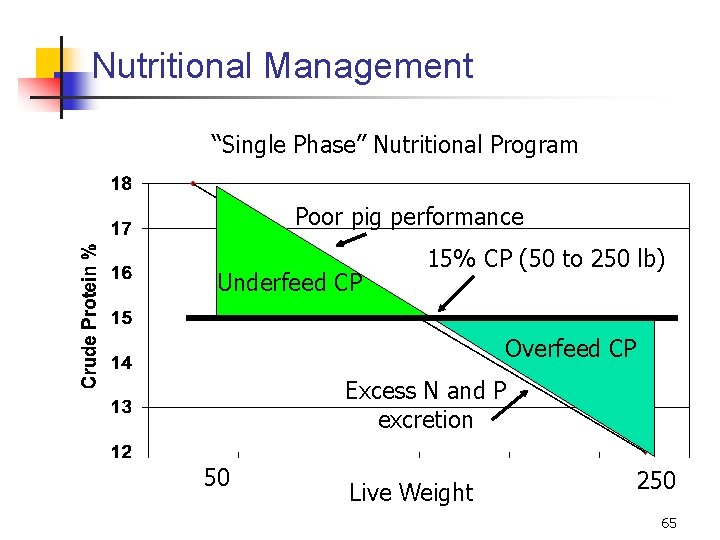
Nutritional Management “Single Phase” Nutritional Program Poor pig performance Underfeed CP 15% CP (50 to 250 lb) Overfeed CP Excess N and P excretion 50 Live Weight 250 65
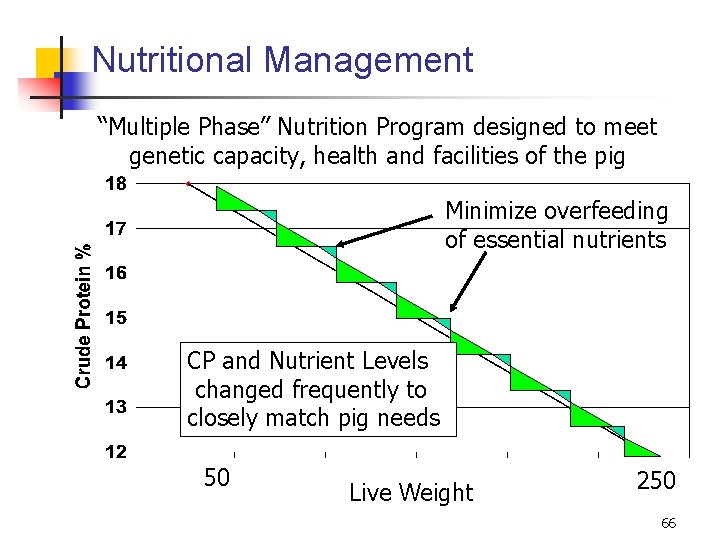
Nutritional Management “Multiple Phase” Nutrition Program designed to meet genetic capacity, health and facilities of the pig Minimize overfeeding of essential nutrients CP and Nutrient Levels changed frequently to closely match pig needs 50 Live Weight 250 66
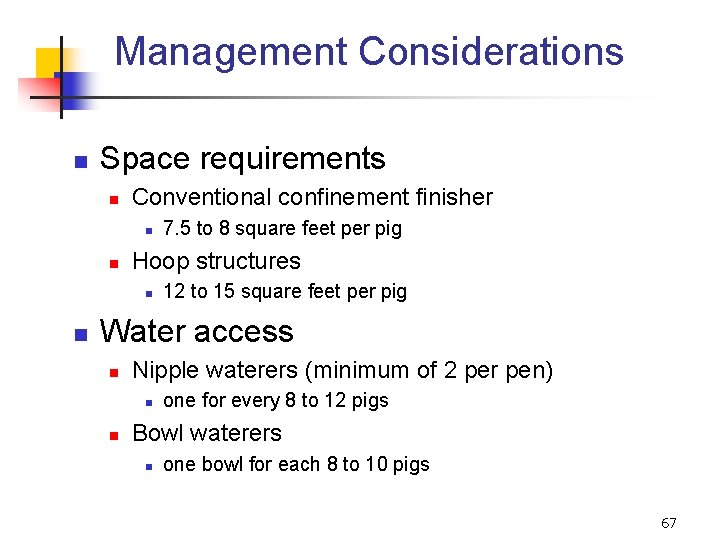
Management Considerations n Space requirements n Conventional confinement finisher n n Hoop structures n n 7. 5 to 8 square feet per pig 12 to 15 square feet per pig Water access n Nipple waterers (minimum of 2 per pen) n n one for every 8 to 12 pigs Bowl waterers n one bowl for each 8 to 10 pigs 67
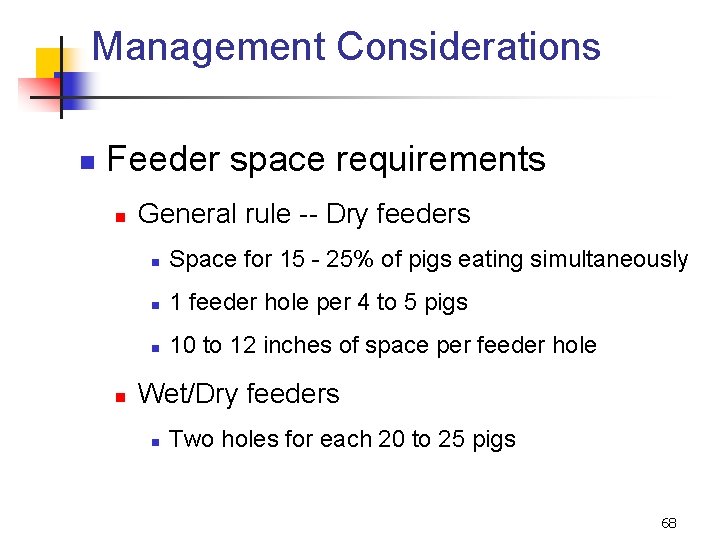
Management Considerations n Feeder space requirements n n General rule -- Dry feeders n Space for 15 - 25% of pigs eating simultaneously n 1 feeder hole per 4 to 5 pigs n 10 to 12 inches of space per feeder hole Wet/Dry feeders n Two holes for each 20 to 25 pigs 68
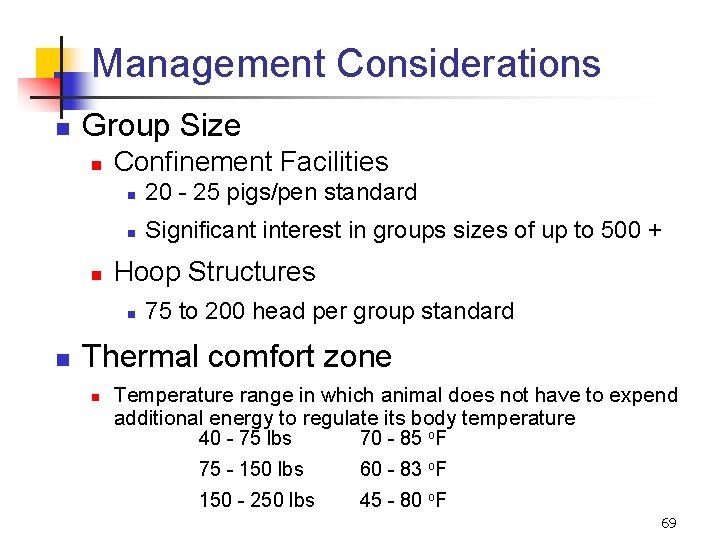
Management Considerations n Group Size n n Confinement Facilities n 20 - 25 pigs/pen standard n Significant interest in groups sizes of up to 500 + Hoop Structures n n 75 to 200 head per group standard Thermal comfort zone n Temperature range in which animal does not have to expend additional energy to regulate its body temperature 40 - 75 lbs 70 - 85 o. F 75 - 150 lbs 60 - 83 o. F 150 - 250 lbs 45 - 80 o. F 69
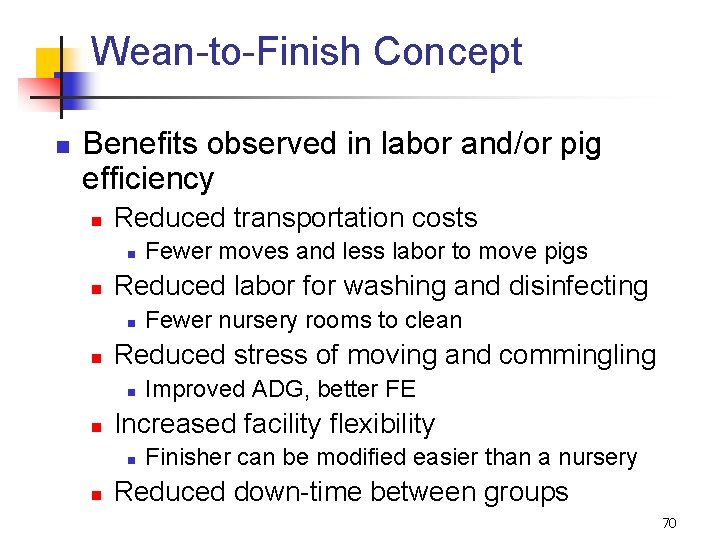
Wean-to-Finish Concept n Benefits observed in labor and/or pig efficiency n Reduced transportation costs n n Reduced labor for washing and disinfecting n n Improved ADG, better FE Increased facility flexibility n n Fewer nursery rooms to clean Reduced stress of moving and commingling n n Fewer moves and less labor to move pigs Finisher can be modified easier than a nursery Reduced down-time between groups 70
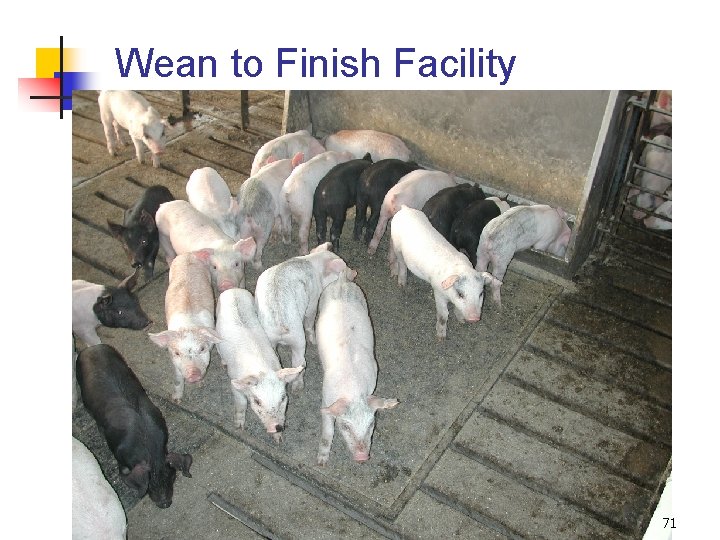
Wean to Finish Facility 71
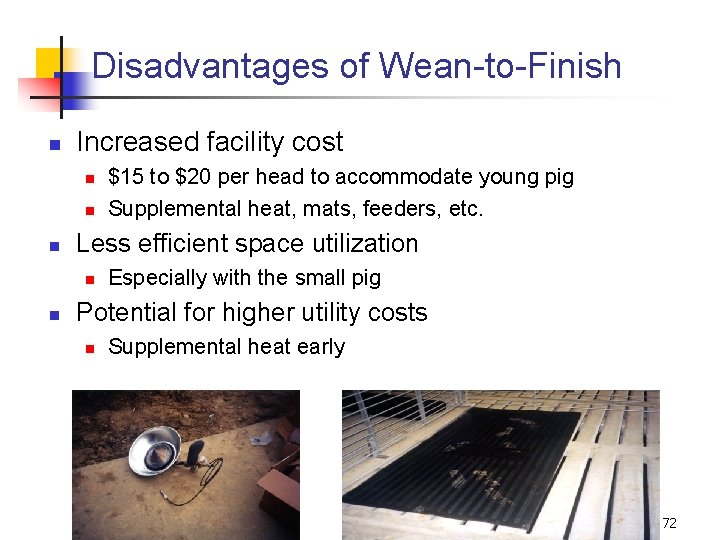
Disadvantages of Wean-to-Finish n Increased facility cost n n n Less efficient space utilization n n $15 to $20 per head to accommodate young pig Supplemental heat, mats, feeders, etc. Especially with the small pig Potential for higher utility costs n Supplemental heat early 72
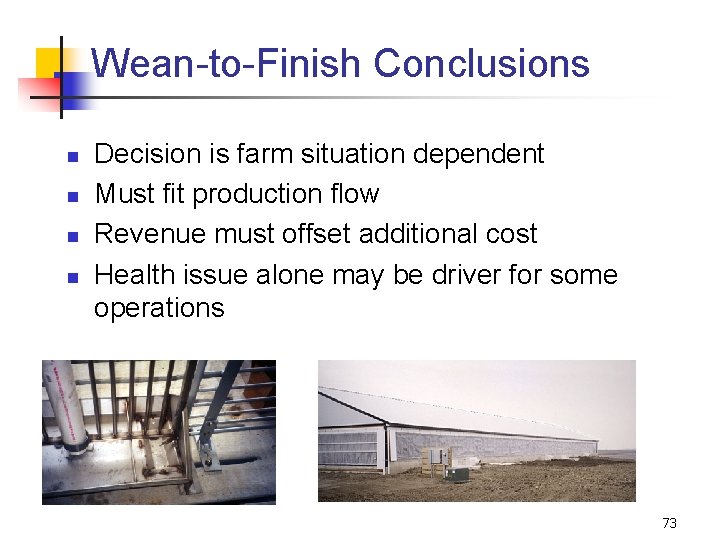
Wean-to-Finish Conclusions n n Decision is farm situation dependent Must fit production flow Revenue must offset additional cost Health issue alone may be driver for some operations 73