
Swept Source Frequency Domain Optical Coherence Tomography Anurag





- Slides: 20
Swept Source Frequency Domain Optical Coherence Tomography Anurag Gupta University of Rochester, BS: Biomedical Engineering Dr. Zhongping Chen, Dr. Jun Zhang and Dr. Qiang Wang The University of California, Irvine Department of Biomedical Engineering Beckman Laser Institute and Medical Clinic 1
Outline 1. Define OCT 2. Clinical Applications 3. Advantage of OCT Over Other Imaging Modalities 4. Types of OCT Systems 5. Motivations for Designing an FDOCT Imaging Modality 6. Sample OCT Image 7. Acknowledgements 2
What Is Optical Coherence Tomography? As Defined in 2005 by the Inventor, Dr. James Fujimoto: “Optical coherence tomography (OCT) is an emerging imaging modality which can generate high resolution, cross-sectional images of microstructure in biological systems. . . by measuring the echo time delay of optical backscattering in the tissue as a function of transverse position. ” http: //www. fitzpatrick. duke. edu/Events/Seminars/2005 Spring. Seminars/Fujimoto. html 3
Clinical Applications • Ophthalmology – Diagnosing retinal diseases and other abnormalities of the eye • Dermatology – – Early detection of skin cancer Diagnosing skin diseases and other problems • Cardiovascular – Imaging of the blood vessels and other cardiovascular areas for early detection of diseases 4
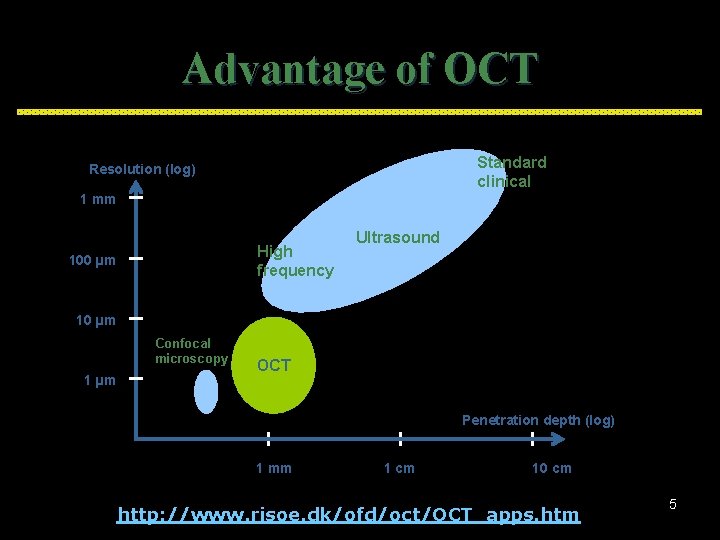
Advantage of OCT Standard clinical Resolution (log) 1 mm High frequency 100 µm Ultrasound 10 µm Confocal microscopy 1 µm OCT Penetration depth (log) 1 mm 1 cm 10 cm http: //www. risoe. dk/ofd/oct/OCT_apps. htm 5
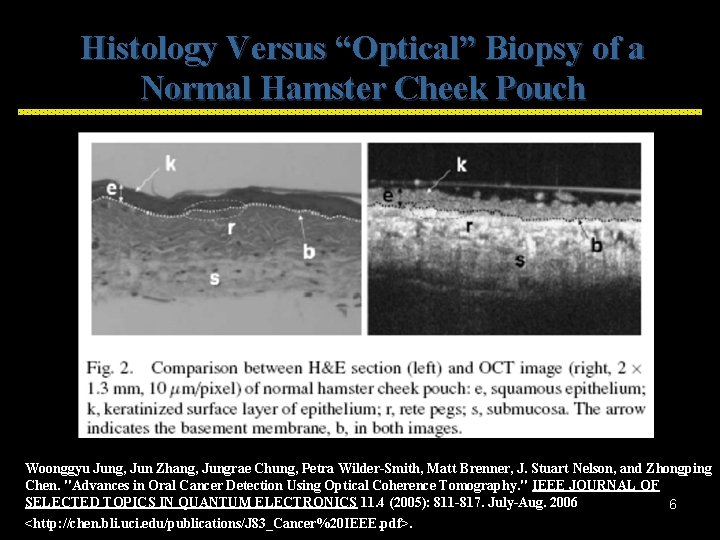
Histology Versus “Optical” Biopsy of a Normal Hamster Cheek Pouch Woonggyu Jung, Jun Zhang, Jungrae Chung, Petra Wilder-Smith, Matt Brenner, J. Stuart Nelson, and Zhongping Chen. "Advances in Oral Cancer Detection Using Optical Coherence Tomography. " IEEE JOURNAL OF SELECTED TOPICS IN QUANTUM ELECTRONICS 11. 4 (2005): 811 -817. July-Aug. 2006 6 <http: //chen. bli. uci. edu/publications/J 83_Cancer%20 IEEE. pdf>.
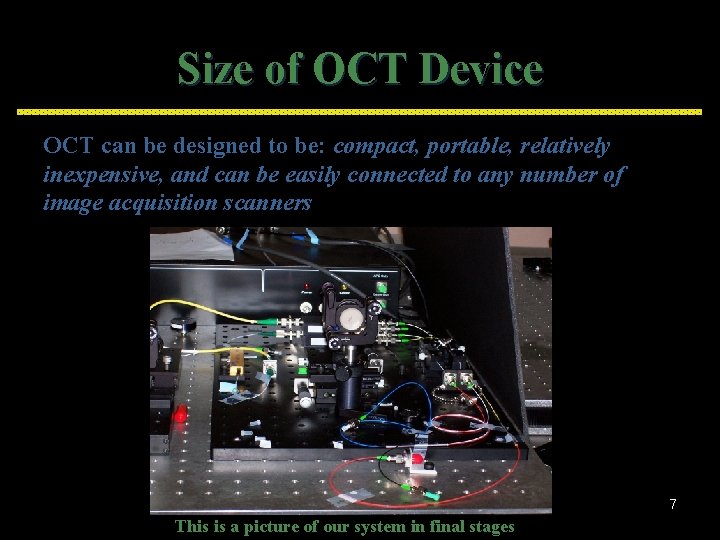
Size of OCT Device OCT can be designed to be: compact, portable, relatively inexpensive, and can be easily connected to any number of image acquisition scanners 7 This is a picture of our system in final stages
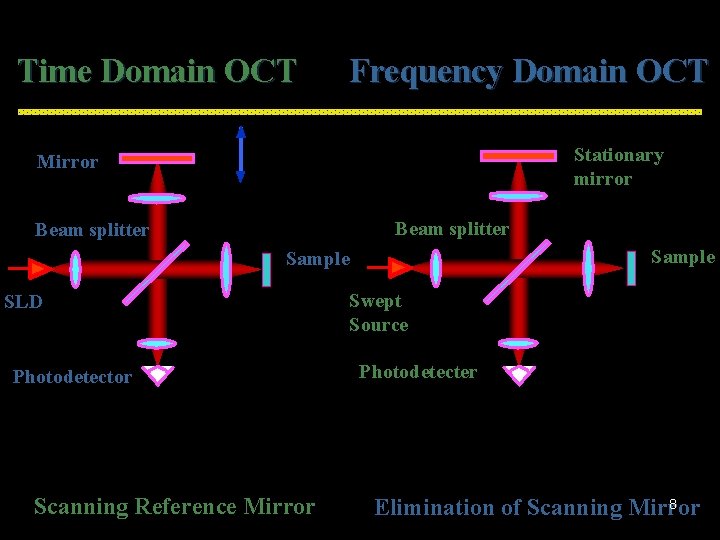
Time Domain OCT Frequency Domain OCT Stationary mirror Mirror Beam splitter Sample SLD Photodetector Scanning Reference Mirror Swept Source Photodetecter 8 Elimination of Scanning Mirror
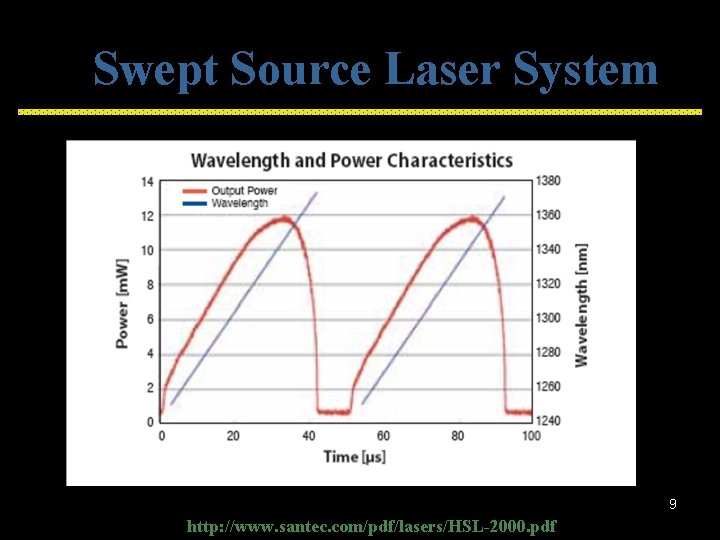
Swept Source Laser System 9 http: //www. santec. com/pdf/lasers/HSL-2000. pdf
Motivations Can You Have a Signal Without Noise? NO! 10
Signal to Noise Ratio (SNR) • A High SNR Ratio: Higher Image Quality – Images are more distinguishable • A Low SNR Ratio: Lower Image Quality – Images are less distinguishable 11
SNR of FDOCT Versus TDOCT FDOCT: acquire signal in the time window of T Signal term # of photons = Noise term # of photons = Fei Wang EE 131 Presentation at Caltech Where N is the # of pixels per depth scan We see that the SNR of FDOCT is N times better than that of TDOCT 12
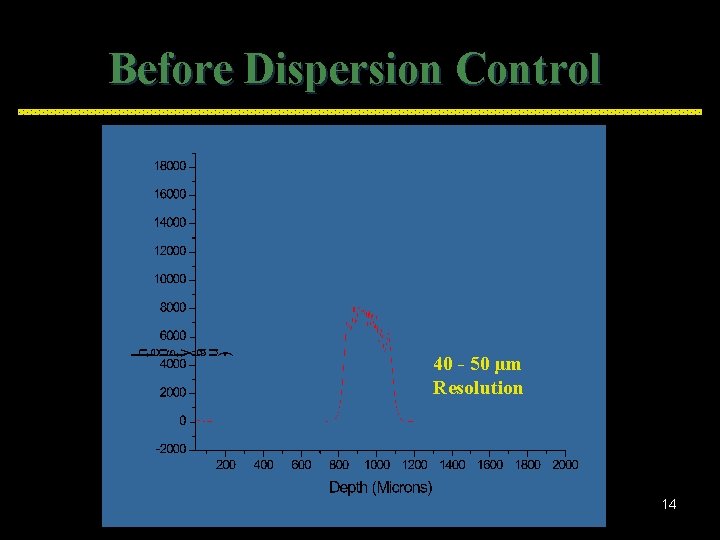
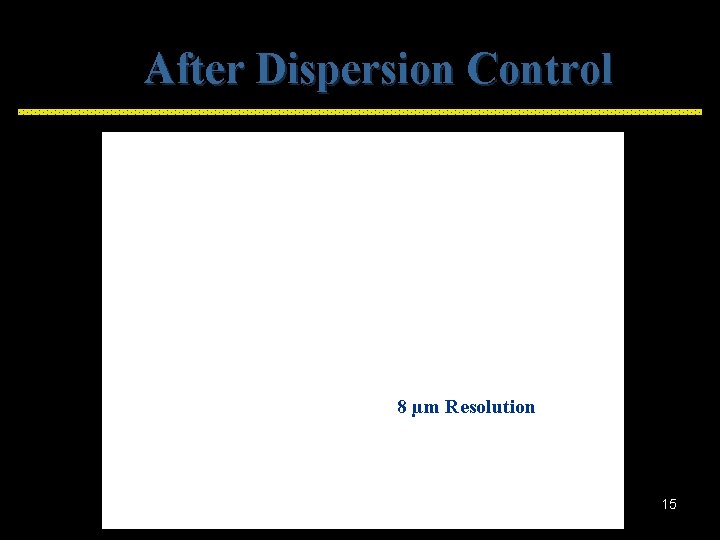
Dispersion Control Dispersion is the separation of white or compound light into its respective colors, as in the formation of a spectrum by a prism. http: //en. wikipedia. org/wiki/Dispersion_(optics) This can cause the resolution of an image to decrease. In FDOCT, Dispersion can be controlled rather easily whereas 13 in other imaging modalities its very difficult.
Before Dispersion Control 40 - 50 µm Resolution 14
After Dispersion Control 8 µm Resolution 15
Image Acquisition Speed • Programmed Using Microsoft Visual C++ • Speed: 15 / 16 Frames Per Second – Images can be Acquired In-Vivo or Ex-Vivo • This makes it a viable option for use during surgery 16
3 D Image Acquisition Scanner 17 This is a picture of our 3 D Image Acquisition Scanner
3 D Image Acquisition Scanner Movie 18
3 D FDOCT Movie of the Retina 19
Acknowledgments The National Science Foundation The University of California, Irvine (UROP) Dr. Zhongping Chen, Dr. Jun Zhang, Dr. Qiang Wang, and Mr. Bin Rao The Beckman Laser Institute and Medical Clinic The Air Force Research Laboratory The IM-SURE Fellows 20