
SWBAT APPLY THE LAW OF CONSERVATION OF MASS
SWBAT: APPLY THE LAW OF CONSERVATION OF MASS TO WORD PROBLEMS SWBAT: CLASSIFY A CHANGE AS PHYSICAL OR CHEMICAL
LAW OF CONSERVATION OF MASS
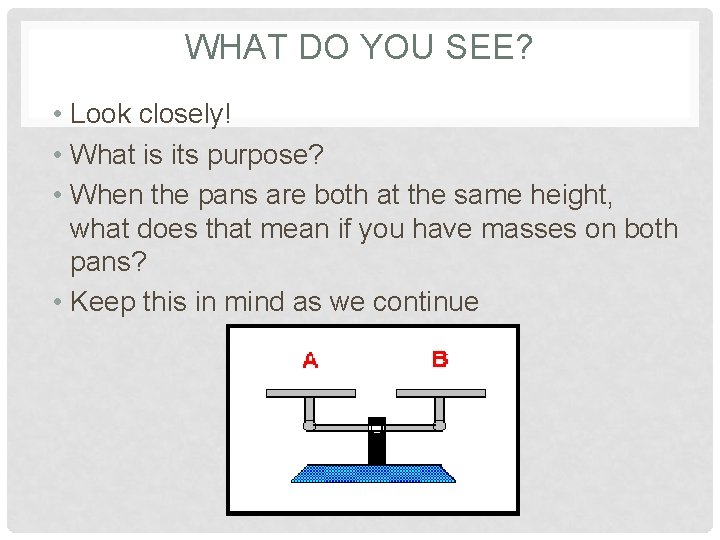
WHAT DO YOU SEE? • Look closely! • What is its purpose? • When the pans are both at the same height, what does that mean if you have masses on both pans? • Keep this in mind as we continue
THE LAW • The law of conservation of matter states that matter (mass) can neither be created nor destroyed. It can, however, can be rearranged. • In a chemical reaction, the mass of the reactants must equal the mass of the products. • HUH?
CHEMICAL EQUATIONS Because the same atoms are present in a reaction at the beginning (reactants) and at the end (products), the amount of matter in a system does not change. The Law of Conservation of Matter Kotz web
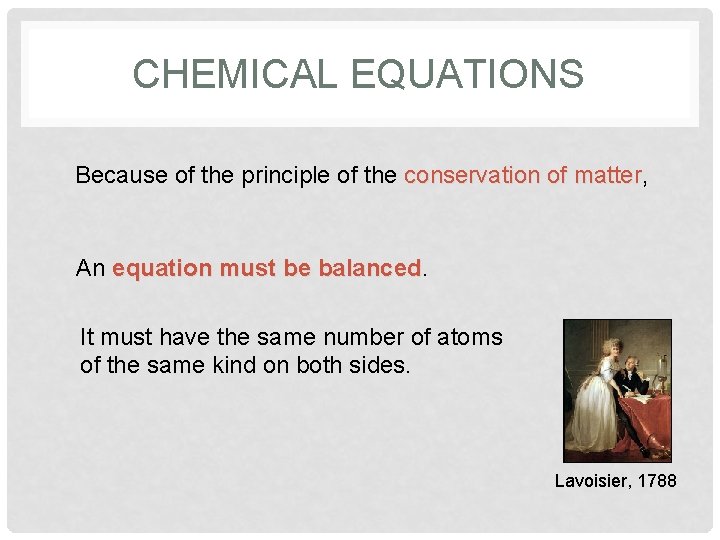
CHEMICAL EQUATIONS Because of the principle of the conservation of matter, matter An equation must be balanced It must have the same number of atoms of the same kind on both sides. Lavoisier, 1788
APPLY IT! • EXPERIMENT #1 • Magnesium + Oxygen ------> Magnesium Oxide • 48. 6 g + 32. 0 g -----> 80. 6 g • a. What is the mass of each reactant? • Mg: 48. 6 g O: 32. 0 g • b. What is the mass of the product? • Mg. O: 80. 6 g • c. What is the total mass of reactants? • Mg+O: 80. 6 g • d. Does this experimental data support the Law of Conservation of Mass? Explain. • YES! The mass of the reactants and mass of the products is the same!
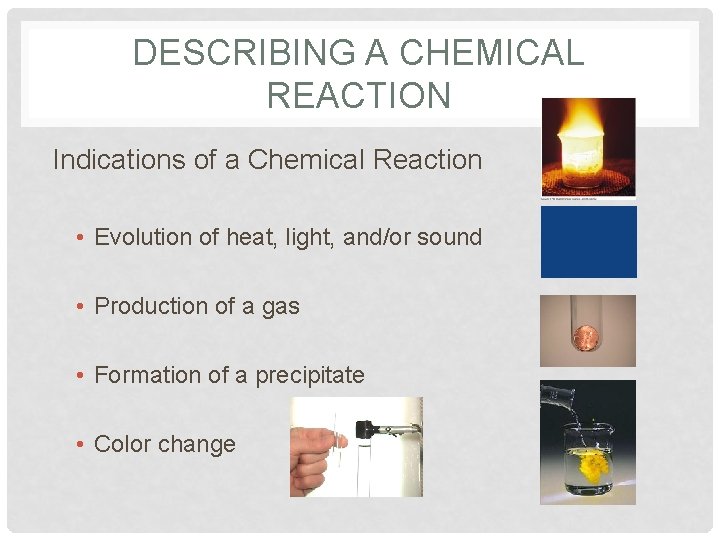
DESCRIBING A CHEMICAL REACTION Indications of a Chemical Reaction • Evolution of heat, light, and/or sound • Production of a gas • Formation of a precipitate • Color change
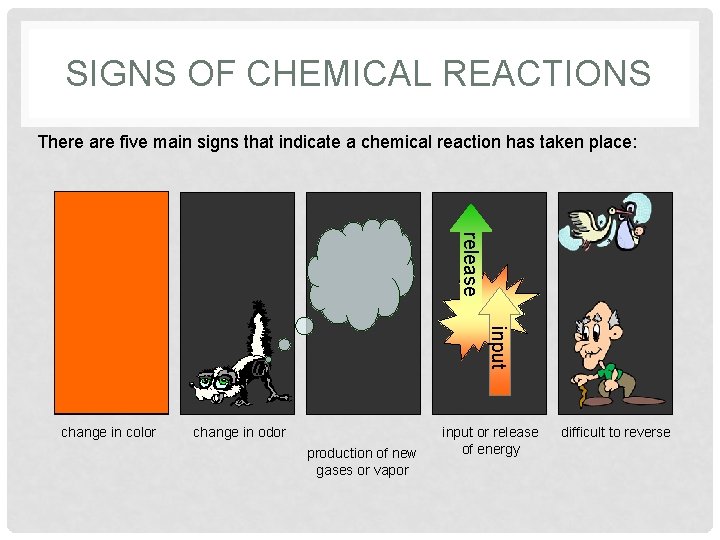
SIGNS OF CHEMICAL REACTIONS There are five main signs that indicate a chemical reaction has taken place: release input change in color change in odor production of new gases or vapor input or release of energy difficult to reverse
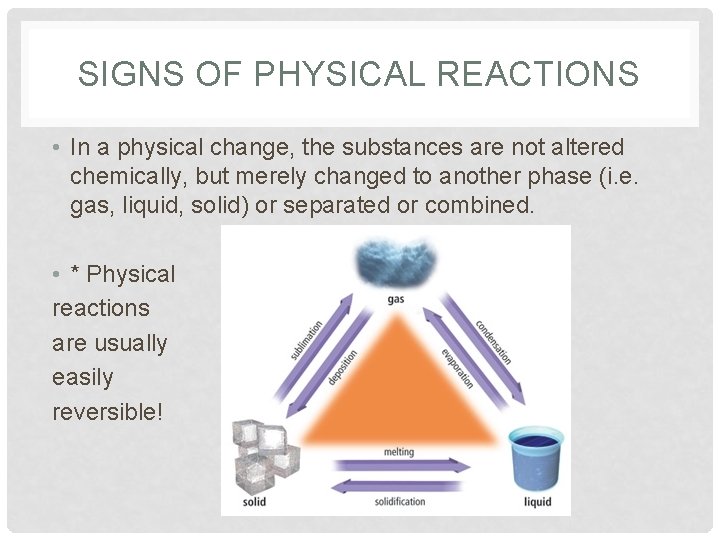
SIGNS OF PHYSICAL REACTIONS • In a physical change, the substances are not altered chemically, but merely changed to another phase (i. e. gas, liquid, solid) or separated or combined. • * Physical reactions are usually easily reversible!
APPLY IT! • • • 1. Burning propane 2. Cooking 3. Breaking glass 4. Burning wood 5. Melting Ice 6. Painting wood 7. Unzipping a zipper 8. Digesting an apple 9. Lighting up a cigarette 10. Putting a plug into a socket
- Slides: 11