
Swarm Euler Angles Analysis Patrick Alken Stefan Maus
- Slides: 14
Swarm Euler Angles Analysis Patrick Alken Stefan Maus University of Colorado at Boulder, USA Swarm Data Quality Workshop 2014, Potsdam 12/04/2014 1
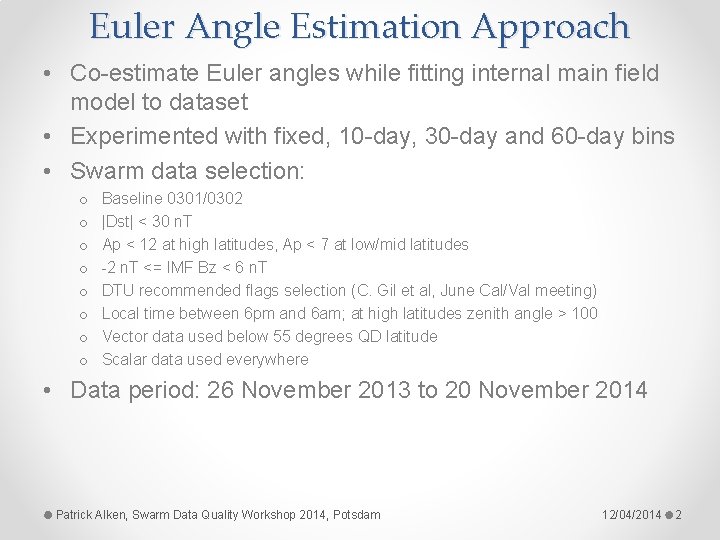
Euler Angle Estimation Approach • Co-estimate Euler angles while fitting internal main field model to dataset • Experimented with fixed, 10 -day, 30 -day and 60 -day bins • Swarm data selection: o o o o Baseline 0301/0302 |Dst| < 30 n. T Ap < 12 at high latitudes, Ap < 7 at low/mid latitudes -2 n. T <= IMF Bz < 6 n. T DTU recommended flags selection (C. Gil et al, June Cal/Val meeting) Local time between 6 pm and 6 am; at high latitudes zenith angle > 100 Vector data used below 55 degrees QD latitude Scalar data used everywhere • Data period: 26 November 2013 to 20 November 2014 Patrick Alken, Swarm Data Quality Workshop 2014, Potsdam 12/04/2014 2
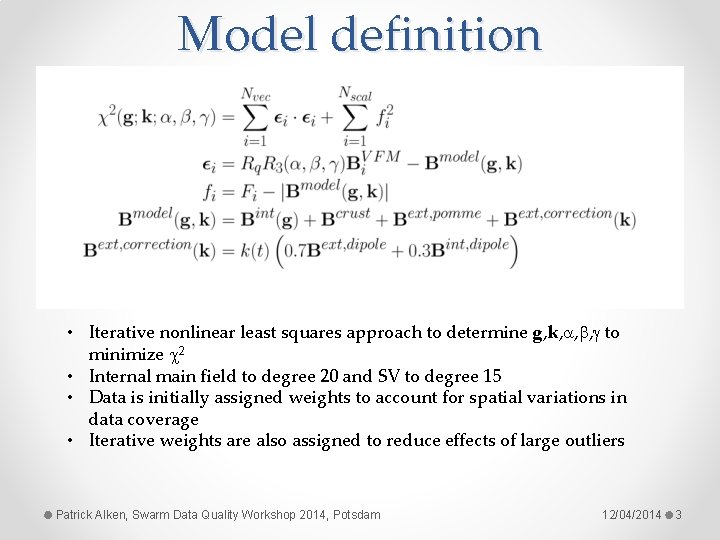
Model definition • Iterative nonlinear least squares approach to determine g, k, , , to minimize 2 • Internal main field to degree 20 and SV to degree 15 • Data is initially assigned weights to account for spatial variations in data coverage • Iterative weights are also assigned to reduce effects of large outliers Patrick Alken, Swarm Data Quality Workshop 2014, Potsdam 12/04/2014 3
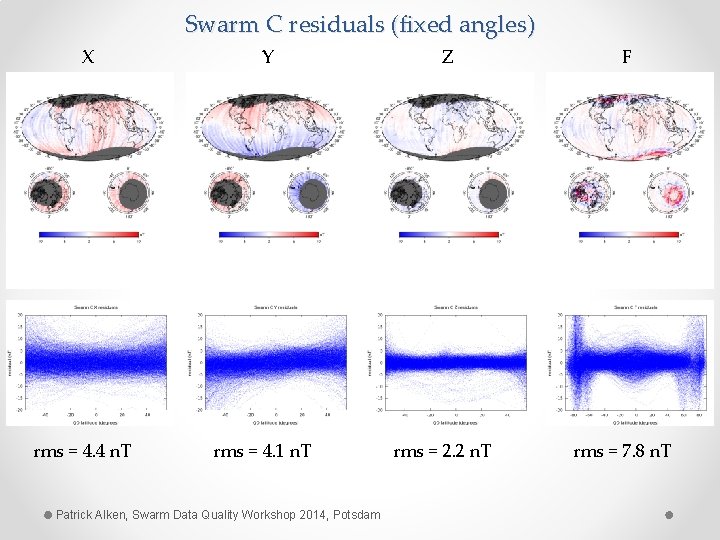
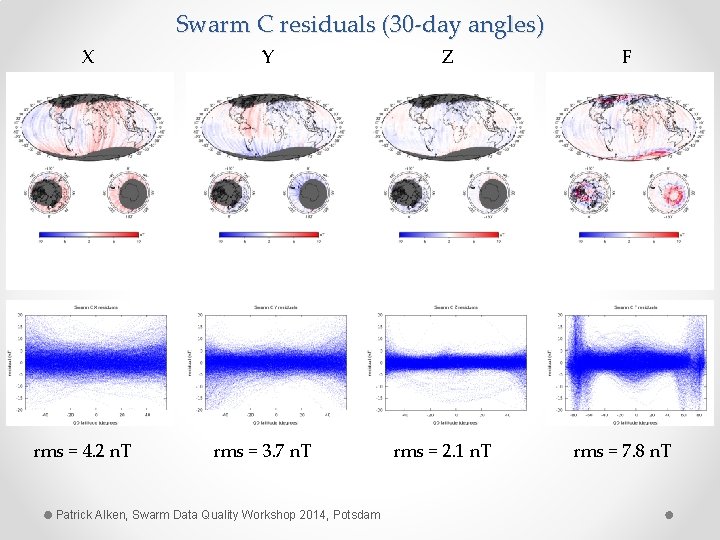
Swarm C residuals (fixed angles) X rms = 4. 4 n. T Y rms = 4. 1 n. T Patrick Alken, Swarm Data Quality Workshop 2014, Potsdam Z F rms = 2. 2 n. T rms = 7. 8 n. T
Swarm C residuals (30 -day angles) X rms = 4. 2 n. T Y rms = 3. 7 n. T Patrick Alken, Swarm Data Quality Workshop 2014, Potsdam Z rms = 2. 1 n. T F rms = 7. 8 n. T
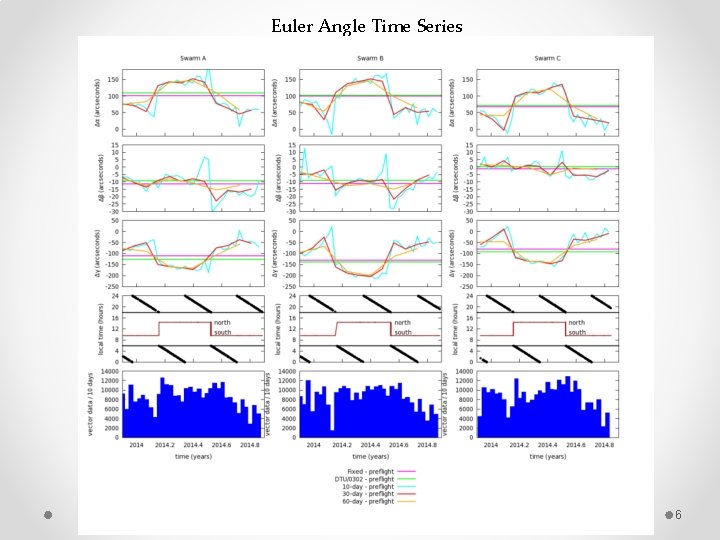
Euler Angle Time Series 6
Summary • Euler angles are changing with time and will need to be updated in the Level-1 b data files • Beta angle seems more stable than alpha/gamma, with a slow drift over time • Alpha and gamma are showing large ~90 arcsecond jumps for all satellites when they enter dawn/dusk orbit Swarm Data Quality Workshop 2014, Potsdam 12/04/2014 7
Update of Euler Angle Time Series Analysis Stefan Maus Compare Euler angle time series by inverting magnetic vector data for the three satellites using a 3 -day moving window Stefan Maus, Swarm Data Quality Workshop 2014, Potsdam 12/04/2014 8
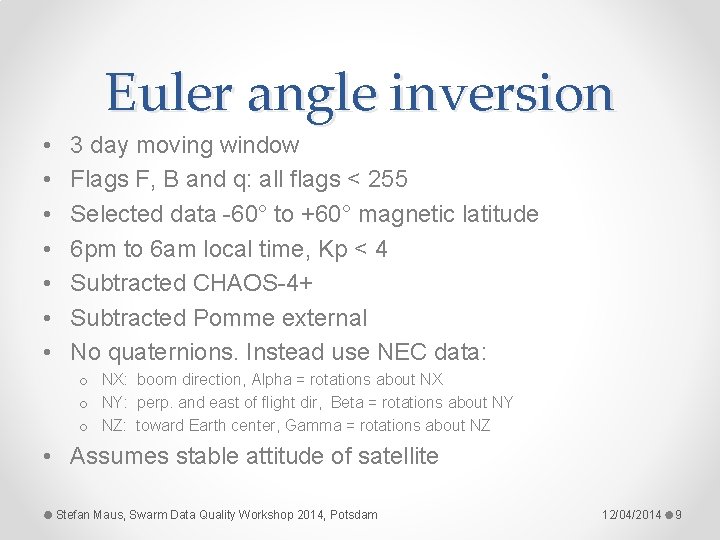
Euler angle inversion • • 3 day moving window Flags F, B and q: all flags < 255 Selected data -60° to +60° magnetic latitude 6 pm to 6 am local time, Kp < 4 Subtracted CHAOS-4+ Subtracted Pomme external No quaternions. Instead use NEC data: o NX: boom direction, Alpha = rotations about NX o NY: perp. and east of flight dir, Beta = rotations about NY o NZ: toward Earth center, Gamma = rotations about NZ • Assumes stable attitude of satellite Stefan Maus, Swarm Data Quality Workshop 2014, Potsdam 12/04/2014 9
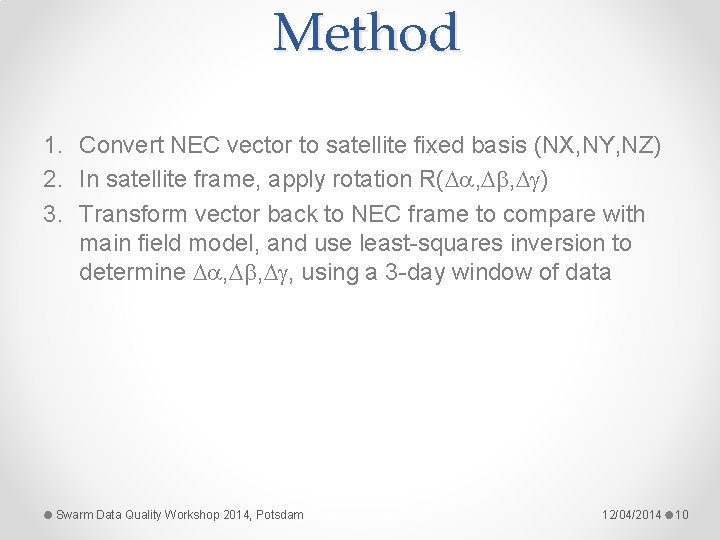
Method 1. Convert NEC vector to satellite fixed basis (NX, NY, NZ) 2. In satellite frame, apply rotation R( , , ) 3. Transform vector back to NEC frame to compare with main field model, and use least-squares inversion to determine , , , using a 3 -day window of data Swarm Data Quality Workshop 2014, Potsdam 12/04/2014 10
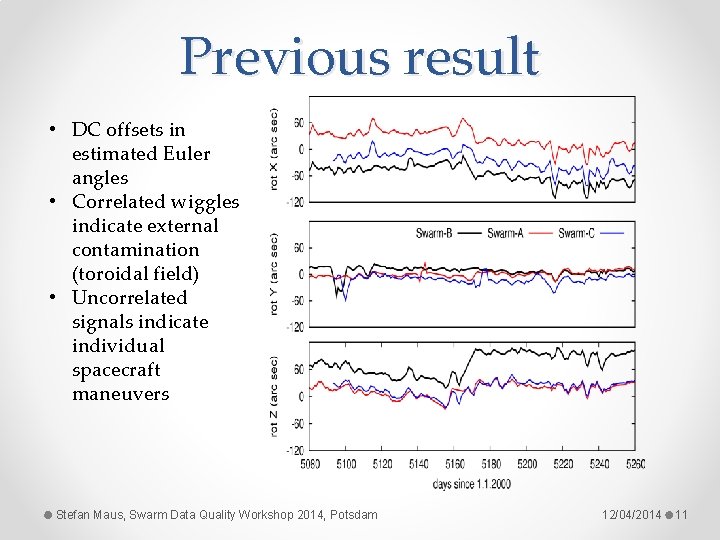
Previous result • DC offsets in estimated Euler angles • Correlated wiggles indicate external contamination (toroidal field) • Uncorrelated signals indicate individual spacecraft maneuvers Stefan Maus, Swarm Data Quality Workshop 2014, Potsdam 12/04/2014 11
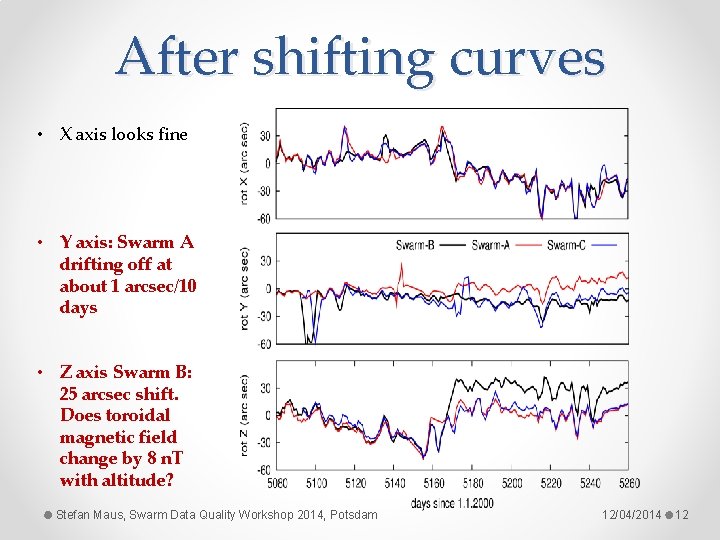
After shifting curves • X axis looks fine • Y axis: Swarm A drifting off at about 1 arcsec/10 days • Z axis Swarm B: 25 arcsec shift. Does toroidal magnetic field change by 8 n. T with altitude? Stefan Maus, Swarm Data Quality Workshop 2014, Potsdam 12/04/2014 12
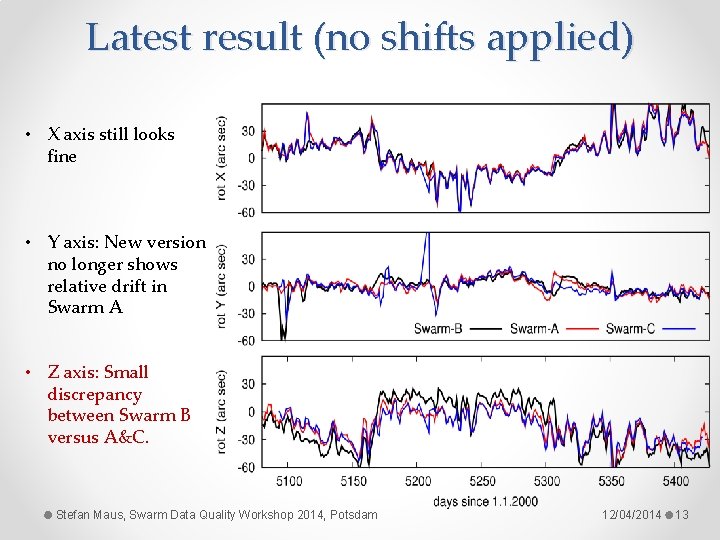
Latest result (no shifts applied) • X axis still looks fine • Y axis: New version no longer shows relative drift in Swarm A • Z axis: Small discrepancy between Swarm B versus A&C. Stefan Maus, Swarm Data Quality Workshop 2014, Potsdam 12/04/2014 13
Conclusions This method does not claim to estimate the absolute values of the Euler angles. Instead, it tracks changes and is useful for identifying different behavior of the different satellites • Rotations about X and Y axis: variations are now consistent between all 3 satellites • Rotations about Z axis: Swarm B shows a slightly different variation over time o This may be due to different external fields at different orbital heights. Stefan Maus, Swarm Data Quality Workshop 2014, Potsdam 12/04/2014 14